


What AI Data Center Cooling Looks Like Across All 50 U.S. States
A state-by-state screen of cooling architecture, power cost, water sensitivity, refrigerant rules and equipment availability.
| KEY TREND | AI rack density is pushing the cooling stack from CRAH/CRAC toward warm-water direct-to-chip systems, while chiller and heat-rejection choices increasingly depend on state climate, electricity price and water availability. |
| MARKET OUTLOOK | The best 2026-2030 cooling strategy is state-specific. Cooler and marine states can reduce chiller dependence fastest, while hot-dry states favor warm-water or zero-water designs and hot-humid states retain more peak mechanical cooling. |
| RECOMMENDED FOR | Data center developers, hyperscalers, colocation operators, cooling OEMs, utilities, EPCs, site-selection teams and electrical/mechanical equipment suppliers |
DMI Analyst View
DataM’s 2026 cooling roadmap captures the central shift correctly: the cooling system is moving from a building-level HVAC problem to a rack-density and heat-rejection problem. The practical ceiling of conventional CRAH/CRAC systems is around 20-30 kW per rack, while single-phase direct-to-chip systems are already being designed for 120-250 kW classes and the next rack generation pushes toward roughly 600 kW. That makes facility-water temperature, CDU topology and the ability to reject heat without adding excessive chiller hours the key design variables.
Across the United States, that architecture does not produce one national answer. DOE climate zones show large differences between marine, cold, mixed-humid, hot-humid and hot-dry regions, while USGS notes that hotter and more humid conditions raise cooling resource requirements and that western and southwestern projects face greater water-availability constraints. EIA’s August 2026 industrial electricity prices add a third variable: dry or zero-water designs may save water but can raise electrical consumption, so the value of that trade differs sharply by state.
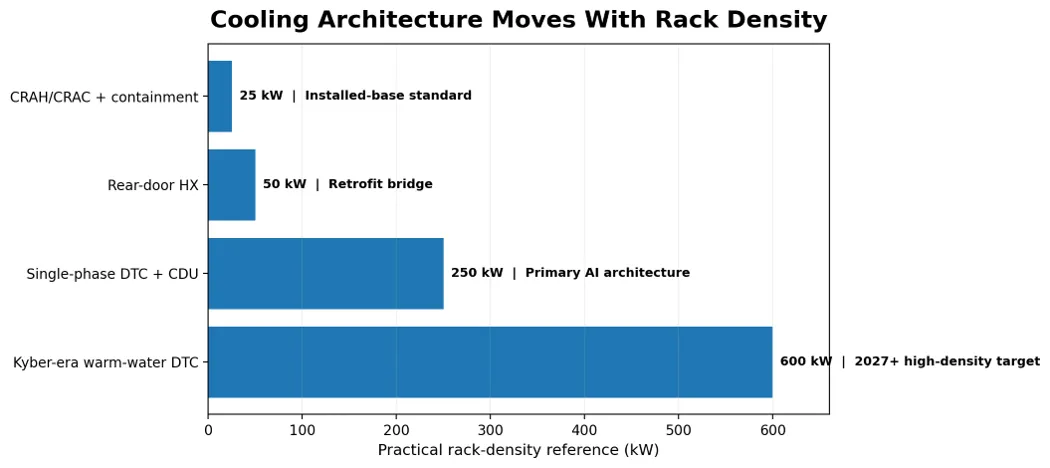
Sources: DOE climate zones | USGS AI data-center resource synthesis | EIA August 2026 industrial prices
Request Sample: https://www.datamintelligence.com/download-sample/data-center-cooling-market
The Cooling Decision Is Now Rack Density + Climate + Water + Power Price
A 50 MW AI campus in Washington, Virginia, Arizona and Texas can run the same GPU architecture but require materially different heat-rejection strategies. Warm-water direct-to-chip loops improve the economics of dry or adiabatic rejection, but the local climate still determines how many hours a project can avoid compressors. USGS specifically finds that cooler and drier conditions support lower energy and water needs, while hot and humid environments require greater resource inputs. In the West and Southwest, water availability can become a siting constraint even when evaporative cooling would improve electrical efficiency.
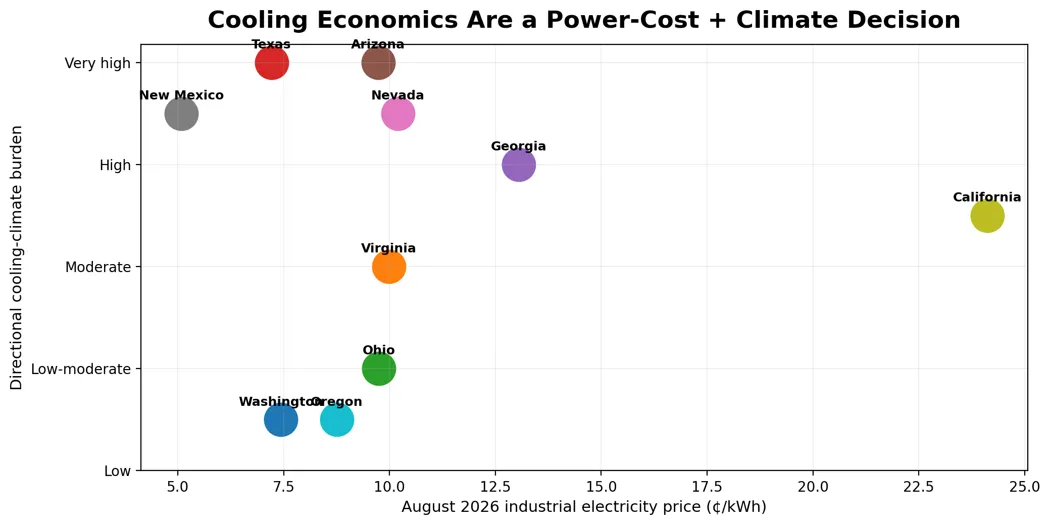
Sources: DataM’s ElectroIQ| EIA | DOE | USGS
State Wise Cooling Deployment
The table below is a screening view summarizing the dominant statewide conditions relevant to large-load screening.
| State | Cooling profile | Industrial rate 垄/kWh | Water screen | Preferred 2026-2030 cooling approach | DataM cooling tier |
| Alabama | Hot/Mixed-Humid | 8.11 | Local water due diligence | DTC + hybrid dry/adiabatic; chiller backup for peak summer conditions | B - balanced |
| Alaska | Very Cold | 23.13 | Local water due diligence | Warm-water DTC + dry cooler/economizer; lowest chiller dependence | B - balanced |
| Arizona | Hot-Dry | 9.73 | High site-level water sensitivity | Warm-water DTC + dry/adiabatic or zero-water design; protect water budget | D - high cooling burden |
| Arkansas | Mixed-Humid | 7.85 | Local water due diligence | DTC + hybrid dry/adiabatic; chiller backup for peak summer conditions | B - balanced |
| California | Hot-Dry / Marine | 24.12 | High site-level water sensitivity | Warm-water DTC + dry/adiabatic rejection; strong economizer potential | C - design-constrained |
| Colorado | Cold / Mixed-Dry | 9.98 | High site-level water sensitivity | Warm-water DTC + dry/adiabatic or zero-water design; protect water budget | B - balanced |
| Connecticut | Cold-Humid | 16.18 | Local water due diligence | Warm-water DTC + dry cooler/economizer; modest peak backup | C - design-constrained |
| Delaware | Mixed-Humid | 10.4 | Local water due diligence | DTC + hybrid dry/adiabatic; chiller backup for peak summer conditions | C - design-constrained |
| Florida | Hot-Humid | 8.93 | Local water due diligence | DTC + hybrid/chiller backup; humidity and water-energy trade-off are central | C - design-constrained |
| Georgia | Hot/Mixed-Humid | 13.05 | Local water due diligence | DTC + hybrid dry/adiabatic; chiller backup for peak summer conditions | C - design-constrained |
| Hawaii | Hot-Humid | 39.33 | Local water due diligence | DTC + hybrid/chiller backup; humidity and water-energy trade-off are central | D - high cooling burden |
| Idaho | Cold / Mixed-Dry | 9.71 | Moderate / local water sensitivity | Warm-water DTC + dry/adiabatic or zero-water design; protect water budget | B - balanced |
| Illinois | Cold-Humid | 11.33 | Local water due diligence | Warm-water DTC + dry cooler/economizer; modest peak backup | B - balanced |
| Indiana | Cold-Humid | 9.28 | Local water due diligence | Warm-water DTC + dry cooler/economizer; modest peak backup | B - balanced |
| Iowa | Cold-Humid | 9.31 | Local water due diligence | Warm-water DTC + dry cooler/economizer; modest peak backup | B - balanced |
| Kansas | Mixed-Dry / Mixed-Humid | 8.49 | Moderate / local water sensitivity | Warm-water DTC + dry/adiabatic or zero-water design; protect water budget | C - design-constrained |
| Kentucky | Mixed-Humid | 7.37 | Local water due diligence | DTC + hybrid dry/adiabatic; chiller backup for peak summer conditions | B - balanced |
| Louisiana | Hot-Humid | 6.1 | Local water due diligence | DTC + hybrid/chiller backup; humidity and water-energy trade-off are central | B - balanced |
| Maine | Very Cold | 14.24 | Local water due diligence | Warm-water DTC + dry cooler/economizer; lowest chiller dependence | B - balanced |
| Maryland | Mixed-Humid | 12.19 | Local water due diligence | DTC + hybrid dry/adiabatic; chiller backup for peak summer conditions | C - design-constrained |
| Massachusetts | Cold-Humid | 20.03 | Local water due diligence | Warm-water DTC + dry cooler/economizer; modest peak backup | C - design-constrained |
| Michigan | Cold-Humid | 8.99 | Local water due diligence | Warm-water DTC + dry cooler/economizer; modest peak backup | B - balanced |
| Minnesota | Very Cold | 9.96 | Local water due diligence | Warm-water DTC + dry cooler/economizer; lowest chiller dependence | A - favorable cooling economics |
| Mississippi | Hot-Humid | 7.57 | Local water due diligence | DTC + hybrid/chiller backup; humidity and water-energy trade-off are central | B - balanced |
| Missouri | Mixed-Humid | 9.89 | Local water due diligence | DTC + hybrid dry/adiabatic; chiller backup for peak summer conditions | B - balanced |
| Montana | Cold / Very Cold | 7.97 | Moderate / local water sensitivity | Warm-water DTC + dry cooler/economizer; lowest chiller dependence | A - favorable cooling economics |
| Nebraska | Cold / Mixed-Dry | 8.37 | Moderate / local water sensitivity | Warm-water DTC + dry/adiabatic or zero-water design; protect water budget | B - balanced |
| Nevada | Hot-Dry / Mixed-Dry | 10.2 | High site-level water sensitivity | Warm-water DTC + dry/adiabatic or zero-water design; protect water budget | D - high cooling burden |
| New Hampshire | Very Cold | 17.26 | Local water due diligence | Warm-water DTC + dry cooler/economizer; lowest chiller dependence | B - balanced |
| New Jersey | Mixed-Humid | 16.24 | Local water due diligence | DTC + hybrid dry/adiabatic; chiller backup for peak summer conditions | D - high cooling burden |
| New Mexico | Hot-Dry / Mixed-Dry | 5.08 | High site-level water sensitivity | Warm-water DTC + dry/adiabatic or zero-water design; protect water budget | C - design-constrained |
| New York | Cold-Humid | 10.54 | Local water due diligence | Warm-water DTC + dry cooler/economizer; modest peak backup | B - balanced |
| North Carolina | Mixed-Humid | 8.23 | Local water due diligence | DTC + hybrid dry/adiabatic; chiller backup for peak summer conditions | B - balanced |
| North Dakota | Very Cold | 8.12 | Moderate / local water sensitivity | Warm-water DTC + dry cooler/economizer; lowest chiller dependence | A - favorable cooling economics |
| Ohio | Cold-Humid | 9.75 | Local water due diligence | Warm-water DTC + dry cooler/economizer; modest peak backup | B - balanced |
| Oklahoma | Mixed-Humid / Hot-Dry | 8.16 | Moderate / local water sensitivity | Warm-water DTC + dry/adiabatic or zero-water design; protect water budget | C - design-constrained |
| Oregon | Marine / Cold | 8.75 | Moderate / local water sensitivity | Warm-water DTC + dry/adiabatic rejection; strong economizer potential | A - favorable cooling economics |
| Pennsylvania | Cold-Humid | 10.47 | Local water due diligence | Warm-water DTC + dry cooler/economizer; modest peak backup | B - balanced |
| Rhode Island | Cold-Humid | 19.87 | Local water due diligence | Warm-water DTC + dry cooler/economizer; modest peak backup | C - design-constrained |
| South Carolina | Hot/Mixed-Humid | 7.88 | Local water due diligence | DTC + hybrid dry/adiabatic; chiller backup for peak summer conditions | B - balanced |
| South Dakota | Cold / Mixed-Dry | 9.43 | Moderate / local water sensitivity | Warm-water DTC + dry/adiabatic or zero-water design; protect water budget | B - balanced |
| Tennessee | Mixed-Humid | 6.92 | Local water due diligence | DTC + hybrid dry/adiabatic; chiller backup for peak summer conditions | B - balanced |
| Texas | Hot-Humid / Hot-Dry | 7.21 | Moderate / local water sensitivity | Warm-water DTC + dry/adiabatic or zero-water design; protect water budget | C - design-constrained |
| Utah | Mixed-Dry / Cold | 8.56 | High site-level water sensitivity | Warm-water DTC + dry/adiabatic or zero-water design; protect water budget | B - balanced |
| Vermont | Very Cold | 12.72 | Local water due diligence | Warm-water DTC + dry cooler/economizer; lowest chiller dependence | B - balanced |
| Virginia | Mixed-Humid | 9.98 | Local water due diligence | DTC + hybrid dry/adiabatic; chiller backup for peak summer conditions | B - balanced |
| Washington | Marine / Cold | 7.43 | Moderate / local water sensitivity | Warm-water DTC + dry/adiabatic rejection; strong economizer potential | A - favorable cooling economics |
| West Virginia | Mixed-Humid | 8.34 | Local water due diligence | DTC + hybrid dry/adiabatic; chiller backup for peak summer conditions | B - balanced |
| Wisconsin | Very Cold | 10.88 | Local water due diligence | Warm-water DTC + dry cooler/economizer; lowest chiller dependence | B - balanced |
| Wyoming | Cold / Mixed-Dry | 8.8 | High site-level water sensitivity | Warm-water DTC + dry/adiabatic or zero-water design; protect water budget | B - balanced |
Sources: EIA, August 2026 DOE climate definitions | DOE county climate guide | USGS western water/cooling analysis
Request Sample: https://www.datamintelligence.com/download-sample/data-center-cooling-market
Key Takeaways
- The Pacific Northwest and northern states have the best physical conditions for reducing compressor hours, but power price and grid availability still matter. Washington combines a marine/cold profile with a relatively low industrial electricity rate, which strengthens the case for warm-water direct-to-chip plus dry heat rejection. Oregon has similar climate advantages but a higher power-cost baseline.
- Virginia, Ohio and other mixed/cold-humid data-center hubs sit in the middle. Direct-to-chip systems can remove most rack heat, but peak summer humidity and warm ambient conditions justify retaining hybrid or chiller-backed rejection for resilience. Their advantage is less about climate perfection and more about established data-center ecosystems and power infrastructure.
- Arizona, Nevada and New Mexico are the design paradox. Dry air helps evaporative approaches, but USGS identifies the West and Southwest as areas with higher water scarcity and supply-demand imbalance. That pushes new AI campuses toward warm-water loops, dry coolers, adiabatic trim and zero-water designs even if the electrical penalty is higher.
- Florida, Louisiana and the Gulf Coast are the opposite problem: water may be more available locally, but hot-humid conditions reduce the number of hours when dry rejection works efficiently. These markets are structurally more dependent on mechanical cooling, dehumidification and carefully designed heat-rejection redundancy.
Water Is Becoming a Cooling-Architecture Variable, Not a Utility Line Item
Microsoft’s next-generation zero-water cooling design is a useful signal for the market. The company says the design uses a closed-loop system that continuously circulates water between servers and chillers after initial fill, eliminating the need for fresh water for cooling. Microsoft has said this approach is expected to avoid more than 125 million liters of water per year per datacenter, depending on site conditions. For hot-dry markets, that changes the site-selection trade: the project can spend more electricity to preserve water and improve permitting resilience.
Refrigerant Rules Start Affecting Data-Center Cooling Procurement in 2027. EPA’s Technology Transitions restrictions set a 700-GWP limit for data centers, computer-room air conditioning and IT equipment cooling beginning January 1, 2027. Comfort-cooling chillers already sit under a 700-GWP limit, and the HFC allowance program steps down again in 2029. The procurement implication is that cooling RFQs now need the refrigerant family, machine-room requirements and future serviceability written into the specification, rather than treated as an OEM detail after award.
Chiller Capacity Is Expanding, but the Backlog Still Shapes 2027
Open Factory’s roadmap highlights a second constraint: even where the cooling architecture still needs chillers, factory availability remains tight. Primary filings reinforce the point. Trane Technologies reported a record $12.1 billion backlog in Q2 2026, up 70% year over year, with Americas Commercial HVAC bookings up 50%. Munters announced an 840 MSEK data-center chiller order in late 2025 scheduled for delivery through the first quarter of 2028. Modine’s FY2026 filing also points to major data-center cooling capacity expansion and committed demand. That means a state with favorable climate can still miss a project schedule if the heat-rejection equipment is ordered too late.
| OEM | 2026 evidence | Procurement read | Source |
| Trane Technologies | $12.1B backlog; Americas Commercial HVAC bookings +50% | Strong demand means 2027 slot discipline remains critical | SEC Q2 2026 |
| Carrier | Open Factory cites North American capacity expansion and strong data-center order growth | New capacity helps, but buyers still need written slot dates | SEC / Open Factory |
| Johnson Controls | Large backlog and data-center HVAC exposure | Require project-specific manufacturing slot confirmation | SEC filing |
| Munters | 840 MSEK data-center chiller order delivering through Q1 2028 | Evidence of multi-year order visibility | Company release |
| Modine / Airedale | North American data-center cooling expansion in FY2027 | Capacity is expanding into a pre-sold market | SEC 10-K |
| Vertiv | Large backlog with 12-18 month shipment window cited in filing | Integrated thermal/electrical packages remain schedule-sensitive | SEC 10-K |
Primary sources: Trane Q2 2026 SEC filing | Carrier Q2 2026 SEC filing | Johnson Controls filing | Munters order release | Modine FY2026 10-K | Vertiv 2025 10-K
Request Sample: https://www.datamintelligence.com/download-sample/data-center-cooling-market
Five Procurement Rules for 2027-2030
- Specify the facility-water class before the CDU or chiller. A warm-water loop can remove an entire chiller dependency in favorable climates. The wrong W-class can lock the project into unnecessary compressor capacity.
- Treat water strategy as a design input at site selection. In hot-dry states, a lower-PUE evaporative solution may create a higher permitting and water-supply risk. Compare WUE and PUE together.
- Reserve heat-rejection capacity when the electrical one-line is frozen. Chillers, dry coolers, pumps, CDUs and controls now sit on the same critical-path logic as transformers and switchgear.
- Write refrigerant compliance into the RFQ. The 2027 data-center GWP limit changes which refrigerants and machine-room designs remain practical over the asset life.
- Design for the 2028 rack, not only the 2026 rack. Facilities built around 40-80 kW halls risk expensive retrofit when 120-250 kW direct-to-chip becomes the standard AI envelope and 600 kW-class racks arrive.
Where ElectroIQ Fits For You
ElectroIQ can connect the cooling roadmap to the electrical and project schedule. A 50 MW AI campus moving from air cooling to direct-to-chip changes the balance of chiller load, pump load, CDU demand and heat-rejection equipment while the electrical package still depends on transformers, switchgear, UPS and generator availability. Tracking those packages together helps identify which project is exposed to a cooling-equipment delay versus a grid-equipment delay.
For OEMs and suppliers, the commercial opportunity is the same: find projects whose 2027-2030 rack-density plan is no longer compatible with the original cooling architecture, then position the replacement CDU, chiller, dry cooler, pump or controls package before the final mechanical redesign is issued.