


Women's Sports Nutrition Market Size and Overview
The global Women's Sports Nutrition market reached an estimated US$ 18.62 billion in 2025 and is expected to reach US$ 46.89 billion by 2035, growing at a CAGR of 9.7% during 2026-2035. The market includes protein powders and ready-to-drink shakes, hydration products, energy foods, creatine, amino acids, vitamins, minerals, collagen, omega-3 ingredients and personalized nutrition services designed for female athletes and active women.
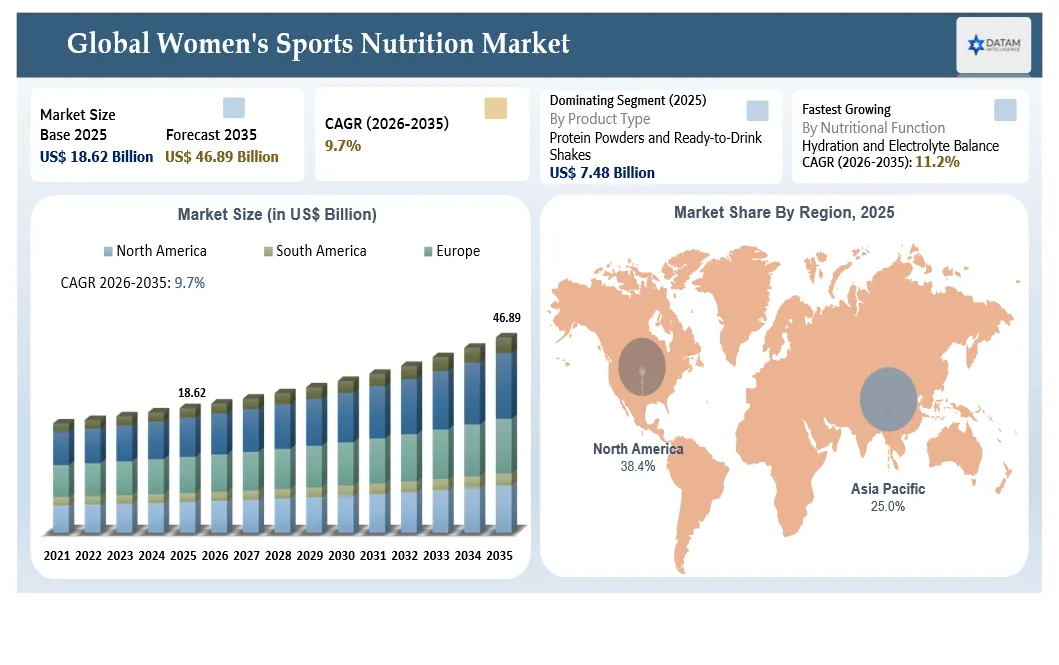
Category growth is being supported by increased female participation in organized sport, greater visibility of professional women’s leagues, wider adoption of resistance training and a shift from weight-loss messaging toward strength, recovery, endurance and long-term health. Women are purchasing sports nutrition for performance, but also for confidence, convenience and preventive health. This broadens demand beyond elite athletes into gym users, runners, cyclists, outdoor enthusiasts, active mothers and women navigating perimenopause or menopause.
Protein and recovery products remain the largest product segment because they serve strength, body-composition and post-exercise needs across many activities. Hydration and electrolyte products are expected to grow fastest as brands develop lower-sugar, clean-label and personalized solutions. North America leads through high sports nutrition penetration, professional women’s sport and direct-to-consumer infrastructure. Asia-Pacific is forecast to grow fastest as urban fitness participation, e-commerce, women’s income and active-lifestyle awareness expand.
| Metric | 2025 | 2035 | Strategic Interpretation |
| Market Size | US$ 18.62 Billion | US$ 46.89 Billion | Category expands from niche female positioning into a mainstream active-health platform. |
| CAGR | 9.7% | 2026-2035 | Growth exceeds mature packaged-food categories because usage occasions and consumer groups are widening. |
| Largest Region | North America, 38.4% | Maintains leadership | High supplement use, retailer depth and women’s sports commercialization. |
| Fastest-Growing Region | Asia-Pacific, 25.0% share in 2025 | Highest forecast CAGR | Urban fitness, digital commerce and regional product localization support expansion. |
| Leading Product | Protein powders and RTD shakes | Continues to lead | Broad relevance to strength, recovery and healthy aging. |
| Fastest-Growing Function | Hydration and electrolyte balance | Strongest growth | Female-specific hydration research and lower-sugar innovation expand demand. |
Women's Sports Nutrition Market Key Takeaways
- Protein and recovery products hold the largest commercial base because they serve strength training, endurance recovery, satiety and healthy aging.
- Hydration and electrolyte products are expected to record the fastest growth as female-specific research and personalized sweat-testing gain visibility.
- Recreationally active women represent the largest consumer group, while perimenopausal and menopausal active women offer one of the most attractive emerging opportunities.
- Iron, calcium, vitamin D, creatine and protein remain high-priority ingredients, but responsible brands increasingly avoid generalized supplementation without screening or professional guidance.
- Direct-to-consumer channels provide education, bundling and subscription value, while supermarkets remain important for ready-to-drink products and bars.
- Professional women’s sport is becoming a commercialization platform that connects athlete credibility, consumer communities and evidence-led product development.
- The category is moving away from shrink-and-tone positioning toward strength, energy availability, recovery, resilience and lifetime performance.
- Long-term leadership will depend on credible science, transparent formulation, enjoyable taste, practical formats and communication that reflects different ages, sports and life stages.
Women's Sports Nutrition Industry Trends and Strategic Insights
- Female-specific research is moving from marketing support into product-development infrastructure as companies study hydration, sweat rates, carbohydrate use and life-stage differences.
- Creatine is gaining mainstream relevance among women for strength, power and healthy aging, supported by growing education beyond traditional bodybuilding audiences.
- Brands are combining performance nutrition with women’s health categories such as iron status, bone health, menstrual health and menopause support.
- Lower-sugar hydration, natural flavors, recognizable ingredients and gastrointestinal tolerance are becoming more important in purchase decisions.
- Digital coaching, wearable data and direct-to-consumer subscriptions are creating personalized product bundles linked to training volume and recovery goals.
- Athlete partnerships are shifting toward long-term research, product testing and community activation rather than isolated endorsement campaigns.
Women's Sports Nutrition Market Scope
| Metrics | Details |
| 2025 Market Size | US$ 18.62 Billion |
| 2035 Projected Market Size | US$ 46.89 Billion |
| CAGR (2026-2035) | 9.7% |
| Largest Market | North America |
| Fastest-Growing Market | Asia-Pacific |
| By Product Type | Protein Powders and RTD Shakes, Hydration Products, Energy Bars/Gels/Chews, Capsules/Tablets/Gummies, Functional Foods and Meal Solutions |
| By Nutritional Function | Muscle Recovery and Strength, Hydration, Energy and Endurance, Iron and Micronutrients, Bone and Joint Health, Menstrual and Life-Stage Support |
| By Ingredient Platform | Dairy Protein, Plant Protein, Amino Acids and Creatine, Electrolytes and Carbohydrates, Vitamins/Minerals/Botanicals, Omega-3/Collagen/Specialty Ingredients |
| By Consumer Group | Recreationally Active Women, Competitive and Elite Athletes, Adolescent and Collegiate Athletes, Pregnant and Postpartum Active Women, Perimenopausal and Menopausal Active Women |
| By Activity Type | Gym and Strength, Running and Endurance, Team Sports, Racquet and Court Sports, Cycling/Swimming/Multi-Sport, Outdoor and Adventure Fitness |
| By Distribution Channel | E-Commerce and DTC, Supermarkets, Specialty Nutrition and Fitness Retail, Pharmacies and Health Stores, Gyms/Clubs/Sports Organizations |
| Report Insights Covered | Market Size, Share, Growth, Consumer Segments, Competitive Landscape and Country-Level Opportunity |
Why does this report matter in 2026?
The year 2026 is an important transition point for the Women's Sports Nutrition market because the category is moving from broad adaptation of male-focused products toward research-led solutions developed around female physiology and lived experience. Gatorade’s Body of Science initiative and related research have highlighted dehydration, carbohydrate under-fueling and sodium-replacement gaps among active women. These findings increase the commercial value of tailored hydration, education and product systems rather than isolated performance claims.
The report matters because women are not a single consumer segment. Nutritional priorities vary by sport, training load, age, menstrual status, pregnancy, postpartum recovery, dietary pattern and medical history. The market therefore requires segmentation beyond pink packaging or smaller serving sizes. Brands need to understand when female-specific design creates value and when evidence supports the same core product with more relevant communication, flavor, format or education.
Competitive timing is also important. Major beverage and nutrition companies are increasing investment in women’s sport, while specialist brands are building credibility through sports dietitians, athlete communities and direct-to-consumer relationships. Decisions made in 2026 on research partnerships, product architecture, athlete activation and retail distribution will influence which companies become trusted category leaders through 2035.
Women's Sports Nutrition Market White Space & Investment Opportunities
- Personalized hydration systems that combine sweat testing, wearable data and practical electrolyte guidance for women across different sports and climates.
- Iron-status education and screening partnerships that direct consumers toward appropriate professional support without encouraging indiscriminate supplementation.
- Protein, creatine and vitamin D products designed for perimenopause and menopause, with evidence focused on strength, function and healthy aging.
- Convenient products for adolescent and collegiate athletes that balance performance, affordability, taste and responsible guidance around energy availability.
- Postpartum return-to-sport nutrition that supports protein intake, hydration, recovery and convenience while respecting medical and lactation considerations.
- Sports-club, team and gym partnerships that combine products with education, dietitian access and longitudinal consumer relationships.
Women's Sports Nutrition Future Market Transformation
The market will transform from a product-led category into a connected performance and wellness system. Consumers will increasingly receive recommendations based on training type, body composition goals, dietary pattern, climate, life stage and tolerance. Subscriptions may combine protein, hydration, micronutrient and recovery products, while digital platforms adjust guidance as activity changes.
Scientific differentiation will become more visible. Brands will need to demonstrate why a formulation, dose, delivery format or education program is appropriate for a specific consumer. Research may focus on hydration variability, iron status, energy availability, resistance training, pregnancy return-to-sport and menopause. This will create opportunities for ingredient companies, laboratories, digital-health platforms and universities to participate in commercial ecosystems.
By 2035, leading brands are likely to connect products with testing, coaching, athlete communities and real-world outcomes. Retailers may organize products by functional need rather than by gender alone. The strongest companies will avoid overgeneralization, communicate uncertainty clearly and provide pathways to professional advice where medical screening is important.
Women's Sports Nutrition Market Buyer Decision-Making Criteria
Consumers prioritize taste, digestive tolerance, ingredient transparency, convenience, price and confidence that a product fits their training goal. Protein quality, serving size, sugar level, electrolyte composition and evidence influence repeat purchasing. Women also evaluate whether brand language feels credible and inclusive rather than stereotyped.
Sports dietitians and institutional buyers consider dosing, anti-doping certification, allergen control, batch consistency, labeling, storage and ease of use during training or competition. Retailers assess velocity, margin, shelf-life, pack architecture and whether the brand can support education and digital demand generation. Products with clear use occasions and realistic claims are easier to recommend than complex formulations with weak evidence.
For life-stage products, buyers place greater emphasis on safety and professional credibility. Iron, pregnancy and menopause positioning requires careful communication because needs vary materially. Brands that offer screening guidance, referrals, educational content and transparent evidence can build trust while reducing regulatory and reputational risk.
Women's Sports Nutrition Market Economic & Investment Analysis
The category benefits from recurring consumption, multiple daily use occasions and the ability to expand across powders, ready-to-drink beverages, bars, gels and supplements. Gross-margin potential can be attractive in direct-to-consumer channels, but customer-acquisition costs, flavor development, certification and retailer fees can be substantial. Established companies benefit from ingredient scale and distribution, while emerging brands compete through community relevance and focused product positioning.
Investment models should separate elite-athlete demand from the much larger recreational market. Professional sport creates visibility, but most revenue comes from consumers who train for health, strength, running events or active lifestyles. Forecasts should therefore connect participation, annual spend, channel mix and repeat purchase rather than rely only on sponsorship growth.
Ingredient economics vary. Whey and dairy proteins can face commodity and logistics volatility, while plant proteins require taste and texture optimization. Electrolytes and carbohydrates are less expensive but compete in crowded categories. Specialty ingredients such as collagen, omega-3, iron forms and clinically studied botanicals can support premium pricing when evidence and formulation are credible.
The strongest investment cases combine a differentiated consumer problem with scalable distribution. Companies should evaluate lifetime value, subscription retention, cross-sell potential and the ability to expand from one function into adjacent needs. A hydration brand may move into energy and recovery, while a protein brand may enter creatine, healthy aging or meal solutions.
Risk remains meaningful. The category is vulnerable to overclaiming, influencer-driven fads, product contamination, inconsistent dosing and consumer skepticism. Responsible investment should include regulatory review, quality systems, adverse-event monitoring and evidence generation. These capabilities may slow launch but create a more defensible brand and reduce the chance of costly reformulation or recall.
Women's Sports Nutrition Investment Trends in the Market
- Capital is moving toward female-specific research platforms that can generate proprietary insight on hydration, recovery, energy availability and life-stage needs.
- Brands are investing in professional women’s leagues, collegiate programs and athlete creators to build trust and community rather than relying only on mass-market advertising.
- Direct-to-consumer companies are funding subscription, personalization and education tools that increase repeat purchase and allow rapid product testing.
- Large nutrition companies are expanding through lower-sugar hydration, ready-to-drink protein and clean-label formats that reach women beyond traditional bodybuilding channels.
- Ingredient suppliers are supporting clinical studies, formulation services and condition-specific claims around iron, creatine, collagen, bone health and healthy aging.
- Investors are prioritizing brands with credible science, inclusive positioning, strong retention and the ability to sell through both digital and retail channels.
Strategic Indicators for the Women's Sports Nutrition Market
High Regulation Impact
Food, supplement and health-claim rules strongly influence product design. Companies must manage ingredient permissions, maximum levels, allergen labeling, sports certification and advertising standards. Female-health claims require particular care because products may touch on anemia, menstrual health, pregnancy or menopause. Brands should separate general nutritional support from diagnosis or treatment language and maintain substantiation for every claim.
High Investment Activity
Investment is rising across women’s sport, active wellness, hydration and healthy aging. The strongest activity is linked to platforms with multiple products and communities rather than single supplements. Strategic investors value consumer data, athlete relationships, retailer access and formulation capability. Capital remains selective because customer acquisition can be expensive and category claims are easy to imitate.
Supply Chain Disruption
Protein ingredients, vitamins, minerals, packaging and flavors can face price and availability changes. Heat, humidity and transport conditions also affect finished-product stability. Companies are qualifying multiple suppliers, increasing safety stock for critical inputs and simplifying formulations where complexity creates unnecessary risk. Batch testing and traceability are essential for products used by tested athletes.
Pricing Volatility
Premium formulations compete with mainstream sports nutrition and private label. Consumers may trade down when household budgets tighten, but they still pay more for taste, tolerance, convenience and trusted science. Brands should maintain a tiered portfolio with entry products, premium specialized formats and bundles that improve perceived value.
Procurement Pressure
Retailers and sports organizations demand reliable supply, clear margins and evidence that products will sell through. Gyms and teams also evaluate education support, anti-doping certification and practical packaging. Procurement decisions increasingly favor suppliers that can provide data, training and activation rather than only inventory.
New Technology Adoption
Wearables, sweat testing, body-composition tools, digital nutrition coaching and AI-supported recommendations are changing product selection. Technology can improve personalization but must avoid unsupported medical inference. Integration is strongest when data leads to simple, actionable guidance and the consumer can adjust recommendations with a qualified professional.
Regional Expansion Opportunity
North America and Europe provide scale and premium demand, while Asia-Pacific offers the fastest growth. Localization is essential because flavors, dietary patterns, protein sources and beauty-wellness overlaps differ by market. Companies should adapt pack sizes, price points and education while maintaining global quality standards.
Government Policy Support
Public investment in women’s sports, physical activity and nutritional health can expand the consumer base. School and collegiate programs can improve education and create early product familiarity. Policy support is most valuable when it promotes participation and evidence-based nutrition without allowing commercial influence to replace independent guidance.
Pricing Intelligence
Price architecture should reflect frequency of use and consumer need. Daily protein and hydration require accessible cost per serving, while specialty life-stage products can support premiums when evidence and convenience are strong. Subscription discounts, bundles and sample packs can reduce trial barriers and improve retention.
AI Impact Analysis of Women's Sports Nutrition Market
AI can support product recommendation by integrating activity, training load, dietary preferences, climate, purchase history and wearable data. Consumer apps can suggest when protein, carbohydrate or hydration products may be useful and can flag when professional guidance is more appropriate. AI can also improve demand forecasting, flavor selection, assortment planning and personalized education.
The technology creates risk when algorithms infer menstrual, pregnancy or medical status without adequate consent or validation. Recommendations around iron, energy deficiency or disordered eating require safeguards and referral pathways. Companies should use explainable models, minimize sensitive data, provide user control and distinguish wellness guidance from clinical advice.
In R&D, AI can accelerate formulation screening, ingredient compatibility and sensory optimization. It can identify patterns in customer reviews and real-world use, but those insights should complement controlled research. The commercial advantage will come from combining data science with sports dietetics, quality systems and responsible communication.
Disruption Analysis of Women's Sports Nutrition Market
Female-focused science is disrupting a market that historically sold broadly similar products with limited differentiation. Research on hydration, iron, energy availability and life stages is creating new product and education opportunities. At the same time, it challenges weak gendered marketing because consumers increasingly expect evidence rather than cosmetic repositioning.
Direct-to-consumer models disrupt traditional retail by allowing brands to build communities, collect feedback and bundle products around goals. Professional women’s sport creates a new media and activation platform, while athlete creators can educate audiences at scale. Retailers remain important, but they must adapt merchandising to functional needs and active-life stages.
Personalization may also disrupt static product lines. Consumers can use wearables, sweat testing and digital coaching to adjust intake. This favors companies with modular product systems and data capabilities. However, the category will remain grounded in convenient, enjoyable products. Technology will enhance rather than replace taste, trust and routine.
Women's Sports Nutrition Market BCG Matrix: Company Evaluation
| Quadrant | Representative Companies | Rationale |
| Stars | PepsiCo/Gatorade, Glanbia Performance Nutrition | High market presence, broad portfolios, athlete partnerships and continued investment in women-specific science and commercialization. |
| Potential | Maurten, Momentous, Thorne, Hum Nutrition | Strong growth platforms, premium positioning or evidence-led differentiation, but lower global share than category leaders. |
| Cash Cows | Abbott, Nestlé Health Science, Herbalife | Established nutrition brands with broad distribution and recurring demand, though women-specific sports positioning varies. |
| Tailenders | Small undifferentiated private-label and influencer brands | Limited evidence, low retention and dependence on short-lived claims create weak defensibility. |
PepsiCo/Gatorade is positioned as a Star because it combines global sports nutrition distribution with substantial research investment and women’s sports activation. Glanbia Performance Nutrition also occupies the Star category through leading protein brands, wide retail reach and strong athlete credibility. Potential players include specialist companies with focused science, premium communities or women’s-health positioning that can scale through partnerships and product expansion.
Women's Sports Nutrition Market Dynamics
Driver Impact Analysis
| Driver | Market Growth Impact | Demand Concentration | Impacted Use Case | Strategic Impact |
| Growth of women’s sport participation | High | Global, strongest in North America and Europe | Performance, hydration and recovery | Expands the addressable consumer base and increases brand investment. |
| Shift toward strength and healthy aging | High | Gym users and women aged 35+ | Protein, creatine and bone health | Broadens sports nutrition beyond endurance and weight management. |
| Female-specific sports science | Medium-High | Hydration and life-stage products | Personalized guidance | Supports differentiated formulations and more credible education. |
| Digital commerce and athlete communities | Medium | DTC and social channels | Subscriptions and bundles | Improves consumer education, testing and repeat purchase. |
Driver: Women’s Sport Participation Creates a Larger and More Visible Consumer Base
Participation is expanding across school, collegiate, professional and recreational sport. Women are also joining strength programs, running clubs, cycling communities and functional fitness at higher rates. This increases demand for convenient nutrition before, during and after exercise. Visibility matters because professional leagues and elite athletes normalize sports nutrition for a broad audience.
Commercial impact extends beyond sponsorship. Teams, coaches and athlete communities create education channels, product-testing environments and repeat-use occasions. Brands that support youth development, coaches and sports dietitians can build trust earlier than companies relying only on celebrity endorsement.
Restraint Impact Analysis
| Restraint | Drag on Market Growth | Primary Impact Area | Impacted Use Case | Strategic Impact |
| Limited female-specific evidence | High | Claims and product design | Life-stage products | Creates skepticism and regulatory risk when marketing exceeds evidence. |
| Premium pricing | Medium-High | Mass-market adoption | Daily protein and hydration | Encourages trade-down and limits repeat purchase. |
| Consumer confusion | Medium | Category navigation | Supplements and multi-ingredient products | Reduces trust and can lead to unsuitable use. |
| Quality and contamination risk | Medium | Competitive athletes | Certified products | Can damage brands and restrict institutional adoption. |
Restraint: Limited Female-Specific Evidence and Inconsistent Claims
Female athletes have historically been underrepresented in sports science, leaving gaps around menstrual phases, pregnancy, menopause and sport-specific hydration. Some brands respond with broad claims that are difficult to substantiate. This weakens trust and can create the impression that female-focused products are repackaged versions of existing formulas.
Companies should define the consumer problem precisely, use appropriate study populations and communicate what is known and uncertain. They should also avoid implying that every woman requires the same supplementation. Evidence-led education and professional referral can become a competitive advantage.
Women's Sports Nutrition Market Segmentation Analysis
The global women's sports nutrition market is segmented by product type, nutritional function, ingredient platform, consumer group, activity type, distribution channel, and region.
By Product Type
Protein Powders and Ready-to-Drink Shakes Will Remain the Largest Product Segment
Protein powders and ready-to-drink shakes lead because they support recovery, strength, satiety and convenient nutrition. The segment serves gym users, runners, team-sport athletes and active aging consumers. Ready-to-drink products increase access through supermarkets and convenience retail, while powders support higher-value subscriptions and customization. Hydration products are forecast to grow faster as lower-sugar and personalized electrolyte solutions gain adoption. Bars, gels and chews remain important for endurance and team sports, while gummies and capsules serve creatine, vitamins and specialty ingredients.
By Nutritional Function
Muscle Recovery and Strength Will Continue to Lead Commercial Value
Muscle recovery and strength is the largest function because resistance training is expanding among women and protein has broad consumer familiarity. Creatine, amino acids and convenient recovery formats strengthen the segment. Hydration and electrolyte balance will grow fastest as research identifies under-fueling and sodium-replacement gaps. Iron and micronutrient support remain important, but require responsible screening and communication. Bone and joint products gain relevance among active aging consumers, while menstrual and life-stage products represent a smaller but strategic opportunity.
By Ingredient Platform
Dairy Protein Will Retain Leadership While Plant Protein Gains Share
Whey and other dairy proteins remain dominant because of amino acid quality, familiarity and formulation versatility. Plant protein gains share among vegan, flexitarian and dairy-sensitive consumers, although taste and texture remain challenges. Creatine is expanding beyond bodybuilding into women’s strength and healthy aging. Electrolytes and carbohydrates remain central to hydration and endurance, while iron, vitamin D, calcium, omega-3 and collagen support differentiated female-health positioning.
By Consumer Group
Recreationally Active Women Will Represent the Largest Consumer Base
Recreationally active women account for the largest demand because they substantially outnumber elite athletes and purchase products for gym training, running, wellness and convenience. Competitive athletes influence credibility but contribute a smaller direct revenue pool. Adolescent and collegiate athletes require affordable, certified and education-led solutions. Perimenopausal and menopausal active women are expected to grow rapidly as strength, protein, creatine and bone health become central to healthy aging. Pregnancy and postpartum represent specialized opportunities requiring careful professional guidance.
By Activity Type
Gym, Strength and Functional Training Will Lead Product Consumption
Gym and strength training lead because they support frequent protein, creatine and recovery use. Running and endurance sports generate higher use of carbohydrates, hydration, gels and chews during activity. Team sports create institutional and youth opportunities, while cycling, swimming and multi-sport support premium endurance products. Outdoor and adventure fitness expands portable nutrition demand. Companies can improve relevance by organizing products around activity occasions rather than generic gender labels.
By Distribution Channel
E-Commerce and Direct-to-Consumer Will Gain the Most Share
E-commerce and direct-to-consumer channels are expected to gain share because they provide education, subscriptions, personalized bundles and access to niche products. Supermarkets remain important for ready-to-drink beverages, bars and mainstream brands. Specialty nutrition retailers support expert guidance and product discovery, while pharmacies add credibility for micronutrient and healthy-aging products. Gyms, clubs and sports organizations offer trusted trial environments and recurring engagement.
Women's Sports Nutrition Market Geographical Penetration
| Region | 2025 Share | Position | Core Growth Logic |
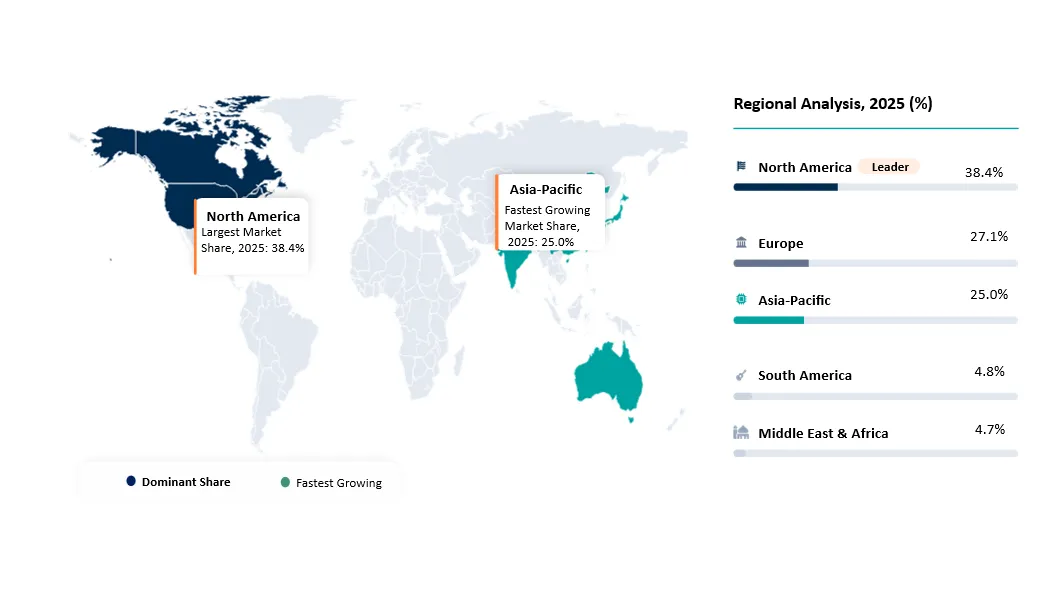
| North America | 38.4% | Largest | High sports nutrition penetration, DTC scale and women’s league commercialization. |
| Europe | 27.1% | Second Largest | Strong endurance culture, premium nutrition and regulatory emphasis on substantiated claims. |
| Asia-Pacific | 25.0% | Fastest Growing | Urban fitness, e-commerce, women’s income and localized active wellness. |
| South America | 4.8% | Emerging | Brazilian fitness culture and expanding online distribution. |
| Middle East & Africa | 4.7% | Emerging | Women’s sports participation initiatives and premium urban demand. |
Europe Women's Sports Nutrition Market Outlook
The Europe women's nutrition and sports nutrition market is expanding rapidly, projected to grow at a compound annual growth rate (CAGR) of over 9%, driven by rising fitness participation, clean-label preferences, and a strong shift toward gender-specific health solutions. Germany is a leading European market with strong gym participation, endurance sport and demand for evidence-led products. Consumers value ingredient transparency, quality and sustainable packaging. Retail includes pharmacies, drugstores, sports retailers and e-commerce. Regulatory discipline makes claim substantiation important. Growth opportunities include vegan protein, clean-label hydration, certified performance products and active-aging nutrition.
North America Women's Sports Nutrition Market Landscape
North America is the largest national market because it combines high supplement use, strong professional women’s sport, leading retailers and extensive direct-to-consumer infrastructure. Protein, hydration and energy products have broad penetration. Growth is supported by women’s basketball, soccer, running, strength training and collegiate athletics. Gatorade’s 2026 Body of Science initiative demonstrates how large brands are investing in female-specific hydration research. Opportunity is strongest in lower-sugar hydration, perimenopause-focused strength nutrition, adolescent athlete education and personalized digital support.
Japan Women's Sports Nutrition Market Trends
Japan offers a sophisticated functional-food market and strong consumer interest in convenient, portion-controlled products. Women’s running, fitness and active aging support demand for protein drinks, amino acids, hydration and beauty-performance crossovers. Localization is essential for taste, pack size and communication. Opportunity is strongest in low-sugar beverages, collagen and protein products, and products that connect mobility, recovery and healthy aging.
China Women's Sports Nutrition Market Outlook
China is expanding through urban gyms, social commerce, running events and domestic active-wellness brands. Female consumers are important in digital fitness and lifestyle nutrition. Market growth depends on trusted quality, localized flavors, influencer education and regulatory compliance. Protein powders and ready-to-drink products lead, while hydration, body composition and women’s wellness create adjacent opportunities.
Women's Sports Nutrition Market Competitive Landscape
- Competition spans global beverage companies, protein leaders, specialist endurance brands, supplement companies and women’s-health platforms.
- Large companies benefit from distribution, R&D and sports sponsorship, while emerging brands compete through focused communities and transparent formulation.
- Differentiation increasingly depends on evidence, taste, tolerance, athlete credibility, anti-doping certification and the ability to serve different life stages.
- Professional women’s sport is becoming a strategic marketing and research channel, increasing the value of long-term league and athlete partnerships.
- Direct-to-consumer data allows specialist brands to refine products quickly, but retail expansion is required for mainstream scale.
- M&A interest is likely to concentrate on brands with strong retention, proprietary science, omnichannel distribution and credible female-consumer insight.
Competitive intensity will increase as general sports nutrition brands develop more relevant products for women and women’s-health companies enter performance categories. Market share will not depend on gendered branding alone. Companies need credible formulations, clear use occasions and evidence that products solve practical problems such as hydration, recovery, protein intake or nutrient gaps.
Leading companies can build defensibility through research networks, sports dietitian education, team partnerships and consumer data. Smaller brands can win focused segments such as endurance, menopause, postpartum return-to-sport or certified collegiate nutrition. The market is likely to support both broad platforms and specialist communities.
Key Companies of the Women's Sports Nutrition Market
- PepsiCo / Gatorade
- Glanbia Performance Nutrition
- Nestlé Health Science
- Abbott
- The Coca-Cola Company
- Herbalife
- Science in Sport
- Maurten
- GU Energy Labs
- OTE Sports
- Skratch Labs
- Nuun
- Clif Bar & Company
- Huel
- Thorne HealthTech
- NOW Foods
- Klean Athlete
- Momentous
- Hum Nutrition
- O Positiv
Women's Sports Nutrition Market Major Pain Points
- Limited female-specific evidence for many performance and life-stage claims.
- Confusion between general sports nutrition and genuinely differentiated female-focused solutions.
- Premium pricing and high customer-acquisition costs in direct-to-consumer channels.
- Risk of iron, hormonal or pregnancy-related claims exceeding appropriate wellness boundaries.
- Taste, texture and gastrointestinal tolerance challenges across protein and endurance products.
- Product contamination and anti-doping risk for competitive athletes.
- Fragmented education across coaches, social media, retailers and health professionals.
- Uneven access to sports dietitians and quality products in emerging markets.
Women's Sports Nutrition Market Recent Developments
- July 2026: Gatorade reported initial findings from its Body of Science research involving more than 500 women. The study highlighted dehydration before workouts, low carbohydrate intake during exercise and incomplete sodium replacement.
- May 2026: Gatorade launched Body of Science as a multi-year global research commitment focused on women’s hydration and nutrition across menstrual, pregnancy and perimenopausal life stages.
- March 2026: Gatorade introduced a lower-sugar hydration product with no artificial flavors, sweeteners or colors, reflecting demand for cleaner and lower-sugar active hydration.
- November 2025: Gatorade announced a partnership with F1 Academy driver Lisa Billard and a program of sweat testing, tailored hydration and recovery support for a young female athlete.
- 2025: Peer-reviewed systematic reviews strengthened attention to iron deficiency, supplementation and performance in female athletes, supporting responsible screening and practitioner-led guidance.
- 2025: Research reviews continued to highlight the shortage of female-specific sports nutrition evidence, encouraging brands and institutions to design studies around hormonal status and life stage.
Analyst View / Opinion on Women's Sports Nutrition Market
The Women's Sports Nutrition market is entering a durable expansion phase because participation, media attention, scientific investment and consumer spending are reinforcing each other. The opportunity extends beyond products explicitly labeled for women. It includes better-designed hydration, protein, energy and micronutrient solutions supported by communication that reflects female consumers accurately.
The strongest near-term revenue pools remain protein, ready-to-drink nutrition and hydration. The highest strategic value may come from research and service layers that improve personalization and trust. Companies should avoid treating menstrual phases as a simplistic product calendar or assuming that every woman needs the same supplement. Credible segmentation and professional education will produce more sustainable growth than aggressive claims.
Professional women’s sport will accelerate category visibility, but mass-market adoption will be driven by recreational women seeking strength, confidence, recovery and long-term health. Companies that connect these goals with accessible products, digital guidance and inclusive communities can build lifetime relationships across changing sports and life stages.
- Protein and hydration will remain the largest scalable categories, while life-stage solutions create premium specialization.
- Perimenopause and menopause will become major innovation themes as women prioritize strength, bone health and healthy aging.
- Female-specific evidence will become a commercial asset and a reputational requirement.
- Retail winners will combine mainstream convenience with specialist education and direct-to-consumer data.
- Athlete partnerships will create the most value when linked to research, product testing and community access.
- Long-term leadership will depend on trust, taste, safety, practical routines and measurable consumer benefit.
Women's Sports Nutrition Market Target Audience
| Industry | Who Should Buy This Report? | Reason to Buy This Report |
| Sports Nutrition Brands | Portfolio, innovation, marketing and business-development leaders | Assess female consumer segments, product opportunities and competitive positioning. |
| Food and Beverage | Functional beverage, protein, snack and health-nutrition teams | Identify adjacency opportunities and channel expansion. |
| Ingredient Suppliers | Protein, electrolyte, vitamin, mineral and specialty-ingredient companies | Understand formulation demand, evidence gaps and partnership opportunities. |
| Sports Organizations | Teams, leagues, clubs, gyms and athlete-support programs | Evaluate nutrition partnerships, education needs and procurement criteria. |
| Retail and E-Commerce | Buyers, category managers and marketplace operators | Assess assortment, price architecture and emerging consumer needs. |
| Investors and Consulting | Private equity, venture capital, institutional investors and advisors | Evaluate growth, defensibility, acquisition targets and strategic white spaces. |
| Healthcare and Research | Sports dietitians, universities, laboratories and digital-health firms | Identify research priorities, education gaps and personalization opportunities. |
Why Choose DATAM?
- Data-driven insights combining market sizing, consumer segmentation, product economics, channel analysis and regional opportunity.
- Post-purchase analyst consultations for portfolio planning, product positioning, partner identification and market entry.
- Annual report updates covering launches, research, sponsorships, regulations, investments and competitive changes.
- Specialized focus on emerging consumer segments and regional commercialization rather than generalized category summaries.
- Actionable analysis that connects sports participation, female health, product science and distribution strategy.
What DATAM Uniquely Provides
- Ten-year forecasts across product type, nutritional function, ingredient platform, consumer group, activity type, distribution channel and region.
- Female-specific segmentation across elite sport, recreational fitness, adolescence, postpartum activity and menopause.
- Buyer-focused analysis of taste, tolerance, evidence, price, certification, convenience and trust.
- Country-level views linking sports participation, retail structure, e-commerce and product localization.
- Competitive analysis across global leaders, specialist brands, women’s-health platforms and ingredient suppliers.
- Strategic recommendations for research partnerships, athlete activation, retail entry and direct-to-consumer growth.
Questions This Report Answers
- How will the global Women's Sports Nutrition market evolve from 2025 through 2035?
- Which product types, nutritional functions and consumer groups offer the strongest growth?
- How will female-specific research change hydration, recovery and life-stage product development?
- Which channels provide the best balance of education, reach and recurring revenue?
- How should companies distinguish credible female-focused innovation from superficial repositioning?
- Which regions offer the strongest opportunity for premium and mass-market products?
- How will professional women’s sport, digital fitness and active aging reshape competition?


























































