


Wire and Cable Compound Market Size
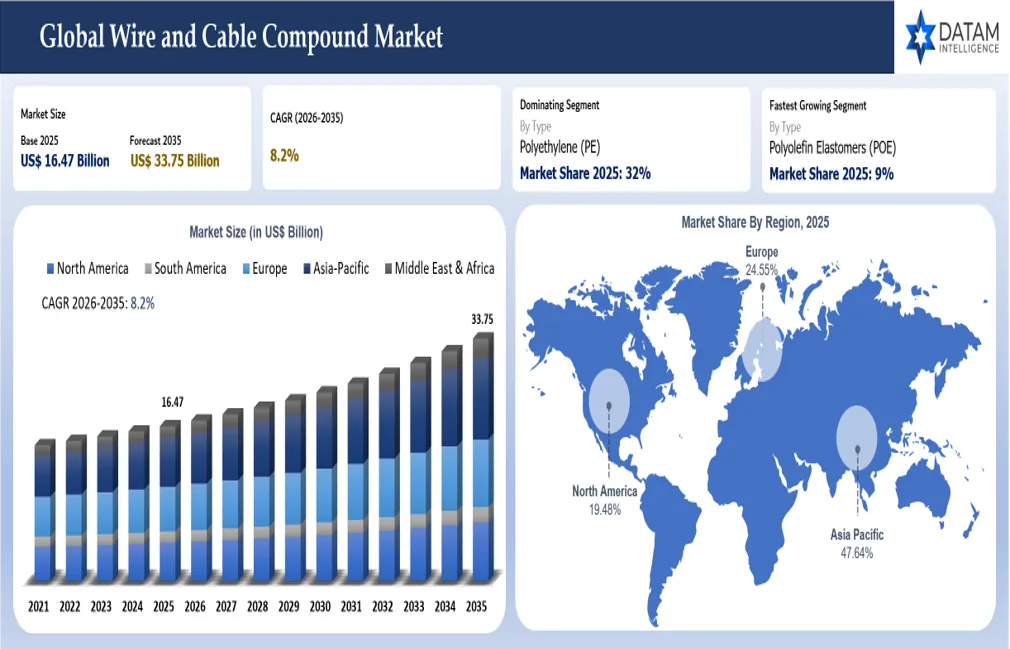
The global Wire and Cable Compound market reached US$ 16.47 billion in 2025 and is expected to reach US$ 33.75 billion by 2035, growing with a CAGR of 8.2% during the forecast period 2026-2035.
Wire and cable compounds are primarily used to provide high insulation levels to wires while also preventing moisture from entering power transmission or telecommunication cables. Furthermore, the compounds give wires and cable excellent mechanical stability and corrosive and chemical resistance. The compounds are designed to act as effective jackets for conducting materials such as wires or cables, making them suitable for various applications ranging from power and automotive to construction and communication.
Many wire and cable compounds are specifically designed for certain end-use applications, such as high and low-voltage power cables, telecommunications, telephone wires, coaxial cables, jacketing and so on. Polymers that can be utilized as the basic polymer in wire and cable compounds come in various forms. The materials used in the electrical insulation of cables or wires are exposed to various external influences that impact the system's overall performance. The compounds must meet specified standards in terms of abrasion, heat and chemical resistance, flame retardancy and mechanical qualities to provide a robust and believable solution.
Wire and Cable Compound Market Key Takeaways
- Polyethylene (PE) has held the highest market share in the global Wire and Cable Compound Market in 2025 due to its usage in insulation, jacketing, power cables, telecommunication, renewable energy cables and automotive cables.
- Polyolefin Elastomers (POE) are expected to be one of the fastest-growing type segments, fueled by growing need for flexible, lightweight and heat-resistant cable compounds in various applications, including EV, renewable energy, telecom and electrical applications.
- Modernization and electrification efforts are rising rapidly, causing higher demand for heat-resistant and durable wire and cable compounds with better thermal stability, insulating properties, fire resistance, mechanical properties and durability.
- Emergence of renewable energy projects, EV charging stations, data centers and telecommunication systems is leading to more opportunities for developing specialty compounds capable of withstanding challenging thermal, mechanical, environmental and fire safety conditions.
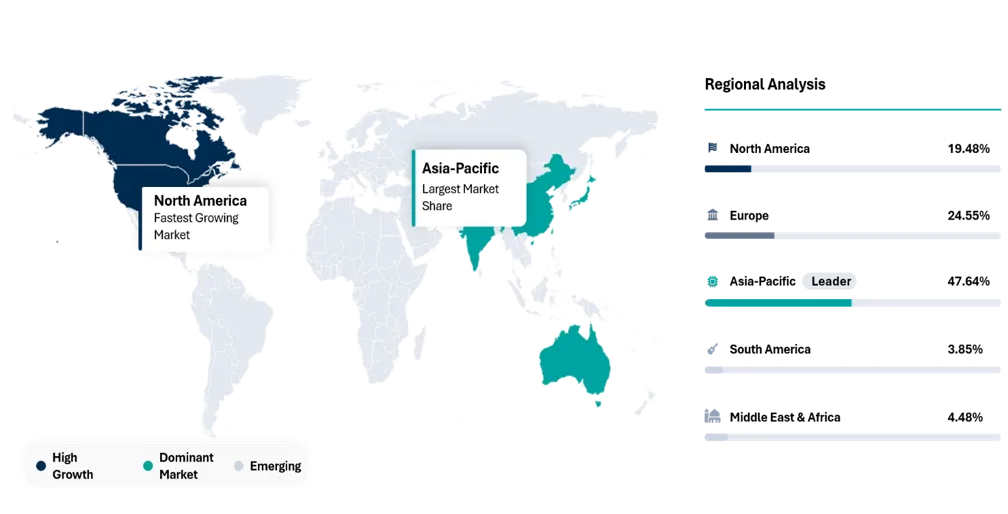
- In 2025, Asia-Pacific dominated the global Wire and Cable Compound Market with approximately 47.64% market share due to fast-growing power grids, renewable energy projects, telecommunication infrastructures, manufacturing of electric vehicles, construction activities and electronics & electrical products in the region.
Wire and Cable Compound Market Scope
| Metrics | Details | |
| 2025 Market Size | US$ 16.47 Billion | |
| 2035 Projected Market Size | US$ 33.75 Billion | |
| CAGR (2026-2035) | 8.2% | |
| Largest Market | Asia-Pacific | |
| Fastest Growing Market | Asia-Pacific | |
| By Type | Polyethylene (PE), Ethylene Vinyl Acetate (EVA), Ethylene Acrylate Copolymers, Polyolefin Elastomers (POE), Olefinic Block Copolymers (OBC), Thermoplastic Polyurethane (TPU), Ethylene Propylene Diene Rubber (EPDM) and Others | |
| By Form | Solid and Foamed | |
| By End-User | Construction, Power, Telecommunication, Renewable, Transportation, Hospitality and Others | |
| By Region | North America | U.S., Canada, Mexico |
| Europe | Germany, UK, Russia, France, Spain, Italy, Poland | |
| Asia-Pacific | China, India, Japan, Australia, South Korea, Indonesia, Malaysia, Singapore, Vietnam, Thailand, Philippines, Taiwan | |
| South America | Brazil, Argentina | |
| Middle East and Africa | UAE, Saudi Arabia, South Africa, Israel, Turkiye, Nigeria | |
| Report Insights Covered | Competitive Landscape Analysis, Company Profile Analysis, Market Size, Share, Growth | |
Wire and Cable Compound Market White Space & Investment Opportunities
- Halogen-Free and Low-Smoke Compounds: Increasing demands for fire and environment safety offer new applications for HFFR and LSZH compounds in construction, transport, data centers and other infrastructures.
- Renewable Energy Cable Compounds: Growing renewable energy production increases the need for cable compounds which can withstand UV, weather, moisture and heat.
- EV and High-Voltage Cable Compounds: The adoption of electric vehicles is presenting an opportunity for light weight, flexible, heat-resistant and high-voltage cable compounds for batteries, charging and powertrain.
- Data Center and Telecom Cable Compounds: Fast deployment of data centers, fiber optics and communication infrastructure is driving up the need for special compounds that are flame resistant, flexible and have good electrical properties.
- Sustainable and Recyclable Compounds: Increasing sustainability needs present a white space opportunity for sustainable and recyclable compounds with electrical, mechanical and flame-retardant properties.
Wire and Cable Compound Market Buyer Decision-Making Criteria
The buyers of Wire and Cable Compounds focus on the capability of the compounds to fulfill the requirements of electrical, thermal, mechanical, safety, compliance, processing and cost competitiveness. Material performance, material uniformity, compatibility with current manufacturing processes and total cost of ownership are some of the factors that cable manufacturers use in selecting their supplier companies. The growing need for cables in power generation and transmission, renewable energy, electric vehicles, telecommunication and construction applications is adding significance to the application-specific performance of materials.
Major Buyer Decision-Making Criteria:
- Electrical Performance
- Flame Retardancy and Fire Safety
- Thermal Resistance and Temperature Rating
- Mechanical Strength and Flexibility
- Material Compatibility and Processability
- Regulatory and Industry Compliance
- Durability and Service Life
- Price and Total Cost of Ownership
- Supply Reliability and Production Capacity
- Consistency and Quality
- Customization and Technical Support
- Sustainability and Recyclability
Wire and Cable Compound Market BCG Matrix: Company Evaluation
STAR
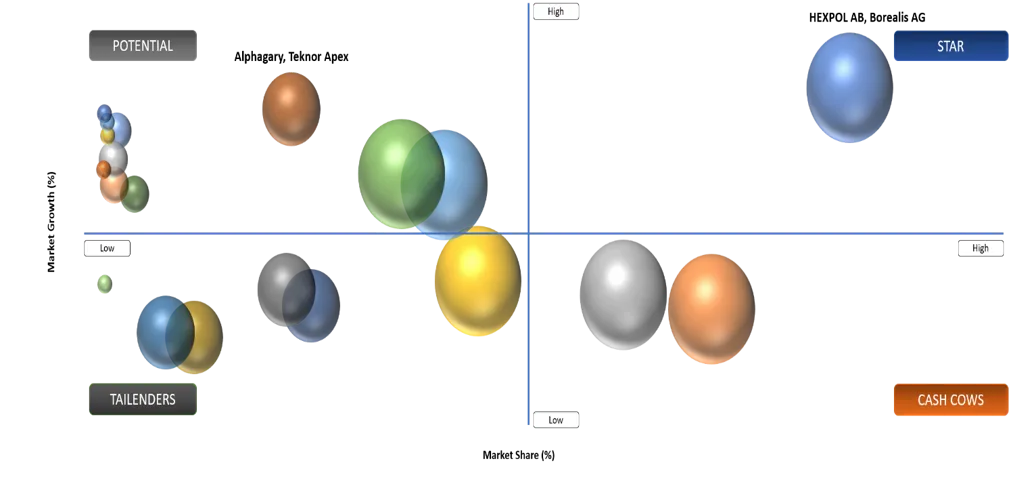
Star companies have dominant market position, wide wire and cable compounds capabilities and significant involvement in high growth applications like renewable energy, electric vehicles, power infrastructure and telecom. HEXPOL AB, Borealis AG, Dow and Avient Corporation are strategically positioned in the Stars quadrant owing to their proven portfolio of polymers and compounds, technology strengths and involvement in evolving cable materials.
POTENTIAL
Potential companies have good technical skills and specialized materials, but there is more scope available for these companies to grow in terms of wire and cable compound markets. Alphagary, Teknor Apex, Trelleborg, BASF SE, Cabot Corporation and SCG Chemicals Co., Ltd., can take advantage of rising demand for special performance, flame retardant, halogen free, sustainable and application specific compounds.
Wire and Cable Compound Market Dynamics
Driver Impact Analysis
| Driver | Market Growth Impact (%) | Demand Concentration | Impacted Use Case | Strategic Impact |
Grid modernization and power infrastructure expansion | 24% | Asia-Pacific, North America, Europe | Power transmission, distribution, building wires | Drives demand for high-performance insulation, jacketing and semiconductive compounds |
Growth of renewable energy installations | 21% | Asia-Pacific, Europe, North America | Solar and wind power cables | Increases demand for UV-, weather-, moisture- and heat-resistant compounds |
Rising electric vehicle and charging infrastructure adoption | 19% | Asia-Pacific, Europe, North America | EV, battery, charging and automotive cables | Accelerates adoption of lightweight, flexible, high-temperature and high-voltage compounds |
Expansion of telecommunications and data-center infrastructure | 17% | North America, Asia-Pacific, Europe | Fiber-optic, data, communication and networking cables | Supports specialized low-smoke, flame-retardant, flexible and high-performance compounds |
Driver: Grid Modernization and Power Infrastructure Expansion
Expansion and upgrading of transmission and distribution grids represent one of the key drivers behind growth in the Wire and Cable Compound Market. The need to upgrade grids, lay underground cables, build smart grid infrastructure and connect new power generation facilities is increasing the demand for cables having better thermal, electrical, mechanical, flame and aging resistance characteristics. This, in turn, is encouraging the use of advanced polyethylene, XLPE, HFFR and other specialty compounds in fast-growing Asian Pacific, North American and European markets.
Restraint Impact Analysis
| Restraint | Drag on Market Growth (%) | Primary Impact Area | Impacted Use Case | Strategic Impact |
Volatility in polymer and additive raw-material prices | 21% | Production cost and margins | PVC, PE, EVA, POE and specialty compounds | Encourages long-term sourcing contracts, formulation optimization and raw-material diversification |
Stringent environmental and regulatory requirements | 18% | Product development and compliance | Halogenated and conventional cable compounds | Increases R&D and certification costs while accelerating adoption of HFFR and LSZH alternatives |
High cost of advanced and specialty compounds | 16% | Material economics | High-voltage, renewable-energy, EV and data-center cables | Can limit adoption in price-sensitive applications and encourages cost-effective formulation development |
Complex processing and performance requirements | 14% | Manufacturing and quality control | High-performance insulation, jacketing and semiconductive compounds | Requires specialized processing capabilities, technical expertise and stringent quality control |
Restraint: Volatility in Polymer and Additive Raw-Material Prices
Price changes in polyethylene, EVA, speciality polymers, plasticizers, flame retardants and other compounds act as one of the biggest constraints for the Wire and Cable Compound Market. Several of these materials are related to petroleum-based feedstocks and make wire and cable compound producers prone to changes in crude oil prices, crude oil supply, energy prices and political situations. Such fluctuations in input material prices lead to higher costs of manufacturing and higher prices for compounds in construction, energy and telecommunications sectors where cables are sensitive to price changes.
Wire and Cable Compound Market Segment Analysis
The global wire & cable compound market is segmented based on type, form, end-user, and region.
The need for adequate insulation and sheathing in wires & cables has boosted the demand for polyethylene compounds
Based on type, the global wire & cable compound market is segmented into Polyethylene, Ethylene Vinyl Acetate (EVA), Ethylene Acrylate Copolymers, Polyolefin Elastomers (POE), Olefinic Block Copolymers (OBC), Thermoplastic Polyurethane (TPU), Ethylene Propylene Diene Rubber (EPDM) and Others.
Polyethylene (PE) compounds are frequently utilized as insulation and sheathing in wires and cables. PE compounds are among the most widely used plastics. The PE compounds are mainly based on polyethylene or copolymers of polyethylene properly adjusted to client specifications. PE comes in a variety of forms, including solid and foamed. The dielectric constant is one of the electrical differences between solid and foam. Foamed PE has a lower dielectric constant than solid PE. Solid PE is used to insulate wires rather than as a cable jacket. PE is employed in a wet environment because of its moisture resistance. PE insulation is stiff and can vary based on high and low-density forms (HDPE and LDPE).
Various companies are launching new polyethylene-based compounds for various end-user industries. For instance, in 2020, Borealis announced the commercial launch of HE1355, a high-density polyethylene grade free of azodicarbonamide (ADCA). It is the first chemically-foamed, ADCA-free material intended to manufacture telecommunications cables. The use of HE1355 allows manufacturers to bypass altogether any issues arising from the inclusion of ADCA on the EU’s Annex XIV of REACH.
Wire and Cable Compound Market Geographical Penetration
U.S. Wire and Cable Compound Market Landscape
U.S. Wire and Cable Compounds Market is fueled by consistent investments in grid transformation projects, data centers, telecoms, renewable energy, electric vehicles and commercial and residential construction. More and more demand is moving towards advanced compounds like XLPE, thermoplastic elastomers, fire-retardant, low smoke halogen free and other customized compounds, which offer enhanced thermal stability, flexibility, safety from fires and durability. The market offers an opportunity for development of sustainable and recyclable compounds along with formulation of application specific compounds in line with emerging safety and environmental norms.
Japan Wire and Cable Compound Market Outlook
The Japan Wire and Cable Compound Market is driven by the need from advanced manufacturing of automobiles and EVs, renewable energy, grid modernization, telecommunications, data centers and industrial automation sectors. Increasing demand for high-performance, flame-retardant, low smoke, heat-resistant, lightweight and environmentally friendly compounds that conform to Japanese standards of quality and safety is observed within the market. Increased investment into next generation mobility and renewable energy systems should create opportunities for more specialized cable compounds with better thermal properties, flexibility and electrical characteristics.
Wire and Cable Compound Market Competitive Landscape
- Product Portfolio Expansion: Leading players are growing their portfolio of products in polyethylene, EVA, POE, TPU, EPDM, HFFR, LSZH and other specialty grades for application in various cables.
- Technology and Product Innovation: Players are focusing on developing innovative formulations that provide enhanced thermal stability, flame retardant properties, flexibility, electrical properties and durability for difficult applications.
- Capacity Expansion: Capacity growth and establishing manufacturing presence regionally is being done to cater to rising demand from power infrastructure, renewable energy, EVs, telecoms and data centers.
- Strategic Acquisitions and Partnerships: Participants in the market are using acquisitions, alliances and strategic partnerships to increase their portfolio of compounds, geographic presence and technology/customer access.
- Sustainability-Focused Development: The key players in the market are working on developing sustainable compounds like recyclable compounds, low carbon compounds, halogen free compounds and bio-based compounds.
Key Companies of Wire and Cable Compound Market
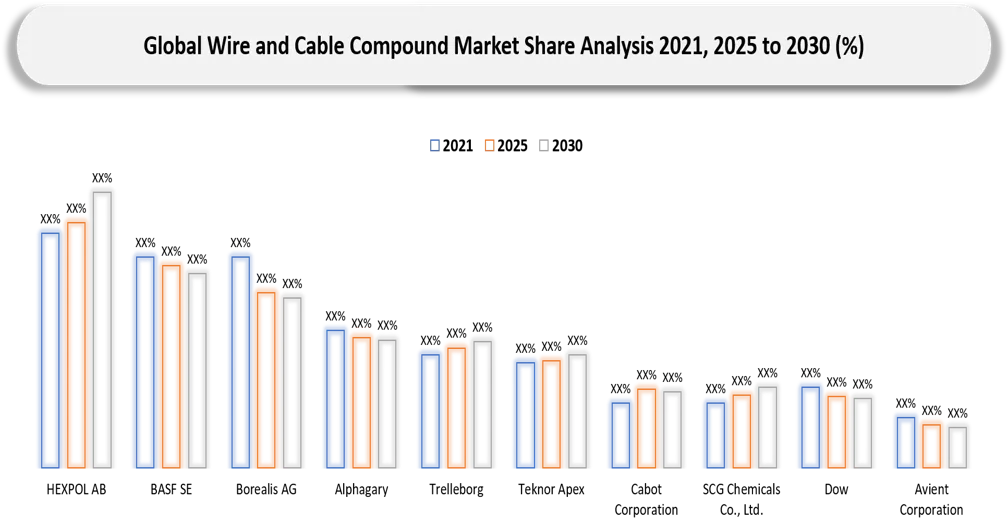
- HEXPOL AB
- BASF SE
- Borealis AG
- Alphagary
- Trelleborg
- Teknor Apex
- Cabot Corporation
- SCG Chemicals Co., Ltd.
- Dow
- Avient Corporation
Wire and Cable Compound Market Recent Developments
- Alphagary - September 2026: Shakun Polymers, a division of Alphagary, has announced increased investments to raise production capacity from 70,000 MT per year to 100,000 MT per year by 2030, aimed at meeting the growing needs for advanced insulation materials, sheathing materials, HFFR/ZHFR, PVC and semiconductive compounds.
- Alphagary - September 2026: Alphagary stated that they had raised their capacity at the Melton Mowbray plant in the UK and Pineville, NC plant, adding approximately 20,000 tonnes of capacity annually, mainly for wire and cable blends.
- Alphagary - September 2026: The wire and cable compounds expansion by Alphagary was noted as it collaborated with Shakun Polymers. The firm aimed at making semiconductive, halogen-free and PVC FRLS compounds useful in the renewable energy, railway, data center, communications and instrumentation sectors.
- Avient Corporation - August 2026: In Q2 of 2026, Avient Corporation recorded revenues of $917 million, an increase of 5.8% compared to the previous year's period, attributed to organic growth, innovations and market share growth. Avient raised its adjusted EPS estimates for 2026 to between $3.10 and $3.25.
- HEXPOL AB - July 2026: HEXPOL purchased the Vipa Group, a major Italian Wire & Cable compounder, for €143.5 million. This acquisition will enhance the Wire & Cable product line portfolio of HEXPOL and increase their exposure to electrification, data centers, telecoms and smart buildings.
What DATAM Uniquely Provides
- Detailed Market Segmentation: Detailed breakdown by compound type, form and end-user segments to uncover the lucrative growth prospects.
- Application-Specific Market Insights: Market assessment on demand by construction, power, telecoms, renewable energy, transportation, hospitality and various other application sectors.
- Competitive Intelligence: Complete analysis of key players’ strategies including their product portfolio, initiatives, capacity expansion plans, mergers & acquisitions and market positioning.
- Emerging Technology and Material Tracking: Identification of developments within the HFFR, LSZH, recyclable material, high performance polymer and other innovative wire and cable compound technology space.
- White-Space and Investment Opportunity Analysis: Identification of underserved markets, emerging opportunities, regional opportunities and investment opportunities to guide market entry and growth decisions.




























































