


Wi-Fi 8 Devices Market Size and Overview
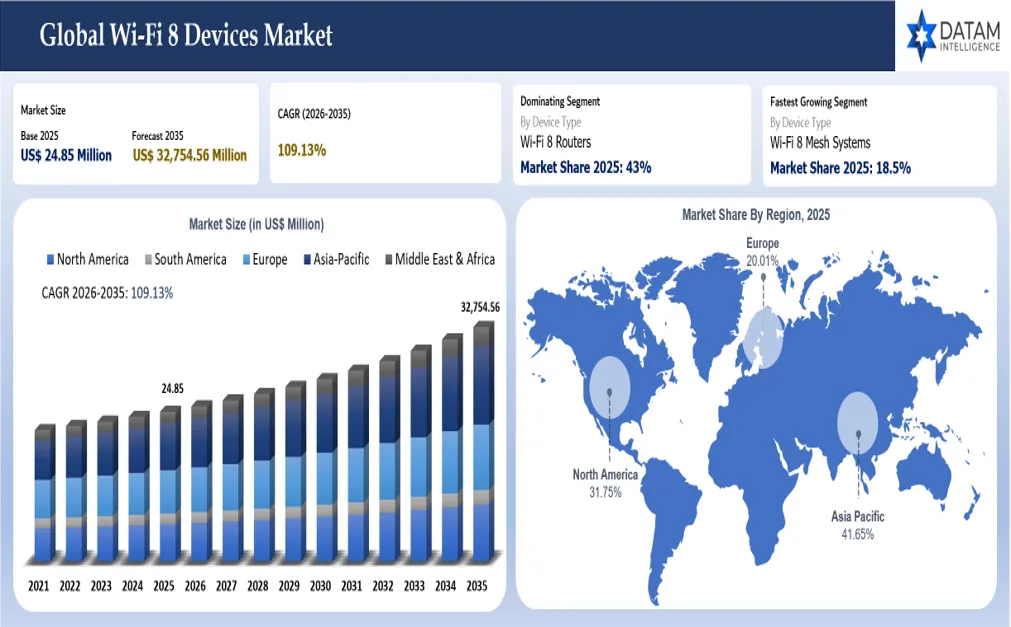
The global Wi-Fi 8 devices market size reached US$ 24.85 million in 2025 and is expected to reach US$ 32,754.56 million by 2035, growing with a CAGR of 109.13% during the forecast period 2026-2035.
The industry has moved from traditional upgrades aimed at maximizing throughput for Wi-Fi products to Ultra High Reliability (UHR) technology for Wi-Fi 8 technology used in the Multi-AP Coordination (MAPC) environment for Wi-Fi 8. Its potential is most realized in four application areas, namely, the enterprise, industrial, smart-home and high-density public networks where both connectivity and latency are crucial. With the technology’s ability to operate on 2.4, 5 and 6 GHz, it allows market players to cater to all coverage, capacity and interference needs.
The growing association between commercialization and 10G Ethernet, 10G PON and 5G/FWA creates chances for gateways based on Wi-Fi 8 and integrated CPE. Presently, early commercial offerings cover four key device segments - routers, mesh systems, access points and gateways, while also showing development around range extenders and client adaptors by device vendors. The IEEE 802.11bn standard is still in development and is expected to be approved in May 2028, which makes the timeline from 2026 to 2028 crucial for commercialization and market development for Wi-Fi 8 products.
Wi-Fi 8 Devices Market Key Takeaways
- Wi-Fi 8 Routers held the major market share in 2025, amounting to a market share of 43.0%, owing to the early adoption of routers with UHR, Multi-AP coordination and multi-gigabit Ethernet technology.
- Wi-Fi 8 Mesh Systems are expected to be the fastest growing category of devices, with a compound annual growth rate (CAGR) of 120.0% between 2026 and 2035, driven by the need for whole-home coverage, roaming and multi-AP connectivity.
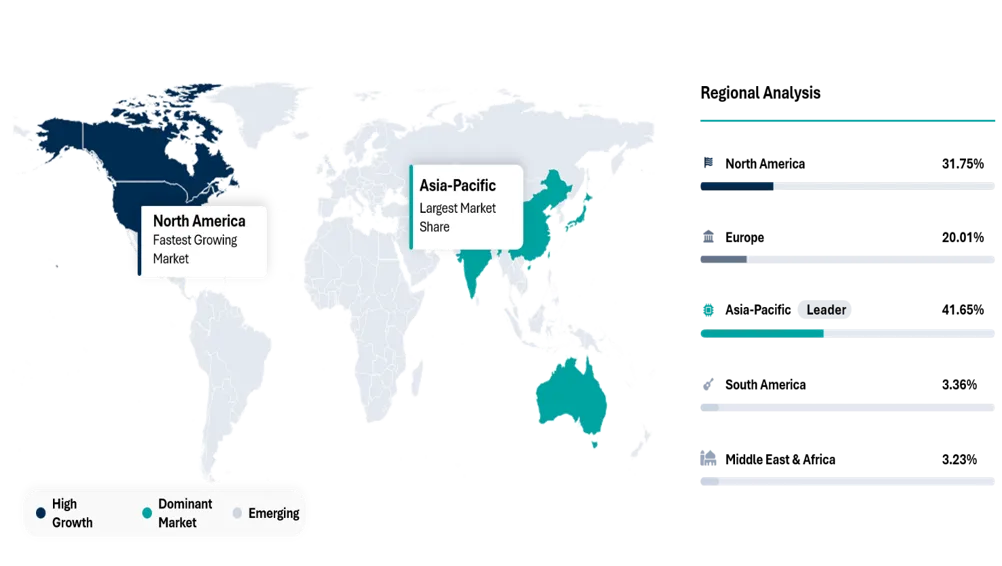
- Asia-Pacific held the largest share of the global Wi-Fi 8 devices market in 2025, accounting for a market share of 41.65%, attributed to its electronics manufacturing base, fiber/5G/FWA network infrastructure and high connectivity needs.
- Enterprise and high-density networks are coming forth as critical deployment settings and Wi-Fi 8 tackles congestion and reliability issues by means of carefully coordinated spatial reuse techniques, interference reduction strategies, seamless mobility and improved latency uniformity.
- The possibilities opened by the pairing of 10G PON, 10G Ethernet and 5G/FWA create further chances for Wi-Fi 8 gateways and broadband CPE by coupling a multi-gigabit wired access with the latest wireless connectivity methods proving to be extremely reliable.
Wi-Fi 8 Devices: Industry Trends and Strategic Insights
- Ultra-reliability is emerging as the key value proposition for Wi-Fi 8 devices, with device differentiation transitioning from maximum throughput to reliable performance, reduced latency and stable connections amid network congestion.
- Wi-Fi 8 devices will benefit greatly from multi-AP collaboration, allowing coordination of spectrum usage and interference among routers, mesh nodes and access points through distributed networking.
- AI-native functionalities are now making their way into Wi-Fi 8 networking hardware, enabling intelligent traffic optimization, network adaptability, interference reduction and power-efficient enhancements.
- Premature deployments are taking place even before the finalization of the standard in order to enable manufacturers to create device ecosystems while IEEE 802.11bn approaches its final stage.
- Wi-Fi 8 is also extending into high-density and mission-critical connectivity, with enterprise campuses, industrial environments, smart homes and multi-gigabit broadband networks as main deployment venues.
Wi-Fi 8 Devices Market Scope
| Metrics | Details | |
| 2025 Market Size | US$ 24.85 Million | |
| 2035 Projected Market Size | US$ 32,754.56 Million | |
| CAGR (2026-2035) | 109.13% | |
| Largest Market | Asia-Pacific | |
| Fastest Growing Market | Asia-Pacific | |
| By Device Type | Wi-Fi 8 Routers, Wi-Fi 8 Mesh Systems, Wi-Fi 8 Access Points, Wi-Fi 8 Gateways, Wi-Fi 8 Range Extenders, Wi-Fi 8 Repeaters and Wi-Fi 8 Client Devices | |
| By Band Configuration | 2.4 GHz, 5 GHz, 6 GHz, Dual-Band, Tri-Band and Multi-Band | |
| By Deployment | Residential, Enterprise, Industrial, Public & High-Density Venues and Service Provider Networks | |
| By Application | High-Speed Broadband Connectivity, Enterprise WLAN, Smart Home & IoT, Industrial Automation, AI & Edge Computing, Gaming & Immersive Applications, Video Conferencing & Collaboration, AR/VR & Spatial Computing, 5G/FWA Broadband Access | |
| By Price Tier | Entry-Level, Mid-Range and Premium | |
| By Connectivity / Backhaul | Gigabit Ethernet, 2.5G Ethernet, 5G Ethernet, 10G Ethernet, 10G PON, 5G/FWA and Multi-Gigabit Wired Backhaul | |
| By Channel Bandwidth | 20 MHz, 40 MHz, 80 MHz, 160 MHz and 320 MHz | |
| By Region | North America | U.S., Canada, Mexico |
| Europe | Germany, UK, Russia, France, Spain, Italy, Poland | |
| Asia-Pacific | China, India, Japan, Australia, South Korea, Indonesia, Malaysia, Singapore, Vietnam, Thailand, Philippines, Taiwan | |
| South America | Brazil, Argentina | |
| Middle East and Africa | UAE, Saudi Arabia, South Africa, Israel, Turkiye, Nigeria | |
| Report Insights Covered | Competitive Landscape Analysis, Company Profile Analysis, Market Size, Share, Growth | |
Why does this report matter in 2026?
2026 is a critical year in the process of commercialization of the Wi-Fi 8 devices market, as manufacturers of equipment and connectivity move from the research and development stage to the beginning stages of launching products while the IEEE 802.11bn standard evolves. This makes 2026 significant when analyzing the timing for launching devices, the preparedness of the ecosystem, positioning of vendors, adoption of technology and possibilities for replacements of routers, mesh systems, access points, gateways and other Wi-Fi 8 compliant devices.
This report is important due to the fact that Wi-Fi 8 is bringing new standards to wireless devices, where competition is focused on reliability and consistent network operations, rather than just being faster. Multi-AP coordination, robustness against interference, reduced latency and better performance in dense environments can be utilized for many different purposes. The report assists stakeholders in identifying the device categories and application scenarios that have a high potential for uptake as Wi-Fi 8 commercialization accelerates.
Wi-Fi 8 Devices Market White Space & Investment Opportunities
- Mid-range Wi-Fi 8 routers and mesh systems have the white space potential as suppliers are striving for UHR network functionality and multi-AP features beyond the high-end networking equipment.
- The high-density enterprise access points can be a potential investment since they can solve performance issues on the large campuses and complicated indoor environments using multi-AP functionality.
- The Wi-Fi 8 gateways for 5G and fixed wireless access and fiber broadband are an emerging white space since they can provide better in-home wireless distribution along with the higher-capacity access network.
- AI-assisted Wi-Fi 8 network devices provide differentiation by virtue of real-time network optimization, traffic management, interference detection and intelligent resource allocation.
- Wi-Fi 8 devices for industrial automation and operations can be viewed as future white space applications, especially where reliable low latency wireless communications are required amidst interference.
Wi-Fi 8 Devices Future Market Transformation
The Wi-Fi 8 devices market will be characterized by a move away from the peak-speed cycle to a more reliability-oriented ecosystem. Future routers, mesh systems, gateways and enterprise access points will feature Multi-AP Coordination, spatial reuse coordination, roaming improvements and interference management, thus providing consistent performance in dense and complex wireless environments. This will help increase the deployment of Wi-Fi 8 devices not only for residential networking but also for enterprise & industrial networks and other high density applications.
Greater network intelligence, coordination of devices and optimization of application performance will define the coming stage. While commercial Wi-Fi 8 is becoming available on one hand and IEEE 802.11bn specification keeps advancing on the other hand, the focus of competition may shift from peak throughput to such features as coverage uniformity, latency predictability, multi-device reliability, interference immunity and efficient spectrum utilization. This transition would make coordinated Wi-Fi 8 equipment more pertinent to industrial automation, immersion, home connectivity and high-density enterprise networks.
Wi-Fi 8 Devices Market Buyer Decision-Making Criteria
Wi-Fi 8 equipment buyers are now beginning to judge equipment by the reliability of equipment, its coverage consistency, ability to work in multiple access points, latency and preparedness of an ecosystem and not only by the peak theoretical throughput. It is especially critical in cases of mesh networks, enterprises and high-density scenarios where interference, roaming and varying signal conditions can have an impact on user experience. Wi-Fi 8’s UHR architecture specifically targets these reliability and coordination challenges.
Major Buyer Decision-Making Criteria
- Ultra-High Reliability and Connection Stability
- Multi-AP Coordination Capability
- Coverage and Edge-of-Network Performance
- Latency and Quality-of-Service Performance
- Seamless Roaming Across Access Points
- Interference Management and Spectrum Efficiency
- Backward Compatibility and Interoperability
- Multi-Gigabit Wired Backhaul and Broadband Support
- Power Efficiency and Thermal Performance
- Total Cost of Ownership and Upgrade Value
Wi-Fi 8 Devices Market Economic & Investment Analysis
The Wi-Fi 8 devices market is entering a new investment phase in 2026 as semiconductor manufacturers and network technology companies are expanding their range of products with homes gateways, mesh networks, corporate access points and multi-gigabit routers. Investments are shifting toward compact and powerful Wi-Fi 8 systems on chips and platforms that are aimed to lessen equipment complexity while making deployment easier across multiple types of devices.
From an economic perspective, the trend towards mass market integration of broadband is beginning to be seen as an important route to commercialization. With the integration of Wi-Fi 8 with 10G PON and 5G/FWA gateways, the operators may increase the connectivity levels even while catering to the price-sensitive broadband users, while investments in the enterprise sector are increasingly focusing on reliable and AI-enabled access infrastructures. This presents an opportunity for device vendors, semiconductor providers, broadband providers and technology partners to secure their foothold prior to the wider commercialization of Wi-Fi 8.
Wi-Fi 8 Device Investment Trends in the Market
- Integrated Wi-Fi 8 SoCs are receiving investments from vendors in their quest to deliver devices that will be simpler, more power-efficient and scalable in manufacturing, with applications ranging from routers and mesh networking systems to gateways.
- AI-powered Wi-Fi 8 technology will be another important strategic investment theme that will combine network intelligence, edge AI processing and connectivity optimization in next-gen networking devices.
- The combination of 10G PON and Wi-Fi 8 will provide mass-market investment opportunities, especially for broadband companies interested in multi-gigabit residential gateways.
- Another emerging investment area will be enterprise Wi-Fi 8 infrastructures due to demand for multi-gigabit, low-latency, reliable connectivity and AI-enabled campus networks.
- Investments have been expanding into Wi-Fi 8 client-device ecosystems ranging from mobile devices to PCs, IoT, automotive and others as the semiconductors suppliers are providing more Wi-Fi 8 silicon and licensing options.
Strategic Indicators For the Wi-Fi 8 Devices Market
High Regulation Impact
The Wi-Fi 8 devices market is highly regulated since the commercial use of the technology is dependent upon country-specific spectrum allocation, radio-frequency power constraints, co-existence criteria and wireless device certification procedures. Different regulations may define the frequency bands in which Wi-Fi 8 devices can operate, number of channels available for operation, maximum transmission power allowed and capabilities of the Wi-Fi 8 devices. These considerations become especially critical as the vendors develop their products, while the IEEE 802.11bn specification keeps evolving.
High Investment Activity
Wi-Fi 8 devices market witnesses intense investments due to increased commercialization by semiconductor vendors, networking OEMs and broadband technologies into routers, mesh networks, enterprise access points, fiber gateways and FWA devices. Broadcom extended its Wi-Fi 8 line-up in 2026 with SoCs aimed at large-scale residential networking and broadband use cases, whereas Qualcomm announced platforms for home networking, enterprise, fiber, FWA and even mobile connections. This investment has been directed towards scalable architecture, processing integration, reduced complexity of devices, AI-driven networking and economic deployment for Wi-Fi 8, which allows for more commercial application of Wi-Fi 8 beyond premium networking devices.
Supply Chain Disruption
The Wi-Fi 8 devices market will continue to be vulnerable to semiconductor and components shortages since initial commercially available Wi-Fi 8 devices will be using proprietary Wi-Fi 8 SoC, radio-frequency components, memory, fast Ethernet interfaces and network components. Wi-Fi 8 is being developed by Broadcom and Qualcomm for routers, mesh systems, gateways, enterprise access points and mobile phones, thereby making the need for semiconductors more pressing with their increasing use. Competition between the semiconductors and memory for use by the artificial intelligence industry and others, can result in either increased costs or delays, which may have a bearing on Wi-Fi 8 device manufacturing, pricing and timelines.
Pricing Volatility
There is going to be price volatility in the Wi-Fi 8 devices market during its initial commercialization stage due to the fact that the initial Wi-Fi 8 products enjoy premium positioning, while at the same time there is cost pressure due to increasing integration of semiconductors and growing economies of scale. The first Wi-Fi 8 consumer routers of TP-Link come at the price point below US$1,000 and the next wave of even more affordable products such as Pro and entry level will be released by 2027, indicating an expected widening of price tiers as the ecosystem matures. At the component level, the Wi-Fi 8 SoC offerings from Broadcom incorporate processors, radios, power amplifiers and multi-gigabit Ethernet, with the company stating that the architecture reduces bill-of-materials costs and PCB complexity. The combination of premium prices for early adopters, product lineup expansion and decreased costs of components is becoming apparent.
Procurement Pressure
As Wi-Fi 8 products are entering the market, the Wi-Fi 8 devices market is dealing with pressure to procure materials, as manufacturers need to buy the necessary Wi-Fi 8 SoCs, RF hardware, memory, multi-gigabit Ethernet connections and other components while the volumes are still making up. Although the expansion of highly integrated SoCs is decreasing the needed components number and BOM complexity, the OEMs need to still ensure access to reliable semiconductor platforms and relevant components. As Wi-Fi 8 is already being adopted in routers, mesh systems, gateways, corporate access points and FWA, the companies need to pay attention to supplier qualification and capacity engagements as well as standardizing of components and multi-sourcing as part of their cost control and manufacturing continuity protection efforts.
New Technology Adoption
The WiFi 8 devices market is set for its early adoption period, which will be based on ultra-reliability and not increased peak speed. The new devices being developed, including routers, access points, gateways and client devices, will feature A lot to increase reliability, spectrum efficiency, coverage and latency in dense wireless networks. In 2026, Broadcom and Qualcomm will have already implemented these functionalities on residential, enterprise, broadband and other Wi-Fi 8 platforms, which demonstrates a move away from technology development towards early commercial deployment of devices.
Regional Expansion Opportunity
There are strong opportunities for regional expansion in the Wi-Fi 8 devices market as commercial products move from their introductory stage to full-scale implementation on a global scale. North America and Europe stand to become early adopters of high-end residential routers, mesh systems and access points, whereas Asia-Pacific is rich in opportunities for market expansion because of its large manufacturing base for networking devices, urban connective needs, rollout of 5G/FWA technologies and the development of fiber networks. Opportunities that arise from South America and the Middle East & Africa regions are quite pertinent to FWA and broadband gateway rollouts by operators, presenting further openings for Wi-Fi 8 devices to take hold once cost-optimized solutions become available.
Government Policy Support
The favorable environment for the Wi-Fi 8 devices market is being created due to various governmental policies, such as the expansion of broadband, public Wi-Fi networks and the availability of more unlicensed spectrum for high bandwidth wireless connectivity. In India, the public Wi-Fi proliferation consultation for the year 2026 from TRAI is specifically focused on increasing the pace of public Wi-Fi infrastructure development and the governmental spectrum policy for the 5.925 to 6.425 GHz lower 6 GHz band has added to the Wi-Fi 8 technology capacity. These initiatives could facilitate the gradual implementation of Wi-Fi 8 routers, access points and gateways, although the adoption of these devices would still be determined by the nation’s spectrum rules, certification requirements and affordability.
Pricing Intelligence
The Wi-Fi 8 devices market is witnessing the emergence of a differentiated price/performances framework, with manufacturers gearing up for products in premium, mid-tier and mass market segments. The Archer 8 Ultra from TP-Link can offer up to 19Gbps of aggregated wireless throughput along with 10Gbps of wired connectivity capability, while the Deco 8 Ultra boasts up to 22 Gbps speeds along with the ability to handle 200+ connections, thus depicting the premium specifications category; however, TP-Link has not released pricing information at this point. From the semiconductor perspective, Broadcom offers the BCM6772 which is made explicitly for mass market routers, extenders and repeaters, featuring integrated capabilities meant to lower BOM costs and PCB design simplicity. Its BCM6776 serves the market for high-end tri-band routers and extenders, illustrating segmentation at the component level between value and high-end Wi-Fi 8 platforms.
| HS Code | Reporter | Trade Flow | 2025 Trade Value | Interpretation |
| 8517.62 | United States | Imports | US$28.4 Billion | Indicates substantial import demand for data-transmission, switching, routing and wireless networking equipment, establishing a strong trade environment for next-generation Wi-Fi devices. |
| 8517.62 | China | Exports | US$45.2 Billion | Highlights China's major role in the global manufacturing and export supply chain for networking, routing and wireless communication equipment. |
| 8517.62 | European Union | Imports | US$19.8 Billion | Reflects significant regional demand for advanced data-transmission and networking equipment across enterprise, industrial and residential connectivity applications. |
| 8517.62 | Vietnam | Exports | US$12.1 Billion | Demonstrates Vietnam's growing importance as an electronics and telecommunications hardware manufacturing and supply-chain hub. |
Note: HS Code 8517.62 covers machines for the reception, conversion, transmission, or regeneration of voice, images, or other data, including switching and routing apparatus. It serves as a broad trade proxy and addressable-market baseline, rather than representing Wi-Fi 8-specific trade values.
AI Impact Analysis of Wi-Fi 8 Devices Market
AI is rapidly becoming an important distinguishing factor in the Wi-Fi 8 devices market, especially in routers, mesh networking solutions, access points and broadband gateways. AI-driven technologies can examine changing network environments to deliver features such as traffic optimization, interference management, channel selection, resource allocation, power optimization and application-aware quality of service. These capabilities serve to enhance the reliability aspect of Wi-Fi 8 technology that aims at ensuring ultra-high reliability through dynamic responses to congestion and densification.
AI technology is also taking the Wi-Fi 8 equipment into a network management platform that will be able to optimize connectivity through multiple access points and connected endpoints. The relevance of this is especially important for AI PCs, industrial Internet of Things, robotics, immersive applications and enterprise dense networks, where any form of latency or connectivity will affect application performance. As adoption grows, capabilities in AI can be a major differentiator, taking competition away from the pure hardware aspect to include automation, reliability, energy efficiency and network performance in specific applications.
Disruption Analysis of Wi-Fi 8 Devices Market
There is a disruption in the market of Wi-Fi 8 devices due to a move away from speed as a distinguishing factor to ultra-reliable performance and network level performance. The new devices are created to provide higher levels of reliability of connection even in congested conditions, interference, mobility and dense clients via functions like Multi-AP coordination, spatial reuse coordination, roaming improvements and reliable links.This is altering the requirements for routers, mesh systems and access points in enterprises, placing increased importance on coordination along with high speed.
The next one is the consolidation of Wi-Fi 8 devices with AI, multi-gigabit broadband and edge networking. New solutions will integrate Wi-Fi with network optimization assisted by AI, multi-gigabit Ethernet, fiber/PON and 5G/FWA gateways capabilities to offer multifunctional network equipment for both residential and business use cases. This could increase rivalry between chip makers, network OEMs and broadband operators but offer new possibilities to AI-equipped homes, dense business networks, industrial networks and managed Wi-Fi services.
Wi-Fi 8 Devices Market BCG Matrix: Company Evaluation
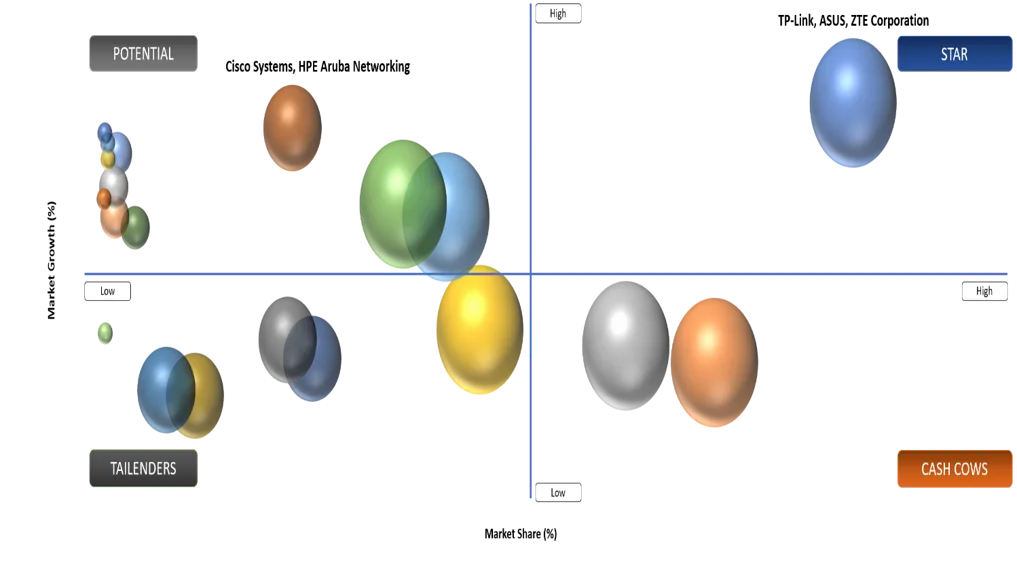
STAR
TP-Link, ASUS, ZTE Corporation and Huawei Technologies are classified as Stars in the Wi-Fi 8 devices market because of their solid networking credentials and active commercialization. Both TP-Link and ASUS have been working on the development of Wi-Fi 8 routers and mesh systems, whereas ZTE and Huawei utilize their broadband CPE, fiber, FWA and telecommunication strengths to support Wi-Fi 8 implementation. Such classification is reinforced by the fact that all of them have integrated Ultra High Reliability, Multi-AP Coordination, multi-gigabit connectivity, AI-based optimization and advanced broadband connectivity into their networking solutions.
POTENTIAL
Cisco Systems, HPE Aruba Networking, NETGEAR, Ubiquiti, Xiaomi and D-Link are categorized as Potential firms on account of their strong presence in enterprise WLANs, consumer networking and connected device ecosystems, along with the scope to diversify into Wi-Fi 8 as it develops. Their current customer base, marketing abilities and additional wired-networking product lines act as a starting point for future adoption. The growth opportunities are especially large in enterprise access points, premium routers, mesh networks, gateways, multi-gigabit networks and AI-based wireless management solutions.
Wi-Fi 8 Devices Market Dynamics
Driver Impact Analysis
| Driver | Market Growth Impact (%) | Demand Concentration | Impacted Use Case | Strategic Impact |
| Ultra-High-Reliability Connectivity Demand | 28% | Enterprise & High-Density Networks | Enterprise WLAN, Smart Buildings | Prioritize consistent low-latency performance and connection reliability |
| Multi-AP Coordination Adoption | 25% | Enterprise & Large Residential Networks | Mesh Networking, Campus Connectivity | Invest in coordinated access-point and network-management architectures |
| Multi-Gigabit Broadband Expansion | 24% | North America, Europe & Asia-Pacific | Fiber Gateways, 5G/FWA | Develop Wi-Fi 8 gateways optimized for high-capacity broadban |
| Growth of AI-Intensive Connected Applications | 23% | Enterprise, Industrial & Consumer Electronics | AI PCs, Robotics, IoT | Integrate intelligent network optimization and low-latency connectivity capabilities |
Driver: Growing Demand for Ultra-High-Reliability Connectivity
A strong demand for high-reliability and low-latency wireless connectivity in dense and high-performance scenarios has been one of the key factors fueling the growth of the Wi-Fi 8 devices market. In contrast to earlier generations of Wi-Fi that have concentrated more on providing high data rates, Wi-Fi 8 will concentrate on providing Ultra High Reliability (UHR) through techniques like Multi-AP Coordination, spatial reuse coordination, better roaming capabilities and better interference resilience. This has been contributing to the rise in the appeal of Wi-Fi 8 routers, mesh systems, access points and gateways for high-density workplaces, smart homes, industries and multi-device networking.
Restraint Impact Analysis
| Restraint | Drag on Market Growth (%) | Primary Impact Area | Impacted Use Case | Strategic Impact |
| Immature Wi-Fi 8 Ecosystem and Standardization | 30% | Product Launch & Adoption Timing | Routers, Mesh Systems, Enterprise APs | Align product roadmaps with evolving IEEE 802.11bn specifications |
| High Initial Device and Upgrade Costs | 27% | Consumer & Enterprise Adoption | Premium Routers, Mesh Networks | Develop cost-optimized platforms and tiered product portfolios |
| Limited Wi-Fi 8 Client-Device Availability | 23% | Ecosystem Interoperability | Smartphones, PCs, IoT Devices | Build backward-compatible products and accelerate ecosystem partnerships |
| Regional Spectrum and Certification Differences | 20% | Market Expansion & Compliance | 6 GHz Wi-Fi Equipment | Localize device configurations and certification strategies by region |
Restraint: Limited Ecosystem Maturity and High Upgrade Costs
Limited maturity in the ecosystem of Wi-Fi 8-compatible devices is another significant limitation, since compatible routers, access points, gateways and clients are just coming to the market as IEEE 802.11bn matures. Limited availability of end-to-end compatible devices is likely to diminish the value proposition for purchasers, as an upgrade from the currently existing Wi-Fi 6/6E or Wi-Fi 7 network will necessitate upgrading many different devices within the network and client sides. This will create an entry barrier for those who have purchased relatively recent wireless network infrastructures, potentially slowing broader Wi-Fi 8 device adoption.
Wi-Fi 8 Devices Market Segment Analysis
The global Wi-Fi 8 devices market is segmented based on the device type, band configuration, deployment, application, price tier, connectivity / backhaul, channel bandwidth and region.
By Device Type
Wi-Fi 8 Routers Establish Early Market Leadership
Wi-Fi 8 routers are expected to hold around 43.0% share in the market in 2025, thus emerging as the dominant device category in the initial stages of their commercialization. The market demand will be driven by high-end residential broadband, multi-gigabit fiber connectivity, gaming, small business use cases, which require UHR, Multi-AP Coordination, 10G Ethernet capabilities and congestion management.
By Band configuration
Wi-Fi 8 Mesh Systems Accelerate Wi-Fi 8 Growth
Wi-Fi 8 mesh devices are predicted to have the highest CAGR of 120.0%, between 2026 and 2035. The growth in Wi-Fi 8 mesh devices is attributed to its capability of coordinating multiple access points, ensuring high reliability for roaming and backhauls as well as maintaining good performance in areas that are prone to congestion and performance limitations within conventional mesh networks.
Wi-Fi 8 Devices Market Geographical Penetration
U.S. Wi-Fi 8 Devices Market Landscape
U.S. Wi-Fi 8 devices market is one of the foremost early adopter markets, owing to its advanced enterprise networking infrastructure, availability of multi-gigabit broadband and having key Wi-Fi 8 technologies providers, such as Qualcomm and Broadcom. During 2026, Qualcomm rolled out Wi-Fi 8 platforms for applications such as home routers, mesh, enterprise access points, 10G fiber gateways and FWA (Fixed Wireless Access), whereas Broadcom rolled out Wi-Fi 8 platforms for use-cases such as residential networking, enterprise access points and broadband infrastructure. These developments put the United States well positioned for the earliest demands for AI ready networks in enterprises, high-quality residential connectivity, multi-gigabit broadband connections and FWA, which will become more widespread as client devices and commercially available Wi-Fi 8 devices grow.
Japan Wi-Fi 8 Devices Market Outlook
Japan Wi-Fi 8 devices market offers opportunities for gradual adoption due to the advanced broadband network in Japan, the maturity of electronics ecosystem and the high demand for wireless connectivity. The Ministry of Internal Affairs and Communications of Japan is moving toward making improvements in technical and regulatory framework for the greater usage of 6 GHz WLAN and DFS in 5 GHz frequency band, thereby improving the spectrum environment. Additionally, the already existing Wi-Fi ecosystem and the consumer electronics market in Japan also drive the demand for next generation connectivity; the Wi-Fi chipset market in Japan was valued at US$ 449.7 million in 2025, reflecting the extent of the connectivity ecosystem in the country. The opportunities in Japan would be mainly through enterprise networking, industrial connectivity, premium networking in households and connected devices.
China Wi-Fi 8 Devices Market Trends
China’s Wi-Fi 8 devices market is poised for early commercialization, driven by the broad broadband customer base, networking devices production landscape and growing development of Wi-Fi 8-equipped CPE and networking solutions in China. Chinese players like ZTE are combining Wi-Fi 8 with 10G PON, AI-driven network optimization, seamless roaming and interference mitigation, while the ecosystem is transitioning towards Wi-Fi 8 routers, gateways, mesh devices and fixed wireless access devices. The market focus is increasingly on Ultra High Reliability, deterministic connections, AI-powered resource optimization and multi-gigabit fiber integration, with enterprise networks, premium residential broadband, smart homes and industrial connectivity as early adoption targets.
South Korea Wi-Fi 8 Devices Market Analysis
Wi-Fi 8 devices market in South Korea represents an opportunity for an early adopter due to the presence of a sophisticated infrastructure for semiconductors, consumer electronics, 5G and broadband in the country. Research from Samsung is aiding the IEEE 802.11bn standard development and its work on Wi-Fi 8 includes focus areas such as Ultra High Reliability, enhanced coverage, lower latency, seamless mobility and power efficiency. The 5G fixed wireless access platform that was released in May 2026 was jointly launched by Samsung Electronics and Broadcom, which integrated Samsung’s 5G modem chip and Broadcom’s Wi-Fi 8 SoC and was intended for mass-market FWA gateways and fiber-like broadband experience. These advancements set South Korea up for opportunities in premium residential networking, 5G/FWA gateways, enterprise networking, home automation and connected device markets as Wi-Fi 8 approaches commercialization.
Germany Wi-Fi 8 Devices Market Projection
The German market for Wi-Fi 8 devices is forecasted to grow gradually with enterprise, industrial and premium residential adoption driven by Germany’s developed broadband network, industrialization and WLAN eco-system. The availability of the 6 GHz spectrum in the country offers increased bandwidth capabilities for WLAN applications, while discussions within the regulatory authorities on future spectrum coordination may play an important role for future developments of Wi-Fi. With the advancement of Wi-Fi 8 towards standardization, the demand for the technology is anticipated to be driven by enterprise access points, multi-AP coordination, industrial communication, premium mesh systems and fiber gateways, where ultra high reliability, interference resilience, seamless roaming and consistent performance are key differentiators.
Wi-Fi 8 Devices Market Competitive Landscape
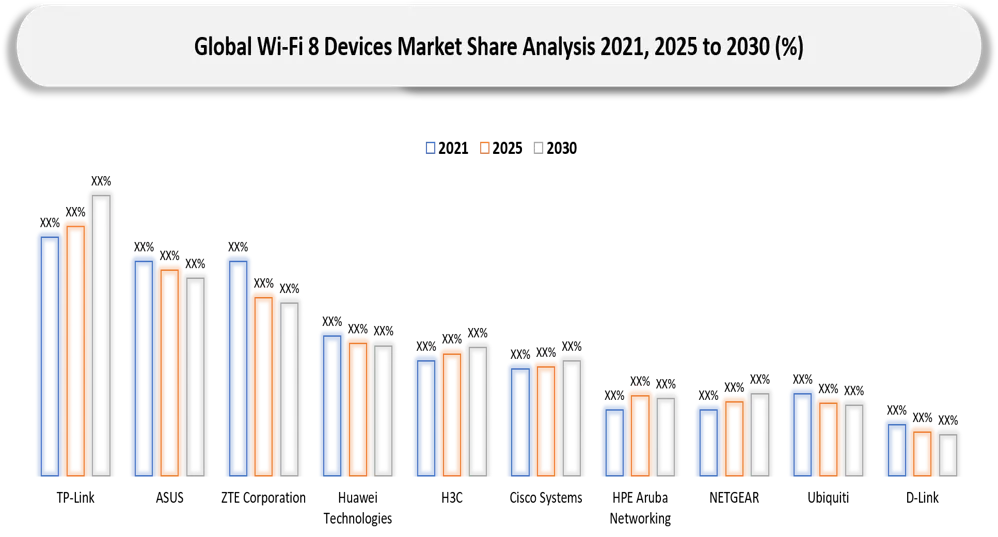
- Commercialization of Wi-Fi 8 technology is influencing positioning of companies with TP-Link and ASUS working on commercial Wi-Fi 8 consumer routers and mesh devices, while ZTE is focusing on Wi-Fi 8 broadband CPEs as IEEE 802.11bn continues to evolve.
- UHR and Multi-AP Coordination are becoming the key differentiators, moving the competition away from pure peak throughput performance to focus on reliability, coordinated spectrum usage, interference robustness, seamless roaming and latency consistency.
- Integration with broadband technologies creates a unique competitive landscape as ZTE and Huawei introduce Wi-Fi 8 integrated with 10G PON, multi-Gigabit Ethernet and 5G/FWA gateways.
- Competitive edge is provided by network-level intelligence, with Cisco and HPE Aruba poised to integrate next-gen Wi-Fi infrastructure with unified management, AI-powered optimization, security and high-density WLAN functionality.
- Breadth of portfolio and reach of the ecosystem are set to define leadership in the future, as vendors that can link routers, access points, mesh nodes, gateways and clients and retain backward compatibility are set to benefit from the switch from Wi-Fi 6/6E to Wi-Fi 7.
Public Company Q1-Q2 2026 Performance Comparison
The following table provides a comparison of five publicly listed companies with business exposure to the
Wi-Fi 8 devices market. Financial parameters are stated on a company basis, while Wi-Fi 8 exposure and operating indicators are presented where publicly disclosed.
| Company | Q1–Q2 2026 Performance | Wi-Fi 8 Devices Exposure | Key Performance Driver |
| ASUS | US$14.7 billion H1 2026 revenue, with net income after tax of approximately US$1.0 billion. | High - Wi-Fi 8 routers and mesh systems, including the ROG Rapture GT-BN98. | Premium gaming, AI-ready computing, PCs and next-generation networking products. |
| ZTE Corporation | US$11.6 billion H1 2026 revenue, up 9.0% YoY; computing revenue increased more than 55%. | High - Wi-Fi 8 broadband CPE, XGS-PON gateways and 5G/FWA solutions. | AI infrastructure, fiber broadband, FWA and convergence of optical access with intelligent Wi-Fi. |
| Cisco Systems | US$30.2 billion Q1–Q2 FY2026 revenue (Q1: US$14.9B; Q2: US$15.3B). | Medium to High - Enterprise WLAN, access points and next-generation wireless infrastructure. | Enterprise networking refresh, AI infrastructure, campus networking and high-density WLAN deployments. |
| NETGEAR | US$327.4 million H1 2026 revenue, with enterprise revenue increasing to approximately US$172.8 million. | Medium - Consumer and business networking portfolio positioned for Wi-Fi 8 transition. | Enterprise networking, ProAV, higher-margin networking products and subscription services. |
| Xiaomi | US$31.0 billion H1 2026 revenue, down 8.4% YoY. | Medium - Large smartphone, smart-home, IoT and connected-device ecosystem supporting future Wi-Fi 8 client adoption. | AIoT ecosystem expansion, smartphones, connected devices and AI-enabled smart-home products. |
Note: Financial periods and fiscal calendars differ across companies. Company-level revenue should not be interpreted as Wi-Fi 8 device revenue unless separately disclosed. Wi-Fi 8 exposure is assessed based on publicly announced products, networking portfolios, commercialization activity and ecosystem positioning.
Key Companies of Wi-Fi 8 Devices Market
- TP-Link (China)
- ASUS (Taiwan)
- NETGEAR (United States)
- ZTE Corporation (China)
- Huawei Technologies (China)
- Zyxel Networks (Taiwan)
- H3C (China)
- Cisco Systems (United States)
- HPE Aruba Networking (United States)
- CommScope / Ruckus Networks (United States)
- Ubiquiti (United States)
- D-Link (Taiwan)
- Xiaomi (China)
- Tenda (China)
- Ruijie Networks (China)
- FiberHome Technologies (China)
- Nokia (Finland)
- Sercomm (Taiwan)
- Arcadyan Technology (Taiwan)
- Sagemcom (France)
Company Profiles
TP-Link
TP-Link is a well-known networking hardware provider and one of the first players in the commercialization of Wi-Fi 8 consumer networking products. The company’s product line features Wi-Fi 8 routers and mesh access points based on high aggregated throughput, multi-gigabit wired interface, high device capacity and enhanced whole-home coverage.
Competitive priorities for the company are the expansion of the product lines of Wi-Fi 8 routers and mesh APs, development of UHR functionality at affordable prices, support of multi-gigabit Ethernet, whole-home reliability and early leadership in the emerging Wi-Fi 8 consumer ecosystem.
ASUS
ASUS is one of the top companies manufacturing consumer electronics and networking equipment, with Wi-Fi 8 capabilities in its premium gaming routers lineup. It recently unveiled the ROG Rapture GT-BN98 Wi-Fi 8 router aimed at gaming and high throughput applications requiring low-latency capabilities for Wi-Fi connections.
Priorities of the competitor include creating differentiation in the area of gaming capabilities providing low-latency performance on Wi-Fi 8; extending premium router and mesh products; implementing multi-gigabit connectivity; and using its ecosystem in the PC and gaming industries.
ZTE Corporation
ZTE is a telecom equipment manufacturer with a significant presence in Wi-Fi 8 gateways and operator-grade customer premises equipment. ZTE's Wi-Fi 8 plan includes next generation connectivity along with 10G PON, 5G FWA, AI-enabled networking and smart home connectivity and therefore is situated in the convergence of broadband connectivity and Wi-Fi.
Key competitors would include ensuring operator deployment of technology, integration of Wi-Fi 8 with fiber and FWA gateways, AI-enabled network management, development of high capacity CPE systems and leveraging its telecom partnerships for Wi-Fi 8 device traction.
Huawei Technologies
Huawei is one of the key players in the telecoms and networking gear manufacturing space with exposure to home networks, enterprise Wi-Fi, broadband CPE and next generation wireless network infrastructure. The Wi-Fi 8 play from Huawei is driven by the need for high-reliability networking, coordination, multi-gigabit broadband and intelligent wireless network management.
Competitive strategy includes combining Wi-Fi 8 with fiber access and enterprise infrastructure, enhancing performance of coordinated multi-AP technology, intelligent home networking products and utilizing telecoms/enterprise customer base.
Cisco Systems
Cisco is one of the most prominent enterprise network equipment manufacturers having substantial exposure to wireless LAN infrastructure, access points, campus networks and high density enterprises. The company’s Wi-Fi 8 opportunity largely consists of moving to ultra high reliability, multi-AP coordination, seamless mobility and AI network management.
Key areas of competition for Cisco include retaining its leadership in enterprise WLANs, incorporating next generation wireless with switching and network management platforms, enhancing AI network optimization and high density campus & performance-sensitive enterprises.
HPE Aruba Networking
HPE Aruba Networking is one of the leading providers of wireless enterprise networking with advanced capabilities in access-points, WLAN management and network infrastructure. The Wi-Fi 8 offering is particularly relevant for the areas where network reliability, coordination among access points and performance are especially important.
Some competitive priorities are development of high density next generation access points, better AI based network management, combination of wired and wireless technologies and enterprise campuses as well as industrial buildings and complicated WLAN setups.
NETGEAR
NETGEAR is a networking device company that operates extensively in the consumer, gaming, SMB and professional networking sectors. The Wi-Fi 8 growth for NETGEAR is related to the move to more stable and intelligent wireless connections, especially in premium consumer, gaming and SMB settings.
Competitive considerations include growing the Wi-Fi 8 router and mesh system lines, optimizing gaming and low-latency features, adding AI-driven network management, boosting multi-gigabit wired connectivity and rolling out next-gen wireless functionality to additional consumer and SMB segments.
Xiaomi
Xiaomi’s consumer electronics and smart home ecosystem includes products such as smartphones, routers, IoT and smart home products. Xiaomi’s Wi-Fi 8 opportunity is especially critical due to the fact that the next generation connectivity can be utilized not only within the network infrastructure but also throughout an entire ecosystem of connected devices.
The competitive priorities for Xiaomi include Wi-Fi 8 integration within the smart home/IoT ecosystems, developing high-end performance home routers/mesh networks, enhancing connectivity between devices and utilizing the broad portfolio of its consumer hardware.
Ubiquiti
Ubiquiti offers networking products for enterprise, small and medium business (SMB), residential and professional markets, which include access points, gateways, switches and managed wireless solutions. The positioning of Ubiquiti offers an opportunity to serve Wi-Fi 8 deployments, where the need for coordination of coverage, centralized management, density of connections and multi-gigabit wired infrastructure is critical.
Competitive priorities involve leveraging its next generation wireless capabilities on its networking offerings, incorporating Wi-Fi 8 along with multi-gigabit switching and gateways, centralization of network management and high-density installations.
D-Link
D-Link is a leading network device company that offers a wide range of devices including routers, mesh networks, access points, gateways and other connectivity devices to both consumers and SMBs. The Wi-Fi 8 growth opportunity at D-Link relates to the upgrading of current Wi-Fi technology for improved reliability and performance.
Competitive priorities will be related to creating effective Wi-Fi 8 routers and mesh systems, expanding the UHR offerings from just premium devices, adding higher speed Ethernet and keeping prices competitive as Wi-Fi 8 advances through its adoption process.
Wi-Fi 8 Devices Market Major Pain Points
- Incomplete IEEE 802.11bn Standardization: The evolving nature of the standards means that there is uncertainty with regard to features, certification, compatibility and the product roadmap.
- Limited Wi-Fi 8 Client-Device Availability: Initial networking hardware will provide minimal value until client devices such as smartphones, PCs, IoT devices and other endpoint devices become widely available.
- Multi-AP Coordination Complexity: There are challenges with respect to coordinated beamforming, spatial reuse and network coordination.
- High Infrastructure Upgrade Requirements: Full implementation of WiFi 8 features may entail upgrade needs for routers, mesh nodes, gateways, access points, wired backhaul and client devices.
- Unclear Near-Term ROI: Features such as reliability, consistent latency and resistance to interference may not be as easy to measure compared to speed enhancements.
Wi-Fi 8 Devices Market Recent Developments
- August 2026 - TP-Link has introduced the first Wi-Fi 8 product series in the form of Archer 8 Ultra router and Deco 8 Ultra mesh networking system. The devices focus on Ultra High Reliability, Multi-AP Coordination, multi-gigabit connection and increased performance during network congestion.
- June 2026 - The Wi-Fi 8 access point from H3C called WA8648 was released, which combined native Wi-Fi 8, AI algorithms, spatial reuse, dynamic spectrum scheduling and Multi-AP Collaboration for use in high-density enterprise and industrial settings.
- June 2026 - The Wi-Fi 8-based WA8648 from H3C won a Best of Show Award runner-up at Interop Tokyo 2026 owing to the Wi-Fi 8 technology, including Multi-AP Collaboration, seamless roaming and mobility and improved reliability in challenging wireless networks.
- June 2026 - ASUS released the Wi-Fi 8-based networking solutions, such as the ROG Rapture GT-BN98 Pro router and ZenWiFi BN12 mesh network system, focusing on gaming with low latency and high-density connectivity.
- June 2026 - Wi-Fi 8 platforms from MediaTek gained prominence at COMPUTEX 2026; the company’s Filogic 8000 platform was given the Best Choice Gold Award and Filogic 8800 was noted for AI-powered Wi-Fi 8 networking. This step has augmented the device ecosystem foundation for Wi-Fi 8.
Analyst View / Opinion on Wi-Fi 8 Devices Market
- Wi-Fi 8 will be redefining the Wi-Fi refresh cycle with Ultra High Reliability (UHR), changing the focus of the competitive landscape from maximum throughput to reliability, low and predictable latency, interference tolerance and performance under congestion.
- Multi-AP Coordination is likely to play a significant architectural role, especially when it comes to the enterprise WLANs, large mesh deployments and dense environments where coordination of spectrum usage can bring improvements to overall network performance.
- The commercialization of the technology prior to its completion in IEEE 802.11bn poses a challenge for vendors who must deal with the risk as well as an opportunity since they get a chance to build product ecosystems.
- Fiber technology of 10G class and FWA gateways present one of the most critical routes of commercialization, which would allow Wi-Fi 8 to act as a high-speed wireless layer for next generation broadband infrastructure and not as an upgrade router.
- AI-enabled network optimization will be a critical distinguishing factor in Wi-Fi 8 products, especially regarding intelligent traffic steering, interference avoidance, channel and resource optimization, QoS aware of applications and performance management.
Wi-Fi 8 Devices Market Target Audience
| INDUSTRY | WHO SHOULD BUY THIS REPORT? | REASON TO BUY THIS REPORT |
| Networking Equipment | Wi-Fi 8 Router & Mesh System Manufacturers | Assess device demand, competitive positioning, product roadmapsand commercialization opportunities |
| Semiconductors | Wi-Fi 8 SoC, RF & Connectivity Chipset Vendors | Evaluate silicon demand, device applications, technology adoptionand OEM opportunities |
| Telecommunications | Broadband, Fiber & FWA Operators | Assess Wi-Fi 8 gateway opportunities and next-generation customer-premises equipment requirements |
| Enterprise Networking | Enterprise WLAN & Access Point Vendors | Identify demand for high-reliability, low-latencyand coordinated multi-AP infrastructure |
| Consumer Electronics | Smartphone, PC & Connected-Device Manufacturers | Evaluate Wi-Fi 8 client-device adoption, compatibility requirementsand ecosystem readiness |
| Industrial Technology | Industrial Wireless & Automation Solution Providers | Identify applications requiring reliable wireless connectivity, low latencyand interference resilience |
| Network Infrastructure | Ethernet Switch & Network Infrastructure Vendors | Assess opportunities to integrate Wi-Fi 8 access equipment with multi-gigabit wired infrastructure |
| System Integration | WLAN Integrators & Managed Network Service Providers | Plan Wi-Fi 8 deployment, network upgradesand high-density connectivity solutions |
| Electronics Manufacturing | ODMs, OEMs & Contract Manufacturers | Identify emerging device specifications, manufacturing opportunitiesand regional production requirements |
| Investment & Advisory | Investors, Technology Funds & Strategy Consultants | Evaluate market entry opportunities, competitive dynamics, investment themesand commercialization risks |
Why Choose DATAM?
- Data-Driven insights: Dive into detailed analyses with granular insights such as pricing, market shares and value chain evaluations, enriched by interviews with industry leaders and disruptors.
- Post-Purchase Support and Expert Analyst Consultations: As a valued client, gain direct access to our expert analysts for personalized advice and strategic guidance, tailored to your specific needs and challenges.
- White Papers and Case Studies: Benefit quarterly from our in-depth studies related to your purchased titles, tailored to refine your operational and marketing strategies for maximum impact.
- Annual Updates on Purchased Reports: As an existing customer, enjoy the privilege of annual updates to your reports, ensuring you stay abreast of the latest market insights and technological advancements. Terms and conditions apply.
- Specialized Focus on Emerging Markets: DataM differentiates itself by delivering in-depth, specialized insights specifically for emerging markets, rather than offering generalized geographic overviews. The approach equips our clients with a nuanced understanding and actionable intelligence that are essential for navigating and succeeding in high-growth regions.
- Value of DataM Reports: Our reports offer specialized insights tailored to the latest trends and specific business inquiries. The personalized approach provides a deeper, strategic perspective, ensuring you receive the precise information necessary to make informed decisions. The insights complement and go beyond what is typically available in generic databases.
What DATAM Uniquely Provides
- Device-Level Wi-Fi 8 Market Mapping: Identifies opportunities within the market for routers, mesh systems, access points, gateways, extenders and Wi-Fi 8-enabled clients.
- UHR Technology-to-Demand Analysis: Links the capabilities offered by Multi-AP Coordination, mobility, resistance to interference and others to device groups and their needs.
- Commercialization Readiness Assessment: Differentiates between product announcements and adoption, considering maturity of the IEEE 802.11bn standard and its certification schedules.
- Broadband Convergence Opportunity Mapping: Examines the potential of 10G PON, multi-gigabit Ethernet and 5G/FWA gateways to drive the adoption of Wi-Fi 8 deployment across residential and operator networks.
- AI-Driven Differentiation Analysis: Examines new opportunities in terms of AI-enabled traffic management, interference avoidance, resource management, application-aware QoS and network performance optimization.
Questions This Report Answers
- How will Ultra High Reliability (UHR), Multi-AP Coordination and seamless mobility reshape demand across routers, mesh systems, enterprise APs and gateways?
- Which device segments and application environments will achieve the earliest commercial adoption?
- How will the evolving IEEE 802.11bn standardization and certification timeline affect product launches, interoperability and market adoption?
- What role will 10G fiber, multi-gigabit Ethernet, 5G/FWA and coordinated wireless infrastructure play in accelerating deployment?
- How will vendors differentiate products through AI-assisted network optimization, interference management, reliability, latency consistency and power efficiency?


























































