

Waterless Direct-to-Chip Cooling Market Size and Overview
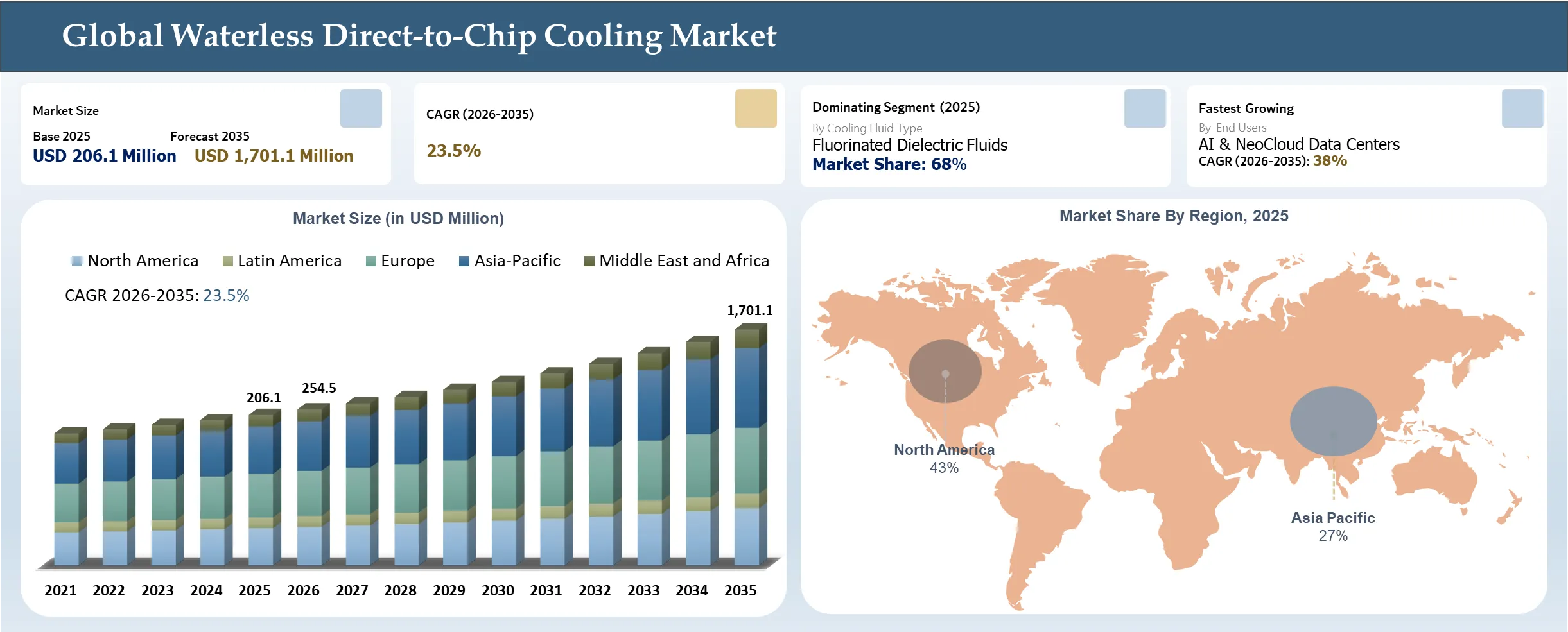
The global waterless direct-to-chip cooling market was valued at USD 206.1 million in 2025 and is projected to reach USD 1,701.1 million by 2035, growing at a CAGR of 23.5% from 2026 to 2035. Increasing thermal loads from AI accelerators, the commercialization of two-phase dielectric cooling systems, and growing investments in water-efficient data centre infrastructure are driving market expansion. In June 2026, ZutaCore secured a USD 100 million Series C funding round, backed by Mitsubishi Electric, Carrier Ventures and Samsung Ventures, to accelerate global commercialization and next-generation cooling development.
The company reported more than 75 deployments worldwide across the Americas, Europe, and Asia, along with cooling technology designed to support AI and HPC processors exceeding 4,000 watts. ZutaCore also established a 2 MW end-of-row testing platform in Israel to validate cooling performance and system integration at multi-megawatt scale. Manufacturers including ZutaCore, Accelsius and Mitsubishi Heavy Industries are advancing refrigerant-based cooling architectures to address higher processor heat loads and reduce water-related risks within IT infrastructure.
Waterless Direct-to-Chip Cooling Market Strategic Takeaways
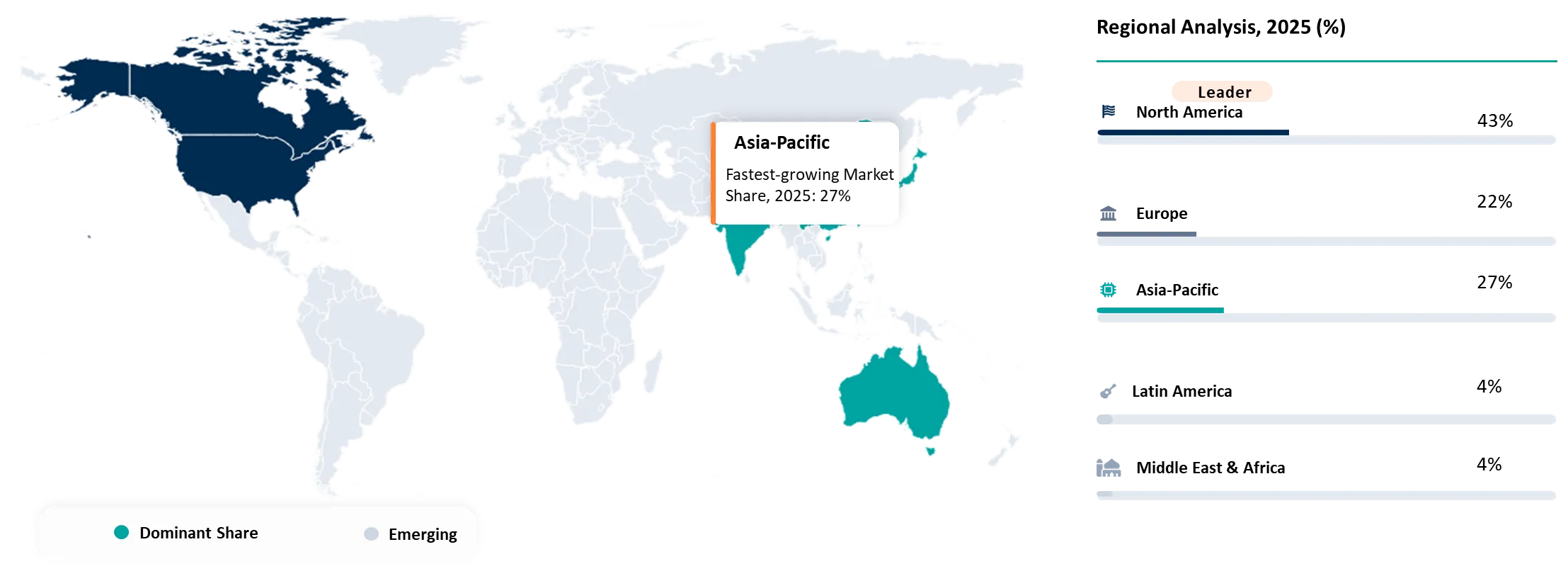
- North America dominates the global landscape, capturing the largest regional market share at 43% in 2025. This leadership is driven by massive AI infrastructure investments and hyperscale data center deployments across the United States and Canada.
- According to Carrier Global Corporation, the overall global data center cooling market is projected to reach USD 20 billion by 2029. Within this broader sector, liquid cooling solutions are expected to register an aggressive 39% CAGR over the same timeframe.
- Regulatory compliance challenges intensified in August 2025 when the European Chemicals Agency (ECHA) published an updated PFAS restriction proposal. This update followed the agency's evaluation of more than 5,600 scientific and technical comments submitted during its consultation process.
- Increasing PFAS regulatory scrutiny restricting fluorinated dielectric fluids acts as the primary market restraint, creating a 32% drag on growth. Complex refrigerant flow management across high-density AI racks poses the second-largest barrier, generating a 26% drag on market expansion.
Waterless Direct-to-Chip Cooling Market Trends & Disruptions Impacting Customers
The waterless direct-to-chip cooling market is witnessing a growing shift toward ultra-thin cold plate designs as AI server manufacturers seek to accommodate higher GPU densities without compromising thermal performance. The disruption in the waterless direct-to-chip cooling market is increasingly associated with the development of unified two-phase cooling architectures that challenge conventional data center cooling infrastructure. Traditional liquid cooling systems depend on separate cooling distribution units (CDUs), facility water loops and heat exchangers, increasing infrastructure complexity and installation requirements.
In November 2026, ZutaCore and Munters introduced the Z₂O cooling architecture, integrating two-phase dielectric direct-to-chip cooling with rooftop dry heat rejection. The system's reference design reported an annualized partial Power Usage Effectiveness (pPUE) of 1.03 and approximately 74% lower cooling energy consumption compared with a high-efficiency chilled-water reference design, indicating the potential to significantly reduce cooling infrastructure requirements.
Waterless Direct-to-Chip Cooling Market Dynamics
Driver Impact Analysis
| Driver | Market Growth Impact (%) |
Growing Investments by HVAC Giants Accelerating Commercialization of Waterless Direct-to-Chip Cooling | 24% |
Growing Deployment of High-Density AI Racks Accelerating Integrated Two-Phase Cooling Adoption | 38% |
Increasing Demand for Simplified Cooling Infrastructure Driving Adoption of Unified Two-Phase Architectures | 28% |
Growing Investments by HVAC Giants Accelerating Commercialization of Waterless Direct-to-Chip Cooling
Increasing investments by established HVAC manufacturers are strengthening the commercialization prospects of waterless direct-to-chip cooling as AI data centers demand higher-capacity thermal management systems. In February 2025, Carrier Global Corporation announced an investment and technology partnership with ZutaCore, targeting next-generation two-phase direct-to-chip cooling systems. According to Carrier Global Corporation, the global data center cooling market is projected to reach USD 20 billion by 2029, while liquid cooling is expected to register a 39% CAGR over the same period.
Restraint Impact Analysis
| Restraint | Drag on Market Growth (%) |
Increasing PFAS Regulatory Scrutiny Restricting Adoption of Fluorinated Dielectric Cooling Fluids | 32% |
Complex Refrigerant Flow Management Across High-Density AI Racks Constraining System Scalability | 26% |
Increasing PFAS Regulatory Scrutiny Restricting Adoption of Fluorinated Dielectric Cooling Fluids
Increasing regulatory scrutiny of per- and polyfluoroalkyl substances (PFAS) is creating significant challenges for the commercialization of waterless direct-to-chip cooling systems that rely on fluorinated dielectric fluids. These fluids are used in certain two-phase cooling architectures because of their electrical insulation properties, controlled boiling temperatures and ability to remove heat through phase change. However, concerns surrounding environmental persistence, emissions and end-of-life disposal are increasing compliance uncertainty for cooling equipment manufacturers and data center operators. In August 2025, the European Chemicals Agency (ECHA) published an updated PFAS restriction proposal following the evaluation of more than 5,600 scientific and technical comments submitted during the consultation process.
Waterless Direct-to-Chip Cooling Market: Commercial Use Cases Across Industries
| COMPANY | USE CASE | BENEFITS |

| ZutaCore's waterless, two-phase direct-to-chip cooling technology is used in AI data centers and high-performance computing (HPC) facilities to manage the increasing heat generated by high-power CPUs and GPUs. Its HyperCool and Z₂O solutions support high-density computing infrastructure through direct chip-level heat removal without relying on conventional water-based cooling systems. | Improves processor thermal management, reduces water consumption, prevents performance loss caused by overheating, supports higher computing density, and reduces cooling infrastructure complexity and energy requirements. |

| Accelsius deploys its NeuCool two-phase direct-to-chip cooling technology in AI data centers and mission-critical computing facilities to manage heat from next-generation GPUs and high-performance processors. The system is designed for high-density server racks and can be retrofitted into existing data centers, with waterless cooling configurations available. | Enables efficient heat removal from high-power processors, supports higher rack power densities, reduces cooling operating costs, minimizes water-related leakage risks to electronic components, and facilitates data center expansion without major infrastructure reconstruction. |
Market Ecosystem
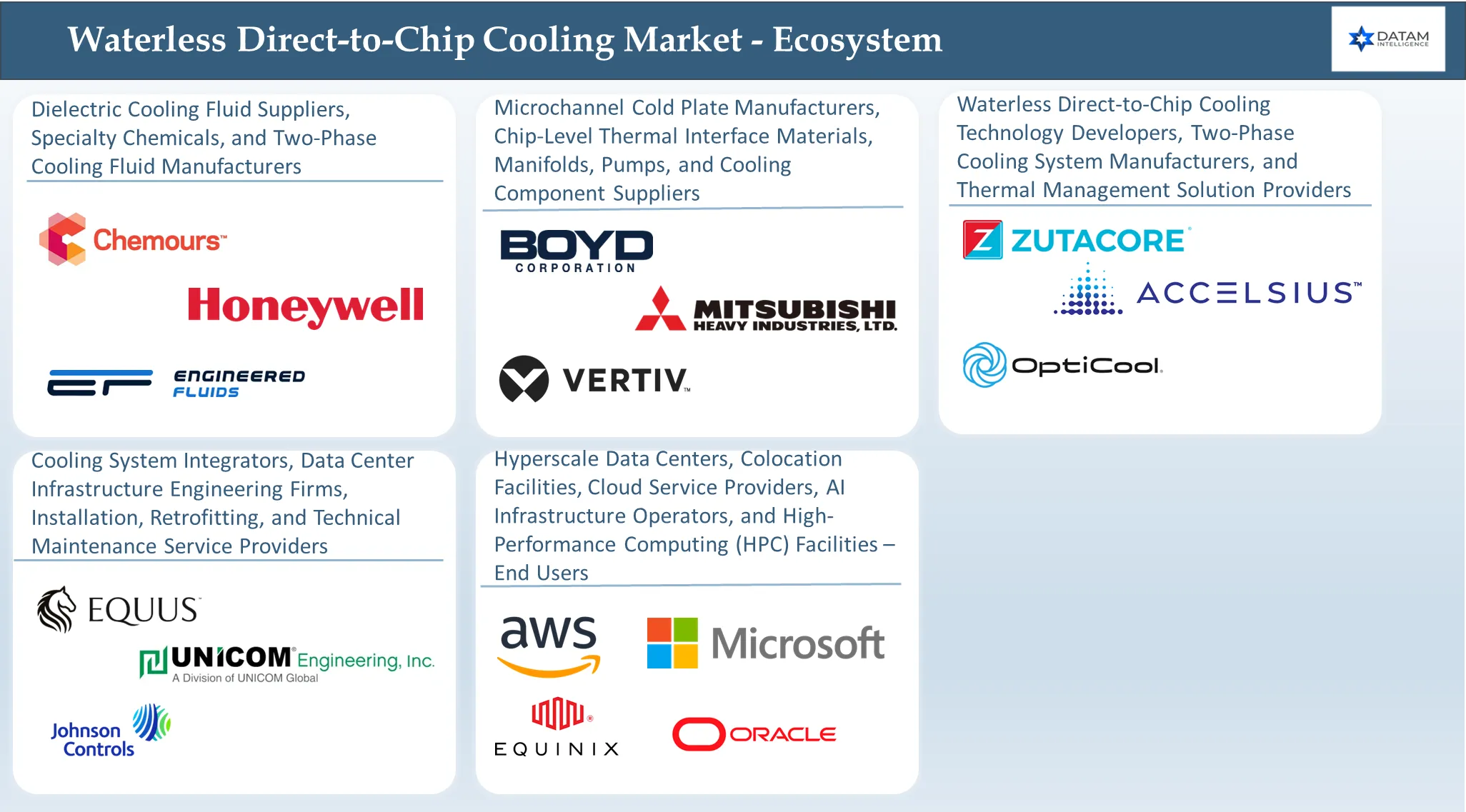
The waterless direct-to-chip cooling market is a collaborative ecosystem where cooling technology developers, component manufacturers, data center infrastructure providers, engineering firms, and end users work together to develop and deploy advanced chip-cooling solutions. Companies such as ZutaCore and Accelsius supply specialized two-phase, dielectric-fluid-based direct-to-chip cooling technologies designed to remove heat directly from high-performance CPUs and GPUs without using water as the cooling medium. Specialized component suppliers provide dielectric fluids, cold plates, manifolds, pumps, heat exchangers, and thermal management components required for cooling system operations.
Engineering, procurement, and construction firms, along with data center infrastructure integrators and installation contractors across North America, Europe, Asia Pacific, and the Middle East & Africa, support system design, integration, retrofitting, and commissioning. Ultimately, hyperscale data center operators, cloud service providers, artificial intelligence infrastructure developers, high-performance computing facilities, and enterprise data centers utilize waterless direct-to-chip cooling solutions to manage increasing processor heat loads.
Waterless Direct-to-Chip Cooling Market Segment Analysis
Waterless Direct-to-Chip Cooling Market Geographical Penetration
Strong AI Infrastructure Investments and Advanced Thermal Management Adoption in North America
North America dominates the waterless direct-to-chip cooling market, accounting for 43% of the global market share in 2025, supported by the strong presence of hyperscale data center operators, AI infrastructure developers, cloud service providers, and advanced cooling technology manufacturers across the United States and Canada. The region benefits from substantial investments in AI computing infrastructure, increasing GPU deployment, and the growing requirement for high-density server cooling solutions.
The expansion of large-scale data centers and increasing processor thermal loads are accelerating the adoption of two-phase dielectric and refrigerant-based direct-to-chip cooling technologies. For example, in November 2025, Accelsius, a U.S.-based company, announced an agreement with DarkNX to deploy its NeuCool two-phase direct-to-chip cooling technology across a planned 300 MW AI data center campus in Ontario, Canada, with the initial deployment covering two facilities totaling 65 MW and installations scheduled for 2026 and 2027.
Waterless Direct-to-Chip Cooling Market BCG Matrix: Company Evaluation
ZutaCore, recognized as a leading technology player in the waterless direct-to-chip cooling market, offers advanced two-phase dielectric cooling solutions, including its HyperCool technology, designed to remove heat directly from high-performance CPUs and GPUs. The company focuses on AI data centers, hyperscale computing facilities, and high-performance computing applications that require efficient thermal management for high-density server infrastructure.
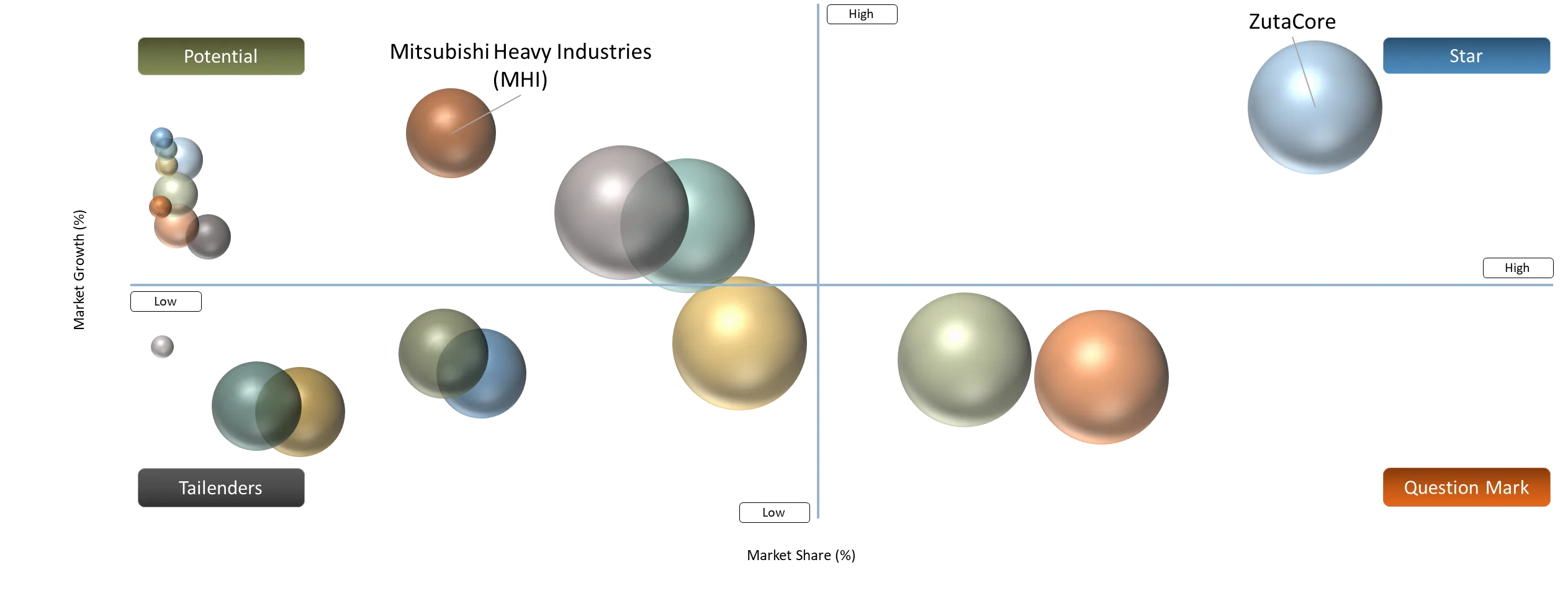
Another significant player in the market is Mitsubishi Heavy Industries (MHI), identified as a potential emerging competitor. The company is strengthening its position through the development of two-phase direct-to-chip cooling technologies using dielectric refrigerants and specialized cooling components. Leveraging its established engineering expertise, thermal management capabilities, and industrial cooling experience, MHI is targeting the growing demand for efficient cooling solutions across AI data centers and high-performance computing infrastructure.
Waterless Direct-to-Chip Cooling Market Competitive Landscape
Key Market Players
- ZutaCore (United States)
- Accelsius (United States)
- Mitsubishi Heavy Industries (Japan)
- OptiCool Technologies (United States)
Waterless Direct-to-Chip Cooling Market Scope
| Metrics | Details |
| 2025 Market Size | USD 206.1 Million |
| 2035 Projected Market Size | USD 1,701.1 Million |
| CAGR (2026-2035) | 23.5% |
| Years Considered | 2025 - 2035 |
| Base Year | 2025 |
| Forecast Period | 2025 - 2035 |
| Units Considered | Value (USD Million) |
| Report Insights Covered | Competitive Landscape Analysis, Company Profile Analysis, Market Size, Share, Growth |
| Segments Covered |
|
| Region Covered | North America, Europe, Asia-Pacific, Latin America, Middle East and Africa |
Waterless Direct-to-Chip Cooling Market: Target Audience and Strategic Intelligence Requirements
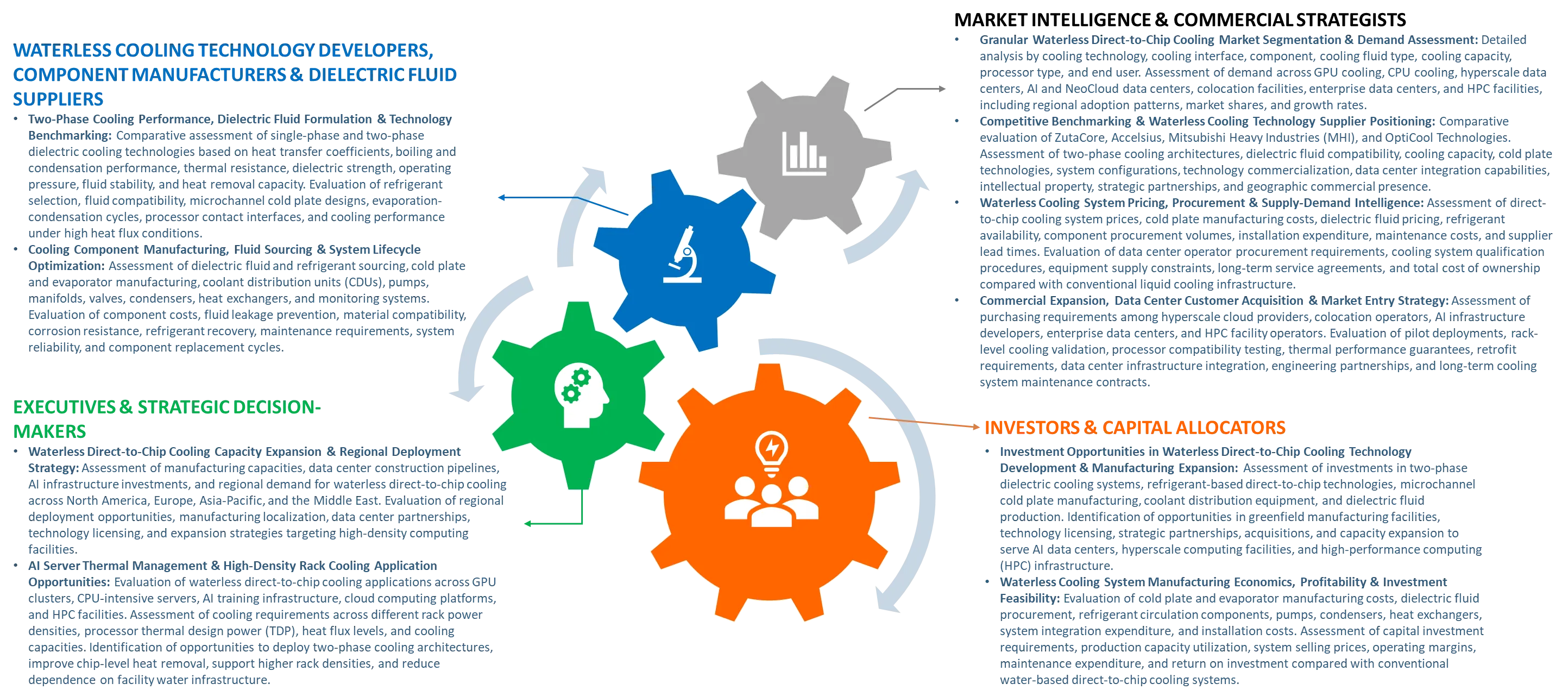
Addressing Client Priorities Through Customized Waterless Direct-to-Chip Cooling Research
CLIENT REQUIREMENT | RESEARCH CUSTOMIZATION PROVIDED | STRATEGIC VALUE TO CLIENTS |
Evaluating the commercial feasibility of waterless direct-to-chip cooling for high-density AI data centers | Assessed the technical and economic suitability of two-phase dielectric direct-to-chip cooling across GPU-intensive servers, AI training clusters, and high-performance computing facilities. Compared cooling capacity, heat removal performance, rack power density compatibility, infrastructure requirements, and installation costs against conventional water-based liquid cooling systems. | Enables clients to identify viable deployment scenarios, estimate cooling infrastructure expenditure, assess potential operating cost savings, and prioritize data center projects requiring high-density thermal management without facility water dependence. |
Understanding rack-level cooling requirements and system integration challenges | Assessed cooling requirements by processor type, rack power density, cooling capacity, heat flux, server architecture, and data center configuration. Examined retrofit compatibility, CDU integration, facility heat rejection requirements, refrigerant circulation, monitoring systems, and commissioning needs. | Helps clients optimize system design, improve server compatibility, reduce deployment complexity, and determine the technical requirements for integrating waterless direct-to-chip cooling into new and existing data centers. |
Key Developments
- April 2026: Carrier Global Corporation (United States), an HVAC and thermal management solutions manufacturer, expanded its investment in ZutaCore (United States), a waterless direct-to-chip cooling technology developer, to strengthen its liquid cooling capabilities for high-density AI data centers. ZutaCore's HyperCool technology uses a closed-loop, two-phase cooling system to remove heat directly from processors. The expanded strategic partnership builds on Carrier's 2025 investment and supports the integration of single-phase and two-phase cooling technologies into Carrier's QuantumLeap portfolio.
- October 2026: ZutaCore (United States), a waterless direct-to-chip cooling technology developer, unveiled its Two-Phase Matrix Flow Boiling technology within its OmniTherm cold plate portfolio at OCP Global Summit 2026. The technology combines pool boiling stability with flow-boiling scalability to maintain uniform temperatures across high-power AI processors. Its cold plates are as thin as 11.6 mm and weigh as little as 300 grams, supporting high-density GPU configurations. Deployments for NVIDIA RTX PRO 6000 Blackwell Server Edition GPUs were underway in the launch quarter.
- November 2026: The Chemours Company (United States), a specialty chemicals and thermal management solutions manufacturer, launched its Faizeon portfolio of two-phase cooling fluids for AI and HPC data centers. The portfolio includes Faizeon 100, 110, 200, and 220 for direct-to-chip cooling. Independent testing showed that Faizeon 200 maintained GPU temperatures up to 19°C lower than a single-phase, water-based cooling fluid while using a lower coolant flow rate.
- July 2026: Accelsius (United States), a two-phase direct-to-chip cooling technology developer, announced independent benchmark results for its NeuCool platform using NVIDIA B200 GPU servers. Third-party testing across approximately 40,000 operating points demonstrated 9°C lower GPU junction temperatures than conventional single-phase cooling under warm-water conditions, with the advantage increasing to 14°C at higher facility water flow rates.
- October 2026: Accelsius (United States), a two-phase direct-to-chip cooling technology developer, upgraded its Springdale laboratory to multi-megawatt testing capacity for validating its NeuCool cooling platform at megawatt-class AI rack densities. The company also announced an additional 18,000 sq. ft. laboratory expansion planned for January 2027 and a 375 kW-capable addition to its NeuCool multi-rack product family.
- April 2026: Accelsius (United States), a two-phase direct-to-chip cooling technology developer, announced the commercial availability of its NeuCool IR150, an integrated rack-level cooling system offering up to 150 kW of cooling capacity. The system combines a two-phase coolant distribution unit (CDU), 42U IT rack space, and integrated liquid and vapor manifolds. Accelsius also launched its NeuCool HyperStart program to help hyperscale data centers, neocloud providers, and technology partners validate two-phase cooling deployments.