


Virtual Clinical Trials Market Size & Growth
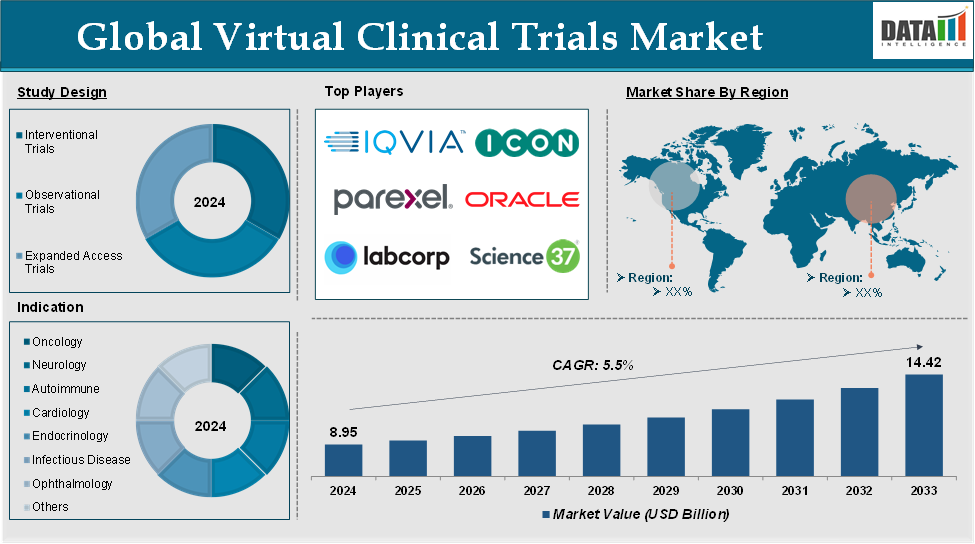
The Virtual Clinical Trials Market size was US$ 9.44 billion in 2025 and is expected to reach US$ 15.21 billion by 2033, growing at a CAGR of 5.5% during the forecast period 2026-2033.
Virtual clinical trials refer to clinical studies that are conducted remotely, leveraging digital technologies to collect data, monitor patients and manage trial procedures without the need for participants to visit a physical clinical site. These trials, also known as decentralized clinical trials (DCTs), are designed to make the clinical trial process more accessible, flexible, and patient-centered by utilizing a variety of digital tools, mobile apps, wearables, and telemedicine platforms.
The demand for virtual clinical trials has been growing rapidly, driven by various factors that improve the efficiency, cost-effectiveness and accessibility of clinical research. Traditional clinical trials often involve physical site visits, which can be time-consuming and burdensome for patients. Virtual clinical trials remove these barriers, offering patients the convenience of participating from their homes or local healthcare facilities.
For instance, the Science 37 platform, which focuses on virtual trials, has helped improve patient participation by making it easier for patients in remote or underserved locations to join trials. They reported significant growth in recruitment rates and participant retention due to the ability to reach broader patient populations.
Executive Summary
Virtual Clinical Trials Market Dynamics: Drivers & Restraints
Improved Data Accuracy and Real-Time Monitoring
The improved data accuracy and real-time monitoring are significantly driving the growth of the virtual clinical trials market and are expected to drive the market over the forecast period. Virtual clinical trials enable continuous and real-time data monitoring, such as vital signs, symptoms and medication adherence. This allows for more accurate tracking of patient health throughout the trial without delays or discrepancies that might occur with periodic in-person visits.
For instance, in Medable's platform, patients are equipped with wearables that monitor physiological data such as heart rate, oxygen levels, and physical activity. This data is transmitted to researchers in real time, enabling early detection of adverse events and faster decision-making. This level of monitoring helps ensure that data is both accurate and timely, reducing the reliance on self-reporting or retrospective data collection, which can be prone to errors.
Real-time monitoring fosters patient engagement by providing instant feedback to participants on their progress. This increases adherence to the trial protocol, especially in long-duration studies, as patients can be reminded to take medication or perform necessary activities through digital tools. For instance, in June 2024, Materna Medical launched a groundbreaking virtual clinical trial evaluating the treatment of vaginismus symptoms using the Milli Vaginal Dilator. This groundbreaking clinical investigation aims to gather valuable data on the effectiveness of the Milli Vaginal Dilator to help relieve the symptoms of vaginismus and related painful intercourse.
Data Privacy and Security Concerns
Data privacy and security concerns are significant challenges that can hamper the growth of the virtual clinical trials market. Since virtual clinical trials rely heavily on the collection, storage and transmission of sensitive patient data such as medical histories, personal identifiers and health metrics, there is an inherent risk related to data breaches, unauthorized access and non-compliance with data protection regulations.
Virtual clinical trials depend on digital platforms, wearables, and mobile applications that collect and transmit sensitive patient information. If these systems are not properly secured, they become vulnerable to cyberattacks, data breaches, or unauthorized access. For instance, a Colorado-based pathology laboratory is notifying more than 1.8 million patients that their sensitive information was compromised one of the largest breaches reported by a medical testing lab to US federal regulators, making the healthcare industry especially vulnerable to hackers.
Patients are often hesitant to share sensitive personal health data through digital platforms due to concerns over privacy and the potential misuse of their information. This mistrust can lead to lower enrollment rates and reduced participation in virtual trials, hindering the effectiveness of such trials. For instance, according to the HHS Cybersecurity Program, 630+ total healthcare organizational breaches and 29 million healthcare records were breached. This hesitation impacts recruitment and retention rates, which are essential to the success of any decentralized clinical trials.
Explore the Future of the Virtual Clinical Trials Market
Get a comprehensive sample report covering Virtual Clinical Trials market trends, technology advancements, competitive landscape, application insights, and growth opportunities. Request your sample today to understand the factors shaping the next generation of decentralized and patient-centric clinical research. Request Sample Report Today!
Virtual Clinical Trials Market Segmentation Analysis
The global virtual clinical trials market is segmented based on study design, indication, phase and region.
Growing Adoption of Remote and Patient-Centric Trial Models Supports the Interventional Trials Segment
The Interventional Trials segment represents a leading segment within the global virtual clinical trials market. Virtual and decentralized approaches are particularly relevant to interventional studies because digital platforms, telemedicine, remote patient monitoring, connected devices, and home-based services can support participant engagement and selected trial activities outside conventional research sites. Industry providers have reported extensive experience applying decentralized models to interventional clinical trials, reflecting the increasing integration of remote technologies into clinical research.
Reflecting this development, Science 37 continues to support decentralized and hybrid clinical research through its clinical trial platform, telemedicine investigators, mobile nurses, remote coordinators, patient communities, and connected devices. Its current platform supports studies across therapeutic areas including oncology, cardiovascular disease, central nervous system, infectious disease, endocrinology, and ophthalmology. This development demonstrates the expanding operational infrastructure available for conducting interventional studies through decentralized and patient-centric models.
Rising Need for Broader Patient Access and Remote Monitoring Accelerates the Oncology Segment
The Oncology segment is expected to dominate the global virtual clinical trials market by indication. Oncology research can benefit from decentralized approaches because patients may face substantial travel, treatment, and monitoring burdens, while sponsors often require access to geographically diverse patient populations.
In line with this trend, Medable introduced a digital oncology trial offering designed to support remote participation, patient-reported outcomes, digital data capture, and real-time oversight across cancer studies. Medable stated that its digital clinical trial platform is used in global cancer trials across all four research phases, highlighting the growing application of decentralized technologies in oncology research.
Virtual Clinical Trials Regional Market Analysis
North America Virtual Clinical Trials Market
North America represents a major market for virtual and decentralized clinical trial technologies, supported by established pharmaceutical and biotechnology research infrastructure, strong CRO capabilities, digital health adoption, and a progressively defined regulatory framework.
The United States is particularly important because the U.S. FDA issued final guidance on conducting clinical trials with decentralized elements in September 2024. The guidance provides recommendations covering decentralized trial implementation, including remote trial activities and participant-centered approaches.
The region is witnessing continued development of integrated DCT platforms incorporating telemedicine, eConsent, eCOA, connected devices, patient engagement technologies, and home-based clinical services. IQVIA, for example, reports decentralized trial activity across more than 75 countries and more than 30 indications through its global DCT offering.
Major demand-generating areas include:
Pharmaceutical and Biotechnology Research
Clinical Research Organizations
Digital Health and Clinical Technology
Medical Devices
Rare Disease Research
Cell and Gene Therapy Development
Asia-Pacific Virtual Clinical Trials Market
Asia-Pacific presents substantial opportunities for virtual and decentralized clinical trials as pharmaceutical research activity expands, digital healthcare infrastructure develops, and sponsors seek broader patient access across geographically diverse populations.
The region includes large and increasingly important clinical research markets such as China, Japan, India, South Korea, Australia, and other Asia-Pacific countries. Adoption is supported by increasing use of digital healthcare technologies, remote patient engagement, electronic data collection, and decentralized clinical services.
Key regional opportunities include:
Expansion of pharmaceutical and biotechnology clinical research.
Increasing deployment of telemedicine and remote patient engagement technologies.
Growing use of digital health technologies for clinical data collection.
Wider opportunities to reach patients beyond major clinical research centers.
Increasing interest in patient-centric and hybrid clinical trial models.
Development of technology-enabled clinical research infrastructure.
The region's geographic diversity makes remote participation and decentralized trial elements particularly relevant where travel to traditional research sites can create participation barriers.
Europe Virtual Clinical Trials Market
Europe is an important market for virtual and decentralized clinical trials, supported by established pharmaceutical research capabilities, digital health adoption, and coordinated regulatory initiatives.
The European Medicines Agency and European regulatory network have developed recommendations intended to facilitate decentralized clinical trials while safeguarding participant rights, well-being, and data robustness. These recommendations cover elements such as home healthcare visits, remote monitoring and diagnostics, direct-to-patient shipment of study medicines, and electronic informed consent.
The region is increasingly focused on:
Decentralized and hybrid clinical trial designs.
Remote patient participation and home-based trial activities.
Electronic informed consent and digital clinical assessments.
Remote monitoring and digital health technologies.
Data quality, privacy, security, and regulatory compliance.
Cross-country regulatory considerations for decentralized trial implementation.
Germany, the United Kingdom, France, Italy, Spain, and the Nordic countries remain relevant clinical research markets, while European regulatory harmonization continues to influence the deployment of decentralized trial approaches.
Latin America Virtual Clinical Trials Market
Latin America represents an emerging opportunity for virtual and decentralized clinical trial models as sponsors seek broader geographic access to clinical research participants and greater flexibility in trial execution.
Brazil and Mexico are particularly relevant markets because of their established healthcare and pharmaceutical research ecosystems, while other countries in the region can benefit from technologies that reduce dependence on frequent visits to centralized research sites.
Growth opportunities include:
Expansion of pharmaceutical and biotechnology clinical research.
Greater use of telemedicine and remote patient engagement.
Adoption of electronic clinical trial technologies.
Home-based and decentralized trial services.
Digital approaches for participant recruitment and retention.
Hybrid trial models that combine conventional research sites with remote activities.
Continued development of digital infrastructure, regulatory capabilities, and local clinical research networks will influence the pace of adoption across the region.
Middle East & Africa Virtual Clinical Trials Market
The Middle East & Africa region offers emerging opportunities for virtual clinical trials as healthcare systems increase digitalization and pharmaceutical research capabilities develop.
Virtual and decentralized models can enable sponsors to extend clinical research participation beyond major healthcare and research centers, particularly when supported by telemedicine, connected devices, remote monitoring, and local healthcare providers.
Virtual Clinical Trials Market Major Players
The major global players in the virtual clinical trials market include IQVIA, ICON plc, Laboratory Corporation of America Holdings, Science 37, Parexel International Corporation, Oracle Corporation, Medidata Solutions, Signant Health, Veristat, LLC, Sanofi and among others.
Virtual Clinical Trials Market Scope
| Metrics | Details | |
| CAGR | 5.5% | |
| Market Size Available for Years | 2023-2033 | |
| Estimation Forecast Period | 2026-2033 | |
| Revenue Units | Value (US$ Bn) | |
| Volume (Units) | ||
| Segments Covered | Study Design | Interventional Trials, Observational Trials and Expanded Access Trials |
| Indication | Oncology, Neurology, Autoimmune/Inflammation, Cardiovascular Disease, Metabolic/Endocrinology, Infectious Disease, Ophthalmology and Others | |
| Phase | Phase I, Phase II, Phase III and Phase IV | |
| Regions Covered | North America, Europe, Asia-Pacific, South America, and Middle East & Africa | |
Key Developments in the Virtual Clinical Trials Market
July 2026: Medable advanced real-time clinical trial infrastructure by highlighting digital data-flow capabilities that support continuous sharing of trial data, endpoints, and safety signals, aligning decentralized clinical research with emerging real-time trial models.
June 2026: Medable launched its Digital Data Flow (DDF) Agent, converting clinical trial protocols into structured, machine-readable USDM 4.0 data. The technology enables downstream workflows and eCOA generation to remain synchronized as protocols evolve.
February 2026: Trialbee released initial AI capabilities across its Honey Platform, introducing an intelligent recruitment roadmap designed to improve patient identification, engagement, and enrollment across global clinical trials.
- January 2026: Medable launched its PI Summary Agent, using agentic AI to continuously monitor eCOA data and provide investigators with AI-generated participant summaries and critical data signals while retaining human oversight.
The global virtual clinical trials market report delivers a detailed analysis with 62 key tables, more than 58 visually impactful figures, and 126 pages of expert insights, providing a complete view of the market landscape.
Why Choose DataM?
Technological Innovations: Explores advancements in virtual and decentralized clinical trial technologies, including telehealth and remote clinical visits, electronic informed consent (eConsent), electronic patient-reported outcomes (ePRO), wearable and connected devices, mobile applications, remote monitoring, home healthcare services, and digital data-capture platforms. These technologies enable trial activities to occur outside traditional clinical sites while supporting participant convenience, broader access, and continuous or remote data collection. The FDA’s 2024 final guidance specifically addresses decentralized elements such as telehealth, in-home visits, local healthcare providers, and remote data acquisition.
Product Performance & Market Positioning: Evaluates virtual clinical trial platforms and service providers based on participant recruitment and retention capabilities, eConsent functionality, remote visit management, digital endpoint collection, ePRO/eCOA capabilities, wearable-device integration, data quality, interoperability, patient engagement, safety monitoring, regulatory compliance, and scalability. The analysis distinguishes fully decentralized and hybrid approaches, recognizing that many modern trials combine remote activities with traditional site-based procedures where clinically necessary.
Real-World Evidence: Highlights the use of decentralized trial models across therapeutic areas to generate evidence closer to real-world patient environments. Remote participation, local healthcare interactions, digital health technologies, and patient-generated data can improve accessibility and support broader participant populations. Recent research examining decentralized clinical trials identifies patient-centricity and generalizability of findings as important drivers of adoption, while also emphasizing the need for appropriate handling of missing data, intercurrent events, safety reporting, and trial design.
Market Updates & Industry Changes: Tracks regulatory, technological, and operational changes shaping virtual clinical trials, including the FDA’s September 2024 final guidance on conducting clinical trials with decentralized elements, increasing use of remote trial activities, integration of digital health technologies, and growing application of AI to recruitment, data monitoring, and clinical-trial operations. Recent evidence also shows continued development of decentralized approaches within real-world evidence frameworks.
Competitive Strategies: Analyzes how clinical research technology companies, CROs, pharmaceutical companies, biotechnology companies, and digital-health providers compete through integrated decentralized trial platforms, patient recruitment capabilities, remote monitoring, eConsent, digital endpoints, home-based services, technology partnerships, and expanded clinical-trial infrastructure. Competitive differentiation increasingly depends on combining digital tools with appropriate clinical oversight rather than simply moving every trial activity online.
Pricing & Market Access: Explains pricing differences according to trial complexity, study phase, therapeutic area, participant volume, geographic coverage, degree of decentralization, technology requirements, number of remote visits, connected-device deployment, home healthcare services, data-management requirements, and integration with existing clinical-trial systems. Market access is supported through direct technology platforms, CROs, clinical research service providers, healthcare networks, digital-health companies, and specialized decentralized-trial providers.
Market Entry & Expansion: Identifies opportunities arising from increasing demand for patient-centric research, reduced participant travel burden, broader geographic recruitment, remote data collection, digital endpoints, and integration of real-world evidence into clinical development. Expansion strategies include hybrid trial models, regional healthcare-provider networks, partnerships with digital-health and technology companies, scalable remote-monitoring infrastructure, and solutions tailored to therapeutic areas where decentralized elements can be implemented without compromising participant safety or data integrity. The FDA notes that decentralized elements can potentially improve participant convenience, reduce caregiver burden, expand access to diverse populations, and improve trial efficiency.
Target Audience
- Pharmaceutical & Biotechnology Companies
- Contract Research Organizations (CROs)
- Clinical Trial Technology & Decentralized Trial Platform Providers
- Medical Device & Digital Health Companies
- Clinical Research Site Networks & Healthcare Providers
- Patient Recruitment & Engagement Solution Providers
- eConsent, ePRO/eCOA & Remote Monitoring Technology Providers




























































