


Veterinary Orthopedics Market Size and Growth
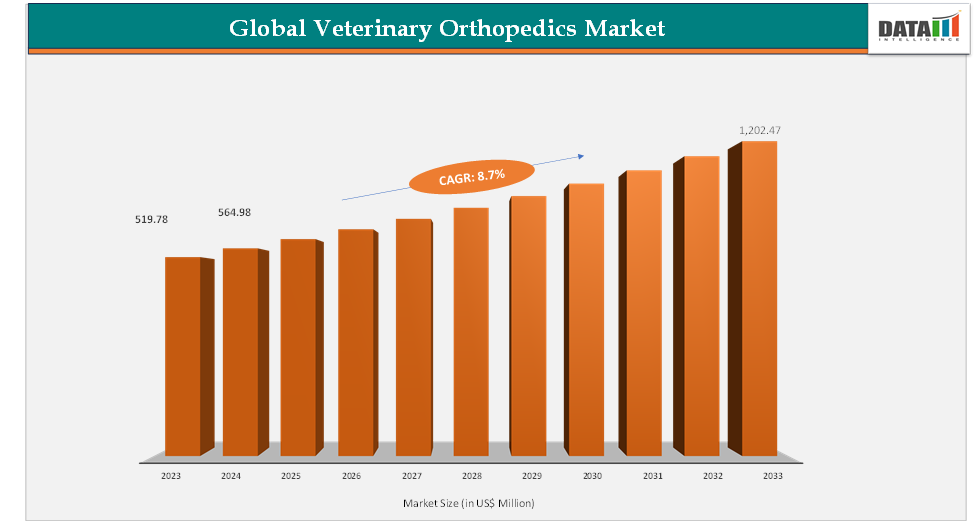
The global veterinary orthopedics market was valued at US$614.09 million in 2025 and is expected to reach US$1,202.47 million by 2033, growing at a CAGR of 8.7% during the forecast period 2026-2033. The veterinary orthopedics market is witnessing steady growth, fueled by increasing pet ownership, rising awareness of animal health, and a growing demand for advanced surgical care for musculoskeletal conditions. Technological advancements, including 3D-printed implants, minimally invasive procedures, and biologic therapies, are enhancing treatment outcomes and expanding clinical capabilities. The market is further supported by a surge in veterinary training, improved diagnostic tools, and greater investment from key players in developing precision instruments and customizable implant solutions. As pet owners increasingly prioritize long-term mobility and quality of life for their animals, the market is positioned for sustained expansion across both developed and emerging regions.
Veterinary Orthopedics Market Key Market Trends & Insights
North America accounted for approximately 41.2% of the Veterinary Orthopedics market in 2024 and is expected to maintain its leading position throughout the forecast period. This dominance is supported by a well-established veterinary healthcare system, high pet ownership rates, and strong consumer willingness to invest in advanced surgical care.
Asia-Pacific is projected to be the fastest-growing region, driven by rising pet adoption, growing awareness of animal health, expanding access to veterinary care, and increasing investments in veterinary infrastructure across emerging economies like China, India, and Southeast Asia. Rapid urbanization, improved disposable incomes, and the expansion of animal health insurance are further boosting demand for high-quality orthopedic treatments in the region.
Orthopedic instruments remain the dominant product segment, owing to their essential role in surgical procedures such as fracture fixation, joint stabilization, and ligament repair. Their high usage rate in both routine and complex surgeries, combined with continuous innovation in materials and design, makes instruments a critical and recurring revenue stream for manufacturers.
Veterinary Orthopedics Market Scope
| Metrics | Details | |
| CAGR | 8.7% | |
| Market Size Available for Years | 2025-2033 | |
| Estimation Forecast Period | 2026-2033 | |
| Revenue Units | Value (US$ Bn) | |
| Segments Covered | Product Type | Instruments, Plates, Implants, Screws |
| Application | Total Knee Replacement, Total Elbow Replacement, Total Hip Replacement, Trauma, Others | |
| End-User | Veterinary Hospitals, Clinics, Others | |
| Regions Covered | North America, Europe, Asia-Pacific, South America, and the Middle East & Africa | |
Market Size & Forecast
- 2025 Market Size:US$614.09 million
2033 Projected Market Size: US$ 1,202.47 Million
CAGR (2026–2033): 8.7%
North America: Largest market in 2024
Asia Pacific: Fastest-growing market
Veterinary Orthopedics Market Dynamics
Driver: Rising Pet Ownership & Companion Animal Spending
Rising pet ownership and growing spending on companion animal healthcare are major drivers of the veterinary orthopedics market, as more households treat pets like family members and willingly invest in advanced treatments such as TPLO surgeries, joint replacements, and trauma repair; coupled with longer pet lifespans and the higher prevalence of age-related conditions like arthritis and hip dysplasia, this has fueled demand for orthopedic care. For instance, according to the American Veterinary Medical Association, in 2024, dogs were owned by 45.5% of U.S. households, totaling about 59.8 million, while cats were present in 32.1% of households, accounting for roughly 42.2 million. On average, annual veterinary spending reached $580 for dogs and $433 for cats. This reflects the expanding companion animal base that sustains long-term demand for veterinary orthopedic solutions.
Moreover, advancements in surgical technologies are making orthopedic treatments more precise and accessible, encouraging wider adoption across veterinary clinics and hospitals. Increasing awareness of pet health and the emotional value attached to companion animals are also influencing owners to opt for specialized care, even at higher costs. Collectively, these factors are positioning veterinary orthopedics as one of the most dynamic and rapidly expanding segments within the broader veterinary healthcare industry.
Restraint: Post-Surgical Complications and Long Recovery Periods
Post-surgical complications and long recovery periods could hamper the growth of the veterinary orthopedics market because many advanced orthopedic procedures, such as joint replacements or ligament repairs, carry risks of infections, implant failures, or poor healing outcomes, which may discourage pet owners from opting for them despite their benefits; additionally, extended recovery timelines requiring strict rest, rehabilitation, and frequent follow-ups can be difficult for both pets and owners to manage, leading to higher overall costs and emotional strain, thereby reducing the willingness of some owners to pursue surgical solutions and limiting the market’s expansion potential.
For more details on this report, Request for Sample
Veterinary Orthopedics Market Segmentation Analysis
The veterinary orthopedics market is segmented by product type, application, end-user, and region.
Product Type-The instruments segment is estimated to have 47.6% of the veterinary orthopedics market share.
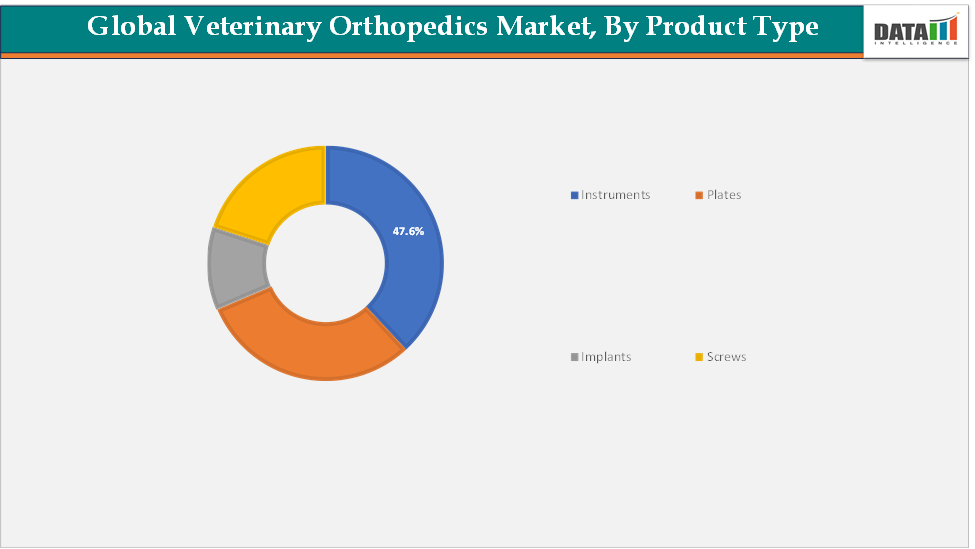
The instruments segment is expected to dominate the veterinary orthopedics market because surgical procedures for pets, such as fracture fixation, joint replacement, and ligament repair, require a wide variety of specialized tools, including bone plates, screws, drills, forceps, and saws, which are indispensable in nearly every operation. Unlike implants, which are patient-specific and replaced after each use, instruments are reusable, high in demand across clinics and hospitals, and critical for enabling precision and safety in orthopedic surgeries.
Additionally, continuous advancements in surgical instrument design, durability, and ergonomics, along with the rising number of orthopedic procedures due to increasing pet ownership and age-related conditions, reinforce the instruments segment’s dominance in driving market revenue.
Veterinary Orthopedics Market Geographical Share
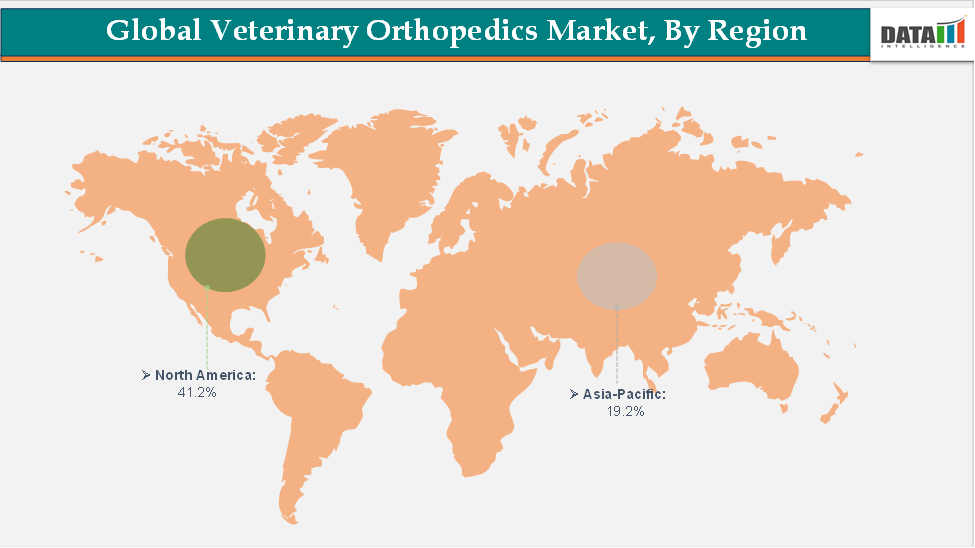
The North America veterinary orthopedics market was valued at 37.20% market share in 2024
North America is expected to dominate the veterinary orthopedics market due to its high rate of pet ownership, substantial spending on companion animal healthcare, and well-established veterinary infrastructure. The region has a large base of pets suffering from age-related orthopedic conditions, such as arthritis and hip dysplasia, creating a strong demand for advanced treatments. In America, adoption rates for both dogs (57%) and cats (64%) increased.
Additionally, the widespread availability of skilled veterinary professionals, the adoption of cutting-edge technologies such as 3D-printed implants and minimally invasive surgical techniques, and the presence of leading market players contribute to the region’s leadership. Favorable insurance coverage for pet healthcare and a culture of treating pets as family further drive willingness to invest in costly orthopedic procedures, solidifying North America’s dominance in this market.
The Asia-Pacific veterinary orthopedics market was valued at 18.60% market share in 2024
The Asia Pacific is the fastest-growing region in the veterinary orthopedics market, driven by rapidly increasing pet ownership, rising disposable incomes, and growing awareness of advanced veterinary care across countries such as China, India, and Japan. Urbanization and the humanization of pets are driving higher spending on companion animal health, including specialized orthopedic treatments for fractures, joint disorders, and age-related conditions.
The expansion of veterinary clinics and hospitals, coupled with improving access to advanced surgical instruments and implants, is further accelerating market growth. Additionally, rising investments by global veterinary companies and local manufacturers in emerging economies, along with increasing adoption of pet insurance, are enhancing affordability and accessibility, positioning the Asia Pacific as the fastest-growing region in this market.
Veterinary Orthopedics Market Competitive Landscape
The major players in the veterinary orthopedics market include BioMedtrix, LLC, Integra LifeSciences Corporation, Fusion Implants, Arthrex, Inc., KYON AG, Narang Medical Limited, Cencora, Inc., GerMedUSA, Orthomed (UK) Ltd, among others.
BioMedtrix, LLC: BioMedtrix, LLC is a key player in the veterinary orthopedics market, specializing in advanced implants and surgical solutions for companion animals. The company is particularly recognized for its Total Hip Replacement (THR) systems, widely used in dogs with severe hip dysplasia and arthritis. With a strong reputation for innovation and quality, BioMedtrix supports veterinarians worldwide by providing reliable orthopedic products that enhance mobility and improve the quality of life in pets, thereby reinforcing its leadership in the sector.
Veterinary Orthopedics Market Recent Developments:
- July 2026 – NC State expands uncemented hip replacement options for small dogs and cats
NC State’s College of Veterinary Medicine began offering newly available uncemented hip replacement implants for smaller companion animals, expanding access to total hip replacement beyond medium- and large-sized dogs and supporting the adoption of advanced joint-replacement solutions in veterinary orthopedics. - July 2026 – Computer-assisted surgical navigation advances veterinary orthopedics
Researchers from Colorado State University, the University of Bern and collaborating institutions highlighted the growing use of computer-assisted surgical navigation in veterinary surgery. The technology combines preoperative imaging, real-time instrument tracking and spatial registration to improve implant placement accuracy and support minimally invasive orthopedic procedures. - July 2026 – PetVivo strengthens evidence for biomaterial-based osteoarthritis treatment
PetVivo announced publication of a peer-reviewed clinical study evaluating Spryng with OsteoCushion Technology in dogs with stifle osteoarthritis and suspected cranial cruciate disease, strengthening clinical evidence for novel biomaterial approaches in veterinary orthopedic care. - June 2026 – Advanced preoperative planning improves TPLO procedures
Veterinary specialists continued adopting digital orthopedic planning platforms such as vPOP PRO for procedures including tibial plateau leveling osteotomy (TPLO), enabling precise bone measurements, implant selection and preoperative assessment of expected surgical outcomes. - 2026 – Veterinary biomechanics research supports optimized implant design
New research in veterinary biomechanics is applying finite-element analysis to evaluate orthopedic implant configurations. Studies of canine elbow arthrodesis demonstrated how plate positioning can influence stress distribution, load transfer and construct stability, supporting more data-driven implant positioning and surgical planning. - 2026 – Novel intramedullary nailing systems advance fracture management in growing dogs
Researchers at the ICAR–Indian Veterinary Research Institute continued development of an elastic intramedullary nailing system for managing long-bone fractures in growing dogs, highlighting innovation in age-specific veterinary orthopedic fixation technologies. - September 2026 – World Veterinary Orthopaedic Congress highlights next-generation surgical technologies
The 2026 World Veterinary Orthopaedic Congress is bringing increased attention to joint replacement, fracture repair, regenerative medicine, biomechanics, rehabilitation, artificial intelligence, augmented reality and robotic surgery, reflecting the industry's shift toward technology-enabled veterinary orthopedic procedures. - September 2026 – Research advances veterinary orthopedic prosthetics
A new systematic review examined the functional feasibility of orthopedic exoprostheses in quadruped animals, including factors affecting prosthetic adaptation across species and sizes, supporting continued development of customized mobility and limb-rehabilitation solutions.
The veterinary orthopedics market report delivers a detailed analysis with 73 key tables, more than 76 visually impactful figures, and 195 pages of expert insights, providing a complete view of the market landscape.
Suggestions for Related Report
For more veterinary health-related reports, please click here



























































