


Vehicle to Home Market Size and Forecast
The global vehicle to home market reached US$ 1.39 billion in 2025 and is expected to reach US$ 19.76 billion by 2035, growing with a CAGR of 30.4% during the forecast period 2026-2035. The adoption of Vehicle-to-Home (V2H) technology is swiftly being fueled with the emergence of electric vehicles and distributed energy systems. The rising uptake of electric vehicles driven by policies from bodies such as the International Energy Agency is bringing about an entirely new approach to the consumption of energy. Furthermore, there is grid instability, growing electricity costs and natural disasters that have led many homeowners to look for resilient energy systems. Through V2H technology, there can be bidirectional charging whereby electric cars can recharge the power grid during outages or times when electricity is expensive. Major car manufacturers such as Nissan Motor Co., Ltd. and Ford Motor Company are working on making V2H technology a commercial success.
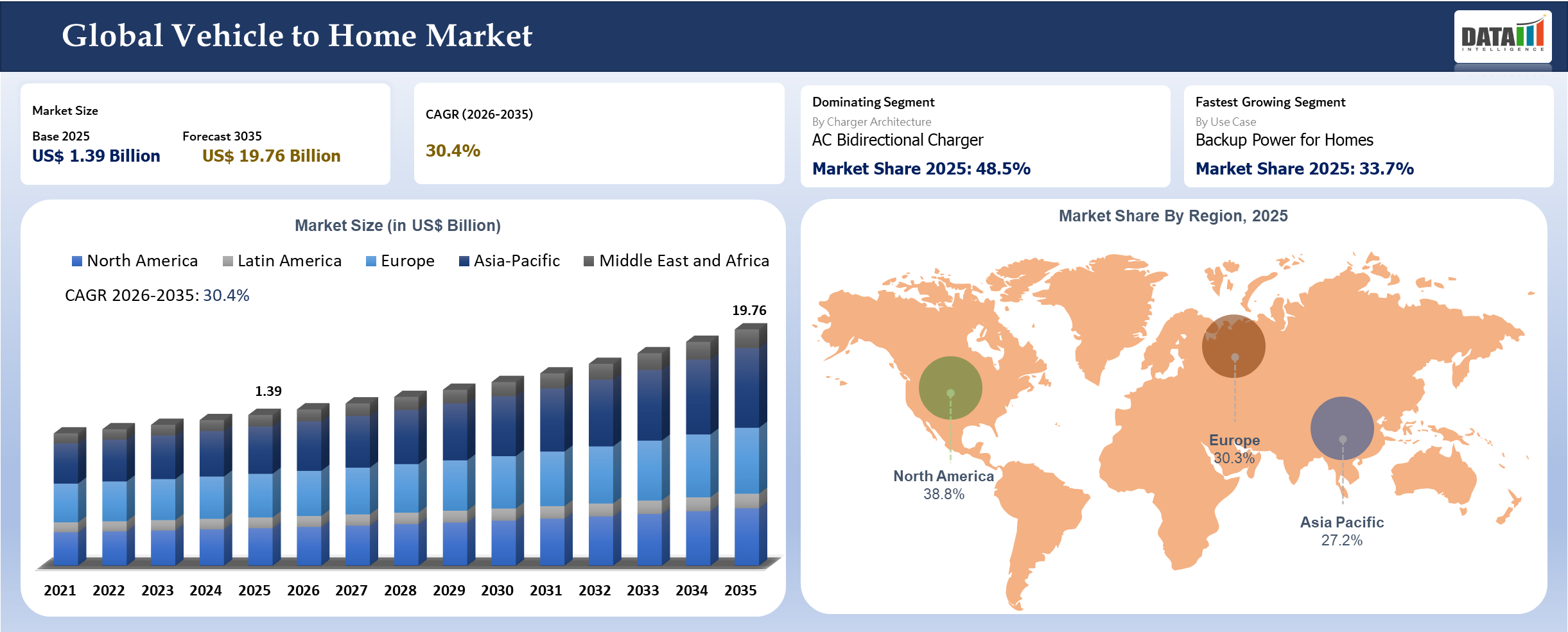
Market players such as the government and energy regulators have been actively engaged in promoting the uptake of V2H by improving grid technology and investing in renewable energy sources. For example, the U.S. Department of Energy has allocated billions of dollars through the Grid Resilience and Innovation Partnerships initiative aimed at improving bi-directional energy systems and the European Commission has initiated the development of smart grids and V2G/V2H technologies through the Fit for 55 packages.
Vehicle to Home Industry Trends and Strategic Insights
- Very high demand for V2H applications when people have understood the importance of resiliency, solar usage and bills.
- The market will be fueled by the ecosystem comprising electric vehicles, bidirectional charging solutions and home power electronics.
- Certification, standards and compatibility are still important barriers to entry, but credible products from OEMs and energy platforms are bringing it into reality.
Vehicle to Home Market Scope
| Metrics | Details | |
| 2025 Market Size | US$ 1.39 Billion | |
| 2035 Projected Market Size | US$ 19.76 Billion | |
| CAGR (2026-2035) | 30.4% | |
| Largest Market | North America | |
| Fastest Growing Market | Asia-Pacific | |
| By Charger Architecture | AC Bidirectional Charger, DC Bidirectional Charger, Integrated Home Energy Hub | |
| By Power Output | Below 7.4 kW, 7.4 kW to 11 kW, 11.1 kW to 22 kW, above 22 kW | |
| By Connection Standard | CHAdeMO, CCS with ISO 15118, Proprietary or Platform Specific Integration | |
| By Use Case | Backup Power for Homes, Solar Self Consumption Optimization, Time of Use Bill Optimization, Critical Load Support, Virtual Power Plant Participation | |
| By Buyer Profile | Detached Homeowners, Premium EV Households, Solar Plus Storage Customers, Utility Pilot Participants | |
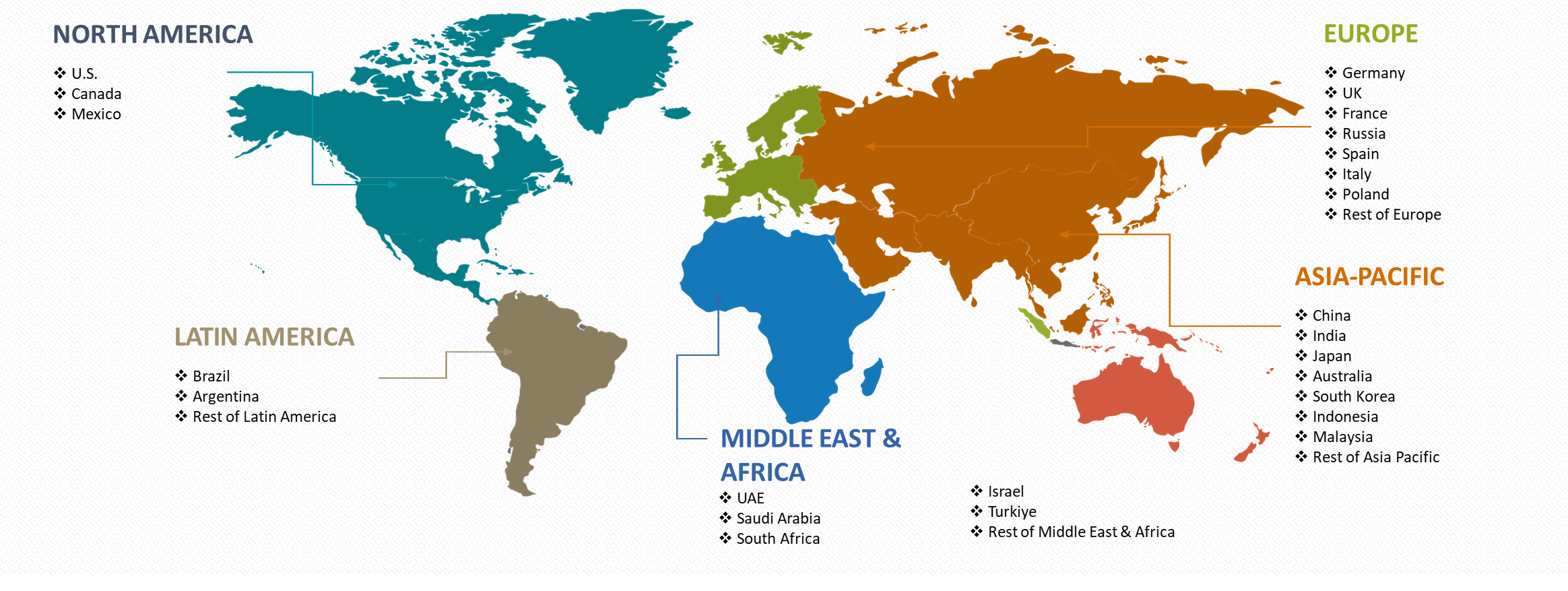
| By Region | North America | USA, Canada, Mexico |
| Europe | Germany, UK, France, Spain, Italy, Poland | |
| Asia-Pacific | China, India, Japan, Australia, South Korea, Indonesia, Malaysia | |
| Latin America | Brazil, Argentina | |
| Middle East and Africa | UAE, Saudi Arabia, South Africa, Israel, Turkiye | |
| Report Insights Covered | Competitive Landscape Analysis, Company Profile Analysis, Market Size, Share, Growth | |
Vehicle to Home Market Disruption Analysis
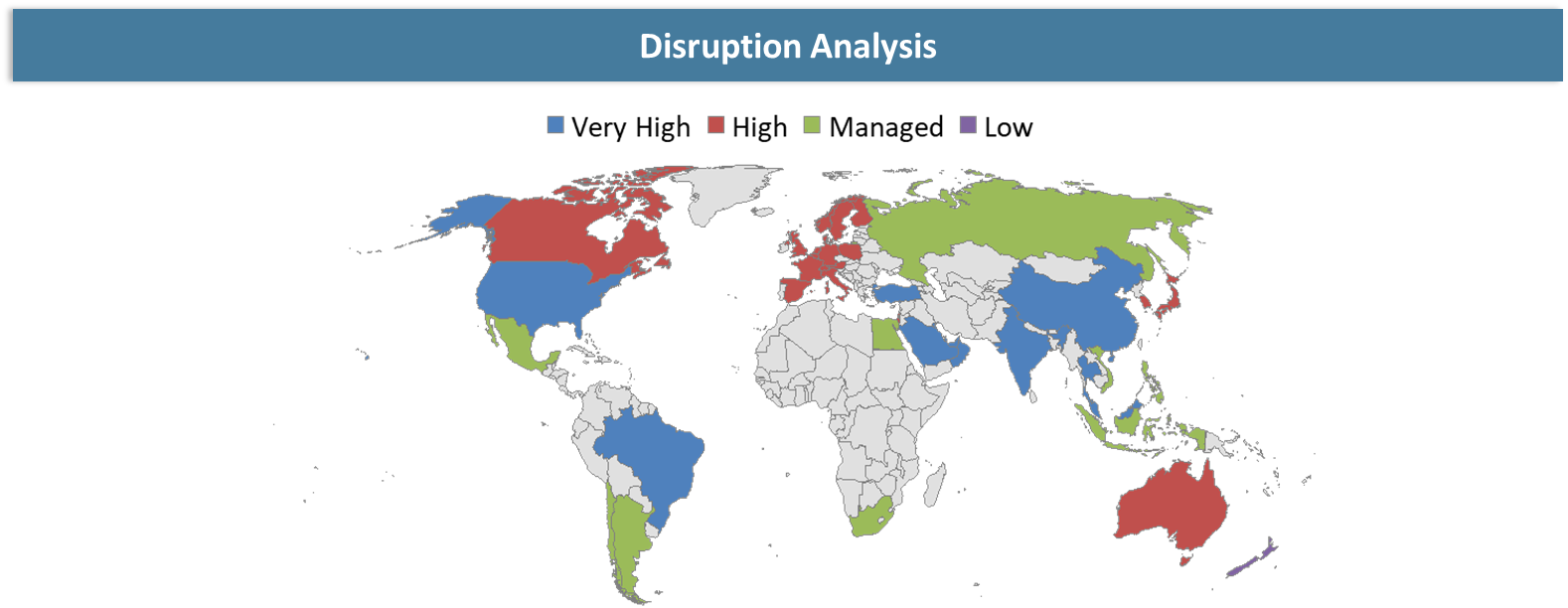
The most disruptive aspect will be the transition from unidirectional EV charging to bidirectional home energy provision for EVs. It disrupts not only the technical architecture of systems involved, but the marketing channels as well. Companies providing EV charging services, companies providing solar panels, companies providing home energy solutions and automakers find themselves in increasingly competitive cross-over territory. The disruption is also caused by moving from a traditional generator-type approach to backup electricity to a software-based solution.
In areas where outages occur, consumers used to compare different backup systems based on pure emergency power provided. V2H disrupts this comparison by adding bill savings and clean energy usage into the mix. Another market disruption stems from the continued development of standards. While V2H systems utilizing CHAdeMO have been dominant thus far, as CCS and ISO 15118-based bidirectional communication pathways improve, they may reduce the historical advantage of CHAdeMO-connected V2H systems.
Vehicle to Home Market BCG Matrix: Company Evaluation

Ford Motor Company, Enphase Energy, Inc. and Wallbox N.V. represent stars in the vehicle-to-home (V2H) market segment. Ford has contributed towards making V2H a known entity to consumers by virtue of its strategy for the F-150 Lightning home backup. On the other hand, Enphase Energy and Wallbox are focused on charger and home energy management in the eco-system. Possible candidates in the V2H market include Nissan Motor Co., Ltd., ABB Ltd. and Schneider Electric SE. The firms derive their strength from having established reputations and partnerships within adjacent energy sectors, notwithstanding that the V2H revenues are still nascent. The QM products offer relevant innovations; however, they still lack critical mass in terms of installations or awareness.
Vehicle to Home Market Dynamics
Home resilience and electricity-bill control are making bidirectional charging easier to sell than abstract grid participation
Households are far more responsive to V2H when it comes to issues surrounding backup power, effective use of rooftop solar systems and saving on bills based on time-of-use rates. It is all in terms of immediate concerns as opposed to future-facing infrastructure. Families who have solar panels, who own luxury electric vehicles, reside in bigger detached houses and who are sensitive to outages will be aware of the benefits that a car can offer. To such families, the electric vehicle becomes an extension of the home’s energy system. Furthermore, the installer is reinforced with the added advantage of product visibility courtesy of the automakers and energy platforms.
Compatibility gaps between vehicles, chargers and home systems still slow mass-market adoption
All electric vehicles do not have two-way power flow capabilities, all charging stations are not able to work with different standards and not all houses can be easily installed unless there are some upgrades on the side of electricity. It causes inconvenience right where the consumers expect easy-to-use solutions. Therefore, the market develops much slower than might be expected from the interest level.
Vehicle to Home Market Segmentation Analysis
The global vehicle to home market is segmented based on the charger architecture, power output, connection standard, use case, buyer profile and region.
Resilience-Driven Adoption and Solar Optimization Propel Vehicle-to-Home (V2H) Market Growth
Families which have suffered from storms, wildfires and blackouts because of grid problems will easily understand the necessity of using the parked EV for charging critical loads during the outages. It is beneficial because it ensures that it is possible to switch easily, maintain minimal range and remove the need to have another generator which is too costly to own or maintain. In addition, it is always easier for customers to invest in resilience solutions for their peace of mind compared to doing it for economic reasons. Therefore, V2H value proposition surpasses energy optimization only value proposition.
One of the main market segments will include the Solar Self Consumption Optimization market because this will tie V2H to an economic value. Customers which have solar panels on their roofs can utilize their electric vehicles to store excess energy generated during the day and utilize the stored energy at night when electricity rates are relatively high. It will allow integration of the V2H solution in the domestic power supply value chain. The process of adding another control point will be made easier because consumers already have batteries and inverters, together with mobile apps.
Vehicle to Home Market Geographical Penetration
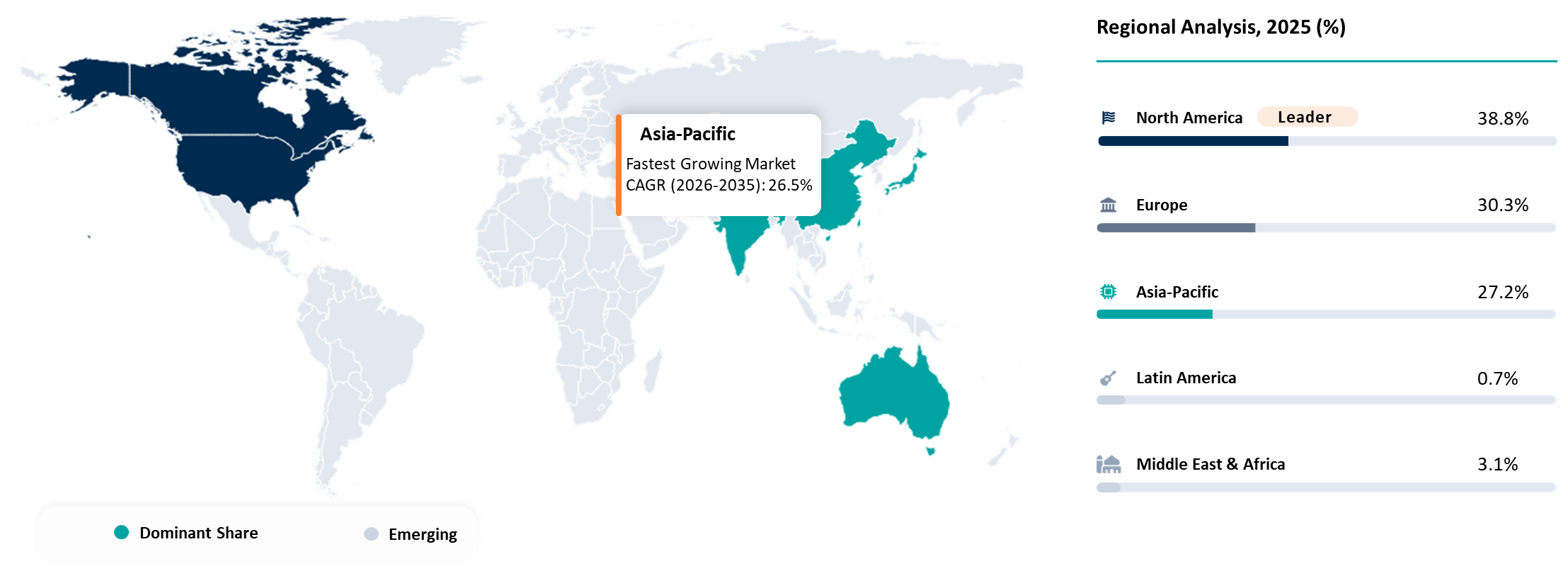
North America Emerges as a High-Value Hub for Vehicle-to-Home Integration Driven by Grid Resilience and Electrification Policies
The growth in the North American V2H market is expected because of increasing power outage incidents, increased EV sales and significant investment in grid modernization by both public and private stakeholders in creating an ecosystem conducive to the growth of the technology. According to the International Energy Agency, developed countries like the U.S. and Canada form a significant percentage of global EV adoption, owing to their strong policies and significant expenditure on infrastructure development. Further, the high presence of residential solar panels in North America, especially in the U.S., offers tremendous benefits in terms of optimizing self-consumption. With the increasing risks due to climate change and electrification, North America is fast emerging as a key player in the V2H market.
USA Vehicle to Home Market Trends
USA dominates the adoption of V2H because of power disruptions caused by climate issues coupled with government policies to upgrade their power grids. According to the U.S. Energy Information Administration, the U.S. had an average of more than 5.5 hours of power outages per customer, not counting significant incidents. It increased the demand for emergency power sources. American automotive companies such as General Motors and Ford Motor Company are partnering with power solution firms to make V2H available commercially. Companies like Enphase Energy and SolarEdge Technologies are also creating home energy systems combined with electric vehicle charging capabilities. The Inflation Reduction Act, which provides funding for renewable energy and energy grid projects, has also indirectly pushed the development of V2H infrastructure through incentives.
Canada Vehicle to Home Market Trends
The development of the Vehicle-to-Home (V2H) market in Canada has begun to take place slowly but surely due to the strong adoption targets set for electric vehicles (EVs), rising grid reliability concerns and the substantial investments being made in charging infrastructure. For example, the Canadian government plans for all new passenger vehicles and trucks to have zero-emission sales by 2035, with EVs expected to account for 480,000 units currently, increase to almost five million in 2030 and rise to 21 million in 2040, thereby making a strong foundation for V2H-enabled systems. The development of the V2H market in Canada is at a relatively nascent stage, with most installations still taking place via pilot projects because of issues related to regulation and certification.
Vehicle to Home Market Competitive Landscape
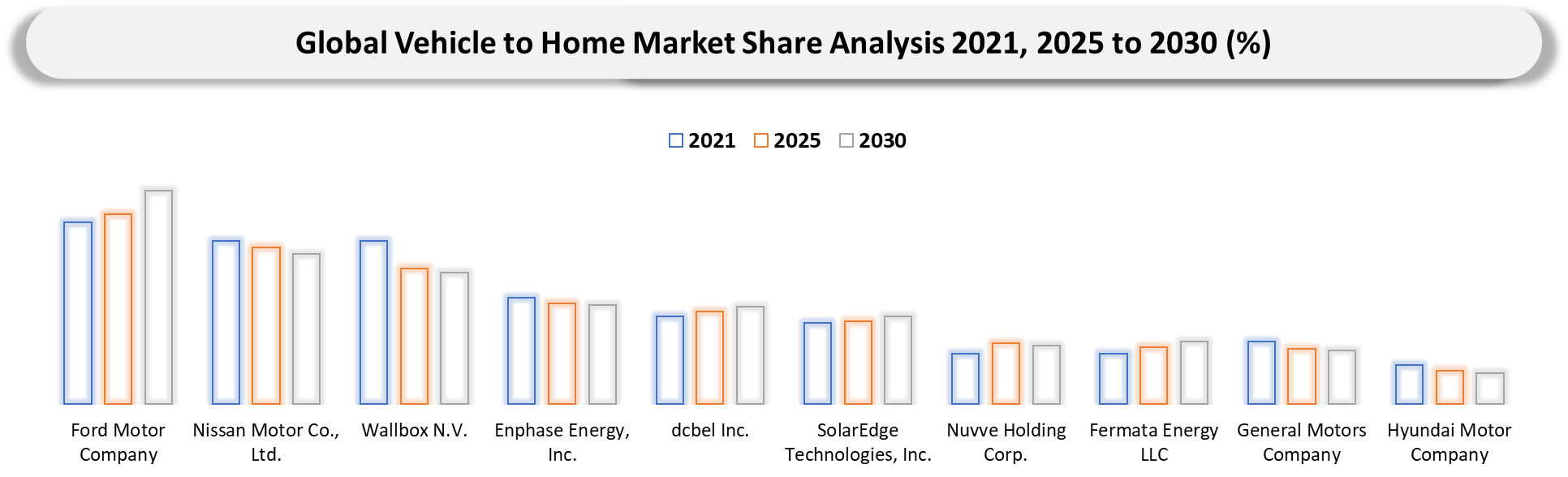
- Competitive dynamics are emerging in the realm of ecosystem dominance. Among the companies making headlines are Ford Motor Company, Enphase Energy, Inc., Wallbox N.V., dcbel Inc. and SolarEdge Technologies, Inc. Each company comes from a different point of departure, but each seeks to control more of the consumer experience. Within this ecosystem, the winning strategy involves making the path to purchase and installation easier, rather than simply delivering a single two-way component.
- The car manufacturers continue to be significant since compatibility becomes a bottleneck, but the energy platform firms have an advantage when they own the charger, software, back-of-house processing and installation partner network.
Key Developments in the Vehicle to Home Market
- August 2026: Ford Motor Company continued expanding bidirectional charging capabilities across its EV ecosystem, with V2H technology supporting backup power, home energy management and greater integration between electric vehicles and residential energy systems.
- July 2026: Nissan Motor Co., Ltd. continued advancing its vehicle-to-home strategy, leveraging bidirectional charging to enable EVs to supply electricity back to homes and support grid flexibility and energy resilience.
- July 2026: ABB Ltd. continued strengthening its EV charging and energy-management portfolio, focusing on bidirectional charging technologies that enable electric vehicles to interact with residential and commercial energy systems.
- June 2026: Schneider Electric SE continued expanding its home energy-management ecosystem, integrating EV charging, solar generation, battery storage and intelligent energy controls to support vehicle-to-home applications.
- June 2026: Enphase Energy, Inc. continued advancing its bidirectional EV charging and home-energy ecosystem, focusing on integrating EVs with solar-plus-storage systems to improve household energy independence.
- May 2026: SolarEdge Technologies, Inc. continued developing integrated EV charging and solar-energy solutions, supporting the broader adoption of bidirectional energy flows between electric vehicles, homes and distributed energy resources.
- May 2026: Ford Motor Company continued expanding customer awareness and deployment of home energy solutions, positioning electric vehicles as potential backup-power resources during grid outages and peak-demand periods.
- April 2026: Nissan Motor Co., Ltd. continued supporting V2H and V2G initiatives in markets where bidirectional charging infrastructure and regulatory frameworks are developing, reinforcing the role of EV batteries as distributed energy resources.
Why Choose DataM?
- Data-Driven insights: Dive into detailed analyses with granular insights such as pricing, market shares and value chain evaluations, enriched by interviews with industry leaders and disruptors.
- Post-Purchase Support and Expert Analyst Consultations: As a valued client, gain direct access to our expert analysts for personalized advice and strategic guidance, tailored to your specific needs and challenges.
- White Papers and Case Studies: Benefit quarterly from our in-depth studies related to your purchased titles, tailored to refine your operational and marketing strategies for maximum impact.
- Annual Updates on Purchased Reports: As an existing customer, enjoy the privilege of annual updates to your reports, ensuring you stay abreast of the latest market insights and technological advancements. Terms and conditions apply.
- Specialized Focus on Emerging Markets: DataM differentiates itself by delivering in-depth, specialized insights specifically for emerging markets, rather than offering generalized geographic overviews. The approach equips our clients with a nuanced understanding and actionable intelligence that are essential for navigating and succeeding in high-growth regions.
- Value of DataM Reports: Our reports offer specialized insights tailored to the latest trends and specific business inquiries. The personalized approach provides a deeper, strategic perspective, ensuring you receive the precise information necessary to make informed decisions. The insights complement and go beyond what is typically available in generic databases.
Target Audience
- EV OEMs and Product Strategy Teams: Automakers evaluating how bidirectional capability can improve vehicle differentiation, household resilience value and ownership economics.
- Residential Energy Platform Providers: Companies supplying inverters, home batteries, charger controls and software that need V2H-ready integration with solar and backup systems.
- EV Charger Manufacturers and Installers: Hardware providers, electrical contractors and certified installers building consumer-ready bidirectional charging offers for homes.
- Utility Innovation and Demand Flexibility Teams: Utilities assessing whether V2H can support resilience, tariff response and future distributed flexibility programs.
- Solar Plus Storage Installers: Residential energy integrators serving homeowners who already understand self-consumption, backup power and app-based energy control.
- Premium Homeowners and Early Adopter EV Buyers: Households seeking outage resilience, energy bill optimization and stronger use of rooftop solar through their EV.
- Home Builders and Smart Home Ecosystem Providers: Stakeholders incorporating bidirectional energy readiness into premium residential design and connected-home planning.
- Investors and Strategic Energy-Tech Backers: Capital providers tracking the convergence of EVs, residential power systems and software-driven energy management.


























































