


Variable Speed Pump Market Size and Overview
The global Variable Speed Pump market reached an estimated US$ 5.36 billion in 2025 and is expected to reach approximately US$ 9.33 billion by 2035, growing at a CAGR of about 5.7% during 2026-2035. The market is being pulled by a structural shift away from constant-speed pumping toward demand-responsive systems that reduce electrical consumption, improve hydraulic control and enable digital monitoring. Variable-speed technology is increasingly specified at the pump level rather than treated as a separate automation upgrade, particularly in HVAC, municipal water, pressure boosting, industrial utilities and process applications.
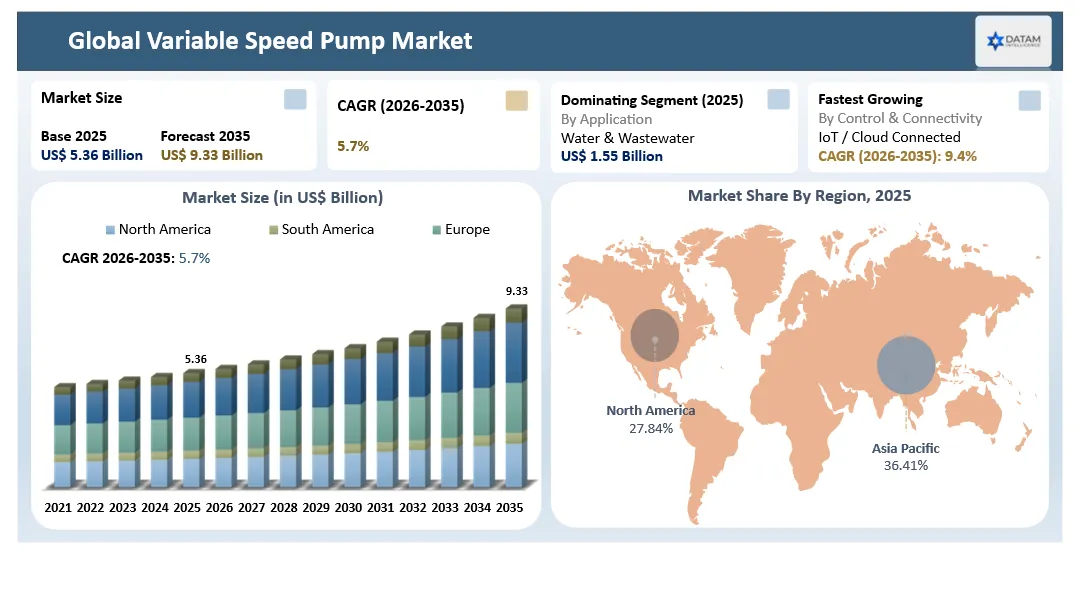
Pumps account for one of the largest application pools for variable-frequency drives. In 2025, the pump application represented roughly one-third of the broader VFD market in several industry estimates, reflecting the strong energy-saving economics of matching motor speed to actual flow demand. The adoption case is especially attractive in centrifugal systems because a modest reduction in rotational speed can materially reduce power draw under the pump affinity laws. This makes variable-speed upgrades an important component of corporate decarbonization, utility energy-efficiency and building-performance programs.
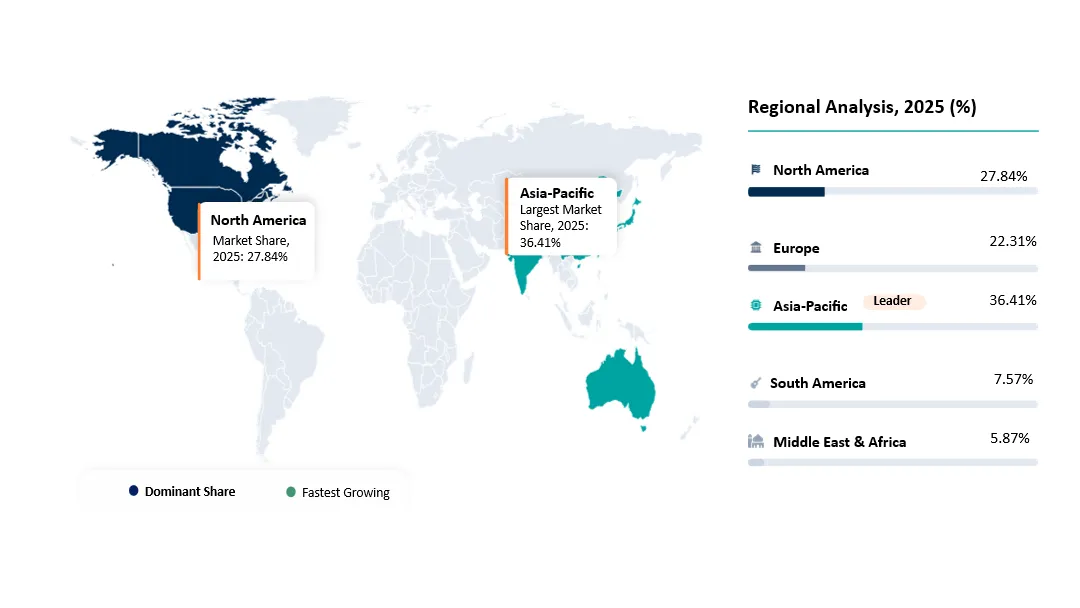
Asia-Pacific is expected to remain the largest market through 2035 because of industrial expansion, urban water infrastructure, district cooling, commercial construction, semiconductor fabs, data centers, irrigation modernization and wastewater investment. North America and Europe remain highly attractive retrofit markets due to high electricity costs, aging installed pump bases, efficiency regulation and mature building automation ecosystems. Growth is increasingly concentrated in integrated pump-drive-control packages rather than discrete hardware.
| Metric | Detail |
| 2025 Market Size | US$ 5.36 Billion |
| 2035 Projected Market Size | US$ 9.33 Billion |
| CAGR (2026-2035) | 5.7% |
| Largest Market | Asia-Pacific |
| Fastest Growth Theme | IoT-connected and sensorless variable-speed pumping |
| Dominant Application | Water & Wastewater / HVAC & Building Services |
| Key Technology | Integrated VFD pump systems |
| Report Period | 2024-2035 |
Variable Speed Pump Market Key Takeaways
- Variable-speed pumping is moving from an energy-saving option to a standard design choice in many HVAC, booster, municipal and industrial projects because life-cycle cost has become a stronger procurement metric.
- Integrated drive packages are gaining share because factory-matched motors, drives, sensors and controls simplify commissioning and reduce compatibility risk.
- Water and wastewater utilities are a major growth pool as operators seek pressure control, leakage reduction, energy optimization and remote asset visibility.
- Commercial buildings and data centers are accelerating demand for variable primary flow, distributed pumping and dynamically controlled chilled-water systems.
- Retrofit remains a large white-space opportunity because the global installed base contains a substantial number of oversized or throttled fixed-speed pumps.
- Sensorless algorithms and digital twins can reduce instrumentation requirements while maintaining flow and differential-pressure control in repetitive building applications.
- High-horsepower industrial and municipal projects remain more engineering-intensive due to harmonics, motor insulation, cable length, power quality and process reliability requirements.
- Competitive differentiation is increasingly based on system efficiency, controls, cybersecurity, service coverage and measured life-cycle savings rather than pump hydraulic efficiency alone.
Variable Speed Pump Industry Trends and Strategic Insights
- Pump OEMs are embedding VFDs, pressure sensors and communication protocols directly into product platforms, reducing the need for third-party panel engineering.
- Digital pump management is expanding from local control toward cloud analytics, remote commissioning, condition monitoring and predictive maintenance.
- Multi-pump booster systems are adopting intelligent staging algorithms that select the most efficient combination of pumps instead of controlling every unit at the same speed.
- Energy service companies and facility operators are increasingly evaluating pump projects on verified kWh savings, avoided peak demand and maintenance reduction.
- Premium-efficiency and permanent-magnet motors are expanding in smaller and medium power ranges, especially in circulators and packaged building-service pumps.
- Open communications including BACnet, Modbus, Ethernet-based industrial protocols and cloud APIs are becoming procurement requirements in smart buildings and factories.
Variable Speed Pump Market Scope
| Segmentation | Coverage |
| By Pump Type | Centrifugal Pumps, Positive Displacement Pumps, Submersible Pumps, Circulator Pumps, Vertical Turbine Pumps, Others |
| By Drive Technology | Integrated Variable Frequency Drive (VFD), External VFD Package, Electronically Commutated Motor (ECM), Smart Motor / Digital Drive, Others |
| By Power Range | Up to 5.5 kW, 5.5-22 kW, 22-75 kW, 75-250 kW, Above 250 kW |
| By Pump Configuration | Single Pump, Duty/Standby Duplex, Multi-Pump Booster Set, Packaged Pump Skid, Distributed Pumping System |
| By Control & Connectivity | Standalone Local Control, PLC / SCADA Integrated, BMS Integrated, IoT / Cloud Connected, Sensorless Control |
| By Application | HVAC & Building Services, Water & Wastewater, Industrial Process, Irrigation & Agriculture, Oil & Gas, Power Generation, Desalination, District Energy, Others |
| By End Use Industry | Commercial Buildings, Municipal Utilities, General Manufacturing, Oil & Gas & Petrochemicals, Power & Energy, Mining & Metals, Food, Beverage & Pharmaceuticals, Agriculture, Data Centers, Others |
| By Distribution Channel | Direct / Project Sales, Pump Distributors, System Integrators & EPCs, OEM & Packaged-System Partners, Online / Catalog Sales |
| By Region | North America, Europe, Asia-Pacific, South America, Middle East & Africa |
| Report Insights Covered | Market Size, Share, Growth, Competitive Landscape, Public Company Performance, Ecosystem, Company Profiles and Country-Level Opportunity |
Why does this report matter in 2026?
The year 2026 is an important decision point for variable-speed pumping because energy efficiency, water resilience and digital infrastructure investment are converging. Electricity prices and carbon reduction targets are increasing the value of pump-system optimization, while new data centers, semiconductor plants, district-energy systems and urban water projects require dynamically controlled pumping from day one. At the same time, users are replacing aging fixed-speed equipment with integrated smart pumps that can communicate with building-management and plant-control systems.
The competitive market is also changing. Large pump companies are expanding software, analytics and lifecycle services, while drive suppliers and automation vendors are moving deeper into pump applications. The report therefore matters for companies deciding whether to compete through hydraulic hardware, motor-drive integration, application software, aftermarket service or complete packaged systems. Procurement increasingly rewards suppliers that can quantify energy savings, shorten commissioning and support digital operation after installation.
Variable Speed Pump Market White Space & Investment Opportunities
- Retrofit conversion of oversized fixed-speed pumps in older commercial, municipal and industrial facilities.
- Packaged variable-speed booster systems for high-rise buildings, hospitals, data centers and industrial campuses.
- Cloud-connected pump optimization services that combine energy analytics, alarms, remote support and predictive maintenance.
- High-efficiency motor and drive packages for desalination, district cooling and large municipal pumping stations.
- Sensorless control algorithms that reduce installed instrumentation and commissioning cost in repetitive HVAC applications.
- Performance contracting models in which suppliers share measured energy savings with facility owners.
Variable Speed Pump Future Market Transformation
By 2035, the market is expected to move from speed control as a standalone feature toward autonomous pumping systems that optimize hydraulic performance, energy use and maintenance continuously. Pump curves, motor maps, valve positions and process signals will increasingly be combined in control software that determines the most efficient operating point for each system. This shift favors manufacturers with integrated hardware, embedded controls and application expertise.
The strongest transformation will occur in multi-pump installations. Instead of simply maintaining a pressure setpoint, future systems will use load prediction, weather data, occupancy, production schedules and utility tariffs to determine when to stage pumps, change pressure targets or shift operating periods. Cybersecurity and interoperable data will become important selection criteria as pumps become connected operational assets.
Variable Speed Pump Buyer Decision-Making Criteria
Buyers prioritize total efficiency at the real operating duty, not only best-efficiency-point pump performance. Key criteria include hydraulic efficiency, drive efficiency, motor efficiency, turndown range, minimum stable speed, harmonic performance, noise, reliability, control compatibility, ease of commissioning, spare-parts availability and service response. For retrofit projects, buyers also consider motor condition, electrical room space, bypass requirements, cable lengths and whether the existing process can tolerate new control logic.
Commercial building buyers place high value on integrated controls, compact footprint, low sound levels and BMS connectivity. Municipal and industrial buyers place greater weight on reliability, redundancy, lifecycle service, cyber-secure remote access and the ability to operate under variable hydraulic conditions. Procurement is increasingly supported by energy models that compare upfront premium with annual kWh savings and expected payback.
Variable Speed Pump Market Economic & Investment Analysis
The economic case for variable-speed pumps is strongest where flow demand varies over time and energy consumption is high. In centrifugal systems, speed reduction can create disproportionate power savings, allowing many retrofit projects to achieve attractive payback periods. However, project economics vary according to operating hours, electricity price, baseline throttling losses, pump oversizing, control requirements and installation cost. Low-duty or nearly constant-load systems may offer less compelling savings.
Investment is shifting toward integrated product families that combine pumps, drives, controls and digital service because this creates higher value per installed point and recurring aftermarket opportunities. Manufacturers are also investing in electronics, firmware, cloud platforms, condition monitoring and application software. This changes the competitive structure from a primarily mechanical-equipment market toward a combined mechanical, electrical and software ecosystem.
Variable Speed Pump Investment Trends in the Market
- Investment in integrated pump-drive manufacturing and factory-matched variable-speed packages.
- Expansion of digital monitoring, remote service and cloud analytics platforms.
- R&D in permanent-magnet motors, low-loss drives and sensorless flow estimation.
- Growth of packaged skids and multi-pump booster solutions for data centers, buildings and municipal applications.
- Acquisitions and partnerships connecting pump OEMs with automation, controls and predictive-maintenance capabilities.
- Service-network investment to support commissioning, retrofit audits and long-term energy optimization.
Strategic Indicators For the Variable Speed Pump Market
High Regulation Impact
Minimum motor-efficiency rules, building-energy codes, utility energy-efficiency programs and water-system standards encourage speed control where it materially reduces pumping energy. Compliance also covers EMC, electrical safety, harmonic distortion and cybersecurity for connected equipment.
High Investment Activity
Capital is being directed to municipal water, data centers, semiconductor fabs, commercial HVAC, district energy, industrial automation and water reuse, all of which create demand for variable-flow pumping systems.
Supply Chain Disruption
Variable-speed pumps depend on power electronics, semiconductors, motors, magnets, sensors and control boards in addition to conventional castings and mechanical components. Electronic component shortages can therefore affect lead times differently from conventional pumps.
Pricing Volatility
Copper, electrical steel, magnets, castings, power semiconductors and freight affect equipment cost. Integrated smart pumps generally carry a price premium but can reduce field panel, instrumentation and commissioning cost.
Procurement Pressure
Large users increasingly request guaranteed efficiency, harmonics data, communication protocols, cybersecurity documentation, spares support and lifecycle service alongside price.
New Technology Adoption
Sensorless control, permanent-magnet motors, cloud connectivity, edge analytics and AI-based optimization are expanding from premium applications toward mainstream building and municipal systems.
Regional Expansion Opportunity
Asia-Pacific offers strong greenfield growth, while North America and Europe offer large retrofit opportunities in buildings and aging water infrastructure.
Government Policy Support
Energy-efficiency standards, water conservation policy, infrastructure funding and decarbonization programs support investment in pump-system efficiency.
Pricing Intelligence
The variable-speed premium varies significantly by power range and integration level. Buyers increasingly compare installed and lifecycle cost rather than hardware price alone.
Disruption Analysis of Variable Speed Pump Market
The market is being disrupted by the convergence of pumps, drives and software. Traditional pump selection focused on hydraulic duty and mechanical reliability; new projects increasingly require digital integration, energy reporting and remote management. This allows automation vendors, drive suppliers and software providers to influence pump specification. It also increases the value of proprietary application algorithms and installed-base data.
A second disruption is the move from centralized mechanical rooms toward distributed pumping in large buildings and data centers. Smaller variable-speed pumps positioned closer to loads can reduce control-valve losses and enable modular capacity. This architecture may change the mix of pump sizes, control systems and maintenance practices over the forecast period.
Variable Speed Pump Market BCG Matrix: Company Evaluation
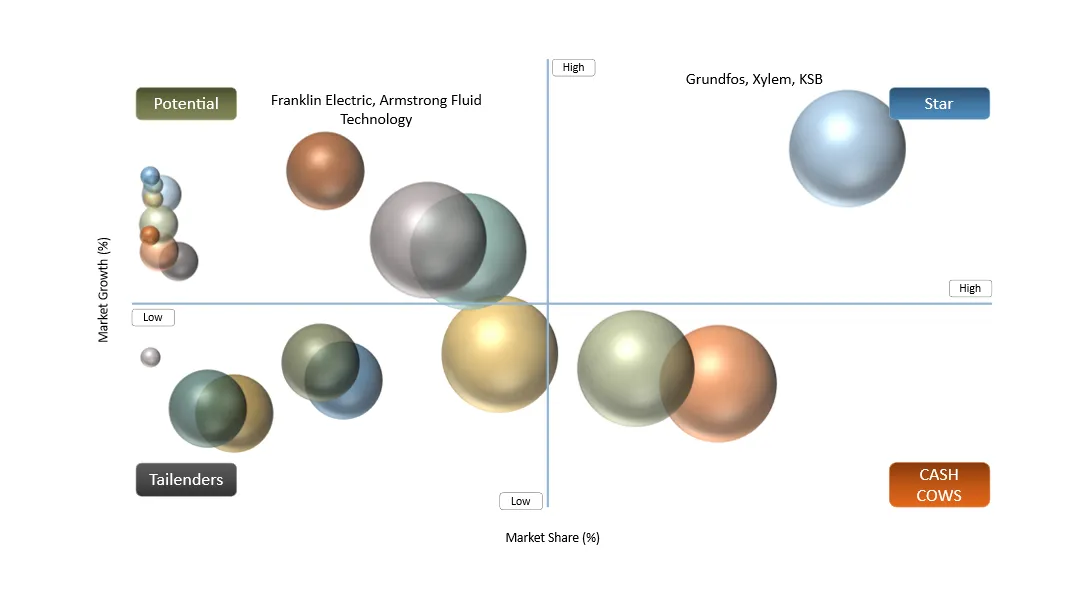
STAR: Grundfos, Xylem, KSB, Sulzer and Wilo are positioned strongly because they combine broad pump portfolios, variable-speed technology, service capability and established channels. Their ability to integrate drives and controls across multiple applications supports continued market share.
POTENTIAL: Franklin Electric, Armstrong Fluid Technology, DAB Pumps, Calpeda and regional smart-pump specialists have strong opportunities in selected building, water, groundwater and packaged-system niches. Growth will depend on geographic expansion, digital functionality and distributor support.
Variable Speed Pump Market Dynamics
Driver Impact Analysis
| Driver | Market Growth Impact | Demand Concentration | Impacted Use Case | Strategic Impact |
Energy-efficiency mandates and high electricity costs | High | Global buildings, water and industry | HVAC, boosters, process utilities | Accelerates replacement of throttled fixed-speed systems and strengthens payback-driven sales. |
Smart water and wastewater investment | High | Municipal utilities | Distribution, lift stations, treatment | Supports remote control, pressure optimization and energy management. |
Industrial automation and digitalization | Medium-High | Manufacturing and process industries | Process pumping, utilities | Increases demand for connected pumps with PLC/SCADA integration. |
Data center and district-energy growth | Medium-High | North America, Europe, APAC | Chilled water and heat rejection | Creates high-value demand for variable-flow, redundant and digitally managed pumping. |
Driver: Energy Efficiency Becomes a Core Pump Specification
Variable-speed pumps gain the greatest advantage where flow demand fluctuates and fixed-speed systems currently use throttling valves, bypasses or on/off cycling. Rising electricity costs and decarbonization targets make this wasted energy more visible to facility and utility managers. As energy audits become routine, pump retrofits increasingly compete successfully for capital because savings can be measured directly from operating hours, speed profiles and power consumption.
Restraint Impact Analysis
| Restraint | Drag on Market Growth | Primary Impact Area | Impacted Use Case | Strategic Impact |
| Higher upfront cost | Medium-High | Retrofit and price-sensitive projects | Small commercial and municipal | Requires lifecycle-cost selling and financing support. |
Power quality and harmonic concerns | Medium | Medium/high power systems | Large motors and critical processes | Increases engineering, filtering and commissioning requirements. |
Skills and integration gaps | Medium | Emerging markets and smaller facilities | BMS/PLC-connected systems | Creates demand for pre-engineered packages and service support. |
Process limitations at low speed | Low-Medium | Certain industrial applications | Minimum flow, solids handling, NPSH-sensitive service | Requires application-specific control limits and hydraulic validation. |
Restraint: Higher Initial Cost and Retrofit Complexity
A variable-speed retrofit may require a drive, enclosure, bypass, sensors, electrical modifications, motor checks, harmonic mitigation and control programming. These costs can discourage projects with limited operating hours or poorly documented systems. Suppliers can reduce the barrier through packaged retrofit kits, energy audits, standardized commissioning and financing models linked to measured savings.
Variable Speed Pump Market Segment Analysis
The global Variable Speed Pump market is segmented based on Pump Type, Drive Technology, Power Range, Pump Configuration, Control & Connectivity, Application, end-use industry, distribution channel, and region.
By Pump Type
Centrifugal Pumps Will Remain the Largest Segment
Centrifugal pumps dominate variable-speed adoption because flow and head respond predictably to speed changes, producing strong energy savings in systems with variable demand. HVAC circulation, water supply, pressure boosting and industrial utilities are especially suitable. Positive displacement pumps also use speed control for accurate metering and process regulation, but their economics are driven more by control precision than affinity-law energy savings.
By Drive Technology
Integrated VFD Packages Will Gain Share
Integrated VFD pump packages are expected to grow faster than externally engineered drive systems because they reduce design, wiring and commissioning effort. Factory-matched motor, drive, sensor and firmware combinations can also improve low-speed stability and protection. External VFDs remain important in high-power projects, retrofits and applications where the drive is installed in centralized electrical rooms.
By Power Range
5.5-75 kW Is the Core Commercial and Industrial Volume Pool
The 5.5-75 kW range captures a broad mix of HVAC, booster, process, water and industrial applications and therefore represents a major revenue pool. Above-250 kW systems generate high project value but have lower unit volumes and greater engineering requirements. Small electronically commutated pumps are expanding in commercial circulation and packaged equipment.
By Pump Configuration
Multi-Pump Booster Sets Will Record Strong Growth
Variable-speed multi-pump systems can stage units to maintain pressure while keeping each active pump near an efficient operating zone. Demand is rising in high-rise buildings, campuses, water distribution and industrial utility systems. Advanced controllers also rotate lead pumps to balance wear and maintain redundancy.
By Control & Connectivity
IoT and Cloud-Connected Pumping Will Grow Fastest
Connected pumps allow remote status monitoring, alarm management, energy reporting and predictive maintenance. Adoption is strongest where users manage many distributed assets or where downtime is costly. Sensorless control remains attractive in building applications because it can reduce instrumentation and simplify commissioning.
By Application
Water & Wastewater and HVAC Will Anchor Demand
Water systems and HVAC represent the most scalable variable-speed applications because load profiles change continuously and pumping energy is significant. Industrial process applications provide higher specification value, while irrigation, desalination, district energy and oil & gas create strong regional opportunities.
By End Use Industry
Commercial Buildings and Municipal Utilities Are Core Buyers
Commercial buildings adopt variable-speed pumps through energy codes, retrofit programs and smart-building controls. Municipal utilities use them to manage pressure, reservoir levels, treatment flow and energy cost. Data centers are an emerging premium segment due to rapidly varying cooling loads and strict uptime requirements.
By Distribution Channel
Direct and Integrator-Led Sales Dominate Complex Projects
Large pump systems are commonly specified through OEM sales teams, EPC contractors and system integrators because hydraulic and electrical design must be coordinated. Distributors remain essential for replacement, smaller building-service pumps and regional service. Online channels are growing in standardized low-power products but remain limited for engineered projects.
Variable Speed Pump Market Geographical Penetration
U.S. Variable Speed Pump Market Landscape
The U.S. market is driven by building retrofits, municipal water investment, data-center construction, semiconductor manufacturing and industrial energy-efficiency programs. Variable-speed pumps are widely used in chilled water, booster systems, water distribution and process utilities. The installed base of older fixed-speed systems creates a substantial retrofit opportunity, while modern building automation favors connected pump packages.
Germany Variable Speed Pump Market Outlook
Germany has high penetration of efficient pumps and drives due to electricity costs, industrial engineering standards and building-energy policy. Demand is strong in industrial manufacturing, district heating, municipal water and commercial buildings. Suppliers compete on efficiency, engineering quality, digital integration and lifecycle service.
Japan Variable Speed Pump Market Trends
Japan is a mature market with strong demand for high-efficiency motors, compact intelligent pumps and industrial automation. Building systems, semiconductor plants, water infrastructure and factory utilities support variable-speed adoption. Local buyers place high value on reliability, low noise, compact design and long equipment life.
China Variable Speed Pump Market Outlook
China combines the world’s largest manufacturing base with large water, wastewater, district-energy, building and industrial investment. Domestic pump and drive suppliers compete aggressively on price, while global companies target higher-efficiency and digitally connected applications. Industrial upgrading and energy-efficiency policy support steady penetration of variable-speed systems.
India Variable Speed Pump Market Outlook
India offers strong growth through urban water supply, wastewater, commercial construction, irrigation, data centers and manufacturing. Energy savings are attractive because many systems operate long hours, but capital sensitivity and uneven technical capability can slow advanced controls. Packaged solutions and local service networks are important competitive advantages.
Middle East and Africa Variable Speed Pump Market Outlook
The region provides opportunities in desalination, district cooling, water transport, high-rise construction, oil & gas and industrial projects. Variable-speed systems are used to optimize large pump loads and manage highly variable demand. Gulf countries are the most advanced adopters, while broader regional growth depends on infrastructure funding and service availability.
Variable Speed Pump Market Competitive Landscape
- Competition spans global pump OEMs, drive suppliers, building-automation companies and regional packaged-system specialists. The strongest players increasingly sell an integrated hydraulic-electrical-digital proposition rather than a standalone pump.
- Grundfos, Xylem, KSB, Sulzer, Wilo and other pump specialists compete through broad application coverage, installed base, service networks and proprietary control platforms.
- Variable-speed technology allows drive and automation companies to influence specification, making interoperability with PLC, SCADA and BMS ecosystems an important differentiator.
- Aftermarket capability is strategically important because retrofit engineering, commissioning and service can generate recurring revenue long after original equipment installation.
- Digital platforms are becoming a source of differentiation through remote monitoring, energy analytics, condition-based maintenance and fleet-level optimization.
- Market share will increasingly depend on the ability to document real operating efficiency rather than catalogue efficiency at a single duty point.
Public Company Q1-Q2 2026 Performance Comparison
| Public Company | Latest 2026 Performance | Pump-Relevant Indicator | Factors Driving Growth / Pressure |
| Xylem | Q2 2026 revenue US$2.34 billion, up about 2% reported; adjusted EPS up 16%. | Orders remained strong and the water infrastructure portfolio benefits from utility modernization and digital water investment. | Municipal water capex, treatment, smart infrastructure, lifecycle services and margin improvement; variable-speed pumping benefits from broader water-system modernization. |
| Sulzer | H1 2026 sales CHF1.67 billion, up 1.0%; EBITDA CHF258.7 million, up 9.7%. | Flow division sales grew 0.5% and margin improved; energy and infrastructure base business supported orders. | Energy, water and industrial infrastructure demand, aftermarket execution and operational improvement; some project delays in Middle East water/industry. |
| Flowserve | Q1 2026 sales US$1.07 billion, down 6.7%; adjusted EPS US$0.85, up 18.1%; backlog US$2.95 billion. | Strong nuclear and aftermarket bookings offset softer original-equipment sales. | Energy infrastructure, nuclear, installed-base service and margin execution; short-term sales affected by project timing and geopolitical conditions. |
| Pentair | Preliminary Q2 2026 sales about US$930 million, down 17% due mainly to Pool channel destocking. | Flow and water-treatment exposure remains strategically relevant, while short-term corporate results were distorted by Pool inventory correction. | Water management, commercial solutions and planned portfolio expansion; temporary channel destocking reduced near-term revenue. |
| KSB | Q1 2026 group sales €712 million, up 0.4%; Pumps segment sales up 4.4% to €390 million; pump orders up 31%. | Large energy order lifted pump order intake; Standard Markets sales grew strongly. | Energy projects, standard-market pump demand, water/wastewater and commercial building services; EBIT pressured by macro and geopolitical conditions. |
Market Ecosystem Table
| Value Chain Sector | Primary Role | Representative Companies / Organizations | Strategic Relevance |
| Raw Materials & Castings | Metal castings, stainless steel, engineered polymers, copper, electrical steel | voestalpine, Outokumpu, regional foundries, specialty material suppliers | Provide hydraulic bodies, shafts, motor materials and structural components. |
| Motors & Drive Electronics | Motors, VFDs, power semiconductors, controls | ABB, Siemens, Danfoss, Nidec, WEG, Yaskawa, Schneider Electric | Enable speed control, motor efficiency, protection and communication. |
| Pump OEMs | Hydraulic pump design and integrated variable-speed systems | Grundfos, Xylem, KSB, Sulzer, Wilo, Ebara, Pentair | Integrate pump hydraulics, motors, drives, sensors and application software. |
| Sensors & Instrumentation | Pressure, flow, vibration, temperature and condition monitoring | Endress+Hauser, Emerson, Siemens, Honeywell, ifm | Provide process feedback and condition data for closed-loop control. |
| System Integrators & EPCs | Panels, PLC/SCADA, packaged skids, commissioning | AECOM, Jacobs, Veolia Water Technologies, regional EPCs and automation integrators | Specify and integrate pumps into complete water, HVAC and process systems. |
| Distributors & Service | Local inventory, application support, repair and retrofit | Motion, Applied Industrial Technologies, Ferguson, local pump distributors | Extend market reach and support replacement and retrofit demand. |
| End Users | Commercial, municipal, industrial, energy and agriculture | Utilities, manufacturers, data centers, commercial property owners, farms | Create demand based on flow, pressure, reliability, energy and automation requirements. |
| Standards & Efficiency Bodies | Pump, motor and building efficiency frameworks | DOE, EU institutions, Hydraulic Institute, Europump, ISO/IEC bodies | Shape testing, minimum efficiency, safety, interoperability and procurement standards. |
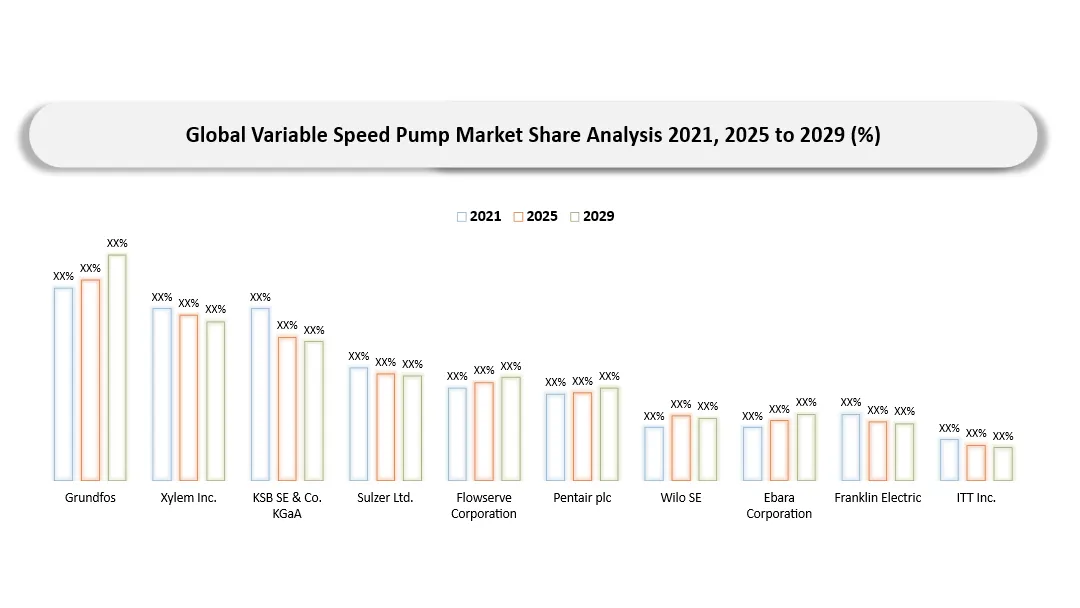
Key Companies
- Grundfos (Denmark)
- Xylem Inc. (U.S.)
- KSB SE & Co. KGaA (Germany)
- Sulzer Ltd. (Switzerland)
- Flowserve Corporation (U.S.)
- Pentair plc (Ireland/U.S.)
- Wilo SE (Germany)
- Ebara Corporation (Japan)
- Franklin Electric (U.S.)
- Armstrong Fluid Technology (Canada)
- ITT Inc. (U.S.)
- Kirloskar Brothers Limited (India)
- Ruhrpumpen (Mexico/Germany)
- Calpeda S.p.A. (Italy)
- DAB Pumps S.p.A. (Italy)
Company Profiles
Grundfos
A global leader in pumps and water technology with a strong portfolio of integrated variable-speed circulators, inline pumps, booster systems and intelligent controls. Its competitive strength comes from factory-integrated drives, application software, broad building-services coverage and global service capability.
Competitive priorities include deeper drive integration, digital services, energy-efficiency positioning, stronger channel support and expansion in high-growth water and building applications.
Xylem
A major water technology company with variable-speed solutions across water infrastructure, applied water, treatment and digital water. Its position is reinforced by a large municipal installed base, controls, monitoring and lifecycle service.
Competitive priorities include deeper drive integration, digital services, energy-efficiency positioning, stronger channel support and expansion in high-growth water and building applications.
KSB
A leading pump and valve manufacturer with variable-speed packages for building services, water, energy and industrial applications. KSB combines engineered pumps, automation and service through a broad global footprint.
Competitive priorities include deeper drive integration, digital services, energy-efficiency positioning, stronger channel support and expansion in high-growth water and building applications.
Sulzer
Strong in engineered pumping, energy, water and industrial applications. Sulzer’s market position benefits from project engineering, high-power equipment and a substantial service network.
Competitive priorities include deeper drive integration, digital services, energy-efficiency positioning, stronger channel support and expansion in high-growth water and building applications.
Flowserve
A major provider of engineered pumps and flow-control equipment to energy, chemical, nuclear and infrastructure markets. Variable-speed control is important in optimizing large process and utility pump systems.
Competitive priorities include deeper drive integration, digital services, energy-efficiency positioning, stronger channel support and expansion in high-growth water and building applications.
Pentair
A water-focused company with commercial, residential and industrial flow-management solutions. Portfolio development in water and hydronic applications broadens exposure to intelligent and variable-speed pumping.
Competitive priorities include deeper drive integration, digital services, energy-efficiency positioning, stronger channel support and expansion in high-growth water and building applications.
Wilo
A specialist in building services, water management and industrial pumps, with strong penetration of electronically controlled and digitally connected pumping systems.
Competitive priorities include deeper drive integration, digital services, energy-efficiency positioning, stronger channel support and expansion in high-growth water and building applications.
Ebara Corporation
A diversified Japanese manufacturer with pumps and fluid machinery across buildings, water, industry and energy. High-efficiency motors and controls support variable-speed adoption.
Competitive priorities include deeper drive integration, digital services, energy-efficiency positioning, stronger channel support and expansion in high-growth water and building applications.
Franklin Electric
Strong in groundwater, water transfer and packaged pumping systems, with variable-speed drives used in residential, agricultural and commercial applications.
Competitive priorities include deeper drive integration, digital services, energy-efficiency positioning, stronger channel support and expansion in high-growth water and building applications.
Armstrong Fluid Technology
Known for intelligent HVAC pumping and integrated controls, including demand-based and sensorless strategies for commercial buildings and district energy.
Competitive priorities include deeper drive integration, digital services, energy-efficiency positioning, stronger channel support and expansion in high-growth water and building applications.
ITT Inc.
Provides engineered flow and industrial process technologies, including pumps used in demanding industrial applications where variable-speed control supports process flexibility.
Competitive priorities include deeper drive integration, digital services, energy-efficiency positioning, stronger channel support and expansion in high-growth water and building applications.
Kirloskar Brothers
A major Indian pump manufacturer serving water, power, buildings, irrigation and industry, positioned to benefit from domestic infrastructure and efficiency upgrades.
Competitive priorities include deeper drive integration, digital services, energy-efficiency positioning, stronger channel support and expansion in high-growth water and building applications.
Ruhrpumpen
An engineered pump company with strong exposure to energy, industrial and water projects where variable-speed control is often engineered at system level.
Competitive priorities include deeper drive integration, digital services, energy-efficiency positioning, stronger channel support and expansion in high-growth water and building applications.
Calpeda
An Italian pump manufacturer active in building services, water and industrial pumping with compact variable-speed solutions for pressure boosting and circulation.
Competitive priorities include deeper drive integration, digital services, energy-efficiency positioning, stronger channel support and expansion in high-growth water and building applications.
DAB Pumps
A building-services and water pump specialist with growing emphasis on integrated electronics, connectivity and compact variable-speed systems.
Competitive priorities include deeper drive integration, digital services, energy-efficiency positioning, stronger channel support and expansion in high-growth water and building applications.
Variable Speed Pump Market Major Pain Points
- Upfront cost premium versus basic fixed-speed pumps in price-sensitive projects.
- Poorly sized systems can reduce expected energy savings even when a VFD is installed.
- Harmonics, EMC and motor-cable issues can complicate medium and high-power retrofits.
- Drive electronics may require cleaner, cooler environments than the mechanical pump itself.
- Fragmented responsibility between mechanical, electrical and controls contractors can slow commissioning.
- Cybersecurity and IT/OT governance increasingly affect cloud-connected pump deployments.
- Shortage of technicians with combined hydraulic, drive and controls expertise in some markets.
- Users may lack baseline energy data needed to justify retrofit investments.
Variable Speed Pump Market Recent Developments
- July 2026: Xylem reported Q2 2026 revenue of approximately US$2.34 billion and continued strong order momentum across its water technology portfolio, supporting investment in connected and efficient pumping systems.
- July 2026: Sulzer reported H1 2026 sales growth and higher profitability, with the Flow division supported by energy and infrastructure demand and an emphasis on execution and lifecycle services.
- July 2026: Pentair reported preliminary Q2 2026 results and announced plans to acquire Taco Group Holdings, a transaction that would deepen its position in water and hydronic building solutions if completed.
- April 2026: Flowserve reported strong Q1 margin expansion and more than US$110 million of nuclear bookings, highlighting demand for engineered flow-control equipment and aftermarket services.
- April 2026: KSB reported a 31% increase in Pumps segment order intake in Q1 2026, driven by a major energy project and continued activity in standard pump markets.
Analyst View / Opinion on Variable Speed Pump Market
- The market is likely to outgrow the broader conventional pump market because variable-speed capability is increasingly embedded in new equipment and retrofit decisions.
- The most attractive opportunities combine large operating hours, variable demand and high electricity cost because energy savings can justify the incremental control investment quickly.
- Integrated pump-drive-control packages will gain share by reducing engineering risk and simplifying commissioning, particularly in commercial and municipal applications.
- Water infrastructure and data-center cooling are likely to be two of the most durable growth pools through 2035, although the technical requirements differ substantially.
- Digital service can become a meaningful recurring-revenue layer as OEMs use operating data for remote diagnostics, optimization and predictive maintenance.
- Suppliers that can combine strong hydraulics with power electronics, software, cybersecurity and lifecycle service will be best positioned to capture premium value.
Variable Speed Pump Market Target Audience
| Industry | Who Should Buy This Report? | Reason to Buy This Report |
| Pump Manufacturers | Product leaders, strategy teams, business development | Assess growth by pump type, power range, application and region. |
| Motor & Drive Suppliers | VFD, motor and power-electronics companies | Understand pump-specific drive demand, integration trends and OEM partnerships. |
| Water & Wastewater | Utilities, EPCs, technology providers | Evaluate energy-efficiency, pressure management and smart pumping opportunities. |
| Commercial HVAC | MEP consultants, facility owners, controls firms | Assess variable-flow, booster and distributed pumping demand. |
| Industrial & Process | Plant managers, reliability teams, system integrators | Benchmark lifecycle economics, automation and retrofit opportunity. |
| Investors & Consulting | Private equity, institutional investors, strategy consultants | Evaluate competitive positioning, public-company performance and value-chain white space. |
| Distributors & Service | Pump distributors, repair providers, retrofit specialists | Identify replacement, commissioning and aftermarket opportunities. |
Why Choose DATAM?
- Data-driven insights combining market sizing, application engineering, energy economics, competitive intelligence and country-level opportunity.
- Post-purchase analyst support for market entry, segmentation, partner identification and competitive benchmarking.
- Annual updates covering product launches, acquisitions, public-company performance, regulatory change and technology adoption.
- Specialized focus on emerging markets and infrastructure-linked demand rather than generalized regional commentary.
- Actionable analysis connecting pump hardware with motors, drives, controls, digital service and end-user procurement criteria.
What DATAM Uniquely Provides
- Ten-year forecasts across pump type, drive technology, power range, configuration, connectivity, application, end use, distribution channel and region.
- Detailed value-chain mapping covering materials, motors, drives, sensors, pump OEMs, integrators, distributors and end users.
- Public-company 2026 performance comparison tied to pump-relevant growth factors.
- Buyer-focused analysis of energy payback, harmonics, integration, service and lifecycle cost.
- Country-level views linking infrastructure investment, industrial capex, water stress, building activity and efficiency policy.
- Strategic recommendations for retrofit programs, channel development, digital services and OEM partnerships.


























































