


Valley Fever Market Size & Industry Outlook
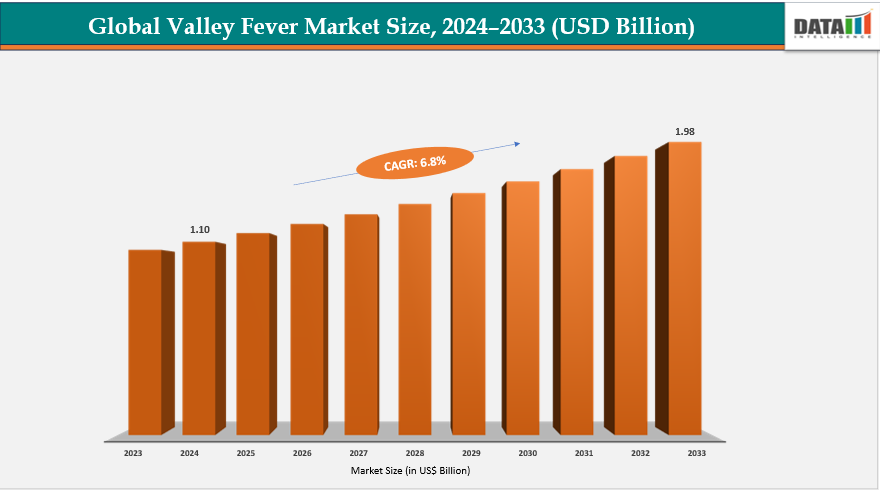
The global valley fever market size reached US$ 1.03 Billion with rise of US$ 1.10 Billion in 2024 is expected to reach US$ 1.98 Billion by 2033, growing at a CAGR of 6.8% during the forecast period 2025-2033. This growth is driven by the increasing incidence of respiratory and systemic fungal infections due to climate change and environmental factors. Changes in temperature, rainfall patterns, and soil conditions in regions where the disease is prevalent have contributed to the spread of Coccidioides spores into previously unaffected areas, increasing the risk of infection.
For instance, in July 2024, the Centers for Disease Control and Prevention (CDC) reported approximately 20,000 new Valley Fever cases in parts of the U.S. Southwest, linked to prolonged droughts and dust storms that facilitate spore dispersal. This environmental shift has expanded the at-risk population and intensified the demand for effective antifungal treatments and diagnostic solutions. Therefore, climate and environmental changes are significant factors influencing disease prevalence, underscoring the need for advanced therapies and proactive disease management strategies worldwide.
Key Highlights
North America dominates the valley fever market with the largest revenue share of 42.5% in 2024.
The Asia Pacific is the fastest-growing region and is expected to grow at the fastest CAGR of 8.1% over the forecast period.
Based on drug type, the fluconazole, segment led the market with the largest revenue share of 45.6% in 2024.
The major market players in the valley fever market are Pfizer, Janssen (Johnson & Johnson), Merck , Astellas Pharma and among others.
Market Size & Forecast
2024 Market Size: US$ 1.10 Billion
2033 Projected Market Size: US$ 1.98 Billion
CAGR (2025–2033): 6.8%
North America: Largest market in 2024
Asia Pacific: Fastest-growing market
Market Dynamics
Drivers:The rise in the prevalence of fungal infections is significantly driving the valley fever market growth
The increasing incidence of coccidioidomycosis (Valley Fever), caused by the coccidioides fungus, is a key driver for the Valley Fever market. Rising cases, particularly of respiratory infections associated with this disease, are intensifying the demand for targeted antifungal therapies and improved diagnostic tools. Contributing factors include a growing immunocompromised population, higher prevalence of chronic conditions such as diabetes, widespread use of corticosteroids, and expanding healthcare access.
For instance, in 2022, the U.S. reported around 20,000 cases of coccidioidomycosis, with Arizona having the highest incidence of 150–200 cases per 100,000 people. The disease is most common in the southwestern U.S., especially among people exposed to soil, and is underreported due to many mild or asymptomatic cases.
Restraints:Regulatory and R&D Challenges are hampering the growth of the valley fever market
A significant restraint in the Valley Fever market is the complex regulatory environment and the challenges associated with research and development of new therapies. Developing novel antifungal drugs or vaccines involves navigating stringent regulatory pathways that require extensive preclinical and clinical testing to demonstrate safety and efficacy. These trials are often time-consuming and expensive, with high failure rates, making it financially and operationally challenging for companies to invest in new treatments..
For more details on this report – Request for Sample
Segmentation Analysis
The global valley fever market is segmented based on type of infection, drug type, route of administration, distribution channel, and region.
Drug Type:The fluconazole from drug type segment is expected to dominate the valley fever market with a 45.6% share in 2024
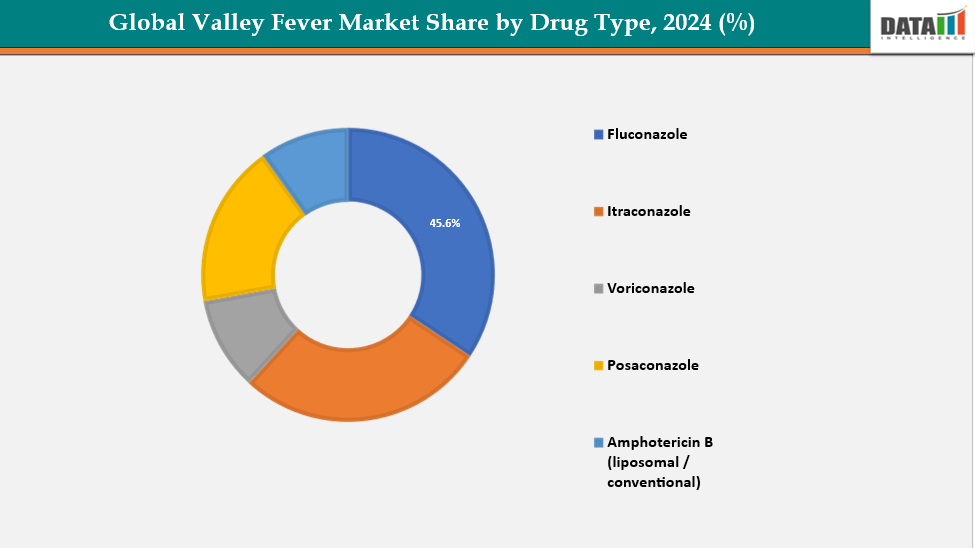
The fluconazole segment in the global valley fever market is driven by the increasing prevalence of fungal infections worldwide, particularly among immunocompromised and high-risk populations. Its widespread off-label use for the treatment of coccidioidomycosis, along with strong clinical awareness among healthcare professionals, supports its adoption. The segment benefits from the availability of broad-spectrum antifungal therapy, expansion of healthcare infrastructure, and the accessibility of cost-effective generic formulations. Additionally, rising government initiatives, research funding, and focus on early intervention to prevent severe disease progression further fuel the demand for fluconazole globally.
Route of Administration: The oral route of administration segment is estimated to have a 35.1% of the valley fever market share in 2024
The global valley fever market's oral route of administration segment is gaining popularity due to its convenience and non-invasive nature. Oral antifungal therapies reduce hospitalization and intravenous administration, especially in regions with limited healthcare infrastructure. Improved drug formulations and increased distribution through retail and online pharmacies are driving the adoption of oral antifungal medications, particularly in mild-to-moderate infections.
Geographical Analysis
North America is expected to dominate the global Valley Fever market with a 42.5% in 2024
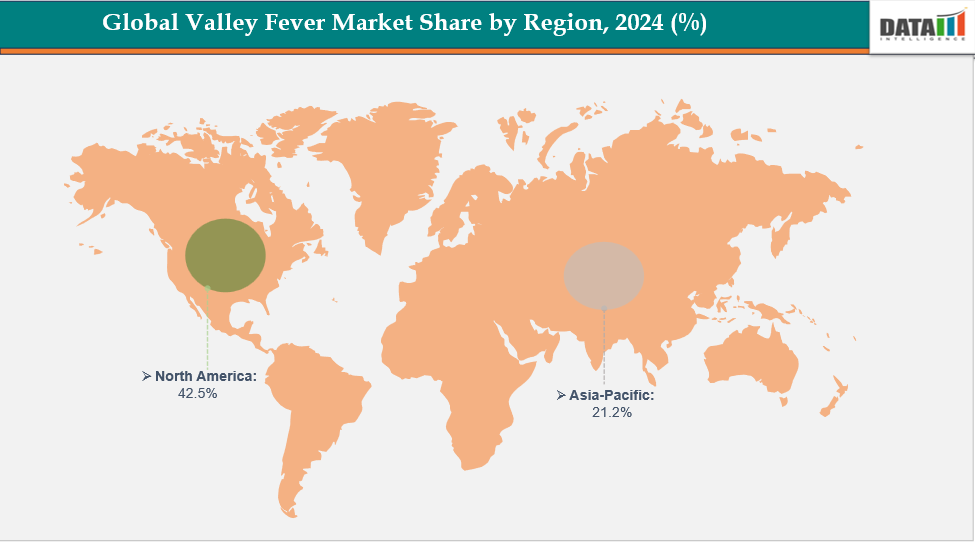
The valley fever market in North America is fueled by the high prevalence of disease, the well-established healthcare infrastructure and growing awareness among physicians and patients are driving the development of faster diagnostic methods and more effective treatments. The large at-risk population, including immunocompromised individuals, also drives demand for treatment and supportive care solutions.
For instance, Valley Fever, also known as coccidioidomycosis, is a fungal infection primarily affecting the lungs. It is caused by inhaling spores of the Coccidioides fungus, which thrives in the soil of arid and semi-arid regions, particularly in the southwestern United States. In early 2025, California reported over 3,100 confirmed cases of Valley Fever, surpassing the total number of infections reported in the previous year.
The United States is the largest and most significant market for Valley Fever, driven by high prevalence in endemic regions such as Arizona and California. Advanced healthcare infrastructure, widespread disease awareness, and extensive use of antifungal therapies like fluconazole and voriconazole make the US the key player in diagnosis, treatment, and market demand.
Europe is expected to be next dominating region after North America the global Valley Fever market with a 34.5% in 2024
Valley Fever, a rare fungal infection, is experiencing growth in Europe due to increased cases from international travel, tourism, and migration. Healthcare professionals are becoming more aware of these infections, and advancements in diagnostic technologies and antifungal therapeutics are helping. Strong regulatory frameworks and well-equipped healthcare facilities also contribute to early intervention and management.
Germany contributes primarily through the development and supply of antifungal drugs and diagnostic solutions, focusing on managing imported or rare cases of Valley Fever. Strong regulatory frameworks and well-established healthcare systems support timely diagnosis and treatment, positioning Germany as an important supplier and innovator in the market.
The Asia Pacific region is the fastest-growing region in the valley fever market, with a CAGR of 8.1% in 2024
The Valley Fever market in the Asia Pacific region is expanding due to improved healthcare infrastructure and infectious disease management investments. The growing awareness of fungal infections and the increasing prevalence of at-risk populations, such as immunocompromised patients and those with chronic respiratory conditions, are driving demand. Government initiatives and pharmaceutical distribution networks are also creating opportunities for antifungal therapies. Urbanization, travel, and environmental risk factors also contribute to market growth.
Japan is an emerging market for valley fever, with growth driven by increasing awareness of fungal infections, rising healthcare investments, and expanding access to antifungal treatments. Although cases remain rare and are mostly linked to travel or imported infections, Japan expanding healthcare infrastructure offers potential opportunities for market expansion.
Competitive Landscape
Top companies in the valley fever market include Pfizer, Janssen (Johnson & Johnson), Merck, Astellas Pharma and among others.
Pfizer: Pfizer plays a key role in the Valley Fever market through its antifungal portfolio, particularly Diflucan (fluconazole) and Vfend (voriconazole), which are widely prescribed off-label for managing coccidioidomycosis. These drugs are used to treat both primary pulmonary infections and severe disseminated cases, making Pfizer a significant player in providing therapeutic options where no FDA-approved, Valley Fever–specific treatment exists.
Key Developments:
In May 2025, A new diagnostic test under development at the Mayo Clinic enabled doctors to detect Valley Fever more quickly, potentially even during the first patient visit. Valley Fever, medically known as coccidioidomycosis, is a lung infection that occurs when fungal spores from dry, dusty soil—common in the U.S. Southwest are inhaled.
Market Scope
Metrics | Details | |
CAGR | 6.8% | |
Market Size Available for Years | 2022-2033 | |
Estimation Forecast Period | 2025-2033 | |
Revenue Units | Value (US$ Bn) | |
Segments Covered | Type of Infection | Acute Valley Fever, Chronic Valley Fever |
Drug Type | Fluconazole, Itraconazole, Voriconazole, Posaconazole, Amphotericin B (liposomal / conventional) | |
Route of Administration | Oral, Intravenous (IV infusion) | |
Distribution Channel | Hospital Pharmacies, Retail Pharmacies, Online Pharmacies | |
Regions Covered | North America, Europe, Asia-Pacific, South America and the Middle East & Africa | |
The global valley fever market report delivers a detailed analysis with 62 key tables, more than 57 visually impactful figures, and 159 pages of expert insights, providing a complete view of the market landscape.
Suggestions for Related Report
For more pharmaceuticals-related reports, please click here


























































