


USA Certified Reference Materials (CRM) Market Size and Overview
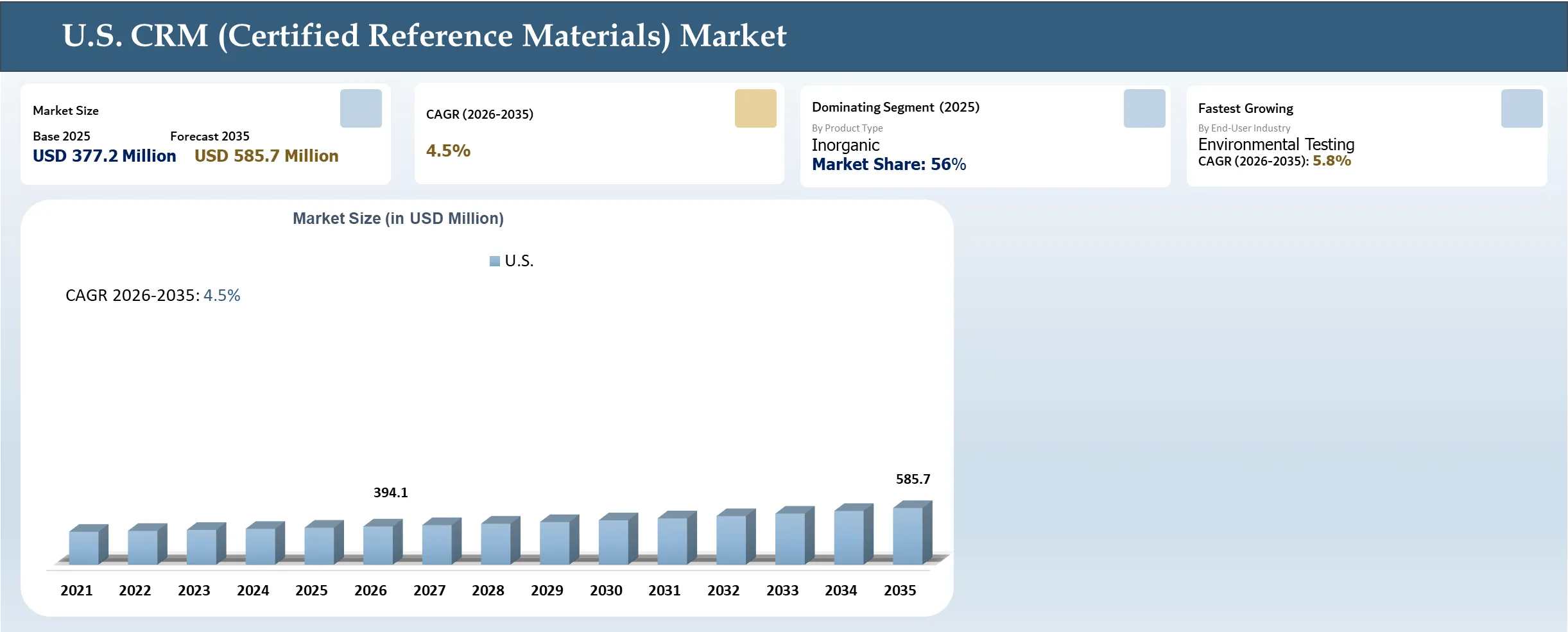
The USA certified reference materials (CRM) market reached USD 377.2 million in 2025 and is expected to reach USD 585.7 million by 2035, growing with a CAGR of 4.5% during the forecast period 2026-2035. The market is expanding due to the increasing requirement for reliable analytical measurements across pharmaceutical quality control, clinical diagnostics, environmental testing, food safety, and advanced materials manufacturing. Certified reference materials provide documented property values, measurement uncertainty, and traceability, enabling laboratories to calibrate instruments, validate analytical methods, and maintain consistent testing results. In April 2025, the National Institute of Standards and Technology (NIST) published updated reference-material certifications, including materials for electrolyte measurements in human serum and anion analysis, supporting clinical laboratory testing and quantitative chemical analysis.
In February 2026, according to LGC Group, the company acquired the ChromaDex Reference Standards portfolio from Niagen Bioscience. The acquisition increased the reference material portfolio of LGC by more than 3,000 reference materials, which include phytochemical reference standards and botanical reference standards utilised in the analysis of dietary supplements, pharmaceutical quality control, food testing and compliance.
USA Certified Reference Materials (CRM) Market Key Takeaways
- Inorganic certified reference materials dominated the USA market, holding a 56% market share in 2025. This dominance is driven by their mandatory use in elemental and metal analysis across environmental, pharmaceutical, and industrial testing.
- Growing demand for biopharmaceutical quality control contributes a 25% growth impact on the USA CRM market. This demand is propelled by the biopharmaceutical sector's expected expansion from USD 666 billion in 2025 to USD 1,184 billion by 2032.
- The National Institute of Standards and Technology (NIST) maintains over 1,000 reference materials, including more than 1,200 Standard Reference Materials (SRMs). In August 2025, NIST launched seven reference materials to the International Space Station aboard a rocket traveling at ~17,500 mph.
- In February 2026, LGC Group expanded its reference material portfolio by acquiring over 3,000 reference materials from Niagen Bioscience. The transaction included the ChromaDex portfolio, focusing on botanical and phytochemical reference standards for dietary supplements and pharmaceuticals.
USA Certified Reference Materials (CRM) Market Scope
| Metrics | Details |
| 2025 Market Size | USD 377.2 Million |
| 2035 Projected Market Size | USD 585.7 Million |
| CAGR (2026-2035) | 4.5% |
| By Product Type | Organic, Inorganic |
| By Application | Quality Control & Assurance, Method Validation, Regulatory Compliance Testing, R&D & Analytical Development, Calibration & Instrument Validation |
| By End-User Industry | Consumer Industry, Contract Testing, University / Non-Profit, Energy Industry, Environmental Testing, Health Care, Industrial / Manufacturing, Materials / Mining |
| Report Insights Covered | Competitive Landscape Analysis, Company Profile Analysis, Market Size, Share, Growth |
USA Certified Reference Materials (CRM) Market Disruption Analysis
Expansion into Space-Based Testing and Manufacturing Reshaping the USA Certified Reference Materials Market
The USA CRM market is disrupted by the growing demand for application-specific and customised reference materials along with developments in analytical instrumentation technology. The use of traditional and general-purpose CRM is being supported by the use of matrix-matched and well-characterised CRM for complicated analysis in the fields of pharmaceuticals, biotechnology, environmental analysis, food safety, and semiconductor production industries.
Furthermore, in February 2026, according to the National Institute of Standards and Technology (NIST), the seven reference materials were launched to the International Space Station on August 24, 2025, aboard a Falcon 9 rocket travelling at approximately 17,500 miles per hour. Of these seven materials, six were Standard Reference Materials (SRMs) meeting NIST’s highest measurement standard, while one was a reference material at the next-highest standard. NIST also reported that its collection contains more than 1,000 reference materials, highlighting the established role of standardised materials in research and industrial measurement. The samples are intended to help scientists determine whether space exposure causes chemical changes, using techniques such as nuclear magnetic resonance spectroscopy.
USA Certified Reference Materials (CRM) Market BCG Matrix: Company Evaluation
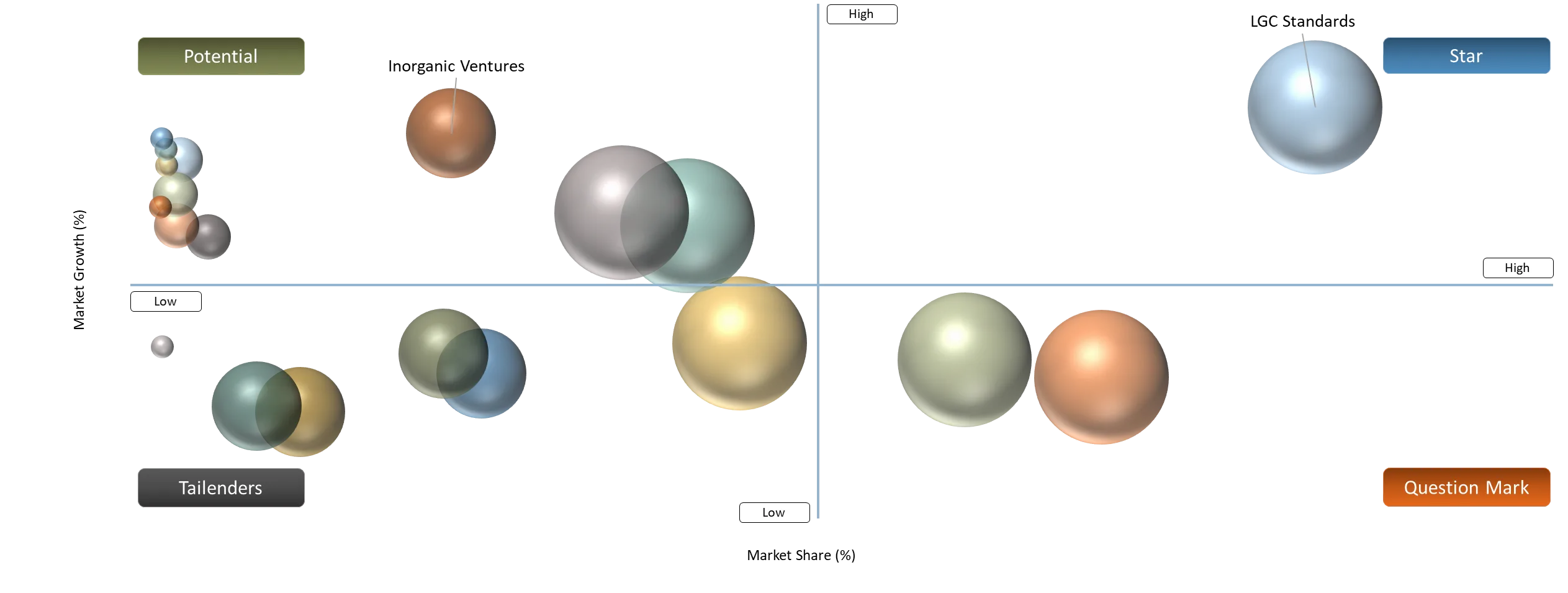
Stars include LGC Standards, MilliporeSigma (Merck KGaA), and Agilent Technologies because of their broad reference-material portfolios, established laboratory customer bases, and strong presence across pharmaceutical, environmental, chemical, and analytical testing applications. Question Marks include Thermo Fisher Scientific, AccuStandard, and Restek Corporation.
Potential includes Inorganic Ventures and RICCA Chemical Company, which focus on analytical standards, inorganic solutions, and laboratory reference materials. Tailenders include CPI International and Waters Corporation in this indicative classification. CPI International supplies specialised laboratory and analytical products, while Waters Corporation has a strong presence in analytical instrumentation and chromatography-related solutions.
USA Certified Reference Materials (CRM) Market Segment Analysis
The USA certified reference materials (CRM) market is segmented based on product type, application, end-user industry, and region.
Inorganic Certified Reference Materials Dominate the USA CRM Market Due to Extensive Use in Elemental Analysis and Regulatory Compliance
The inorganic segment dominates the USA certified reference materials (CRM) market, with a market share of 56% in 2025, due to its extensive use in elemental analysis, chemical testing, environmental monitoring, and industrial quality control. Inorganic Certified Reference Materials (CRMs) constitute the analytical foundation for elemental and metal analysis across environmental monitoring, pharmaceutical quality control, food safety, geological surveys, industrial metals testing, and clinical chemistry.
Governed by the dual-accreditation framework of ISO 17034 (reference material producer competence) and ISO/IEC 17025 (testing and calibration laboratory competence), inorganic CRMs are mandated inputs for every laboratory operating in a regulated environment globally. The market's structural architecture reflects decades of methodological investment; NIST's Standard Reference Materials program alone certifies and provides over 1,200 SRMs with well-characterised composition or properties, establishing the primary metrological benchmark to which all downstream inorganic standards must trace traceability.
USA Certified Reference Materials (CRM) Market Competitive Landscape
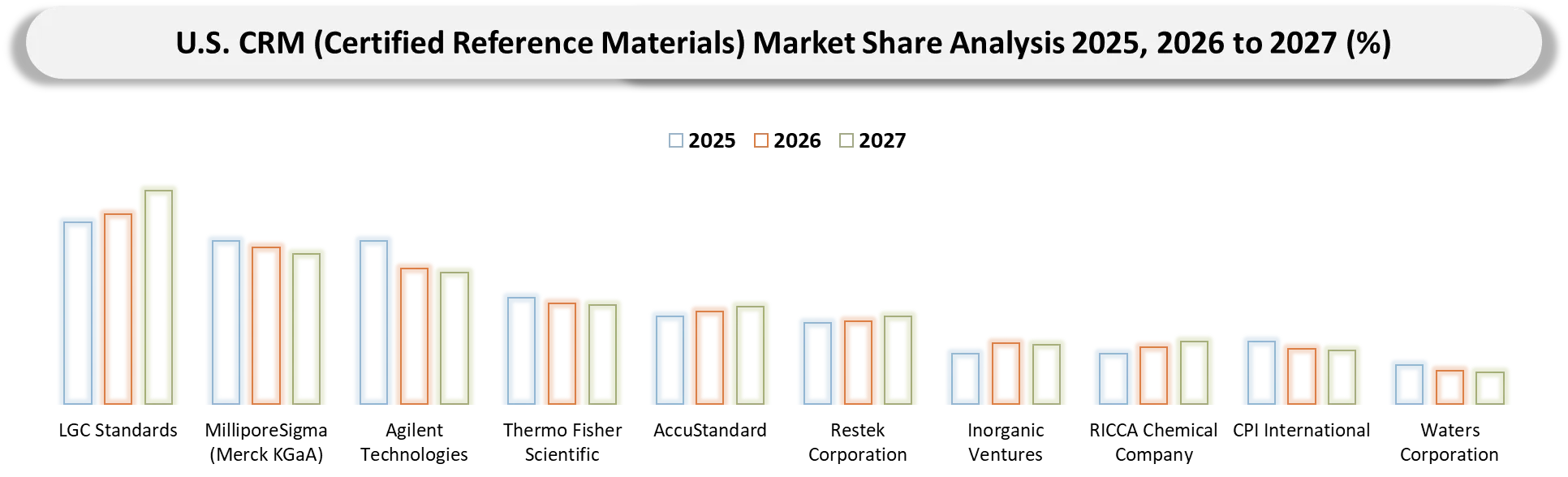
- The USA certified reference materials (CRM) market is characterised by a competitive mix of specialised reference-material manufacturers, analytical laboratory suppliers, and diversified life-sciences and laboratory-instrument companies. LGC Standards, MilliporeSigma (Merck KGaA), Agilent Technologies, Thermo Fisher Scientific, AccuStandard, Restek Corporation, Inorganic Ventures, RICCA Chemical Company, CPI International, and Waters Corporation compete through certified chemical standards, inorganic and organic reference materials, analytical calibration solutions, and products supporting pharmaceutical, environmental, food-safety, and industrial testing. Competition is shaped by certification quality, metrological traceability, breadth of product portfolios, regulatory documentation, distribution reach, and the ability to meet specialised laboratory requirements.
- Key players in the USA Certified Reference Materials (CRM) market include LGC Standards (United Kingdom), MilliporeSigma (Merck KGaA) (Germany), Agilent Technologies (United States), Thermo Fisher Scientific (United States), AccuStandard (United States), Restek Corporation (United States), Inorganic Ventures (United States), RICCA Chemical Company (United States), CPI International (United States), and Waters Corporation (United States).
Key Developments
- July 2025: AccuStandard expanded the ISO 17034:2016 scope to include Physical Property CRMs for petroleum (Density Standards).
- March 2025: AccuStandard launched a new PFAS CRM including all 29 target compounds listed in the EN 17892 method for EU drinking water.
- January 2026: Antylia Scientific appointed Hermes González-Bello as CEO to drive growth across its CRM brands, including SPEX and ZeptoMetrix.
- November 2025: Antylia Scientific Consolidated SPEX and Environmental Express under the Antylia umbrella to provide integrated CRM solutions for environmental analysis.
Why Choose DataM?
- Technological Innovations: Explores advancements in certified reference materials, analytical calibration standards, high-purity chemicals, and matrix-matched reference materials, highlighting their role in improving measurement accuracy, analytical reliability, and laboratory quality control across pharmaceutical, environmental, food, and industrial testing.
- Product Performance & Market Positioning: Evaluates CRM suppliers based on certification quality, metrological traceability, measurement uncertainty, homogeneity, stability, product portfolio, and compliance with ISO 17034 and ISO/IEC 17025 requirements, identifying how leading companies differentiate their offerings across specialized laboratory applications.
- Real-World Evidence: Highlights the application of CRMs in drinking-water analysis, environmental contaminant monitoring, pharmaceutical quality assurance, food-safety testing, elemental analysis, and industrial material characterization, demonstrating their importance in validating analytical methods and ensuring dependable laboratory results.
- Market Updates & Industry Changes: Tracks developments in reference material certification, new standard reference material releases, analytical testing requirements, laboratory accreditation practices, and regulatory method updates in the USA, helping stakeholders understand evolving procurement needs and quality assurance priorities.
- Competitive Strategies: Analyzes how key suppliers, including LGC Standards, MilliporeSigma, Agilent Technologies, Thermo Fisher Scientific, AccuStandard, Restek Corporation, Inorganic Ventures, RICCA Chemical Company, CPI International, and Waters Corporation, compete through product specialization, certification capabilities, portfolio expansion, technical support, and laboratory distribution networks.
- Pricing & Market Access: Examines CRM pricing considerations based on material composition, purity, concentration, certification complexity, matrix type, packaging size, shelf life, and documentation requirements, while assessing supplier availability, distribution channels, delivery lead times, and the cost implications of specialized or custom reference materials.
- Market Entry & Expansion: Identifies opportunities arising from demand for environmental testing, pharmaceutical quality control, food-safety analysis, advanced analytical instrumentation, and industrial compliance testing. It also evaluates strategies such as expanding specialized CRM portfolios, strengthening certification capabilities, developing application-specific standards, and building partnerships with laboratories and analytical testing providers.
Target Audience 2026
- Certified Reference Material Manufacturers and Suppliers
- Analytical Instrument and Laboratory Equipment Manufacturers
- Pharmaceutical and Biotechnology Companies
- Environmental Testing Laboratories
- Food and Beverage Testing Companies
- Chemical, Petrochemical, and Materials Manufacturers
- Clinical and Diagnostic Laboratories


























































