


UPS Market Size and Overview
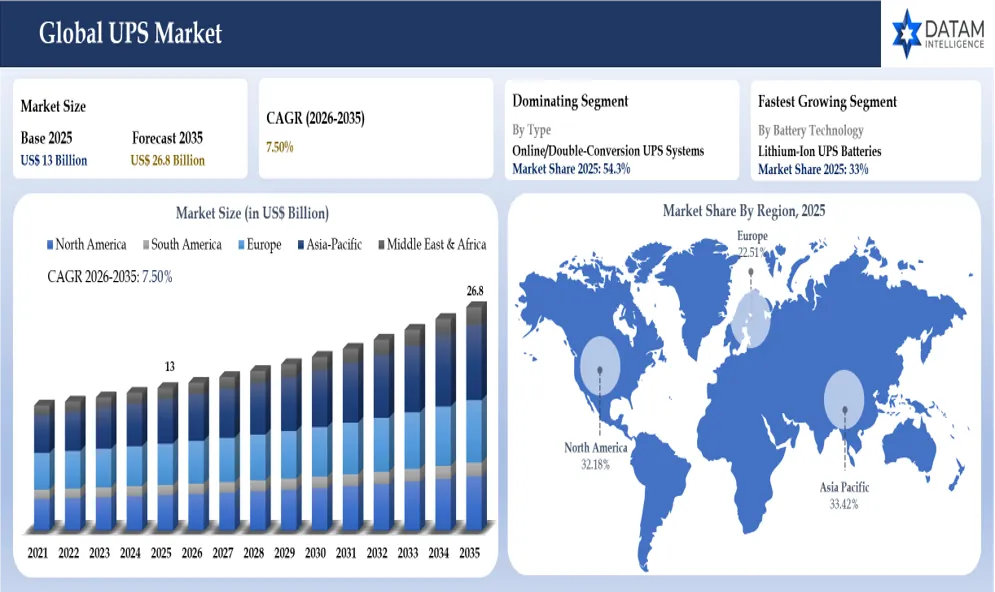
The global UPS market reached US$ 13 billion in 2025 and is expected to reach US$ 26.8 billion by 2035, growing with a CAGR of 7.50% during the forecast period 2026-2035.
The demand for UPS systems has been increasing in order to ensure reliable power protection at AI data centers, cloud computing, semiconductor processing, healthcare services, telecommunication and industrial automation systems. In high density AI data centers, 100 kW or higher energy is needed per rack, hence the growing need for high capacity three phase UPS systems, modularity and redundant power systems. Critical facilities have adopted the N+1 power redundancy that ensures there is extra power unit other than the one needed to operate the load. On the other hand, hospitals, factories and banks need uninterrupted power supply in order to protect their critical machinery from damage and any possible breakdowns. The demand for power stability is driving the deployment of UPS systems, which can handle increasing power loads.
Technology innovations have affected the UPS purchase decision because of increased power conversion efficiency, sophisticated battery technology and intelligent monitoring. The lithium-ion batteries could last about 2 to 3 times longer than the typical lead-acid batteries under proper operating conditions but depend on temperature, how the batteries were charged and discharged. The UPS could operate at a high efficiency rate of 96% to 99%, depending on the mode of operation. Intelligent monitoring could help the operator identify any problems such as battery deterioration and failure due to overheating. This is increasing the need for power efficient, modular UPS systems that provide power security, cost effectiveness and maintenance services in the context of data centers, industries, businesses and institutions.
UPS Market Key Takeaways
- Online or Double Conversion UPS systems were the market leaders in the global UPS market in 2025 with about 54.3% market share owing to high reliability, continuous power conditioning and usage in critical applications.
- Lithium-ion UPS batteries are getting more popularity owing to their increased service life, greater energy density, faster charging rate and less maintenance cost. The lithium-ion segment in the UPS batteries segment will witness a growth at a CAGR of 9.51% between 2026 and 2035.
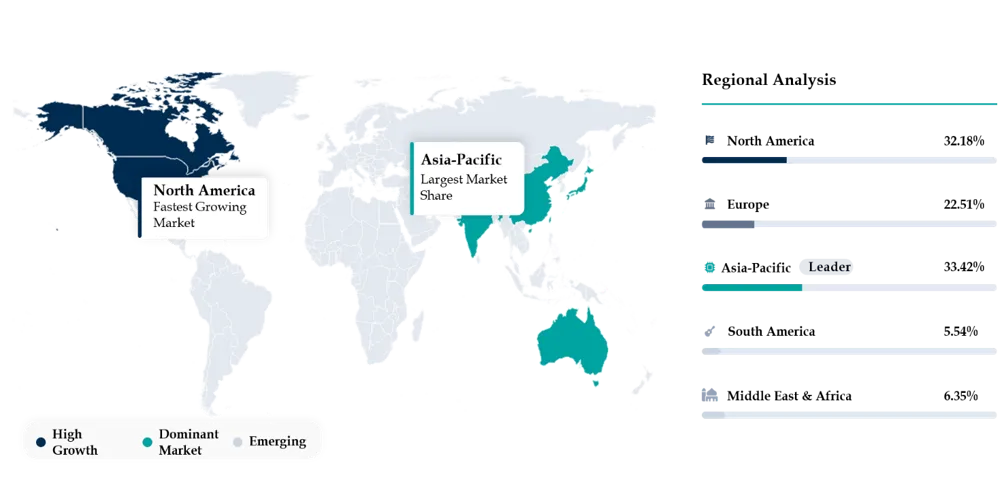
- The Asia Pacific region was the largest region in 2025, representing 33.42% share of the global UPS market, backed by the development in the data centers, industrial automation, telecommunications industry and the requirement for reliable backup power solutions.
- Modular UPS systems are becoming more popular as they help companies to progressively increase their power capacity and improve redundancy and maintenance without having to replace their entire system.
- Increased investments in AI infrastructure and high-density data centers have been driving the demand for UPS systems with high-capacity batteries, energy-efficient power conversion systems, remote monitoring technology and predictive maintenance features.
UPS Industry Trends and Strategic Insights
- With the rise in power density in AI data centers, there is a growing need for higher-capacity three-phase uninterruptible power supply systems that will be capable of handling variable electrical loads, maintaining power flow and offering redundancy to the vital computing systems.
- There has been increased interest in lithium-ion batteries in data centers and industries owing to the extended lifespan, minimal maintenance needs and space saving compared to the typical lead-acid battery technology.
- The modular designs of UPS systems are allowing data centers and industries to increase their power supply incrementally, while remaining redundant and being able to replace individual power units without changing their overall system design.
- Energy efficiency is emerging as a key purchasing consideration since UPSs in data centers, hospitals and industries run for long durations. Purchasers are looking to optimize conversion efficiency under actual load conditions to save on electrical energy use and cooling as well as minimize costs.
- UPS suppliers are enhancing their remote diagnostic, battery life analysis and maintenance prediction abilities to detect component wear out before problems arise. Integrating with generators, switchgears, PDUs and DCIM solutions adds importance to system reliability and lifecycle service.
UPS Market Scope
| Metrics | Details | |
| 2025 Market Size | US$ 13 Billion | |
| 2035 Projected Market Size | US$ 26.8 Billion | |
| CAGR (2026-2035) | 7.50% | |
| Largest Market | Asia-Pacific | |
| Fastest Growing Market | North America | |
| By Type | Standby/Offline UPS, Line-Interactive UPS and Online/Double-Conversion UPS | |
| By Power Capacity | Up to 1 kVA, Above 1–10 kVA, Above 10–100 kVA, Above 100–500 kVA, Above 500–1,000 kVA and Above 1,000 kVA | |
| By Battery Technology | Lead-Acid Batteries, Lithium-Ion Batteries, Nickel-Cadmium Batteries and Other Battery Technologies | |
| By Component | Hardware, Software and Services | |
| By Power Conversion | AC-to-AC UPS, AC-to-DC UPS and DC-to-DC UPS | |
| By UPS Configuration | Standalone/Fixed-Capacity UPS and Modular/Scalable UPS | |
| By End-User | Data Centers and Cloud Computing, Information Technology and Enterprise Networks, Telecommunications and 5G Infrastructure, Banking, Financial Services and Insurance (BFSI), Healthcare and Hospitals, Pharmaceutical and Biotechnology, Industrial Manufacturing and Factory Automation, Oil and Gas, Power Generation and Utilities, Renewable Energy and Energy Storage, Transportation and Railways, Aviation and Airports, Defense and Aerospace, Government and Public Infrastructure, Commercial Buildings and Office Complexes, Retail and E-commerce Facilities, Education and Research Institutions, Residential and Small Office/Home Office (SOHO), Mining and Metals, Food and Beverage Processing, Automotive and Electric Vehicle Manufacturing, Semiconductor and Electronics Manufacturing, Media, Broadcasting and Entertainment, Water and Wastewater Treatment, Logistics, Warehousing and Distribution Centers and Others | |
| By Distribution Channel | Direct Sales, Distributors and Resellers, System Integrators and Other Indirect Channels | |
| By Region | North America | U.S., Canada, Mexico |
| Europe | Germany, UK, Russia, France, Spain, Italy, Poland | |
| Asia-Pacific | China, India, Japan, Australia, South Korea, Indonesia, Malaysia, Singapore, Vietnam, Thailand, Philippines, Taiwan | |
| South America | Brazil, Argentina | |
| Middle East and Africa | UAE, Saudi Arabia, South Africa, Israel, Turkiye, Nigeria | |
| Report Insights Covered | Competitive Landscape Analysis, Company Profile Analysis, Market Size, Share, Growth | |
Why does this report matter in 2026?
The UPS industry is expected to be very strategic by 2026, driven by the rising need for dependable and efficient UPS systems for AI infrastructure, hyperscale data centers, cloud computing and semiconductor manufacturing. The increasing server power density and variability in computing load have forced facility planners to evaluate their UPS capacity, redundancy, battery runtime and energy efficiency when creating new plants or improving old ones. At the same time, old power-protection systems at industrial plants, hospitals, telecom facilities and office buildings offer the potential for replacement and upgrade. This report will assist in determining which types of UPS systems, power capacities and batteries are best suited to meet changing demands.
In 2026, competitive advantage will be more about factors other than mere hardware, as the consumer assesses lifetime costs, efficiency of power conversion, use of lithium ion batteries, scalability, intelligence monitoring and maintenance. Manufacturers and investors must separate new opportunities for growth within the domain of artificial intelligence data centers and digital infrastructure from existing replacement-based needs and examine competitive situations between international vendors and regional manufacturers. This document helps decision-makers evaluate products and markets and plan for investments based on the linkage between market segmentation, technological disruption, competitive positioning and investment opportunities, all relevant to the developing power protection industry.
UPS Market White Space & Investment Opportunities
- There is rising demand for AI data centers and high-density computing, creating business opportunities for UPS systems that feature modularity, scalability in power protection, N+1 redundancy and energy savings for GPU clusters and hyperscale infrastructure.
- The use of lithium-ion batteries especially lithium iron phosphate (LFP) opens up possibilities of designing UPS solutions with higher battery longevity, low maintenance needs, efficient space management and intelligent battery management features.
- The emergence of hyperscale data centers and semiconductor manufacturing plants offers business opportunities for scalable and high-capacity UPS architecture solutions that cater to rising electrical loads and power reliability needs.
- The combination of real-time monitoring, predictive analytics and intelligent diagnostics provides scope for the creation of software-based UPS systems capable of detecting battery deterioration, temperature problems and hardware malfunctions that can lead to unexpected downtime, as well as recurring income from monitoring and maintenance services.
- The need for upgrading of the existing aging UPS installations in hospitals, industrial plants, telecommunication infrastructure and commercial properties provides a new business opportunity.
UPS Future Market Transformation
The UPS market is forecasted to move from traditional backup power devices to intelligent, scalable power protection systems tailored for AI data centers, dense computing environments, advanced manufacturing plants and other critical facilities. In the future, systems would be designed with an increased emphasis on modularity, higher power density, increased efficiency in conversion, battery technology and intelligent control that would react based on load changes. The use of battery energy storage solutions, generation systems and data center energy management systems may contribute to a more coordinated approach to power management. Additionally, AI-based diagnostics and predictive maintenance reduce the risks posed by battery deterioration and equipment malfunctions. The increase in demand from users for continued operation, improved energy efficiency and lower costs will likely lead to competition in the industry based mainly on interoperability, scalability, information security and lifecycle services of systems rather than on their hardware components.
UPS Market Buyer Decision-Making Criteria
The purchasers of the UPS consider the importance of the equipment that needs protection, the length of backup duration needed, the load size, the quality of power required and the consequences of an unforeseen shutdown in terms of money. Data center operators give preference to continuous availability, easy-to-scale solutions, high redundancy levels and energy efficiency. Meanwhile, companies from the industrial and medical sectors tend to look for reliability in operation, integration with existing electrical wiring and good technical support. The frequency of battery replacements, its life span, the need for maintenance, the conditions for installing it and the total cost of ownership also play a role in the buying process. For high-density AI data center applications, buyers are beginning to evaluate the capabilities of UPS units to handle variable power loads, facilitate growth potential and work seamlessly with monitoring software and generators and other power devices.
Major Buyer Decision-Making Criteria:
- Power Capacity and Scalability
- Reliability and Redundancy
- Backup Runtime
- Power Quality and Conversion Efficiency
- Battery Technology and Lifecycle Costs
- Total Cost of Ownership (TCO)
- Monitoring and Predictive Maintenance
- Integration and Compatibility
- Service and Technical Support
- Physical Footprint and Installation Requirements
- Safety and Compliance
- Supplier Capability and Product Availability
UPS Market Economic & Investment Analysis
Investment opportunities are generated in the UPS market as a result of the capital expenditures required in the construction of AI data centers, hyperscale cloud computing infrastructure, semiconductor fabrication plants and critical power systems. These expenditures are contributing towards higher demand for high capacity modular UPS systems, advanced battery packs, power conversion efficiency and power management solutions. In the economic context, investments are measured in terms of the total cost of ownership that includes electricity usage, cooling, battery replacement, maintenance and cost implications of power outages. In addition to the revenue potential from hardware sales, the scope of the investment opportunities includes the upgrades of batteries to lithium-ion, renovation of outdated systems, predictive maintenance and service agreements. Nonetheless, high start-up capital, volatility of component prices, battery costs, delivery problems and competition from existing manufacturers may pose challenges for margin and return on investments. It is therefore imperative to take into account the differentiation of technology, economies of scale, service capability and exposure to data centers among others when considering investment in the UPS industry.
UPS Investment Trends in the Market
- The need for large power capacities, better redundancy and protection and increased power density in AI data centers and computing sites is driving the growth of investments in high-power and scalable UPS technology.
- UPS manufacturers are focusing on expanding the investment in lithium-ion battery technologies, with special emphasis on lithium iron phosphate (LFP) technologies to improve battery life, decrease maintenance requirements, enhance thermal safety and optimize installation space.
- Efficiency improvement in power-conversion technologies, including silicon carbide (SiC) semiconductor and inverter technology, has become integral for data centers and industrial facilities to minimize energy loss as well as to decrease operational costs.
- Manufacturers are initiating the use of smart monitoring systems, forecast diagnostics and remote battery control in order to identify fault development, increase availability and additionally generate new sources of revenue from software-based monitoring and maintenance services.
- Companies are launching an effort to develop modular products, build up their manufacturing facilities, establish service centers and create spare parts networks to promote faster deployment of UPS solutions, help meet the increasing number of installations and improve the quality of after-sale service.
Strategic Indicators for UPS Market
High Regulation Impact
There are important regulations that apply to the UPS industry with regard to electrical safety, electromagnetic compatibility, energy efficiency and transportation and handling of batteries. The IEC 62040 family sets out the essential requirements concerning the safety, electromagnetic compatibility and performance of UPS systems and there are regional regulations like the EU's RoHS and WEEE regulations regarding hazardous substances and the treatment of end-of-life electrical equipment. There are also requirements when using lithium-ion UPS systems in terms of battery safety and heat management. There are many variations that depend on country, product architecture and installation site. Therefore, regulatory requirements play an important part in strategic considerations for the production of goods that will be used in data centers, hospitals, manufacturing sites and other mission critical applications.
High Investment Activity
The investment trends within the UPS industry are shifting towards higher capacity UPS power protection solutions for artificial intelligence data centers, hyperscale clouds and semiconductor manufacturing facilities, as failure to protect such infrastructures against any power loss results in major business losses. There are developments within the data center segment and critical infrastructure businesses, that include investments into modular UPS architectures, redundant power systems, Lithium-ion battery banks and prefabricated power solutions. The investments into UPS are also aimed at providing high efficiency in power conversion, advanced monitoring, predictive maintenance services and service networks, which allows for creating a competitive advantage and generating recurring revenues from maintenance services in addition to selling the equipment itself.
Supply Chain Disruption
The UPS market faces the risk of disruptions related to the supply chains that impact the supply of power semiconductors, microcontrollers, capacitors, magnetic components, batteries and other assemblies used in the power conversion process. The production of high-capacity UPS relies on having access to various components such as IGBTs, SiC components, transformers and battery management systems. On the other hand, lithium-ion battery procurement is affected by issues such as the availability of cells as well as variations in the cost of raw materials. The procurement process for components used in the production of UPS can be affected by geopolitical risks, trade regulations, concentration of component manufacturing and logistical challenges. All these factors have the potential of increasing procurement costs and extending the delivery times, especially when it comes to large data centers which have tight deadlines.
Pricing Volatility
Factors that drive prices for UPSs include volatility of copper, lead, steel, power semiconductors and battery components, as well as the fluctuation in logistics expenses and component availability. In H1 2025, average Copper prices on the London Metal Exchange (LME) increased by 4% year-on-year to around $9,432 per tonne while average prices for lead fell by 8% to about $1,959 per tonne, demonstrating how such input costs can behave differently. The large fluctuations in prices will affect the costs of UPS manufacturing, batteries sourcing, suppliers’ margins and project costs. The initial costs, replacement cycle and maintenance requirements of lithium-ion battery systems are different from those of lead-acid systems, which is why costs will depend on the specific battery size and the configurations and requirements of the UPS system. Manufacturers have many possible strategies for controlling the price volatility of batteries and, among others, they are likely to vary their sources of supply, sign long-term supply contracts and optimize their inventory.
Procurement Pressure
The pressure on procurement is rising in the UPS market because of the growing need for high-capacity power protection systems, triggered by developments in the AI data center construction, growth of hyperscale clouds and the emergence of high-density computing. As per JLL’s 2026 Global Data Center Outlook, the global average lead time for data center equipment became about 33 weeks and the average lead time for data center equipment in the United States was 42 weeks, still staying high compared to pre-2020 levels. However, there is an additional variability in lead times depending on UPS capacity, design, vendor and geographic location. The shortage of power modules, batteries, transformers and other essential parts of UPS systems can delay project implementation and raise expenses for the project.
New Technology Adoption
The UPS industry is moving towards adoption of more modular UPS systems, advanced battery technology and high conversion efficiency to cope with ever-increasing power density and reliability needs of AI data centers, semiconductor fabrication plants and other mission-critical facilities. Lithium ion batteries are becoming more prevalent in high capacity UPS due to their extended lifespan, low maintenance needs and smaller size although there is still an important role for lead acid batteries in many applications. The silicon carbide (SiC) power semiconductor could increase conversion efficiency and reduce thermal losses in selected UPS designs while the monitoring capabilities, battery state analysis, remote diagnostics and predictive maintenance allow operators to detect possible system failures at an early stage. This is causing a shift in the procurement preferences of companies from the current UPS systems to those which offer scalability and upgrades at a higher energy efficiency level.
Regional Expansion Opportunity
Asia-Pacific is one of the largest regions that provides a lot of opportunities for market expansion of UPS due to rising development of data centers, cloud computing, AI infrastructure and industry modernization in countries like India, Malaysia, Indonesia, Thailand and Vietnam. According to Cushman & Wakefield, the pipeline of data center developments in the Asia-Pacific region reached 26.5 GW in H1 2026, Southeast Asia accounting for nearly 50% of total under-development capacity and Malaysia and Thailand being among the most active countries in this region. Other opportunities include developing data centers ready for AI in India and emerging markets like Indonesia and Vietnam due to investments into digital infrastructure. The way UPS companies may take advantage of such an opportunity is through local manufacturing and service network as well as working together with developers and electrical contractors of data centers and adjusting products to the local environment.
Government Policy Support
Government policies that are geared towards data centers, artificial intelligence infrastructure and semiconductors act as indirect demand drivers by providing incentives for investments into facilities that need uninterrupted supply of power. Under the Union Budget 2026-27, India is proposing a tax holiday until 2047 for eligible foreign cloud service providers utilizing data centers in India for their global operations under certain conditions. In the states, under the Uttar Pradesh Data Center Policy 2026, there are incentives available for eligible data center units such as capital subsidy up to Rs 20 crore, electricity duty exemption for ten years and dual-grid power infrastructure for eligible data center parks. These initiatives could provide chances for UPS vendors who manufacture high-capacity modular UPS, redundant power supply, battery technologies and power protection with efficiency. But these policies mainly cater to data center’s investments, not the UPS’s themselves, so the effect of these policies on the UPSs' market depends on the subsequent constructions and acquisitions.
Pricing Intelligence
Pricing intelligence for UPS systems is contingent on the comparison of specifications, configuration and commercial scope of the system and not only its price per piece of equipment. Single-phase UPS systems will fall in low price tiers due to lower capacity, whereas three-phase UPS systems will have higher prices due to their power modules, redundancy design, batteries and other complex components. Some of the main pricing factors are rated capacity (kVA/kW), back-up time, battery technology, N+1 redundancy, monitoring, installation, commissioning, warranty and maintenance services. For the buyers, comparison of quotations will allow them to see differences in the size of batteries, accessories that come along with the system, the range of services provided and the cost of operation; for the sellers, price levels and configurable service packages will provide means of differentiation among data centers, industrial applications, healthcare and commercial usage. In contrast to pricing volatility, pricing intelligence analyzes the pricing of UPS systems.
| HS Code | Reporter | Trade Flow | 2025 Trade Value | Interpretation |
| 850440 | China | Exports | US$ 36 billion | Major global export hub for static converters, supporting international supply of power-conversion equipment used across industrial, commercial and electronic applications. |
| 850440 | Germany | Exports | US$ 9.3 billion | Significant exporter of static converters, reflecting its industrial electrical equipment and power electronics manufacturing base. |
| 850440 | United States | Imports | US$ 18 billion | Major importing market for static converters used in data centers, IT infrastructure, industrial equipment and power management systems. |
| 850440 | Germany | Imports | US$ 10 billion | Significant importing market for static converters, reflecting demand across industrial automation, commercial infrastructure and electrical systems. |
Note: HS Code 850440 covers static converters broadly, including but not limited to UPS systems. The reported 2025 trade values represent total trade under this classification and should be interpreted as indicators of the broader power-conversion equipment supply chain, not as UPS specific trade values.
AI Impact Analysis of UPS Market
AI is impacting the UPS industry not only as an additional source of demand but also as a means of increasing the performance of these systems. The growth of AI training clusters, hyperscale data centers and high-density GPU servers leads to an increase in power loads and increased demands for high-capacity online UPS systems with redundancy and fast load switching capabilities. AI workloads result in highly variable power consumption which makes UPS sizing, transients management, battery operation and interaction between generators and power distribution systems more relevant than ever. It also stimulates manufacturers to design scalable UPS solutions with improved power densities and efficiencies.
The use of AI in UPS systems also includes predictive maintenance, analysis of battery state, anomaly detection and diagnostics of malfunctions. Through the analysis of temperature, loads, battery operation and equipment behavior, artificial intelligence may provide an opportunity for detecting the beginning of battery deterioration or equipment malfunctioning, which will allow for conducting maintenance work before the problem arises. The combination of AI monitoring with the systems of data center infrastructure management and energy management will facilitate the process of loads balancing, energy monitoring and maintenance scheduling. Nonetheless, such advantages would be contingent upon the validity of sensor data, reliable connectivity, cybersecurity measures and integration into current infrastructure; AI-based monitoring would supplement physical redundancy, battery tests and traditional power protection measures.
Disruption Analysis of UPS Market
UPS market is changing through the transition from old-style fixed capacity solutions to new modular and high density solutions that are required in modern data centers and computing environments. The old-style UPS systems required proper capacity planning and expensive expansions, while with the modular system the operator could increase capacity gradually, keep redundancy and service individual modules without interrupting the important loads. Li-Ion batteries have emerged as a solution to conventional Lead Acid battery technology, thanks to their increased service life, less maintenance, better space efficiency, although the cost of initial investment and thermal management issues play a role. Developments in silicon carbide power semiconductors, inverters and optimized modes of operation have become another way for product differentiation.
One more disruptive trend is the shift from independent backup devices to smart, networked power protection systems that are incorporated into data center infrastructure management and energy management systems. Remote monitoring, battery life analysis, predictive maintenance and automatic alerts allow suppliers to move from selling their hardware only to providing lifecycle and support services. Possible future architectures related to direct current power distribution, battery power storage and on-site power generation may affect the design of the UPS systems as well. Such trends provide an opportunity for manufacturers that provide interoperable systems, security, guaranteed power continuity and improved system efficiency, putting competitive pressure on those suppliers whose solutions are based only on traditional hardware and software components of the UPS systems.
UPS Market BCG Matrix: Company Evaluation
STAR
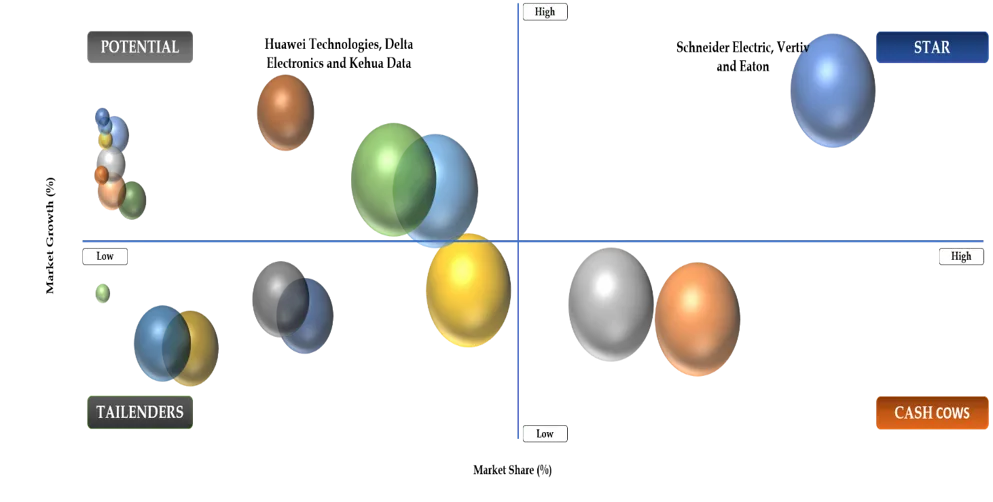
Schneider Electric, Vertiv and Eaton exemplify Star UPS companies based on the fact that they have an existing range of products, well-established distribution and services network and presence in the growing market for the power infrastructure of data centers. The increasing demands in AI computing, hyperscale data centers and cloud services provide room for the expansion of large-scale modular UPS, energy-efficient power conversion, integration of lithium-ion batteries and power intelligence for these players. The strengths for Schneider Electric are found in its comprehensive power management portfolio, for Vertiv in its integrated critical power and cooling systems and for Eaton in its extensive electrical power management systems.
POTENTIAL
Some of the potential growth companies in the UPS industry include Huawei Technologies, Delta Electronics and Kehua Data because of the companies’ expertise in power electronics and opportunities in modular UPS, telecommunication infrastructure, industrial applications and data center expansions. Some of the other areas where growth could be realized include high-power density protection, energy efficiency, intelligent monitoring and battery integration. It will be important for the success of these companies to build stronger market positions through wider acceptance internationally and domestically, differentiation and competition against other well-established suppliers.
UPS Market Dynamics
Driver Impact Analysis
| Driver | Market Growth Impact (%) | Demand Concentration | Impacted Use Case | Strategic Impact |
| AI and Hyperscale Data Center Expansion | 30% | North America, Asia Pacific | AI computing, cloud infrastructure, hyperscale data centers | Drives demand for high-capacity, modular and high-efficiency UPS systems |
| Increasing Need for Power Reliability | 25% | North America, Europe, Asia Pacific | Healthcare, BFSI, telecommunications, critical infrastructure | Strengthens demand for online UPS systems and high-availability power protection |
| Industrial Automation and Digitalization | 20% | Asia Pacific, Europe, North America | Manufacturing, robotics, process control | Expands adoption of industrial-grade UPS solutions |
| Energy Efficiency and Advanced Battery Adoption | 15% | North America, Europe, Asia Pacific | Data centers, enterprise IT, telecommunications | Accelerates adoption of energy-efficient UPS designs and lithium-ion battery systems |
Driver: AI Data Center Expansion and High-Reliability Power Requirements
The quick proliferation of artificial intelligence computing, cloud computing and hyperscale data centers is another driving force behind the development of the UPS industry, because servers have to be provided with continuous and reliable power supply in order to avoid downtime and potential damage. The high density of rack power has increased demand for high-capacity online double-conversion UPS systems, modular designs, redundant infrastructures and battery monitoring systems. In addition, data center managers are looking for UPS options that foster a reduction in power consumption through efficient power conversion while remaining capable of future capacity upgrades and being economical in operation.
Restraint Impact Analysis
| Restraint | Drag on Market Growth (%) | Primary Impact Area | Impacted Use Case | Strategic Impact |
| High Initial Installation Costs | 30% | Capital expenditure | SMEs, commercial facilities, industrial installations | Delays adoption and increases preference for lower-cost UPS systems |
| Battery Replacement and Maintenance Costs | 25% | Lifecycle operating expenses | Data centers, telecommunications, industrial facilities | Raises total cost of ownership and encourages adoption of longer-life batteries |
| Energy Losses and Cooling Requirements | 20% | Operating efficiency | Hyperscale data centers, enterprise IT, industrial plants | Drives demand for high-efficiency UPS systems and improved thermal management |
| Supply Chain Disruptions and Raw Material Price Volatility | 15% | Component availability and manufacturing costs | Large-scale data centers, commercial and industrial projects | Creates procurement delays and pricing uncertainty, potentially reducing manufacturer margins |
Restraint: High Initial Investment and Total Cost of Ownership
The need for high initial investment continues to be one of the primary constraints facing the UPS industry, especially when high-capacity online UPS units, which will have redundant systems, batteries, electrical connections and commissioning, are needed. Despite lithium-ion UPS systems being able to decrease maintenance and increase efficiency regarding space, the initial costs for installing such a system could prove higher compared to traditional lead-acid systems. Other costs related to battery replacements, cooling, regular tests and preventive maintenance are going to make the price for ownership even higher. These financial concerns might affect the decision to upgrade the current UPS system of many small and medium businesses, as well as industrial companies who have budget constraints.
UPS Market Segmentation Analysis
The global UPS market is segmented based on the type, power capacity, battery technology, component, power conversion, UPS configuration, end-user, distribution channel and region.
By Type
Online UPS Systems Led the Market Through Superior Power Protection
Online/Double-Conversion UPS systems held around 54.3% share of the global UPS market in 2025 due to the capacity to deliver uninterrupted power conditioning with minimal or zero downtime in the event of any power failure. Online UPS systems are popularly adopted in industries like data centers, hospitals, telecommunications and industries which require high-quality power conditioning systems since their operations are affected by power fluctuations or disruptions. Additional requirements for online UPS arise due to growing workload of AI, cloud computing facilities and high density server installations as sensitive electronics need protection from voltage changes, electrical disturbances and power outages.
By Battery Technology
Lithium-Ion Batteries Are Reshaping Backup Power Technology
Lithium ion UPS batteries have been witnessing adoption owing to their high energy density, fast charging ability, longevity and low maintenance needs relative to conventional lead acid batteries. This makes them suitable for use in data centers and telecommunication facilities among others. While their upfront cost tends to be relatively high, the lesser need for replacements and maintenance could potentially bring down costs. The rising demand for reliable and compact backup power sources could help the segment to grow, with the lithium ion UPS batteries expected to grow at 9.51% CAGR between 2026 and 2035.
UPS Market Geographical Penetration
U.S. UPS Market Landscape
The primary drivers behind the UPS market in the U.S. include the increasing adoption of AI and hyperscale data centers, the growth in the usage of cloud computing and the demand for uninterruptible power supply within the health care, financial, telecom and industrial sectors. Demand is in the process of shifting in favor of high-capacity online double-conversion and modular UPS systems that ensure better efficiency, redundancy and scalability for power-hungry computing environments. The development of lithium-ion batteries, intelligent monitoring and predictive maintenance systems becomes crucial as many organizations look to cut costs and reduce downtime as much as possible. Companies like Schneider Electric, Eaton, Vertiv and ABB are competing against each other with power protection solutions, integrated data center infrastructure and maintenance services.
China UPS Market Trends
China’s UPS market is being fueled by the growth in its AI computing infrastructure, hyperscale data centers and its East Data, West Computing strategy and all of them are fueling the need for large-capacity, modularity and energy-efficient power protection systems. There are several Chinese firms like Huawei, Kehua Tech and KSTAR, competing in the market through scalable UPS designs, competitive pricing and local service. The increasing density of servers is leading to the growing importance of high-capacity UPSs, whereas lithium-ion batteries, intelligent battery management and predictive maintenance are gaining popularity. The rising requirement for energy efficiency and advancement in the technological sector in the country are motivating investment into advanced power conversion technologies.
Germany UPS Market Analysis
The UPS market in Germany thrives because of the country’s robust industrial base, increasing capacity of data centers and requirement of stable power supply in industries including automobiles, machinery, chemicals, health care and precision engineering. The role of Frankfurt as a data center center for Europe, together with the growth in needs related to cloud computing and AI infrastructures, is expected to increase the demand for UPS systems having greater capacities and offering redundancy along with scalable power protection. Adoption of Industry 4.0 would further fuel the demand for power protection of automated manufacturing, robotics and control systems. Technologies including lithium-ion battery systems, efficient power conversion, remote monitoring and predictive maintenance are becoming increasingly important as companies strive to enhance reliability and minimize their lifecycle costs. Competitiveness among the vendors, including Schneider Electric, Eaton, Vertiv and ABB, is in terms of system efficiency, reliability, integration capability and maintenance services.
Japan UPS Market Outlook
The Japanese UPS market is driven by an increase in the capacity of data centers in key cities like Tokyo and Osaka, development of semiconductors and need for power in industries such as precision manufacturing, telecommunication, health care and industrial automation. There is an increase in the demand for high capacity online double conversion UPS systems as well as modular UPS as a result of the growth in cloud computing and AI workloads in Japan, which is very concerned about business continuity and disaster recovery. Major companies in Japan such as Fuji Electric, Mitsubishi Electric and Toshiba compete with other international players through the application of innovative power conversion techniques and high-efficiency systems. The aging of existing UPS systems, the introduction of lithium-ion batteries and the increase in remote monitoring and predictive maintenance are also presenting new possibilities to companies concentrating on reliability, energy efficiency and reducing life cycle costs.
UPS Market Competitive Landscape
The UPS industry comprises competitive rivalry among firms already in the power management industry, those specialized in critical power supply and manufacturers of modular power protection systems. Competitive differences are being influenced more and more by efficiency, reliability, scalability, batteries and service.
- Schneider Electric, Eaton and Vertiv offer stiff competition in the areas of small business backup solutions, enterprise-level power protection and data center systems with high capacities, thanks to their extensive product line-up and worldwide distribution channels for their power management systems.
- Huawei, Delta Electronics, Kehua and KSTAR bring even more competition into the industry with their modular architecture UPSs, high power density and competitive pricing aimed at data centers, telecommunications network systems and commercial installations.
- Product differentiation by manufacturers is achieved by virtue of the use of online double conversion technology, energy-efficient operation, scalability and redundancy designs which lead to better power availability and energy conservation.
- Integration of lithium-ion batteries, battery management systems, remote monitoring and diagnostics capabilities have become critical competitive advantages for suppliers to enhance their lifespan and identify potential issues while providing maintenance.
- Competitiveness is not limited to equipment only but goes to the installation, commissioning, maintenance, battery replacement and even upgrade of the existing systems. Good support network and relationship with customers are key factors for revenue generation for suppliers.
Public Company Q1-Q2 2026 Performance Comparison
The table below compares five publicly listed companies with direct exposure to the UPS (Uninterruptible Power Supply) market. Financial metrics reflect company-wide revenue because standalone UPS revenue is generally not separately disclosed. Performance drivers distinguish broader corporate results from specific UPS-related activities, particularly demand for AI data centers, critical power infrastructure and advanced power management.
| Company | Q1–Q2 2026 Performance | UPS Exposure | Key Performance Driver |
| Schneider Electric SE | Q1 revenue: US$11.42 billion; Q2 revenue: US$13.18 billion; H1 organic growth: 14% | APC and Galaxy UPS systems for data centers, enterprise IT and industrial facilities | AI data center expansion, energy management demand and investment in critical power infrastructure |
| Eaton Corporation plc | Q1 revenue: US$7.45 billion; Q2 revenue: US$8.53 billion; reported growth: 21% | Single-phase and three-phase UPS systems, power distribution and battery management | Data center power demand, electrical infrastructure investment and growth in power management solutions |
| Vertiv Holdings Co. | Q1 revenue: US$2.65 billion; Q2 revenue: US$3.27 billion; Q2 growth: 24% | Liebert UPS systems and integrated critical power infrastructure | AI infrastructure expansion, high-density computing and demand for integrated power and cooling systems |
| ABB Ltd. | Q1 revenue: US$8.73 billion; Q2 revenue: US$9.48 billion; reported growth: approximately 12% | Industrial, commercial and data center UPS systems | Electrification investment, industrial automation and critical infrastructure modernization |
| Delta Electronics, Inc. | Q1 revenue: US$5.02 billion; Q2 revenue: US$5.77 billion; H1 growth: 41% | UPS systems and power electronics for data centers, telecommunications and industrial applications | AI-related data center power demand, power electronics growth and integrated power management solutions |
Note: Revenue figures represent consolidated company performance, not UPS specific sales. Companies report in different currencies and reported growth rates may reflect differences in exchange rates, acquisitions and organic business performance.
Key Companies of UPS Market
- Schneider Electric SE (France)
- Eaton Corporation plc (Ireland)
- Vertiv Holdings Co. (United States)
- ABB Ltd. (Switzerland)
- Huawei Technologies Co., Ltd. (China)
- Delta Electronics, Inc. (Taiwan)
- Mitsubishi Electric Corporation (Japan)
- Riello UPS (Italy)
- Legrand SA (France)
- CyberPower Systems, Inc. (Taiwan)
- Toshiba Corporation (Japan)
- Socomec Group (France)
- Fuji Electric Co., Ltd. (Japan)
- Piller Power Systems GmbH (Germany)
- Shenzhen KSTAR Science & Technology Co., Ltd. (China)
- Kehua Data Co., Ltd. (China)
- AEG Power Solutions (Netherlands)
- INVT Power (China)
- Borri S.p.A. (Italy)
- Centiel SA (Switzerland)
Company Profiles of UPS Market
Schneider Electric SE
Schneider Electric is an international company that deals with energy management and automation and has a substantial position in the UPS segment. It offers APC UPS solutions, including one-phase and three-phase UPSs of the Galaxy series for the usage in data centers, enterprise IT, commercial buildings, industry and other critical infrastructure.
Priorities of competition can be defined as increasing implementation of high-capacity UPS solutions for AI and hyperscale data centers, improving energy efficiency, developing modular and scalable power architecture, installing lithium-ion battery systems and providing lifecycle services through digital monitoring and maintenance.
Eaton Corporation plc
Eaton is an organization engaged in manufacturing power management products and these include uninterruptible power supply systems used for data centers, enterprise IT, commercial, industrial buildings, healthcare and telecommunication sectors. The offerings include both single phase and three-phase uninterruptible power supply systems with power distribution equipment, battery management and electrical infrastructure solutions.
The competitive priorities of Eaton include growing its market presence in the areas of data centers and industrial applications, creation of energy-efficient UPS technologies, increasing the range of lithium-ion batteries, digital power management solutions and providing services for installation, maintenance and modernization of equipment.
Vertiv Holdings Co.
Vertiv is a provider of important digital infrastructure and equipment for use in a wide range of different types of environments, including UPS systems, power distribution systems, thermal management products and integrated solutions to help the data centers and communication networks. The Liebert branded UPS solutions by Vertiv can accommodate even the smallest IT environment and multinationals and have applications in data centers and hyper-scaled data centers. The company stands to capitalize on increased demand for electricity because of artificial intelligence, cloud computing and denser servers.
Key competitive challenges are increasing high-capacity and modular UPS solutions, increasing efficiency of power conversion, accommodating the rapidly evolving demands of AI workloads, combining power and cooling infrastructures and offering prefabricated solutions for large data center projects.
ABB Ltd.
ABB is an internationally renowned manufacturer of electrical and automation products that maintains a UPS portfolio for data centers, commercial buildings, industrial, healthcare facilities and other mission-critical applications. Some of the UPS systems offered by ABB include single-phase UPS systems, three-phase stand-alone UPS, modular UPS, high-power UPS, industrial UPS and medium voltage UPS.
Some of the competitive priorities of the company include enhancing its presence in industrial applications and critical infrastructures, increasing the efficiency and reliability of its products, expanding its modular and high-power UPS offerings, integration of UPS systems in the larger electrical distribution system and maintenance and technical support services.
Huawei Technologies Co., Ltd.
Huawei has UPS and integrated power infrastructure solutions for telecommunication networks, enterprises and large data centers. The company offers modular UPS solutions, power management technologies, battery solutions and monitoring technologies to deliver power efficiency and reliability. Huawei’s know-how in digital infrastructure helps it to become a part of growing cloud computing, AI infrastructure and telecommunication sectors.
Competitive priorities are associated with the growth of modular high capacity UPS installations, energy efficiency and power density improvement, monitoring and battery management integration, fast expansion of data centers and competitive positioning in telecommunication and digital infrastructure segments.
Delta Electronics, Inc.
Delta Electronics is an organization which provides services related to power and thermal management solutions for data center, IT infrastructure, telecommunication, industry and commercial sectors. The products offered by Delta Electronics include single and three-phase UPS, modular and power management solution systems. Power electronics experience of Delta makes it possible to concentrate on power conversion and energy efficiency.
Competitive Priorities include development of high-efficiency UPS systems, modular solutions for data centers, higher power density and scalability, advanced batteries and monitoring and using of power electronics know-how for telecommunications, industrial automation and enterprise infrastructure customers.
UPS Market Major Pain Points
- The high initial cost associated with acquisition and installation continues to act as one of the major deterrents in the use of UPSs, especially those with high capacities, requiring redundancy and having complex requirements like batteries, power paths, etc.
- Degradation in battery life and uncertain behavior at the time of the end of life are some of the issues related to operation due to the fact that the capacity of the battery decreases with time, temperature changes, discharge, etc.
- The use of energy while transferring electrical energy increases electricity usage and cooling demands, especially in continuously running data centers and industries, making it necessary to make UPS efficient without reducing the availability of power and redundancy of power.
- The integration of new UPS systems with existing generators, switchgears, power distribution units, building management systems and data centers is very technical, hence delays in installation, risk of incompatibility and higher costs of upgrading.
- Keeping the supply of electricity continuous when performing UPS maintenance is one of the most challenging tasks since failure in inverters, lack of redundancy, improper maintenance process and failure in fault isolation can affect the critical loads.
UPS Market Recent Developments
- September 2026 - Schneider Electric: The company unveiled its pre-assembled power modules and power skids in capacities ranging between 2 MW and 2.5 MW, using Galaxy VXL UPS technology to fast-track the adoption of AI-driven power infrastructure within hyperscale and colocation data centers.
- August 2026 - Vertiv: Vertiv added another entry in their PowerUPS 9000 line of uninterruptible power supplies with a 1.8 MW unit that is specifically designed for use in AI data centers.
- August 2026 - GE Vernova: GE Vernova released the medium voltage UPS which is capable of providing power protection for bigger segments of AI data center and energy intensive infrastructure. Shipment of this UPS was expected in the middle of 2027.
- August 2026 - Toshiba: The 1610XPi series from Toshiba International Corporation was unveiled in the single phase version in 6 kVA and 10 kVA capacities. It used online double conversion design with galvanic isolation functionality.
- July 2026 - Crusoe and ON.energy: Crusoe and ON.energy entered into an alliance to install 5 GW worth of AI UPS systems from ON.energy in various hyperscale data center complexes, with further installations expected in 2027.
Analyst View / Opinion on UPS Market
- The UPS industry seems to be poised for growth, with the growing need for large scale UPS systems due to an increased demand in AI computing and building of hyperscale data centers. This is attributed to the fact that there has been an increase in server power density.
- The use of lithium-ion batteries has affected the approach of UPS manufacturers in terms of their product development, especially for those designed for data centers and telecommunications. It is because issues of available space, need for maintenance, performance and monitoring of batteries have an effect on purchase decisions in such cases.
- Power efficiency is becoming increasingly important in view of the need for minimizing power losses and cooling expenses by continuously operating data centers and industrial operations. The manufacturers providing for efficient power conversion, inverters and operation are more likely to satisfy such demands.
- Modularity and scalability of UPS systems provide certain financial and operational benefits, since the clients are able to add capacity as the electric loads increase, save money on excessive investments and make maintenance easier. Yet it depends on proper design of the redundancy, load and configuration of the system.
- It is evident that in the future, the source of competitive advantage is going to be not only in sales of hardware. Companies providing customers with quality UPS systems in combination with battery diagnostics, remote monitoring, predictive maintenance, upgrades and international services can significantly improve customer loyalty.
Target Audience of UPS Market
| INDUSTRY | WHO SHOULD BUY THIS REPORT? | REASON TO BUY THIS REPORT |
| Data Centers and Cloud Computing | Data Center Operators, Cloud Service Providers, Hyperscale Infrastructure Companies | Evaluate market growth, demand for high-capacity UPS systems, modular architectures and backup power for AI infrastructure. |
| Electrical Equipment Manufacturing | UPS Manufacturers, Power Electronics Companies, Electrical Equipment Suppliers | Identify product innovation opportunities, competitive positioning, technology trends and market expansion strategies. |
| IT and Networking | IT Infrastructure Providers, Enterprise IT Managers, Server and Network Equipment Companies | Assess power protection requirements, enterprise infrastructure investments and demand for reliable UPS solutions. |
| Telecommunications | Telecom Operators, Network Infrastructure Providers, Tower Companies | Evaluate UPS requirements for network uptime, 5G infrastructure, communication towers and edge computing. |
| Industrial Manufacturing | Industrial Automation Companies, Factory Operators, Process Industry Manufacturers | Identify demand for industrial-grade UPS systems that protect automated processes and minimize production downtime. |
| Healthcare | Hospitals, Diagnostic Laboratories, Medical Equipment Manufacturers | Assess backup power requirements for critical medical equipment, diagnostic systems and healthcare infrastructure. |
| Banking and Financial Services | Banks, Financial Institutions, Payment Processing Companies, Fintech Infrastructure Providers | Understand demand for uninterrupted power in transaction processing, financial data centers and digital banking infrastructure. |
| Commercial and Residential Infrastructure | Commercial Property Developers, Facility Managers, Residential Energy Solution Providers | Evaluate demand for UPS installations across offices, commercial buildings, residential properties and small businesses. |
| Energy and Utilities | Power Utilities, Renewable Energy Companies, Microgrid Operators | Examine UPS applications in control systems, substations, energy storage facilities and critical power infrastructure. |
| Investors and Consulting Firms | Private Equity Firms, Venture Capital Investors, Market Research Firms, Strategy Consultants | Assess market forecasts, competitive dynamics, emerging technologies, investment opportunities and industry risks. |
Why Choose DATAM?
- Data-Driven insights: Dive into detailed analyses with granular insights such as pricing, market shares and value chain evaluations, enriched by interviews with industry leaders and disruptors.
- Post-Purchase Support and Expert Analyst Consultations: As a valued client, gain direct access to our expert analysts for personalized advice and strategic guidance, tailored to your specific needs and challenges.
- White Papers and Case Studies: Benefit quarterly from our in-depth studies related to your purchased titles, tailored to refine your operational and marketing strategies for maximum impact.
- Annual Updates on Purchased Reports: As an existing customer, enjoy the privilege of annual updates to your reports, ensuring you stay abreast of the latest market insights and technological advancements. Terms and conditions apply.
- Specialized Focus on Emerging Markets: DataM differentiates itself by delivering in-depth, specialized insights specifically for emerging markets, rather than offering generalized geographic overviews. The approach equips our clients with a nuanced understanding and actionable intelligence that are essential for navigating and succeeding in high-growth regions.
- Value of DataM Reports: Our reports offer specialized insights tailored to the latest trends and specific business inquiries. The personalized approach provides a deeper, strategic perspective, ensuring you receive the precise information necessary to make informed decisions. The insights complement and go beyond what is typically available in generic databases.
What DATAM Uniquely Provides
- DATAM gives extensive analysis of UPS market segmentation according to power rating, UPS type, batteries, components, configurations, distribution channel and application in different industries to enable stakeholders identify particular demand opportunities in data centers, commercial and industrial settings.
- DATAM assesses the effects of AI computing, expansion of hyperscale data centers and high-density servers on the UPS demand and the need for increased power, modularity, redundancies and efficiency in terms of infrastructure needs.
- DATAM reviews technology shifts within the UPS industry that include lithium-ion batteries, high-efficiency online UPS systems, modular UPSs, advanced battery management and diagnostic capabilities.
- DATAM determines the competitive position of the leading UPS suppliers such as Schneider Electric, Eaton, Vertiv, Huawei, Delta Electronics and Mitsubishi Electric based on their product offering, technology, application areas and services provided by them.
- DATAM provides information on investment and market entry prospects in data center power protection, UPS upgrades, battery replacement, remote monitoring and maintenance services which would be helpful for manufacturers, suppliers and investors to select appropriate market areas.


























































