UK Lighting Market Size and Overview
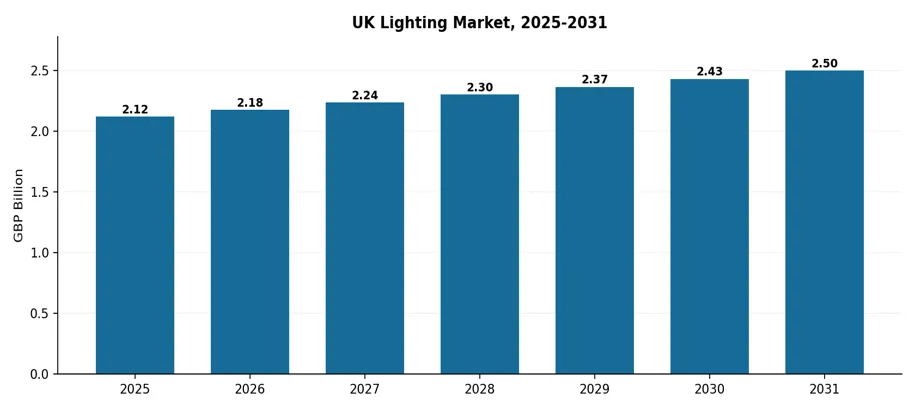
The UK Lighting Market is estimated at GBP 2.12 billion in 2025 and is forecast to reach GBP 2.50 billion in 2031, equal to 2.79% annualized growth. The market includes electric lamps, luminaires and directly associated lighting controls sold into residential, commercial, industrial and public infrastructure applications. Replacement of older light sources, demand for lower energy consumption and commercial building refurbishment support the market. Construction conditions and consumer spending remain important influences on near-term lighting sales.
LED products lead new installations and replacement purchases across UK lighting applications. Offices, schools, healthcare facilities, shops, homes and infrastructure operators have different requirements for light quality, emergency performance, robustness and controls. The UK supply chain combines local manufacturers, multinational lighting brands, electrical distributors, online sellers and installation contractors. Buyers increasingly assess the total cost of lighting, including electricity use, replacement intervals, installation time and product repairability. The forecast assumes steady but uneven demand through 2031, rather than a uniform increase across all product types.
| 2025 MARKET SIZE | 2031 FORECAST | CAGR (2026-2031) |
| GBP 2.12 Billion | GBP 2.50 Billion | 2.79% |
UK Lighting Key Takeaways
UK lighting sales are estimated at GBP 2.12 billion in 2025 and are forecast to reach GBP 2.50 billion by 2031.
LED luminaires and replacement lamps remain the main source of equipment demand across homes, workplaces and infrastructure.
Commercial refurbishment and public-sector energy upgrades create opportunities for higher-efficiency fixtures and controls.
Connected lighting, occupancy sensors and emergency testing add value beyond basic replacement luminaires.
UK manufacturers and distributors compete on product availability, installation convenience, lighting quality and warranty support.
Weak construction activity, price-sensitive buyers and lower-cost imports can slow growth in several lighting categories.
UK Lighting Industry Trends and Strategic Insights
The shift from replaceable lamps toward complete LED luminaires changes aftermarket purchasing and long-term service requirements.
Controls are increasingly specified together with lighting in offices, warehouses, public buildings and street-lighting contracts.
Repairable components, reuse of existing housings and recycling are gaining attention as buyers assess lifecycle costs.
Lighting companies increasingly compete through project specification and technical support rather than product price alone.
UK Lighting Market Scope
| METRICS | DETAILS |
| 2025 Market Size | GBP 2.12 Billion |
| 2031 Projected Market Size | GBP 2.50 Billion |
| CAGR (2026-2031) | 2.79% |
| By Product Type | LED lamps, integrated luminaires, emergency, architectural, industrial, exterior and controls |
| By End-Use Industry | Residential, offices, education, healthcare, retail, hospitality, industrial and infrastructure |
| By Lighting Technology | LED, fluorescent and legacy replacement, specialty and emergency lighting |
| By Controls | Manual, occupancy, daylight, DALI, wireless and connected controls |
| By Application | Indoor, outdoor, architectural, commercial, residential and municipal applications |
| By Installation | New construction, retrofit, replacement, modernization and lifecycle services |
| Competitive Landscape | 10 leading domestic and international suppliers relevant to the UK lighting market |
| Market Data Coverage | 2025-2031 UK lighting market value, product segmentation and industry trends |
| Currency | United Kingdom, covering private and public-sector lighting demand |
Coverage: United Kingdom. This report covers lighting equipment and associated controls for residential, commercial, industrial, public and outdoor applications. Major product categories include LED lamps, integrated luminaires, architectural fixtures, industrial and street lighting, emergency lights and connected controls. It excludes vehicle lighting, standalone electronic components sold outside lighting applications and lighting installation services unrelated to product purchases.
UK Lighting Market White Space & Investment Opportunities
Building renovation programmes: target commercial property owners, education estates and healthcare operators with LED retrofit and controls packages.
Circular lighting products: offer replaceable LED engines, repairable drivers, reuse services and documented end-of-life recycling.
Connected infrastructure: supply smart street lighting, occupancy-based commercial systems and central emergency monitoring.
Winning suppliers can combine lighting design, payback calculations, installation guidance, reliable stock and locally accessible technical support. Product families that span offices, retail, industrial and external areas can improve specification efficiency for contractors managing multiple projects. Long-term revenue opportunities also arise from upgrades, testing, replacement modules and controls support.
Driver Impact Analysis
Energy cost management and the replacement of legacy lighting are major demand drivers in the UK. Building owners are moving from fluorescent, halogen and older discharge systems toward efficient LED fixtures to reduce electricity consumption and maintenance. Replacement decisions are strongest where facilities run long operating hours, such as offices, retail sites, warehouses, hospitals and transport buildings. Public estates and multi-site operators value standard luminaires, dependable warranties and measurable operating savings. Manufacturers with low-disruption replacement formats can benefit from this installed-base conversion.
| DRIVER | AFFECTED PRODUCT / SIGNAL | 2026–2031 CAGR | STRATEGIC IMPACT |
| Legacy lighting replacement | High | LED lamps and new luminaires for existing buildings | Provide energy-savings models and easy-install retrofit ranges |
| Building modernization | High | Office, education, retail and healthcare lighting | Engage M&E contractors and specification teams early |
| Connected controls | Medium-High | Sensors, DALI systems and emergency monitoring | Bundle luminaires with controls and commissioning |
| Public infrastructure upgrades | Medium-High | Street lighting, public estate and transport fixtures | Pursue framework and multi-site procurement programmes |
Digital lighting and building refurbishment provide further demand. New developments and renovated workplaces increasingly include daylight regulation, presence detection, DALI controls and monitoring to improve occupant comfort and operational efficiency. Street-lighting upgrades can also incorporate remote control and fault alerts, while emergency-lighting systems benefit from automated testing. Contractors often prefer manufacturers able to provide product selection, lighting calculations, approved technical data and installation support. This makes engineering and channel relationships particularly important in commercial sales.
Restraint Impact Analysis
The largest constraint is uneven construction and refurbishment spending. Higher financing costs, weak property development activity and tighter public-sector budgets can postpone lighting installations, even where LED technology offers long-term savings. Residential buyers are often price sensitive and commercial clients may replace only failed fixtures when capital is constrained. Project delays can push lighting orders into later periods because luminaires are commonly purchased close to electrical fit-out. Suppliers therefore face variable order timing and distributor inventory risks.
| RESTRAINT | PRIMARY EXPOSURE | RISK LEVEL | STRATEGIC IMPACT |
| Weak building investment | Residential, office and commercial project orders | High | Track renovation budgets and diversify sector exposure |
| Commodity price pressure | LED lamps and standard luminaires | High | Differentiate on product quality and warranty support |
| Retrofit installation complexity | Legacy wiring, ceiling systems and emergency circuits | Medium-High | Offer installer-ready replacement and testing products |
| Controls interoperability | Connected lighting and building integration | Medium | Support open protocols and installer training |
Price competition and technical complexity create additional challenges. Imports and private-label products place pressure on commodity lamp and luminaire margins. Connected controls require installer capability and compatibility with existing wiring, building controls and emergency circuits. Some retrofit sites have limited access, outdated electrical layouts or specialized illumination requirements. Manufacturers must also manage changes in component availability, product certification and demand for repairable products. Clear product documentation, reliable supply and retrofit-friendly ranges help reduce these risks.
UK Lighting Market Competitive Landscape
UK lighting competition includes major multinational suppliers and established domestic companies. Signify and LEDVANCE have broad professional and replacement lighting portfolios. Zumtobel Group, TRILUX and Whitecroft are prominent in specification-led projects. FW Thorpe, Dextra, Ansell, NVC and Collingwood provide locally relevant products, installer channels and commercial lighting expertise. Market positions differ substantially among residential lamps, public-sector projects, industrial fixtures and connected lighting.
| COMPANY | UK LIGHTING POSITIONING |
| Signify UK | Philips-branded lamps and luminaires, professional LED systems, connected lighting and consumer offerings across UK channels. |
| Zumtobel Group (Thorn and Zumtobel) | Thorn and Zumtobel provide indoor, outdoor, office, architectural and industrial luminaires with control platforms. |
| FW Thorpe (Thorlux) | UK-listed lighting group with Thorlux commercial and industrial systems and a portfolio of specialist lighting businesses. |
| Whitecroft Lighting | UK commercial and architectural lighting supplier active in office, education, health and public building projects. |
| Dextra Group | UK manufacturer of commercial and industrial lighting with bespoke and project-led luminaires. |
| TRILUX UK | Office, retail, industrial and outdoor LED lighting, digital controls and lighting modernization programmes. |
| Ansell Lighting | UK lighting supplier covering commercial, industrial, emergency, outdoor and residential applications. |
| NVC Lighting | Professional LED luminaires and emergency lighting for contractors, developers and facilities. |
| LEDVANCE | LED lamps, luminaires and smart lighting with a broad commercial and distribution portfolio. |
| Collingwood Lighting | Commercial, domestic and exterior LED lighting with strong UK electrical wholesale and installer reach. |
Product performance, price, energy efficiency, lighting design support, delivery times and warranty service shape purchasing decisions. Large commercial projects often involve architects, M&E consultants and contractors, while residential and small-business purchases rely more heavily on wholesalers, installers and retail channels. Product availability and credible whole-life savings can be as important as brand recognition.
UK Lighting Market Recent Developments
March 20, 2026: Ovia introduced the Berula linear batten multi-current LED luminaire for commercial and general-purpose installations, with flexible installation and output options.
April 17, 2026: Ovia launched its Pitch Finder LED floodlighting system for professional outdoor sports facilities.
June 29, 2026: DW Windsor added an interior lighting range to its product portfolio, extending its offering beyond external and public-realm applications.
July 15, 2026: Messe Frankfurt announced the acquisition of LiGHT Expo London, expanding its involvement in the UK architectural and professional lighting sector.
September 3, 2026: NVC Lighting launched GREENLAND PRO, a high-performance IP66 non-corrosive luminaire designed to improve installation and project flexibility.
October 28, 2026: Recolight introduced Recolight Revive, a programme focused on giving existing luminaires a second life through reuse and circular approaches.