UK Industrial Motors Market Size and Overview
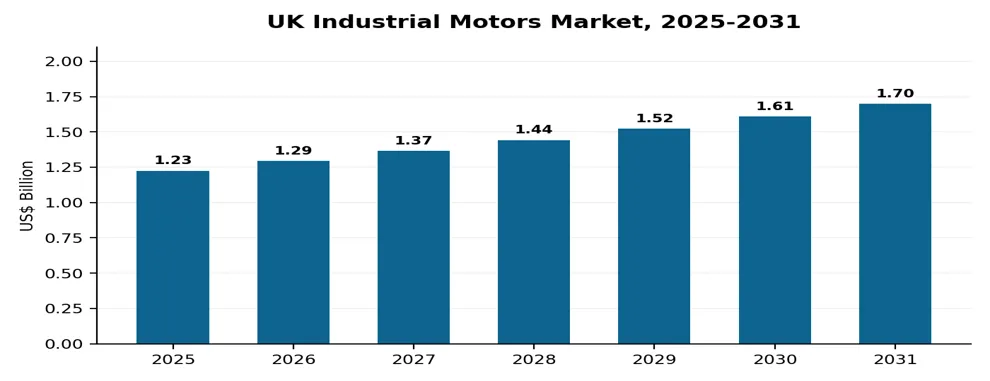
The UK industrial motors market is estimated at US$ 1.23 billion in 2025 and is forecast to reach US$ 1.70 billion by 2031, equivalent to approximately 5.60% annualized growth. Industrial electric motors power pumps, fans, compressors, materials-handling equipment and production machinery across the UK. Replacement demand and energy-efficiency improvements support the market alongside selective investment in manufacturing and water infrastructure.
The market includes industrial induction motors, synchronous and permanent-magnet motors, servo motors and specialty equipment supplied for plant upgrades and new machinery. Revenue covers motor equipment purchased by industrial operators and machinery manufacturers. Standalone variable-speed drives, vehicle traction motors, household motors and residential applications are excluded.
| 2025 MARKET SIZE | 2031 FORECAST | CAGR (2026-2031) |
| US$ 1.23 Billion | US$ 1.70 Billion | 5.60% |
UK Industrial Motors Key Takeaways
Industrial motor revenue is estimated at US$ 1.23 billion in 2025 and US$ 1.70 billion by 2031.
Energy audits and operating-cost pressure encourage industrial facilities to replace older motors with IE3, IE4 and higher-efficiency designs.
Water utilities, food and beverage production, packaging and materials handling are important sources of recurring motor demand.
UK industry requires reliable low-voltage motors alongside specialist high-power and hazardous-area motor systems for process facilities.
Motor upgrades are most attractive where running hours are high, failure costs are significant and frame compatibility is straightforward.
National distributor stockholding, emergency replacement capability, service engineering and energy-saving evidence are key supplier differentiators.
UK Industrial Motors Industry Trends and Strategic Insights
Industrial customers increasingly compare motor efficiency against lifetime electricity costs, running hours, repair frequency and system loading.
High-efficiency synchronous reluctance motors are gaining interest for continuous-duty pumps, ventilation systems and process equipment.
UK distributors are expanding local stock of standard IE3 and IE4 motors to reduce the downtime caused by unplanned motor failures.
Machinery builders are evaluating compact motor systems, integrated monitoring and servo technologies for packaging, robotics and automated handling.
UK Industrial Motors Market Scope
| METRICS | DETAILS |
| 2025 Market Size | US$ 1.23 Billion |
| 2031 Projected Market Size | US$ 1.70 Billion |
| CAGR (2026-2031) | 5.60% |
| By Motor Type | Induction, synchronous, permanent-magnet, reluctance, servo and specialty |
| By End-Use Industry | UK manufacturing, machinery, food, chemicals, metals, water, logistics and process plants |
| By Power Rating | Below 0.75 kW, 0.75-7.5 kW, above 7.5-75 kW, above 75 kW |
| By Efficiency | IE2, IE3, IE4, IE5 and advanced efficiency designs |
| By Motor Application | Pumps, fans, compressors, material handling, machine tools and robotics |
| By Installation | Low- and medium-voltage, OEM, retrofit, hazardous-area and heavy-duty |
| Competitive Landscape | 10 motor manufacturers active in British industrial applications |
| Market Data Coverage | 10 motor manufacturers and suppliers serving UK industrial applications |
| Market Definition | 2025-2031 UK industrial motor market, end-use applications and growth outlook |
Coverage: United Kingdom. The report covers industrial induction, permanent-magnet, synchronous reluctance, servo, medium-voltage and specialty motors used in manufacturing, process plants, water utilities and industrial infrastructure. Standalone variable-frequency drives, automotive traction motors and consumer applications are outside the scope.
UK Industrial Motors Market White Space & Investment Opportunities
Motor replacement programs: prioritize high-running-hour pump, fan and compressor installations where an IE4 or IE5 upgrade can produce measurable electricity savings.
OEM and machinery accounts: supply compact induction and servo motors to UK machinery builders, packaging lines and automated distribution equipment manufacturers.
Water and process applications: target water-treatment upgrades, food processing, chemicals and industrial refrigeration with reliable and application-specific motors.
Winning suppliers will combine local stock availability, efficiency documentation, motor selection and installation support. Frame-size compatibility, spare parts and urgent replacement service can matter as much as initial purchasing price.
Driver Impact Analysis
UK industrial motors serve a large installed base of pumps, fans, compressors, conveyors and production machines. A substantial proportion of electricity use in many industrial facilities comes from motor-driven systems, so replacement choices can materially affect energy bills. Efficiency requirements and facility energy audits encourage end users to examine older motor fleets, particularly on assets operating across multiple shifts. Upgrades to efficient motor designs are increasingly evaluated together with suitable controls, although standalone drive revenue is excluded from this market.
| DRIVER | AFFECTED PRODUCT / SIGNAL | 2026–2031 IMPACT | STRATEGIC IMPACT |
| Motor replacement and efficiency | High | IE3, IE4 and advanced efficiency replacements | Target high-utilization pumps, compressors and fans with energy audits |
| Water and utility investment | High | Water treatment pumps and process motors | Develop utility-approved products and rapid replacement support |
| Automation and machine building | Medium-High | Servo, gear and synchronous motor demand | Work directly with UK OEMs and systems integrators |
| Energy management obligations | Medium-High | Plant audits and motor lifecycle upgrades | Document lifetime savings and compliance benefits |
Modernization in water treatment, food manufacturing, logistics and precision engineering adds demand for reliable industrial motor systems. The UK Energy Savings Opportunity Scheme has also increased the need for large organizations to track energy-saving actions. Machinery OEMs favor standardized motor frames, dependable delivery and service support. Higher-efficiency motors and synchronous reluctance technologies can command a premium when users can document operating-hour savings and uptime improvements.
Restraint Impact Analysis
Industrial motor procurement remains sensitive to weak manufacturing capital expenditure, plant shutdown schedules and low-cost imports. Operators often repair existing motors when replacement requires changes to couplings, wiring or machinery controls. High-efficiency models may have a higher initial purchase cost, and their economic benefit can be limited on low-utilization equipment. The cost of retrofitting also rises when site acceptance tests, specialist installation or downtime are needed.
| RESTRAINT | PRIMARY EXPOSURE | RISK LEVEL | STRATEGIC IMPACT |
| Industrial capex pressure | Manufacturing plant modernization budgets | High | Emphasize urgent uptime and efficiency-driven retrofits |
| Repair versus replace decisions | Existing repairable motors | High | Present measurable lifetime-cost comparisons |
| Imported motor price competition | Standard low-voltage motors | Medium-High | Compete on delivery, certification and after-sales service |
| Mechanical and control compatibility | Mountings, couplings, starters and existing drives | Medium-High | Offer replacement checks and commissioning support |
Supply risks include availability of copper windings, electrical steel, bearings and specialist electronic or magnet components. For critical industrial loads, lead-time uncertainty can delay maintenance schedules. Buyers also need to confirm voltage, motor frame, ingress protection, thermal limits and compatibility with existing soft starters or frequency converters. Suppliers can reduce these barriers through application audits, replacement equivalence tables, local stockholding and commissioning support.
UK Industrial Motors Market Competitive Landscape
Competition in the UK industrial motors market includes global manufacturers, specialist motor suppliers and established domestic distributors. The supplier base serves standard low-voltage induction motors, heavy-duty process motors, geared motors and precision servo applications. Industrial buyers consider efficiency class, delivery time, local support, spare-parts access and duty-cycle performance alongside price.
| COMPANY | INDUSTRIAL MOTOR POSITIONING |
| ABB | Low- and medium-voltage motors, IE5/IE6 reluctance technology and UK distribution coverage |
| WEG | Premium-efficiency induction, synchronous and heavy-duty motors with UK application support |
| Siemens / Innomotics | Industrial and medium-voltage motors serving manufacturing, utilities and process industries |
| Brook Crompton | Industrial AC motors, IE3/IE4 product ranges and replacement support in the UK |
| Nidec | Industrial, servo and specialist motors for OEM and process applications |
| SEW-EURODRIVE | Geared motors and high-efficiency motor solutions for machinery and material handling |
| NORD DRIVESYSTEMS | IE5+ synchronous and geared motors with UK industrial distribution and services |
| TECO-Westinghouse | Low- and medium-voltage motors and engineered machines for industrial duty |
| Marelli Motori | Large AC and DC machines for industrial and power generation applications |
| Leroy-Somer (Nidec) | Industrial and heavy-duty motors with repair, aftermarket and specialist engineering support |
Premium-efficiency motors compete with repair and rewinding options for existing installations. UK distribution partnerships and rapid replacement services are especially important for water utilities, food factories and continuous-process sites, where equipment failures can cause expensive production losses.
UK Industrial Motors Market Recent Developments
February 3, 2026: ABB expanded its IE6 synchronous reluctance motor range to 110-450 kW, offering higher-efficiency options for industrial pumps, fans and compressors.
March 11, 2026: ABB appointed HAYLEY DEXIS as its first UK national distributor for low-voltage motors, backed by strategically stocked replacement motors in the West Midlands.
April 3, 2026: Brook Crompton highlighted its WE3 and WE4 industrial motor ranges, extending IE3 and IE4 choices in aluminium and cast-iron frames.
May 19, 2026: WEG and SpinDrive announced a partnership to combine active magnetic bearings and condition monitoring with industrial motor systems.
July 1, 2026: WEG introduced its W22 Prime induction motor to the UK market, offering IE4 and IE5 efficiency options for industrial replacement applications.
July 22, 2026: Amendments to the UK Energy Savings Opportunity Scheme took effect, expanding reporting of energy-saving measures and supporting closer assessment of industrial motor upgrades.