UK Data Center Transformer Market Size and Overview
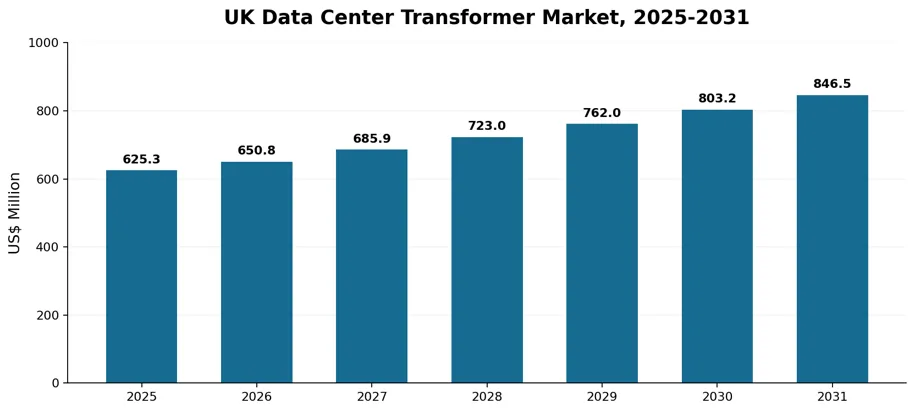
The UK Data Center Transformer Market generated an estimated US$625.3 million in 2025 and is projected to reach approximately US$846.5 million by 2031, equivalent to 5.18% annualized growth over the period. New hyperscale campuses, AI computing facilities and colocation expansions require transformers for utility interconnection, campus distribution and power delivery to critical halls. Grid availability and equipment delivery schedules are major purchasing considerations.
Transformers connect the public electricity network with data center substations and downstream electrical distribution. Projects may require large primary units, medium-power unit substations and dry-type units near the critical load. Early selection of voltage, capacity, losses, redundancy and maintenance access can reduce commissioning risk. New UK grid-connection rules are making the timing of equipment orders particularly important.
| 2025 MARKET SIZE | 2031 FORECAST | CAGR (2026–2031) |
| US$625.3 Million | US$846.5 Million | 5.18% |
UK Data Center Transformer Key Takeaways
Market revenue rises from approximately US$625.3 million in 2025 to US$846.5 million by 2031, with 5.18% estimated annualized growth.
Hyperscale, AI and colocation facilities need dedicated primary transformers and multiple levels of campus distribution.
Utility connection timing is a key procurement constraint. Developers increasingly reserve transformer capacity before final commissioning.
New campuses favor repeatable transformer and substation configurations that support phased power additions.
Oil-immersed equipment holds a substantial share in major substations, while dry-type equipment benefits from indoor installations and safety needs.
Buyers value guaranteed delivery windows, low losses, maintainability and local installation and testing support.
UK Data Center Transformer Industry Trends and Strategic Insights
High-density AI facilities are increasing attention to transformer sizing, redundancy and the ability to accommodate future electrical load.
UK developers are coordinating procurement earlier with distribution and transmission network operators to reduce grid-connection delays.
Utility-accepted designs, efficient dry-type units and continuous condition monitoring are gaining relevance in facilities with strict uptime targets.
Suppliers that combine equipment manufacturing with on-site testing, logistics and commissioning support have an advantage in constrained urban sites.
UK Data Center Transformer Market Scope
| METRICS | DETAILS |
| 2025 Market Size | US$625.3 Million |
| 2031 Projected Market Size | US$846.5 Million |
| CAGR (2026–2031) | 5.18% |
| By Transformer Type | Distribution transformers, medium-power, large-power, modular substations |
| By Data Center Type | Hyperscale, AI, cloud, colocation, enterprise and edge data centers |
| By Voltage Rating | Secondary distribution, medium voltage, high voltage and grid connections |
| By Insulation and Cooling | Oil-immersed, natural and synthetic ester, dry-type and cast resin |
| By Power Architecture | Utility-fed substations, campus primary power and downstream distribution |
| By Phase and Installation | Three-phase, pad-mounted, indoor, outdoor and modular units |
| By Installation Stage | New campus construction, expansion, retrofit, replacement and aftermarket |
| Competitive Landscape | 10 manufacturers and specialist transformer suppliers serving UK critical-load demand |
| Market Data Coverage | 2025-2031 UK data center transformer market, equipment applications and trends |
Coverage: United Kingdom. The report covers power and distribution transformers serving hyperscale, cloud, AI, colocation, enterprise and edge data centers. Included applications are utility interconnection substations, campus medium-voltage distribution, indoor distribution, phased expansions, replacement and associated transformer lifecycle services.
UK Data Center Transformer Market White Space & Investment Opportunities
Primary substation packages: engage early on grid-interface transformer requirements for hyperscale developments and larger colocation campuses.
Standardized distribution: offer repeatable unit substations, efficient dry-type equipment and modular transformer configurations for multi-building sites.
Service and availability: develop transformer monitoring, factory testing, installation support, spares and preventive maintenance programs.
Securing contracts requires coordination with data center developers, utility engineers, electrical consultants and EPC contractors. Suppliers able to demonstrate approved designs, reliable production slots and service coverage can convert project pipelines into repeat business.
Driver Impact Analysis
The expansion of hyperscale and AI infrastructure is increasing the quantity and rating of transformers required at the data center site. Large facilities often need dedicated grid connections and multiple transformer stages before electricity can reach the server halls. Early procurement of primary substation transformers is increasingly important because a completed data hall cannot be energized until its power equipment has passed commissioning.
| DRIVER | AFFECTED PRODUCT / SIGNAL | 2026–2031 CAGR | STRATEGIC IMPACT |
| Hyperscale and AI campus construction | High | Large primary and medium-power transformers | Reserve factory production early and coordinate with grid engineers |
| Colocation additions and retrofits | High | Unit substations, dry-type equipment and replacements | Offer standard transformer blocks for phased upgrades |
| Network upgrades and viable grid connections | Medium-High | Dedicated grid-interface transformer packages | Qualify designs with utilities before purchase orders |
| Reliability and efficiency requirements | High | Low-loss designs, redundancy and monitoring | Show total-life economics and local service support |
Colocation expansion also supports steady replacement and upgrade demand. Operators are adding capacity to existing campuses while managing redundancy and service access in live facilities. Low-loss designs, dry-type units and remote condition monitoring help owners reduce operating costs and improve reliability. Grid upgrades and a more coordinated connection process could improve project conversion when eligible developments advance.
Restraint Impact Analysis
The most immediate constraint is the UK grid-connection process. A rapid rise in large-demand applications has increased uncertainty about when new data centers can secure usable power. Projects without a firm connection schedule may delay transformer orders or change specifications. Long production and delivery windows for medium- and large-power transformers create a second bottleneck, particularly where utility approval and factory testing are required.
| RESTRAINT | PRIMARY EXPOSURE | RISK LEVEL | STRATEGIC IMPACT |
| Grid connection delays | Primary transformers and utility interfaces | High | Link equipment commitments to realistic grid milestones |
| Long factory and delivery windows | Medium- and large-power transformers | High | Secure manufacturing slots and lock key specifications |
| Materials and cost exposure | Copper, steel and insulation systems | Medium-High | Use dual sourcing and agreed price-adjustment mechanisms |
| Installation and design complexity | Urban substations and changing site requirements | Medium-High | Plan transport, lifting and commissioning before delivery |
Copper, electrical steel and specialist insulation materials increase cost exposure for transformer suppliers. In addition, dense urban campuses can make transport, lifting and installation difficult. Changes to intended capacity, voltage or redundancy late in the project can force transformer redesign and requalification. Developers therefore need earlier specification freeze, logistics planning and clear interfaces with utilities and EPC firms.
UK Data Center Transformer Market Competitive Landscape
The market includes established global power-transformer manufacturers, UK-based engineering and transformer-service companies, and distribution-equipment suppliers. Large campus tenders usually consider production capacity, grid-operator acceptance, efficiency, reliability, installation support and the supplier’s ability to deliver coordinated substation packages.
| COMPANY | DATA CENTER TRANSFORMER POSITIONING |
| Hitachi Energy | Large and medium-power transformers, including high-capacity units for hyperscale campus substations |
| GE Vernova | UK transformer production, grid-facing equipment and engineering for large infrastructure projects |
| Siemens Energy | Power transformers and substation equipment with engineering and service support in Britain |
| HD Hyundai Electric | High-capacity transformer supply for utility connections and critical-power installations |
| Eaton | Dry-type and distribution transformer equipment within packaged electrical infrastructure |
| SGB-SMIT Group | Power and distribution transformer products serving the UK and European substation market |
| Wilson Power Solutions | UK transformer supply and service focusing on efficient distribution and packaged units |
| Winder Power | UK transformer engineering, repairs and maintenance for critical electrical equipment |
| Mitsubishi Electric | Large power transformers for grid connections and electricity infrastructure |
| Schneider Electric | Dry-type transformer and integrated power-distribution systems for critical facilities |
Competition is strongest for high-capacity utility-interconnection equipment, prefabricated distribution substations, low-loss dry-type units and aftermarket services. Qualified suppliers that offer predictable factory slots, local commissioning capability and monitoring systems can gain stronger positions in long-running campus expansion programs.
UK Data Center Transformer Market Recent Developments
March 2, 2026: National Grid and technology partners completed a UK trial showing that an AI compute cluster could cut electricity demand by more than one-third in under a minute. This may help future grid connections for large data centers.
June 10, 2026: National Grid announced more than £1 million in innovation funding covering five projects, including work on faster grid connections for data centers using flexible demand.
June 26, 2026: National Grid Electricity Distribution announced a partnership with the Data Centre Alliance to improve coordination on power connections and project planning.
July 29, 2026: Ofgem consulted on a commitment fee and project milestones for large data center connections after applications rose sharply. The proposed rules aim to give viable projects better access to network capacity.
August 13, 2026: National Grid launched the North West London Upgrade. The scheme includes a new substation and network improvements intended to enable connections for five data centers.
October 15, 2026: Pure Data Centres completed installation of the final Hitachi Energy transformer at its 90 MW Brent Cross campus, bringing substation capacity to 150 MVA.