UK Data Center Lighting Market Size and Overview
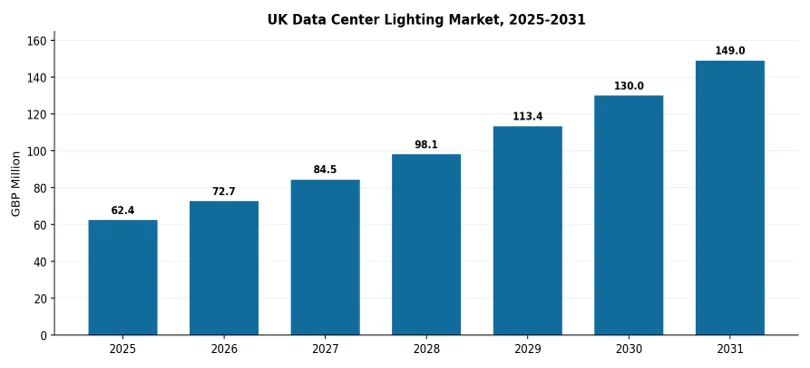
The UK Data Center Lighting Market is estimated at GBP 62.4 million in 2025 and is projected to reach GBP 149.0 million by 2031, representing approximately 15.61% annualized growth. The market covers interior, emergency and exterior lighting bought for data centre facilities. Demand is supported by hyperscale and colocation construction, investment in AI-ready computing sites and the replacement of older fixtures across operational campuses. Data halls require dependable task lighting, while electrical rooms, mechanical plant areas, corridors and security spaces need fixtures selected for safety and long service life.
The UK is an established European data centre hub, with a concentration of major facilities around London and Slough and a growing pipeline in regional locations. Lighting orders are typically awarded as part of electrical or M&E installation packages, often after designs and equipment standards have been agreed. Operators assess fixture reliability, emergency escape provisions, occupancy-based controls, service access and compatibility with site management systems. The study counts data centre lighting equipment and directly associated lighting controls, excluding unrelated general-building lighting and wider data centre electrical equipment.
| 2025 MARKET SIZE | 2031 FORECAST | CAGR (2026-2031) |
|---|---|---|
| GBP 62.4 Million | GBP 149.0 Million | 15.61% |
UK Data Center Lighting Key Takeaways
UK data centre lighting demand is estimated at GBP 62.4 million in 2025 and is forecast to reach GBP 149.0 million by 2031.
London and Slough remain important markets, while data centre projects in Wales, the Midlands and northern England widen opportunities.
Data halls, switchrooms, UPS areas, mechanical rooms, service corridors and outdoor security zones require distinct lighting packages.
Emergency escape lighting and scheduled testing matter because facilities must remain safe during maintenance or power disruptions.
Occupancy sensors, DALI-based controls and durable LEDs can lower lighting consumption in spaces that are not continuously occupied.
Suppliers that coordinate early with M&E contractors and deliver standardized replacement products can win multi-site programmes.
UK Data Center Lighting Industry Trends and Strategic Insights
The growth of AI-oriented campuses increases the need for consistent lighting schedules across phased data centre buildings.
Lighting design is increasingly coordinated with mechanical systems, electrical room layouts, access routes and emergency planning.
Operators are looking for repeatable luminaire specifications and spare-parts availability to reduce disruption to operating sites.
Central emergency-lighting testing, occupancy controls and fault monitoring offer service and controls opportunities after installation.
UK Data Center Lighting Market Scope
| METRICS | DETAILS |
| 2025 Market Size | GBP 62.4 Million |
| 2031 Projected Market Size | GBP 149.0 Million |
| CAGR (2026-2031) | 15.61% |
| By Lighting Type | Interior LED, emergency lighting, exterior and security fixtures, controls and services |
| By End-Use Industry | Hyperscale/cloud, colocation, enterprise, edge and AI-oriented data centres |
| By Power Rating | Low-wattage, medium-output, high-output and emergency specialty fixtures |
| By Voltage | Normal facility supply, UPS-backed and central-battery emergency circuits |
| By Control Method | Standalone switching, DALI, occupancy sensors and BMS integration |
| By Application | Data halls, electrical rooms, mechanical rooms, corridors and campus perimeters |
| By Installation Stage | Greenfield fit-out, phased expansion, retrofit, maintenance and commissioning |
| Market Data Coverage | 2025-2031 UK data centre lighting demand, equipment categories and market trends |
UK Data Center Lighting Market White Space & Investment Opportunities
Hyperscale and AI campuses: engage M&E designers early with standardized data-hall, plantroom and emergency-lighting schedules for phased projects.
Controls and testing upgrades: add DALI, occupancy sensors and emergency-lighting monitoring to existing facilities where access and commissioning can be managed safely.
Regional project channels: develop relationships with contractors and engineering consultants involved in Wales, northern England and other emerging data centre locations.
Lighting vendors can improve conversion by providing design support, documented photometric performance, reliable delivery and consistent product families. Operators also value low-disruption replacements, long warranty support and spare parts for multiple facilities. Relationships with electrical contractors, M&E consultants and data centre operators are central to project access.
Driver Impact Analysis
New data centre construction is the leading driver. The UK pipeline includes hyperscale sites, colocation extensions and AI infrastructure projects, each requiring lighting across data halls, mechanical and electrical areas, circulation routes and the campus perimeter. Lighting procurement often follows the building fit-out programme, so contractors value manufacturers able to support phased orders, repeat specifications across buildings and provide emergency-lighting documentation. Regional developments also broaden access beyond the mature London and Slough cluster.
| DRIVER | AFFECTED PRODUCT / SIGNAL | 2026–2031 IMPACT | STRATEGIC IMPACT |
| Hyperscale and AI data centre buildout | High | New data halls, plantrooms and emergency lighting | Engage engineering consultants and fit-out contractors early |
| Phased campus expansion | High | Repeat lighting packages for multiple buildings | Offer standardized fixture schedules and delivery slots |
| Energy efficiency and controls | Medium-High | LED upgrades and occupancy / DALI systems | Quantify operating savings and simplify controls integration |
| Safety and lifecycle requirements | Medium-High | Emergency luminaires and monitored testing | Provide full commissioning, testing and replacement support |
Energy efficiency and operational safety are the second set of drivers. LED fixtures offer lower maintenance needs than older fluorescent systems and can be paired with presence detection in rooms used mainly for inspection or service. Emergency lighting is required for safe exit routes and supporting areas, and self-test or central monitoring can simplify planned checks in large multi-building facilities. Operators increasingly value repeatable lighting products that can be replaced without prolonged work near live electrical equipment. Suppliers able to demonstrate reliability, commissioning support and consistent supply can secure recurring site programmes.
Restraint Impact Analysis
Lighting makes up a relatively small share of data centre investment, which can make it difficult for specialist vendors to influence early budgets. Electricity connection capacity, cooling systems and high-value electrical equipment are usually higher-priority procurement items. Lighting purchases may therefore be delayed or re-scoped when construction schedules change. In many facilities, working lighting is maintained until an upgrade or planned shutdown is convenient, restricting immediate replacement demand despite potential energy savings.
| RESTRAINT | PRIMARY EXPOSURE | RISK LEVEL | STRATEGIC IMPACT |
| Grid and planning delays | New site energization and phased procurement | High | Track construction milestones and align release schedules |
| Low share of project capex | Lighting budgets and design influence | Medium-High | Specify through M&E and safety teams before tendering |
| Supplier approval and integration | Controls, emergency circuits and BMS links | Medium-High | Provide approved interoperable systems and documents |
| Price competition and retrofit access | Commodity LEDs and live facility upgrades | Medium | Emphasize reliability and low-disruption installation |
The UK also faces project planning, grid connection and construction-capacity constraints. Data centre schemes can be delayed between announcement, permission and site energization, creating uncertainty about when electrical contractors will release lighting orders. Approved luminaire lists, emergency compliance requirements and coordination with building management systems make late supplier substitutions difficult. Price competition in commodity LEDs and differing contractor preferences add pressure. Vendors can address these issues through early specifications, phased delivery commitments, robust emergency testing packages and simple retrofit installation.
UK Data Center Lighting Competitive Landscape
Competition includes British commercial lighting manufacturers, international lighting groups and emergency-system specialists. Whitecroft and Thorlux have relevant UK lighting engineering and manufacturing capabilities. Signify, Zumtobel, TRILUX and Glamox compete through large luminaire portfolios. Eaton, Schneider Electric, Legrand and Mackwell participate in emergency systems, controls or supporting building infrastructure. Actual supply positions vary by project and approved vendor list.
| COMPANY | DATA CENTER LIGHTING POSITIONING |
| Whitecroft Lighting | UK lighting manufacturer focused on large-scale data centre projects, technical-room luminaires and coordinated M&E specifications. |
| Thorlux Lighting | UK industrial and commercial LED lighting supplier with smart controls, emergency options and high-bay fittings for technical buildings. |
| Signify | Philips-branded LED luminaires, connected controls and professional lighting for large facilities and campuses. |
| Zumtobel Group | Professional interior, industrial and emergency lighting for data halls, service corridors and support spaces. |
| TRILUX | Industrial and commercial LED fixtures, emergency options and lighting-management solutions for technical facilities. |
| Glamox | Robust industrial LED and emergency lighting suitable for plantrooms, corridors and multi-building sites. |
| Eaton | Emergency lighting, safety systems and related electrical infrastructure products for critical facilities. |
| Schneider Electric | Data centre power and building-control integration, including controls that connect lighting to facility management. |
| Legrand | Emergency lighting, exit signs and intelligent building infrastructure for critical commercial sites. |
| Mackwell | UK emergency lighting supplier providing central batteries, testing systems and emergency lighting components. |
Selection depends on reliable LED performance, photometric design, emergency provisions, control integration, warranty support and delivery schedules. M&E consultants and electrical contractors frequently influence preferred fixture families. Manufacturers that can deliver compliant lighting packages, commissioning support and long-term replacements are better placed to compete for large and repeat data centre projects.
UK Data Center Lighting Recent Developments
February 24, 2026: Barbour ABI identified 22 UK data centre projects with appointed contractors expected to complete within two years, including work in Slough, Harlow and Newport. These projects create opportunities for lighting and electrical fit-out packages.
June 30, 2026: VIRTUS announced its LONDON19 project on the Slough Trading Estate. The planned facility will add 32.5 MW of IT load and will require new technical-room, circulation and emergency lighting.
July 21, 2026: Kao Data announced a planned data centre development at Park Royal in London, adding another project to the future pipeline for specialist lighting contractors and M&E suppliers.
August 13, 2026: Vantage Data Centers and Nebius announced a high-density AI deployment at the Newport CWL1 campus in Wales. Further AI installations support demand for lighting in associated infrastructure areas.
August 2026: Whitecroft Lighting projected that the UK data centre lighting market could reach approximately GBP 130 million in 2030, compared with GBP 54 million in 2024, as construction of AI and cloud facilities expands.
October 9, 2026: Whitecroft described data centre lighting as a growing specialist market requiring coordinated specification, site resilience and the ability to supply large facilities at scale.