


U.S. PFAS CRM Market Size and Overview
The U.S. Per- and Polyfluoroalkyl Substances Certified Reference Materials (PFAS CRM) market is estimated at USD 19.18 million in 2025 and is projected to reach USD 52.06 million by 2035, growing at an assumed CAGR of 10.5% during 2026-2035. Market demand is driven by environmental monitoring, drinking-water compliance, contaminated-site assessment, and laboratory quality assurance, which require reliable reference standards for trace-level PFAS measurement.
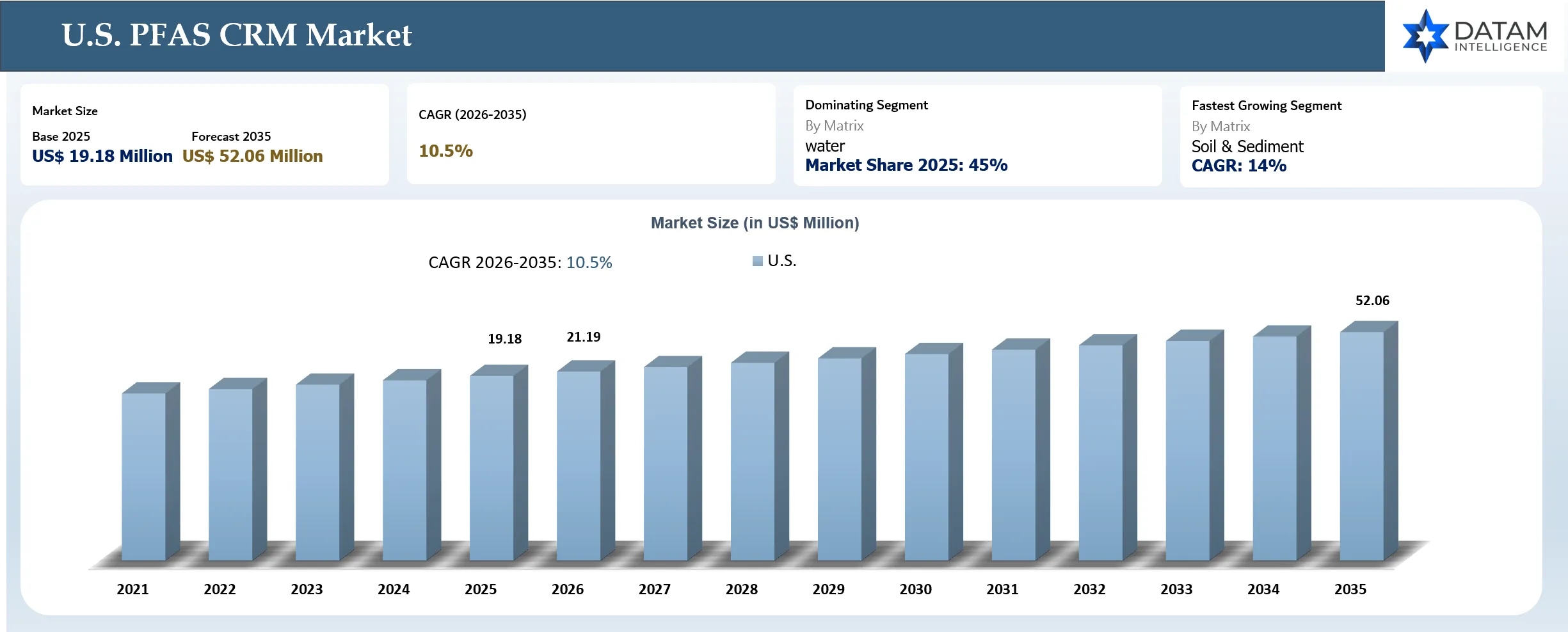
In June 2026, the U.S. Environmental Protection Agency proposed monitoring requirements for 30 unregulated contaminants under the Sixth Unregulated Contaminant Monitoring Rule (UCMR 6), extending the scope of potential drinking-water monitoring. Separately, in February 2026, the EPA finalized the addition of sodium perfluorohexanesulfonate (PFHxS-Na) to the Toxics Release Inventory, requiring covered facilities to track and report relevant releases. These developments expand chemical monitoring and reporting requirements, creating potential demand for suitable PFAS analytical standards and quality-control materials.
U.S. PFAS CRM Market Key Takeaways
- Native PFAS CRMs dominated the U.S. PFAS CRM Market by product type in 2025, accounting for an assumed 60.0% market share. Demand is associated with calibration and quantitative analysis of established PFAS compounds, including PFOA, PFOS, PFHxS and PFNA. Restek’s four-component PFAS CRM combines these commonly analysed compounds in one standard, illustrating the availability of multicomponent reference materials for routine laboratory testing.
- Stable Isotope-Labeled (SIL) PFAS CRMs are modelled as the fastest-growing product segment, with an assumed CAGR of 14.0% during 2026–2035. Their use in isotope-dilution analysis helps laboratories correct for analytical losses and matrix effects during sample preparation and measurement. EPA Method 533 uses isotope-dilution LC-MS/MS for drinking-water PFAS analysis, providing a technical basis for continued use of isotope-labelled standards in method-specific testing.
- Environmental Testing Laboratories represented the largest end-user segment in the working model for 2025, with an assumed 35.0% share. Demand spans drinking water, groundwater, wastewater, soil and sediment analysis. In May 2026, AccuStandard expanded its PFAS CRM portfolio with standards for emerging PFAS, including PFMOAA and HFPA-TA, while its August 2026 update added standards for PFAS testing in textiles and leather.
U.S. PFAS CRM Market Scope
| Metrics | Details |
| 2025 Market Size | USD 19.18 Million |
| 2035 Projected Market Size | USD 52.06 Million |
| CAGR (2026-2035) | 10.5% |
| By Product Type | Native PFAS CRMs, Stable Isotope-Labeled (SIL) PFAS CRMs, Others |
| By PFAS Chemical Class | Perfluoroalkyl Carboxylic Acids (PFCAs), Perfluoroalkane Sulfonic Acids (PFSAs), Fluorotelomer Compounds (FTs), FOSAs & FOSEs, Others |
| By Matrix | Water, Soil & Sediment, Biological Samples, Food & Feed, Consumer Products & Packaging, Aqueous Film-Forming Foam (AFFF), Others |
| By Regulatory Method | EPA Methods, ASTM Methods, ISO Methods, DIN Methods, AOAC Methods, Others |
| By Analytical Technique | LC-MS/MS, LC-HRMS, GC-MS, Other Analytical Techniques |
| By End User | Environmental Testing Laboratories, Government & Regulatory Laboratories, Food & Consumer Product Testing Laboratories, Pharmaceutical & Biotechnology Laboratories, Industrial Manufacturing Laboratories, Academic & Research Institutes, Contract Research Organizations (CROs) |
| Report Insights Covered | Competitive Landscape Analysis, Company Profile Analysis, Market Size, Share, Growth |
U.S. PFAS CRM Market Disruption Analysis
Evolving PFAS Regulations and Analytical Methods Reshaping CRM Requirements
The U.S. PFAS certified reference materials (CRM) market is being reshaped by changes in regulatory testing requirements and the range of compounds laboratories must measure. EPA Methods 533 and 537.1 address PFAS in drinking water, while Method 1633 covers 40 PFAS across environmental and biological matrices. These differing method requirements influence CRM composition, calibration needs and product selection, placing greater importance on standards matched to specific compounds, analytical methods and sample matrices.
In July 2026, the International Organization for Standardization registered a committee draft for the revised ISO 17034, which governs the competence of reference-material producers and is intended to replace the 2016 edition. Any eventual changes could require CRM manufacturers to review production controls, technical documentation and quality systems. Separately, on May 18, 2026, the EPA proposed changes to the federal PFAS drinking-water rules, including retaining PFOA and PFOS limits while proposing to rescind requirements for four other PFAS-related parameters. These regulatory developments create uncertainty in future testing priorities and the composition of PFAS CRM portfolios.
U.S. PFAS CRM Market BCG Matrix: Company Evaluation
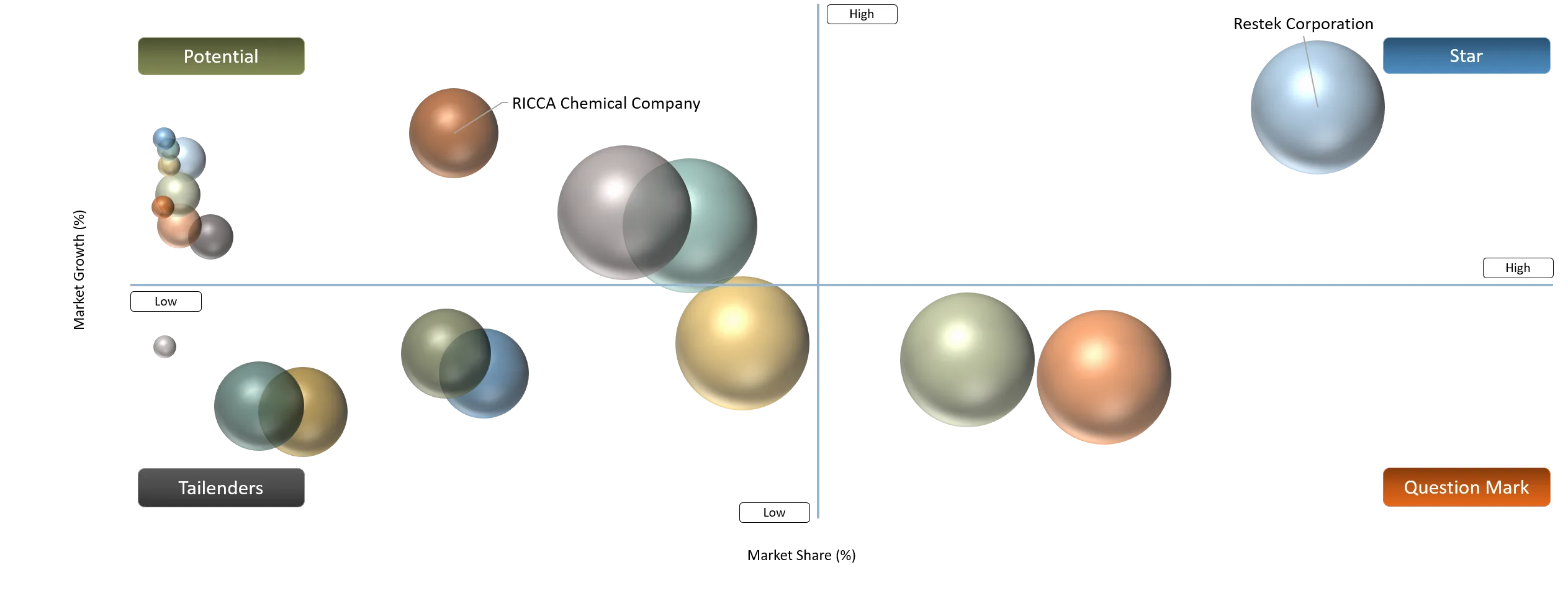
Restek Corporation and AccuStandard are positioned as Stars in the U.S. PFAS Certified Reference Materials (CRM) Market due to their established PFAS reference-standard portfolios and products aligned with environmental and regulatory testing methods. Restek offers multicomponent PFAS standards, including PFAS 3 and PFAS 4 CRMs, while AccuStandard supplies PFAS standards and develops reference materials for emerging compounds. RICCA Chemical Company is classified as a Potential Star, supported by its VeriSpec PFAS CRM portfolio and ISO 17034 accreditation for certified reference materials, providing a platform to serve laboratories requiring traceable analytical standards.
Phenomenex, Inc. is positioned as a Question Mark, given its involvement in PFAS analytical solutions and access to reference-standard offerings, while its role as a direct PFAS CRM manufacturer is less clearly established than that of Restek and AccuStandard.
U.S. PFAS CRM Market Segment Analysis
The U.S. PFAS CRM market is segmented based on product type, PFAS chemical class, matrix, regulatory method, analytical technique, end-user industry
Dominance of Native PFAS CRMs and Environmental Testing Applications
The U.S. drinking-water testing segment generates demand for PFAS CRMs through regulatory monitoring, laboratory calibration and analytical quality control. The U.S. EPA’s Methods 533 and 537.1 enable laboratories to measure 29 unique PFAS compounds in drinking water. These methods support monitoring under the fifth Unregulated Contaminant Monitoring Rule and the federal PFAS drinking-water regulation, creating demand for native and isotope-labelled reference standards matched to method requirements.
Demand also extends to environmental testing beyond drinking water. EPA Method 1633 covers 40 PFAS compounds in wastewater, surface water, groundwater, soil, biosolids, sediment, landfill leachate and fish tissue. Commercial suppliers are responding with method-specific standards: Restek offers PFAS 3 and PFAS 4 CRMs containing three and four commonly analysed compounds, respectively, while AccuStandard offers standards aligned with EPA and other analytical methods. These products help laboratories calibrate instruments and verify quantitative results across different sample types.
U.S. PFAS CRM Market Competitive Landscape
- U.S.-based companies such as Restek Corporation, AccuStandard, RICCA Chemical Company, and Phenova supply PFAS certified reference materials and analytical standards for environmental monitoring, drinking-water compliance, contaminated-site investigations, and laboratory quality control. Restek offers multicomponent PFAS CRMs, including PFAS 3 and PFAS 4 standards, while AccuStandard manufactures certified reference materials and develops standards for emerging PFAS compounds. RICCA Chemical Company supplies PFAS CRMs through its VeriSpec product portfolio, and Phenova offers PFAS calibration standards and quality-control materials aligned with EPA analytical methods.
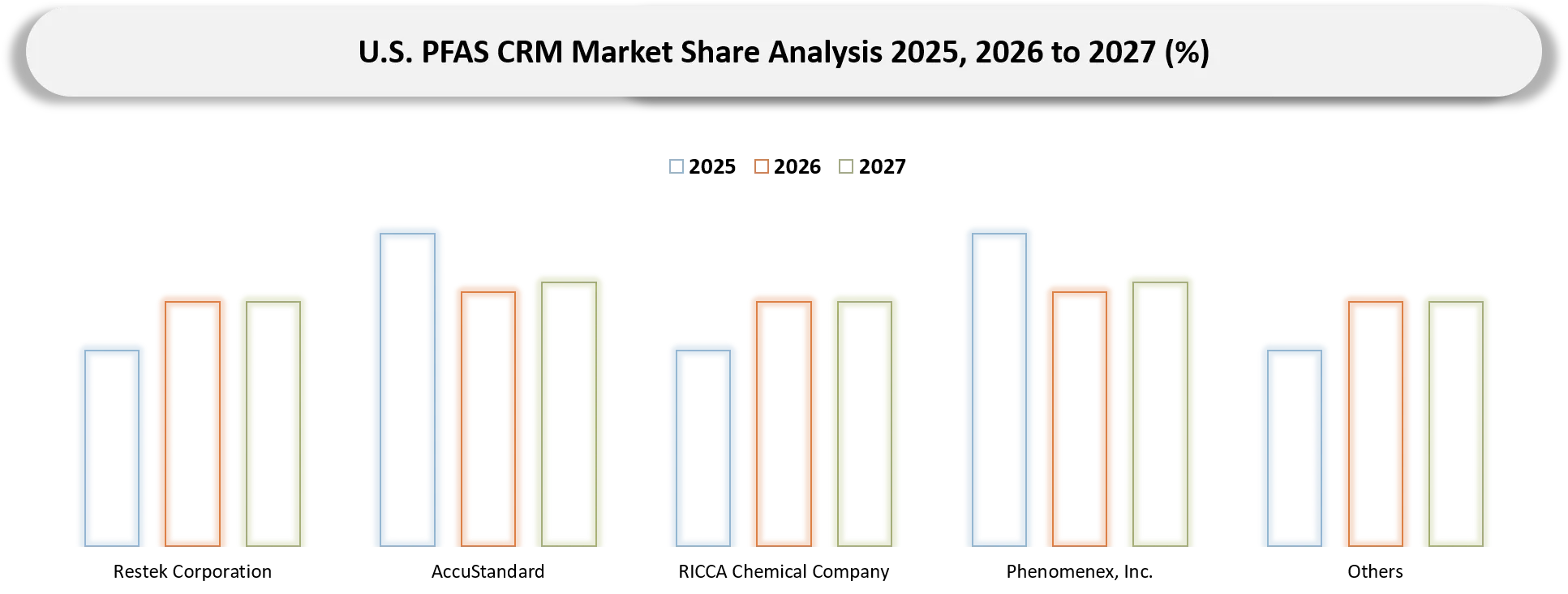
- Key players in the U.S. PFAS CRM market include Restek Corporation, AccuStandard, RICCA Chemical Company, Phenomenex, Inc.
Key Developments
- May 2026: AccuStandard expanded its PFAS CRM portfolio with emerging-compound standards. The company introduced single-component reference standards for PFMOAA, HFPA-TA and other emerging PFAS, alongside a PFAS set aligned with UK Drinking Water Inspectorate guidance. These additions broaden its reference-standard range beyond conventional PFAS compounds and support laboratories developing expanded analytical panels
- February 2026: Restek Corporation introduced EPA Method 533 and 537.1 PFAS certified reference-material mixes. Each mix combines the compounds required by its respective drinking-water method in a single ampul, simplifying calibration preparation and reducing handling steps. The standards are produced in ISO-accredited laboratories, with reported purity above 99%, expanding Restek's method-specific PFAS CRM portfolio.
- June 2025: Restek launched two multicomponent PFAS certified reference materials. Its PFAS 3 Standard contains PFOS, PFOA and PFHxS, while the PFAS 4 Standard adds PFNA. The products combine frequently analyzed compounds into ready-to-use mixtures for water, food and other sample matrices, reducing the need for laboratories to purchase and prepare individual standards separately.
Why Choose DataM?
- Technological Innovations: Examines advancements in PFAS certified reference materials, including stable isotope-labeled standards, multi-component PFAS mixtures, matrix-specific reference materials, and standards for emerging PFAS compounds, supporting accurate quantification and reliable laboratory testing.
- Product Performance & Market Positioning: Evaluates how PFAS CRM manufacturers differentiate their products through certified concentrations, measurement uncertainty, traceability, purity, stability, and compatibility with EPA analytical methods, particularly Methods 533, 537.1, and 1633A.
- Real-World Applications: Highlights the use of PFAS CRMs by U.S. laboratories in drinking-water compliance testing, contaminated-site investigations, groundwater monitoring, wastewater analysis, firefighting-foam contamination assessment, and food and biological sample testing.
- Market Updates & Industry Changes: Tracks developments during 2025-2026, including PFAS reference-standard launches, expanded compound coverage, new matrix-specific materials, supplier portfolio expansions, and changes in U.S. PFAS monitoring and analytical requirements.
- Pricing & Market Access: Assesses PFAS CRM pricing based on compound composition, isotope labeling, concentration, certification level, mixture size, and packaging. It also examines supplier availability, distribution channels, procurement requirements, and access to specialized standards for U.S. environmental, industrial, government, and research laboratories.
- Market Entry & Expansion: Identifies opportunities arising from drinking-water testing, environmental remediation, industrial contamination monitoring, and emerging PFAS analysis requirements. It evaluates strategies such as expanding isotope-labeled standard portfolios, developing matrix-specific CRMs, strengthening laboratory partnerships, and improving access to specialized reference materials across the United States.
Target Audience 2026
- PFAS Certified Reference Material Manufacturers and Producers
- Analytical and Environmental Testing Laboratories
- Government and Regulatory Agencies
- Pharmaceutical and Biotechnology Companies
- Food and Beverage Testing Organizations
- Environmental Monitoring and Water Quality Organizations
- Industrial Chemical and Manufacturing Companies
- Semiconductor and Electronics Manufacturers
- Wastewater Treatment and Remediation Companies
- Contract Research Organizations and Academic Research Institutes
- Reference Material Distributors and Laboratory Suppliers
- Mining, Metals and Critical Minerals Companies


























































