


U.S Natural Food Colors Market Size
The U.S. natural food colors market reached approximately US$ 563.0 million in 2025 and is estimated to reach approximately US$ 1,117.8 million by 2035, representing a CAGR of approximately 7.1% during 2026-2035. Market expansion is being supported by the accelerated replacement of synthetic dyes across mainstream food and beverage portfolios, increasing FDA activity around natural color approvals, retailer-led reformulation requirements, and growing investment in U.S. natural-color manufacturing capacity. In April 2025, FDA and HHS announced a national initiative to phase out petroleum-based synthetic food dyes and accelerate the approval of natural alternatives, shifting natural-color adoption from primarily voluntary clean-label positioning toward broader reformulation programs.
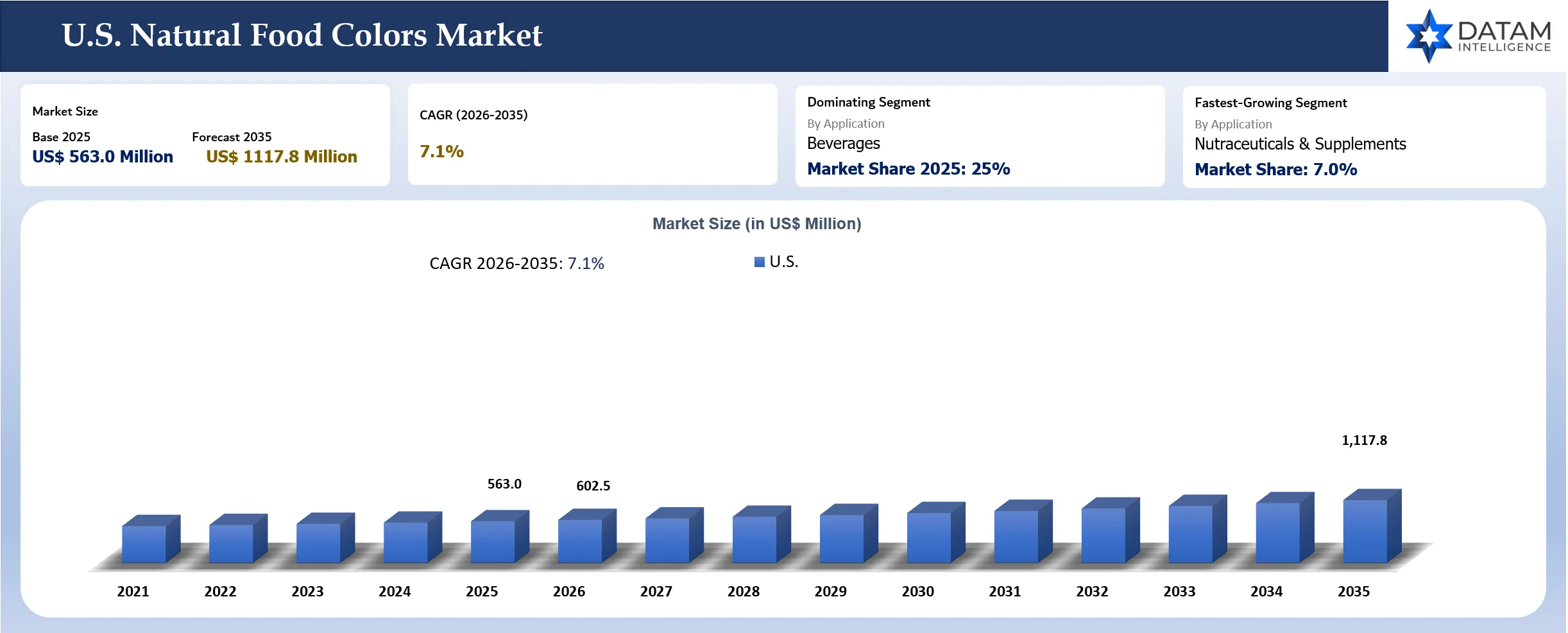
The regulatory transition is being accompanied by a widening natural-color toolkit and increasing manufacturer activity. FDA approved Galdieria extract blue, butterfly pea flower extract, and calcium phosphate from natural sources in May 2025 and subsequently approved gardenia (genipin) blue in July 2025, expanding natural-color options for applications including beverages, confectionery and other food categories. In February 2026, FDA also approved beetroot red and expanded permitted uses of spirulina extract, further broadening formulation options. On the supply side, ADM announced a more than US$16 million investment in July 2026 to expand naturally derived color production in Northern Kentucky, adding 14,000 square feet of manufacturing space and following a US$26 million investment in its neighboring facility. These developments indicate that the market is moving toward portfolio-wide synthetic-color replacement, higher-performance natural systems, and expanded domestic production capacity.
White-Space Opportunities for U.S. Natural-Color Manufacturing Capacity and Reformulation Support
The acceleration of synthetic-dye replacement is creating white space for localized natural-color manufacturing and application-support capacity in the U.S. In July 2026, ADM announced an investment of more than $16 million to expand naturally derived color production at its Boone County, Kentucky facility, adding 14,000 sq. ft. of manufacturing space and new production capabilities for liquid and dry-blended color solutions by early 2027. The investment follows a $26 million investment in its neighboring Erlanger facility, indicating that suppliers are expanding physical capacity ahead of large-scale food and beverage reformulation demand. This creates white space for manufacturers capable of supplying localized, scalable and application-ready natural-color systems to U.S. CPG customers.
Expansion of dedicated U.S. manufacturing and application infrastructure is also creating opportunities beyond basic pigment production. In May 2025, Oterra opened a 155,000-square-foot U.S. headquarters and production hub in Mount Pleasant, Wisconsin, combining manufacturing, logistics, innovation and application laboratories to support U.S. conversion from artificial dyes to natural colors. At the same time, FDA approvals of additional natural colors, including Galdieria extract blue, butterfly pea flower extract, gardenia blue, beetroot red and expanded spirulina uses—are widening the addressable application base. This creates white space for application-specific color development, stabilization, formulation support and domestic production targeting difficult categories such as beverages, confectionery, dairy, snacks and processed foods.
U.S. Natural Food Colors Key Takeaways
- In 2025, beverages led the U.S. natural food colors market by application, accounting for approximately 25.0% share, supported by synthetic-color replacement across sports drinks, fruit drinks, functional beverages, teas, and enhanced waters.
- Nutraceuticals & supplements represented the fastest-growing application in 2025, with an estimated 7.0% share, supported by clean-label product development, botanical formulations, and increasing integration of naturally derived ingredients into functional products.
- FDA-led synthetic-dye phaseout initiatives are accelerating natural-color procurement, with the 2025 regulatory push encouraging manufacturers to replace petroleum-based dyes and increasing demand for approved natural alternatives across mainstream food categories.
- Natural-color manufacturers are expanding U.S. production capacity to capture reformulation demand, including ADM's more than US$16 million 2026 investment in its Northern Kentucky naturally derived color production operations and Oterra's 155,000-square-foot U.S. production and innovation hub opened in 2025.
U.S. Natural Food Colors Industry Trends and Strategic Insight
- Suppliers are shifting from pigment supply toward formulation-led solutions, offering shade matching, stabilization, application testing, and technical support to help U.S. food manufacturers replace synthetic colors across multiple product categories.
- Natural-color developers are prioritizing difficult color applications, particularly blue, green, and purple, through stabilized pigments, improved dispersion technologies, encapsulation, and emerging natural-source platforms to overcome performance limitations.
- Manufacturers are expanding U.S. production capacity and localized supply chains to support accelerating CPG reformulation programs, improve supply reliability, and reduce exposure to agricultural feedstock and international sourcing variability.
- Regulatory approvals and portfolio-wide reformulation are reshaping competitive strategies, encouraging leading suppliers to expand approved natural-color portfolios, develop application-specific systems, and establish deeper technical partnerships with large food and beverage manufacturers.
Market Scope
| Metrics | Details |
| 2025 Market Size | US$ 563.0 Million |
| 2035 Projected Market Size | US$ 1,117.8 Million |
| CAGR (2026-2035) | 7.1% |
| By Type | Carotenoids, Anthocyanins, Betalains, Curcuminoids, Chlorophylls, Phycocyanins, Carmine/Cochineal, Other Natural Colorants |
| By Form | Liquid, Powder, Paste or Gel |
| By Solubility | Water-Soluble, Oil-Soluble, Dispersible |
| By Application | Beverages, Confectionery, Dairy & Dairy Alternatives, Bakery & Desserts, Snacks & Savory Foods, Processed Foods, Nutraceuticals & Supplements, Other Food Applications |
| By Source | Fruits & Vegetables, Spices & Herbs, Seeds & Botanicals, Algae & Microorganisms, Flowers, Animal-Derived Sources, Other Sources |
| Report Insights Covered | Competitive Landscape Analysis, Company Profile Analysis, Market Size, Share, Growth |
U.S. Natural Food Colors Disruption Analysis
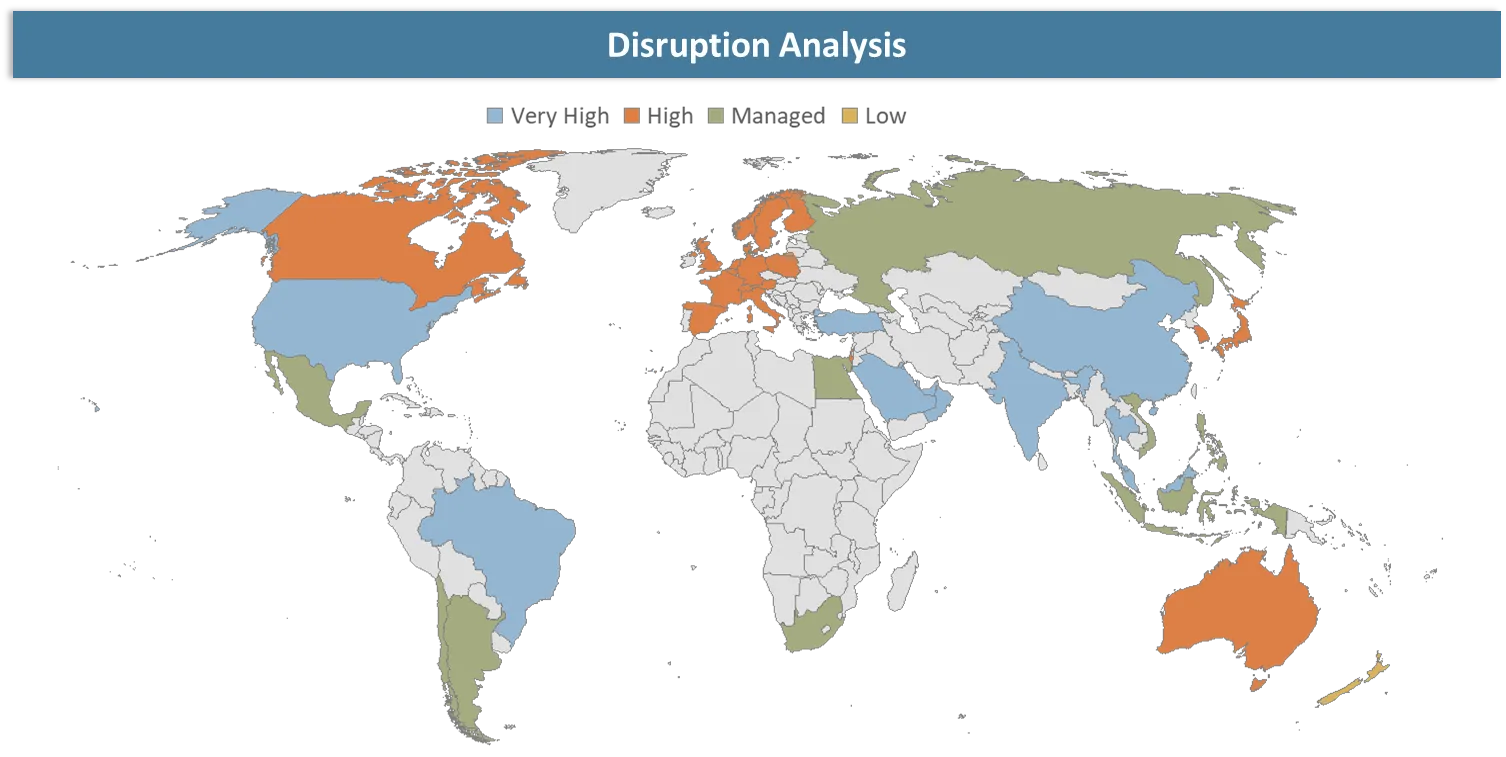
Synthetic-color replacement is shifting competition from pigment supply toward reformulation capability
The disruptive nature of the U.S. natural food colors market is increasingly shaped by the transition away from synthetic dyes across mainstream food portfolios. Regulatory actions, retailer requirements, and CPG reformulation programs are changing the basis of competition from simply offering natural pigments to delivering functional replacements that reproduce the required shade, stability, and processing performance. This is challenging suppliers with conventional pigment portfolios because manufacturers increasingly require color matching, formulation optimization, stabilization, and technical support alongside the ingredient itself.
Application-driven innovation is disrupting conventional natural-color product models.
Technological disruption is emerging as suppliers develop stabilized, encapsulated, fermentation-derived, and application-ready natural-color systems to address limitations associated with conventional botanical pigments. Innovation is particularly concentrated around difficult color spaces such as blue, green, and purple, where pH sensitivity, heat exposure, oxidation, and light stability can restrict direct substitution. As a result, suppliers with application laboratories, proprietary stabilization technologies, diversified pigment sources, and domestic production capabilities are gaining an advantage over companies competing primarily on pigment availability, creating a shift toward solution-based natural-color partnerships across U.S. food and beverage manufacturing.
U.S. Natural Food Colors BCG Matrix: Company Evaluation
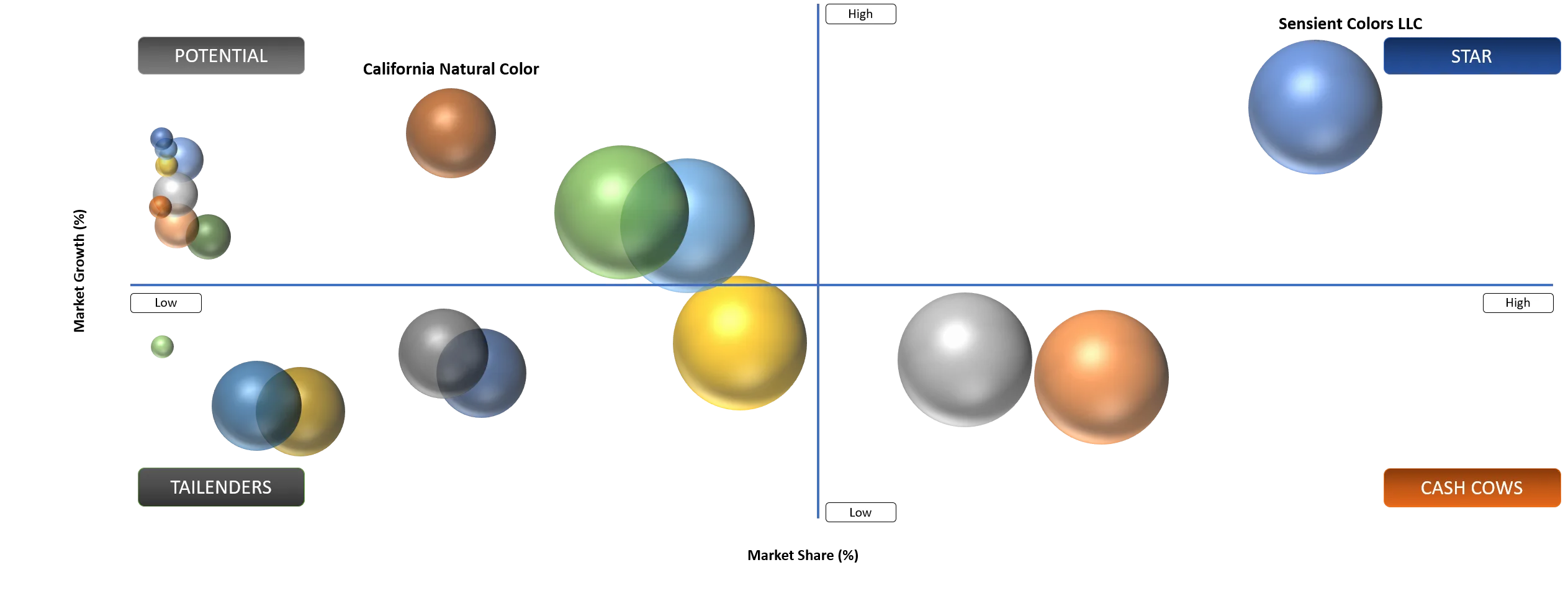
Star companies are Sensient Colors LLC, Oterra A/S, GNT Group B.V. (EXBERRY), and Givaudan Sense Colour due to their broad natural-color portfolios, established U.S. manufacturing presence, extensive application-development capabilities, and strong relationships with major food and beverage manufacturers. Their ability to support large-scale synthetic-color replacement, provide application-specific color systems, and invest in production capacity positions them strongly in the U.S. natural food colors market.
Question mark companies are Kalsec Inc., colorMaker, Inc., and IFC Solutions due to their established natural-color manufacturing and formulation capabilities but comparatively smaller scale and market reach than the leading global suppliers. Potential companies include California Natural Color, Nature’s Flavors, and San-Ei Gen F.F.I., Inc., supported by specialized natural-color portfolios, botanical color expertise, and targeted U.S. application capabilities, while their comparatively narrower geographic or portfolio scale limits their positioning against larger diversified players.
U.S. Natural Food Colors Market Dynamics
Driver Impact Analysis
| Driver | Market Growth Impact (%) | Demand Concentration | Impacted Use Case | Strategic Impact |
FDA-led synthetic-dye phaseout is converting reformulation commitments into immediate natural- color procurement | 5.4% | Major CPG manufacturers, food & beverage processors, ingredient formulators, regulatory-driven reformulation programs | Synthetic-dye replacement across cereals, confectionery, beverages, snacks, bakery and processed foods | Accelerates natural-color adoption and shifts procurement from voluntary clean-label initiatives toward regulatory-driven portfolio reformulation |
Major CPG reformulations are creating repeat demand for application -specific natural-color systems | 5.0% | Large U.S. CPG companies, national food brands, formulation partners, natural-color suppliers | Portfolio-wide reformulation, color matching, stability optimization and application-specific color systems | Creates recurring procurement opportunities and strengthens supplier relationships through technical formulation partnerships |
School-food requirements are accelerating natural-color conversion across high-volume children's product categories | 4.6% | School meal programs, K–12 food suppliers, children's food manufacturers, institutional foodservice providers | Cereals, snacks, beverages, confectionery and other products supplied to school food programs | Extends natural-color adoption into high-volume children's categories and creates additional reformulation requirements for manufacturers |
Expanded natural-color approvals are widening formulation options for previously synthetic-dependent applications | 4.4% | Beverage manufacturers, confectionery producers, dairy processors, ingredient developers, color technology suppliers | Blue, green, purple and other challenging color applications | Expands the addressable application base and enables suppliers to commercialize previously constrained natural-color formulations |
FDA-led Synthetic-Dye Phaseout is Converting Reformulation Commitments into Immediate Natural-Color Procurement
The U.S. FDA and HHS announced in April 2025 a national transition away from petroleum-based synthetic food dyes, establishing a timeline for the food industry to move toward natural alternatives and accelerating the review of new natural color additives. The initiative initially targeted elimination of six remaining synthetic dyes by the end of 2026, while FDA subsequently encouraged manufacturers to accelerate the removal of FD&C Red No. 3 ahead of its January 15, 2027 food deadline. This regulatory direction is converting synthetic-color replacement from a discretionary clean-label initiative into a defined reformulation requirement, creating direct demand for approved natural pigments, coloring foods, and application-specific color systems.
The effect is already visible in manufacturer reformulation and supplier capacity expansion. In May 2025, FDA approved three natural-source color additives, including Galdieria extract blue, expanding available natural-color options for beverages, confectionery, dairy and other applications, in July 2025, FDA approved gardenia (genipin) blue for sports drinks, enhanced water, fruit drinks and ready-to-drink teas. By August 2026, General Mills had removed certified colors from 100% of its U.S. cereals, with 90% of its U.S. retail portfolio already converted and full portfolio removal targeted by the end of 2027. Suppliers are also expanding capacity: ADM announced a more than $16 million investment and 14,000 sq. ft. manufacturing expansion in Northern Kentucky for naturally derived colors, alongside a recent $26 million investment at its neighboring facility.
Restraint Impact Analysis
| Restraint | Drag on Market Growth (%) | Primary Impact Area | Impacted Use Case | Strategic Impact |
Natural pigments often require formulation redesign rather than direct synthetic- color substitution | 4.6% | Product development, formulation optimization and application testing | Synthetic-dye replacement across beverages, confectionery, bakery and processed foods | Extends reformulation cycles and increases technical requirements for successful natural-color conversion |
Color performance can deteriorate under acidic, thermal and light-exposed processing conditions | 4.4% | Color stability, processing performance and shelf-life management | Acidic beverages, confectionery, dairy, bakery and heat-processed foods | Restricts direct substitution and increases demand for stabilization, encapsulation and application-specific color systems |
Botanical feedstock variability complicates shade consistency across production batches and seasons | 3.9% | Raw-material sourcing, quality control and batch consistency | Fruit-, vegetable-, spice-, herb- and botanical-derived color production | Increases quality-control requirements and encourages diversified sourcing and standardized color formulations |
Natural alternatives can increase formulation costs, particularly in price-sensitive mass-market products | 4.2% | Ingredient economics, formulation cost and product margins | Mass-market beverages, snacks, cereals, confectionery and processed foods | Can slow conversion where manufacturers cannot absorb higher color costs or reformulation expenses |
Natural pigments often require formulation redesign rather than direct synthetic-color substitution.
Natural pigments often cannot be substituted on a one-to-one basis for synthetic colors because their color intensity, stability, solubility, and processing behavior differ across food formulations. Manufacturers may need to adjust pigment concentrations, pH conditions, emulsification systems, processing temperatures, and ingredient combinations to achieve the desired shade. This creates additional technical work when converting established products from synthetic to natural color systems. The challenge is particularly relevant in beverages, confectionery, bakery products, and processed foods where color performance is highly formulation-dependent.
The need for application-specific reformulation can extend development timelines and increase technical costs for food manufacturers. Natural colors such as anthocyanins, betalains, carotenoids, and phycocyanins can respond differently to heat, light, oxygen, and pH, requiring stabilization or blending with other ingredients. Suppliers are therefore increasingly expected to provide color matching, formulation optimization, stability testing, and application support rather than supplying pigments alone. This favors technically capable suppliers but can slow rapid conversion across large product portfolio
U.S. Natural Food Colors Segment Analysis
The U.S. natural food colors market is segmented based on type, form, solubility, application, source, and region.
Accelerating Synthetic-Color Replacement is Expanding Demand for Natural Beverage Color Systems
The beverages segment is emerging as a key application for natural food colors in the U.S., supported by manufacturers reformulating soft drinks, sports drinks, functional beverages, juices, teas, and enhanced waters to reduce reliance on synthetic dyes. Beverage formulations require colors that remain stable under acidic pH, light exposure, heat processing, and extended shelf-life conditions, increasing demand for application-specific and stabilized natural color systems. The availability of additional natural-source color additives is also broadening the range of shades that beverage manufacturers can achieve without relying on petroleum-based synthetic colors.
Regulatory developments are directly expanding the addressable opportunity. In May 2025, the FDA approved Galdieria extract blue and expanded permitted uses of butterfly pea flower extract, including applications relevant to beverages such as sports drinks and fruit drinks. In July 2025, the FDA approved gardenia (genipin) blue, including uses in sports drinks, flavored water, fruit drinks, and ready-to-drink teas. In February 2026, FDA also approved beetroot red and expanded permitted uses of spirulina extract, further increasing the range of natural colors available to U.S. manufacturers..
Competitive Landscape
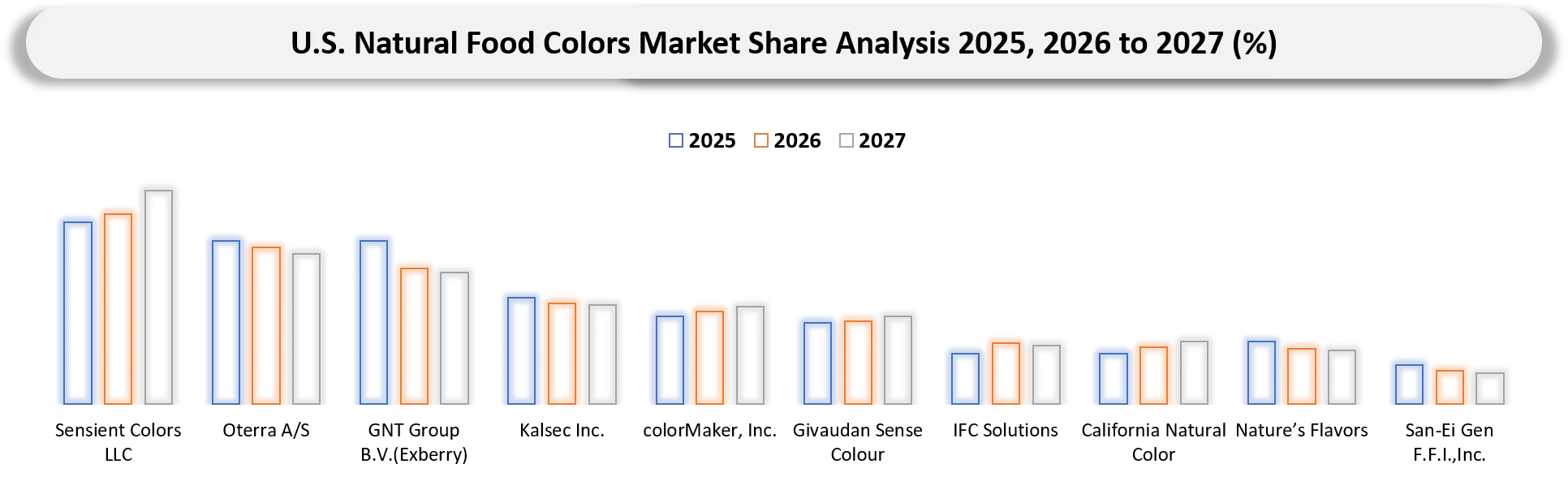
- Key players include Sensient Colors LLC, Oterra A/S, GNT Group B.V.(Exberry), Kalsec Inc., colorMaker, Inc., Givaudan Sense Colour, IFC Solutions, California Natural Color, Nature’s Flavors, San-Ei Gen F.F.I.,Inc.
Key Developments
- January 2026: ADM invested US$26 million in its Erlanger, Kentucky facility to expand capacity for naturally derived color and flavor solutions, including a 3,600-square-foot facility expansion, automated technologies, digitalization, and process upgrades. The investment builds on a US$15 million 2025 expansion of ADM's Customer Creation and Innovation Center and is intended to support growing U.S. food and beverage reformulation demand.
- October 2025: Givaudan broke ground on a new US$215 million production facility in Reading, Ohio, representing one of its largest U.S. investments in many years. The 24,000-square-meter facility is designed to strengthen Givaudan's U.S. production footprint and expand its ability to serve food and beverage customers with innovative solutions.
- July 2026: Oterra launched liquid natural blue color solutions designed to provide food and beverage manufacturers with broader natural blue-color options. The launch is particularly relevant to U.S. reformulation activity because blue remains one of the more technically challenging synthetic-color replacement categories.
- May 2025: FDA approved three food colors from natural sources, including Galdieria extract blue and butterfly pea flower extract, expanding the range of naturally derived colorants available for use in U.S. food formulations and supporting replacement of synthetic dyes.
- August 2026: General Mills completed the removal of certified colors from its entire U.S. cereal portfolio, demonstrating how synthetic-color replacement is progressing from individual product reformulation toward portfolio-wide conversion among major U.S. CPG manufacturers.
Key Procurement Priorities and Buyer Evaluation Criteria
- Firms procuring natural food colors are prioritizing suppliers that can provide consistent shade performance, clean-label formulations, broad color portfolios, and application-specific solutions suitable for high-volume food and beverage manufacturing.
- Procurement decisions are increasingly influenced by reformulation requirements, FDA natural-color approvals, synthetic-dye phaseout initiatives, retailer standards, school-food requirements, and the need to replace certified colors without compromising product appearance or processing performance.
- Key supplier evaluation criteria include color stability, shade consistency, color intensity, processing compatibility, regulatory status, and supply reliability, particularly for applications exposed to heat, light, acidic conditions, or extended shelf life.
- Additional considerations include technical application support, customization capabilities, domestic manufacturing footprint, raw-material traceability, certification credentials, minimum order quantities, lead times, and ability to support portfolio-wide reformulation programs across cereals, confectionery, beverages, snacks, bakery, and dairy products.
- For large CPG manufacturers, procurement is increasingly shifting toward formulation partners rather than standalone pigment suppliers, favoring vendors capable of providing color matching, stabilization, application testing, prototype development, and troubleshooting throughout the reformulation process.
- Supply continuity is becoming a strategic procurement criterion, with buyers increasingly assessing U.S. production capacity, agricultural feedstock diversification, inventory availability, and dual-sourcing capabilities to reduce exposure to botanical raw-material variability and import-related disruptions.
Why Choose DataM?
- Regulatory & Reformulation Intelligence: Tracks FDA approvals, synthetic-dye phaseout initiatives, state-level requirements, retailer standards, and evolving natural-color authorization pathways, identifying how regulatory changes are translating into formulation and procurement requirements across U.S. food categories.
- Technology & Product Innovation: Evaluates advances in natural-color technologies including botanical pigments, coloring foods, fermentation-derived pigments, microencapsulation, stabilization, and application-specific blends, highlighting innovations addressing heat, light, pH, and shelf-life limitations.
- Product Performance & Market Positioning: Assesses natural-color suppliers based on shade range, stability, color intensity, processing compatibility, clean-label credentials, application expertise, and ability to replace synthetic dyes across demanding food and beverage applications.
- Real-World Reformulation Evidence: Highlights portfolio-level reformulation activity across cereals, confectionery, beverages, snacks, bakery, dairy, and children's foods, demonstrating how manufacturers are transitioning from individual SKU changes toward broader artificial-color replacement programs.
- Supply Chain & Manufacturing Intelligence: Examines domestic manufacturing capacity, botanical raw-material sourcing, production expansions, feedstock variability, and supply-chain localization, identifying how U.S. color manufacturers are preparing for accelerated reformulation demand.
- Competitive Strategies: Analyzes how leading players differentiate through application laboratories, custom color development, formulation support, strategic capacity investments, acquisitions, new natural-color approvals, and expanded product portfolios.
- Pricing & Market Access: Evaluates pricing differences according to pigment source, concentration, formulation complexity, application requirements, stability performance, certification, and customization, alongside major routes to market through direct CPG relationships, ingredient suppliers, and distributors.
- Market Entry & Expansion: Identifies opportunities arising from synthetic-dye replacement, natural blue and green development, portfolio-wide CPG reformulation, retailer requirements, and domestic production expansion, while assessing strategies for entering high-volume U.S. food and beverage applications.
Target Audience
- Food & Beverage Manufacturers: CPG companies, food processors, beverage producers, confectionery manufacturers, bakery companies, dairy producers, and snack manufacturers reformulating products with natural color systems.
- Natural Food Color Manufacturers: Producers of botanical extracts, natural pigments, coloring foods, carotenoids, anthocyanins, phycocyanin, and application-specific natural color blends.
- Ingredient & Formulation Companies: Ingredient suppliers, premix manufacturers, formulation houses, and clean-label solution providers integrating natural colors into finished food and beverage formulations.
- Retailers & Private-Label Manufacturers: Supermarkets, mass merchandisers, club stores, and private-label producers establishing artificial-color restrictions and reformulation requirements across food portfolios.
- Foodservice & Institutional Food Providers: School meal operators, contract foodservice companies, institutional caterers, and suppliers adapting products to artificial-color restrictions and evolving procurement standards.
- Regulatory & Food Safety Organizations: Federal and state regulatory agencies, food safety bodies, and compliance organizations monitoring color additive approvals, labeling requirements, and synthetic-dye phaseout initiatives.
- Investors & Private Equity Firms: Stakeholders evaluating opportunities across natural color manufacturing, formulation technologies, ingredient production, application services, and domestic supply-chain expansion.
- Analytical Testing & Certification Providers: Laboratories and certification organizations conducting color additive testing, contaminant analysis, specification verification, stability assessment, and regulatory compliance testing.


























































