


U.S. Industrial Lighting Market Size
The U.S. Industrial Lighting Market was valued at US$ 0.53 Billion in 2025 and is forecast to reach US$ 0.63 Billion by 2031, an annual growth rate of 2.80%. Demand comes from factories, warehouses, logistics centers, processing plants and other sites that use lighting for long operating hours. Replacement of older high-bay fixtures remains an important source of sales.
Industrial buyers compare lighting costs over the full life of a facility. High energy use and difficult maintenance access make LED retrofits attractive in warehouses and production halls. Many projects also include occupancy sensors, daylight controls and lighting that can withstand dust, washdowns or vibration. New construction adds demand, though budget approvals and contractor schedules can affect the timing of orders.
| 2025 MARKET SIZE | 2031 FORECAST | CAGR (2025-2031) |
| US$ 0.53 Billion | US$ 0.63 Billion | 2.80% |
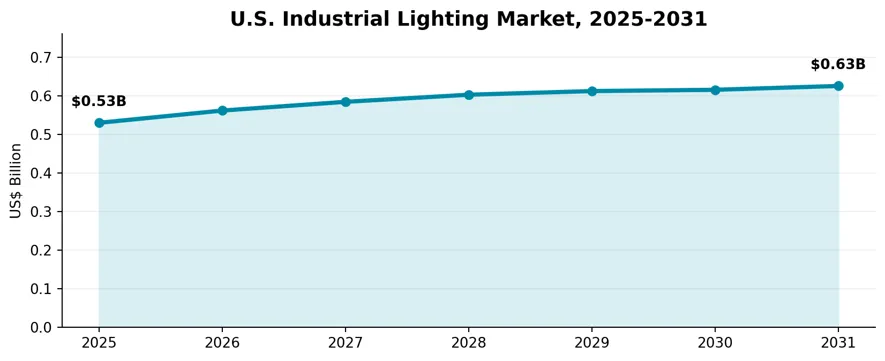
U.S. Industrial Lighting Key Takeaways
Industrial lighting sales are expected to rise from US$ 0.53 Billion in 2025 to US$ 0.63 Billion in 2031.
LED high-bay fixtures are used in warehouses, production halls and distribution buildings where lighting runs for long shifts.
Retrofit projects target sites with older metal halide, fluorescent and other high-maintenance fixtures.
Food processing, chemicals and heavy manufacturing need lighting rated for water, dust or hazardous conditions.
Motion sensors and wireless controls help cut operating costs in aisles and storage areas with irregular activity.
Contractors and plant managers favor products that are easy to install and can be replaced without extended shutdowns.
U.S. Industrial Lighting Industry Trends and Strategic Insights
Warehouses continue to replace older high-bay lighting. Buyers weigh light output, installation time and warranty terms.
Manufacturers are upgrading task and production-area lighting to support inspections, worker safety and longer shifts.
Sealed vapor-tight and hazardous-location fixtures serve facilities where moisture, chemicals or dust limit equipment choices.
Controls are increasingly included in large retrofit projects, especially where different production zones have different schedules.
U.S. Industrial Lighting Market Scope
| METRICS | DETAILS |
| 2025 Market Size | US$ 0.53 Billion |
| 2031 Projected Market Size | US$ 0.63 Billion |
| CAGR (2025-2031) | US$ 0.53 Billion |
| By Product Type | High-bay and low-bay LED fixtures, linear luminaires, vapor-tight and hazardous-location lighting, industrial floodlights and lighting controls |
| By Lighting Type | Indoor commercial, industrial, outdoor area, street and architectural lighting |
| By Technology | LED luminaires, replaceable LED lamps, specialty and legacy sources |
| By Installation | New-build installations, retrofit and maintenance replacements |
| By Application | Manufacturing, logistics and warehouses, food processing, chemicals, heavy industry and utilities |
| By Industry | Commercial property, industrial facilities, public infrastructure and hospitality |
| By Sales Channel | Electrical distributors, direct project sales, contractors and online sales |
| By Project Type | New construction, retrofit, renovation and public replacement projects |
| Competitive Landscape | 10 major suppliers serving U.S. lighting customers |
Coverage: United States. The report covers industrial high-bay and low-bay luminaires, linear LED lighting, vapor-tight fixtures, hazardous-location lighting, industrial floodlights, task lighting and lighting controls supplied for industrial facilities. Applications include manufacturing plants, warehouses, logistics centers, food processing, mining-related facilities and utilities.
U.S. Industrial Lighting Market White Space & Investment Opportunities
Warehouse retrofits: replace older high-bay installations where electricity savings and reduced maintenance can support investment.
Demanding environments: supply fixtures with appropriate ratings for washdowns, dust, chemicals or vibration.
Industrial controls: pair LED retrofits with occupancy sensing and controls for aisles, storage areas and production shifts.
Suppliers with reliable delivery, clear performance data and practical installation support can improve their position with plant owners and electrical contractors.
Driver Impact Analysis
Industrial facilities are replacing older lamps and high-bay fixtures to reduce electricity use and maintenance. Long operating hours make the payback more attractive.
| DRIVER | INTENSITY | AFFECTED EQUIPMENT | COMMERCIAL IMPACT |
| Industrial LED replacements | High | High-bay and linear luminaires | Repeat orders for warehouses and factories |
| Industrial construction | High | High-bay fixtures and task lighting | Equipment demand from new facilities |
| Workplace safety | Medium | Task and high-visibility lighting | Demand for reliable illumination |
| Lighting controls | Medium | Sensors and connected luminaires | Adds value to retrofit contracts |
New logistics and manufacturing facilities generate orders for industrial fixtures. Large buildings may also need lighting controls, emergency lighting and task lighting.
Restraint Impact Analysis
Plant budgets can delay lighting upgrades when production equipment takes priority. Shutdown windows and contractor availability may also slow installation.
| RESTRAINT | PRIMARY EXPOSURE | RISK LEVEL | STRATEGIC IMPACT |
| Capital budget limits | Factory retrofit schedules | High | Purchase decisions can slip |
| Low-cost competition | Standard LED high-bay fixtures | High | Margin pressure |
| Installation downtime | Operating production sites | Medium | Work may need phased schedules |
| Product qualification | Hazardous and washdown areas | Medium | Longer specification process |
Price competition is strong in standard LED fixtures. Specialty products may need longer qualification due to safety ratings, harsh operating conditions and customer specifications.
U.S. Industrial Lighting Market Competitive Landscape
The U.S. industrial lighting market includes broad lighting suppliers and specialist manufacturers. Competition is strongest in high-bay LEDs, warehouse lighting and rugged fixtures for industrial sites. Distributors and electrical contractors influence purchasing decisions.
| COMPANY | LIGHTING POSITIONING |
| Acuity Brands Lighting | Lithonia Lighting high-bay, vapor-tight and industrial LED fixtures |
| Current Lighting | LED high-bay, linear and industrial lighting products |
| Signify | Industrial LED luminaires and connected lighting systems |
| RAB Lighting | High-bay fixtures, floodlights and industrial LED lighting |
| Dialight | Rugged and hazardous-location LED lighting |
| Hubbell Lighting | Industrial and heavy-duty luminaires and controls |
| LEDVANCE | Industrial high-bay and LED retrofit products |
| Cree Lighting | LED fixtures for selected industrial applications |
| Phoenix Lighting | Heavy-duty lighting for ports, mining and industrial environments |
| Larson Electronics | Hazardous-location and industrial lighting products |
Acuity Brands, Current Lighting, Signify and RAB supply high-bay and industrial fixtures. Dialight and Phoenix Lighting serve heavy-duty applications, while Hubbell, LEDVANCE, Cree Lighting and Larson Electronics offer products for selected industrial environments.
U.S. Industrial Lighting Market Recent Developments
March 13, 2026: Lithonia Lighting expanded its Compact Pro LED high-bay family with another contractor-focused option.
March 30, 2026: Lithonia Lighting announced updates to its CSVT vapor-tight lighting range, including a shorter fixture size.
May 18, 2026: Lithonia Lighting launched its Beyond LED High Bay for warehouses, automotive plants and other large indoor spaces.
August 17, 2026: Lithonia Lighting said its Beyond High Bay was selected for the 2026 IES Progress Report.
September 15, 2026: Lithonia Lighting introduced the RENEGADE LED High Bay with adjustable lighting options.
October 13, 2026: Lithonia Lighting highlighted an updated IP65 Compact Pro Round Bay for industrial use.


























































