


U.S. Data Center Transformer Market Size
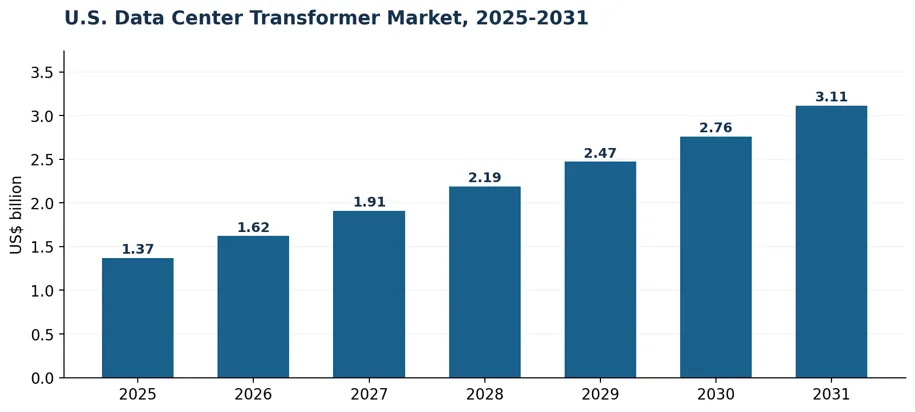
The U.S. Data Center Transformer Market is assessed at US$ 1.37 billion in 2025 and is forecast to reach US$ 3.11 billion in 2031, equivalent to 14.67% annualized growth. Transformer equipment connects incoming utility supply to campus distribution systems and powers downstream data halls. New hyperscale investments and higher-density AI facilities are increasing the importance of substation capacity and delivery schedules.
Transformers are essential to data center electrical systems. They connect incoming utility power to the campus and supply medium-voltage distribution networks inside the site. Larger AI campuses often need multiple transformers to support phased openings and backup capacity. Buyers are placing orders earlier because delivery schedules can affect when a facility starts operating.
| 2025 MARKET SIZE | 2031 FORECAST | CAGR (2026–2031) |
| US$ 1.37 Billion | US$ 3.11 Billion | 14.67% |
U.S. Data Center Transformer Key Takeaways
Demand is growing as data center operators invest in new substations and expand existing campuses.
New hyperscale campuses require dedicated primary substations and medium-power transformers well before final commissioning.
AI clusters place greater loads on campus power infrastructure. Transformer redundancy and maintainability now influence site economics.
Transformers ordered late in the development cycle can delay energized capacity even when data halls are physically ready.
Modular substations, energy-efficient dry-type units and condition monitoring support premium equipment and service demand.
U.S. Data Center Transformer Industry Trends and Strategic Insights
The commercial bottleneck increasingly appears at utility interconnection and transformer delivery, with order decisions moving earlier in project design.
Campus operators are standardizing electrical blocks to replicate proven transformer and substation specifications across multiple sites.
Domestic manufacturing additions are improving future capacity, though qualification and commissioning still limit near-term supply.
Data center operators favor equipment that can accommodate phased growth without disruptive electrical reconfiguration.
U.S. Data Center Transformer Market Scope
| METRICS | DETAILS |
| 2025 Market Size | US$ 1.37 Billion |
| 2031 Projected Market Size | US$ 3.11 Billion |
| CAGR (2026–2031) | 14.67% |
| By Transformer Type | Distribution, medium-power, large-power substation, modular unit substation |
| By Data Center Type | Hyperscale/cloud, colocation, enterprise, AI-oriented campuses, edge |
| By Voltage Rating | Low voltage secondary, medium-voltage primary, high-voltage grid connection |
| By Insulation and Cooling | Oil-immersed, natural ester, dry-type cast resin, forced-air and forced-oil cooling |
| By Power Architecture | Utility-fed substations, campus primary substation, secondary distribution, behind-the-meter generation |
| By Phase and Installation | Three-phase, indoor, outdoor, pad-mounted, modular substation |
| By Installation Stage | New-build, campus expansion, equipment replacement, commissioning, aftermarket |
| Competitive Landscape | 10 transformer and power-equipment providers active in U.S. critical-load supply |
| Market Data Coverage | 2025-2031 U.S. data center transformer market, equipment applications and market trends |
Coverage: United States. The report covers transformers used in data center substations and electrical distribution systems, including hyperscale, colocation, enterprise and edge facilities. It includes transformer types, voltage ratings, insulation and cooling methods, installation settings and new-build or replacement demand.
U.S. Data Center Transformer Market White Space & Investment Opportunities
Dedicated substations: pursue transformer packages for new hyperscale campuses where equipment reservations precede site energization.
Repeatable power blocks: develop standardized modular substations and medium-voltage transformer arrangements for phased AI deployments.
Service and availability: expand factory testing, spare-transformer programs, remote monitoring and onsite transformer commissioning support.
New opportunities depend on direct specification engagement with utilities, campus developers and electrical EPC firms. Suppliers with approved designs and credible manufacturing slots are best placed to win multi-site purchasing programs.
Driver Impact Analysis
Hyperscale construction creates large campus-level demand for power and distribution transformers. Large interconnection substations are specified years before operational handover.
| DRIVER | AFFECTED PRODUCT / SIGNAL | 2026–2031 CAGR | STRATEGIC IMPACT |
| Hyperscale data center buildout | High | New campus substation packages | Reserve transformer production slots early in project design |
| AI compute load density | High | Medium-voltage and high-capacity distribution | Coordinate cooling, redundancy and transformer thermal design |
| Campus expansion programs | High | Repeat orders for standardized electrical blocks | Create framework agreements across portfolios |
| Domestic capacity investment | Medium-High | Local testing and shorter logistics paths | Align qualification with future production schedules |
Higher rack densities and multiple data halls increase distribution complexity. Operators prioritize low-loss transformer designs and equipment that can be serviced without interrupting live facilities.
Restraint Impact Analysis
Lead times for power transformers remain long as factories balance grid replacement projects with data center work. Production-slot access and transportation planning can determine delivery timing.
| RESTRAINT | PRIMARY EXPOSURE | RISK LEVEL | STRATEGIC IMPACT |
| Long delivery windows | Medium- and large-power transformers | High | Order before final electrical construction milestones |
| Electrical-steel and copper exposure | Transformer cores and windings | High | Use contract escalation and dual-source planning |
| Grid interconnection uncertainty | Primary substations and utility feeds | High | Link manufacturing releases to utility milestones |
| Specification revisions | Modular and bespoke transformer designs | Medium-High | Freeze capacity and efficiency specifications early |
Grid connection schedules, uncertain load ramp-up and changes in project capacity can defer procurement. Overly specific designs also increase qualification and manufacturing risk.
U.S. Data Center Transformer Market Competitive Landscape
Competition includes established transformer manufacturers, U.S. distribution-equipment suppliers and companies with large-power substation experience. Buyers weigh delivery commitments, factory capacity, thermal performance, utility acceptance and field-service support.
| COMPANY | DATA CENTER TRANSFORMER POSITIONING |
| Hitachi Energy | Large power and medium-power transformers for utility-fed data center campuses. |
| GE Vernova / Prolec GE | Medium-power and distribution transformer manufacturing with U.S. capacity investments. |
| Siemens Energy | High-voltage transformer supply for major interconnection substations. |
| Virginia Transformer | Engineered-to-order power transformers for large commercial and utility loads. |
| HD Hyundai Electric | Power transformers for high-capacity U.S. infrastructure and critical-load substations. |
| Eaton | Dry-type and distribution transformers and packaged electrical systems for facilities. |
| Howard Industries | Distribution transformers with U.S. manufacturing and utility channels. |
| ERMCO | Pad-mounted distribution transformers serving campus electrical distribution. |
| Mitsubishi Electric Power Products | Large power equipment and transformer solutions for grid connections. |
| Delta Star | Power transformer manufacturing, repair and substation applications. |
The leading suppliers are pursuing expanded U.S. manufacturing and broader service coverage. Competition for hyperscale projects depends on campus-wide electrical engineering expertise as well as transformer specifications.
U.S. Data Center Transformer Market Recent Developments
March 17, 2026: Prolec GE Waukesha began work on a US$140 million plant expansion in Goldsboro, North Carolina. The company expects annual production of medium-power transformers to grow from 220 to 420 units.
June 29, 2026: Hitachi Energy started construction of a US$457 million large transformer facility in South Boston, Virginia. The plant will help meet demand for grid connections and other large power projects.
July 9, 2026: Reuters reported that U.S. transformer shortages were affecting data center projects. Some developers are ordering equipment earlier to avoid delays.
July 30, 2026: Trench Group opened a US$60 million factory in Charlotte, North Carolina. It will make high-voltage transformer bushings.
September 15, 2026: Hitachi Energy announced plans for a US$528 million transformer factory in Gallman, Mississippi. Production is expected to start in 2029.
September 18, 2026: Utility Dive reported that the planned Mississippi factory will make transformers rated at 10 to 160 MVA and up to 230 kV. These sizes can be used for substations that serve large data centers.


























































