


U.S. Data Center Cables & Wires Market Size and Overview
The U.S. data center cables and wires market covers medium- and low-voltage electrical feeders, critical-power conductors, structured copper cabling, optical fiber, high-speed cable assemblies and specialty control cables used in hyperscale, colocation, enterprise and AI data centers. This market measures cable and wire products supplied for U.S. data-center construction, expansion and network or electrical upgrades, excluding switchgear, transformers, UPS equipment, IT hardware and non-cable electrical components.
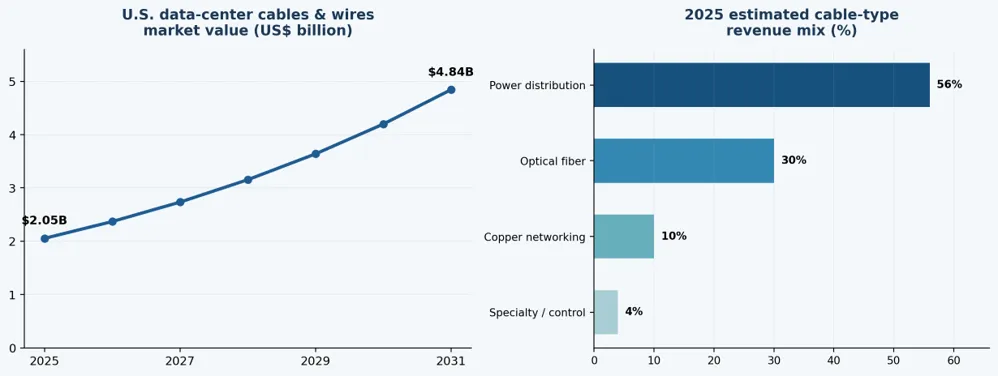
DataM estimates the U.S. data center cables and wires market at US$ 2.05 billion in 2025, reaching US$ 4.84 billion by 2031, representing a 15.37% CAGR during 2026–2031. The cable-only model allocates approximately 12% of data-center electrical-components expenditure to the in-scope cables and wires in 2025, increasing to 14% by 2031 as power density and fiber-intensive AI networks lift cabling requirements. The forecast covers power, optical, copper networking and specialty cables without including the broader electrical-equipment market.
U.S. Data Center Cables & Wires Market Key Takeaways
• DataM estimates data-center cable and wire sales of US$ 2.05 billion in 2025 and US$ 4.84 billion in 2031, equivalent to a 15.37% annual growth rate over 2026–2031.
• Power distribution cables represent an estimated 56% of 2025 sales, reflecting medium-voltage site feeders, low-voltage distribution, standby-power connections and rack-level power systems.
• Optical fiber cables account for an estimated 30% of 2025 revenue. Higher fiber counts, campus connectivity and AI network architectures are expected to increase their contribution to cable spending.
• Copper networking and high-speed electrical interconnect cables represent an estimated 10% of sales in 2025, supported by structured networks, short-reach connections and rack-level data links.
• Specialty, control and fire-performance cable products contribute an estimated 4% of the market in 2025, with growth opportunities in resilient power infrastructure and modular data halls.
U.S. Data Center Cables & Wires Industry Trends and Strategic Insights
• AI-ready network architectures favor preterminated fiber, high-density optical cable assemblies and streamlined rack-to-rack deployment, while cable selection must accommodate transceiver roadmap changes.
• Campus-scale developments require coordination among utilities, electrical engineering contractors, switchgear OEMs and cable vendors; feeder specification and installation lead time can shape the construction critical path.
• Prefabricated electrical skids, modular data halls and factory-configured distribution packages shift cable procurement toward standardized harnesses and quality-assured assemblies.
• Higher heat loads and cable congestion raise the value of validated fire ratings, bend management, pathway design and documented performance under dense deployments.
U.S. Data Center Cables & Wires Market Scope
| METRICS | DETAILS |
|---|---|
| Base Year / Forecast | 2025 / 2026–2031 |
| Geographic Coverage | United States |
| Market Size and Growth | US$ 2.05 billion (2025); US$ 4.84 billion (2031); 15.37% CAGR (2026–2031). Cable and wire products serving U.S. data centers only. |
| By Cable Type | Power Cables & Wires (MV feeders, LV distribution, UPS / battery / generator cables, rack power whips); Datacom & Network Cables (SMF, MMF, copper Ethernet, DAC / AEC); Specialty (fire-rated / LSZH, control, grounding). |
| By Data Center Type | Hyperscale; Colocation; Enterprise / Private; Edge / Modular; AI / High-Density Compute. |
| By Cable Application | Site Power / Utility Interconnection; Electrical Distribution; UPS & Backup; Rack-Level Power; Structured Cabling; Campus Fiber; Controls / Fire Safety / BMS. |
| By Network / Transmission Medium | Copper Power Conductors; Copper Data Interconnects; Single-Mode Fiber; Multimode Fiber; Hybrid Copper-Fiber. |
| By Power Cable Voltage Rating | Low Voltage (up to 1 kV); Medium Voltage (above 1 kV to 35 kV); High Voltage (above 35 kV, utility / campus application). |
| By Cable Jacket / Fire Performance | Plenum / Riser; LSZH; Fire-Resistant / Circuit Integrity; XLPE / PVC / EPR and other materials. |
| By Deployment Location | Outside Plant / Campus; Electrical Rooms; Overhead Cable Tray; Underfloor / Conduit; Rack / Row Interconnect. |
| Competitive Landscape | 10 company profiles; product positioning; channel coverage; data-center partnerships and recent developments. |
| Market Insights | Cable-only market sizing, power / optical / networking product mix, installation demand, segment growth, market dynamics, capital opportunities and competition. |
U.S. Data Center Cables & Wires Market White Space & Investment Opportunities
• High-density optical infrastructure: Design-in opportunities for preterminated fiber trunks, low-loss connections, structured fiber pathways and modular expansion programs at hyperscale and AI facilities.
• Critical-power cables: Suppliers can target factory-tested low-voltage distribution assemblies, medium-voltage feeders, resilient grounding and flexible rack-level power interconnects.
• Prefabricated and modular delivery: Cable harnesses and labeled assemblies can reduce on-site labor intensity and accelerate phased hall commissioning.
• Service-led differentiation: Documentation, onsite logistics, testing support, rapid replenishment and compatibility with preferred installer standards create recurring account value.
• Brownfield upgrades: Refreshes of enterprise sites and leased colocation halls create demand for power densification, fiber reconfiguration and fire-code-compliant replacements.
U.S. Data Center Cables & Wires Market Dynamics
The estimated market expands as more data-center campuses progress from announcement to energized construction and as operating halls are upgraded for denser rack power and faster networking. Cable demand is measured at the installed-product level: main site feeders, distribution wiring, UPS and generator connections, optical fiber trunks, structured copper networks, high-speed electrical assemblies and control cabling. Utility-ready projects create sizeable early-stage power-cable orders, while phased fit-outs and network refreshes generate subsequent fiber and copper-cable demand.
Driver Impact Analysis
| DRIVER | DEMAND EXPOSURE | IMPACTED CABLES | STRATEGIC IMPLICATION |
|---|---|---|---|
| Hyperscale / AI capacity additions | New campus builds and phased hall fit-out | MV / LV power; SMF; rack interconnects | Secure approved vendor status and project-based supply programs. |
| Higher power per rack | UPS / distribution expansion; greater electrical density | LV feeders; rack whips; grounding | Develop application-qualified assemblies and improve installation efficiency. |
| Network architecture upgrades | Migration to high-density links and fiber pathways | SMF; MMF; DAC / AEC | Expand optical portfolio and preterminated system capabilities. |
| Modular / prefabricated construction | Factory-built electrical blocks and repeatable designs | Preassembled power / control / fiber | Partner with OEMs, EPCs and modular integrators. |
New hyperscale and AI-capable capacity is the principal source of incremental cable demand. Medium-voltage cables connect campus distribution infrastructure and low-voltage products distribute critical power to electrical rooms and equipment rows. Optical fiber demand grows with increased network ports, inter-building backbone connections and high-bandwidth cluster architectures. Standardized cables, preterminated assemblies and tested cable harnesses enable repeatable procurement across multiple halls.
From a commercial standpoint, cable suppliers benefit from early specification with EPC contractors, data-center developers and network-system integrators. Sales opportunities extend beyond new builds: older facilities are replacing power pathways, increasing fiber density and changing distribution layouts as racks become more power intensive. Qualification, availability, installation productivity and compliance documentation frequently determine supplier selection.
Restraint Impact Analysis
| RESTRAINT | EXPOSURE AREA | IMPACTED USE CASE | STRATEGIC RESPONSE |
|---|---|---|---|
| Power connection / permitting delays | Utility interconnection and campus energization | MV feeders and facility electrical distribution | Align manufacturing slots to verified utility and EPC milestones. |
| Conductor and polymer cost volatility | Long-duration contracts and fixed-price bids | Copper / aluminum power cables; specialty jackets | Price-index mechanisms, procurement planning and disciplined contract terms. |
| Installation labor and pathway constraints | High-density retrofits and accelerated fit-out | Fiber trunks; structured cabling; power whips | Use preterminated designs, documentation and installer training. |
| Rapid network-standard evolution | High-speed AI and cloud interconnect upgrades | Optical / copper data cables | Maintain flexible architecture and interoperability testing. |
Power connection constraints, permitting and construction sequencing can delay cable release orders even after a data-center project is publicly announced. Large feeder orders are especially dependent on energized-site milestones. Fiber and data-network cabling may be ordered closer to hall fit-out, creating a different timing exposure. Suppliers should assess project maturity, owner financing, equipment schedules and utility availability when positioning capacity.
Copper and aluminum price volatility affects cable quotations and can compress margins on long-cycle contracts. Optical fiber shortages, delivery schedules for specialized jackets and connector interoperability add further risks. Higher cable density can raise installation costs through crowded trays, bend-radius requirements and fire-rating constraints. Suppliers able to supply pretested assemblies, predictable pricing mechanisms and contractor-ready documentation can reduce these barriers.
U.S. Data Center Cables & Wires Market Competitive Landscape
The competitive landscape spans power-cable manufacturers, optical-fiber specialists, structured-cabling vendors and high-speed interconnect providers. Competitive assessment considers participation in data-center power and networking projects, approved product families, production footprint, design-in relationships and fulfillment capabilities. The market sizing relates only to data-center cable and wire revenue, excluding non-cable product sales of the profiled suppliers.
| COMPANY | U.S. DATA-CENTER POSITIONING |
|---|---|
| Prysmian | Medium- and low-voltage power cables plus fiber / optical cabling for data-center infrastructure. |
| Southwire | Building wire, electrical distribution and critical-power cable supply to U.S. construction programs. |
| Corning | Optical fiber, preterminated connectivity and high-density data-center cabling. |
| CommScope | Structured copper and fiber cabling systems for enterprise and hyperscale networks. |
| Belden | Data and control cables, network connectivity and industrial-grade communications. |
| AFL | Fiber-optic cable, accessories, assemblies and installation solutions. |
| Amphenol | High-speed copper / optical interconnects and cable assemblies. |
| Leviton | Copper and fiber structured cabling, patching and facility network infrastructure. |
| Panduit | Structured cabling, pathways, cable management and data-center connectivity. |
| Superior Essex Communications | Copper communications cables and network infrastructure cabling. |
Competitive differentiation depends on electrical ratings, optical loss performance, product certifications, installation labor savings, stock availability and coordination with EPC and systems integrator partners. Suppliers with a broad portfolio can participate across several infrastructure packages, while focused specialists compete through high-density optical products, preterminated assemblies and unique application specifications.
U.S. Data Center Cables & Wires Market Recent Developments
• Corning — 2026: Continued expanding its optical-connectivity focus for AI data-center deployments and dense fiber architectures.
• Prysmian — 2026: Continued investment in U.S. optical-fiber and cable manufacturing capacity to address communications infrastructure demand.
• Belden — 2026: Advanced high-density fiber and connectivity product offerings relevant to mission-critical infrastructure.
• Amphenol — 2026: Expanded high-speed interconnect capabilities through its optical and datacom portfolio.
• Southwire — 2026: Continued investment in U.S. manufacturing supporting utility, building and electrical-infrastructure customers.


























































