


U.S. Cables & Wires Market Size and Overview
The U.S. cables and wires market was valued at US$ 29.01 billion in 2025 and is projected to reach US$ 34.02 billion by 2031. The attached U.S. market database indicates a 1.85% CAGR for 2026–2031, following a stronger rise in market value between 2025 and 2026. The forecast captures electrical power cables, datacom cable products and application-specific specialty cables.
Low-voltage products account for the largest 2025 revenue pool at US$ 14.56 billion, or 50.18% of the national total. Medium- and high-voltage cables contribute US$ 9.08 billion, followed by datacom cables at US$ 3.82 billion and specialty cables at US$ 1.55 billion. These four product families are mutually exclusive within the supplied market classification.
| 2025 MARKET SIZE | 2031 FORECAST | CAGR (2026–2031) |
| US$ 29.01 Billion | US$ 34.02 Billion | 1.85% |
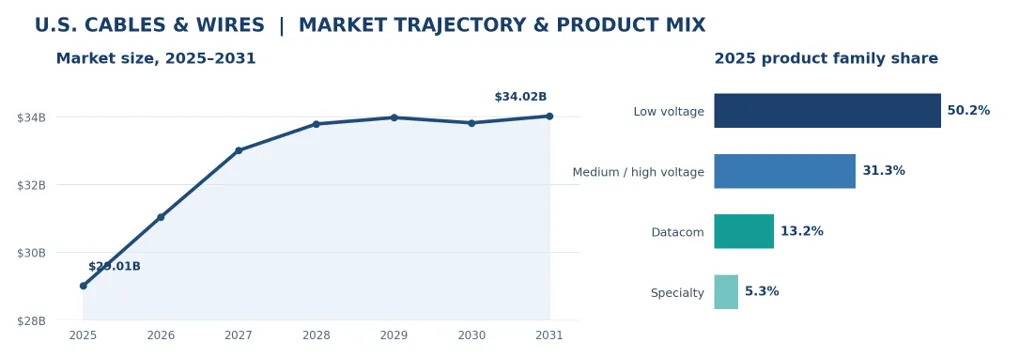
Low-voltage cables lead the product mix with US$ 14.56 billion in 2025, equal to 50.18% of total U.S. cable and wire sales.
Medium- and high-voltage cables represent US$ 9.08 billion in 2025 and are expected to expand to US$ 10.75 billion by 2031, with a 2.04% CAGR for 2026–2031.
Datacom cable demand is forecast to increase from US$ 3.82 billion in 2025 to US$ 4.40 billion in 2031, including US$ 1.07 billion of fiber-optic cables in 2031.
Low-smoke, halogen-free cables record the highest CAGR among the displayed subcategories at 8.55% over 2026–2031, albeit from a comparatively small base.
Fire-resistant cables are projected to grow at 3.05% CAGR in 2026–2031, ahead of the total market, indicating a targeted premium-specification opportunity.
The aggregate market rises by US$ 5.01 billion between 2025 and 2031. Product differentiation, availability and specification-led sales are likely to matter more than uniform category growth.
U.S. Cables & Wires Industry Trends and Strategic Insights
Grid modernization and new power loads support opportunities in medium- and high-voltage cables. the market dataset projects high-voltage sales at US$ 4.50 billion by 2031, up from US$ 3.73 billion in 2025.
AI-driven data-center deployment is increasing supplier emphasis on power distribution cables, structured cabling and high-density optical interconnects. Datacom cable revenue is projected to reach US$ 4.40 billion by 2031.
Fire-safety specifications create room for specialized low-voltage offerings. Low-smoke, halogen-free products are forecast to grow from US$ 185.42 million in 2026 to US$ 279.48 million in 2031.
Domestic production capacity, lead-time guarantees and distributor relationships are becoming important competitive levers as cable producers expand U.S. plants or acquire local businesses.
U.S. Cables & Wires Market Scope
| METRICS | DETAILS |
| 2025 Market Size | US$ 29.01 Billion |
| 2031 Projected Market Size | US$ 34.02 Billion |
| CAGR (2026–2031) | 1.85% |
| Geographic Coverage | United States |
| By Cable Type | Datacom Cables (Communication & Data Cables, Fiber Optic Cables); Low-Voltage Cables (Fire Resistant Cables, Low Smoke & Halogen Free Cables, Low Voltage Cables & Wires); Medium- and High-Voltage Cables (Medium Voltage Cables, High Voltage Cables); Special Cables (Mining Oil & Gas Cables, Photovoltaic Cables, Ship & Harbour Cables, Windmill Cables) |
| By Industry | Industrial — Discrete (Aerospace & Defense, Automotive, Batteries, Electrical & Electronics, Machine Building, Semiconductor); Process (Chemicals, Energy/Oil & Gas, Metal Processing); Hybrid (Food & Beverage, Lifesciences, Mining & Quarrying, Other Manufacturing). Non Industrial — Transportation (Air, Land, Rail, Marine Services); Infrastructure & Services (Commercial Real Estate, Data Centers, Healthcare, Hospitality & Entertainment, Public Sector/Research/Education, Residentials, Water & Waste, Others). Power Utilities — Power Generation (Coal, Conventional Excl. Coal, Renewables); Power Distribution & Transmission. |
| By Conductor / Transmission Medium | Copper; Aluminum; Optical Fiber; Composite / Hybrid Construction |
| By Voltage Rating (Power Cables) | Low Voltage (up to 1 kV); Medium Voltage (above 1 to 35 kV); High Voltage (above 35 to 230 kV); Extra-High Voltage (above 230 kV) |
| By Insulation and Sheathing Material | Cross-Linked Polyethylene (XLPE); Polyvinyl Chloride (PVC); Ethylene Propylene Rubber (EPR/EPDM); Polyethylene (PE); Low Smoke Zero Halogen (LSZH); Other Materials |
| By Installation Method | Overhead; Underground / Buried; Submarine / Underwater; Indoor / Building; Outdoor / Industrial |
| Competitive Landscape | Competitive positioning, 10 company profiles, recent developments and partnerships |
| Market Data Coverage | Cable-type and cable-subtype market values, 2025–2031 (US$ million); industry, material, voltage and installation breakdowns within the defined report scope |
The industry categories follow the supplied workbook’s industry-vertical taxonomy. Its industry values describe the broader electrical-components market. Cable-specific industry splits plus the additional material, voltage and installation segmentations are analytical coverage to be established through separate market allocation and validation.
U.S. Cables & Wires Market White Space & Investment Opportunities
Premium safety cable products: Low-smoke, halogen-free cables represent US$ 162.44 million in 2025 and show 8.55% CAGR over 2026–2031. Product qualification, fire-performance validation and specification-led distribution offer commercially targeted expansion paths.
High-voltage capacity and project alignment: High-voltage cable value rises from US$ 3.73 billion in 2025 to US$ 4.50 billion in 2031. Manufacturers can prioritize transmission-project qualification, utility procurement relationships and improved delivery commitments.
Fiber connectivity for digital infrastructure: Fiber-optic cables are forecast at US$ 1.07 billion in 2031. Product density, deployment speed and domestic manufacturing can help suppliers address data-center connectivity demand.
Demand is also becoming more specification-sensitive. Transmission and distribution customers prioritize long-term cable reliability, fire performance and predictable delivery windows. Data-center buyers emphasize dense, high-availability power and communication links. Suppliers that align engineering, certification and local inventory with customer procurement calendars can capture a greater share of complex programs.
Driver Impact Analysis
Grid upgrades, electrification and large commercial power loads support demand for high-voltage cable, particularly where utilities require tested products, consistent delivery and long-cycle supply agreements. In parallel, fiber-intensive network expansion creates opportunities for datacom cable manufacturers serving data centers, enterprise networks and communications infrastructure. Safety-driven specifications favor differentiated low-voltage products, including fire-resistant and low-smoke constructions.
| DRIVER | AFFECTED PRODUCT / SIGNAL | 2026–2031 CAGR | STRATEGIC IMPACT |
| Grid reinforcement and electrification | High-voltage cable forecast: US$ 4.50B in 2031 | 2.41% | Prioritize utility approvals, production slots and high-voltage customer access. |
| Network connectivity and data centers | Fiber-optic cable forecast: US$ 1.07B in 2031 | 1.98% | Expand optical solutions, data-center accounts and domestic lead-time capacity. |
| Higher fire and life-safety requirements | Low-smoke, halogen-free cable: US$ 279.48M in 2031 | 8.55% | Build premium specifications, certifications and project distributor coverage. |
| Resilient building cable specifications | Fire-resistant cable forecast: US$ 380.26M in 2031 | 3.05% | Differentiate products by fire resistance, reliability and installation readiness. |
For cable manufacturers, market growth does not automatically translate into the same rate of profit growth. The mix of conductor metals, insulation compounds, freight, labor and testing affects bid economics. Where contracts permit indexed metal-price adjustment, suppliers may protect margins more effectively. Where projects depend on permitting milestones, staged production planning reduces inventory and working-capital exposure.
Restraint Impact Analysis
Volatility in copper and aluminum prices can compress margins between bid submission and product delivery, especially for projects with fixed-price commitments. Utility permitting, interconnection queues and construction scheduling can shift expected cable deliveries between quarters. Specialized products face additional challenges in qualification, certification, installation capability and production-slot availability, making diversified customer exposure and disciplined contract terms important.
| RESTRAINT | PRIMARY EXPOSURE | RISK LEVEL | STRATEGIC IMPACT |
| Copper and aluminum price volatility | Low- and medium-voltage product pricing and contractor budgets | High | Index-based quotations, hedging and pass-through clauses protect project margins. |
| Permitting and infrastructure delays | Utility transmission and specialized power-cable orders | High | Diversify project backlog and stage production around realistic commissioning dates. |
| Manufacturing and skilled-labor constraints | U.S. extrusion capacity, testing and specialized cable production | Moderate–High | Invest in process capability, workforce development and delivery reliability. |
| Competitive price pressure and imports | Standardized low-voltage and commodity datacom cables | Moderate | Compete through product certification, channel service and customer-specific designs. |
A further constraint arises from competitive lead times for high-voltage and specialty installations. Even when demand is secured, manufacturing capacity, skilled installation crews and testing appointments can determine when revenue is realized. Product substitution is limited where utility specifications or safety standards require a particular design, increasing the strategic value of early approval and documented performance.
U.S. Cables & Wires Market Competitive Landscape
The U.S. competitive environment combines diversified power-cable manufacturers, optical-connectivity providers and specialists serving industrial or infrastructure applications. Recent capacity additions and acquisitions indicate competition around local manufacturing footprint, technical qualifications and distribution access.
| COMPANY | U.S. CABLES & WIRES POSITIONING |
| Southwire | Building wire, power cables and utility-linked electrical infrastructure. |
| Prysmian | Power, industrial, construction and optical-cable systems. |
| Nexans | Electrification and low-voltage wire, including expanded U.S. manufacturing presence. |
| Corning | Optical fiber, cable and advanced connectivity for data centers and broadband. |
| Belden | Industrial communication, specialty cables and network connectivity. |
| Amphenol | Fiber and copper connectivity systems across datacom and infrastructure. |
| AFL | Optical fiber cable systems, accessories and network services. |
| Marmon Electrical | Diversified electrical wire and cable solutions for industrial and utility uses. |
| LS Cable & System | Power and submarine cable systems with U.S. investment activity. |
| Sumitomo Electric Industries | Optical fiber, energy cable and industrial wiring systems. |
Commercial differentiation increasingly depends on the ability to qualify for utility and hyperscale programs, secure supply against project schedules, provide higher-performance cable constructions and serve national distributor or OEM accounts.
U.S. Cables & Wires Market Recent Developments
Southwire — October 2026: Broke ground on a Mississippi manufacturing expansion involving more than US$ 256 million of investment and approximately 380,000 square feet of added space, with about 130 jobs expected.
Prysmian — September 2026: Announced groundbreaking for a more than US$ 1 billion expansion project in Claremont, North Carolina, reinforcing domestic fiber and optical-cable capacity.
Belden — August 2026: Expanded its portfolio with high-density fiber infrastructure and life-safety cabling offerings alongside industrial connectivity releases.
Nexans — June 2026: Completed acquisition of a U.S. low-voltage copper and aluminum wire manufacturer, expanding its industrial footprint and distribution capabilities in the American market.
Corning — May 2026: Announced a manufacturing partnership to increase U.S. optical-connectivity capacity tenfold, raise domestic fiber production capacity by more than 50% and support over 3,000 jobs.
Amphenol — January 2026: Completed an acquisition that expanded fiber-optic interconnect capabilities for datacom and communications infrastructure.


























































