


U.S. Artificial Blood Market Size and Overview
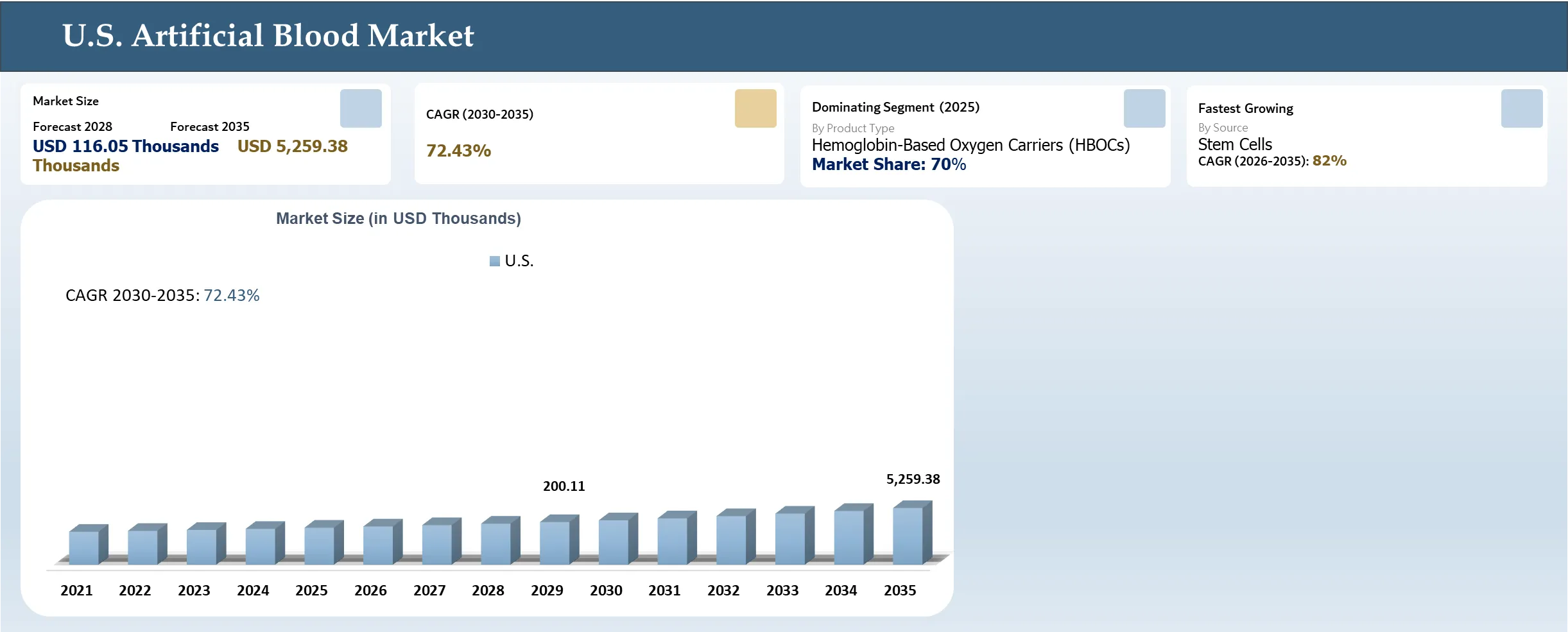
The U.S. artificial blood market remains pre-commercial through 2027, with measurable revenue beginning in 2028 at USD 116.05 thousand and expanding to USD 5,259.38 thousand by 2035, reflecting a transition from clinical development toward selective Commercialization, growing with a CAGR of 72.43% during the forecast period 2030-2035. The market is shifting from laboratory research toward potential commercialisation because of innovations in oxygen carriers and growing demand for blood substitutes in urgent and remote settings.
In March 2025, Pennsylvania State University received a five-year, USD 2.7 million grant from the National Institutes of Health (NIH) to create a prototype of an innovative shelf-stable blood substitute called Nano-RBC, which imitates red blood cells in its structure and ability to deliver oxygen. In addition, the U.S. Department of Defense awarded USD 1.80 million to KaloCyte in 2025 to support the production of ErythroMer for preclinical studies, demonstrating continued investment in artificial red blood cell technology.
White-Space Opportunities for the U.S. Artificial Blood Market, DARPA-Funded Engineered Red Blood Cells and Shelf-Stable Blood Substitute Technologies
The investment opportunities in engineered red blood cells, shelf-stable oxygen carriers, platelet-derived products, dried plasma, and field-deployable transfusion technologies, with DARPA’s Smart-Red Blood Cells (Smart-RBC) program identifying approximately USD 35.1 million for performer awards to advance engineered red blood cell research. The investment focuses on improving physiological resilience in extreme environments through cell engineering, biological research, prototype development, and safety testing.
DARPA also announced its Resuscitation and Prevention of Ischemia-Induced Dysfunction (RAPIID) program on May 28, 2026, to advance shelf-stable blood substitutes through preclinical testing, clinical trials, regulatory approval, and manufacturing scale-up. The major investment areas under RAPIID include oxygen-carrying components, platelet-derived products, dried plasma, ruggedised packaging, and point-of-care diagnostic devices for military and civilian trauma care.
The investments are expected to create opportunities for companies developing artificial red blood cells, oxygen carriers, blood storage technologies, and transfusion systems. KaloCyte is positioned in the artificial red blood cell substitute segment through its ErythroMer technology, which is designed to provide oxygen-carrying functionality when conventional blood is unavailable.
Hemarina is active in marine-derived haemoglobin-based oxygen carriers, creating opportunities in oxygen transport and biomedical applications. HbO2 Therapeutics focuses on haemoglobin-based oxygen therapeutics, while OXYVITA develops polymerised haemoglobin-based oxygen-carrying solutions. Hemanext operates in red blood cell processing and storage technologies, supporting improvements in blood product quality and transfusion practices.
In the engineered blood cell segment, Cellino and Fate Therapeutics offer relevant capabilities in cell engineering and cellular manufacturing that may support future research into engineered blood components. Haima Therapeutics is developing bio-inspired blood substitute technologies, while Terumo BCT and Fresenius Kabi participate in blood component processing, collection, and transfusion technologies.
U.S. Artificial Blood Market Key Takeaways
- DARPA allocated approximately USD 35.1 million in performer awards under its Smart-RBC program to advance engineered red blood cell research. Furthermore, DARPA announced its 36-month RAPIID program on May 28, 2026, to advance shelf-stable blood substitutes into human clinical trials.
- The limited commercial availability of FDA-approved artificial blood products imposes a 20% drag on hospital adoption. It restricts near-term market penetration and highlights the importance of hitting key regulatory milestones.
- A Phase I clinical trial evaluated liposomal haemoglobin in 12 healthy adults using doses of 10 mL, 50 mL, and 100 mL. A mild fever observed at the 10 mL dose resolved spontaneously without secondary interventions.
- Scarlet Therapeutics secured a DARPA agreement worth up to USD 14 million in September 2026. The contract funds the development of adaptive Smart Red Blood Cells for complex medical environments.
U.S. Artificial Blood Market Industry Trends and Strategic Insight
- Research is moving beyond oxygen delivery toward combinations of oxygen carriers, synthetic platelet products, and dried plasma intended to reproduce more of the critical functions of whole blood.
- Developers are engineering haemoglobin encapsulation, molecular modification, and controlled oxygen-release mechanisms to address the vascular and oxidative toxicity that undermined earlier artificial blood candidates.
- Product development is increasingly shaped by military trauma-care requirements, where immediate access to blood products may be limited by evacuation delays, storage restrictions, and difficult operating conditions.
- Laboratory-grown red blood cells represent a parallel development pathway for producing transfusion products with controlled cellular characteristics, although manufacturing economics and production scalability remain important challenges.
- Rather than competing immediately with donated blood across all transfusion settings, developers are targeting specific unmet needs, including severe haemorrhage, remote medical operations, and situations where conventional blood products are difficult to store or deliver.
U.S. Artificial Blood Market Scope
| Metrics | Details |
| 2025 Market Size | USD 116.05 Thousands |
| 2035 Projected Market Size | USD 5,259.38 Thousands |
| CAGR (2026-2035) | 72.43% |
| By Product Type | Hemoglobin-Based Oxygen Carriers (HBOCs), Perfluorocarbon-Based Oxygen Carriers (PFCs) |
| By Source | Human Hemoglobin, Animal Hemoglobin, Stem Cells, Synthetic Materials, Recombinant Hemoglobin, Others |
| By Application | Anemia & Blood Loss, Surgical & Perioperative Care, Injuries & Trauma, Organ Transplantation, Emergency & Critical Care, Others |
| By End-User | Hospitals, Military & Defense Healthcare, Organ Transplant Centers, Research Institutes, Others |
| Report Insights Covered | Competitive Landscape Analysis, Company Profile Analysis, Market Size, Share, Growth |
U.S. Artificial Blood Market Disruption Analysis
Shift From Donor-Dependent Transfusions to Engineered Oxygen Carriers Reshaping the U.S. Artificial Blood Market
The disruption in the U.S. artificial blood market is primarily associated with the development of engineered oxygen carriers and artificially produced red blood cells that are meant to enhance the traditional transfusion of blood obtained from donors. Traditional transfusion technology relies on the availability of donors, the compatibility of blood groups, and storage and transportation logistics, among other factors that have been a problem, especially in cases of emergency bleeding situations and military operations. Encapsulated haemoglobin and artificial red blood cell substitutes are bringing about changes in the delivery of oxygen, making the process more efficient in terms of storage and transport.
The relatively small reduction in available blood stock provides an impetus for finding reliable substitutes for regular donor-based blood transfusions. In March 2025, according to PubMed Central, in 2023 the United States collected about 11.586 million units of whole blood and apheresis red blood cells, while about 10.328 million units were transfused. The article also noted that about 10.975 million units were left available after tests and other rejections, showing a decline of 0.5% compared to 2021. The research demonstrates the significance of an adequate blood supply and can provide a possible scenario for artificial blood technology that can be used as an additional resource in cases of emergency or lack of a regular blood supply.
U.S. Artificial Blood Market BCG Matrix: Company Evaluation
Stars include KaloCyte, Inc. and HbO₂ Therapeutics, which are positioned as potential Star-category companies based on their development of haemoglobin-based oxygen carriers for applications requiring alternative oxygen delivery. Question Marks include VirTech Bio is positioned in the Question Mark category because its artificial blood technology development represents a potential route toward alternative oxygen delivery, but its commercial position and adoption in the U.S. market remain uncertain.
Potential include OXYVITA Inc. is categorised as a Potential company because of its work on haemoglobin-based oxygen carriers and polymerised haemoglobin technology. Tailenders: None of the four companies can be confidently classified as a Tailender based solely on publicly available evidence.
U.S. Artificial Blood Market Dynamics
Driver Impact Analysis
| Driver | Market Growth Impact (%) | Demand Concentration | Impacted Use Case | Strategic Impact |
Rising demand for rapid blood replacement in trauma, severe bleeding, and emergency medical situations is driving the development of artificial blood. | 30% | Emergency departments, trauma centres, and prehospital EMS | Rapid oxygen delivery and emergency resuscitation following severe blood loss | Accelerates development of fast-deploying oxygen carriers and emergency blood substitutes. |
Dependence on volunteer blood donors and vulnerabilities in blood supply chains are encouraging the development of alternative oxygen-carrying products. | 25% | Hospitals, blood banks, disaster-response services, and regions with constrained supply | Supplementing conventional transfusions during shortages and mass-casualty incidents | Encourages development of alternatives that reduce dependence on donor availability and blood collection logistics. |
The need for blood products that can be stored and transported without conventional refrigeration is supporting innovation in artificial blood technologies. | 25% | Rural healthcare facilities, ambulance services, remote clinics, and emergency stockpiles | Emergency transfusion support where refrigerated blood products are difficult to maintain | Prioritizes shelf stability, transportability, and rapid preparation of artificial blood products. |
The need to treat severe bleeding in remote combat zones is accelerating the development of portable, shelf-stable artificial blood substitutes. | 20% | Military medics, forward operating units, and austere prehospital environments | Point-of-injury resuscitation and battlefield hemorrhage management | Supports defense-funded development of shelf-stable oxygen carriers, portable delivery systems, and integrated blood analogues. |
Rising demand for rapid blood replacement in trauma, severe bleeding, and emergency medical situations is driving the development of artificial blood
The need for rapid blood replacement is driving the development of artificial blood technologies that would help supplement the traditional methods of blood transfusion in cases of injuries, bleeding and other emergencies. In the US, emergency care providers are stressing the concept of early blood replacement. But the traditional form of blood requires proper storage, testing for compatibility, and transportation of the product, which can be difficult in cases of remote areas, disasters, and battlefield scenarios.
Federal research programs are contributing to the fast-tracked development of shelf-stable blood substitutes to meet the critical need for blood replacement in military and emergency trauma applications. In May 2026, according to the Defense Advanced Research Projects Agency (DARPA), its Resuscitation and Prevention of Ischemia-Induced Dysfunction (RAPIID) program was established as a 36-month initiative, consisting of a first phase of 12 months, dedicated to preclinical safety, efficacy, and manufacturing planning for the next 24 months, during which shelf-stable blood substitutes will be taken through the initial human clinical trials. The goals of the program include developing shelf-stable oxygen carriers, platelet derivatives, and dried plasma, as well as rugged delivery and point-of-care diagnostics devices.
Restraint Impact Analysis
| Restraint | Drag on Market Growth (%) | Primary Impact Area | Impacted Use Case | Strategic Impact |
Risks of cardiovascular complications, oxidative damage, and other adverse effects associated with certain haemoglobin-based oxygen carriers limit their clinical development and adoption. | 30% | Product safety, cardiovascular tolerance, and formulation development | Emergency oxygen delivery following severe blood loss | Increases the need for safer haemoglobin formulations, oxidative-stress control, and stronger clinical safety evidence. |
The lack of sufficient evidence demonstrating the safety and effectiveness of artificial blood substitutes in large-scale human studies restricts their routine clinical use. | 25% | Clinical validation and regulatory approval | Trauma resuscitation and emergency transfusion support | Extends development timelines and requires robust human-trial evidence before wider adoption. |
The complexity of developing stable, biocompatible oxygen carriers and conducting extensive clinical trials increases the financial burden on artificial blood developers. | 25% | Research and development, manufacturing scale-up, and clinical-trial costs | Development and production of HBOCs, encapsulated haemoglobin, and synthetic oxygen carriers | Raises capital requirements and encourages strategic partnerships, government funding, and manufacturing collaborations. |
The limited availability of artificial blood products approved for routine human use constrains market penetration and widespread hospital adoption. | 20% | Regulatory availability and commercialisation | Hospital transfusion services, emergency departments, and prehospital care | Restricts near-term commercial adoption and increases the importance of regulatory milestones and targeted initial applications. |
Risks of cardiovascular complications, oxidative damage, and other adverse effects associated with certain haemoglobin-based oxygen carriers limit their clinical development and adoption
The development of artificial blood products faces significant challenges because certain haemoglobin-based oxygen carriers (HBOCs) have the capacity to provoke cardiovascular disorders, oxidative stress, and organ damage. In contrast to natural erythrocytes, which possess haemoglobin in their cells, some HBOCs have haemoglobin circulating without cellular protection. Such free haemoglobin may bind with nitric oxide and produce dangerous oxidative compounds that are responsible for vasoconstriction, high blood pressure, myocardium and kidney damage, thus decreasing the usefulness of some forms of artificial blood.
The challenges that are affecting the development and approval of haemoglobin-based oxygen carriers for clinical use is that of cardiovascular safety. In April 2025, according to Frontiers, researchers analysed clinical trial data for five HBOCs and myocardial infarction incidence ratios between 1.19 and 7.38 were found compared to the controls in each respective case. Positive correlations between myocardial infarction incidence and dose of HBOCs, intravascular half-lives, and other oxidative stress indicators were found. All of this means that oxidative stress and other cardiovascular complications continue to pose major obstacles on the way to successful clinical development of some haemoglobin-based oxygen carriers. In the context of the U.S. Artificial Blood Market, this factor may complicate clinical development efforts.
U.S. Artificial Blood Market Segment Analysis
The U.S. artificial blood market is segmented based on product type, source, application, end-user, and region.
Hemoglobin-Based Oxygen Carriers Lead the U.S. Artificial Blood Market Through Continued Clinical Development and Safety Evaluation
The haemoglobin-based oxygen carriers (HBOCs) are dominating the U.S. artificial blood market due to their specific application in providing oxygen to tissues of the body where traditional red blood cells cannot be used immediately. The development of these carriers aims at handling emergencies such as blood loss and trauma resuscitation. Unlike PFC oxygen carriers, HBOCs have received extensive research in the field, as haemoglobin is an oxygen-binding protein found in red blood cells and can serve as the basis for developing oxygen carriers.
Evidence from clinical practice has influenced the development process of Hemoglobin-Based Oxygen Carriers (HBOCs) by proving that significant progress has been made in formulation and validation of safety. In September 2025, a PubMed Central article, indexed in the National Library of Medicine in 2026, discussed the clinical development of HBOCs and concluded that none of the HBOCs was approved by the U.S. FDA for use. It also included information on a Phase I clinical trial of liposomal haemoglobin where 12 healthy adults were tested using 10 mL, 50 mL, or 100 mL of the treatment. A slight fever was noticed when using 10 mL, and the reaction subsided on its own.
U.S. Artificial Blood Market Competitive Landscape
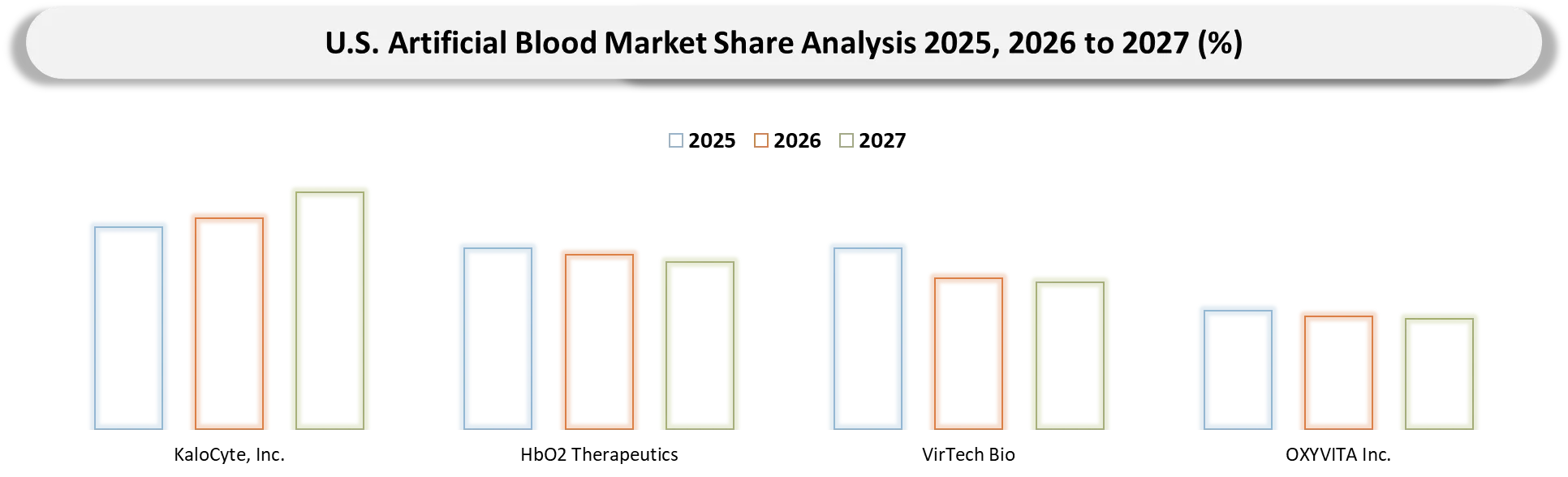
- The U.S. artificial blood market is characterized by a small group of biotechnology developers and specialized research companies working on engineered oxygen carriers and hemoglobin-based blood substitutes. KaloCyte, Inc. is developing ErythroMer, a shelf-stable artificial red blood cell substitute designed to deliver oxygen during severe blood loss; HbO2 Therapeutics focuses on hemoglobin-based oxygen therapeutics; VirTech Bio and OXYVITA Inc. represent additional specialized participants in oxygen-carrier and hemoglobin technology development. Unlike established medical product markets, competition is currently driven primarily by formulation safety, oxygen-delivery performance, preclinical and clinical evidence, manufacturing readiness, and progress toward regulatory approval rather than by established commercial sales. As no HBOC has received U.S. FDA approval for routine clinical use, reliable company-level revenue shares or market shares are not publicly established.
- Key players include KaloCyte, Inc. (United States), HbO₂ Therapeutics (United States), VirTech Bio (United States), and OXYVITA Inc. (United States).
Key Developments
- September 2026: Scarlet Therapeutics Ltd., a UK-based biotechnology company, developing red blood cell-based therapeutics, secured a DARPA agreement worth up to USD 14 million in to develop adaptive Smart Red Blood Cells (Smart-RBCs).
- January 2025: Scorpius Holdings, Inc., U.S.-based integrated contract development and manufacturing organization (CDMO), announced a collaboration with KaloCyte, Inc., a U.S.-based preclinical biotechnology company developing artificial blood substitutes, to improve manufacturing efficiency for ErythroMer, a dried, bio-inspired artificial red blood cell designed to address life-threatening blood loss when conventional blood is unavailable or in short supply.
- July 2026: Hemanext Inc., a U.S.-based medical technology company, announced a strategic production partnership with OneBlood, a U.S.-based nonprofit blood collection and distribution organization, to expand the adoption of Hemanext ONE, a device designed to improve red blood cell storage by reducing oxygen levels.
- July 2026: Vascular Solutions, LLC, a U.S.-based medical technology and medical device subsidiary of Teleflex Incorporated, a U.S.-based global medical technology company, received U.S. FDA licensure for Ezplaz Freeze-Dried Plasma, the first freeze-dried plasma product licensed for use in the United States.
Key Procurement Priorities and Buyer Evaluation Criteria
- Organizations investing in the U.S. artificial blood market prioritize suppliers capable of developing safe, biocompatible oxygen carriers that can deliver oxygen to body tissues during severe blood loss, trauma, and emergency medical situations where conventional blood transfusions may be delayed or unavailable.
- Procurement and partnership decisions are increasingly influenced by demand for shelf-stable blood substitutes, rapid preparation and administration, extended storage capability, and reliable transportation to emergency departments, military medical units, and remote healthcare settings.
- Buyers evaluate product safety, oxygen-carrying capacity, cardiovascular tolerability, oxidative stability, blood compatibility, shelf life, and consistency between batches when selecting artificial blood technology developers. Evidence from preclinical studies and human clinical trials is particularly important because safety concerns and regulatory requirements continue to limit the routine clinical use of hemoglobin-based oxygen carriers (HBOCs).
Why Choose DataM?
- Technological Innovations: Explores advancements in artificial blood technologies, including hemoglobin-based oxygen carriers (HBOCs), perfluorocarbon-based oxygen carriers (PFCs), encapsulated hemoglobin, and stem cell-derived red blood cells, highlighting their potential to improve oxygen delivery and support emergency blood replacement.
- Product Performance & Market Positioning: Evaluates artificial blood solutions based on oxygen-carrying capacity, biocompatibility, cardiovascular safety, oxidative stability, storage life, and administration requirements, identifying how developers differentiate their technologies for trauma care, surgical procedures, and emergency medicine.
- Real-World Evidence: Examines preclinical studies, clinical trials, and emerging applications of artificial blood technologies, assessing their potential role in severe blood loss, military medicine, emergency resuscitation, and situations where conventional blood transfusions may be delayed or unavailable.
- Market Updates & Industry Changes: Tracks developments in clinical research, government-funded programs, product development, regulatory pathways, and manufacturing readiness across the U.S. artificial blood ecosystem, highlighting progress toward shelf-stable oxygen carriers and advanced blood substitute technologies.
- Competitive Strategies: Analyzes the development priorities and strategic positioning of key companies, including KaloCyte, Inc., HbO₂ Therapeutics, VirTech Bio, and OXYVITA Inc., with a focus on technology differentiation, research collaborations, clinical validation, intellectual property, and commercialization strategies.
- Pricing & Market Access: Assesses the potential cost drivers associated with research and development, clinical trials, specialized manufacturing, product storage, and distribution, while evaluating regulatory requirements and access pathways that influence the future availability of artificial blood products in the United States.
- Market Entry & Expansion: Identifies opportunities arising from demand for rapid emergency oxygen delivery, military and battlefield healthcare, trauma management, and shelf-stable blood alternatives, while examining the importance of FDA approval, clinical safety evidence, scalable manufacturing, and partnerships in achieving broader market adoption.
Target Audience 2026
- Biotechnology and Artificial Blood Developers
- Pharmaceutical and Biopharmaceutical Companies
- Hospitals and Healthcare Providers
- Blood Banks and Transfusion Services
- Military and Defense Healthcare
- Emergency Medical and Trauma Care Providers
- Research Institutes and Academic Organizations


























































