


Tinplate Market Size
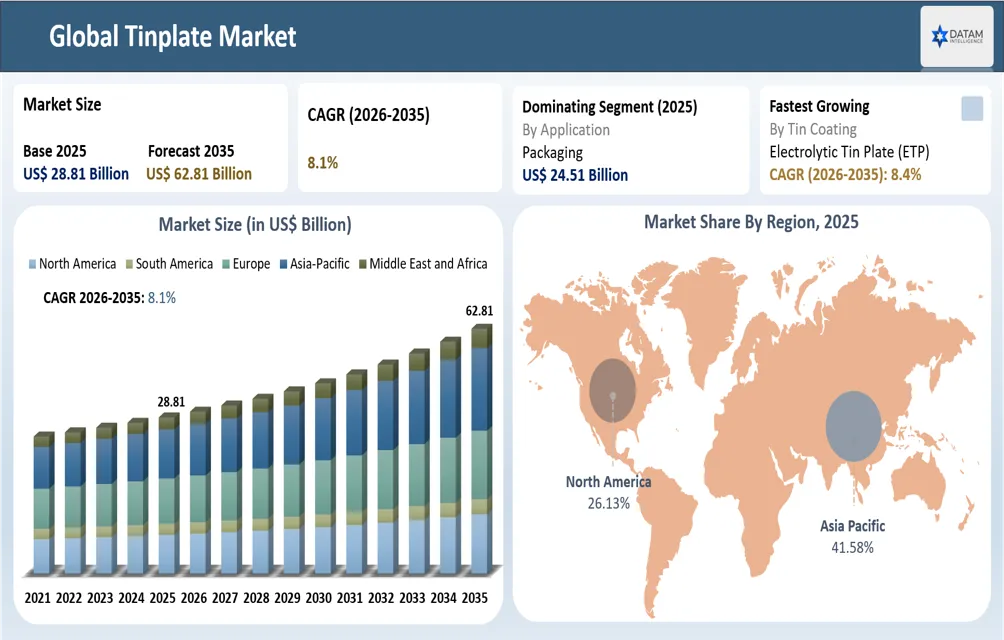
The global tinplate market reached US$ 28.81 billion in 2025 and is expected to reach US$ 62.81 billion by 2035, growing with a CAGR of 8.1% during the forecast period 2026-2035.
The tinplate market is changing as producers and packaging processors make adjustments to meet the rising demands for strong, rustproof and recyclable metal containers in the fields of food, drinks, sprays, paints, chemicals and pharmaceutical products. The development of the market is aided by the growing popularity of packaged food, the need for an extended shelf life of the goods, the desire to receive hygienic products as well as the need for materials with good barrier properties. On the other hand, increasing costs of materials have spurred the manufacturers and can-makers to achieve greater efficiency in terms of material usage.
The market is also driven by fluctuations in raw materials, packaging material substitution and the increasing demands of sustainability. The fluctuation in the prices of tin globally affects production costs, while flexible packaging, PET and aluminum create competition in terms of weight, cost and convenience. Consequently, manufacturers of tinplate products are now concentrating on the light weighting of their products, the improvement of their coatings and surface treatments to comply with environmental legislation, digital metal decoration and efficient recycling of materials.
Tinplate Market Key Takeaways
- Tinplate demand depends on applications related to packaging, namely food packaging, beverages packaging, aerosol packaging, closure packaging and specialty packaging due to its corrosion-resistance and durability.
- Food and beverage cans are key applications which accounted for 85.08% of worldwide market volume in 2025 because of shelf life protection, food safety, barrier and packaging properties.
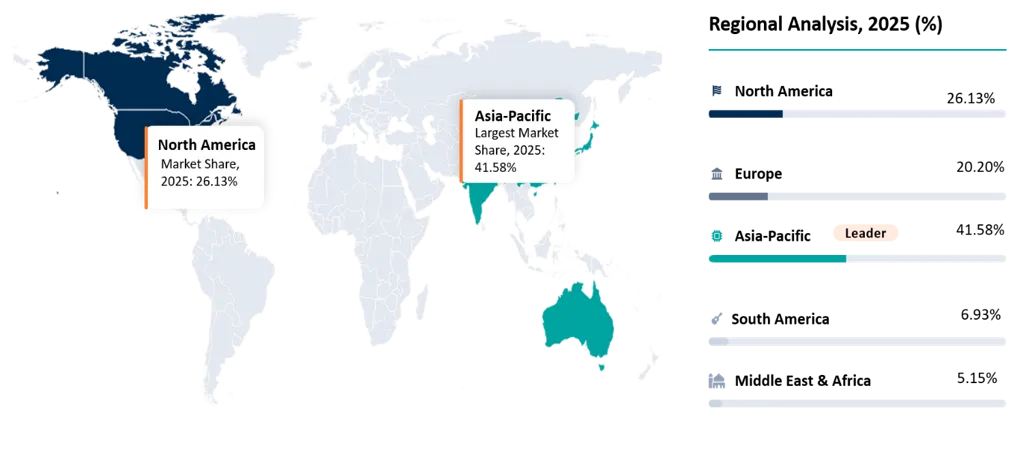
- Asia-Pacific is a major player in tinplate consumption accounting for 41.58% of worldwide consumption in 2025 because of efficient food processing, can-making capability, consumption of packaged foods and export-oriented packaging production.
- Environmental and regulatory restrictions determine market trends which pay more attention to BPA-free coatings, chromium-free passivation process, recyclability and emissions reduction in production.
- Light-weighting and print-ready options gain importance because of necessity to reduce material usage and preserve packaging quality.
Tinplate Industry Trends and Strategic Insights
- Lightweighting and Downgauging of Tinplate: Manufacturers are introducing new generation light-weighted tinplate products that help lower material usage, product weight and expenses while ensuring dented resistant properties, seamability, retortability and shelf-life protection.
- Digital Printing and Premium Metal Decoration: Digital printing is increasingly becoming more relevant to small batches, customized decorations, seasonal introductions and localized SKUs in food cans, promotional cans, aerosols and personal care packaging, moving the decoration process towards hybrid offset digital printing technology.
- Advanced Tin Coating and Surface Treatment: The producers of tinplate are advancing their electroplating control technologies, passivation and surface modification for providing more uniform coating weights, corrosion resistance, adhesion and food contact properties.
- BPA-Free and Regulatory-Ready Lacquer Systems: Packaging industries require the development of lacquer systems without BPA (Bisphenol-A), application-specific lacquers, especially for food/beverage, aerosols and chemical packaging where food-contact regulations determine material choices.
- Growth of Tinplate Scrap Recovery and Detinning: The process of collection and separation and then detinning of tinplate is becoming an opportunity for the circular economy to recover both the tin as well as the ferrous steel.
Tinplate Market Scope
| Metrics | Details | |
| 2025 Market Size | US$ 28.81 Billion | |
| 2035 Projected Market Size | US$ 62.81 Billion | |
| CAGR (2026-2035) | 8.1% | |
| Largest Market | Asia-Pacific | |
| Fastest Growing Market | Asia-Pacific | |
| By Tin Coating | Electrolytic Tin Plate (ETP), Hot Dipped Tin Plate and Others | |
| By Type | Single Reduced (Batch Annealed, Continuous Annealed) and Double Reduced (DR-8, DR-9, DR-10) | |
| By Grade | Prime Grade and Secondary Grade | |
| By Thickness | Less than 0.15 mm, 0.15 mm - 0.20 mm, 0.21 mm - 0.25 mm, 0.26 mm - 0.35 mm and More than 0.35 mm | |
| By Application | Packaging, Electrical and Electronics, Automotive, Aerospace and Others | |
| By Region | North America | U.S., Canada, Mexico |
| Europe | Germany, UK, Russia, France, Spain, Italy, Poland | |
| Asia-Pacific | China, India, Japan, Australia, South Korea, Indonesia, Malaysia, Singapore, Vietnam, Thailand, Philippines, Taiwan | |
| South America | Brazil, Argentina | |
| Middle East and Africa | UAE, Saudi Arabia, South Africa, Israel, Turkiye, Nigeria | |
| Report Insights Covered | Competitive Landscape Analysis, Company Profile Analysis, Market Size, Share, Growth | |
Why does this report matter in 2026?
The global tinplate market report is significant in 2026 owing to the transition of the market from conventional tin plate for cans to a more sophisticated grade of food-safe, corrosion-resistant, retortable, printable and light gauge tinplate. In packaging, which is still the primary area of demand, the increasing demands for tinplate coming from food, beverages, aerosols, paints and chemicals packaging industries are raising the significance of coating uniformity, formability and surface characteristics. Meanwhile, manufacturers are also adapting to products such as BPA-free paint, chrome-free passivation, digital printing and downgauging, thereby making technology and product specifications key criteria in purchase and development considerations.
The report is also relevant to 2026 owing to cost, trade and competition challenges faced by tinplate makers. Fluctuation in tin prices impacts coating costs and pricing, with flexible packaging, PET bottles and aluminum cans causing increasing substitution pressure. In addition, changes in tariffs, quotas, CBAM compliance and antidumping policies make sourcing and landed cost decisions challenging. Hence, the report allows evaluating the supply-demand dynamics, competitive position, lightweighting potential and use of low carbon tinplates and new detinning/recovery opportunities in an increasingly dynamic packaging materials environment.
Tinplate Market White Space & Investment Opportunities
- Expansion of Tinplate Packaging in Tier 2 and Tier 3 Cities: Increasing consumption of packaged ghee, edible oils, dairy sweetmeats, tea, coffee, pickles, processed food products and premium dry foods provides whitespace for tinplate producers and tinplate converters catering to emerging urban areas.
- Detinning and Organized Tinplate Scrap Recovery: Possibilities of investments lie in processes that allow the recovery of tin and ferrous metal from waste tinplate containers, production off-cuts and scrap tinplate.
- Lightweighting Through Downgauged Tinplate: Possibilities for investments exist in thin gauge and double reduced tinplate technologies that reduce material usage without compromising on stiffness and formability of tinplate packaging material.
- Digital Printing and Premium Metal Decoration: Short-runs, customization and seasonality of metal packs provide room for good quality printing ready tinplate used in premium food, promotion, aerosol and specialty cans.
- Sustainable and Advanced-Coating Tinplate: White space exists for BPA free, chromium free and low carbon tinplate solutions to cater to evolving needs for food contact quality, consistent coating and recycling.
Tinplate Future Market Transformation
The future developments in the tinplate market will be determined by the trend towards light-weightedness and high performance and sustainable metal packaging with increasing use of double reduced and thin gauge tinplate for decreasing the weight of the metal used but retaining the integrity of the metal cans and their ease of forming. There will be rising demand for food grade, retortable, printable and anti-corrosive products with improvements in BPA free and chromium free coating, digital metal printing and quality control through automation providing for better product differentiation and productivity at the converter end. On the other hand, the expansion of food-packaging, aerosols and pharmaceutical packaging, as well as batteries and some electrical parts, will provide further avenues for usage. There is also a trend towards the adoption of circular supply chains in the tinplate industry, through the organization of scrap collection and the detinning and recovery of tin and steel.
Tinplate Market Buyer Decision-Making Criteria
Generally, when making the purchase of tinplate, buyers make the assessment based on the properties of the material, coating quality, dimensional standards, appropriate packaging, availability and overall landed cost of purchase. Decisions regarding the purchase of tinplate are especially affected by the ability of the material to comply with food-contact needs and its capability of withstanding corrosion and high-speed canmaking, printing, lacquering and forming operations. In the case of packaging converters, the particular grade, thickness, temper and tin coating are critical, along with the consistency of supplies and pricing due to volatile prices for tin, steel and energy.
Major Buyer Decision-Making Criteria
- Tin Coating Uniformity and Corrosion Resistance
- Grade, Thickness and Temper Suitability
- Formability and Canmaking Performance
- Surface Quality, Printability and Lacquer Adhesion
- Food-Contact and Packaging Compliance
- Strength, Rigidity and Lightweighting Potential
- Supply Reliability and Production Capacity
- Tin and Steel Price Stability
- Recyclability and Sustainability Credentials
- Technical Support and Converter Compatibility
Tinplate Market Economic & Investment Analysis
Investment in the tinplate Industry offers an attractive future prospect, based on growing consumer demands for packaged foods, beverages, aerosols, paints, chemicals and specialty metal packagings. The investment prospects can be enhanced through the adoption of a trend of light weightings, double reduced high strength, food grade, retortable grades and premium surface for printing in the market. The Asia Pacific region continues to be the primary growth area, while the emerging market for packaged foods from Tier 2 and Tier 3 cities provides new demand opportunities. Nevertheless, investments have to consider fluctuating prices of tin, as well as high steel and energy costs, imports and alternative packaging materials.
Investment possibilities include not only traditional tinplate manufacturing but also adding value to coatings, making downgauge products, digital metal printing, quality control automation and scrap collection and detinning infrastructure. Circular economy investment possibilities are especially interesting since recycled tin and ferrous steel can add more value through materials, reducing the reliance on primary raw materials. Investments can also focus on local converter networks for food, aerosol and specialty packaging where organized retail and packaged food presence is growing.
Tinplate Investment Trends in the Market
- Investment in Lightweight and Double-Reduced Tinplate Production: Capital expenditure in producing tinplates of high strength and thinner gauge to achieve reduction in material usage without compromising on the desired rigidity and formability of cans.
- Expansion of Sustainable Tinplate Coating Technologies: Capital expenditure is now moving towards sustainable processes of BPA and chromium-free as well as lower carbon tinplate production.
- Growth of Digital Metal Printing Infrastructure: Investments in digital printing systems for producing limited runs, custom designs, high-end graphics and seasonal metal packages.
- Development of Detinning and Tinplate Scrap-Recovery Systems: There are now investment possibilities in developing systems for collecting, sorting and detinning tin and ferrous metal from production scraps and tinplate containers used by consumers.
- Expansion of Tinplate Supply for Emerging Packaged-Food Markets: Investment now focuses more on converters and distribution systems in Tier 2 and Tier 3 cities, especially for edible oil, dairy, pickles, tea, coffee and high-quality dried foodstuffs.
Strategic Indicators For Tinplate Market
High Regulation Impact
There is a high regulatory impact on the tinplate market due to high standards required in terms of food contact safety and packaging safety standards, coating and recycling of the materials, especially within its major packaging applications. The regulatory impact is increasingly seen in the choice of food grade tinplate, surface treatment, passivation systems and coatings with an increasing focus on BPA free and chromium free coating materials. Increasing regulations on clean, hygiene, food-grade and tamper resistant packaging in emerging markets of packaged foods are also driving the adoption of tinplate containers.
High Investment Activity
The Investment activities in the tinplate market have been seen to focus on issues of efficiency, lightweighting, innovative coatings and recyclability of materials rather than just adding capacity. The producers and converters are increasingly becoming well placed to capitalize on the need for double reduced and thin gauge tinplate, non-BPA and chrome-free coatings, ready-to-print tinplate, digital metal printing and automated inspection technologies. In addition, investment in the recycling of tinplate scrap and detinning will provide chances for recycling both tin and ferrous steel and ensuring material security as well as closed-loop packaging systems.
Supply Chain Disruption
Tinplate market faces the potential risk of supply chain disruptions due to the volatility of tin availability and pricing, steel and energy input costs, dependence on imports, transportation limitations and trade policies. Any disruption in tin supplies will directly impact the cost of coating and the planning of procurement processes, whereas delays in shipments, tariff duties and other trade barriers will increase the landed cost and cause uncertainties in supply chain operations for canmakers and converters of packages.It is especially pertinent for producers of food, drink, aerosols and industrial packaging that require uniform tin coatings, particular thicknesses and grades to be continually available.
Pricing Volatility
The tinplate market is undergoing serious fluctuations in pricing due to the fact that tin plays a very important role in the coating production process, thereby affecting its cost and planning. The price of tin on LME has reached a level of US$53,462 per ton as of January, 2026, thus intensifying the cost for tinplate producers and customers. However, the market is also to grow from US$28.81 billion in 2025 to US$52.80 billion by 2033 and increase its consumption volume from 22,283.88 KT to 32,133.73 KT, requiring producers to balance rising demand with volatile raw-material costs.
Procurement Pressure
The tinplate Procurement Process is affected by the uncertainties of price fluctuations in tin, steel, energy, import exposure, disruptions in shipping and lack of high-quality capacity. Procurement processes also need to take into account the need for balancing cost against specifications on tin coating, gauge, quality, formability and food contact capability. Long periods of food contact approval can limit quick changeovers in suppliers and trade and logistical challenges can result in increased landed costs and make procurement planning difficult for canners and packagers.
New Technology Adoption
Innovations being introduced by the tinplate market include solutions that enhance coating accuracy, material utilization, packing effectiveness and manufacturing uniformity. Some of the innovations being embraced by the market include improved electrochemical tin plating control systems, batch and continuous annealing optimization, lightweight and downgauging, BPA-free and regulatory compliant lacquers and automated systems for thickness, coating and surface inspections. Digital printing and high-end decorations are also becoming increasingly significant, allowing for small-scale manufacturing, custom designs and higher SKU capability. These innovations are aiding tinplate manufacturers to increase efficiency, cut down on their use of materials and cope with growing demands in food, beverage, aerosol and specialty packaging.
Regional Expansion Opportunity
Asia-Pacific holds maximum regional growth potential for the tinplate market, consuming 41.58% of global demand in 2025 due to its substantial can making capacity, packaged food manufacturing, seafood exports, beverage packaging and converter capacity in China, India, Japan, South Korea and Southeast Asia. The country holding maximum potential is India where the move from loose to packaged branded food products in Tier 2 and Tier 3 cities increases the demand for hygienic, tamperproof, printable and recyclable tinplates for ghee, edible oil, dairy products, sweets, pickles, tea, coffee and ready to eat products. Tinplate suppliers have the opportunity to leverage this through regional converter tie-ups and local supply chains around new clusters of packaged foods.
Government Policy Support
The Government policy support is shaping the tinplate market through regulations related to food contact packaging, recycling, trade and manufacturing policies. In India, regulations for clean, hygienic, food grade and tamper-proof packaging is facilitating the shift from unorganized or loose foods to organized food packaging using metal cans and therefore creating opportunities for tinplates in packaged ghee, edible oil, dairy products, confectionery, pickles and ready-to-eat meals. At the same time, steel packaging recycling policies facilitate sustainability for tinplate, while anti-dumping duties and trade policies impact regional procurement, landed cost and manufacturing decisions.
Pricing Intelligence
Tinplate prices are mainly driven by the price of the steel substrate and such factors as type of product, its food-grade quality, coating weight, thickness and surface finish. The forecast says that the market size of tinplate will grow from US$28.81 billion in 2025 to US$52.80 billion by 2033, with the volume increasing from 22,283.88 KT to 32,133.73 KT. Electrolytic Tin Plate (ETP) occupied 91.18% of the market in 2025, as it is widely used in tinplate applications that require controlled tin coating, corrosion resistance, printability and uniformity of surface quality.
| HS Code | Reporter | Trade Flow | 2025 Trade Value | Interpretation |
| 721012 | European Union | Exports | US$1.53 Billion | Strong export position reflecting established tinplate production and packaging-steel capacity. |
| 721012 | European Union | Imports | US$0.74 Billion | Imports complement regional supply and indicate continued cross-border sourcing of tinplate. |
| 72101290 | India | Exports | US$2.19 Billion | Strong export activity highlights India’s expanding role in supplying tin-coated flat steel to global packaging markets. |
| 72101290 | India | Imports | US$88.5 Million | Relatively low import value indicates substantial domestic availability and limited import dependence. |
Note: HS 721012 and HS 72101290 cover flat-rolled products of iron or non-alloy steel, of a width of 600 mm or more, plated or coated with tin, with a thickness of less than 0.5 mm; HS 72101290 is the relevant national-level sub-code used for tinplate trade classification in India.
AI Impact Analysis of the Tinplate Market
The most substantial effect of AI would come into play regarding the manufacturing process of tinplate and its quality control rather than the material itself. The application of analytics powered by artificial intelligence could improve the quality control of such tinplate attributes as weight of tin coating, sheet thickness, sheet surface condition and temper control, thus enabling producers to discover any process inconsistencies. It coincides with the market’s current deployment of automated thickness testing, coating weight measurement, surface defect detection and traceability systems, especially for food, beverage, aerosol and specialty packaging applications where uniformity in material quality is critical.
AI can offer more benefits in the context of process optimization and lightweighting through analysis of production data in rolling, annealing and coating. It may allow companies to better optimize consistency in double-reduced and thinner tinplate production while minimizing losses and minimizing chances of rejection. AI combined with quality control and regional supply planning may lead to greater flexibility and assist in satisfying specific needs of converters of food and beverage, aerosol, paint and chemical packaging.
Disruption Analysis of Tinplate Market
Disruption in raw materials and logistical chains is one of the risks facing the tinplate market, caused mainly by the volatility in refined tin pricing, rising costs of steel and energy, high dependence on imports, logistic limitations and trade barriers. Since tin is an important component of coatings, any disruption in mining, refining, exportation or logistical activities can result in increasing coating costs and delay in raising of prices due to increased cost of production. The issues are especially relevant to ETP, food-grade and specialty tinplate, where there is a need for control of coating weight, gauge, surface finish and compliance.
Material substitution and competition by flexible packaging, PET bottles and aluminum cans in terms of weight, convenience, price and consumer appeal represent additional challenges for the industry. Moreover, global oversupply and international competition in the steel industry could increase competitive pressures regarding pricing. In addition to trade restrictions, carbon-related regulations might have an impact on sourcing and exports. Hence, tinplate manufacturers have started to distinguish themselves through lightweighting, double reduced grades, chrome-free passivation, low carbon steel, improved coating performance, printable surfaces and regional security of supply instead of just material availability.
Tinplate Market BCG Matrix: Company Evaluation
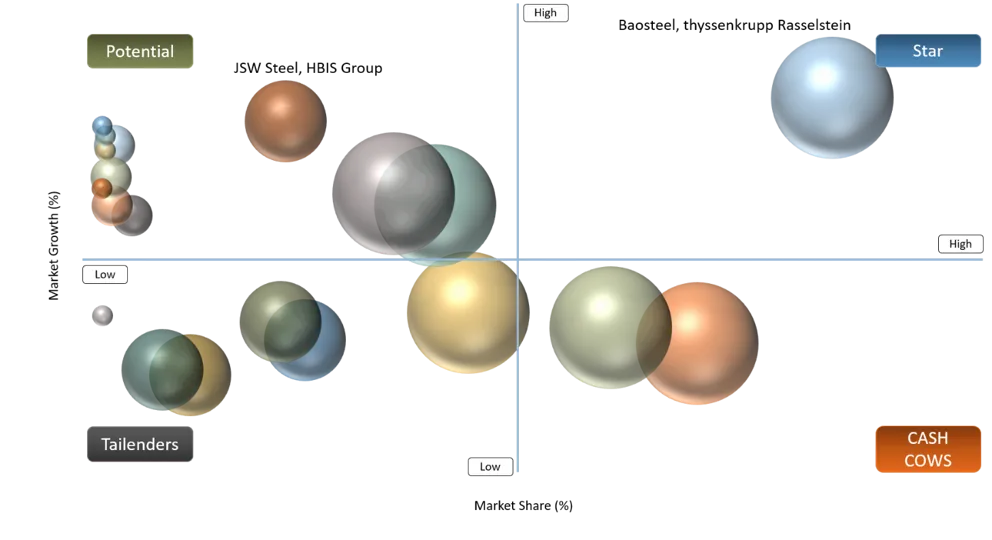
STAR
In tinplate market, Baosteel, thyssenkrupp Rasselstein, POSCO, JFE Steel and ArcelorMittal are some of the companies that form the most formidable star position owing to their strong market presence and ability to produce tinplates. They have been able to invest in coating quality, chrome-free passivation, light weighting technology, compliance with food contact standards and application specific grades of tinplates which help them win demand through performance, recycling and security.
POTENTIAL
JSW Steel, HBIS Group and other regional tin plate producers form the Potential category since they have possibilities for enhancing their market positions via regional expansion, imports substitution and better converter support. An increasing consumption of packaged foods, edible oils, aerosols, closures, pharmaceuticals and industrial packaging products in India and Southeast Europe may be considered an approach that would help these firms to penetrate into the market. This potential is reinforced due to the need for stable supply of quality packaging materials, shorter lead times and even regional sourcing apart from current global suppliers.
Tinplate Market Dynamics
Driver Impact Analysis
| Driver | Market Growth Impact (%) | Demand Concentration | Impacted Use Case | Strategic Impact |
| Rising Demand for Specialized Packaging | 30% | Food, beverage, aerosol, paint & pharmaceutical packaging | Food cans, aerosol cans, closures & specialty containers | Drives demand for food-grade, corrosion-resistant, print-ready and application-specific tinplate |
Growth in Industrial Batteries & Electronic Components | 15% | Asia-Pacific, North America & Europe | Battery casings, housings, connectors & shielding | Expands tinplate demand beyond packaging and favors controlled thickness and surface quality |
| Sustainability Push & High Recyclability | 25% | Europe, Japan, South Korea, U.S. & India | Food, beverage & industrial metal packaging | Supports adoption of recyclable, low-carbon and circular tinplate solutions |
| Shift from Loose to Packaged Foods | 20% | India, particularly Tier 2 & Tier 3 cities | Ghee, edible oils, dairy products, sweets, pickles, tea, coffee & ready-to-eat foods | Creates new regional demand and opportunities for localized supply and converter partnerships |
Driver: Rising Demand for Specialized Packaging
One of the main drivers of growth in the tinplate market is growing demand for custom metal packaging in various applications in the food & beverages, aerosol cans, paint & chemicals and pharmaceutical industries. Indeed, tinplate is especially good for packaging which needs to be highly corrosion-resistant, has extended shelf-life, provides excellent barrier properties, formability and high print quality. Moreover, food & beverages segment will profit from the use of tinplate owing to the fact that it is good for hygiene and tamper-proof packaging. The growing need for customized packaging is increasing the significance of specialized grades, controlled tin coating, light-weighting and ready-to-print coatings, helping tinplate manufacturers to tap into high-end packaging needs instead of competing on commodity prices of steel alone.
Restraint Impact Analysis
| Restraint | Drag on Market Growth (%) | Primary Impact Area | Impacted Use Case | Strategic Impact |
| High Fluctuations in Global Tin Prices | 55% | Coating cost & pricing stability | ETP, food cans, beverage cans & specialty packaging | Raises procurement costs, creates pricing uncertainty and pressures producer margins |
Aggressive Competition from Flexible Packaging, PET Bottles & Aluminum Cans | 45% | Material substitution & packaging economics | Food, beverage, personal care & household packaging | Forces tinplate suppliers to compete through lightweighting, recyclability, durability and premium printability |
Global Steel Overcapacity & Import Competition | 30% | Pricing & market share | Packaging-grade tinplate and general canmaking | Increases price pressure and makes regional production efficiency and supply differentiation more important |
Trade Restrictions & Carbon-Related Requirements | 25% | Cross-border sourcing & landed cost | Export-oriented tinplate and packaging supply chains | Can alter sourcing economics, increase compliance costs and favor localized supply networks |
Restraint: High Fluctuations in Global Tin Prices
The main constraint facing the tinplate market is the significant volatility in the international prices of tin since refined tin is an important input used in electrolytic coating. Volatility in the prices of tin makes it difficult to calculate the coating cost, plan procurement activities and make price quotations to customers since it would be hard to transfer the increased input cost to the can makers and packaging convertersThis effect is especially crucial to ETP, which held 91.18% of the market in 2025, since exact and accurate tin coating is important for rust prevention. Disruptions in the availability of tin due to mining, smelting, export restrictions and logistics will be able to compound this risk even more.
Tinplate Market Segment Analysis
The global tinplate market is segmented based on the tin coating, type, grade, thickness, application and region.
By Application
Packaging dominates the Tinplate Market due to its extensive use across food, beverage and specialty containers.
Packaging is the dominant segment within the tinplate market, contributing to 85.08% of the total market volume in 2025. This is due to the widespread application of tinplate in food canning, beverage canning, aerosol canning, paints and chemicals canning, closure canning and decorative canning applications where the need for corrosion resistance, barrier properties, formability, printability and extended shelf-life becomes crucial. The increasing consumption of packaged foods and preference for recyclable metal canning drives packaging to remain as the primary source of demand for tinplate.
By Tin Coating
Electrolytic Tin Plate (ETP) is the fastest-growing coating segment due to its precise coating control and packaging performance
Electrolytic Tin Plate (ETP) leads as the fastest growing segment in the tin coating segment, expected to grow at a CAGR of 8.4% from 2026 to 2035. This can be attributed to precise coating ability, surface finish, corrosion resistance, good printability and excellent suitability for food contact packaging and lacquer systems.It continues to grow due to the need for performance consistency, lightweighting, regulation compliance and high-quality printed metal packaging.
Tinplate Market Geographical Penetration
U.S. Tinplate Market Landscape
Characteristics of the U.S. tinplate market include a high level of demand for food cans, beverage cans, aerosol cans, closures and industrial packaging, with purchasers valuing corrosion resistance, formability, printability, food contact approval and long shelf life. The industry features a focus on security of domestic supply, with the United States Steel Corporation being one of the main suppliers of tinplate in the U.S. On the other hand, U.S. converters have higher energy costs, higher labor costs and compliance costs, making it more likely to adopt light-weighting, down-gauging, higher tin plate grade and coating control. There is substitution pressure for aluminum, PET and flexible packages, while steel import duties, import competition and material cost changes may affect tinplate supply, price and competitiveness.
Japan Tinplate Market Outlook
The Japan’s tinplate market features mature demand driven by quality factors for top-grade packaging steel, especially for applications in food, beverages, aerosols, closures and specialty metal packagings. The focus on high accuracy of tin coating, high-quality surfaces, formability, corrosion resistance and food-contact properties leads to demand for premium tinplate produced by reputable suppliers like Nippon Steel and JFE Steel. Lightweighting/downgauging becomes more important as packers try to minimize material usage while preserving can strength and processing properties, but tinplate producers have to compete with aluminum, PET and flexible packaging solutions in markets where lightweight and convenience are prioritized.
China Tinplate Market Trends
China’s tinplate market is influenced by China’s massive packaging steel manufacturing base, along with demand for its products in packaging applications such as food, beverages, aerosols, paints, chemicals and various other applications that use metal packaging. In addition, production size and exporting competitiveness continue to play an essential role in the market. However, the industry continues to trend towards lightweighting and downgauging, where strong and thin grades of tinplates enable can makers to reduce the amount of material used without compromising the structural integrity of the cans. However, at the same time, Chinese suppliers are experiencing increased pressure owing to uncertainties in the costs of tin and steel, over-supply in the international steel market, competitive threats and substitutes in the form of other packaging material, which drives the manufacturers towards improving the coatings performance and supply capabilities.
Tinplate Market Competitive Landscape
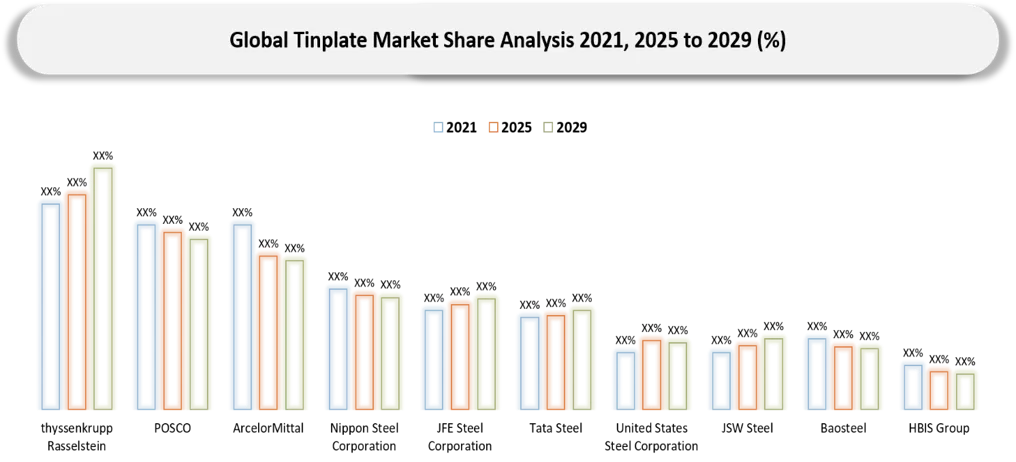
- Leader-driven but moderately fragmented: The global tinplate market is dominated by major Asian and European packaging steel manufacturers, with the top five players contributing to 50.16% of the global market share in 2025.
- Baosteel holds the leading position: Baosteel ranks first, holding a market share of 17.32%, backed by bulk tinplate manufacturing, steel manufacturing and coating expertise and domestic and export supply.
- thyssenkrupp Rasselstein competes through premium packaging steel: With a market share of 13.60%, thyssenkrupp Rasselstein has specialized in premium tinplate and sustainable packaging steel.
- Asian producers strengthen competition through scale and coating expertise: POSCO, JFE Steel and Nippon Steel rely on their integrated mills, coating technologies and packaging steel portfolio, especially for food, beverages, aerosols and specialty cans.
- Competition is shifting toward differentiated tinplate performance: Producers compete through coating uniformity, food contact specifications, lightweighting, double reduced steel grades, surface characteristics, printability and reliability of supply, in the face of aluminum, plastic and paper packaging substitutes.
Public Company Q1-Q2 2026 Performance Comparison
The below table provides a comparative analysis of five companies that are traded publicly with substantial operations in the tinplate market. The financial measures are shown at the company level, whereas the operational measures show their involvement in tinplate operations.
| Company | Q1–Q2 2026 Performance | Tinplate Exposure | Key Performance Driver |
Baoshan Iron & Steel (Baosteel) | Revenue: US$23.72 Bn Net Profit: US$674.6 Mn | Major producer of ETP, food-grade, printed and specialty tinplate | Scale, integrated steelmaking, coating capabilities and pricing pass-through |
| thyssenkrupp AG | Sales: US$13.52 Bn Adjusted EBIT: US$355.2 Mn | High exposure through thyssenkrupp Rasselstein, a major European packaging-steel and tinplate supplier | Premium packaging steel, efficiency improvements and sustainable packaging grades |
| POSCO Holdings | Revenue: US$24.28 Bn Operating Profit: US$1.00 Bn | Tinplate supplied for food, beverage, aerosol, closure and general-can applications | Integrated steelmaking, advanced coating technology and Asian packaging demand |
| JFE Holdings | Revenue: US$7.22 Bn Operating Profit: US$294.6 Mn | Tinplate and packaging steel form part of its specialty flat-steel portfolio | High-quality steel production, coating technology and premium packaging applications |
| Tata Steel | Revenue: US$6.40 Bn EBITDA: US$986.7 Mn | Direct exposure through Tata Tinplate, with expansion of India tinplate capacity from 0.4 to 0.7 MTPA underway | Strong India steel performance and investment in tinplate capacity expansion |
Note: Financial periods differ because companies follow different fiscal calendars. Company-level financial values represent the overall company and should not be interpreted as tinplate revenue unless separately disclosed.
Key Companies of Tinplate Market
- thyssenkrupp Rasselstein (Germany)
- POSCO (South Korea)
- ArcelorMittal (Luxembourg)
- Nippon Steel Corporation (Japan)
- JFE Steel Corporation (Japan)
- Tata Steel (India)
- United States Steel Corporation (United States)
- JSW Steel (India)
- Baosteel (China)
- HBIS Group (China)
Company Profiles
Baosteel
Baosteel has been identified as the market leader for the global tinplate market with a market share of 17.32% for 2025. This has been enabled through extensive production capabilities of tinplate along with integrated production of steel and its derivatives with an offering that includes ETP, food grade tinplate, printed tinplate and specialty coated packaging steel.
Competitive priorities include ensuring cost competitiveness with integrated production, improved coating quality, food grade and printed tinplate production and lightweight packaging, as well as tin and steel cost variability management.
thyssenkrupp Rasselstein
Thyssenkrupp is engaged in the tinplate market through its affiliate Thyssenkrupp Rasselstein, which is one of Europe’s biggest suppliers of packaging steels. Competitive advantages include high-quality tinplate, innovative packaging steel grades, sustainability, recyclability and close ties with international can makers and packaging converters.
Competitive priorities involve increasing the number of applications for premium packaging steels, enhancing sustainability and low-carbon products, achieving higher efficiencies and assisting converters with application-specific grades.
POSCO
POSCO is one of the top global suppliers of tinplate to food cans, beverage cans, aerosol cans, closures, general cans and other metal packaging end uses. The strengths of POSCO include an integrated steel production process, coating technology and strong Asian manufacturing capability where the products have characteristics such as corrosion resistance, formability, surface and printability.
The competitive priorities of POSCO include having quality coatings, developing food contact packaging, enhancing surface and printing performance, developing premium packaging steel and integrated manufacturing capability.
JFE Steel
JFE Steel is one of the large Japanese producers of steel with existing presence in packaging steel and tinplate end uses. Competitive strengths of JFE Steel include high quality production of flat steels, coating technologies and needs for high-quality packaging materials characterized by consistency in dimensions and corrosion resistance.
The main competitive priorities of the company include premium tinplate, lightweighting/downgauging, coatings and good customer relations with packaging converters.
ArcelorMittal
ArcelorMittal is a significant international manufacturer of steel, having exposures in tinplate and packaging steel in applications such as food, beverages, aerosol and industrial packaging. The company’s competitiveness is enabled by its global scale of production, extensive steel expertise and long-established connections in the regional packaging markets.
Competitive imperatives include efficiency of production, coating efficiency, light weight packaging, sustainable steel products and improving competitiveness compared to competing packaging materials.
Nippon Steel
Nippon Steel is one of the foremost producers of steel in Japan, with an important position in the market of quality packaging steel and tinplate. The competitive advantage is associated with top material quality, processing precision, surface properties and the ability to supply steel for challenging food, beverage, aerosol and specialty packaging applications.
Competitive priorities are advanced grades of tinplate, lightweighting, surface/coating quality, food contact performance and higher value-added packaging applications.
Tata Steel
Tata Steel has participation in the tinplate market through its packaging-steel sector and Tata Tinplate. The company's position is strengthened due to its integrated steel production facility and presence in India's growing packaged food and metal packaging industry.
The competitive strategy for Tata involves the growth of tinplate capacity, supplying the new packaged foods market, developing lightweight and Double Reduced products and developing domestic converters' relationships.
United States Steel Corporation
United States Steel Corporation is one of the key players in North America in supplying tinplate, where domestic production serves customers in food/beverage, aerosol, closures and industrial packaging markets. The competitiveness of the company is largely dependent on domestic supply security and the local availability of packaging steel in North America.
Competitive priorities involve ensuring domestic supply security, enhancing lightweighting and downgauging, managing coating quality and addressing import competition and shifts in trade policies.
JSW Steel
JSW Steel is a steel manufacturer in India with tinplates that include Single Reduced and Double Reduced tinplates for use in food packaging and other uses. The Double Reduced tinplate provides stronger material and enables production of thinner materials that fit into the current lightweighting trend.
Competitive Priorities include increased adoption of the Double Reduced tinplates, efficient material use, improved packaging materials supply within India and tapping into India’s packaged food industry.
HBIS Group
HBIS Group is a leading steel manufacturer from China producing tinplate in coil and sheet form for packaging food, beverages, medicines, cosmetics and chemicals. Its extensive steel manufacturing facility in China and HBIS Serbia operations help it supply its product range to Asian and European packaging markets.
Competitive priorities include expansion of Double Reduced tinplate, accessing the European market, improvement of premium packaging steel and maintaining cost competitiveness.
Tinplate Market Major Pain Points
- High Tin Price Volatility: Any changes in the price level of refined tin affect the cost of electrolytic coating, thus creating problems with procurement, pricing and margins for the tinplate manufacturers and converters.
- Pressure from Alternative Packaging Materials: Flexible packaging, PET containers and aluminum cans represent alternative packaging materials that offer competition with tinplate packaging on the basis of weight, cost, convenience and design.
- Limited Premium-Grade Production Capacity: The production capacity of high-quality food-grade and specialized tinplate may be limited, resulting in difficulties in obtaining necessary coating specifications.
- Complex Food-Contact Qualification Requirements: The lengthy process of certifying products for food contact can hamper the ability of suppliers to switch and can raise the costs and time associated with launching new coating products.
- Import, Freight and Trade-Policy Exposure: Tinplate producers, can makers and packagers can be at risk due to their dependence on imports and vulnerability to shipping problems, duties, dumping and other trade policies.
Tinplate Market Recent Developments
- FY2025-26 - Tata Steel: Additional progress with the 300 KTPA expansion of the Jamshedpur tinplate plant, aimed at increasing the production capacity from about 380 KTPA to 680 KTPA by FY2027-28. The sales volume of domestic tinplate products grew by 10% year-on-year during FY2025–26.
- June 2026 - ArcelorMittal: Continues transitioning into CFPA for packaging steel in accordance with evolving regulations in Europe. ArcelorMittal stated that its CFPA manufacturing lines were functioning across all of its packaging steel plants, but its further transition will be reliant on regulations and customers’ needs.
- June 2026 - Baosteel: Raised its July 2026 ETP tinplate list price by RMB 220 per ton in response to ongoing raw materials cost pressures. As per the DataM report, this marks the fifth tinplate price increase by Baosteel since January 2026.
- April 2026 - thyssenkrupp Rasselstein: Announced innovations in the tinplate packaging segment at METPACK 2026 in the form of new rasselstein CUP and rasselstein D&I Solid products, which provide for material saving and thickness reduction while ensuring packaging stability. Also launched its FEA-based Canculator digital solution.
- September 2025 - HBIS Group: HBIS Serbia maintained its supply of Single Reduced and Double Reduced tinplate coils and sheets used in food, pharmaceutical, cosmetics and chemicals packaging applications. This is according to the DataM report, which states that food safety certifications for its packaging clients have also been ongoing.
Analyst View / Opinion on Tinplate Market
- Packaging will remain the core demand engine: The dominance of tinplate as a material for metal packaging will be maintained due to the need for corrosion resistance, barrier property, formability, printability and long shelf life of food, beverage, aerosol, paint, chemical and specialty packaging.
- Lightweighting will reshape product competition: The growing preference in the market for Double Reduced and thin gauge tinplate will enable can manufacturers to save on materials without compromising on stiffness and strength properties.
- ETP will strengthen its technological leadership: Electrolytic Tin Plate will continue to be the favored coating technology due to its superior coating thickness control, uniformity of coating surface, corrosion resistance and printability.
- Competitive advantage will shift toward value-added tinplate: Manufacturers will compete more on basis of food grade capability, chromium free passivation, high quality surface, compatibility with digital printing, specific application grades and low carbon products than just on volume of tinplate.
- Circularity will become a strategic growth opportunity: Well organized recycling of scrap tinplate, detinning and recycling of tin and ferrous steel could help in securing the raw material sources and also contribute to the development of the market’s recyclability strategy.
Tinplate Market Target Audience
| INDUSTRY | WHO SHOULD BUY THIS REPORT? | REASON TO BUY THIS REPORT |
| Tinplate & Packaging Steel Manufacturers | Strategy, business development and product management teams | Assess market growth, segment demand, competitor positioning and opportunities for capacity and product expansion. |
| Steel Producers & Integrated Steelmakers | Corporate strategy and investment teams | Evaluate tinplate production opportunities, coating technologies, lightweighting and regional supply-demand dynamics. |
| Metal Packaging Manufacturers | Procurement, sourcing and operations teams | Understand tinplate availability, pricing, grades, thicknesses and coating requirements for canmaking operations. |
| Food & Beverage Packaging Companies | Packaging, procurement and innovation teams | Identify demand trends for food cans, beverage cans, closures and recyclable metal packaging. |
| Aerosol & Specialty Packaging Manufacturers | Product development and sourcing teams | Assess opportunities for tinplate in aerosol, pharmaceutical, cosmetic, paint and chemical containers. |
| Tin & Coating Technology Suppliers | Technology, sales and business development teams | Identify demand for electrolytic tin coating, surface treatment, passivation and food-safe coating technologies. |
| Steel Service Centers & Distributors | Commercial and supply-chain teams | Evaluate regional demand, pricing conditions and opportunities to strengthen tinplate distribution networks. |
| Recycling, Detinning & Scrap-Recovery Companies | Business development and investment teams | Identify opportunities for tin recovery, ferrous scrap upgrading and closed-loop tinplate supply chains. |
| Investors & Private Equity Firms | Investment, strategy and due-diligence teams | Assess market attractiveness, competitive concentration, investment opportunities and long-term growth prospects. |
| Government, Trade & Industry Organizations | Policy, trade and industry-development teams | Evaluate tinplate supply security, trade flows, recycling potential, domestic production and packaging-sector development. |
Why Choose DATAM?
- Data-Driven insights: Dive into detailed analyses with granular insights such as pricing, market shares and value chain evaluations, enriched by interviews with industry leaders and disruptors.
- Post-Purchase Support and Expert Analyst Consultations: As a valued client, gain direct access to our expert analysts for personalized advice and strategic guidance, tailored to your specific needs and challenges.
- White Papers and Case Studies: Benefit quarterly from our in-depth studies related to your purchased titles, tailored to refine your operational and marketing strategies for maximum impact.
- Annual Updates on Purchased Reports: As an existing customer, enjoy the privilege of annual updates to your reports, ensuring you stay abreast of the latest market insights and technological advancements. Terms and conditions apply.
- Specialized Focus on Emerging Markets: DataM differentiates itself by delivering in-depth, specialized insights specifically for emerging markets, rather than offering generalized geographic overviews. The approach equips our clients with a nuanced understanding and actionable intelligence that are essential for navigating and succeeding in high-growth regions.
- Value of DataM Reports: Our reports offer specialized insights tailored to the latest trends and specific business inquiries. The personalized approach provides a deeper, strategic perspective, ensuring you receive the precise information necessary to make informed decisions. The insights complement and go beyond what is typically available in generic databases.
What DATAM Uniquely Provides
- Deep Tinplate Market Segmentation: Segmented by tinplate types, tin coating, thickness, applications and grades, with market values, volume, share and growth trends up to 2033.
- Application-Specific Competitive Intelligence: Assessment of companies by market share, portfolio, pricing, SWOT, latest trends and competitive position of major tinplate manufacturers.
- Tinplate Technology & Manufacturing Analysis: Assessment of electrolytic tin coating technology, annealing and tempering, lightweighting/downgauging, food-grade coating, metal printing and automatic inspection.
- Regional and Country-Level Opportunity Mapping: In-depth study on opportunity mapping of Asia-Pacific, North America, Europe, South America and Middle East & Africa, covering country-level demands and opportunities for growth like India's evolution from loose to packaged foods.
- Actionable Strategic Intelligence: Comprehensive analysis of the following - supply chain risks, tin price volatility, trade barriers, pricing, sustainability, detinning and scrap generation, investment opportunities and GTM strategy.




























































