


Telecom Infrastructure Market Size and Overview
The telecom infrastructure market reached US$261 billion in 2025 and is expected to reach US$ 457.8 billion by 2035, growing with a CAGR of 5.78% during the forecast period 2026-2035 Market growth is being driven by continued 5G deployment, fiber network expansion, cloud-native core modernization, private wireless networks, edge computing and rising data traffic across consumer and enterprise applications.
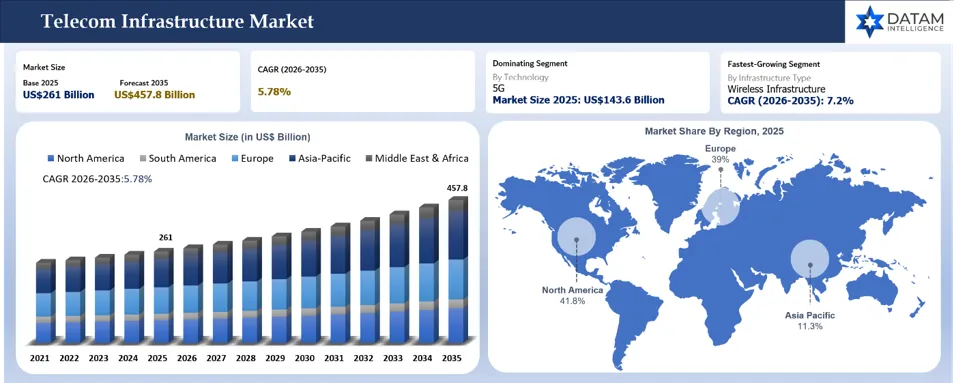
In 2025, 5G was commercially available in more than 120 countries, reinforcing demand for radio access networks, antennas, small cells, optical transport and high-capacity backhaul infrastructure. During 2026, competitive investment increasingly shifted toward AI-native RAN, autonomous network management, Open RAN, network slicing and energy-efficient infrastructure, as operators sought higher network performance with lower operating costs. At the same time, high capital expenditure, spectrum costs, permitting delays and complex multi-vendor integration remain key constraints. Overall, the market is transitioning from hardware-centric deployment toward intelligent, software-defined and AI-enabled telecom infrastructure.
Telecom Infrastructure Market Key Takeaways
- 5G deployment remains a major market driver, with 5G commercially available in more than 120 countries in 2025 and expected to account for nearly one-third of global mobile connections by year-end.
- Telecom infrastructure investment remains highly capital intensive. In 2025, global annual investment in mobile internet infrastructure reached approximately US$127 billion, with mobile network operators contributing US$109 billion, or 85%.
- AI-native telecom infrastructure emerged as a major 2026 technology theme, with Ericsson introducing AI in RAN capabilities that delivered up to 20% higher downlink throughput and 10% better spectral efficiency across deployments and trials.
- Market expansion through 2035 will increasingly be shaped by AI-driven network automation, cloud-native cores, Open RAN, fiber expansion, 5G-Advanced and autonomous networks, while high capital requirements and infrastructure deployment complexity remain key constraints.
Telecom Infrastructure Market Scope
| Metrics | Details | |
| 2025 Market Size | US$261 Billion | |
| 2035 Projected Market Size | US$457.8 Billion | |
| CAGR (2026-2035) | 5.78% | |
| Largest Market | North America | |
| Fastest Growing Market | Asia-Pacific | |
| By Component | Hardware, Software, Services | |
| By Technology | 5G, 4G/LTE, 2G/3G | |
| By Infrastructure Type | Wireless Infrastructure, Wired Infrastructure, Satellite & Other Infrastructure | |
| By End User | Telecom Operator, Enterprises | |
| By Region | North America | U.S., Canada, Mexico |
| Europe | Germany, UK, France, Spain, Italy, Poland | |
| Asia-Pacific | China, India, Japan, Australia, South Korea, Indonesia, Malaysia, Singapore, Vietnam, Thailand, Philippines, Taiwan | |
| South America | Brazil, Argentina | |
| Middle East and Africa | Israel, Saudi Arabia, UAE, Turkiye, South Africa, Nigeria | |
| Report Insights Covered | Competitive Landscape Analysis, Company Profile Analysis, Market Size, Share, Growth | |
Telecom Infrastructure Market White Space & Investment Opportunities
- AI-Native RAN And Autonomous Network Infrastructure: Invest in AI-enabled radio access networks, intelligent orchestration, predictive maintenance and autonomous network management platforms that can improve spectrum utilization, capacity and operating efficiency. Opportunities are particularly attractive for solutions that integrate with existing 5G infrastructure while providing software-based migration toward 5G-Advanced and 6G. Nokia’s 2026 AI-native RAN platform highlights the industry shift toward programmable infrastructure capable of delivering higher capacity from existing spectrum assets.
- Satellite-Terrestrial Converged Networks And Direct-To-Device Connectivity: Develop hybrid telecom infrastructure combining terrestrial mobile networks with non-terrestrial networks to extend coverage across rural, remote and underserved areas. Investment opportunities include satellite gateways, NTN-compatible network software, D2D connectivity platforms and resilient emergency communications. In March 2026, GSMA Foundry and ESA announced access to up to €100 million in funding for AI, NTN, D2D and 6G projects, supporting commercialization of integrated satellite-terrestrial networks.
- Open, Cloud-Native And Multi-Vendor Network Platforms: Expand investment in Open RAN, virtualized RAN, cloud-native cores, interoperable network APIs and vendor-neutral orchestration platforms. Telecom operators increasingly require flexible architectures that reduce dependence on proprietary hardware and allow network functions to scale through software. The principal white space lies in solving multi-vendor integration, network assurance and AI orchestration challenges, as GSMA notes that fragmented network environments and siloed data remain major barriers to scaled telecom AI adoption.
Telecom Infrastructure Market Buyer Decision-Making Criteria
Major Buyer Decision-Making Criteria:
- Network Performance and Reliability
- Total Cost of Ownership
- 5G and 5G-Advanced Compatibility
- Scalability and Capacity Expansion
- Interoperability With Existing Infrastructure
- Open RAN and Multi-Vendor Compatibility
- Network Security and Cybersecurity Capabilities
- Energy Efficiency and Power Consumption
- AI-Driven Network Automation Capabilities
- Deployment Speed and Implementation Complexity
- Cloud-Native and Virtualization Support
- Fiber and Backhaul Compatibility
- Network Management and Orchestration Capabilities
- Vendor Technology Roadmap and Innovation Capability
- Equipment Lifecycle and Upgrade Flexibility
- Regulatory and Spectrum Compliance
- Technical Support and Managed Services Availability
- Vendor Track Record and Operator References
- Supply Chain Reliability and Equipment Availability
- Pricing, Financing and Commercial Terms
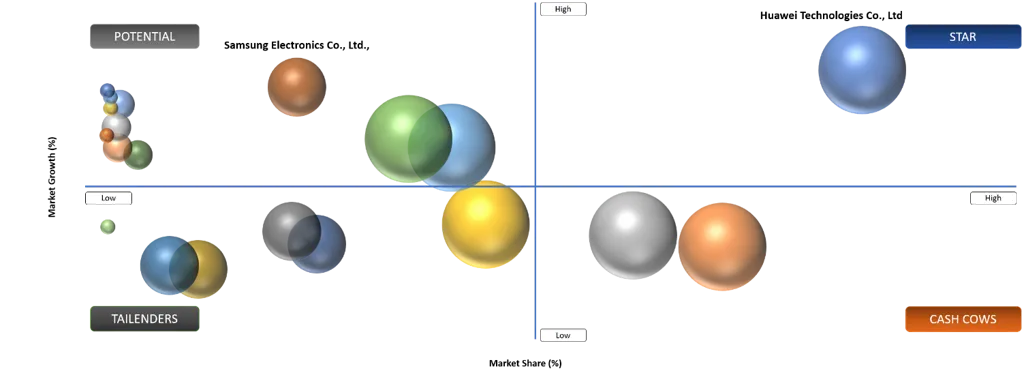
Telecom Infrastructure Market BCG Matrix: Company Evaluation
STAR
Huawei Technologies Co., Ltd., Telefonaktiebolaget LM Ericsson, Nokia Corporation, and ZTE Corporation can be positioned as Stars due to their broad telecom infrastructure portfolios, large-scale operator deployments, and continued investment in 5G, 5G-Advanced, optical networks, cloud-native cores, AI-enabled RAN, and future 6G technologies. Ericsson reported a 37% global RAN market share outside China in 2025 and 206 live 5G networks across 85 countries. Nokia is strengthening its position through AI-native networking, optical infrastructure and its Infinera acquisition, while ZTE continues advancing 5G-A, optical transmission and intelligent network infrastructure.
POTENTIAL
Samsung Electronics Co., Ltd., Cisco Systems, Inc., Ciena Corporation, NEC Corporation, Fujitsu Limited, and Arista Networks, Inc. represent high-potential participants as telecom infrastructure increasingly shifts toward virtualized, cloud-native, open and AI-driven architectures. Samsung is expanding commercial vRAN and Open RAN deployments with operators such as Orange and Vodafone and advancing AI-RAN with NVIDIA. Cisco is targeting service providers with AI-powered automation, converged networking, assurance and infrastructure supporting 5G and IoT monetization. These companies have opportunities to expand their competitive positions as operators increase investment in Open RAN, AI-native networking, edge infrastructure, high-capacity optical connectivity and network automation.
Telecom Infrastructure Market Dynamics
Driver Impact Analysis
| Driver | Market Growth Impact (%) | Demand Concentration | Impacted Use Case | Strategic Impact |
Accelerating 5G And 5G-Advanced Deployment | 18.6% | Mobile network modernization | RAN, 5G core, small cells and backhaul | Expanding 5G coverage is driving replacement and modernization of radio, core, transport and edge infrastructure. |
Rising Data Traffic And AI-Driven Connectivity Demand | 14.8% | Network capacity expansion | AI applications, cloud services, video and enterprise connectivity | Higher bandwidth and lower-latency requirements are accelerating investment in fiber, optical transport, edge infrastructure and intelligent network management. |
Expansion Of Fiber And Rural Broadband Infrastructure | 12.4% | Fixed and converged networks | FTTH, mobile backhaul and underserved-area connectivity | Public and private broadband programs are supporting fiber expansion, network densification and improved high-speed connectivity across underserved markets. |
Driver: Accelerating 5G And 5G-Advanced Deployment
Accelerating deployment of 5G and 5G-Advanced networks is a major growth driver for the Telecom Infrastructure Market. Operators are upgrading radio access networks, core systems, antennas, fiber backhaul and edge infrastructure to support higher capacity, lower latency and growing enterprise connectivity requirements. According to the GSMA, 5G was commercially available in more than 120 countries and was expected to represent nearly one-third of global mobile connections by the end of 2025. More than 80 operators across over 60 markets were also planning commercial 5G launches. This expansion creates sustained demand for base stations, massive MIMO radios, cloud-native cores, network automation and optical transport while preparing operators for AI-enabled services, network slicing, private networks and future 6G migration.
Restraint Impact Analysis
| Restraint | Drag on Market Growth (%) | Primary Impact Area | Impacted Use Case | Strategic Impact |
High Network Deployment And Capital Expenditure Requirements | 14.50% | Network expansion economics | 5G, fiber and rural network deployment | High upfront expenditure on RAN, towers, fiber, core networks and spectrum can delay modernization, particularly in low-return locations. Mobile operators account for about 85% of global mobile internet infrastructure investment, highlighting the significant financing burden carried by operators. |
Rising Energy And Network Operating Costs | 11.20% | Network operating expenditure | 5G base stations and dense radio networks | Greater network densification and antenna deployment can increase electricity consumption despite improved 5G energy efficiency. Energy can represent around 20% of operators' operating costs, increasing pressure to deploy energy-efficient hardware and AI-based network optimization. |
Regulatory, Permitting And Right-Of-Way Delays | 8.70% | Infrastructure deployment timelines | Fiber rollout, towers and small-cell deployment | Lengthy permits, right-of-way approvals and fragmented local requirements can increase construction costs, postpone network launches and reduce the commercial viability of planned infrastructure expansion. The FCC has identified permitting delays as an impediment to broadband investment and deployment. |
Restraint: High Network Deployment And Capital Expenditure Requirements
High network deployment and capital expenditure requirements remain a major restraint for the telecom infrastructure market. Expansion of 5G networks, fiber backhaul, small cells, towers, edge infrastructure and cloud-native cores requires substantial upfront investment from telecom operators. Capital intensity becomes particularly challenging in rural and low-density areas, where subscriber revenues may not justify infrastructure costs. Operators must also allocate significant resources toward spectrum acquisition, equipment upgrades, cybersecurity and ongoing network modernization. According to the GSMA, mobile operators account for approximately 85% of global mobile internet infrastructure investment, highlighting the significant funding burden carried by network providers. These pressures can delay network expansion, lengthen investment payback periods and increase reliance on infrastructure sharing, phased deployments and government-supported connectivity programs.
Telecom Infrastructure Market Segmentation Analysis
The global telecom infrastructure market is segmented based on component, technology, infrastructure type, end user and region.
Technology: The 5G segment accounts for an estimated 53.4% of the global telecom infrastructure market.
The 5G segment represented approximately 53.4% of the global telecom infrastructure market in 2024, maintaining its position as the leading category. The global shift from 4G LTE to 5G is accelerating investments in base stations, small cells, fiber backhaul, and cloud-native core networks. With its ability to deliver high bandwidth, ultra-low latency, and reliable connectivity, 5G has become the foundation for advanced applications such as smart cities, autonomous mobility, industrial IoT, and immersive digital services.
Growth within this segment is also being fueled by strategic acquisitions and partnerships that enhance deployment capabilities. For instance, in June 2024, Accenture finalized the acquisition of Fibermind, an Italy-based network services provider specializing in fiber and 5G rollout. This acquisition expands Accenture’s expertise in telecom network engineering while integrating advanced capabilities in automation, robotics, data, and AI, helping clients accelerate and optimize 5G deployments.
As nations and enterprises continue to prioritize digital transformation, spectrum expansion, and advanced connectivity infrastructure, the 5G segment is expected to remain at the forefront of telecom infrastructure growth. Its critical role in supporting cloud, edge computing, and AI-driven ecosystems ensures strong demand over the coming years.
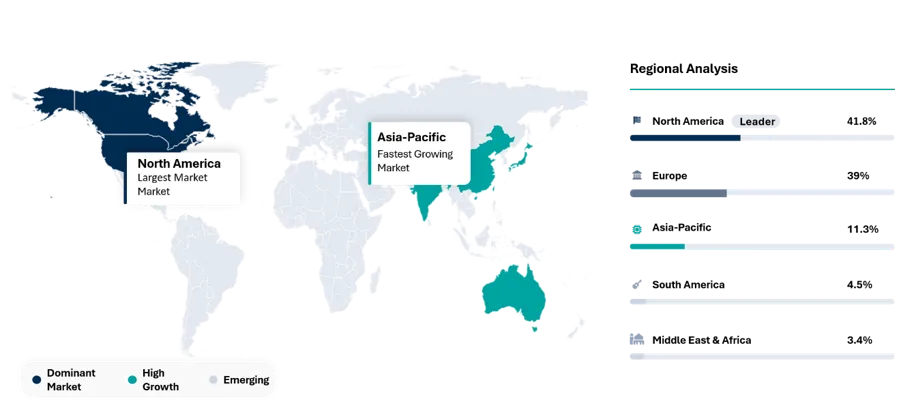
Telecom Infrastructure Market Geographical Penetration
U.S. Telecom Infrastructure Market Landscape
The United States telecom infrastructure market is advancing through large-scale fiber deployment, 5G network modernization, Open RAN adoption and government-supported broadband expansion. The NTIA’s BEAD program provides USD 42.45 billion for high-speed broadband infrastructure, supporting connectivity expansion across underserved and rural locations. Private investment is also accelerating, with AT&T committing more than USD 250 billion through 2030 toward U.S. fiber, wireless and advanced connectivity infrastructure. In 2026, AT&T reported that more than half of its radio replacement program had been completed as it advances toward Open RAN-capable infrastructure. Growing AI traffic, connected devices, enterprise private networks and demand for resilient low-latency connectivity are further supporting investments in spectrum, radio systems, fiber backhaul, network automation and cloud-native telecom architectures.
Japan Telecom Infrastructure Market Outlook
The Japan telecom infrastructure market is moving toward AI-native, virtualized and energy-efficient network architectures as operators modernize 5G infrastructure and prepare for 5G-Advanced and 6G. NTT DOCOMO became Japan’s first operator in June 2026 to deploy Nokia’s AI-powered MantaRay AutoPilot for automated commercial network optimization. In July 2026, DOCOMO also completed Japan’s first commercial deployment of Ericsson’s RAN Processor 6672, which offers up to four times greater capacity efficiency and more than 50% lower energy consumption than the previous-generation solution. Meanwhile, SoftBank is progressing toward commercial AI-RAN deployment through its AITRAS platform and Telco AI Cloud strategy. Investments in vRAN, AI-RAN, millimeter-wave coverage, edge computing and network automation are therefore reshaping Japan’s telecom infrastructure ecosystem.
Telecom Infrastructure Market Competitive Landscape
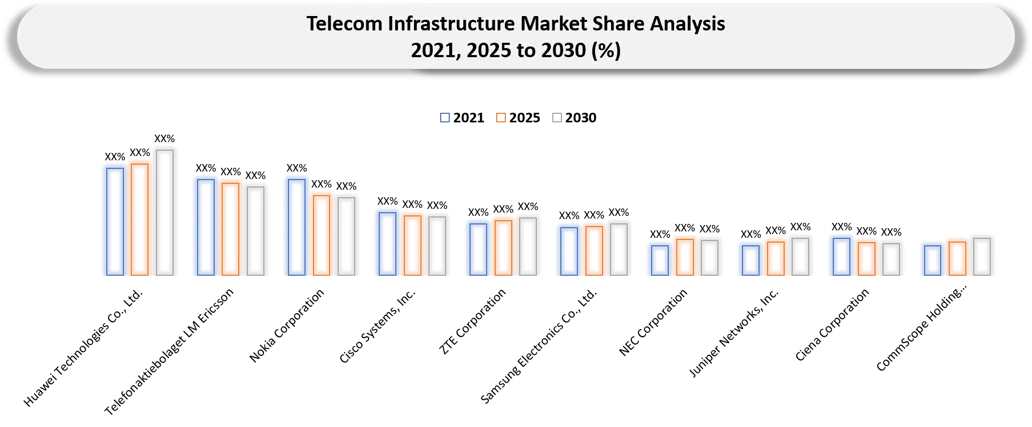
- The global Telecom Infrastructure Market is highly competitive, with established network equipment vendors, cloud and networking companies, and telecom infrastructure operators competing across 5G, Open RAN, core networks, optical transport, network automation, and AI-enabled infrastructure. Major companies include Huawei Technologies Co., Ltd., Telefonaktiebolaget LM Ericsson, Nokia Corporation, Cisco Systems, Inc., ZTE Corporation, Samsung Electronics Co., Ltd., NEC Corporation, Juniper Networks, Inc., Ciena Corporation, and CommScope Holding Company, Inc.
- Competition is increasingly shifting from traditional hardware capabilities toward AI-native networks, software-defined infrastructure, cloud RAN, Open RAN interoperability, autonomous network management, energy efficiency, and multi-vendor integration. In 2026, Nokia and Ericsson expanded cooperation around open standards and interoperable automation applications, reflecting growing operator demand for flexible multi-vendor network architectures. Nokia also introduced a commercial AI-native RAN platform designed for 5G and 5G-Advanced networks with an upgrade path toward 6G.
- Ericsson is strengthening AI-driven RAN optimization, with a 2026 SoftBank trial reporting improvements of up to approximately 25% in spectral efficiency and 50% in downlink user throughput. Samsung is expanding its virtualized and Open RAN capabilities, including collaboration with Vodafone on AI-ready vRAN infrastructure in Europe. Huawei, meanwhile, continues investing in autonomous network technologies and in June 2026 helped launch the OpenAN initiative targeting large-scale adoption of Level 4 autonomous networks.
- Overall, competitive differentiation is increasingly determined by 5G and 5G-Advanced performance, AI-enabled automation, Open RAN compatibility, cloud-native architecture, network security, energy efficiency, total cost of ownership, and operators' ability to transition toward autonomous and eventually 6G-ready networks.
Key Companies of the Telecom Infrastructure Market
- Huawei Technologies Co., Ltd. (China)
- Telefonaktiebolaget LM Ericsson (Sweden)
- Nokia Corporation (Finland)
- Cisco Systems, Inc. (United States)
- ZTE Corporation (China)
- Samsung Electronics Co., Ltd. (South Korea)
- NEC Corporation (Japan)
- Juniper Networks, Inc. (United States)
- Ciena Corporation (United States)
- CommScope Holding Company, Inc. (United States)
- Fujitsu Limited (Japan)
- Corning Incorporated (United States)
- Infineon Technologies AG (Germany)
- American Tower Corporation (United States)
- Cellnex Telecom, S.A. (Spain)
- Crown Castle Inc. (United States)
- Broadcom Inc. (United States)
- Hewlett Packard Enterprise Company (United States)
- Dell Technologies Inc. (United States)
- Arista Networks, Inc. (United States)
Telecom Infrastructure Market Recent Developments
- September 2026: Nex-Tech Wireless signed a four-year network modernization agreement with Ericsson to upgrade approximately 85% of its RAN footprint across rural Kansas and deploy a cloud-native 5G Standalone Core, including Ericsson Radio System and AI-capable RAN technologies.
- September 2026: Nokia was selected by Planters Broadband Cooperative to build an AI-ready fiber network across underserved communities in southeast Georgia. The deployment will use Nokia’s Lightspan platform and support 10G, 25G and 50G broadband capabilities, alongside AI-driven network automation.
- August 2026: ZTE and AIS showcased next-generation digital infrastructure solutions at ZTE Day Thailand 2026, focusing on autonomous networks, 5G-Advanced, 6G and green data centers to support Thailand’s expanding AI, cloud and digital-services ecosystem.
- August 2026: Huawei released SingleRAN 22.1, its commercial mobile-network software platform designed for the mobile AI era. The release integrates technologies including GigaUplink, GigaBand, iBeam 3.0, IDEA and RANSpirit to enhance network capacity, efficiency and AI-enabled operations.
- August 2026: Costa Rica’s Instituto Costarricense de Electricidad selected Ericsson as the main supplier for its 5G Standalone network. The project covers 5G RAN, 5G Core, network slicing, cybersecurity and AI-powered network automation, including deployment of Ericsson’s Intelligent Automation Platform.
- July 2026: Nokia launched its commercial AI-native RAN platform, combining Nokia anyRAN software with NVIDIA’s Aerial AI-RAN platform. Nokia stated that the architecture is designed to deliver more than 100% spectral-efficiency gains by 2028, supporting operators transitioning toward AI-native networks and future 6G infrastructure.
- July 2026: Ericsson, AT&T and MediaTek completed North America’s first in-field trial of Layer 1 and Layer 2 Triggered Mobility on a commercial 5G network. Ericsson reported that the 5G-Advanced technology can reduce handover interruption time by up to 40%, improving connectivity for latency-sensitive applications.
What DATAM Uniquely Provides
- In-depth segmentation of the Telecom Infrastructure Market by component, technology, infrastructure type, end user and region, with additional assessment of hardware, software, services, 5G, 4G/LTE, wireless infrastructure, wired infrastructure and satellite infrastructure.
- Competitive analysis of leading telecom infrastructure companies covering product portfolios, 5G and 5G-Advanced capabilities, radio access networks, core networks, optical transport, Open RAN, cloud-native infrastructure, network automation, AI integration, geographic presence, partnerships and commercialization strategies.
- Comprehensive assessment of telecom operator and enterprise infrastructure demand, including network modernization requirements, spectrum deployment, fiber expansion, data traffic growth, rural connectivity, private networks, edge infrastructure, cloud migration and increasing requirements for high-capacity, low-latency communications.
- Detailed evaluation of emerging technology and investment trends covering AI-native networks, Open RAN, virtualized RAN, cloud RAN, autonomous networks, network slicing, edge computing, energy-efficient infrastructure, satellite connectivity and early-stage 6G development.
- Actionable intelligence on infrastructure deployment economics, including capital expenditure priorities, total cost of ownership, equipment replacement cycles, vendor selection criteria, interoperability requirements, network densification, fiber backhaul requirements and monetization opportunities for telecom operators.
Strategic assessment of regional opportunities and competitive positioning, highlighting infrastructure gaps, regulatory developments, spectrum availability, government broadband programs, operator investment plans, partnerships, mergers and acquisitions, and expansion opportunities across developed and emerging telecom markets.



























































