


Tandem PV Cell Market Size and Overview
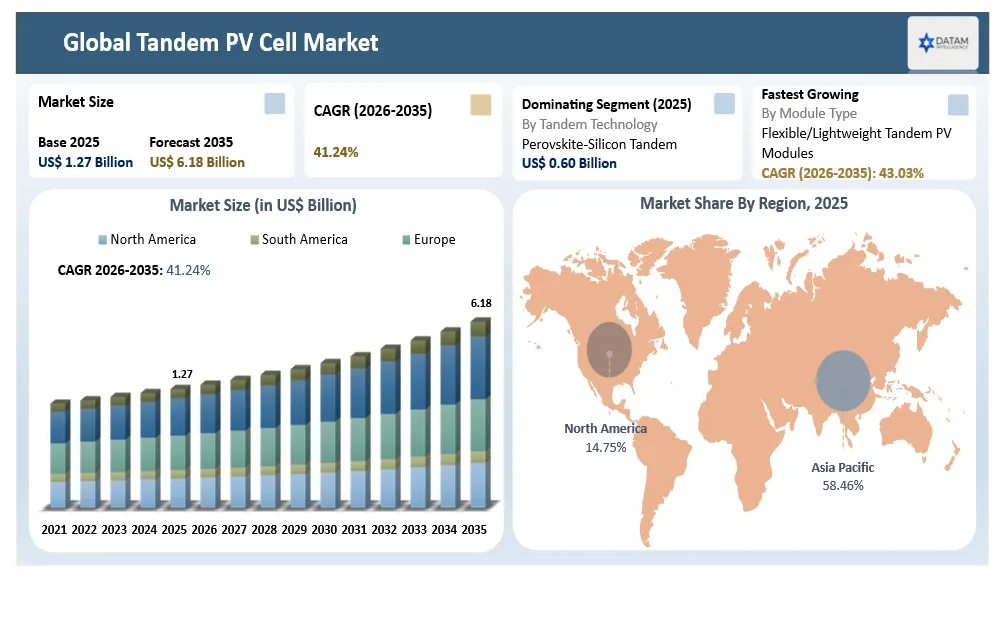
The global tandem PV cell market reached US$ 1.27 billion in 2025 and is expected to reach US$ 6.18 billion by 2035, growing with a CAGR of 41.24% during the forecast period 2026-2035.
The advancement of perovskite-silicon tandem technology from laboratory efficiency records to commercialization on a larger scale is propelling the industry forward. In 2026, LONGi reported achieving a certified efficiency of 35.5% with its crystalline silicon-perovskite tandem cell and also achieved an efficiency of 34.3% with a 261 cm² cell. Meanwhile, Trinasolar reported that it had developed a 210 mm industrial-size tandem cell with an efficiency of 32.6% as well as a full-area tandem module that was 29.2% efficient with an output of 907 W. These developments demonstrate that the tandem solar cell market is progressing beyond record laboratory devices toward manufacturing-relevant formats and high-power commercial modules.
The business focus is now more about translating increased cell efficiency into enhanced energy density and reduced system costs. In 2026, Oxford PV and Fraunhofer ISE have announced the development of a bifacial perovskite-silicon tandem module that produced 546 watts with full-area efficiency of 25.6%, demonstrating advancements in terms of module integration and interconnection scalability. Tandem PV technology’s capacity to create more energy from the same amount of installation area makes it very beneficial for land-restricted utility-scale projects, rooftop installations, BIPV and other space-sensitive applications, thus creating ideal conditions for the development of the tandem perovskite solar cell market through technological advancements.
Tandem PV Cell Market Key Takeaways
- Perovskite-Silicon Tandem held the largest market share in the tandem PV cell market in 2025, accounting for 47.6%, attributed to high efficiency capability, ease of integration in existing silicon fabrication facilities and most commercially advanced technology pipeline amongst tandem solar technologies.
- Flexible/Lightweight Tandem PV Modules will emerge as the fastest-growing segment with a CAGR of 43.03% from 2026 to 2035 owing to growing requirements for light-weight applications, BIPV, transport and mobile power sources.
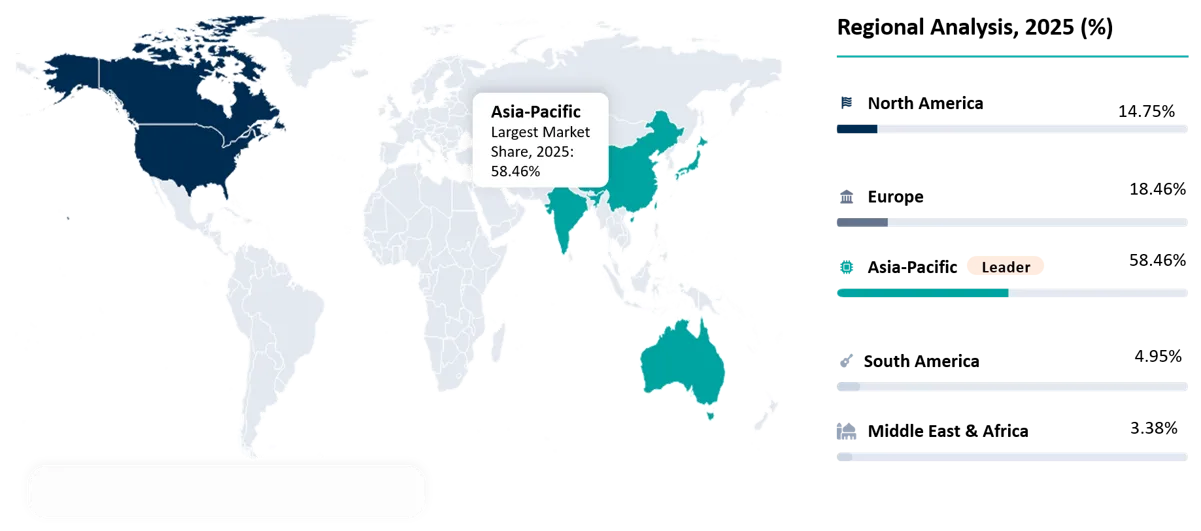
- In the global tandem PV cell market, Asia-Pacific emerged as the leading region with a 58.46% market share due to its technological advancement in PV cell manufacturing in China, advanced solar technologies in Japan and growing efforts for tandem cell manufacturing in India.
- There is a shift in the industry from lab efficiency records to production-level cells and modules with 35.5% efficiency achieved by LONGi in tandem cells and 907W tandem modules with 29.2% efficiency from Trinasolar.
- Commercial deployment requires overcoming bankability and scale-up issues such as operational stability, uniform deposition of large areas, enclosure effectiveness, yield and qualification for warranty modules lasting a long time.
Tandem PV Cell Industry Trends and Strategic Insights
- The perovskite-silicon tandem technology is making a shift from research-level activities to pilot and commercial fabrication operations, with an emphasis placed on scale-up and commercialization at the manufacturing level.
- HJT and TOPCon are becoming important platforms of silicon bottom cell technology, leading to stiff competition based on efficiency, compatibility in manufacturing process and costs.
- The industry is shifting from focusing on cell efficiency records to concentrating on module performance in terms of durability, degradation, yield, certification and reliability.
- Integration into existing manufacturing systems and scalability are now considered important competitive advantages, in particular those that allow for integration with manufacturing of crystalline-silicon photovoltaic modules.
- Tandem solar cells are advancing to areas that would see more benefit from increasing efficiencies, such as BIPV, small rooftop space, vehicle-mounted photovoltaics, floatovoltaics and aircraft.
Tandem PV Cell Market Scope
| Metrics | Details | |
| 2025 Market Size | US$ 1.27 Billion | |
| 2035 Projected Market Size | US$ 6.18 Billion | |
| CAGR (2026-2035) | 41.24% | |
| Largest Market | Asia-Pacific | |
| Fastest Growing Market | Asia-Pacific | |
| By Tandem Technology | Perovskite-Silicon Tandem, Perovskite-CIGS Tandem, All-Perovskite Tandem, III-V-Silicon Tandem and Other Tandem Technologies | |
| By Silicon Bottom-Cell Technology | TOPCon, HJT, PERC, IBC and Other Silicon Technologies | |
| By Architecture | 2-Terminal (2T), 3-Terminal (3T), 4-Terminal (4T) and Other Architectures | |
| By Integration | Monolithic, Optically Coupled and Mechanically Stacked | |
| By Module Type | Rigid Tandem PV Modules, Flexible/Lightweight Tandem PV Modules and Semi-Flexible Tandem PV Modules | |
| By Substrate | Glass, Silicon Wafer, Flexible Polymer, Metal Foil and Other Substrates | |
| By Application | Utility-Scale Solar, Commercial & Industrial, Residential, Building, Integrated Photovoltaics (BIPV), Transportation, Aerospace & Defense, Portable & Off-Grid Power and Other Applications | |
| By Installation | Ground-Mounted, Rooftop, Vehicle-Integrated, Floating and Other Installations | |
| By Cell Efficiency | Below 25%, 25%-30%, 30%-35% and Above 35% | |
| By Region | North America | U.S., Canada, Mexico |
| Europe | Germany, UK, Russia, France, Spain, Italy, Poland | |
| Asia-Pacific | China, India, Japan, Australia, South Korea, Indonesia, Malaysia, Singapore, Vietnam, Thailand, Philippines, Taiwan | |
| South America | Brazil, Argentina | |
| Middle East and Africa | UAE, Saudi Arabia, South Africa, Israel, Turkiye, Nigeria | |
| Report Insights Covered | Competitive Landscape Analysis, Company Profile Analysis, Market Size, Share, Growth | |
Why does this report matter in 2026?
2026 is an important transition year in the market for tandem PV cell, as the perovskite-silicon tandem technology moves from being developed in the lab and in pilot projects to commercial manufacturing. This report provides a concentrated analysis of technology designs, bottom cell options on silicon, manufacturing options, efficiency levels, scale-up in production and commercial readiness, enabling players to differentiate between lab performance and bankable technologies.
The report is also significant for PV companies and technology providers when making business decisions about tandem integration, 2T versus 4T structure, manufacturing compatibility, durability and cost reduction. The report assists investors, manufacturers, materials providers and downstream solar companies to find out new opportunities in utility scale PV, highly-efficient rooftops, Building Integrated PV (BIPV), Vehicle Integrated PV (VIPV) and aerospace applications and benchmark the competitive environment in the tandem solar cells market and tandem perovskite solar cells market.
Tandem PV Cell Market White Space & Investment Opportunities
- Commercial scale perovskite-silicon tandem production: There is a potential to scale up pilot lines into large-scale production without sacrificing performance, yield and compatibility with existing silicon PV manufacturing.
- Tandem-specific interface and coating technologies: Opportunities are appearing in the charge-transport layers, recombination layers, transparent conductive electrodes and coating technologies that increase tandem cells' efficiency and producibility.
- Perovskite stability and module durability solutions: Technologies such as advanced encapsulation, barrier films and degradation control materials are essential white spots to increase lifetime of tandems modules.
- High-value applications with limited installation area: BIPV, vehicular PV, lightweight PV and aerospace PV provide opportunities where the improved efficiency or energy to weight ratio of the tandem structure allows it to command a premium over traditional PV.
- Specialized tandem PV manufacturing infrastructure: Opportunities are available for equipment manufacturers, test, measurement and process control companies catering to the move from laboratory cells to manufacture.
Tandem PV Cell Future Market Transformation
The market for tandem PV cells will shift from one that is efficiency driven to one that is manufacturing and bankability driven, with perovskite-silicon tandem cells becoming increasingly embedded in commercial PV module platforms. Competitiveness in the future will be less about efficiency records in the laboratory and more about scalable deposition, manufacturing yields, degradation, certification and integration with silicon PV production facilities. The appearance of large-scale tandem modules and GW-scale manufacturing roadmaps signals an impending move towards industrialization.
In the long run, the 2T monolithic tandems, 4T mechanically stacked modules and all-perovskite tandems will fill distinct market segments, while higher efficiency allows more energy production per unit area for applications like rooftops, BIPV, floating arrays and mobility. The development of interface design, scalable deposition, encapsulation and testing for lifetime energy output will dictate which designs make it to commercial reality. This will alter the tandem solar cell market and tandem perovskite solar cell market landscape, with the competition moving away from efficiency to manufacturing cost structure and energy yield.
Tandem PV Cell Market Buyer Decision-Making Criteria
When assessing the worth of tandem PV cells and modules, it becomes imperative for buyers to determine the commercial value of higher efficiency instead of just looking at efficiency alone. The most important factor in tandem technology is the ability of extra power output to justify the extra cost associated with the technology while ensuring long-term stability, manufacturing consistency and bankability. Purchasing decisions in 2026 are thus affected by the combination of cell structure, suitability of the bottom cell, module reliability, production efficiency, energy generation throughout its lifespan and overall project economics.
Major Decision-Making Criteria
- Module Conversion Efficiency
- Lifetime Energy Yield
- Perovskite Stability and Degradation Rate
- 2T vs. 4T Architecture
- Silicon Bottom-Cell Compatibility
- Manufacturing Yield and Scalability
- Module-Level Reliability
- Temperature, Humidity and UV Stability
- Encapsulation and Barrier Performance
- Levelized Cost of Electricity (LCOE)
- Power Density per Unit Area
- Production-Line Compatibility
- Technology Bankability and Warranty
- Field Performance and Certification
- Total Cost of Ownership
Tandem PV Cell Market Economic & Investment Analysis
The economic rationale behind the tandem PV cell market is increasingly driven by the balance between increased efficiency and the incremental cost of making the tandem cells. While perovskite-silicon tandems produce greater output for their size, the economic feasibility of such tandems is determined by yield, throughput, the silicon bottom cell design, deposition costs and longevity of the module. According to the techno-economic evaluation of 2026, manufacturing scale, material/process costs, efficiency and lifetime are critical factors influencing the competitive advantage of tandems and LCOE.
Opportunities for investment are thus focusing on solutions that can address the issue of the tandem cost premium while improving the performance and manufacturability. Important categories are scalable perovskite deposition, low-cost materials, tandem-specific interfaces/electrodes, high-volume manufacturing systems, encapsulation, reliability assessment and integration into existing silicon PV manufacturing processes. Investors are advised to consider lifetime energy production, manufacturability, production yield, levelized cost of electricity and bankability along with lab efficiency when analyzing opportunities in the tandem solar cell market and tandem perovskite solar cell market.
Tandem PV Cell Investment Trends in the Market
- The shift in capital is occurring from lab-based research and development to pilot- and industrial-scale manufacturing, where scalability of the manufacturing process, yields and throughput are key factors in investing in perovskite-silicon tandems.
- Collaborations with companies and technology licensing have become popular commercialization strategies that allow developers of tandems to leverage proprietary perovskite technology along with the expertise in silicon PV manufacturing.
- Investors prefer retrofits and "drop-in" tandem technologies, especially those that will fit into existing TOPCon, HJT and other crystalline silicon production processes.
- Bankability and reliability are emerging investment criteria that will increase investments in technologies such as encapsulation, degradation mitigation, accelerated testing, certification and field validation that will enable commercial warranties.
- Investments are growing in localized tandem PV manufacturing eco-systems, comprising specialized deposition equipment, materials, process control, testing facilities and regional manufacturing capacity.
Strategic Indicators For the Tandem PV Cell Market
High Regulation Impact
Tandem PV cell market has strong regulatory impact, as their commercialization implies validation of performance, safety, reliability and environmental compliance of modules within the current PV qualification standards framework while testing and standardization for tandems is still developing. The regulation is especially important for the lead-based perovskite cells, where the manufacturer needs to solve issues of preventing lead leakage, encapsulation of modules, recycling and EoL processing. With increasing efforts of international organizations on the development of standards for performance, durability and safety of tandem devices, regulatory compliance becomes more critical.
High Investment Activity
Tandem PV cell market investment trends show rapid momentum as the market transitions from experimental stage to commercial production of tandem perovskite-silicon cells. Investments are becoming more oriented towards commercial production capacity and integration and less towards research.One significant aspect of the year 2026 is the individual five-year agreements signed by Caelux and Rayzon Solar and Caelux and Navitas Solar, which aim to manufacture 5 GW per year of perovskite-silicon tandem modules in India, resulting in a total capacity of 10 GW with commercial production expected from 2028. This shows that confidence in tandem technology is growing and investments are being directed at integrating TOPCon with tandem technology.
Supply Chain Disruption
The tandem PV cells market is threatened by supply chain disruption because the manufacturers will have to align the traditional silicon PV supply chain with additional needs for perovskite precursors, transport layers, transparent conducting electrodes, deposition equipment and encapsulation technology. This introduces a dependence on the quality of the materials and the compatibility of the processes that were never needed for conventional silicon PV cells. As the industry transitions to large-scale production of commercial tandem PV cells, scalable deposition processes and a stable source of materials, along with the integration of tandem cells into existing silicon PV production, have become essential challenges. The opening of the 2026 tandem PV commercial factory demonstrates the industry’s drive to build more reliable, local tandem PV supply chains.
Pricing Volatility
Market for tandem PV cells is expected to be affected by pricing uncertainty due to the high costs of manufacturing tandem modules resulting from perovskite deposition costs, specialized materials, tandem interface, silicon bottom cells and integration process. According to a techno-economic analysis of 2026, estimated costs of manufacturing are about US$0.131/W for 2T and US$0.164/W for 4T tandem modules at 1 GW capacity while they can be lowered down to US$0.108/W and US$0.131/W at 10 GW capacity correspondingly. Additionally, due to possible increase in the implementation of technologies in future, these modeled costs can reach US$0.093/W for 2T and US$0.114/W for 4T which is lower than the conventional costs of manufacturing crystalline-silicon cells.
This makes production scale, manufacturing efficiency, materials choice and technology advances key factors affecting the future of tandem pricing strategy. The result is that prices will become more and more responsive to the rate of scaling up of the industry and to manufacturers’ ability to lower the premium over silicon PV.
Procurement Pressure
The tandem PV cell market is coming under growing procurement pressure as purchasers not only look beyond efficiency but also seek proof of commercial production capability, certification, evidence of reliability, availability and performance guarantees. The China Huaneng procurement of 1.2 MW of perovskite-silicon HJT tandem cells in 2026 was required to have commercial production efficiency greater than 25%, IEC 61215 and IEC 61730 certifications, commercial production capacity of at least 100 MW, outdoor performance that is commensurate with a 25-year lifetime and a 25-year performance guarantee. These specifications show that procurement has now become a test for commercial readiness, forcing tandem cell manufacturers to show their bankability and scalable supply capacity instead of relying only on lab efficiency credentials.
New Technology Adoption
There is an increasing prevalence of perovskite-silicon tandem technology with 2T monolithic and 4T mechanically stacked designs in the tandem PV cell market, as suppliers try to improve efficiency levels above the standard silicon technology. The trend in adopting technologies has shifted towards techniques that combine high efficiency with scalable deposition, silicon bottom cell compatibility and improved stability as well as industrial-sized manufacturing instead of concentrating on laboratory techniques. The development in perovskite-silicon tandem technologies and the progress in scalable cell processing technologies reflects the shift of technology from being validated to being deployed industrially.
Regional Expansion Opportunity
Tandem PV cell market is seeing significant regional growth potential due to the localization of tandem PV cell manufacturing technology. In India, Caelux is partnering independently with both Rayzon Solar and Navitas Solar to produce 5 GW each of tandem cells, for a total of 10 GW of capacity of tandem perovskite-silicon modules. In the United States, tandem PV manufacturing is being enhanced through commercial manufacturing capability, whereas Europe is growing through programs like the PEPPERONI pilot line in Germany. These efforts provide opportunities in tandem cell manufacturing, perovskites materials, deposition equipment, bottom silicon cells, module manufacturing and technology licensing.
Government Policy Support
The role of government policies in favoring the tandem PV cell market is increasingly taking center stage as far as funding is concerned, especially research and development, pilot line funding and domestic advanced-PV manufacturing programs. In India, the MNRE has provided direct funding for a “Scale-up of Perovskite Tandem Solar Cells” program at IIT Bombay for an estimated project cost of ₹83.19 crore, where ₹45.74 crore is being provided by the MNRE. The ministry has also supported a pilot manufacturing plant for silicon–perovskite tandem technology. In the U.S., the DOE has funded projects for CubicPV, Swift Solar, Tandem PV and First Solar which focused on perovskite-tandem efficiency, durability, manufacturability and commercialization.
Pricing Intelligence
Price intelligence in the market for tandem PV cells is becoming more focused on the cost and value of various tandem configurations and less about short-term price fluctuations. According to a techno-economic analysis from 2026, the cost of producing 2T and 4T tandem modules will be around US$0.131/W and US$0.164/W, respectively, when produced at a capacity of 1 GW and it will decrease to US$0.108/W and US$0.131/W when produced at 10 GW capacity. It was found that materials and equipment are important components in the cost of the perovskite part of the tandem module.
Key Pricing Intelligence: Currently, 2T presents a better cost case compared to 4T, although further improvements in efficiency and manufacturing can potentially bring down the cost of tandem manufacturing of 2T to about US$0.093/W at 10 GW level. This suggests that there is a possible shift from a premium technology-based product to cost-effective high-efficiency PV.
| HS Code | Reporter | Trade Flow | 2025 Trade Value | Interpretation |
8541.42 (Photovoltaic cells, not assembled in modules or made up into panels) | China | Export | US$31.8 Billion | Indicates China's large-scale international trade position in photovoltaic cells; includes conventional and advanced PV cells and cannot isolate tandem technology. |
8541.42 (Photovoltaic cells, not assembled in modules or made up into panels) | Vietnam | Import | US$8.4 Billion | Indicates substantial imports of photovoltaic cells for downstream processing and module manufacturing; the trade category does not distinguish tandem from conventional cells. |
8541.43 (Photovoltaic cells assembled in modules or made up into panels) | United States | Import | US$18.6 Billion | Reflects substantial U.S. demand for imported photovoltaic modules and panels across utility-scale, commercial and residential solar applications. |
8541.43 (Photovoltaic cells assembled in modules or made up into panels) | European Union (EU-27) | Import | US$14.2 Billion | Reflects significant EU reliance on imported photovoltaic modules and panels; the HS category includes conventional and advanced PV technologies. |
Note: HS 8541.42 covers photovoltaic cells not assembled in modules or made up into panels, while HS 8541.43 covers photovoltaic cells assembled in modules or made up into panels. Neither HS code separately identifies tandem PV technology; therefore, the reported trade values represent broader PV trade activity relevant to the tandem PV value chain rather than direct tandem PV market sales.
AI Impact Analysis of Tandem PV Cell Market
AI is evolving into an enabling technology tool for the tandem PV cell market rather than a stand-alone driver of the market. Machine learning algorithms can help speed up the screening of perovskites, prediction of the bandgap and stability, optimization of transport layers and identifying processing parameters for tandem cell fabrication. More specifically, AI-enabled optimization can help minimize the need for trial and error that comes from the sheer amount of variables present in perovskite-silicon tandems. Recent studies from 2026 have shown AI-enabled optimization in all of the mentioned categories.
The bigger strategic effect will manifest itself through manufacturing and quality control enabled by AI as tandem PV transitions to commercial level. AI could contribute to process optimization, defect/morphology identification, degradation forecasting, yield optimization and digital-twin-based production management that could help the manufacturer overcome reproducibility and scalability obstacles standing on the way to commercialization of tandems. This would accelerate development process and make the manufacturing more economical, especially when it comes to perovskite-silicon tandem technology when the control over interfaces/deposition conditions is crucial.
Disruption Analysis of Tandem PV Cell Market
The tandem PV cells market will be affected by the disruptive change in the shift from traditional single junction PV cells using silicon PV to perovskite silicon tandem cells which aim at overcoming the efficiency limitations of single junction silicon cells. This disruptive change becomes increasingly important where high power density will be able to produce more energy using limited space. By 2026, commercial demonstration manufacturing and large format tandem development mean that the technology is moving on from lab validation to manufacture.
There is also a second form of disruption being experienced at the manufacturing process stage through the development of techniques for deposition and integration that can work alongside current silicon photovoltaic technology. Recent developments in deposition processes that do not require vacuums or solvents, cell manufacturing in industrial formats and specific coating processes for tandem cells are addressing challenges associated with yield, uniformity, longevity and cost of manufacturing. Thus, the competitive advantage is now moving from efficiency records in the laboratory to scalability, performance, bankability and cost per watt.
Tandem PV Cell Market BCG Matrix: Company Evaluation
STAR
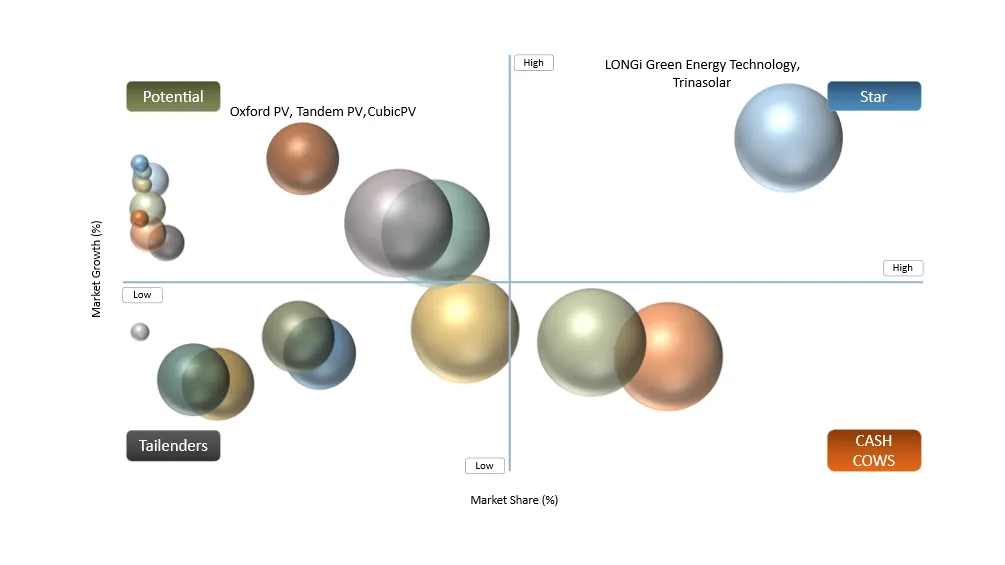
LONGi Green Energy Technology, Trinasolar, JinkoSolar and Hanwha Qcells could be branded as stars because of the synergy of their established production volume of PV panels, R&D expertise, financial power and the development of tandem PV panels. Longi and Trinasolar have made remarkable breakthroughs in the field of high efficiency perovskite-silicon tandem cells and modules, whereas JinkoSolar and Hanwha Qcells have large manufacturing capacity as well as experience in making silicon cells. Thus, their potential to integrate tandem PV panels into high-production volume of PV panels ecosystem makes them competitive in an ever-growing market.
POTENTIAL
The potential group comprises Oxford PV, Tandem PV, CubicPV, Caelux, Swift Solar, Renshine Solar, UtmoLight, GCL Optoelectronics, Microquanta Semiconductor and EneCoat Technologies. These companies belong to the potential group owing to their distinctive technology portfolio and the upside they stand to realize upon successful commercialization of their technologies. Oxford PV and Tandem PV are some of the best pure-play candidates within the group. Caelux, on the other hand, is focused on developing its unique perovskite-coated glass technology with plans for manufacturing partnerships at a large scale. Other companies are working on perovskite and next-generation PV technologies that could be relevant to tandem solar cells.
Tandem PV Cell Market Dynamics
Driver Impact Analysis
| Driver | Market Growth Impact (%) | Demand Concentration | Impacted Use Case | Strategic Impact |
Rising Demand for Higher-Efficiency Solar PV Modules | 30% | Utility-Scale, C&I | High-efficiency solar installations | Accelerates adoption of tandem PV technology to increase power output per unit area |
Growing Adoption of Perovskite–Silicon Tandem Technology | 25% | Utility-Scale, C&I, BIPV | High-efficiency tandem modules | Drives commercialization, R&D investment and manufacturing scale-up |
Increasing Solar Power Capacity Additions | 25% | Utility-Scale, Residential | Grid-connected solar generation | Expands the addressable market for next-generation PV technologies |
Growing Demand for Lightweight and Space-Efficient PV | 20% | BIPV, Transportation, Aerospace | Lightweight and space-constrained solar applications | Creates new opportunities where conventional PV efficiency and weight limitations are restrictive |
Driver: Demand for Higher Power Density and PV Efficiency
The main driving force behind the tandem PV cells market is the requirement for higher electrical power generation using limited spaces for solar installations. The use of perovskite-silicon tandem cells allows harnessing a larger part of the solar spectrum as compared to conventional single-junction silicon cells due to the presence of complementary bandgaps. This capability of tandem cells becomes especially relevant for utility scale projects that have limited land availability, rooftop solar projects with dense rooftop installation space, Building Integrated Photovoltaic (BIPV) systems and other applications where high power density may be used to improve energy yield and reduce some balance of system costs.
Restraint Impact Analysis
| Restraint | Drag on Market Growth (%) | Primary Impact Area | Impacted Use Case | Strategic Impact |
High Manufacturing Costs and Complex Production Processes | 35% | Production Economics | Utility-Scale, C&I | Limits price competitiveness and slows large-scale commercialization |
Long-Term Stability and Durability Challenges | 30% | Product Reliability | Utility-Scale, Residential | Increases technology qualification requirements and bankability concerns |
Limited Manufacturing Scale and Production Yield | 20% | Manufacturing Capacity | Large-Scale Solar | Restricts supply availability and delays cost reductions |
Technology Integration and Process Compatibility | 15% | Existing PV Manufacturing Infrastructure | Tandem Module Manufacturing | Requires additional equipment, process optimization and integration investment |
Restraint: Long-Term Stability and Commercial Reliability
One key barrier to the tandem PV cell market is ensuring long-term stability, reliability and lifetime similar to that of the existing silicon PV technology. The perovskite-silicon tandem cells can face issues like halide phase segregation, ion transport, thermal and UV degradation, interface deterioration and reverse bias stress. In addition, scaling up to the module level may pose further issues related to reliability and uniformity. All these can require advanced encapsulation and qualification and testing processes, which may slow down commercialization of tandem technologies due to their higher efficiencies.
Tandem PV Cell Market Segmentation Analysis
The global Tandem PV Cell market is segmented based on the Tandem Technology, Silicon Bottom-Cell Technology, Architecture, Integration, Module Type, Substrate, Application, Installation, Cell Efficiency and region.
By Tandem Technology
Perovskite-Silicon Tandem Dominates Due to Superior Efficiency and Manufacturing Compatibility
Perovskite-Silicon Tandem was the leader in the tandem PV cells market in 2025, having a market share of 47.6%. This position can be attributed to the use of a high bandgap perovskite top cell with already well-established bottom cells in silicon. It allows efficient use of solar spectrum and use of existing silicon cell technologies. Commercialization efforts, pilot productions and applicability to the next-generation silicon technologies such as TOPCon and HJT make it the most realistic route towards the future of tandem PV cells.
By Module Type
Flexible/Lightweight Tandem Modules Gain Momentum Across Weight-Sensitive Solar Applications
The Flexible/Lightweight Tandem PV Modules will see significant growth with an estimated CAGR of 43.03%. It is expected to be the fastest growing segment due to the capability of thin-film perovskite layers and light-weight substrates to provide increased power generation with reduced loading. This segment provides growth potential in building-integrated photovoltaics, transportations, portable power, aviation and rooftops where weight is an issue. This segment differs from rigid modules in that it opens up applications of tandem PV modules on non-rigid substrates.
Tandem PV Cell Market Geographical Penetration
U.S. Tandem PV Cell Market Landscape
The U.S. tandem PV cell market is moving from a stage of technological development towards large-scale commercial production within the country, with the help of government funding, advanced-PV initiatives and manufacturing investments by the private sector. The Department of Energy in the United States has funded perovskite and tandem PV initiatives which concentrate on scalability, durability, process control and commercialization, while Tandem PV has established a 40 MW commercial demonstration factory in Fremont, California, in 2026 and received US$7.7 million from the Department of Energy ARPA-E SCALEUP Ready initiative to promote commercialization. These activities have boosted the U.S. ecosystem of perovskite-silicon tandem manufacturing, transparent conductive oxide manufacturing, process integration and reliability validation.
Japan Tandem PV Cell Market Outlook
Japan has now become a very strategically vital region in terms of the perovskite-silicon tandem PV, thanks to NEDO’s Green Innovation Fund and the launch of Next-Generation Tandem Solar Cell Mass Production Technology Demonstration Project in 2026. Japanese companies have now begun moving towards commercializing perovskite-silicon tandems through manufacturing and field demonstrations; one such company that is aiming to sell its perovskite-silicon tandem cells with a conversion efficiency of greater than 40% from FY2028 is Kaneka. This strategic partnership between the government support, manufacturing skills and commercial products makes Japan an important region in terms of technology development and commercialization in the tandem solar cell market and tandem perovskite solar cell market.
China Tandem PV Cell Market Trends
The tandem PV cell market in China is quickly evolving from research in laboratories to pilot scale manufacturing and commercialization. LONGi is constantly working on increasing the efficiency of perovskite-silicon tandem and building a 100 MW pilot production line, estimated cost of which is CNY 203.53 million (US$29.9 million). Similarly, Trinasolar is also taking efforts in developing its tandem cells into large area modules. All these developments clearly reflect the evolution of process integration, pilot capacities, efficient modules and commercialization of the Tandem Solar Cell Market and Tandem Perovskite Solar Cell Market.
India Tandem PV Cell Market Projection
There is potential for considerable scale-up of the India tandem PV cell market as the local manufacturers shift their production capabilities towards the development and manufacture of perovskite-silicon tandem cells. One of the critical developments in 2026 is the signing of a separate five-year partnership by Caelux with Rayzon Solar and Caelux with Navitas Solar, where each partnership will result in a planned output of 5 GW of tandem module production in India and thus 10 GW total capacity. The partnerships incorporate the use of Caelux’s perovskite-coated glass as an energy-generating material, along with the n-type TOPCon silicon and aim for up to 28% efficiency of the modules, with production scheduled for 2028.
Germany Tandem PV Cell Market Analysis
Germany is becoming an increasingly important industrialization and technology validation center in the tandem PV cell market because of the significant progress made in the transfer of the perovskite-silicon tandem technology from lab-based development to industrial-level modules. In 2026, Fraunhofer ISE and Oxford PV developed a 546 W bifacial perovskite-silicon tandem module with 25.6% efficiency on the full surface area of the module by using matrix-shingled interconnection and lead-free conductive adhesives. At the same time, Germany is making progress in industrial integration of the modules under the HoTSun program, with the aim of developing tandem modules with efficiency higher than 26%, based on low-temperature interconnection, encapsulation and testing procedures that are optimized for industrial production.
Tandem PV Cell Market Competitive Landscape
- The industry is dominated by innovations and the competitive rivalry among the firms is on developing and improving the performance of perovskite-silicon tandem technology, while transitioning from research cells to commercially viable modules.
- Long-established PV companies like LONGi, Trinasolar, JinkoSolar and Hanwha Qcells have been competing using their well-established manufacturing capabilities and capability to incorporate tandem technology in silicon-based cells.
- The specialized players Oxford PV, Tandem PV, Caelux, CubicPV and Swift Solar target the areas of their proprietary perovskite material, architecture, lightweighting and commercialization approach.
- The expansion of pilot lines and manufacturing partnerships have become competitive advantages for companies looking to showcase their ability to manufacture at scale, increase yield efficiency and narrow down the gap between record cell efficiency and module efficiency.
- Competitiveness is moving more towards reliability and bankability, where long term stability, encapsulation efficiency, large area uniformity and qualification testing play crucial roles.
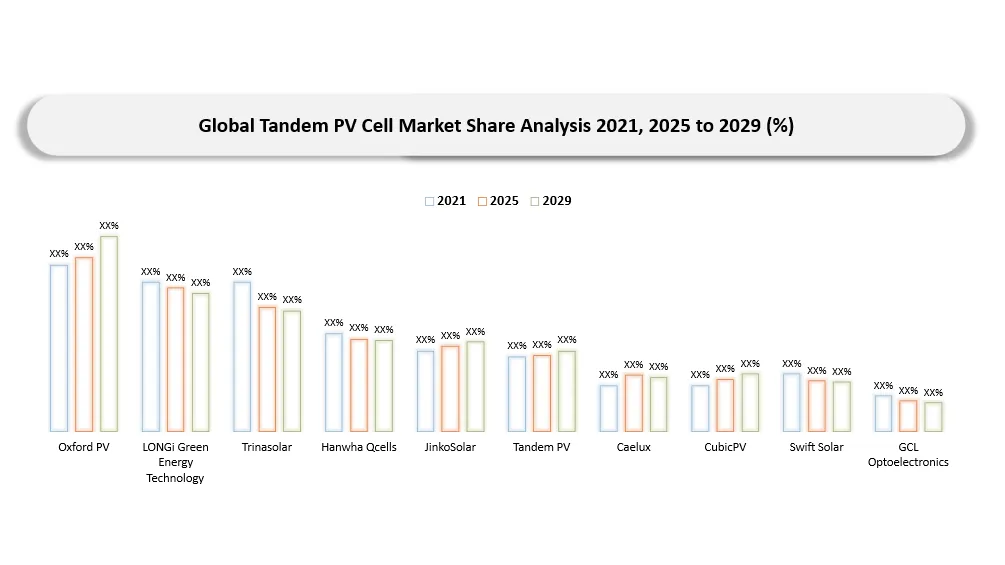
Public Company Q1-Q2 2026 Performance Comparison
This table below presents the comparison of five publicly traded companies that have been active in the tandem PV cell market and future generation photovoltaics. The financial metrics provided are in respect to the companies themselves, whereas technological and operational metrics are in respect to the advancement of perovskite-silicon tandem PV cell technology.
| Company | Q1–Q2 2026 Performance | Tandem PV Cell Exposure | Key Performance Driver |
| LONGi Green Energy Technology | H1 2026 revenue: US$3.9 billion; module shipments: 29.93 GW | Strong direct exposure through crystalline silicon–perovskite tandem R&D | 35.5% certified tandem-cell efficiency and large silicon manufacturing base |
| Trinasolar | H1 2026 revenue: US$4.46 billion; net loss: US$38 million | Direct exposure through industrial perovskite–silicon tandem development | 907 W tandem module with 29.2% full-area efficiency |
| JinkoSolar | Q1 revenue: US$1.8 billion; Q2 revenue: US$1.8 billion; H1 combined: US$3.6 billion | Emerging exposure through next-generation PV and tandem R&D | Large manufacturing scale and advanced n-type technology platform |
Hanwha Qcells | Q2 sales: US$3.2 billion; operating profit: US$212 million | Direct exposure through perovskite–silicon tandem pilot development | Tandem reliability validation supported by established module manufacturing |
| JA Solar | H1 2026 revenue: US$2.5 billion; cell and module shipments: 22.25 GW | Emerging exposure through high-efficiency n-type and tandem-related R&D | Large TOPCon manufacturing base suitable for future tandem integration |
Note: Financial periods and reporting formats differ across companies. Dollar values are approximate conversions based on 2026 exchange rates and rounded for presentation. Company-level revenue should not be interpreted as Tandem PV Cell revenue; the comparison combines overall financial performance with tandem-specific R&D, manufacturing readiness and commercialization indicators.
Key Companies of the Tandem PV Cell Market
- Oxford PV (United Kingdom)
- LONGi Green Energy Technology (China)
- Trinasolar (China)
- JinkoSolar (China)
- Hanwha Qcells (South Korea)
- CubicPV (United States)
- Tandem PV (United States)
- Swift Solar (United States)
- Caelux (United States)
- GCL Optoelectronics (China)
- Microquanta Semiconductor (China)
- Renshine Solar (China)
- EneCoat Technologies (Japan)
- UtmoLight (China)
- Anhui Huasun Energy (China)
- Tongwei (China)
- Panasonic (Japan)
- Saule Technologies (Poland)
- Saule Research (Poland)
- Heliatek (Germany)
Company Profiles
Oxford PV
Oxford PV is the leading player in the perovskite-silicon tandem technology space with an intense focus on turning its leading tandem efficiencies into marketable solar panels. The firm is the first to ship commercial tandem modules and has developed a large intellectual property portfolio in perovskite-silicon technology.
The firm’s competitive priorities are scaling production, improving module efficiencies from its current commercial platform, proving long-term reliability and licensing its tandem technology.
LONGi Green Energy Technology
The combination of LONGi’s global manufacturing leadership in silicon PV cells and perovskite-silicon tandem R&D gives it an especially strong incumbent competitor positioning. The critical capability of this company is the ability to marry the tandem technology with already existing highly efficient silicon cell systems.
Strategic considerations for competition should be focused on developing large-area tandem cells, silicon bottom-cell integration, increasing production yields and commercialization of efficiency records.
TrinaSolar
TrinaSolar is developing tandem PV as the next step for the firm’s volume manufacturing of modules, especially concentrating on large-area cells and high-power utility scale modules. The strategic competitive approach centers around closing the technological gap between tandem performance in laboratories and the practical module configurations.
Key competitive issues concern industrial-scale perovskite deposition, full-module interconnection and encapsulation, uniform efficiencies in large-area cells and lowering costs in tandem manufacturing.
JinkoSolar
JinkoSolar has vast manufacturing capability and n-type silicon technology to exploit the tandem PV space. The company’s competitive strength is that it has the capability of fast scaling of the tandem product line within its current cell and module manufacturing facility after technology readiness and economics prove to be commercially viable.
The key competitive issues include silicon bottom cells suitable for tandems, large area devices and preparation for high-volume commercialization.
Hanwha Qcells
Hanwha Qcells is involved in perovskite-silicon tandem cell development in addition to its proven high-efficiency solar cell product line. Hanwha Qcells differentiates itself by concentrating on the tandem cell stability, reliability testing and production integration in addition to record efficiencies.
Key areas of competition involve increasing stability, ramping up pilot production, accelerating tandem module testing and integration of perovskite technology into existing silicon production lines.
Tandem PV
Tandem PV is an enterprise that specializes in the development and commercialization of perovskite-silicon tandem modules. It aims at achieving higher power density and has been working towards making the process of producing tandem modules commercially viable.
The competitive objectives include increasing capacity, establishing long-term reliability of the modules, enhancing the economic viability of the production process and securing early commercial clients for its efficient tandem modules.
Caelux
Caelux has adopted a unique tandem commercialization strategy that involves perovskite-coated glass, with an emphasis on how such glass will be easily integrated into existing silicon module production processes instead of establishing an entirely new ecosystem. Through this method, Caelux has been able to position itself as both a technology provider and supplier for other companies.
Competitive priorities include coated glass production capacity, silicon module integration, manufacturing partnerships and stability/bankability.
Cubic PV
The primary focus of CubicPV is developing novel PV cell manufacturing technology, specifically the development of perovskite-silicon tandem solar cells and advanced silicon PV technology platforms. The company’s competitive advantage lies in the integration of its unique tandem technology with manufacturing technology.
The competitive priorities for CubicPV include pilot manufacturing capability, tandem device performance enhancement, process improvement, building strategic alliances and lowering the cost of high-efficiency tandem cells.
Swift Solar
The Swift Solar product platform includes differentiating tandem photovoltaic systems that have significant relevance to applications where the conventional solar module based on glass is not appropriate. The company’s focus is on achieving high power-to-weight performance in aerospace, defense, transportation and other specialty solar applications.
Key competitive priorities of the company include enhancing flexible tandem efficiency, durability to environmental factors, developing scalable deposition process and commercializing products.
GCL Optoelectronics
GCL Optoelectronics is a company in China that specializes in next-gen PV and has expertise in perovskite and tandem-related solar applications. The importance of this company lies in its connections with the vast solar manufacturing industry in China and its efforts to develop large-area perovskites for industrial-scale production.
Competitive priorities involve enhancing large-area coating homogeneity, increasing yield, increasing stability, scale-up pilot production and creating commercially-viable tandem-compatible products.
Tandem PV Cell Market Major Pain Points
- Large-Area Manufacturing Uniformity: It is hard to ensure uniform layer thickness, structure and electrical properties of perovskites in large areas of wafers/modules.
- Tandem-Specific Reliability Risks: There are many challenges related to perovskite phase separation, ion mobility, degradation under heat/ultraviolet light, interface stability and reverse biasing conditions.
- Production-Line Integration Constraints: Current crystalline silicon production lines have yet to be fully adapted for tandem production, making it difficult to achieve the required deposition, temperature requirements, processes and machine compatibility.
- Complex Cell Characterization and Quality Control: The monolithic 2T tandem cells make it challenging to test the perovskite and silicon sub-cells independently; special inline electroluminescence, photoluminescence and spectroscopy techniques must be employed for testing.
- Bankability and Lifetime Validation Gap: Regardless of the high efficiency gains, a lack of long-term field data and changing reliability criteria makes it difficult to set a warranty period and finance and energy yield expectations similar to those of mature silicon PV.
Tandem PV Cell Market Recent Developments
- August 2026 - Swift Solar: Successfully scaled up plans for manufacturing a platform in the US with the acquisition of silicon heterojunction technology, which would help the company commercialize its lightweight perovskite-silicon tandem modules.
- July 2026 - LONGi Green Energy Technology: Demonstrated an efficiency of 35.5% in two-terminal crystalline silicon-perovskite tandem solar cell technology, which was independently verified by ESTI, positioning the company as a world leader in tandem PV technology.
- July 2026 - UtmoLight: Successfully conducted a field stability study on their large area perovskite/tandem modules for 172 days. It is a major step forward towards commercialization since the biggest problem with commercializing perovskite modules is their stability.
- June 2026 - Trinasolar: Made significant progress towards a tandem PV technology breakthrough in the form of a 907 W perovskite-crystalline silicon tandem module that has an efficiency of 29.2% based on a normal-sized 3.1 m² module, moving closer towards utility-scale module production.
- June 2026 - Renshine Solar: Successfully designed and manufactured a 65 cm² all-perovskite tandem solar module with 26.2% conversion efficiency in partnership with Nanjing University.
Analyst View / Opinion on Tandem PV Cell Market
- Perovskite-silicon tandem PV has passed the stage of pure research laboratory PV technology, but the commercialization period of the market is still one in which large-scale manufacturing, reliability and bankability will play a decisive role.
- Efficiency should not be seen as the sole competitive factor. It will be increasingly important that the products have a high module lifetime, low degradation, high production yield and lifetime energy yield to be economically competitive to advanced silicon PV.
- Architecture 2T would continue to play an important role in mainstream deployment, especially when manufacturers can combine the perovskite top cell with proven silicon bottom cells without the need for any significant manufacturing complexity.
- The biggest opportunity in the short term will probably arise from high-value segments where power density is important, such as roof-space constrained rooftops, building-integrated photovoltaics (BIPV) and utility-scale projects with high land or system balance of system costs.
- The winners will be those firms that manage to overcome the commercialization hurdle instead of simply becoming the most efficient in the laboratory. Deposition, interface engineering, encapsulation, quality control and endurance testing will probably be the key elements determining success in the tandem solar cell market and tandem perovskite solar cell market.
Tandem PV Cell Market Target Audience
| INDUSTRY | WHO SHOULD BUY THIS REPORT? | REASON TO BUY THIS REPORT |
| Solar Photovoltaics (PV) | PV manufacturers, cell producers and module manufacturers | Assess tandem PV adoption, efficiency improvements, production capacity and competitive positioning |
| Renewable Energy | Renewable energy developers, IPPs and project investors | Evaluate next-generation solar opportunities, project economics and technology adoption |
| Semiconductor & Electronics | Semiconductor manufacturers and electronics technology companies | Identify opportunities in advanced cell architectures, materials and manufacturing technologies |
| Perovskite Materials | Perovskite material suppliers and technology developers | Assess demand for perovskite materials, coatings and tandem-cell technologies |
| Advanced Materials & Chemicals | Specialty chemical, coating, encapsulation and materials companies | Evaluate material requirements and emerging opportunities across the tandem PV value chain |
| Automotive | Automotive OEMs and vehicle-integrated PV suppliers | Assess opportunities for lightweight, high-efficiency vehicle-integrated photovoltaic applications |
| Construction & Building Materials | Construction companies, façade manufacturers and BIPV providers | Identify opportunities for integrating high-efficiency tandem PV into buildings and façades |
| Aerospace & Defense | Satellite manufacturers and aerospace technology companies | Evaluate high-efficiency and high-specific-power PV applications for space and aerospace systems |
| Utilities & Power Generation | Electric utilities, solar power producers and IPPs | Assess technology selection, efficiency benefits, project economics and future solar-generation opportunities |
| Industrial Manufacturing | PV equipment manufacturers, automation providers and production-line integrators | Identify opportunities in tandem-cell manufacturing equipment, process development and production scale-up |
Why Choose DATAM?
- Data-Driven insights: Dive into detailed analyses with granular insights such as pricing, market shares and value chain evaluations, enriched by interviews with industry leaders and disruptors.
- Post-Purchase Support and Expert Analyst Consultations: As a valued client, gain direct access to our expert analysts for personalized advice and strategic guidance, tailored to your specific needs and challenges.
- White Papers and Case Studies: Benefit quarterly from our in-depth studies related to your purchased titles, tailored to refine your operational and marketing strategies for maximum impact.
- Annual Updates on Purchased Reports: As an existing customer, enjoy the privilege of annual updates to your reports, ensuring you stay abreast of the latest market insights and technological advancements. Terms and conditions apply.
- Specialized Focus on Emerging Markets: DataM differentiates itself by delivering in-depth, specialized insights specifically for emerging markets, rather than offering generalized geographic overviews. The approach equips our clients with a nuanced understanding and actionable intelligence that are essential for navigating and succeeding in high-growth regions.
- Value of DataM Reports: Our reports offer specialized insights tailored to the latest trends and specific business inquiries. The personalized approach provides a deeper, strategic perspective, ensuring you receive the precise information necessary to make informed decisions. The insights complement and go beyond what is typically available in generic databases.
What DATAM Uniquely Provides
- Tandem-specific technology mapping: Distinguishes perovskite-silicon, perovskite-CIGS, all-perovskite and III-V-silicon approaches by following 2T and 4T configurations, not viewing advanced PV as one technology.
- Commercialization-readiness assessment: Distinguishes lab results from pilot, pre-commercial and commercial tandem manufacturing stages, giving better insight into technologies and companies that move to market introduction.
- Bankability-focused competitive analysis: Assess degradation, outdoor stability, yield in manufacturing, certification, warranty readiness and lifetime energy yield in addition to efficiency, covering the gap between records and bankable modules.
- Manufacturing economics and integration analysis: Focuses on evaluating the significance of TOPCon/HJT silicon bottom cell technology, scalable deposition, interface engineering, encapsulation and existing silicon PV manufacturing process integration to establish future cost and scale.
- Application-specific opportunity identification: Evaluates opportunities where tandems' improved power density and efficiency have the most economic benefit, which include utility scale projects with land limitations, rooftops, BIPV, floatovoltaic, mobility and other space-constrained applications, rather than assuming universal adoption of solar.


























































