


Global Synthetic Media Market Overview
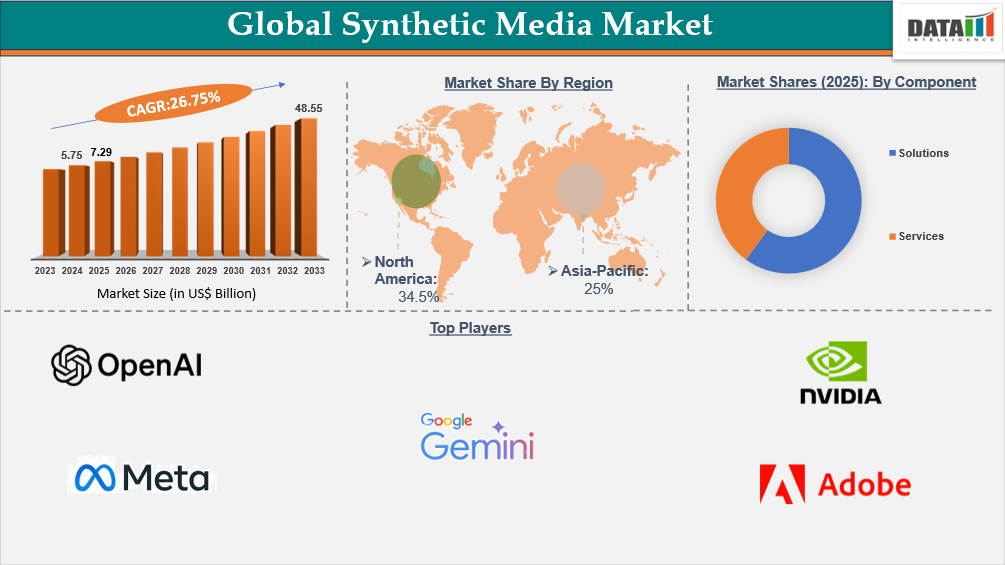
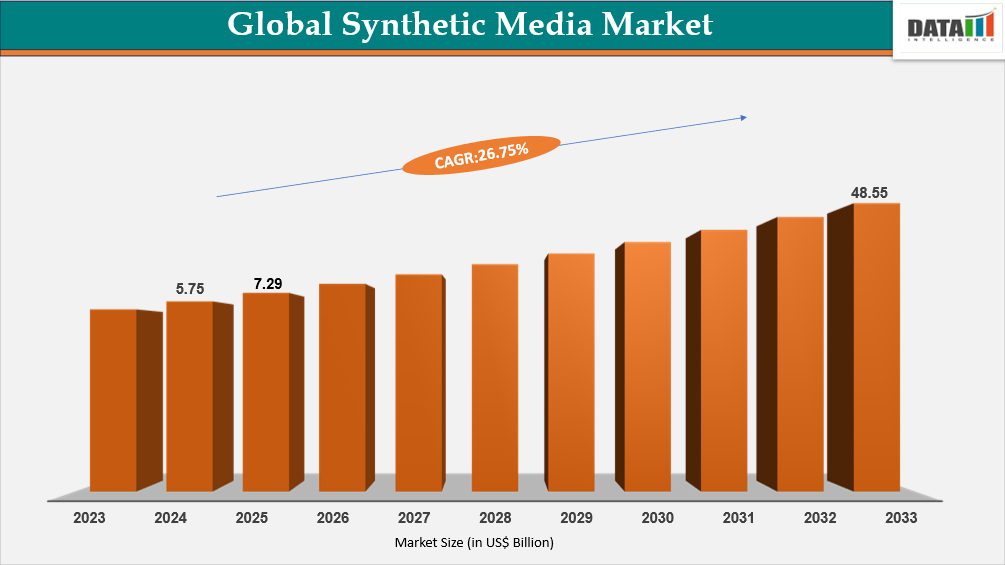
Global Synthetic Media Market reached US$ 7.29 billion in 2025 and is expected to reach US$ 48.55 billion by 2033, growing with a CAGR of 26.75% during the forecast period 2026-2033. The global synthetic media market is expanding due to rapid advances in AI, generative models, and computing power that enable the creation of realistic images, videos, and audio at scale.
Companies are responding with new tools and platforms. For example, Adobe expanded its Firefly suite in 2025 to include image-to-video and audio generation capabilities for creative professionals, while Meta launched Vibes, a feed dedicated to AI-generated short videos, allowing users to create and remix content directly on its platform. The developments show that major tech firms view synthetic media as strategic for content personalization, marketing, and immersive digital experiences. The trend is reflected in product launches, platform integrations, and investments in next-generation generative AI models designed for scalable, high-quality media production.
Synthetic Media Industry Trends and Strategic Insights
- Asia-Pacific is the fastest-growing region in the synthetic media market, capturing a share of 25% in 2025.
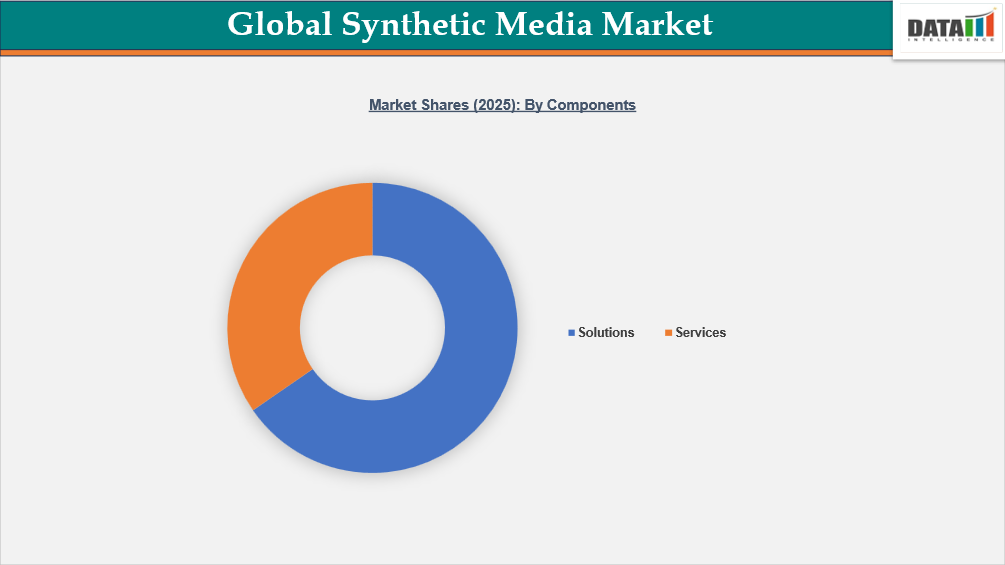
- By component, the solutions are projected to be the largest market, holding a significant share of about 60-65% in 2025.
Global Synthetic Media Market Size and Future Outlook
- 2025 Market Size: US$ 7.29 Billion
- 2033 Projected Market Size: US$ 48.55 Billion
- CAGR (2026-2033): 26.75%
- Largest Market: North America
- Fastest Market: Asia-Pacific
Synthetic Media Market Scope
| Metrics | Details |
| By Component | Solutions, Services |
| By Technology | Generative AI, Speech or Voice Synthesis, Computer Vision or Graphics, Natural Language Processing (NLP), Others |
| By End-User | Media and Entertainment, Advertising and Marketing, Gaming and Metaverse, E-commerce and Retail, BFSI, IT and Telecom, Education and Training, Healthcare and Life Sciences, Others |
| By Channel | Web-Based, Mobile Apps, Desktop Software, Cloud Platforms, Social Media Platforms, Others |
| By Region | North America, South America, Europe, Asia-Pacific, Middle East, and Africa |
| Report Insights Covered | Competitive Landscape Analysis, Company Profile Analysis, Market Size, Share, Growth |
Synthetic Media Market Dynamics
Growing Preference for Video-Based and Animated Learning Content
The growing adoption of video-based and animated content is a key driver of the synthetic media market, particularly in education, corporate training, and marketing. The human brain processes visual information 60,000 times faster than text, and research from the UK Digital Marketing Association shows that viewers retain 95% of a message when watching it in video format, compared with just 10% from reading text.
Video content has seen near-universal adoption, with 93% of businesses using video as a marketing tool in 2025, up from 91% in 2024. Furthermore, 95% of marketers consider video crucial to their overall strategy, highlighting the increasing reliance on dynamic, visual storytelling. Animated learning and explainer videos further enhance engagement and comprehension, allowing learners to grasp complex concepts quickly.
Video dominates online consumption, accounting for 82% of all internet traffic in 2025, and the rollout of 5G networks is expected to increase mobile video consumption by 30% by 2025. These trends, combined with the effectiveness of animated content in improving retention and engagement, are driving enterprises, educators, and marketers to increasingly integrate AI-generated video and animated content into their workflows, directly fueling growth in the synthetic media market.
Data Privacy, Deepfake Misuse, and Regulatory Uncertainty
Despite the rapid adoption of synthetic media, rising deepfake misuse and data privacy concerns are creating significant challenges for the market. The volume of deepfake content shared online is exploding, surging from an estimated 500,000 files in 2023 to 8 million by 2025. North America has been the primary target, experiencing a 1,740% increase in deepfake fraud between 2022 and 2023, with financial losses exceeding $200 million in Q1 2025 alone. The Asia Pacific region is not far behind, witnessing a 1,530% rise in deepfake-related incidents over the same period.
Such rapid growth of malicious AI-generated content has amplified regulatory scrutiny, while companies face mounting pressure to protect sensitive data and comply with emerging legal frameworks. Misuse risks and inconsistent regulations may slow adoption, particularly for smaller startups without robust content moderation or compliance mechanisms. Enterprises are increasingly prioritizing platforms that offer ethical safeguards, transparency, and legal protections, highlighting how regulatory uncertainty remains a key restraint for the synthetic media market.
Synthetic Media Market Segmentation Analysis
The global synthetic media market is segmented based on components, technology, end-user, channel, and region.
Rising Adoption of Ready-to-Use AI Platforms Drives Synthetic Media Solutions Demand
The solutions segment is driving significant demand in the synthetic media market, holding approximately 60–65% share, as enterprises, content creators, and educational institutions increasingly adopt ready-to-use AI-powered platforms for video, audio, image, and text generation. Solutions provide integrated tools that simplify content creation workflows, offering scalability, automation, and multi-format output that can be deployed immediately without extensive customization.
Providers continue to enhance their platforms with advanced capabilities. For instance, in December 2024, Pika Labs, a U.S.-based AI company, launched Pika 2.0, which allows users to integrate custom characters, objects, and scenes into AI-generated videos while maintaining lifelike motion and visual coherence, supporting diverse use cases such as social media content, marketing campaigns, and short-form storytelling. Therefore, these AI-powered solutions are solidifying their position as the dominant component in the market, enabling faster, more efficient, and highly scalable content creation across industries.
Expanding Enterprise Needs for AI Consulting and Integration Boost Services Segment Growth
The services segment is emerging as the fastest‑growing component in the synthetic media market, expanding at an estimated 24–26% CAGR as organizations increasingly require expert support to implement, customize, and scale AI‑driven media solutions. As enterprises adopt synthetic media technologies, the demand for professional services, including AI consulting, system integration, model fine‑tuning, and managed support, is rising sharply, particularly among large corporations and regulated sectors.
For instance, in 2025, Capgemini, a France-based consulting and technology services company, expanded its AI consulting portfolio with new synthetic-media-focused offerings, enabling enterprises to integrate generative AI into marketing workflows, optimize content production pipelines, and implement governance frameworks for ethical and compliant AI usage across video, audio, and image applications. Therefore, the expansion of professional services is accelerating the adoption of synthetic media, helping organizations leverage AI technologies efficiently while ensuring compliance, scalability, and optimized content creation.
Synthetic Media Market Geographical Penetration
Rising AI Innovation and Digital Content Demand in Asia-Pacific
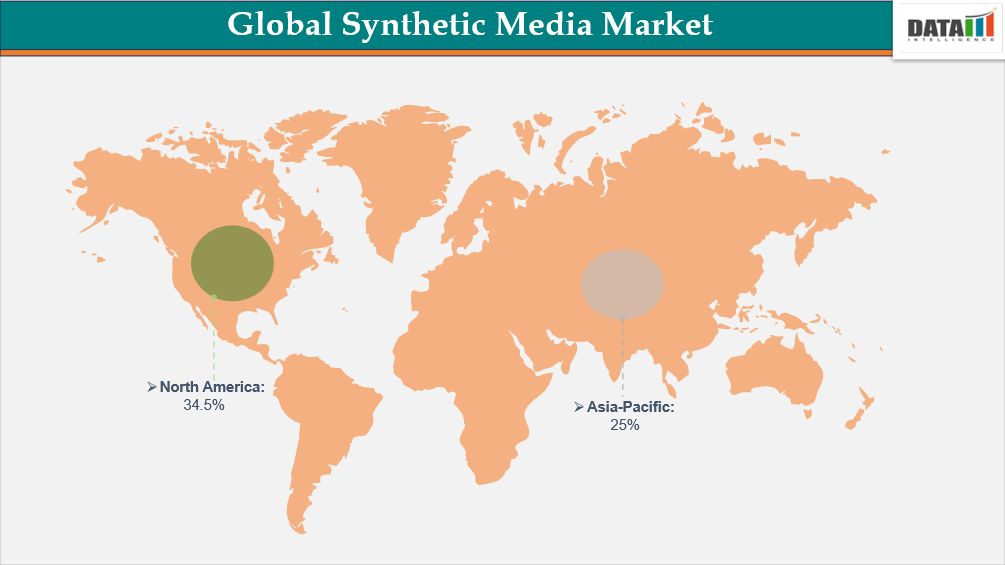
Asia-Pacific is the fastest-growing region in the global synthetic media market, accounting for approximately 25% share in 2025. Rapid digitalization, expanding creator economies, and strong government investments in artificial intelligence are accelerating regional adoption of AI-generated video, virtual humans, and automated content creation tools. Countries across East Asia and South Asia are actively promoting domestic AI development to strengthen digital competitiveness and reduce reliance on foreign technologies.
For instance, in July 2025, China-based Baidu, Inc. unveiled ERNIE 4.5 and its reasoning model ERNIE X1, along with making ERNIE Bot freely accessible ahead of schedule. These enhanced multimodal AI models significantly boost capabilities for generating text, images, and video content, enabling developers and enterprises across the Asia-Pacific region to build advanced AI-driven media applications more rapidly and cost-effectively.
India Synthetic Media Market Outlook
India’s booming digital economy, growing smartphone penetration, and rapidly expanding e-commerce sector are driving strong demand for AI-generated media content. Businesses are increasingly adopting generative AI to create personalized visuals, video ads, and interactive digital experiences. For instance, in December 2025, Flipkart, an India-based e-commerce giant, acquired a majority stake in Minivet AI, a startup specializing in generative video solutions, to accelerate AI-powered visual commerce and personalized media creation.
Government initiatives supporting digital innovation and the proliferation of AI startups further accelerate adoption, positioning India as one of the fastest-growing markets for synthetic media in the Asia-Pacific region.
China Synthetic Media Market Trends
China dominates the Asia-Pacific synthetic media market with over 28% regional share, driven by state-backed AI initiatives, a robust digital economy, and large-scale content creation infrastructure. Businesses and content creators are increasingly adopting generative AI tools for video, image, and audio production across entertainment, marketing, and e-commerce sectors.
For instance, in April 2025, Alibaba Cloud, a China-based cloud computing and AI company, unveiled Wan2.1‑FLF2V‑14B, its latest open-source video generation model designed to simplify AI video creation by allowing creators to define start and end frames and automatically generate smooth, high-quality video transitions from text and image prompts. Overall, continuous innovation by major tech players, strong government support, and widespread adoption of AI-driven content creation are reinforcing China’s leadership and accelerating growth in the regional synthetic media market.
Strong AI Ecosystem and Enterprise Adoption Driving Synthetic Media Growth in North America
North America dominates the global synthetic media market in 2025, accounting for approximately 34.5% of total revenue, driven by its advanced AI infrastructure, strong innovation ecosystem, and early enterprise adoption of generative technologies. The region benefits from substantial investments and continuous technological advancements by major players such as Adobe, Google, and NVIDIA, which are accelerating the development of AI-powered content generation, graphics processing, and cloud-based creative platforms.
For instance, in August 2025, ElevenLabs, a U.S.–based AI audio research and product company, launched Eleven Music, a studio-grade AI music generation platform that enables businesses, creators, artists, and everyday users to generate professional-quality music from natural language prompts in any genre or style, built in collaboration with major music industry partners to include licensing guardrails for rights holders. Therefore, the continuous innovation, strong capital investment, and rapid commercialization of generative AI solutions collectively reinforce North America’s leadership and long-term growth momentum in the synthetic media market.
U.S. Synthetic Media Market Insights
The U.S. holds the majority of North America’s synthetic media market, contributing approximately 79–85% of the regional share in 2025. The country remains the primary innovation hub, supported by strong AI research ecosystems, Silicon Valley technology clusters, and substantial venture capital funding. Leading technology firms and AI startups continue to invest heavily in generative AI, accelerating advances in AI-driven video, audio, and content-creation platforms.
For instance, in 2025, Runway AI, Inc., a U.S-based AI research company, introduced Gen-4.5, an advanced text-to-video model designed to deliver enhanced cinematic realism, improved motion consistency, and higher character fidelity, enabling enterprises and creators to produce production-quality AI-generated video content at scale. Such continuous innovation and rapid commercialization of next-generation generative AI tools reinforce the U.S.’ position as the central growth engine of the regional synthetic media market.
Canada Synthetic Media Industry Growth
Canada accounts for approximately 10% of North America’s synthetic media market in 2025, supported by a strong AI research ecosystem and growing startup activity in generative AI. Contributes through innovation in AI-driven content creation technologies.
For instance, in June 2025, Captions, a New York–based AI video company with a strong presence across North America, launched Mirage Studio, an AI-powered platform that generates realistic virtual character videos with lifelike expressions and actions. Overall, increasing adoption of AI-generated video across advertising, digital marketing, social media, and enterprise communication, combined with continued product innovation and research-backed AI development, is driving Canada’s steady growth within the regional synthetic media market.
Regulatory Analysis
The synthetic media market is shaped by evolving regulations addressing privacy, copyright, and deepfake misuse worldwide. In the EU, the proposed AI Act and the Online Safety Act (UK) require clear labeling of AI-generated content, ensuring transparency and accountability while mitigating misinformation and harmful content. In the U.S., federal proposals like the NO FAKES Act and state laws in California and New Jersey regulate unauthorized use of likenesses and mandate disclosure for AI-generated content, increasing compliance obligations for platforms and creators.
In India, the IT Act 2000 and the Intermediary Guidelines and Digital Media Ethics Code Rules, 2026 enforce labeling of AI-generated content, penalize impersonation, and require platforms to remove harmful synthetic media promptly. In China, regulators mandate metadata labeling and state oversight for AI-generated text, audio, and video, ensuring traceability and control.
The above regulations enhance transparency, protect privacy and identity rights, and curb misuse, but they also increase operational costs and compliance complexity for synthetic media platforms. At the same time, they encourage responsible innovation, creating opportunities for platforms that can provide compliant, trustworthy, and ethical generative AI solutions.
Synthetic Media Market Competitive Landscape
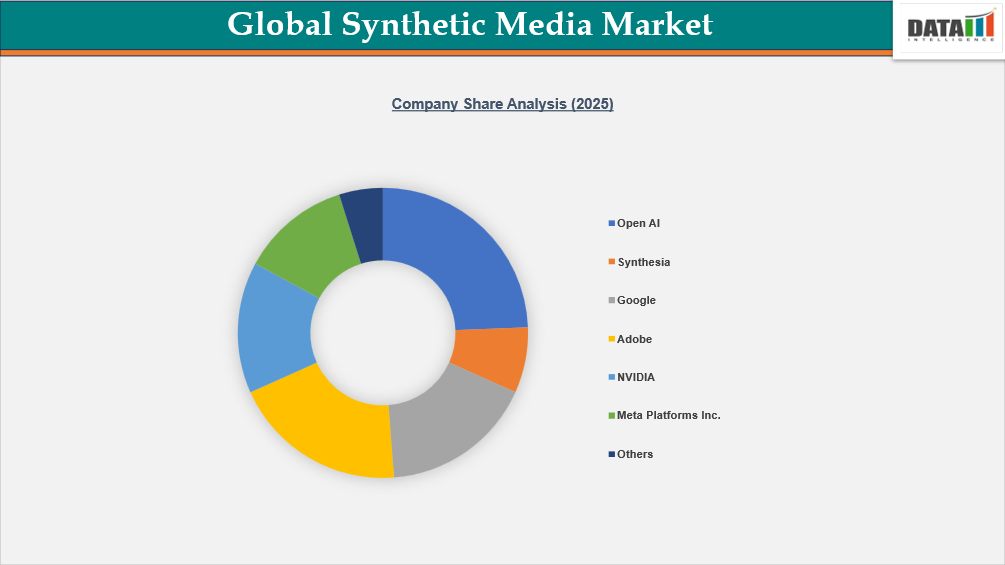
- The global synthetic media market is characterized by a competitive landscape that includes both established and regional players.
- Key players include OpenAI, Synthesia, Google, Adobe, NVIDIA, Meta Platforms Inc., Descript, DeepBrain AI, Stability AI, D‑ID, Rephrase.ai, Hour One AI, Lumen5, Speechify, and Respeecher
Synthetic Media Market Key Developments
- In 2026, ByteDance, the China‑based tech company, introduced Seedance 2.0, an advanced multimodal AI video generation model that creates short videos from text, images, audio, and video inputs.
- In 2025, Baidu, the Beijing‑based search and AI company, launched MuseSteamer, its AI‑powered image‑to‑video generator aimed at business users, along with enhanced AI search features
Why Choose DataM?
- Data-Driven Insights: Dive into detailed analyses with granular insights such as pricing, market shares and value chain evaluations, enriched by interviews with industry leaders and disruptors.
- Post-Purchase Support and Expert Analyst Consultations: As a valued client, gain direct access to our expert analysts for personalized advice and strategic guidance, tailored to your specific needs and challenges.
- White Papers and Case Studies: Benefit quarterly from our in-depth studies related to your purchased titles, tailored to refine your operational and marketing strategies for maximum impact.
- Annual Updates on Purchased Reports: As an existing customer, enjoy the privilege of annual updates to your reports, ensuring you stay abreast of the latest market insights and technological advancements. Terms and conditions apply.
- Specialized Focus on Emerging Markets: DataM differentiates itself by delivering in-depth, specialized insights specifically for emerging markets, rather than offering generalized geographic overviews. This approach equips our clients with a nuanced understanding and actionable intelligence that are essential for navigating and succeeding in high-growth regions.
- Value of DataM Reports: Our reports offer specialized insights tailored to the latest trends and specific business inquiries. This personalized approach provides a deeper, strategic perspective, ensuring you receive the precise information necessary to make informed decisions. These insights complement and go beyond what is typically available in generic databases.
Target Audience 2026
- Manufacturers/ Buyers
- Industry Investors/Investment Bankers
- Research Professionals
- Emerging Companies




























































