

Sustainable Ingredients Market Size
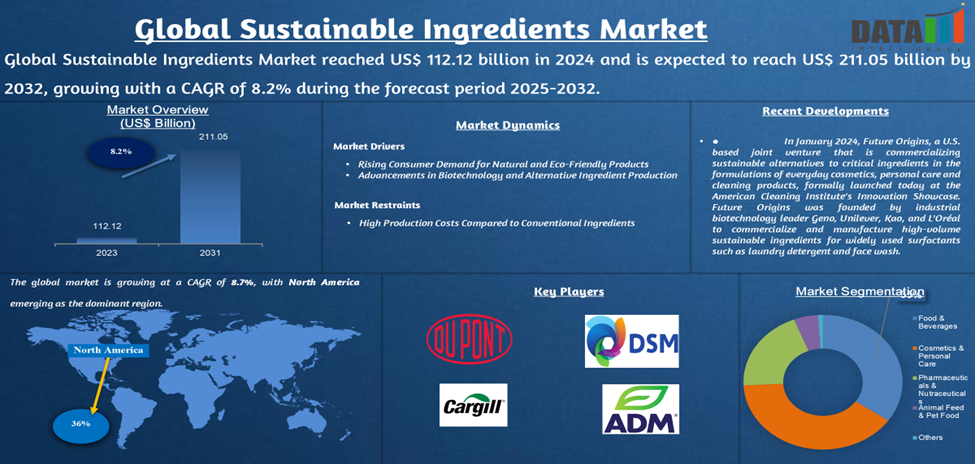
The Global Sustainable Ingredients Market size was valued at approximately US$ 121.31 billion in 2025 and is forecast to reach approximately US$ 271.03 billion by 2035, growing at a CAGR of 8.2% during the forecast period 2026-2035.
The global sustainable ingredients market is experiencing significant growth, driven by increasing consumer demand for natural and eco-friendly products. This trend is evident across various sectors, including food, cosmetics, and personal care, as consumers become more conscious of the environmental and health impacts of their purchases. The shift towards sustainability is further supported by governmental policies promoting the use of renewable resources and the reduction of carbon footprints.
In North America, the demand for sustainable ingredients is particularly high. This can be attributed to a combination of consumer awareness and regulatory support. For instance, the U.S. Department of Agriculture (USDA) has implemented programs encouraging the adoption of sustainable agricultural practices, which in turn boost the availability and use of eco-friendly ingredients in various industries.
Also, federal and state incentives aimed at decarbonizing transportation have led to increased demand for biofuels, further emphasizing the region's commitment to sustainability. This regulatory environment, coupled with a consumer base that prioritizes health and environmental responsibility, positions North America as a leader in the sustainable ingredients market.
Executive Summary
For more details on this report – Request for Sample
Scope
| Metrics | Details |
| CAGR | 8.2% |
| Size Available for Years | 2025-2035 |
| Forecast Period | 2026-2035 |
| Data Availability | Value (US$) |
| Segments Covered | Type, Properties, Application and Region |
| Regions Covered | North America, Europe, Asia-Pacific, South America and Middle East & Africa |
| Fastest Growing Region | Asia-Pacific |
| Largest Region | North America |
| Report Insights Covered | Competitive Landscape Analysis, Company Profile Analysis, Market Size, Share, Growth, Demand, Recent Developments, Mergers and Acquisitions, New Product Launches, Growth Strategies, Revenue Analysis, Porter’s Analysis, Pricing Analysis, Regulatory Analysis, Supply-Chain Analysis and Other key Insights. |
Market Dynamics
Rising Consumer Demand for Natural and Eco-Friendly Products
The global sustainable ingredients market is experiencing significant growth, primarily driven by rising consumer demand for natural and eco-friendly products. This shift in consumer preferences is evident across various sectors, including cosmetics, food, and household goods. In the cosmetics industry, there is a growing trend towards natural and environmentally friendly beauty products. Consumers are increasingly seeking products free from synthetic chemicals, reflecting a broader desire for transparency and sustainability in personal care items.
Similarly, the food industry has seen a surge in demand for products containing clean label ingredients. These are derived from natural sources and are free from artificial additives and preservatives. This trend aligns with consumers' increasing interest in health and wellness, as well as their desire for transparency in food sourcing and production. Consumer willingness to support sustainability is further highlighted by data indicating that a significant portion of consumers are prepared to pay more for eco-friendly brands. This willingness to invest in sustainable products underscores the importance of environmental considerations in purchasing decisions.
Advancements in Biotechnology and Alternative Ingredient Production
Advancements in biotechnology and alternative ingredient production are significantly propelling the global sustainable ingredients market. These innovations are transforming traditional manufacturing processes, leading to the development of eco-friendly and health-conscious products that cater to the evolving preferences of consumers worldwide.
The biotechnology sector has witnessed remarkable growth, with its market size expanding from approximately $1.68 trillion in 2024 to an estimated $3.54 trillion by 2033, reflecting a compound annual growth rate (CAGR) of 9.18%. This surge is largely attributed to the increasing demand for sustainable and efficient production methods across various industries, including food and beverages. Biotechnological advancements have enabled the creation of biotech ingredients, which are produced through microbial fermentation, plant tissue culture, and enzymatic processes.
The advancements in biotechnology and alternative ingredient production are pivotal in driving the global sustainable ingredients market. These innovations not only address environmental and health concerns but also align with the growing consumer demand for sustainable and ethically produced products. As research and development continue to evolve, the market is poised for sustained growth, offering diverse and sustainable options to meet the needs of a conscientious global consumer base.
High Production Costs Compared to Conventional Ingredients
High production costs relative to conventional ingredients significantly constrain the global sustainable ingredients market. Sustainable products are, on average, 75% to 85% more expensive than their traditional counterparts, creating a substantial price disparity that deters mass-market adoption.
This cost differential stems from factors such as limited economies of scale, higher raw material expenses, and more complex production processes associated with sustainable ingredients. While consumers express a willingness to pay a premium for sustainability, averaging an additional 9.7%, this is often insufficient to bridge the existing price gap. Consequently, the elevated costs pose a significant barrier to widespread consumer acceptance and hinder the market penetration of sustainable products.
Market Segment Analysis
The global sustainable ingredients market is segmented based on type, properties, application and region.
Evolving Consumer Preferences and Innovation Driving the Future of Plant-Based Sustainable Ingredients
The global demand for plant-based sustainable ingredients has been expanding rapidly, fueled by growing consumer awareness of health, environmental sustainability, and ethical consumption. Innovations in plant-based food technology have led to the development of products that closely mimic the taste and texture of traditional animal-based foods, making them more appealing to a broader audience. This trend is reinforced by an increasing number of consumers seeking plant-based alternatives as part of a shift toward more sustainable and nutritious diets.
The industry has also seen support from regulatory initiatives and corporate commitments to sustainability, further driving adoption across various food and beverage categories. In January 2023, GoodMills Innovation offers a variety of ingredients for use in plant-based foods, including texturates for meat alternatives. The company reported rising interest in these ingredients in late 2023, after they attracted a wide audience at Food Ingredients Europe.
Market Geographical Share
Rising Consumer Shift and Industry Investments Driving Sustainable Ingredients Growth in North America
North American market has witnessed a notable surge in demand for sustainable ingredients, propelled by evolving consumer preferences and robust industry initiatives. In the United States, organic retail sales have consistently grown, with 2021 figures surpassing $52 billion, accounting for approximately 5.5% of total retail food sales.
This upward trend reflects a significant consumer shift towards organically produced foods, leading to an expansion in U.S. organic production. To further support this growth, the U.S. Department of Agriculture (USDA) has implemented programs such as the Organic Market Development Grant, allocating $85 million across 107 projects in 2024 to enhance the availability and demand for domestically produced organic agricultural products.
In Canada, the food processing industry has demonstrated resilience and growth, with the value of production reaching $156 billion in 2022. The food service sector also experienced a rebound, with sales hitting $85 billion in 2023 and a projected growth rate of 3% for the year, indicating a stabilization following pandemic-related slowdowns. This growth is indicative of a broader consumer trend favoring sustainable and health-conscious food options.
Additionally, the plant-based protein market in Canada is poised for substantial expansion, with projections indicating a 14% annual increase by 2024, potentially capturing up to a third of the total protein market. These developments underscore a robust and growing demand for sustainable ingredients across North America, driven by both consumer behavior and proactive industry responses.
Major Global Players
The major global players in the market include Cargill, Incorporated, Archer Daniels Midland Company (ADM), Koninklijke DSM N.V., BASF SE, Kerry Group plc, Ingredion Incorporated, Tate & Lyle PLC, Givaudan SA, Corbion N.V., and Dupont de Nemours, Inc.
Recent Developments
Lesaffre expands into sustainable cosmetic ingredients: In February 2026, Lesaffre announced the launch of Innosya, a new business dedicated to fermentation-derived ingredients for the cosmetics industry. The initiative focuses on developing biotechnology-based ingredients that can complement or replace conventional petrochemical-derived and resource-intensive plant-extracted materials.
Croda introduces its Beauty of Zero sustainability programme: In May 2026, Croda launched Beauty of Zero, an initiative focused on improving sustainability across the personal care value chain. Its priorities include biotechnology-enabled ingredient innovation, renewable raw materials, reduced manufacturing waste, responsible sourcing and biodegradable ingredient development.
Amyris expands precision fermentation manufacturing: In March 2026, Amyris announced the completion of a new production line at its precision fermentation facility in Barra Bonita, Brazil. The expansion strengthens its manufacturing capabilities for specialized molecules and supports the development of sustainable ingredients for multiple industrial applications.
Symrise invests in precision-fermented proteins: In April 2026, Symrise announced a strategic investment in Bond Pet Foods to accelerate the development of animal-identical proteins through precision fermentation. The collaboration aims to introduce alternative protein ingredients for pet nutrition and diversify conventional ingredient supply chains.
Sustainable bio-vanillin commercialization advances: In June 2026, Enzidia, Refine Biology and Asia Aroma entered a joint development and commercialization agreement for fermentation-derived bio-vanillin. The partnership combines enzyme technology, fermentation scale-up and flavor-industry distribution to advance a biotechnology-based alternative to conventional vanillin production.
India strengthens its bio-based ingredient ecosystem: In July 2026, India's Department of Science and Technology highlighted financial assistance for Sonic Biochem Extractions to commercialize functional and textured soya protein concentrates. The project supports domestic production of plant-based protein ingredients for food manufacturers and responds to demand for non-GMO, clean-label nutritional products.
Carbon-based fermentation receives research support: The European Commission's FERM4FOOD project focuses on converting captured industrial carbon dioxide into functional food ingredients, including lactic acid, single-cell protein and microbial oils. The initiative aims to demonstrate scalable production pathways while reducing dependence on conventional agricultural and fossil-based resources.
Why Purchase the Report?
- To visualize the global sustainable ingredients market segmentation based on type, properties, application and region.
- Identify commercial opportunities by analyzing trends and co-development.
- Excel data sheet with numerous data points at the sustainable ingredients market level for all segments.
- PDF report consists of a comprehensive analysis after exhaustive qualitative interviews and an in-depth study.
- Product mapping available as excel consisting of key products of all the major players.