


Sustainable Finance Market Size
Global Sustainable Finance Market reached US$ 1,111.60 billion in 2025 and is expected to reach US$ 6,290.00 billion by 2033, growing with a CAGR of 24.19% during the forecast period 2026-2033.
In 2024, the global sustainable finance market recorded asset levels of approximately US$ 3.2 trillion, reflecting an 8% growth from 2023 and driven largely by strong equity market performance in Europe and North America. Despite this expansion in asset value, net inflows dropped significantly to US$ 37 billion, over 40% lower than the previous year, indicating more cautious capital deployment even as institutional commitments to sustainability continued to rise. Notably, the UN-convened Net-Zero alliances, comprising 86 institutions managing US$ 9.5 trillion, mobilized US$ 380.6 billion toward climate-related projects, demonstrating the sector’s capacity to convert strategic commitments into large-scale funding.
Sustainable Finance Market Trend
A defining trend shaping the market is the concentration of sustainable fund assets in Europe, which accounted for over 50% of the global total in 2024, followed by the US with 11%, and the rest of the world sharing just 5%. Institutional investors within these markets are delivering tangible climate outcomes, such as the reported reduction of 213.4 million tons of CO₂e in financed emissions, underscoring the role of sustainable finance as both a capital growth mechanism and a tool for measurable environmental impact.
For more details on this report - Request for Sample
Sustainable Finance Market Scope
| Metrics | Details |
| By Investment Type | Equity, Fixed Income, Mixed Allocation, Others |
| By Transaction Type | Green Bond, Social Bond, Mixed-Sustainability Bond, Others |
| By End-User | Utilities, Transport & Logistics, Chemicals, Food & Beverage, Government Sectors, Others |
| By Region | North America, South America, Europe, Asia-Pacific and Middle East and Africa |
| Report Insights Covered | Competitive Landscape Analysis, Company Profile Analysis, Market Size, Share, Growth |
Sustainable Finance Market Dynamics
Integration of Climate Stress Testing into Financial Risk Assessment Frameworks
In 2022, only 41% of banks had integrated climate-risk stress testing into their risk frameworks, a figure that rose to 100% by 2025, as reported by the European Central Bank. The ECB’s 2022 climate stress test, involving 41 major European banks, estimated combined short-term credit and market losses of around €70 (US$ 82) billion under disorderly transition and physical-risk scenarios.
In the UK, the Bank of England's 2022 Climate Biennial Exploratory Scenario (CBES) projected that a delayed climate transition could result in £110 (US$ 128) billion in additional bank losses, with around 40% emerging in the first five years of transition. Meanwhile, India’s Reserve Bank introduced the Climate Risk Information System (RBI-CRIS) in 2025 to bridge data gaps and help regulated entities more effectively assess and manage climate-related financial risks.
Lack of Unified Global Taxonomy for Sustainable Financial Products
In 2024, the World Bank reported that 47 sustainable finance taxonomies were in place globally, yet coverage remained uneven, with only about 75% of advanced economies and just 10% of emerging and developing markets having adopted such frameworks. This lack of alignment, evident in differing systems used by the EU, China, Japan, and Brazil, creates barriers to cross-border capital flows and slows the scaling of global sustainable finance initiatives.
Sustainable Finance Market Segment Analysis
The global sustainable finance market is segmented based on investment type, transaction type, end-user and region.
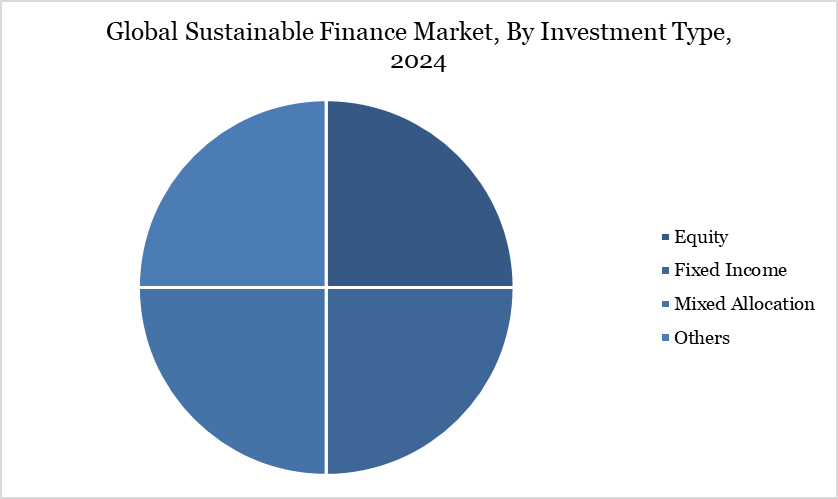
Equity Segment Driving Sustainable Finance Market
According to UNCTAD, global sustainable fund assets reached US$ 3.2 trillion in 2024, marking an 8% rise from 2023, with equity funds accounting for the majority share of these assets due to strong stock market performance and continued investor demand for ESG-compliant companies. Globally, equity-focused sustainable funds represented over 65% of total sustainable fund assets in 2024, with Europe holding the largest portion at US$ 2.7 trillion, followed by North America and Asia-Pacific, reflecting the segment’s dominant role in driving sustainable finance growth worldwide.
Sustainable Finance Market Geographical Share
North America Drives the Global Sustainable Finance Market
In North America, the sustainable finance market is being driven by large-scale government-led bond programs and institutional climate commitments. Canada’s Green Bond Program, launched in 2022, has raised CAD 15.5 billion (~US$ 11.3 billion) through multiple issuances, including CAD 4 billion in February 2024 and CAD 2 billion in February 2025.
The US Development Finance Corporation committed over US$ 2.3 billion in climate-linked investments in 2024, targeting renewable energy and resilience projects. Additionally, members of the UN-convened Net-Zero Banking Alliance in North America collectively manage over US$ 4.5 trillion in assets, channeling billions annually toward low-carbon transitions.
Sustainability Analysis
The global sustainable finance market marked over a 17% increase in 2023, driven by a surge in sustainable bonds, now accounting for 11% of global bond issuance. Meanwhile, sustainable fund assets climbed to US$ 3.2 trillion, although net inflows declined sharply, dropping by over 40% year-on-year to US$ 37 billion, highlighting growing investor caution. Europe continued to dominate the fund landscape, holding 84% of global sustainable fund assets, while developing economies adopted approximately 60% of new sustainable finance policy measures, signaling a strong yet uneven global policy momentum. Furthermore, members of the UN-convened Net-Zero alliances, comprising 86 financial institutions managing over US$ 9.5 trillion, directed US$ 380 billion toward climate solutions and achieved financed emissions reductions of 213 million tons CO₂e.
Sustainable Finance Market Major Players
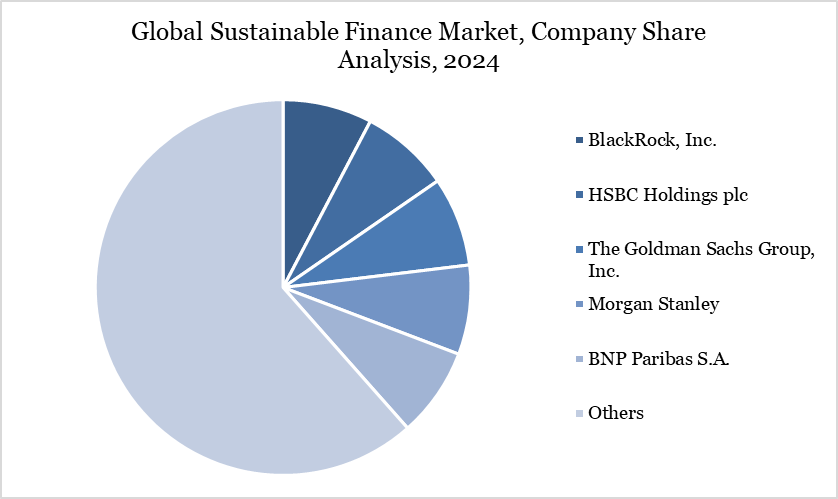
The major global players in the market include BlackRock, Inc., HSBC Holdings plc, The Goldman Sachs Group, Inc., Morgan Stanley, BNP Paribas S.A., Amundi S.A., The Vanguard Group, Inc., State Street Global Advisors, Inc., UBS Group AG, and Triodos Bank N.V.
Key Developments
- On April 28, 2026, global financial institutions and asset managers accelerated investments in sustainable finance initiatives, with increasing allocations toward green bonds, ESG-linked loans, and climate-focused infrastructure funds across North America, Europe, and Asia Pacific. Governments and regulators continued strengthening sustainability disclosure frameworks and carbon neutrality commitments, driving rapid expansion of sustainable investment portfolios worldwide.
- On March 14, 2026, BlackRock announced the expansion of its sustainable investing platform through new climate transition funds and ESG-focused investment strategies aimed at supporting renewable energy, low-carbon infrastructure, and corporate decarbonization projects globally.
- On February 9, 2026, HSBC Holdings plc launched a new sustainable finance program to support green hydrogen, clean mobility, and energy transition projects across Asia and Europe. The initiative includes sustainability-linked financing solutions and expanded green lending commitments for industrial decarbonization.
- On January 2026, industry reports highlighted strong growth in the global sustainable finance market, driven by rising ESG adoption, stricter climate disclosure regulations, increasing green bond issuances, and institutional demand for responsible investment strategies. Financial markets witnessed rapid integration of sustainability metrics into banking, insurance, and asset management operations.
- On December 2, 2025, JPMorgan Chase & Co. expanded its sustainable development financing initiatives by increasing investments in renewable energy, carbon capture, and sustainable infrastructure projects. The company also strengthened climate risk assessment and ESG advisory services for corporate clients.
- On October 2025, BNP Paribas announced new green financing partnerships focused on accelerating clean energy deployment and sustainable industrial transformation across Europe. The initiative supports green bonds, transition finance, and low-carbon technology investments.
- On August 2025, Goldman Sachs enhanced its sustainable finance strategy through expanded ESG investment products and climate-focused advisory services. The company increased support for renewable energy projects, sustainable transportation, and environmentally responsible infrastructure financing.
- On June 2025, International Finance Corporation (IFC) launched new blended finance programs aimed at mobilizing private capital for climate resilience, sustainable agriculture, and green infrastructure projects in emerging economies. The initiative reflects growing international focus on scaling sustainable development financing globally.
Why Choose DataM?
Data-Driven Insights: Dive into detailed analyses with granular insights such as pricing, market shares and value chain evaluations, enriched by interviews with industry leaders and disruptors.
Post-Purchase Support and Expert Analyst Consultations: As a valued client, gain direct access to our expert analysts for personalized advice and strategic guidance, tailored to your specific needs and challenges.
White Papers and Case Studies: Benefit quarterly from our in-depth studies related to your purchased titles, tailored to refine your operational and marketing strategies for maximum impact.
Annual Updates on Purchased Reports: As an existing customer, enjoy the privilege of annual updates to your reports, ensuring you stay abreast of the latest market insights and technological advancements. Terms and conditions apply.
Specialized Focus on Emerging Markets: DataM differentiates itself by delivering in-depth, specialized insights specifically for emerging markets, rather than offering generalized geographic overviews. This approach equips our clients with a nuanced understanding and actionable intelligence that are essential for navigating and succeeding in high-growth regions.
Value of DataM Reports: Our reports offer specialized insights tailored to the latest trends and specific business inquiries. This personalized approach provides a deeper, strategic perspective, ensuring you receive the precise information necessary to make informed decisions. These insights complement and go beyond what is typically available in generic databases.
Target Audience
Manufacturers/ Buyers
Industry Investors/Investment Bankers
Research Professionals
Emerging Companies



























































