


Structural Health Monitoring in Construction Market Size and Overview
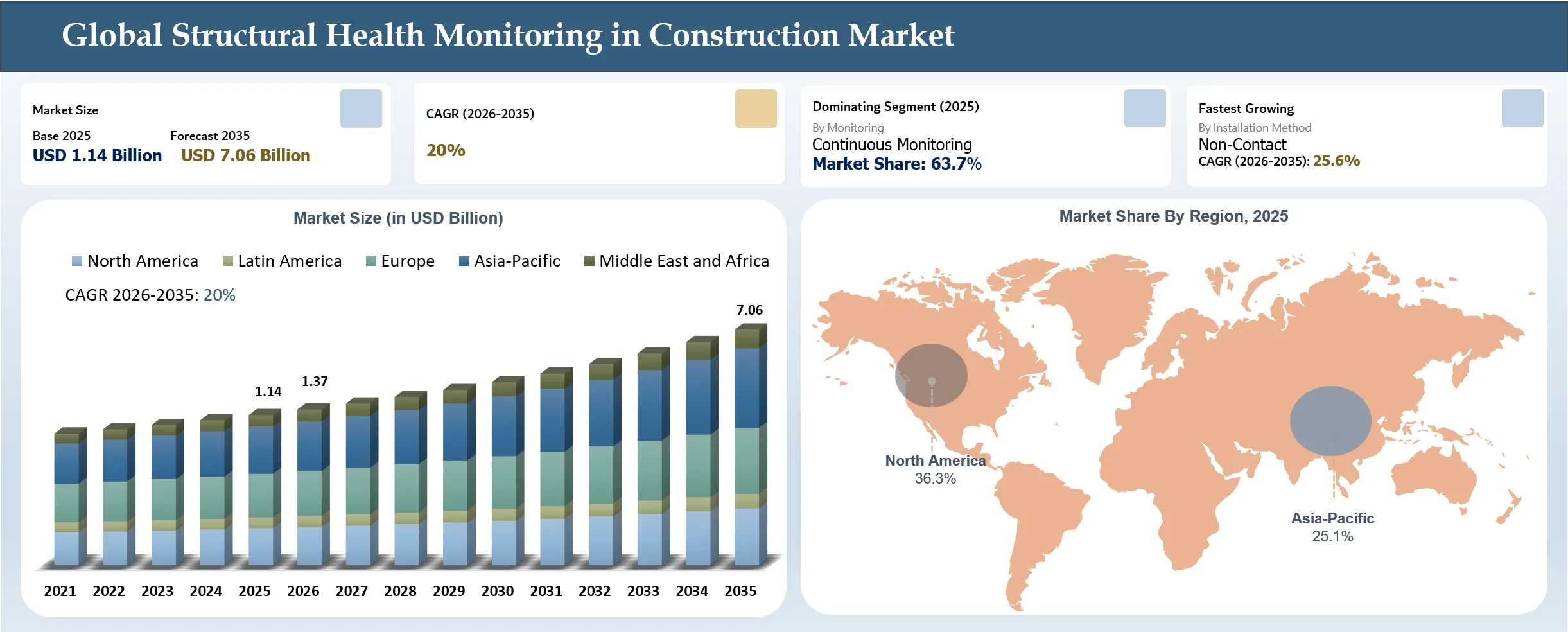
The global structural health monitoring in construction market reached USD 1.14 billion in 2025 and is expected to reach USD 7.06 billion by 2035, growing with a CAGR of 20% during the forecast period 2026-2035. The market is witnessing increasing technology adoption, driven by the need to detect structural deterioration, corrosion, cracks, and other issues with structures in the form of bridges, buildings, and civil infrastructure. The worldwide structural health monitoring in Construction market is rapidly moving away from traditional visual inspections to sensor- and data-driven assessments of structure health.
Recent developments demonstrate the increasing technical capacity of the market. In October 2025, according to Information Technology in Construction (ITcon), the combination of Structural Health Monitoring (SHM), Building Information Modelling (BIM), and Artificial Neural Networks (ANNs) resulted in 85% precision in damage detection and an R² equal to 0.96 in predicting the degree of damage, thereby confirming the rising contribution of AI-powered BIM-based solutions to infrastructure management.
In April 2026, according to Springer Nature, proof was provided that SHM solutions that use smart sensors and machine learning algorithms managed to reach a regression coefficient higher than 0.99 through experimental analysis with the use of Fiber Bragg Grating accelerometers, whereas a resonance frequency of 708 Hz was detected to assess structural vibrations. The authors also identified the possibility of using acoustic emission and surface acoustic wave sensors for detecting cracks, measuring corrosion of rebars, and estimating the remaining lifespan of concrete buildings.
In addition, the rising use of AI, Internet of Things (IoT), and digital twin technology is contributing to smart structural health monitoring systems indispensable in enhancing infrastructure safety and enabling predictive maintenance. In November 2025, according to the Enterprise Europe Network, the CAEmate, an Italian start-up, developed the WeStatiX SHM platform, which uses artificial intelligence, the Internet of Things (IoT), and finite element analysis to create digital twins for real-time monitoring of structures and their predictive maintenance. The WeStatiX SHM platform has already delivered structural monitoring services to more than 300 structures in Italy and abroad. CAEmate was granted more than EUR 1 million (USD 1.16 million) from Horizon and Interreg funds between 2020 and 2023, raised EUR 3 million (USD 3.4 million) during a seed funding round in December 2023, and additionally obtained EUR 3 million (USD 3.4 million) in public co-financing at the beginning of 2025.
White-Space Opportunities for Structural Health Monitoring in Bridge Rehabilitation and Transportation Infrastructure Construction
In May 2026, the U.S. Department of Transportation (USDOT), through the Federal Highway Administration (FHWA), announced that USD 3 billion would be made available under the Bridge Investment Program (BIP), creating a significant opportunity for structural health monitoring (SHM) in the construction market. Bridge infrastructure is the primary area receiving the highest investment, with funding focused on repairing, rehabilitating, preserving, protecting, and replacing aging bridges.
The program includes planning grants for feasibility studies and project development and Bridge Project grants for eligible projects with total costs of USD 100 million or less, creating opportunities for the integration of structural sensors, vibration monitoring, strain measurement, corrosion detection, IoT platforms, and digital asset management systems during bridge rehabilitation and construction activities.
Other major transportation infrastructure investments further expand the addressable opportunity, including USD 5.5 billion under the FY 2026 Bridge Formula Program, USD 1.3 billion for roads and bridges under USDOT's USD 1.73 billion BUILD investment, USD 600 million for the reconstruction of the Delaware River Bridge, USD 108.7 million for the Johnson and Gerstle River bundled bridge replacement project in Alaska, and more than USD 1.05 billion for the Blatnik Bridge replacement connecting Minnesota and Wisconsin.
These investments are expected to generate opportunities for companies operating across the SHM and bridge infrastructure value chain, although the USDOT funding is awarded primarily to public-sector project sponsors rather than directly to SHM technology providers. Hexagon AB, Trimble, Bentley Systems, Siemens, Campbell Scientific, HBK, National Instruments, and Worldsensing could benefit through demand for structural sensors, data acquisition systems, wireless monitoring networks, digital twins, BIM integration, and infrastructure analytics.
Engineering and construction companies such as AECOM, Jacobs, WSP Global, Tetra Tech, Parsons, HDR, and Stantec could benefit through bridge inspection, structural assessment, engineering design, asset management, and rehabilitation projects, while construction contractors and infrastructure developers could deploy SHM systems for real-time monitoring during construction and throughout the operational life of bridges.
The concentration of investment in bridge rehabilitation and replacement represents the largest immediate opportunity, while additional spending on roads, highways, freight corridors, ports, transit, and other transportation infrastructure could support broader adoption of SHM technologies for condition assessment, predictive maintenance, safety monitoring, and long-term infrastructure asset management.
Structural Health Monitoring in Construction Market Key Takeaways
- North America holds the largest regional market share at 36.3% in 2025, driven by continuous infrastructure monitoring projects. The market momentum relies heavily on public and private safety initiatives across major U.S. and Canadian transit networks.
- Continuous monitoring dominates the global market, holding 63.72% of the total share in 2025 due to demand for real-time risk assessment. This dominant position is supported by automated sensing systems that systematically replace traditional periodic inspections.
- Smart sensor ML algorithm testing in April 2026 reached a regression coefficient exceeding 0.99 using Fiber Bragg Grating accelerometers. The experimental trial successfully identified structural vibrations at a targeted resonance frequency of 708 Hz.
- The U.S. Federal Highway Administration announced USD 3 billion under the Bridge Investment Program in May 2026 for bridge rehabilitation. The funding focuses on upgrading aging bridges through integrated vibration, strain, and corrosion sensors.
Structural Health Monitoring in Construction Market Industry Trends and Strategic Insight
- SHM is moving toward BIM-centered infrastructure intelligence, where live sensor data, structural models, and damage assessment algorithms are consolidated into a single digital environment to support engineering and asset-management decisions.
- Artificial intelligence is becoming the analytical layer of SHM systems, shifting the technology from simple data collection toward automated anomaly detection, damage classification, and predictive maintenance planning.
- Digital twins are emerging as a strategic integration platform, connecting physical structures with continuously updated virtual models to support structural-condition assessment throughout construction and operational lifecycles.
- Strategically, SHM providers are likely to differentiate through integrated platforms rather than individual sensors, combining sensing hardware, AI-based analytics, visualization, and decision-support capabilities into end-to-end infrastructure monitoring solutions.
- Reliability under environmental and operational variability is becoming a major technology focus, encouraging the development of adaptive algorithms, sensor fusion, and uncertainty-aware monitoring models capable of distinguishing actual structural damage from temperature, loading, or environmental effects.
Structural Health Monitoring in Construction Market Scope
| Metrics | Details | |
| 2025 Market Size | USD 1.14 Billion | |
| 2035 Projected Market Size | USD 7.06 Billion | |
| CAGR (2026-2035) | 20% | |
| Largest Market | North America | |
| Fastest Growing Market | Asia-Pacific | |
| By Monitoring | Corrosion, Crack, Strain and Deformation, Stress and Load, Displacement and Settlement, Vibration and Acceleration, Tilt and Inclination, Temperature, Moisture and Humidity, Pressure and Seepage, Concrete Strength and Maturity, Acoustic/Damage-Event, Others | |
| By Structure Type | Buildings, Bridges, Tunnels & Underground Structures, Dams & Hydropower Structures, Marine & Port Structures, Transportation Infrastructure, Energy and Utility, Others | |
| By Sensing Technology | Fiber-Optic, Electrical and Resistive, Vibrating-Wire, Piezoelectric, Electrochemical, MEMS-Based, Acoustic, Ultrasonic, Radar and Electromagnetic, Vision-Based Sensing, Others | |
| By Structural Material | Concrete, Steel, Composite, Masonry, Timber, Other Materials | |
| By Construction Stage | Construction, Commissioning, In-Service, Damage/Deterioration, Repair and Rehabilitation | |
| By Installation Method | Embedded, Surface-Mounted, Externally Attached, Non-Contact | |
| By Monitoring Frequency | Continuous, Periodic, Event-Triggered, On-Demand | |
| By Data Communication | Wired, Wireless, Hybrid | |
| By Region | North America | U.S., Canada, Mexico |
| Europe | Germany, UK, France, Spain, Italy, Poland | |
| Asia-Pacific | China, India, Japan, Australia, South Korea, Indonesia, Malaysia | |
| Latin America | Brazil, Argentina | |
| Middle East and Africa | UAE, Saudi Arabia, South Africa, Israel, Türkiye | |
| Report Insights Covered | Competitive Landscape Analysis, Company Profile Analysis, Market Size, Share, Growth | |
Structural Health Monitoring in Construction Market Disruption Analysis
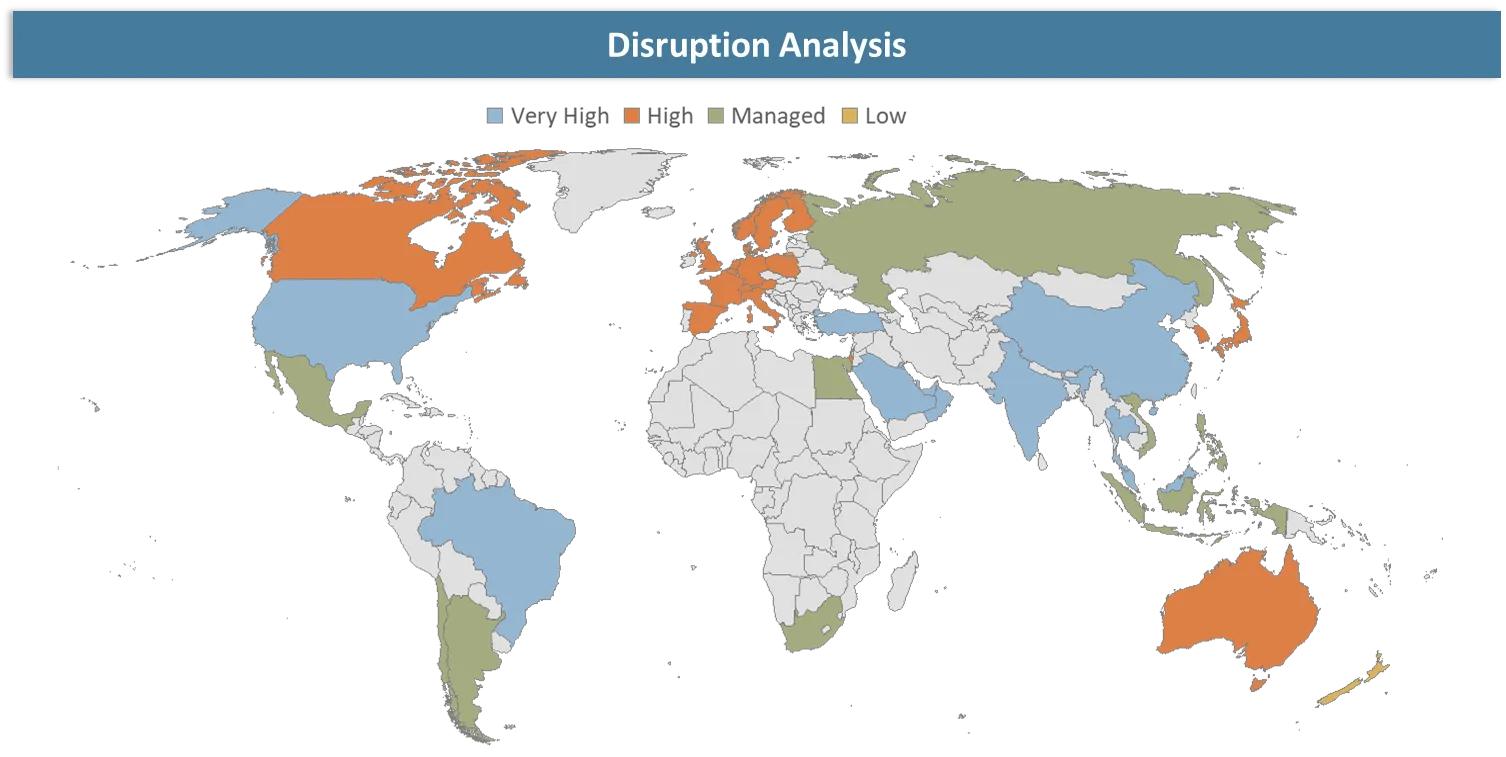
Shift Toward Digital Twin-Enabled Structural Intelligence Reshaping the Construction Monitoring Landscape
The disruption in the structural health monitoring in construction market is increasingly becoming related to the adoption of digital twin technology along with sensors and structural modeling. The traditional SHM system has been predominantly a standalone monitoring system, whereby engineers would need to manually assess the sensor data and perform periodic inspections. The digital twin systems are revolutionizing this by making connections between physical structures and the virtual world using the updated models, thus allowing for condition-based monitoring and predictive maintenance.
Furthermore, deployment of digital twins is challenging the traditional cost and scalability model for SHM systems by providing centralized monitoring for more than one infrastructure asset. In June 2025, according to the U.S. Department of Transportation, the BRACE² system increased from its initial plan of monitoring five bridges to 22 bridges, streamlining data collection in less than one minute and running on existing cloud technology for under USD 20 a month for 22 bridges. It shows how digital twins supported by cloud technology have the potential to increase the monitoring scope while decreasing the infrastructure costs of traditional stand-alone systems. It is therefore clear that competition in SHM is moving towards integrated systems. As a result, the shift is moving SHM competitive advantage to platforms that include sensor networks, structural models, real-time data analysis, and cloud computing.
Structural Health Monitoring in the Construction Market BCG Matrix: Company Evaluation

Stars include Hexagon AB, Spectris plc / HBK, and Campbell Scientific, Inc. because of their broad sensing, measurement, geospatial, and structural monitoring capabilities combined with strong technology portfolios. These companies are well positioned to benefit from the increasing integration of digital platforms, advanced analytics, and connected sensing technologies into construction and infrastructure monitoring. Question Marks include MISTRAS Group, Inc., SIXENSE Group, Acellent Technologies, Inc., COWI A/S, and James Fisher and Sons plc, as these companies possess strong technical capabilities in inspection, engineering, monitoring, and asset integrity but face the challenge of expanding standardized and scalable SHM platforms across the broader construction market.
Potential companies include Nova Metrix LLC, Geocomp Corporation, GEOKON, Incorporated, GeoSIG Ltd., and Kinemetrics, Inc., which benefit from specialized expertise in geotechnical instrumentation, vibration measurement, seismic monitoring, and structural sensing. These companies have opportunities to improve their market position through greater integration of IoT connectivity, cloud analytics, digital twins, and AI-enabled structural assessment. Tailenders include Senceive Limited, SISGEO S.r.l., Worldsensing S.L., and Resensys, LLC. These companies maintain specialized positions in wireless monitoring, geotechnical instrumentation, and infrastructure sensing but have comparatively narrower market reach than larger diversified technology and engineering groups.
Structural Health Monitoring in Construction Market Dynamics
Driver Impact Analysis
| Driver | Market Growth Impact (%) | Demand Concentration | Impacted Use Case | Strategic Impact |
Growing need for real-time infrastructure safety monitoring is driving the adoption of SHM systems to detect structural deterioration and prevent failures in buildings. | 30% | High – Concentrated in bridges, high-rise buildings, tunnels, dams, and safety-critical infrastructure. | Real-time crack detection, strain monitoring, vibration analysis, displacement measurement, and failure prevention. | Accelerates the transition from periodic inspections to continuous monitoring and increases demand for automated early-warning systems. |
Ageing infrastructure and rising maintenance requirements are increasing demand for continuous condition assessment and predictive maintenance solutions. | 28% | Very High – Primarily concentrated in ageing bridges, buildings, transportation networks, dams, and public infrastructure. | Deterioration tracking, corrosion monitoring, lifecycle assessment, rehabilitation planning, and predictive maintenance. | Strengthens long-term demand for lifecycle-based SHM services and shifts infrastructure management toward condition-based maintenance. |
Increasing integration of AI, IoT, and wireless sensors is accelerating the deployment of automated and real-time structural monitoring systems. | 24% | High – Strong demand across large infrastructure portfolios, remote assets, smart construction projects, and difficult-to-access structures. | Wireless sensing, automated anomaly detection, remote monitoring, predictive analytics, and multi-asset monitoring. | Expands the market beyond conventional hardware by increasing the strategic importance of AI analytics, cloud platforms, and connected sensor ecosystems. |
Growing adoption of digital twin technology in construction and infrastructure is driving demand for sensor-based SHM to enable predictive analysis and lifecycle optimization. | 18% | Moderate to High – Concentrated in complex and high-value assets, including bridges, major buildings, rail infrastructure, and smart infrastructure projects. | Digital structural models, real-time condition synchronization, predictive maintenance, and lifecycle optimization. | Reshapes competition toward integrated sensor-to-software platforms and increases demand for interoperability between SHM, BIM, IoT, and asset-management systems. |
Growing need for real-time infrastructure safety monitoring is driving the adoption of SHM systems to detect structural deterioration and prevent failures in buildings
The increasing requirement to detect structural damage before it escalates into a hazardous situation has been instrumental in pushing forward the use of structural health monitoring (SHM) technologies in construction. Traditional inspection schemes offer periodic evaluations, while the real-time SHM system provides a continuous evaluation of structural characteristics like strain, vibration, displacements, corrosion, and cracks. Its need is becoming increasingly obvious as owners of infrastructure want to detect structural issues early on.
In parallel, the scale of ageing bridge infrastructure is strengthening demand for technologies capable of providing continuous and remote structural surveillance. In March 2026, according to AcademicJobs, the U.S. has more than 605,000 bridges, with nearly 67,000 classified as structurally deficient, while 42% of U.S. bridges are at least 50 years old. The source also highlighted that conventional SHM systems are installed on fewer than 20% of long-span bridges worldwide, demonstrating a substantial monitoring gap. Furthermore, satellite-based InSAR technology can detect 1–2 mm annual structural shifts, supporting the expansion of non-contact and continuous monitoring capabilities. These infrastructure safety challenges are increasing the strategic importance of SHM technologies for detecting early-stage deterioration and prioritizing maintenance interventions.
Restraint Impact Analysis
| Restraint | Drag on Market Growth (%) | Primary Impact Area | Impacted Use Case | Strategic Impact |
Lack of interoperability and standardized data formats makes it difficult to integrate SHM sensors. | 28% | Data integration and system interoperability | Multi-sensor monitoring, BIM-SHM integration, digital twins, and centralized asset monitoring | Increases integration costs and deployment time, creating demand for open data standards, middleware, and vendor-neutral monitoring platforms. |
Complexity in managing and interpreting large volumes of monitoring data increases dependence on specialized analytics capabilities and skilled professionals. | 26% | Data analytics and workforce capability | Continuous monitoring, predictive maintenance, anomaly detection, and multi-asset infrastructure management | Raises operational costs and slows adoption among smaller asset owners, increasing the strategic importance of AI-driven analytics and automated data interpretation. |
Environmental and operational variations, including temperature, humidity, wind, and loading conditions, can affect sensor accuracy and generate false alarms. | 24% | Sensor reliability and data accuracy | Strain monitoring, vibration analysis, crack detection, and long-term condition assessment | Requires advanced signal processing, environmental compensation, sensor fusion, and adaptive algorithms to distinguish actual damage from normal environmental variations. |
Cybersecurity and long-term data ownership concerns are creating additional barriers to deploying connected and wireless SHM systems across critical construction infrastructure. | 22% | Data security and governance | Cloud-connected SHM, wireless sensor networks, digital twins, and remote infrastructure monitoring | Increases the need for secure data architectures, access controls, clear data ownership frameworks, and cybersecurity capabilities within SHM platforms. |
Lack of interoperability and standardized data formats makes it difficult to integrate SHM sensors
One of the major restraints affecting structural health monitoring in the construction market is the lack of interoperability between sensors, data acquisition systems, BIM platforms, and asset-management software. SHM installations frequently combine multiple sensing technologies and software platforms from different providers, creating difficulties in data formatting, communication protocols, and lifecycle data integration. This fragmentation increases engineering complexity and restricts the ability of infrastructure owners to establish unified, scalable monitoring systems across large construction portfolios.
In addition, the absence of standardized data structures can significantly limit the integration of SHM information with BIM, IoT, and digital twin platforms. In May 2026, according to Ocean Engineering and indexed by the Transportation Research Board (TRID), the IFC 4.3 schema could effectively represent only 57% of wharf components and 50% of monitoring system components within the evaluated SHM framework. Furthermore, 19% of wharf components and 50% of monitoring system components were only partially represented, while 24% of wharf components remained unrepresented. These findings demonstrate the substantial interoperability gaps that remain when integrating structural and monitoring information into standardized digital frameworks, increasing the need for customized data mapping and additional system integration efforts.
Structural Health Monitoring in Construction Market Segment Analysis
The global structural health monitoring in the construction market is segmented based on monitoring, structure type, sensing technology, structural material, construction stage, installation method, monitoring frequency, data communication, and region.
Continuous Monitoring Driving Dominance in the Structural Health Monitoring in Construction Market
The continuous monitoring segment dominates the structural health monitoring in construction market, accounting for 63.72% of the market share in 2025. The segment's leading position is driven by the increasing requirement for uninterrupted assessment of structural conditions across bridges, buildings, tunnels, dams, and other critical infrastructure. Unlike periodic inspections, continuous monitoring enables the real-time collection of data on structural parameters such as strain, vibration, displacement, temperature, and crack development, allowing infrastructure operators to identify abnormal structural behavior at an earlier stage. The growing focus on infrastructure safety, predictive maintenance, and lifecycle management is further strengthening the deployment of permanently installed sensor networks.
Furthermore, recent advancements in low-cost IoT sensing and real-time analytics are expanding the accessibility and scalability of continuous monitoring. In January 2026, Springer Nature demonstrated a real-time SHM framework using smartphone and ESP32 sensor nodes, with smartphone accelerometers capable of sampling vibration data at rates of up to 100 Hz. During validation involving 100 artificially injected anomalies, the system achieved an F1-score of 0.693, with 68.63% precision and 70.00% recall. The study also reported that the Isolation Forest-based approach achieved 0.92 overall accuracy in the laboratory-scale evaluation, demonstrating how continuous data acquisition combined with automated anomaly detection can improve structural monitoring capabilities. These developments reinforce the strategic position of continuous monitoring as infrastructure owners increasingly seek automated, real-time, and scalable alternatives to periodic inspections.
Structural Health Monitoring in Construction Market Geographical Penetration
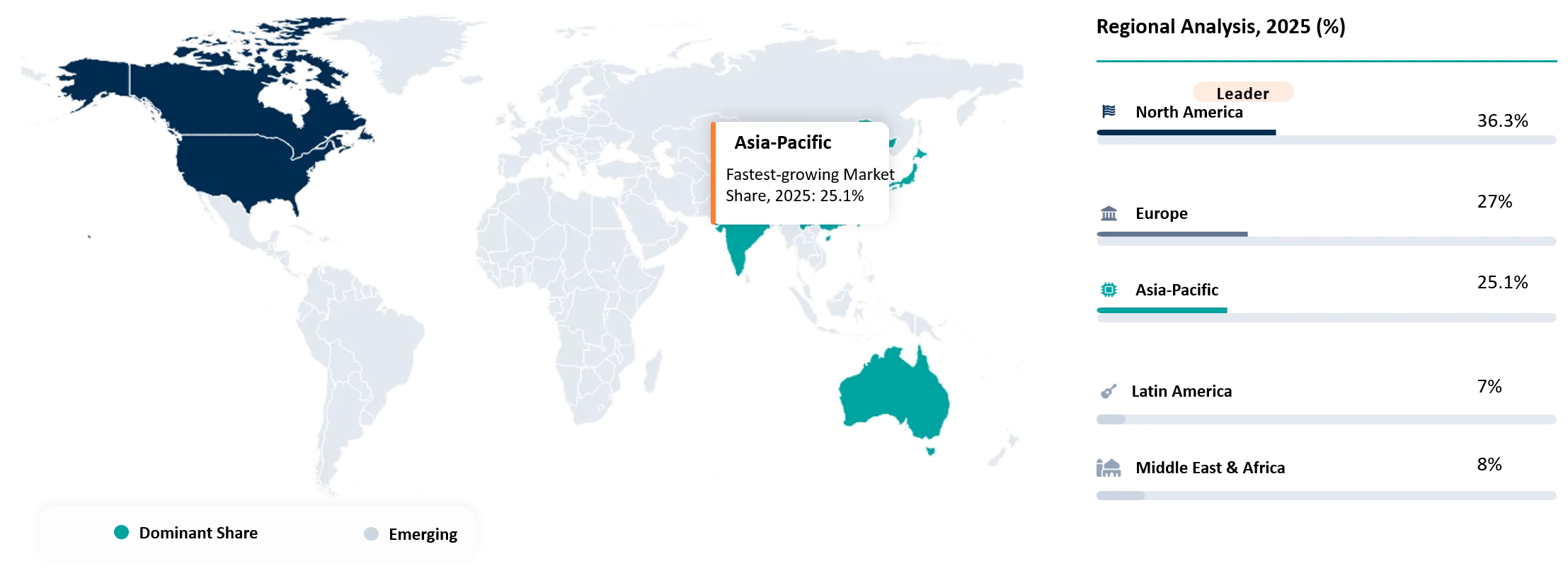
Advanced Infrastructure Monitoring and Digital Technology Adoption Strengthening North America's Market Leadership
North America dominates the structural health monitoring in construction market, accounting for 36.3% of the global market share in 2025. The region's leading position is supported by the extensive deployment of structural monitoring technologies across bridges, transportation infrastructure, buildings, and other critical assets, alongside growing adoption of wireless sensing, real-time analytics, and digital asset-management systems. Federal and state transportation agencies in the U.S. are increasingly incorporating sensor-based structural assessment into infrastructure management strategies, strengthening demand for continuous monitoring solutions and predictive maintenance capabilities.
The growing emphasis on infrastructure safety and predictive maintenance is driving consolidation among companies offering advanced structural monitoring and inspection capabilities. In February 2026, Argus Monitoring Solutions Holdings, LLC, a North America-focused technology-enabled test and measurement services platform, acquired Civionic Engineering & Consulting, Inc., a Canadian structural health monitoring and infrastructure inspection services company headquartered in Port Moody, British Columbia, Canada, and Piedmont Geologic, P.C., a U.S.-based environmental and geotechnical monitoring services company headquartered in Raleigh, North Carolina, United States. Civionic, founded in 2014, specializes in structural health monitoring for bridges and transportation networks, including advanced sensor deployment and infrastructure performance analysis.
U.S. Structural health monitoring in construction Market Trends
The U.S. holds a dominant position in the North American structural health monitoring in construction market due to its extensive portfolio of ageing transportation infrastructure, strong public-sector infrastructure management systems, and increasing adoption of sensor-based condition assessment technologies. The country's large bridge, highway, tunnel, and public infrastructure base creates sustained demand for continuous structural monitoring and predictive maintenance. The availability of established engineering firms, specialized SHM technology providers, and federal research programs further support the deployment and commercialization of advanced sensing, data analytics, and digital infrastructure management solutions.
The growing need for continuous monitoring of critical steel infrastructure is accelerating the adoption of wireless sensing technologies for early crack detection and predictive maintenance. In October 2025, MISTRAS Group, a U.S.-based technology-enabled industrial asset integrity and testing solutions company, partnered with Villari, a Netherlands-based structural monitoring technology provider headquartered in Delft, to offer wireless crack-detection sensors for critical steel structures. Villari's globally certified system uses passive magnetic flux leakage to detect and monitor fatigue crack growth continuously, while the partnership combines this sensor technology with MISTRAS's monitoring and data analytics capabilities.
Canada Structural health monitoring in construction Market Outlook
Canada is emerging as an major country in the North American Structural Health Monitoring in Construction due to its extensive infrastructure base, increasing focus on infrastructure resilience, and growing adoption of sensor-based and AI-enabled monitoring technologies. The country is strengthening its structural monitoring ecosystem through government-supported innovation programs, research institutions, and infrastructure modernization initiatives. Canada's large portfolio of bridges, tunnels, transportation assets, and public infrastructure is creating demand for technologies that can provide continuous condition assessment and support more targeted maintenance decisions.
The growing demand for integrated and continuous infrastructure monitoring is driving companies to expand their structural and geotechnical sensing capabilities through strategic acquisitions. In June 2025, Eddyfi Technologies, a Canada-based advanced non-destructive testing and structural integrity technology company based in Québec, acquired Sisgeo, an Italy-headquartered manufacturer of geotechnical and structural monitoring instrumentation based near Milan. Founded in 1993, Sisgeo brings more than 30 years of experience in high-precision sensing and serves civil engineering, mining, rail, and energy infrastructure sectors. The acquisition strengthens Eddyfi's Remote Monitoring Solutions portfolio by adding Sisgeo's wired sensors and structural monitoring systems alongside its existing Senceive and Sensor Networks brands.
Infrastructure Expansion and Smart Monitoring Adoption Accelerating Structural Health Monitoring Demand in Asia-Pacific
Asia-Pacific is a major growth region in the structural health monitoring in construction market, accounting for 25.1% of the global market share in 2025. The region's market position is supported by extensive investment in transportation infrastructure, urban construction, high-rise buildings, bridges, tunnels, and energy assets across China, India, Japan, South Korea, and Southeast Asia. Rapid urbanization and the expansion of smart-city infrastructure are increasing the requirement for sensor-based structural assessment, while the growing adoption of wireless sensing, IoT platforms, artificial intelligence, and digital infrastructure management is accelerating the transition toward continuous and predictive monitoring systems.
The growing emphasis on infrastructure safety and digital construction is accelerating collaboration between academic institutions and SHM technology providers. In April 2025, the Vietnam Aviation Academy (VAA), a Vietnam-based public higher education and research institution, met with OSMOS Group, a France-headquartered structural health monitoring (SHM) technology company, represented by its CEO Bernard Hồ Đắc. The collaboration explored the deployment of OSMOS's Optical Strand fiber-optic sensing technology, which enables real-time monitoring of structural deformation and anomaly detection, across infrastructure projects, bridges, roads, and civil buildings in Vietnam.
Japan Structural health monitoring in construction Market Trends
Japan is one of the major countries in the Asia-Pacific structural health monitoring in construction market due to its advanced infrastructure engineering capabilities, extensive ageing transportation assets, and strong emphasis on preventive maintenance. The country has established a sophisticated infrastructure management ecosystem supported by government agencies, engineering companies, sensor manufacturers, and research institutions. Japan's increasing focus on digital infrastructure management and the integration of sensing technologies into bridge, tunnel, and road maintenance is strengthening the adoption of continuous structural condition assessment and predictive maintenance solutions.
The increasing need to monitor aging infrastructure in real time is driving the development of advanced sensing technologies capable of detecting early-stage structural deterioration. In September 2025, MEKTEC Corporation, a Japan-based flexible printed circuit (FPC) technology and electronics company headquartered in Tokyo, collaborated with The University of Osaka, a Japan-based public research university, along with HAKATTE Inc., the Omi Railway Line Management Organization, and the City of Higashi-omi to begin demonstration trials of a new FPC-based strain sensor for real-time infrastructure monitoring. The trials, which commenced on August 25, 2025, cover a large bridge and railway infrastructure in Shiga Prefecture. The sensor detects minute strains in concrete and metal structures in real time, supporting early anomaly detection and infrastructure maintenance.
Structural Health Monitoring in Construction Market Competitive Landscape
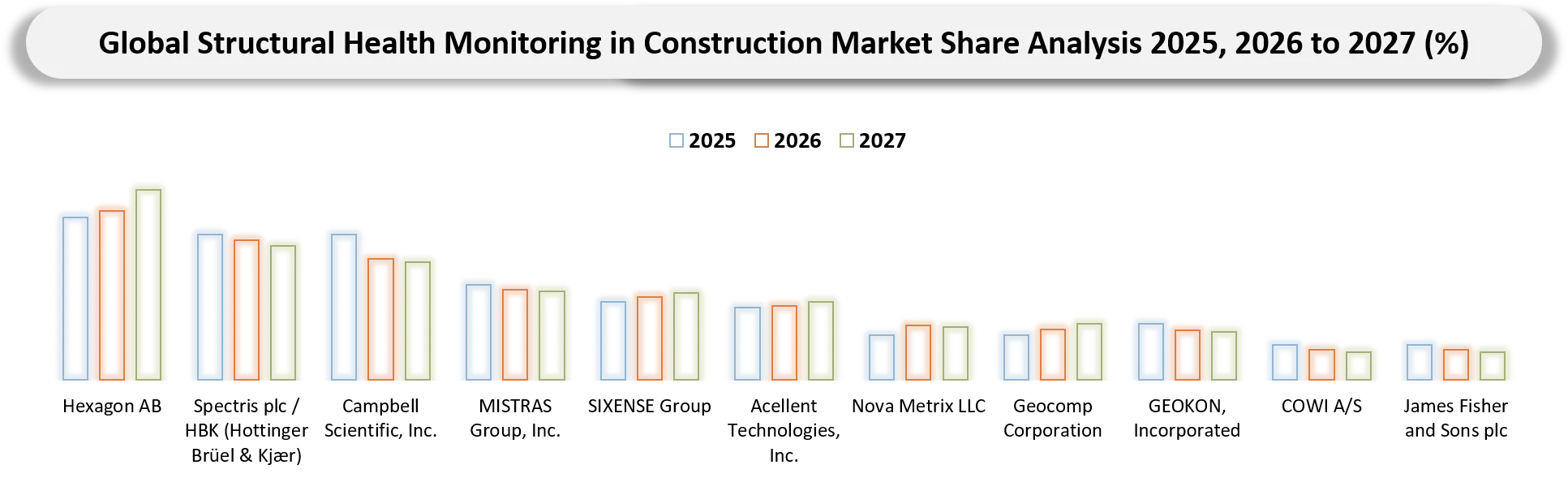
- The Structural Health Monitoring in Construction Market is characterized by a fragmented competitive landscape, comprising diversified measurement and digital technology providers, specialized SHM and sensing companies, and engineering-led infrastructure monitoring firms. Hexagon AB, Spectris plc/HBK, and Campbell Scientific, Inc. represent larger technology and measurement participants with broad capabilities in sensors, data acquisition, precision measurement, and analytics. MISTRAS Group, SIXENSE Group, COWI A/S, and James Fisher and Sons plc strengthen the market through inspection, engineering, asset integrity, and infrastructure monitoring services. Meanwhile, specialized providers such as Acellent Technologies, Nova Metrix LLC, Geocomp Corporation, GEOKON, GeoSIG Ltd., and Kinemetrics, Inc. focus on advanced sensing, geotechnical instrumentation, vibration analysis, and structural condition assessment. The competitive landscape is increasingly shaped by the ability to combine sensing hardware with wireless connectivity, cloud-based data management, AI analytics, and digital-twin integration.
- Key players include Hexagon AB (Sweden), HBK – Hottinger Brüel & Kjær (Germany), Campbell Scientific, Inc. (United States), MISTRAS Group, Inc. (United States), SIXENSE Group (France), Acellent Technologies, Inc. (United States), Nova Metrix LLC (United States), Geocomp Corporation (United States), GEOKON, Incorporated (United States), COWI A/S (Denmark), James Fisher and Sons plc (United Kingdom), GeoSIG Ltd. (Switzerland), Kinemetrics, Inc. (United States), Senceive Limited (United Kingdom), SISGEO S.r.l. (Italy), Worldsensing S.L. (Spain), and Resensys, LLC (United States).
Key Developments
- June 2026: OKI (Oki Electric Industry Co., Ltd.), a Japan-based information and telecommunications manufacturer headquartered in Tokyo, was selected as the representative organization for a Japan Aerospace Exploration Agency (JAXA) Space Strategy Fund project jointly proposed with LTS, Inc., a Japan-based consulting and business transformation services company headquartered in Minato-ku, Tokyo.
- January 2026: Monnit Corporation, a U.S.-based Internet of Things (IoT) and wireless remote monitoring technology company headquartered in Salt Lake City, Utah, entered into a master partnership agreement with Widetec Corporation, a Japan-based IT infrastructure design, construction, and operations company headquartered in Tokyo, to distribute Monnit ALTA Wireless Sensors and related IoT solutions across Japan.
- October 2025: TDSE Inc., a Japan-based data science and artificial intelligence solutions company headquartered in Tokyo, and Tokai Steel Pipe Co., Ltd., a Japan-based steel pipe and infrastructure-related manufacturing company headquartered in Nagoya, launched CorroSensing, an AI-powered deterioration diagnosis system for water pipe bridges.
- February 2026: IDS GeoRadar, an Italy-based radar sensing and structural monitoring technology company headquartered in Pisa and part of Sweden-headquartered Hexagon AB, launched MyMo, a portable, non-contact structural health monitoring solution.
- August 2026: The Seoul National University of Science and Technology (SEOULTECH), a South Korea-based national public university and research institution headquartered in Seoul, announced the development of an AI-based framework for long-term bridge damage monitoring.
Key Procurement Priorities and Buyer Evaluation Criteria
- Organizations investing in the Structural Health Monitoring in Construction Market are increasingly selecting suppliers based on their ability to provide reliable, scalable, and integrated monitoring solutions that combine sensors, data acquisition systems, communication networks, and analytics platforms for continuous structural condition assessment.
- Procurement decisions are increasingly influenced by the growing adoption of real-time monitoring, IoT-enabled sensing, wireless communication, artificial intelligence, BIM integration, and digital twin technologies, as infrastructure owners seek systems capable of supporting predictive maintenance and lifecycle-based asset management.
- Buyers evaluate suppliers based on factors such as sensor accuracy, measurement reliability, long-term durability, environmental resistance, monitoring range, data quality, system interoperability, and the ability to minimize false alarms when selecting SHM technology partners.
Why Choose DataM?
- Technological Innovations: Explores advancements in structural health monitoring technologies, including fiber-optic sensors, wireless sensor networks, MEMS, AI-based analytics, IoT connectivity, digital twins, and non-contact monitoring, enabling continuous and more accurate assessment of structural conditions.
- Product Performance & Market Positioning: Evaluates how different companies differentiate their SHM solutions based on sensor accuracy, reliability, durability, monitoring range, real-time data capabilities, interoperability, and scalability across bridges, buildings, tunnels, dams, and transportation infrastructure.
- Real-World Evidence: Highlights practical adoption of SHM technologies across critical construction assets, demonstrating applications such as crack detection, strain measurement, vibration monitoring, corrosion assessment, displacement tracking, and predictive maintenance.
- Competitive Strategies: Analyzes how leading companies expand through sensor technology innovation, integrated hardware-software platforms, strategic partnerships, engineering expertise, wireless connectivity, and the development of scalable infrastructure monitoring solutions.
- Pricing & Market Access: Examines cost variations based on sensing technology, installation requirements, monitoring frequency, infrastructure complexity, data analytics capabilities, and system integration, along with market access through direct engineering contracts, infrastructure agencies, construction companies, and technology partnerships.
- Market Entry & Expansion: Identifies growth opportunities across ageing infrastructure, smart cities, transportation networks, high-rise construction, bridges, tunnels, and energy infrastructure, while outlining strategies such as technology differentiation, digital platform integration, regional partnerships, and expansion into predictive infrastructure maintenance services.
Target Audience
- Construction Companies and Contractors
- Infrastructure Owners and Asset Operators
- Government Agencies and Public Infrastructure Authorities
- SHM Technology Providers and Sensor Manufacturers
- Engineering, EPC, and Consulting Firms
- Digital Twin, IoT, and Software Providers
- Real Estate Developers and Building Owners


























































