


Spatial Computing Market Size
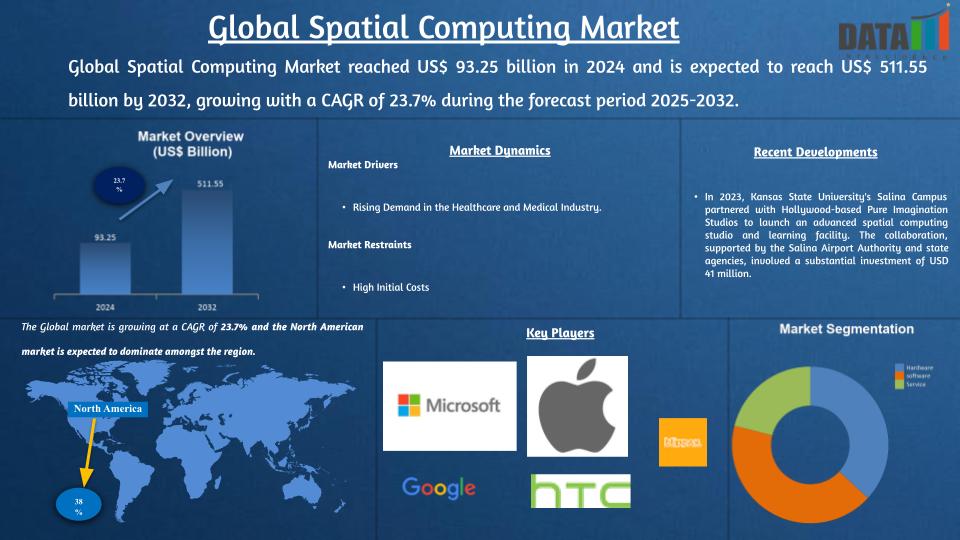
Global Spatial Computing Market reached US$ 115.35 billion in 2025 and is expected to reach US$ 627.53 billion by 2033, growing with a CAGR of 23.7% during the forecast period 2026-2033.
Growing application of spatial computing in major industries like retail, real estate and tourism helps to boost market growth over the forecast period. Also, technological advancements in augmented reality and virtual reality in the field of spatial computing sparked a revolutionary revolution in how people perceive and interact with the digital and physical worlds. This development further helps to boost market growth.
The growing adoption of spatial computing in retail operations helps to grow the market. For instance, on August 28, 2023, Auki Labs announced the public beta of its spatial computing platform to make retail operations more efficient and to enable advanced in-store shopper marketing experiences. The newly launched platform is available for retailers in North America and Europe.
Major key players in North America are employing merger and acquisition strategies to enhance market growth throughout the forecast period. For instance, on April 21, 2022, Blackrock Neurotech acquired MindX, a spatial computing software firm to commercialize a full stack brain-computer interface product. This acquisition helps to deliver full-stack, integrated BCI products with innovative capabilities.
For more details on this report – Request for Sample
Spatial Computing Market Scope
| Metrics | Details |
| CAGR | 23.7% |
| Size Available for Years | 2023-2033 |
| Forecast Period | 2026-2033 |
| Data Availability | Value (US$) |
| Segments Covered | Solution, Technology, Application, End-user and Region |
| Regions Covered | North America, Europe, Asia-Pacific, South America and Middle East & Africa |
| Fastest Growing Region | Asia-Pacific |
| Largest Region | North America |
| Report Insights Covered | Competitive Landscape Analysis, Company Profile Analysis, Market Size, Share, Growth, Demand, Recent Developments, Mergers and Acquisitions, New Product Launches, Growth Strategies, Revenue Analysis, Porter’s Analysis, Pricing Analysis, Regulatory Analysis, Supply-Chain Analysis and Other key Insights. |
Market Dynamics
Growing Applications of Spatial Computing in the Healthcare and Medical Industry
Spatial Computing is used for medical training and education, allowing medical professionals to practice surgeries and medical procedures in a risk-free virtual environment. This enhances the training experience and accelerates learning, contributing to improved healthcare practices. Spatial computing enables remote consultations and telemedicine. Doctors interact with patients and diagnose conditions from a distance, providing access to healthcare services in remote areas or during emergencies.
Virtual reality is used for pain management by immersing patients in calming and distracting environments, reducing the perception of pain during medical procedures. Virtual reality therapy helps to reduce stress and anxiety. For instance, on August 02, 2023, XRHealth, a leading company in spatial computing, announced that virtual reality therapy helps to reduce stress and anxiety in patients by 34%. The company's VR technology is used for therapeutic intervention which resulted in decreased stress in 73% of patients.
Technological Advancement in Spatial Computing Drives Market Growth
Technological advancement in hardware components of spatial computing, such as more powerful processors, high-resolution displays, and advanced sensors, enables spatial computing devices to deliver more realistic and responsive experiences. These technological advancements in the hardware of spatial computing attract both consumers and businesses to invest in the latest devices.
In addition to this hardware of spatial computing leads to a better user experience. It includes reduced motion sickness, decreased latency, and improved tracking accuracy, in virtual and augmented reality devices, making it more comfortable and engaging. Technological progress enables the creation of more immersive and high-quality content for virtual and augmented reality applications. This includes interactive storytelling, realistic simulations and lifelike graphics, which increase the appeal of spatial computing to a broader audience.
High Cost of Spatial Computing Hardware Hampers Market Growth
The cost of developing and manufacturing spatial computing hardware, such as virtual reality (VR) headsets and augmented reality (AR) glasses is high. High cost limiting widespread adoption, particularly in the consumer market. The success of spatial computing heavily depends on the availability of immersive and engaging content. A limited content ecosystem hinders user adoption, as there may not be enough compelling applications to justify the investment in hardware.
The use of spatial computing technologies, especially augmented reality raises privacy concerns, as these devices capture and analyze the real world and people's interactions. Users and regulators are concerned about potential misuse of personal data and invasions of privacy. Developing spatial computing hardware and software that provide seamless and realistic experiences is technically challenging. Issues like motion sickness, latency and tracking inaccuracies negatively impact user satisfaction.
Market Segment Analysis
The global spatial computing market is segmented based on solution, technology, application, end-user and region.
Growing Importance of Hardware Solutions
Based on the solution segment, the spatial computing market is divided into hardware, software and services. The Hardware segment accounted for the largest market share in the global spatial computing market. Rapid innovation in hardware components, such as cameras, sensors and processors, has resulted in more powerful and capable spatial computing devices. The growing technological advancements in hardware solutions and spatial computing help to boost market growth over the forecast period.
To fulfill consumer’s demand for spatial computing major key players in the market launched new products in the market. For instance, on June 05, 2023, Apple launched Apple Vision Pro, a revolutionary spatial computer that seamlessly blends digital content with the physical world. It creates an infinite canvas for apps that scale beyond the boundaries of traditional display and introduces a fully 3D user interface controlled by natural inputs.
Market Geographical Share
High Penetration of Technology in North America Helps to Boost Market Growth of Spatial Computing
North America accounted largest market share in the global spatial computing market due to growing research and development and growing adoption of spatial computing technologies. US is a dominating country in the region due to an increase in research and development activities by major key players such as Microsoft, Google, Apple and Facebook (Meta).
Some of the major key players in the region follow a merger and acquisition strategy to expand their business. For instance, on July 01, 2021, North Penn School District (NPSD) announced a collaboration with Notion Theory and Unity to launch North America’s first Spatial Computing Program for high school students. The course will provide North Penn High School students with Augmented Reality and Virtual Reality development experience. Through this newly launched program students are able to learn how to develop and publish Augmented Reality and Virtual Reality applications.
Market Major Players
The major global players in the market include Apple Inc., Blippar Group Limited, Google LLC, HTC Corporation, Lenovo Group Limited, Sony Corporation, Microsoft Corporation, Magic Leap Inc., Qualcomm Incorporated and Vuzix Corporation.
Sustainability Analysis
The global spatial computing market is progressively helping to promote sustainability by enabling effective resource usage, lowering environmental impact and improving decision-making in areas including urban planning, agriculture and logistics. Spatial computing contributes to the development of smart cities by optimizing resource usage, lowering energy consumption and improving waste management.
Spatial computing promotes sustainable agriculture by monitoring soil health, water usage and crop conditions. John Deere uses spatial computing to provide precision irrigation, which saves farmers' water resources. Precision agriculture technologies, such as spatial computing, can boost crop yields while minimizing environmental effect. The market's incorporation into crucial industries emphasizes its pivotal role in meeting global sustainability goals.
By Solution
- Hardware
- AR Devices
- VR Devices
- MR Devices
- Software
- Software Development Kit
- Game Engine
- Modeling & Visualization Software
- Content Simulation Software
- Others
- Services
- Professional Services
- Training & Consulting
- Support & Maintenance
- System Integration & Implementation
- Managed Services
- Professional Services
By Technology
- Artificial Intelligence
- Augmented Reality
- Virtual Reality
- Mixed Reality
- Internet of Things
- Digital Twins
- Others
By Application
- Entertainment
- Design and manufacturing
- Meetings and interaction
- Logistics
- Others
By End-user
- Healthcare
- Education
- Construction
- Aerospace & Défense
- Automotive
- BFSI
- IT & Telecom
- Energy & Utilities
- Manufacturing
- Others
By Region
- North America
- US
- Canada
- Mexico
- Europe
- Germany
- UK
- France
- Italy
- Spain
- Rest of Europe
- South America
- Brazil
- Argentina
- Rest of South America
- Asia-Pacific
- China
- India
- Japan
- Australia
- Rest of Asia-Pacific
- Middle East and Africa
Key Developments
February 2026: Rising adoption of AI-powered augmented reality (AR), virtual reality (VR), and mixed reality (MR) ecosystems accelerated growth in the global Spatial Computing market. Technology companies increasingly deployed spatial computing platforms for industrial automation, healthcare visualization, immersive collaboration, and digital twin applications.
January 2026: Increasing investments in wearable devices, smart glasses, and AI-integrated spatial interfaces strengthened innovation in the Spatial Computing market worldwide. Enterprises expanded deployment of spatial computing solutions supporting real-time 3D interaction, immersive workplace collaboration, and intelligent environment mapping.
December 2025: Growing commercialization of next-generation XR hardware, spatial operating systems, and digital twin technologies accelerated expansion of spatial computing ecosystems globally. Technology providers increasingly focused on lightweight headsets, cloud-rendered immersive environments, and AI-driven spatial analytics platforms.
November 2025: Expansion of industrial metaverse initiatives and smart manufacturing projects across North America, Europe, and Asia-Pacific strengthened deployment of spatial computing technologies in enterprise environments. Manufacturers increasingly integrated spatial computing systems into factory automation, predictive maintenance, and remote operational workflows.
October 2025: Rising advancements in computer vision, edge AI, and real-time 3D rendering improved scalability and performance in the Spatial Computing market globally. Research institutions accelerated development of context-aware spatial intelligence systems capable of supporting advanced navigation, gesture recognition, and immersive simulation capabilities.
September 2025: Increasing collaborations between semiconductor companies, software developers, and XR hardware manufacturers accelerated innovation in spatial computing technologies worldwide. Strategic partnerships focused on AI-enabled wearable devices, immersive enterprise applications, and next-generation spatial operating environments.
August 2025: Growing demand for immersive education, virtual healthcare, and interactive retail experiences strengthened expansion of the Spatial Computing market globally. Organizations increasingly adopted spatial computing solutions for medical visualization, virtual training, remote assistance, and personalized customer engagement applications.
July 2025: Rising integration of generative AI, digital twins, and immersive simulation technologies accelerated innovation in spatial computing platforms worldwide. Companies expanded development of AI-enhanced XR collaboration systems supporting engineering design, architecture visualization, and enterprise productivity applications.
June 2025: Increasing focus on digital transformation, immersive interaction technologies, and intelligent 3D computing supported strong growth in the global Spatial Computing market. North America maintained market leadership due to advanced XR ecosystems and strong technology investments, while Asia-Pacific emerged as the fastest growing region driven by rapid adoption of smart manufacturing, gaming, and digital infrastructure technologies.
Why Purchase the Report?
- To visualize the global spatial computing market segmentation based on solution, technology, application, end-user and region, as well as understand key commercial assets and players.
- Identify commercial opportunities by analyzing trends and co-development.
- Excel data sheet with numerous data points of spatial computing market-level with all segments.
- PDF report consists of a comprehensive analysis after exhaustive qualitative interviews and an in-depth study.
- Product mapping available as excel consisting of key products of all the major players.
The global spatial computing market report would provide approximately 69 tables, 80 figures and 205 pages.
Target Audience
- Manufacturers/ Buyers
- Industry Investors/Investment Bankers
- Research Professionals
- Emerging Companies



























































