


Space-Based Data Center Market Size and Overview
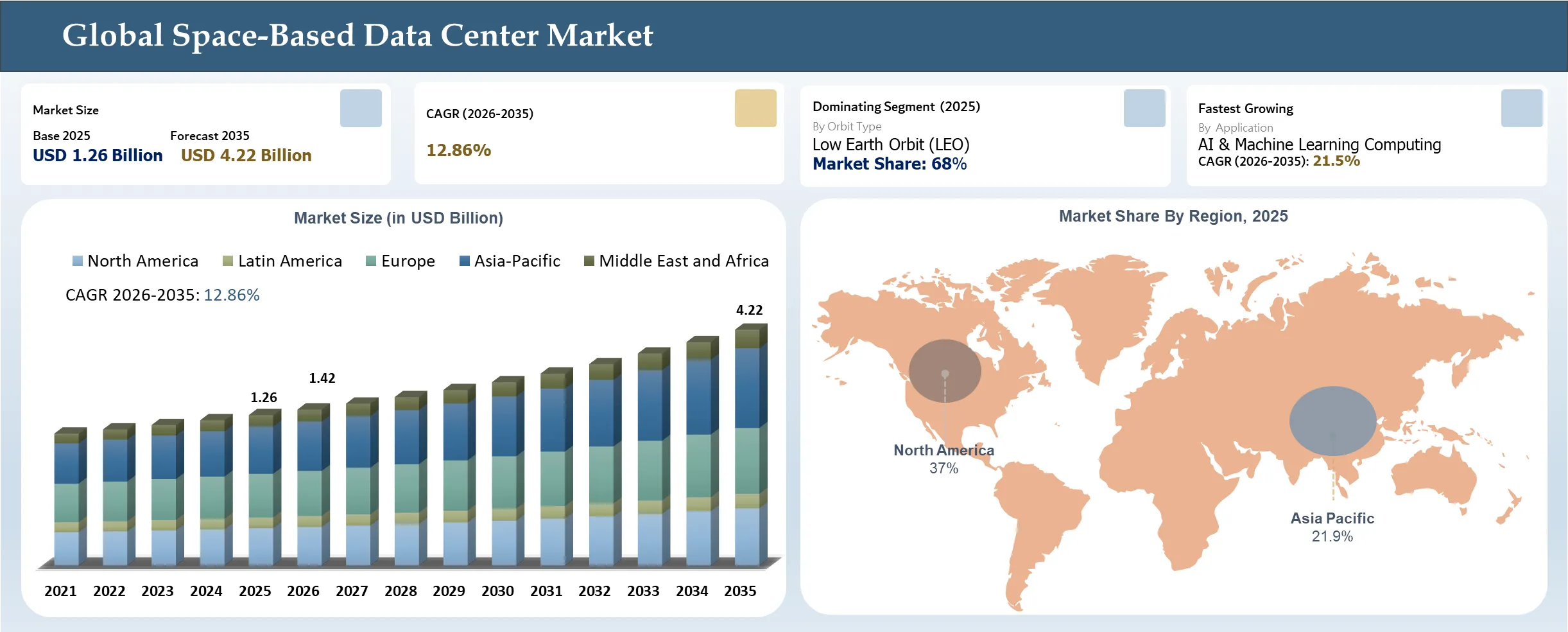
The global space-based data center market was valued at USD 1.26 billion in 2025 and is projected to reach USD 4.22 billion by 2035, growing at a CAGR of 12.86% from 2026 to 2035. The market is gaining traction as growing demand for AI computation, high-performance data processing, and secure digital storage leads to the building of orbital computing platforms. The growth in the volume of satellite data and the need for low-latency in-orbit processing are opening opportunities for AI inference, Earth observation analytics, and secure data management. Orbital data centers combine computing processors, enterprise storage systems, solar energy generation, and optical communication solutions to enable processing and storing of data in space.
In September 2025, Axiom Space and Spacebilt presented their intentions to launch an orbitally connected optical data center node on the International Space Station in 2027, supported by Microchip Technology, Phison Electronics, and Skyloom. As stated by Axiom Space, the planned node will feature more than 1 petabyte of data storage capacity, Phison's enterprise SSDs, and Microchip's PIC64-HPSC spaceflight processor. Skyloom will supply an optical communication terminal capable of delivering 2.5 Gbps of speed with the perspective of delivering 100 Gbps.
Space-Based Data Center Market Key Takeaways
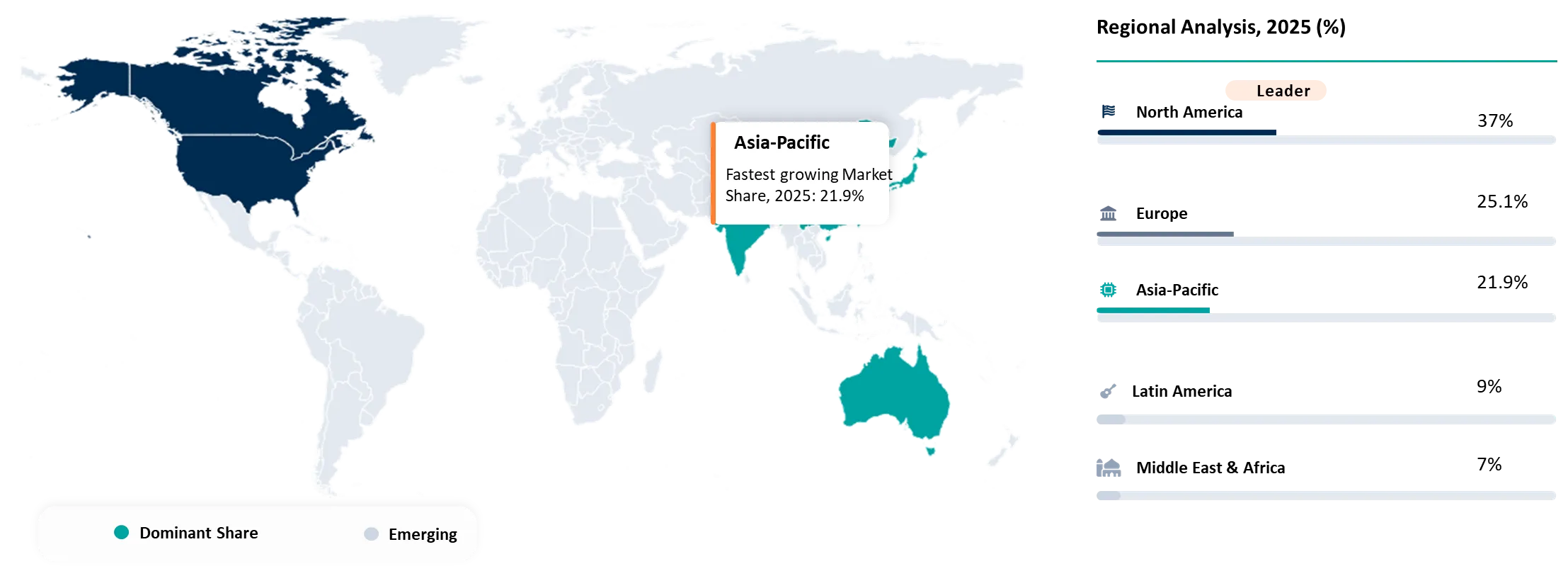
- North America led the global space-based data center market in 2025 with a dominant 37% regional market share. Growth is driven by heavy investments in aerospace, artificial intelligence, and private commercial space infrastructure.
- According to OECD data, the broader space economy generated between USD 550 billion and USD 600 billion in total revenue in 2025. More than 14,000 satellites were in orbit, with private commercial operators deploying 88% of all satellites launched in 2025.
- SpaceX acquired xAI for approximately USD 1.25 trillion in February 2026 to combine aerospace and AI capabilities. Following the transaction, SpaceX reached a market valuation of USD 1 trillion, while xAI was valued at USD 250 billion with operational spend of USD 1 billion per month.
- EDGX successfully demonstrated its STERNA AI computing system powered by NVIDIA processing in orbit in April 2026. Designed for a seven-year operational lifespan, the system dynamically adjusts its power usage between 10W and 45W.
Space-Based Data Center Market Trends & Disruptions Impacting Customers
The laser-based inter-satellite communication networks have become significant in the space-based data center market, considering that the computing platforms in space need high-speed, low-latency communication channels for the exchange of large amounts of data. Optical communication terminals provide faster transfer of data between the networked satellites as opposed to radio frequency communication, which enables distributed computing, AI computation, and efficient data transfer among orbiting computing networks.
The disruption in the Space-Based Data Center market arises from the change from traditional computing systems on Earth to a distributed computing network in orbit, which would be capable of processing data in space itself. Also, events that took place in 2025 and 2026 showcase how such a transformation is influencing the market dynamics. In April 2026, the company from Belgium, EDGX, successfully demonstrated its STERNA AI computing system in orbit, which works using NVIDIA-based processing and dynamically varies its power usage between 10W and 45W. The system was planned for an operational life of seven years.
Space-Based Data Center Market Dynamics
Driver Impact Analysis
| Driver | Market Growth Impact (%) |
Increasing Demand for AI Computing Infrastructure to Overcome the Capacity Limitations of Earth-Based Data Centers | 35% |
Growing Investments in Orbital AI Computing to Accelerate Commercial Space-Based Data Center Deployment | 28% |
Advancements in Space-Qualified AI Processors to Enable High-Performance Computing Beyond Earth | 22% |
Increasing Demand for AI Computing Infrastructure to Overcome the Capacity Limitations of Earth-Based Data Centers
The rising demand for AI computing is fueling the establishment of space data centers due to the challenges faced by terrestrial data centers in terms of electricity usage, power grid constraints, and the difficulty of creating new data center facilities. In July 2026, according to TechTarget, the electricity consumption of global data centers went up by 17% in 2025 to 485 TWh, with that of AI-centric data centers having a growth rate of 50%.
Restraint Impact Analysis
| Restraint | Drag on Market Growth (%) |
High Thermal Management Complexity Due to the Limitations of Heat Dissipation in Space | 32% |
Radiation-Induced Hardware Degradation Increasing Computing System Reliability Risks | 24% |
High Thermal Management Complexity Due to the Limitations of Heat Dissipation in Space
The space-based data centre market is subject to a major constraint caused by the problem of removing the heat produced by powerful computing processors in outer space. In contrast to regular land-based data centres where the cooling process is based on air and liquid cooling methods, an outer space computing facility will have to utilize mainly radiation for transferring heat energy, using radiator panels designed specifically for this purpose. In June 2026, according to the World Economic Forum, a two-sided radiator operating at around 20°C produces just 633 W/m2. The article also mentions that a 1 MW orbiting data center would need roughly 1,600 m2 of radiator area, and using the thermal control system of the International Space Station at such capacity would mean 100 metric tons of radiator mass.
Opportunity Impact Analysis
| Opportunity | Market Growth Impact (%) |
| Commercialization of High-Capacity Orbital Data Center Satellites | 30% |
Commercialization of High-Capacity Orbital Data Center Satellites
The commercialization of high-capacity orbital data center satellites is creating significant opportunities in the space-based data center market, as organizations advance from developing experimental satellites to utilizing satellite platforms that can deliver dedicated services such as computing, storage, and artificial intelligence. The rising need for secure storage, in-orbit analytics, and computing will prompt developers to add advanced processors, solid-state storage with higher capacity, solar power, and optical communications into their satellites.
Challenge Impact Analysis
| Challenge | Market Growth Impact (%) |
Achieving Cost-Efficient and Technically Reliable Large-Scale Orbital Data Center Deployment | 28% |
Achieving Cost-Efficient and Technically Reliable Large-Scale Orbital Data Center Deployment
The space-based data center market will encounter difficulties in terms of scaling commercially because of the complicated nature of satellite construction, launch costs, thermal control, radiation shielding, and wideband data transmission capabilities. Contrary to terrestrial data centers, space-based ones will not be able to use normal cooling equipment or replace their hardware regularly because of the need for radiator systems, radiation hardening of processors, and computing redundancy.
Space-Based Data Center Market: Commercial Use Cases Across Industries
| COMPANY | USE CASE | BENEFITS |

| Develops orbital AI computing infrastructure to support satellite operators, Earth observation companies, and cloud computing customers. Its Starcloud-1 satellite demonstrated AI model training and inference in orbit, while Starcloud-2 is designed to provide GPU computing, persistent storage, and real-time processing of satellite-generated data. | Enables faster processing of satellite imagery and sensor data, reduces dependence on transmitting large volumes of raw data to Earth, supports AI computing in orbit, and provides opportunities for secure cloud storage and high-performance computing services. |

| Develops orbital data center nodes to support government and defence agencies, commercial satellite operators, civil space programs, and scientific research organizations. Its infrastructure enables in-orbit data storage, AI/ML computing, multi-sensor data fusion, space cybersecurity, and processing of satellite and spacecraft mission data. | Supports real-time space data analytics, improves mission responsiveness, reduces reliance on terrestrial communication infrastructure, strengthens secure data management, and enables autonomous decision-making for satellite networks and space missions. |
Market Ecosystem
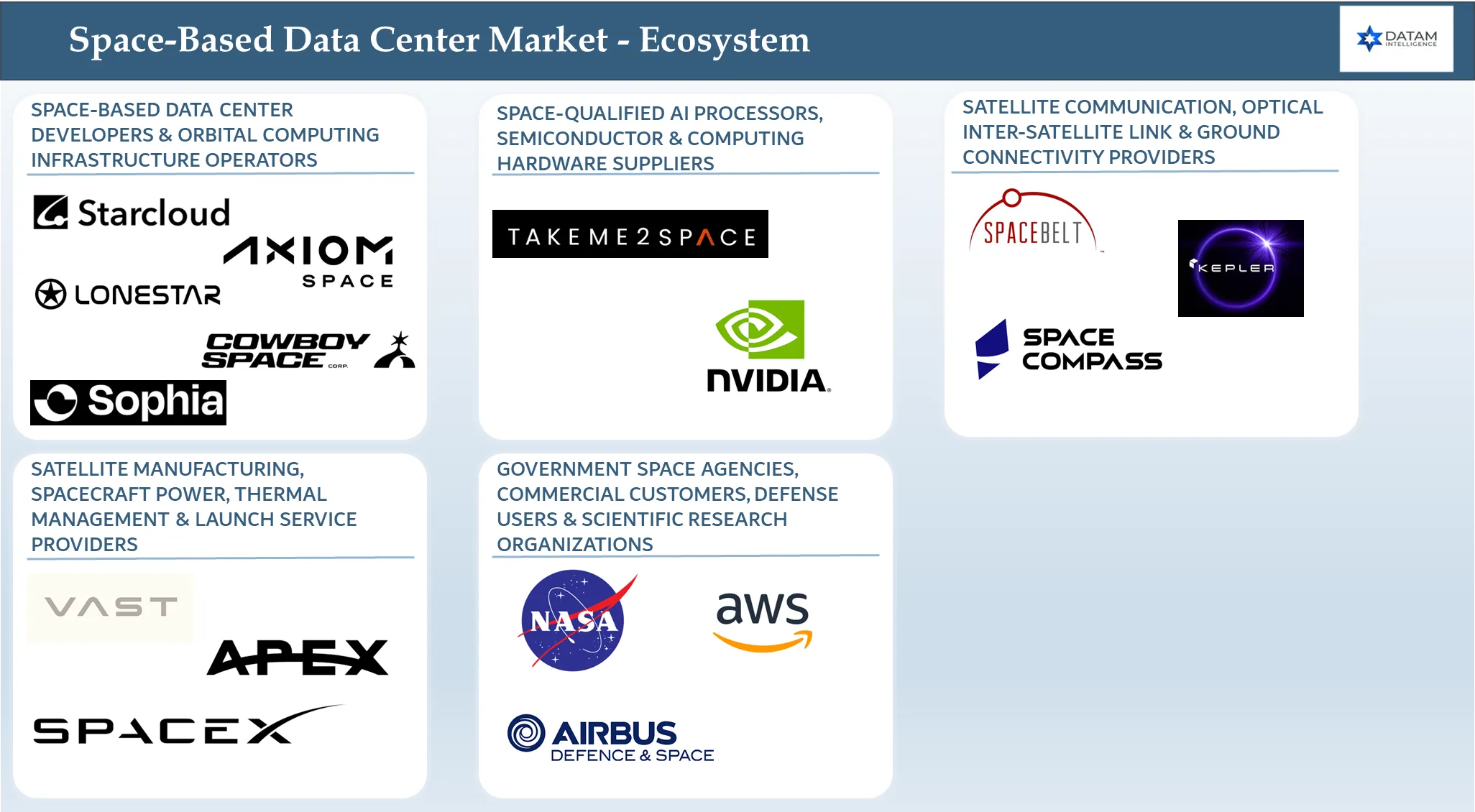
The Space-Based Data Center Ecosystem includes orbital infrastructure providers, satellite producers, artificial intelligence semiconductors suppliers, storage technology providers, optical communications firms, launch services providers, and national space agencies. The ecosystem is growing due to the transition of commercial space operations from publicly owned satellite infrastructure and computing services to those that are privately operated.
Based on The Space Economy at a Glance 2026 by the OECD, space economy revenues totalled USD 550-600 billion in 2025, whereas more than 14,000 satellites have been deployed into orbit. In addition, private operators launched 88% of all satellites in 2025, emphasizing the increasing involvement of private players in the development of space infrastructure.
Space-Based Data Center Market Segment Analysis
By Payload Type
The payload type segment is divided into Data Processing, Data Storage, and Communication and Data Transfer subcategories. Such payloads provide the backbone of the space data center infrastructure by performing computational processes, storing information in orbit, and connecting orbiting satellites with ground networks. The market drivers for such segments are high volumes of data from satellites, computational needs, and interconnection of orbiting computing infrastructure.
By Orbit Type
Orbit types include low Earth orbit (LEO), medium Earth orbit (MEO), and geostationary Earth orbit (GEO). Orbit choice determines the factors of latency in communication, satellite coverage, power needs, costs of implementation, and orbital infrastructure availability. The market depends on the capability of various orbit environments to perform computing, storage, and data transfer processes, as well as the increasing development of satellite constellations and space infrastructure.
By Power Capacity
The power capacity segment is further classified as below 100 kW, 100 kW to 1 MW, and above 1 MW. The power capacity dictates the computational load for the orbital data center, which includes the processor load, storage systems, communications equipment, and the cooling load. The progress in the market will depend on the progress made in the technologies for efficient solar power generation, power distribution, energy storage, and heat rejection in space.
By Communication Infrastructure
The communication infrastructure subsystem encompasses optical communication systems, RF communication systems, inter-satellite link systems, space-to-ground communication systems, and other forms of communication technology systems. The communication infrastructure systems are responsible for the transfer of information between the data centers in orbit, satellites, ground stations, and computer systems on Earth. The growing need for high-bandwidth, low-latency data transfer and communication is driving the growth of the communication infrastructure.
By Application
The application segment includes AI and machine learning computing, cloud and general-purpose computing, data processing and analytics, data storage, backup, and archival, scientific and simulation computing, and various other applications. Data centers in space are being designed to enable computational tasks that can be performed near the source of satellite data, eliminate the requirement to transport large amounts of unprocessed data down to Earth, and facilitate quick analysis of mission-critical data. Increasing interest in orbital AI processing, satellite data analytics, scientific work, and distributed computing is opening new avenues for applications.
By End User
The end-user market includes commercial, government and defense, research and academia, critical infrastructure and enterprise, and other types of users. The demand from the commercial market will include satellite operators, Earth observation firms, and technology vendors with requirements for computing and storage capacity in orbit. The government and defence agencies can utilize such systems for space situational awareness, secure data handling, intelligence processing, and mission operations, whereas the research entities and enterprises will be among other prospective customers for scientific computing and data processing purposes.
Space-Based Data Center Market Geographical Penetration
Strategic Consolidation of AI and Aerospace Capabilities to Accelerate Space-Based Data Center Commercialization in North America
North America accounted for about 37% of the market share in the space-based data center market across the globe in 2025, becoming a dominant region due to huge investments made in commercial space infrastructure, artificial intelligence, satellite communications, and advanced computing solutions. The market growth in North America is driven by leading aerospace companies, artificial intelligence companies, satellite operators, and governmental space agencies, especially in the United States.
The combination of space technology companies and artificial intelligence companies is promoting the development of computing capabilities in space, in-space data processing, and in-space data storage, thus supporting the leading market position in North America. In February 2026, SpaceX, a U.S.-based aerospace manufacturer, launch services provider, and satellite communications provider, acquired xAI, a U.S.-based artificial intelligence company and a provider of Grok AI, for approximately USD 1.25 trillion. In the process of this acquisition, the market valuation of SpaceX increased to USD 1 trillion, while the market valuation of xAI increased to USD 250 billion. xAI was spending approximately USD 1 billion per month on its operations.
Space-Based Data Center Market BCG Matrix: Company Evaluation
Starcloud, recognized as a leading emerging player in the Space-Based Data Center Market, is creating orbital computer infrastructure that will help process AI computing workloads, high-performance computing applications, and satellite data. The company is working on creating space-based data centers that will be able to use high-performance computing hardware along with space power and communication facilities. Another important company in this regard is Lonestar Data Holdings, which has been considered a promising company in the space-based data storage market. The company is developing orbital data storage and backup infrastructure that can help governments and commercial companies. The company’s StarVault project and the plans for the expansion of in-space storage capabilities give it a promising role in the emerging orbital data storage ecosystem.
Space-Based Data Center Market Competitive Landscape
Key Market Players
- Starcloud (United States)
- Axiom Space (United States)
- Lonestar Data Holdings (United States)
- Cowboy Space (United States)
- Kepler Communications (Canada)
- Sophia Space (United States)
- Space Compass (Japan)
- TakeMe2Space (India)
- SpaceBelt (United States)
- NVIDIA Corporation (United States)
Space-Based Data Center Market Scope
| Metrics | Details |
| 2025 Market Size | USD 1.26 Billion |
| 2035 Projected Market Size | USD 4.22 Billion |
| CAGR (2026-2035) | 12.86% |
| Years Considered | 2025 - 2035 |
| Base Year | 2025 |
| Forecast Period | 2025 - 2035 |
| Units Considered | Value (USD Billion) |
| Report Insights Covered | Competitive Landscape Analysis, Company Profile Analysis, Market Size, Share, Growth |
| Segments Covered | By Payload Type Data Processing Units Data Storage Units Communication & Data Transfer Units By Orbit Type Low Earth Orbit (LEO) Medium Earth Orbit (MEO) Geostationary Earth Orbit (GEO) By Power Capacity Less than 100 kW 100 kW to 1 MW 1 MW and above By Communication Infrastructure Optical Communication Systems Radio Frequency (RF) Communication Systems Inter-Satellite Link (ISL) Systems Space-to-Ground Communication Systems Others By Application AI & Machine Learning Computing Cloud & General-Purpose Computing Data Processing & Analytics Data Storage, Backup & Archival Scientific & Simulation Computing Others By End User Commercial Government & Defense Research & Academic Critical Infrastructure & Enterprise Others
|
| Region Covered | North America, Europe, Asia-Pacific, Latin America, Middle East and Africa |
Space-Based Data Center Market: Target Audience and Strategic Intelligence Requirements
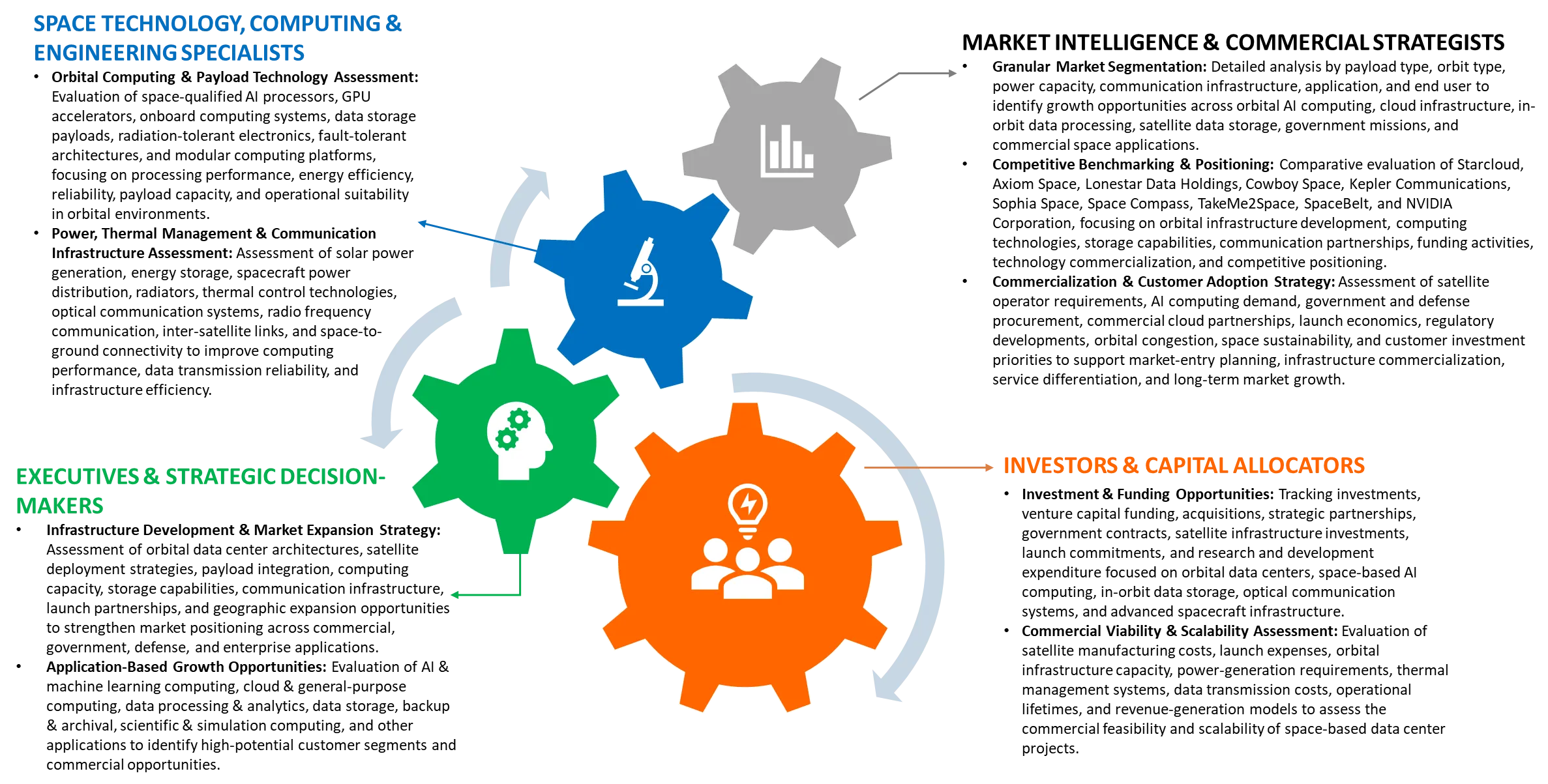
Addressing Client Priorities Through Customized Space-Based Data Center Research
CLIENT REQUIREMENT | RESEARCH CUSTOMIZATION PROVIDED | STRATEGIC VALUE TO CLIENTS |
Assessing commercial feasibility and operational scalability | Analyzed satellite manufacturing expenses, launch costs, power-generation capacity, thermal management requirements, communication infrastructure, orbital maintenance limitations, and operational lifetime considerations. | Enables clients to evaluate project feasibility, optimize capital expenditure, identify operational constraints, and develop scalable orbital data center deployment strategies. |
Evaluating regulatory, orbital and space sustainability challenges | Examined orbital spectrum allocation, satellite licensing, space debris mitigation, collision avoidance, radiation exposure, cybersecurity, data sovereignty, and international space governance requirements. | Helps clients anticipate regulatory barriers, strengthen operational risk management, improve compliance readiness, and develop sustainable orbital infrastructure strategies. |
Key Developments
- March 2026: Kepler Communications Inc., a Canada-based company that provides satellite telecommunication services and space infrastructure solutions, developed its first scalable commercial cloud infrastructure that operates in space using NVIDIA Corporation, which is a U.S.-based semiconductor and accelerated computing technology company.
- May 2026: Lonestar Data Holdings Inc., a U.S.-based space-based data storage and digital infrastructure developer, entered into a Space Act Agreement with NASA, a U.S.-based federal government space exploration and research agency, through its Ames Research Center to promote lunar data storage, off-world computing, and space communication infrastructure.
- May 2026: Pixxel Space Technologies, an India-based space technology and satellite manufacturer, partnered with Sarvam AI, an India-based artificial intelligence and sovereign AI platform developer, to develop India's first orbital data center satellite called Pathfinder.
- May 2025: Eric Schmidt, a U.S.-based technology executive and an individual investor, acquired a majority stake in Relativity Space Inc., a U.S.-based aerospace manufacturing and reusable launch vehicle developer, becoming its CEO.
- April 2026: Phantom Space Corporation, a United States-based aerospace manufacturing, satellite infrastructure and launch vehicle manufacturer, acquired Thermal Management Technologies LLC, a United States-based aerospace and defense thermal management component manufacturer, to hasten the development of its Phantom Cloud orbital data center constellation.
- April 2025: Kepler Communications Inc., a Canada-based satellite telecommunications and optical data relay infrastructure service provider, entered into a commercial agreement with Axiom Space Inc., a United States-based commercial space infrastructure and orbital data center infrastructure developer, to deliver two initial on-orbit computing payloads for the Axiom's Orbital Data Center (ODC) infrastructure.
- January 2025: Flexential, a United States-based data center colocation, cloud, connectivity and IT infrastructure services provider, formed a partnership with Lonestar Data Holdings Inc., a United States-based space-based data storage and lunar infrastructure developer, to enable the deployment of its Freedom lunar data center mission.
- September 2026: Redwire Corporation, a United States-based aerospace, defense technology and space infrastructure solutions provider, signed a Memorandum of Understanding (MoU) with Sophia Space Inc., a United States-based orbital computing and space-based data center technology developer, to promote scalable orbital data center infrastructure.