


Sovereign AI Infrastructure Market Size and Overview
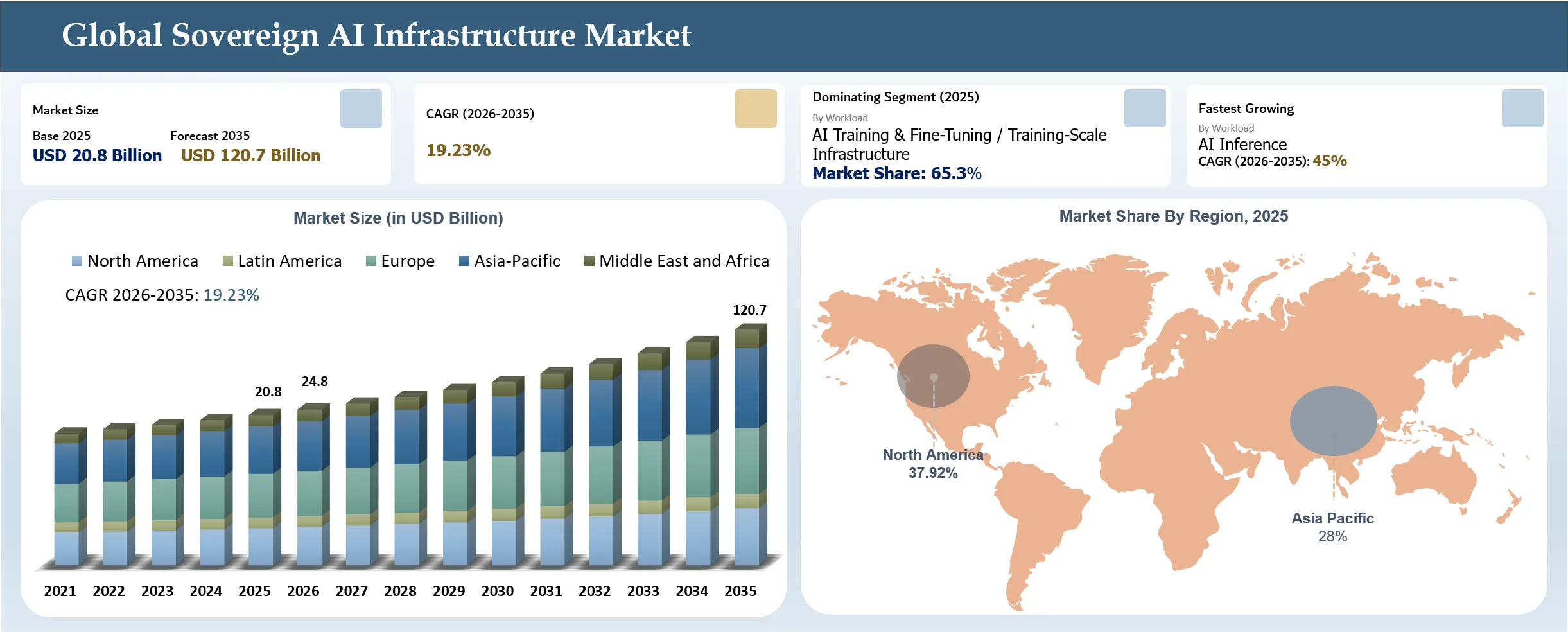
The global sovereign AI infrastructure market reached USD 20.8 billion in 2025 and is expected to reach USD 120.7 billion by 2035, growing with a CAGR of 19.23% during the forecast period 2026-2035. The market is gaining significant traction as governments and enterprises are investing in nationally controlled AI computing ecosystems comprising AI data centers, GPU clusters, sovereign cloud systems, HPC systems, secure networks, and data infrastructure. Investments into such infrastructure are being driven in 2025–2026 by the increased adoption of generative AI, data sovereignty efforts undertaken by governments, and the necessity to create national capacities for AI computing. For instance, Adani Group in February 2026 announced plans to invest USD 100 billion into creating capacity for renewable energy-based AI-ready data centers in India by 2035, which is supposed to spur an additional investment of USD 150 billion in manufacturing, servers, sovereign clouds, and infrastructure. There are also investments from the UK Sovereign AI Fund created with USD 674.75 million (£500 million) to enable the development of domestic AI capacities. Thus, the market is moving towards nationally controlled AI compute solutions, whereas the cost of GPUs, power, data center capacity shortage, and dependence on the advanced semiconductor supply chain are major obstacles to market growth.
India's policies support the rapid advancements in sovereign AI computing and data centre infrastructure. In February 2026, according to CNBC-TV18, India's Union Budget 2026-27 proposed to extend a data-center tax holiday until 2047, which is expected to support long-term investment in domestic AI compute infrastructure. Yotta Data Services aims to grow its GPU cluster from 10,000 to 60,000 GPUs over the next 12 months, which means a 6-fold increase. At present, Yotta Data Services runs a 2 GW data centre campus and aims at setting up about 1 GW capacity. Setting up an AI-ready data centre infrastructure costs between USD 5 million and USD 6 million per MW. As one of the examples of sovereign AI infrastructure, Yotta has shifted the Indian government's Bhashini language-AI platform to its Shakti sovereign cloud. Over 1.8 billion files have been migrated and 35-40 technology components customized. Bhashini has seen a 40% boost in performance, a 30% decrease in cost, and 17 times increase in volume post migration.
White-Space Opportunities from EU Sovereign AI Infrastructure Investments
In February 2025, the European Commission launched the InvestAI initiative to mobilise USD 230.74 billion (€200 billion) for artificial intelligence, creating a significant white-space opportunity across sovereign AI infrastructure, particularly large-scale AI computing and gigafactory development. The highest investment concentration is in AI gigafactories, with a dedicated USD 23.07 billion (€20 billion) European fund initially intended to finance four AI gigafactories, each equipped with around 100,000 advanced AI chips, approximately four times the chip capacity of AI Factories then being established. These facilities are designed for training complex, very large AI models and require substantial investment in high-performance computing, data centres, advanced networking, power capacity and energy-efficient infrastructure. Beyond gigafactories, the initiative supports AI Factories, AI start-ups and scale-ups, data infrastructure, common European data spaces, generative-AI applications, AI talent development, and industrial AI adoption. The EU had already committed USD 11.5 billion (€10 billion) to AI Factories, with the commission stating that this public investment would unlock more than 10 times as much private investment, while six additional AI Factories announced in March 2025 were backed by approximately USD 559.5 million (€485 million) in combined EU and national investment.
The investment creates opportunities across the AI infrastructure value chain, with NVIDIA positioned to benefit from demand for advanced AI processors and accelerated-computing platforms, while Nokia can benefit from high-speed networking and AI-native connectivity requirements; Nokia received USD 46.15 million (€40 million) from Business Finland in 2026 toward two R&D projects supporting more than USD 115.3 million (€100 million) of planned investment in Finland focused on AI-powered 6G and defence networks. Schneider Electric is also positioned to benefit from the power-management, electrical distribution and data-centre infrastructure required by energy-intensive AI facilities, while European data-centre and cloud infrastructure providers can benefit from the expansion of AI computing capacity. Where Atos/Eviden and HPE are positioned through HPC systems, data-centre infrastructure, power distribution and energy management, where Schneider Electric, Vertiv and Eaton can benefit; high-speed networking, where Nokia, Ericsson and Cisco can participate; and cloud and AI platforms, where Microsoft, Google and Amazon Web Services can benefit from expanding European AI-compute capacity. The EU’s 2026 Cloud and AI Development Act also targets expansion of energy-efficient data-centre capacity and aims to triple EU data-centre capacity over the next 5–7 years, creating additional opportunities for data-centre operators, cooling, power and infrastructure suppliers.
Sovereign AI Infrastructure Market Strategic Takeaways
- North America held the leading position in 2025 with a 37.92% market share due to large-scale data center investments. Asia-Pacific represented the fastest-growing region, holding a 28% market share in 2025.
- AI training and fine-tuning dominated workload demand, accounting for 65.3% of the total sovereign AI infrastructure market in 2025. National programs are fueling this, such as India adding 20,000 GPUs to expand its national capacity beyond its 38,000 GPU baseline.
- The U.S. Stargate project pledged USD 500 billion over four years, deploying USD 100 billion in 2025 and expanding its target capacity to nearly 7 GW. Proposed export regulations require host-government participation for single-country shipments exceeding 200,000 advanced GPUs.
- The European Commission launched the USD 230.74 billion (€200 billion) InvestAI initiative, including USD 23.07 billion (€20 billion) dedicated to setting up four AI gigafactories equipped with 100,000 chips each. This builds on a prior USD 11.5 billion (€10 billion) commitment meant to unlock over 10 times as much private investment.
Sovereign AI Infrastructure Market Industry Trends and Strategic Insight
- AI compute is being treated as strategic national infrastructure. Governments are moving beyond conventional cloud procurement and developing domestic AI compute ecosystems to retain greater control over AI workloads, sensitive data, and critical digital capabilities.
- Sovereign cloud architectures are replacing dependence on unrestricted hyperscale environments. Governments and regulated industries increasingly require cloud environments where data, AI models, computing resources, and operational controls remain subject to domestic jurisdiction and governance.
- Sovereignty is increasingly assessed across the complete AI stack—including accelerators, servers, interconnects, storage, cloud platforms, orchestration software, cybersecurity, data governance, and application environments—rather than through domestic ownership of data centers alone.
- A more commercially viable model is emerging in which countries retain control over data, infrastructure operation, workload governance, security, and compute access while selectively using internationally sourced accelerators, networking equipment, software, and cloud technologies. This creates a controlled-interdependence model rather than complete supply-chain isolation.
- Sovereign AI investment is creating demand across AI data-center construction, power distribution, grid infrastructure, liquid cooling, networking, storage, cybersecurity, cloud platforms, orchestration software, and facility-management systems, broadening the addressable supplier ecosystem.
Sovereign AI Infrastructure Market Scope
| Metrics | Details | |
| 2025 Market Size | USD 20.8 Billion | |
| 2035 Projected Market Size | USD 120.7 Billion | |
| CAGR (2026-2035) | 19.23% | |
| Largest Market | North America | |
| Fastest Growing Market | Asia-Pacific | |
| By Component | Hardware, Software & Platforms, Services | |
| By Deployment Model | On-Premises, Cloud | |
| By Workload | AI Training & Fine-Tuning, AI Inference | |
| By End User | Government & Public Sector, Defense & Intelligence, Cloud & AI Service Providers, Telecommunications Service Providers, BFSI, Healthcare & Life Sciences, Manufacturing, Energy & Utilities, Research & Academia, Others | |
| By Region | North America | U.S., Canada, Mexico |
| Europe | Germany, UK, France, Spain, Italy, Poland | |
| Asia-Pacific | China, India, Japan, Australia, South Korea, Indonesia, Malaysia | |
| Latin America | Brazil, Argentina | |
| Middle East and Africa | UAE, Saudi Arabia, South Africa, Israel, Türkiye | |
| Report Insights Covered | Competitive Landscape Analysis, Company Profile Analysis, Market Size, Share, Growth | |
Sovereign AI Infrastructure Market Disruption Analysis
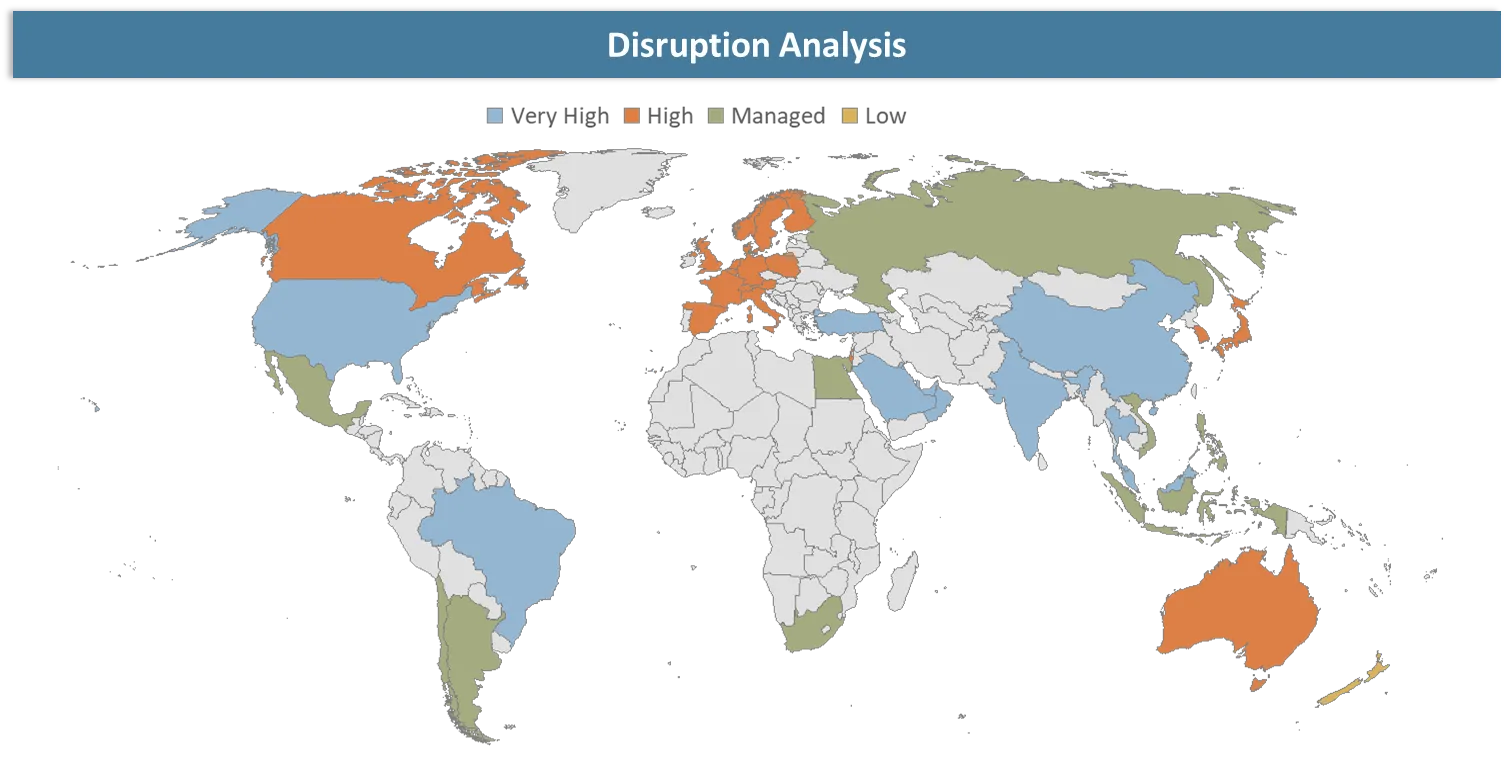
Shift from Cloud Sovereignty to Compute Sovereignty Reshaping AI Infrastructure Deployment
Disruption in the sovereign AI infrastructure market mainly involves the move from traditional data sovereignty to compute sovereignty in that governments wish to take control of where AI models are hosted, who manages the computing infrastructure, and what jurisdiction applies to AI workloads. This trend has been exhibited during the years 2025–2026 in terms of the fast growth of national AI-compute initiatives. In October 2025, the European Commission expanded its AI Factory network to 19 new AI Factories in 16 member states in addition to its AI Factory network, and the European Union’s future AI Gigafactories will offer access to high-performance computing.
In addition, the rising concentration of AI workloads is affecting the traditional dependency on external cloud-based infrastructure owing to the demands from the government side for increased control over GPU power, model training, data processing, and infrastructure management. In September 2025, the United Kingdom disclosed AI factories with 120,000 NVIDIA Blackwell Ultra GPUs and up to USD 14.8 billion (£11 billion) allocated for local data centers to support the sovereign AI goals of the country. This leads to the emergence of new infrastructure trends such as AI factories of a country, sovereign clouds, accelerator clusters, and local data centers, disrupting the traditional model in which advanced AI computing capacity is primarily accessed through globally managed hyperscale cloud platforms.
Sovereign AI Infrastructure Market BCG Matrix: Company Evaluation

Stars include NVIDIA, Microsoft, Amazon Web Services (AWS), and Google Cloud because they have strong positions across AI computing, accelerated infrastructure, sovereign cloud environments, networking, and AI software ecosystems. These companies are well positioned to capture the transition toward nationally controlled AI infrastructure as governments and regulated industries seek localized compute capacity and greater control over AI workloads. Question marks include Oracle, IBM, Dell Technologies, and Hewlett Packard Enterprise (HPE). These companies have established capabilities in sovereign cloud, AI servers, high-performance computing, hybrid infrastructure, and government-oriented technology solutions, but face strong competition from hyperscalers and vertically integrated AI infrastructure providers.
Potential includes Cisco and Supermicro, which benefit from increasing demand for AI networking, high-density GPU systems, liquid-cooled servers, and scalable data-center infrastructure. Cisco has an important role in the networking and security layers required for sovereign AI clusters, while Supermicro is expanding its position in GPU-optimized and liquid-cooled AI servers. Tailenders include OVHcloud and Orange, whose sovereign AI infrastructure participation is more regionally concentrated compared with the global hyperscale and AI infrastructure leaders.
Sovereign AI Infrastructure Market Dynamics
Driver Impact Analysis
| Driver | Market Growth Impact (%) | Demand Concentration | Impacted Use Case | Strategic Impact |
Growing Government Focus on Technological Sovereignty | 25% | Government & Public Sector; Defense & Intelligence; Europe; North America; Asia-Pacific | National AI Infrastructure; Sovereign Cloud; Public-Sector AI; National AI Factories | Accelerates government-led investment in domestically controlled AI compute, cloud, and data-center infrastructure. |
Rising Demand for Sovereign AI Computing Capacity | 24% | Government; Research & Academia; Hyperscale AI Operators; North America; Asia-Pacific | AI Model Training; AI Inference; Generative AI; AI Supercomputing | Drives deployment of GPU clusters, AI servers, HPC systems, high-speed networking, and dedicated AI data centers. |
Rising Geopolitical and Supply-Chain Risks | 19% | Government; Defense; Semiconductor-Dependent Industries; North America; Europe; Asia-Pacific | Secure AI Computing; Strategic AI Workloads; Domestic AI Infrastructure | Encourages diversification of AI hardware supply chains and increases demand for locally controlled compute capacity. |
Increasing Demand for Secure AI Infrastructure | 17% | Defense & Intelligence; Government; BFSI; Healthcare; Telecommunications | Secure AI Training; Confidential AI Computing; Sensitive Data Processing; AI Inference | Increases adoption of isolated infrastructure, cybersecurity, confidential computing, sovereign cloud, and controlled data environments. |
Growing Need for Domestic AI Model Development | 15% | Government; Research & Academia; Technology Companies; Asia-Pacific; Europe | Foundation Models; Generative AI; Model Training & Fine-Tuning; AI Research | Creates recurring demand for domestic GPU capacity, AI supercomputing, model-storage infrastructure, and AI development platforms. |
Growing Government Focus on Technological Sovereignty
The growing government focus on technological sovereignty is accelerating demand for AI infrastructure sovereignty as countries attempt to gain control over computing infrastructure, semiconductors, and computing facilities for national AI. In 2025-2026, there has been a greater shift towards the development of domestic AI hardware and computing infrastructure instead of depending completely on internationally controlled infrastructure. The UK announced the launch of a USD 1.01 billion (£750 million) national AI supercomputer in June 2026, out of which USD 539.8 million (£400 million) will be spent on buying next-generation AI chips, demonstrating the increasing emphasis on securing domestic access to advanced computing technologies and strengthening national AI infrastructure capabilities.
Technology sovereignty in Abu Dhabi is bolstered through investments in sovereign cloud, secure government data infrastructure, and AI-powered public services. In January 2025, according to the Abu Dhabi Department of Government Enablement (DGE), the Government Digital Strategy of Abu Dhabi from 2025-2027, backed by USD 3.54 billion (AED 13 billion), was established to speed up technological sovereignty and government AI-native solutions. The goals of this strategy include 100% end-to-end digital transformation of government processes, implementation of over 200 AI solutions, migration to sovereign clouds, and establishment of an ERP system. It is projected that it will contribute USD 6.54 billion (AED 24 billion) to GDP and create 5,000 jobs. During 2025, Abu Dhabi increased sovereign digital infrastructure in cooperation with Microsoft and G42, and Abu Dhabi's Unified Government Data Centre, in partnership with e&, offered secure AI-ready capacity for essential government data. According to the government, 95% of employees in the public sector have been trained on AI, and the AI-enabled TAMM platform has had 3.8 million users, providing more than 1,150 services in 90+ languages, resolving 95% of requests via AI.
Restraint Impact Analysis
| Restraint | Drag on Market Growth (%) | Primary Impact Area | Impacted Use Case | Strategic Impact |
Limited Availability of Advanced AI Accelerators | 28% | GPU/AI accelerator procurement; AI compute capacity | AI Model Training; Generative AI; AI Supercomputing | Restricts the ability of sovereign operators to rapidly scale high-performance compute and can extend infrastructure deployment timelines. |
Dependence on Foreign Semiconductor Supply Chains | 25% | AI chips; HBM; advanced packaging; semiconductor manufacturing | National AI Compute; Foundation Model Training; High-Performance AI | Limits complete technology autonomy and exposes sovereign infrastructure projects to export controls, geopolitical disruptions, and supplier concentration. |
High Energy Requirements of AI Compute Clusters | 27% | Data-center power; grid connections; cooling; energy procurement | AI Training; Large-Scale Inference; AI Supercomputing | Power availability is becoming a physical deployment constraint; IEA reported that AI-focused data-center electricity consumption increased 50% in 2025, while overall data-center electricity demand grew 17%. |
Interoperability Challenges Across AI Infrastructure Stacks | 20% | Compute, networking, cloud platforms, orchestration and software integration | Multi-Vendor AI Clusters; Hybrid Sovereign Cloud; Distributed AI | Increases integration complexity and can create vendor lock-in, making it harder to combine accelerators, networks, cloud environments and AI software across sovereign infrastructure. |
Limited Availability of Advanced AI Accelerators
One of the major constraints limiting the expansion of the sovereign AI infrastructure market is the limited availability of advanced AI hardware accelerators like advanced GPUs, high-bandwidth memory (HBM), and advanced semiconductor packaging technologies that enable large-scale AI computing infrastructures. In 2025, the four largest chip designers of AI hardware accelerators – NVIDIA, Google, AMD, and Amazon – accounted for over 90% of the worldwide capacity of CoWoS advanced packaging and HBM chips, demonstrating how concentrated the resources are that enable the manufacturing of top-end AI hardware accelerators.
Restrictions on AI export from other countries can have an impact on the availability of high-end GPUs needed to deploy AI infrastructure. In March 2026, according to BusinessMirror, the U.S. Commerce Department was considering regulations where American consent will be mandatory in almost all international shipments of advanced AI accelerators manufactured by NVIDIA and AMD. These regulations were already applicable to more than 40 countries, but were now expected to be expanded to include other destinations. According to the suggested regulation, shipments with up to 1,000 NVIDIA GB300 GPUs would go through a less stringent clearance process, whereas shipments with larger clusters would need preclearance, and shipments in quantities higher than 200,000 GB300 GPUs by a single company within a single country might need host country government participation and further assurances. The scope of the suggested regulations is large, as NScale would be supplying 200,000 GB300 GPUs to Microsoft at four locations. Consequently, the suggested regulatory scheme can lead to uncertainties in the procurement of advanced accelerators needed for AI infrastructure development.
Sovereign AI Infrastructure Market Segment Analysis
The global Sovereign AI Infrastructure market is segmented based on component, deployment model, workload, end user, and region.
AI Training & Fine-Tuning / Training-Scale Infrastructure Driving Dominant Demand in Sovereign AI Infrastructure
The AI training & fine-tuning/training-scale infrastructure segment remains the dominant workload in the sovereign AI infrastructure Market, occupying 65.3% of the market share in 2025. The dominance of the segment can be attributed to the rising implementation of sovereign AI programs by governments, defense agencies, institutes, and technology initiatives of a country that would need high-performance computing power to create and fine-tune their foundation models, LLMs, and AI domain models. During 2025-2026, there has been an increased focus on building AI capabilities within the country, which would increase the demand for GPU/accelerator-based servers, networking, storage, and cooling infrastructure for compute-heavy workloads.
The need for training-scale infrastructure continues to pick momentum in 2026, owing to the needs of sovereign AI programs for access to compute power to train, experiment, and fine-tune models. In February 2026, India announced the provision of 20,000 more GPUs to its already existing 38,000 GPU count in the nation's AI compute capacity. The Sovereign AI program in the UK offers participating AI firms up to 1 million GPU hours per startup by leveraging national supercomputing facilities, while the government has allocated a budget of USD 380.69 million (£282 million) for leading-edge AI startups and compute-heavy projects. These developments showcase the growing need for huge GPU clusters, fast interconnects, storage, and cooling solutions to fine-tune sovereign AI models, further solidifying AI training & fine-tuning / training-scale infrastructure as the leading workload segment.
Sovereign AI Infrastructure Market Geographical Penetration
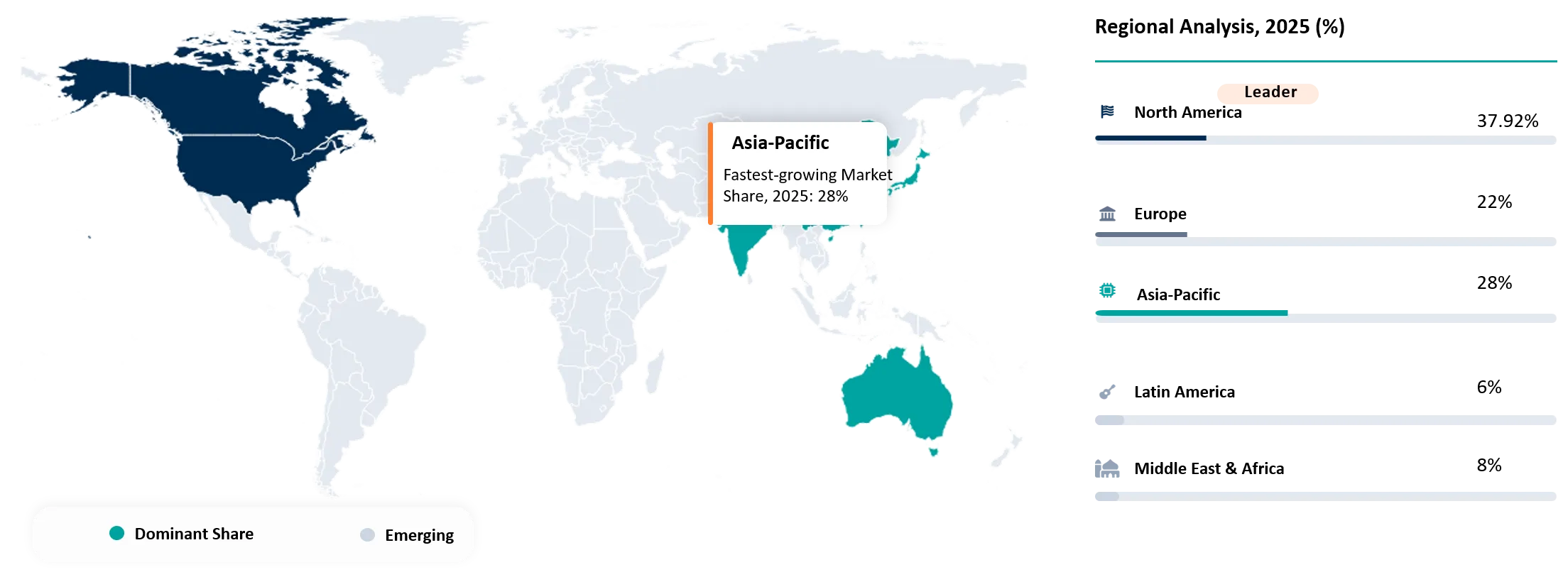
North America Dominates Sovereign AI Infrastructure Market Through Large-Scale AI Compute Investments
The North America region holds the leading position in the sovereign AI infrastructure market with a market share of 37.92% in 2025, owing to the availability of sophisticated AI computing infrastructure, massive investments from governments and private organizations in AI infrastructure, and the dominance of key players offering AI and cloud computing technology. The strength of this region is augmented by the development of AI data centers and high-performance computing capabilities within this region, especially in the United States. In January 2025, OpenAI, SoftBank, and Oracle launched the stargate project that aims to make an investment worth USD 500 billion in four years into AI infrastructure within the United States, out of which USD 100 billion will be invested in the current year. By September 2025, Stargate grew its planned capacity to nearly 7 GW with investments worth over USD 400 billion for the next three years.
The collaboration will enhance high-performance computing for AI, AI workload security, and sovereign cloud infrastructure in North America. In December 2025, Global AI, a U.S.-based provider of sovereign AI infrastructure, partnered with HUMAIN, a Saudi Arabia-based PIF-owned artificial intelligence company, to develop large-scale AI data centers and computing capabilities in the U.S.A. and globally. The collaboration includes the construction of the American AI data center campus featuring NVIDIA GB300 NVL72 and Quantum-X800 InfiniBand networking systems that enable national-scale AI model training, secured inference, and sovereign cloud deployments. Global AI owns a specially designed New York data center featuring NVIDIA GB200 NVL72 clusters as well as implementing the largest-ever installation of NVIDIA GB300 NVL72 systems in the state (first shipment already deployed). The data center uses advanced liquid cooling, which is found in just 5% of the world’s data centers.
U.S. Sovereign AI Infrastructure Market Trends
The U.S. holds a dominant position in the North American sovereign AI infrastructure market, supported by its established ecosystem of AI technology, presence of prominent AI players and hyperscale cloud service providers, state-of-the-art semiconductor manufacturing capabilities, and substantial data center infrastructure. The country reaps dividends out of the existing high demand for AI computing capability that is under domestic control within the government sector, defense industry, healthcare sector, and others. In the period 2025-2026, growing focus on enhancing domestic capabilities and minimizing dependency on foreign computing infrastructure bolstered the country’s position.
Increased capacity for sovereign AI cloud infrastructure improves data control and security in the U.S. In October 2025, Zadara, a U.S.-based cloud infrastructure & edge-cloud services company, joined forces with Micro Support Group (MSG), a U.S.-based data center and IT infrastructure company, to create a sovereign AI cloud solution in the USA Northeast, leveraging NVIDIA GPUs. This solution is intended to ensure greater data sovereignty and security for AI infrastructure, while also catering to those seeking an alternative to VMware-centric infrastructure. Zadara currently has more than 500 edge-cloud sites globally, whereas the partnership aims at AI workloads needing data sovereignty in the USA Northeast region.
Canada Sovereign AI Infrastructure Market Outlook
Canada is emerging as a key country in the North American sovereign AI infrastructure Market, with government funding of its computing resources, AI research infrastructure, and data centers. The country’s approach is based on ensuring that any sensitive data, intellectual property, and AI computing workloads occur in Canada through its infrastructure, not via foreign infrastructure. As seen in November 2025, Canada's Budget 2025 was released; the country allocated USD 925.6 million over five years to sovereign public AI infrastructure to boost domestic AI computing capacity.
Through the nation's first sovereign AI factory, TELUS, NVIDIA, and HPE contribute to the sovereign AI environment of Canada. In September 2025, TELUS, a Canada-based telecommunications and digital technology company, launched Canada’s first fully sovereign AI factory in Rimouski, Quebec, in collaboration with NVIDIA, a U.S.-based AI semiconductors and accelerated computing company, and Hewlett Packard Enterprise, a U.S.-based enterprise technology and IT infrastructure company. The facility is 100% Canadian-controlled, processes data and computing within Canada, and enables AI models to be trained, fine-tuned, and inferred. It runs on NVIDIA H200 GPUs and HPE infrastructure, provides Rmax performance equal to 22.74 petaflops, and is ranked 78th in the TOP500 of November 2025, being thus the fastest and most powerful supercomputer in Canada.
Rapid AI Compute Expansion and Sovereign Infrastructure Investment Driving Asia-Pacific Growth
The Asia-Pacific is the fastest-growing region in the sovereign AI infrastructure Market, with a market share of 28% in 2025, which is backed up by the fast-growing investments in AI computing power, sovereign data centers, national AI initiatives, and digital infrastructure. The countries in the region are showing an increasing inclination towards locally built AI infrastructure to facilitate national AI models, government use cases, defense, and key industries while also having better control over their data and computing resources. The region is well supported by the large presence of the semiconductor manufacturing industry, the data center ecosystem, and growing AI computing demand.
Taiwan is strengthening its sovereign AI capabilities through the development of large-scale, locally controlled AI supercomputing infrastructure. In November 2025, Visionbay.ai, a Taiwan-based AI supercomputing and cloud-AI operations provider and a dedicated business unit of Hon Hai Technology Group/Foxconn, announced plans to build Taiwan’s largest GPU cluster and its first supercomputing center based on NVIDIA GB300 NVL72 systems, scheduled to come online in the first half of 2026. The initiative is designed to strengthen Taiwan’s sovereign AI infrastructure by providing secure local supercomputing, data residency, and reduced dependence on overseas computing resources. Hon Hai Technology Group (Foxconn) (Taiwan; electronics manufacturing and technology solutions provider) supports the project through its manufacturing, server R&D, supply-chain integration, and cooling capabilities.
Japan Sovereign AI Infrastructure Market Trends
Japan holds a key position in the Asia-Pacific sovereign AI infrastructure market, owing to the digital infrastructure, semiconductor industry, technological environment, government-sponsored AI initiatives, and growing interest in having domestically controlled AI computing infrastructure. Japan is building its sovereignty in AI by building an ecosystem around it that includes AI models, data centers, clouds, compute resources, and infrastructure required for the same. In January 2025, Japan proposed an investment in excess of USD 313.5 billion (¥50 trillion) in AI and semiconductor sectors, along with the development of information and communications networks that would connect AI sites and data centers.
Japan is accelerating sovereign AI infrastructure development through large-scale investments in domestically controlled, high-performance computing capacity. In May 2026, GMI Cloud, a U.S.-based AI cloud infrastructure provider, announced a USD 12 billion sovereign AI infrastructure initiative in Kagoshima, Japan, in partnership with Wistron, a Taiwan-based electronics manufacturing and technology company. The project is planned as a large-scale AI factory with an initial 350 MW deployment and a long-term target of 1 GW of power capacity, with construction expected to begin in late 2026. The NVIDIA-powered infrastructure is intended to strengthen Japan’s sovereign AI capabilities by supporting locally controlled AI computing for applications including robotics, autonomous vehicles, and advanced manufacturing.
Sovereign AI Infrastructure Market Competitive Landscape
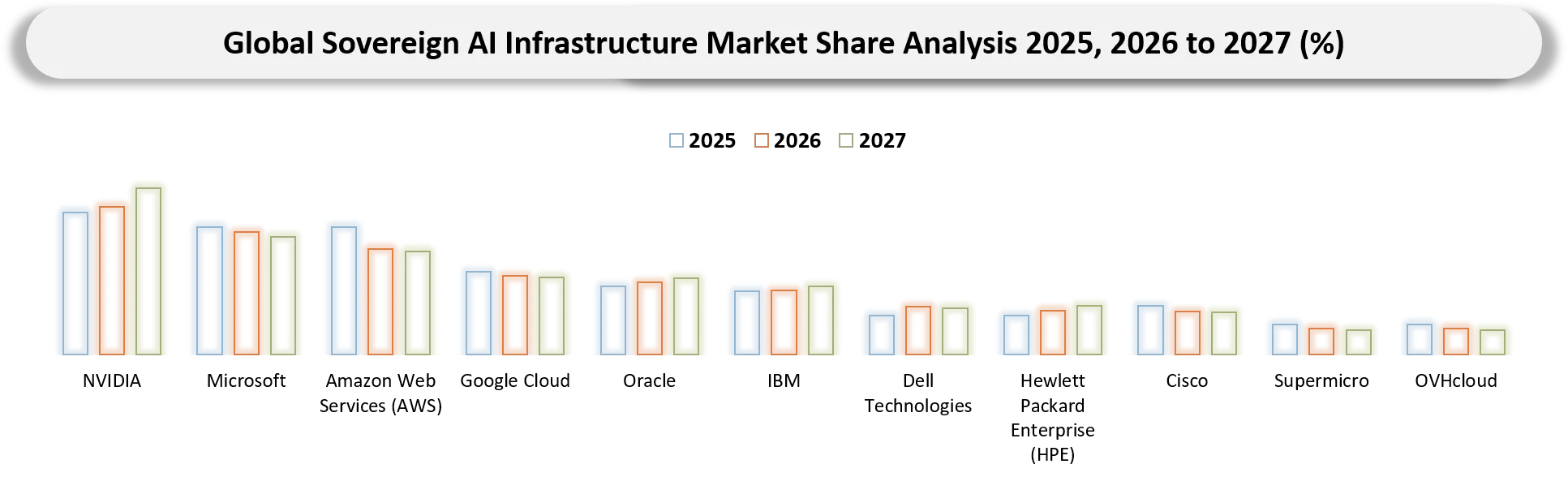
- The market is characterized by three key participant groups: AI accelerator and computing infrastructure providers, hyperscale cloud and sovereign cloud providers, and enterprise infrastructure, networking, and integrated AI solution providers. NVIDIA leads the AI accelerator and accelerated-computing layer, while Dell Technologies, Hewlett Packard Enterprise, and Supermicro focus on AI servers, accelerated computing systems, and integrated infrastructure; Microsoft, Amazon Web Services (AWS), Google Cloud, Oracle, and IBM compete through sovereign cloud, AI platforms, and high-performance computing capabilities; while Cisco, OVHcloud, and Orange strengthen the ecosystem through networking, sovereign cloud, edge, and telecommunications infrastructure. This creates a highly ecosystem-driven landscape where AI compute availability, sovereign cloud capabilities, data residency, infrastructure control, security, scalability, and government partnerships define competitiveness.
- Key players include NVIDIA, Microsoft, Amazon Web Services (AWS), Google Cloud, Oracle, IBM, Dell Technologies, Hewlett Packard Enterprise (HPE), Cisco, Supermicro, OVHcloud, and Orange.
Key Developments
- May 2025: Groq, a U.S.-based AI semiconductor and inference infrastructure company, became the exclusive inference provider for Bell Canada, a Canada-based telecommunications company, to support Bell’s sovereign AI network.
- October 2025: Singularity Venture Hub, Cayman Islands-based AI/Web3 venture incubation and digital-asset advisory company, partnered with Project Mycelium, a global decentralized AI infrastructure and sovereign compute company, to develop a sovereign, agent-first AI cloud across a decentralized network spanning more than 50 countries.
- August 2025: SK Telecom, a South Korea-based telecommunications and AI infrastructure company, launched a sovereign AI infrastructure platform offering GPU-as-a-Service (GPUaaS), powered by more than 1,000 NVIDIA Blackwell GPUs in a single cluster called “Haein.”
- June 2026: Singtel Digital InfraCo’s RE: AI, Singapore-based sovereign AI cloud and digital infrastructure provider, partnered with WEKA, a U.S.-based AI data and memory infrastructure company, to deliver sovereign AI infrastructure across Singapore and the broader ASEAN region.
- April 2026: OneQode, an Australia-based mission-critical digital infrastructure and high-performance compute provider, formed a multimillion-dollar strategic alliance with Hitachi Vantara, a U.S.-based data storage, infrastructure, and hybrid-cloud management company, and a wholly owned subsidiary of Japan’s Hitachi Ltd., and Cylix Applied Intelligence, a global AI solutions and managed AI services provider, to deploy Sovereign AI Factory infrastructure across key markets.
- May 2025: NAVER, a South Korea-based internet, cloud, and AI technology company, and NVIDIA, a U.S.-based AI semiconductor and accelerated-computing company, strengthened their strategic AI alliance around sovereign AI, aiming to help countries develop locally controlled AI capabilities through domestic data processing, localized large language models, and AI infrastructure.
Key Procurement Priorities and Buyer Evaluation Criteria
- Organizations making investments in the Sovereign AI Infrastructure Market are looking at service providers that can offer AI compute capabilities that are secure, domestically controlled, and have the ability to train and infer at high speed.
- The procurement decision-making process has increasingly become dependent on AI sovereignty, data localization, resilient supply chain, cybersecurity, and reduction of dependence on technology controlled by foreigners. The ability to incorporate AI accelerators, AI servers, sovereign cloud infrastructure, networking, storage, power and cooling solutions also plays an important role in buyer evaluation of providers.
- When buying from AI infrastructure providers, buyers consider parameters like data residency, certifications of security and compliance, AI computing capabilities, availability of GPUs and accelerators, performance, scalability, interoperability, workload portability, energy efficiency, and total cost of ownership. The capacity of maintaining sensitive data and AI workloads in specific national or regional jurisdictions is another parameter that buyers evaluate.
Why Choose DataM?
- Technological Innovations: Explores advancements in sovereign AI infrastructure, including accelerated computing, AI servers, sovereign cloud platforms, high-performance networking, AI workload orchestration, advanced cooling, and energy-efficient data-center technologies, enabling secure and scalable AI training, fine-tuning, and inference within designated jurisdictions.
- Product Performance & Market Positioning: Evaluates how infrastructure providers differentiate through AI compute performance, GPU and accelerator availability, scalability, data residency, security, interoperability, workload portability, and total cost of ownership, highlighting competitive positioning across government, defense, telecommunications, financial services, healthcare, and other critical industries.
- Real-World Evidence: Highlights deployment of sovereign AI infrastructure across government services, defense and intelligence, national AI models, healthcare, financial services, telecommunications, and research institutions, demonstrating benefits such as greater control over sensitive data, regulatory compliance, reduced dependence on foreign infrastructure, and improved access to domestic AI computing resources.
- Market Updates & Industry Changes: Tracks key developments such as national AI infrastructure programs, sovereign cloud launches, AI data-center investments, GPU and accelerator deployments, domestic AI model initiatives, and government-backed compute programs across North America, Europe, and Asia-Pacific, supporting analysis of the rapidly developing sovereign AI ecosystem.
- Competitive Strategies: Analyzes how leading companies expand through AI infrastructure investments, sovereign cloud offerings, strategic government partnerships, localized data centers, accelerator and server deployments, technology alliances, and integrated AI infrastructure solutions to address growing demand for nationally controlled AI capabilities.
- Pricing & Market Access: Examines differences in infrastructure costs based on compute capacity, accelerator type, deployment model, data-center requirements, workload intensity, security requirements, and service model, while assessing access through hyperscale cloud providers, sovereign cloud platforms, infrastructure vendors, and government-supported computing environments.
- Market Entry & Expansion: Identifies growth opportunities driven by national AI strategies, data-sovereignty regulations, defense modernization, AI model development, government digitalization, and expansion of domestic compute capacity, while outlining strategies such as localized infrastructure deployment, sovereign cloud partnerships, government contracts, regional data-center expansion, and AI ecosystem collaborations.
Target Audience
- Government Ministries & Public-Sector Agencies
- Defense & Intelligence Organizations
- AI & Cloud Service Providers
- Data Center Operators & Infrastructure Developers
- Semiconductor & AI Hardware Companies
- Telecommunications Service Providers
- BFSI, Healthcare & Other Regulated Enterprises


























































