


Sovereign AI Cloud Market Size and Overview
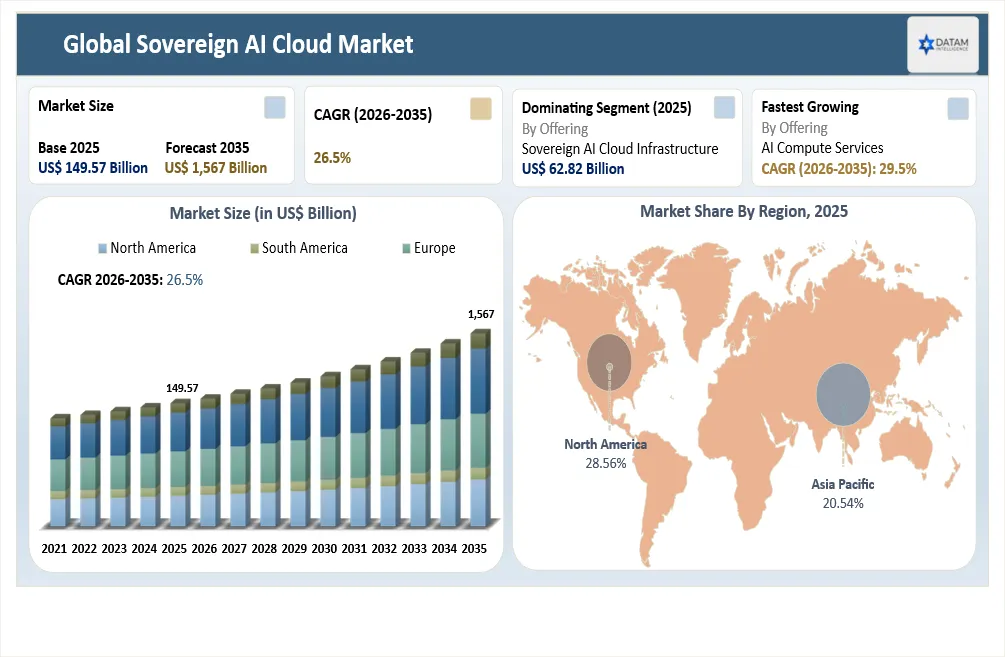
The global sovereign AI cloud market reached US$ 149.57 billion in 2025 and is expected to reach US 1,567 billion by 2035, growing with a CAGR of 26.5% during the forecast period 2026-2035.
Market is shifing from traditional data residency-based approaches towards holistic sovereign AI ecosystems that involve GPU-based ecosystem within the country, sovereign cloud environment, AI model hosting, network, data governance, and operations management. Government organizations and highly regulated industries are increasingly demanding technology infrastructure which not only allows data localization but also gives control on the training and inferencing of AI models, control over encryption keys and software stacks, and operational control, driving the need for sovereign AI cloud services and AI compute national platforms.
Competitive intensity is moving towards national-level compute ecosystems with the involvement of governments, hyperscale companies, telecommunication and infrastructural providers making investments in localized GPU compute infrastructure, AI data centers and sovereignty platforms. The Government of India has stated that over 38,000 GPUs have been empanelled by IndiaAI Mission, and another 20,000 GPUs will be onboarded as part of the IndiaAI Mission, thereby reflecting the demand for local AI infrastructure. According to NVIDIA, over 20 telecommunications companies globally have started creating or deploying national AI clouds, indicating that localized computing, national connectivity, and country-specific control are critical factors within the sovereign AI cloud market.
Sovereign AI Cloud Market Key Takeaways
- In 2025, sovereign AI cloud infrastructure led the global sovereign AI cloud Market with 42% market share, owing to the increase in the need for localized GPU computing, dedicated AI data centers, sovereign cloud technologies as well as regulated AI tasks.
- The AI Compute Services segment is expected to expand fastest in terms of revenue at a CAGR of 29.5% from 2026 to 2035 owing to increasing demand for GPU computing support for the AI training, fine-tuning and inference processes.
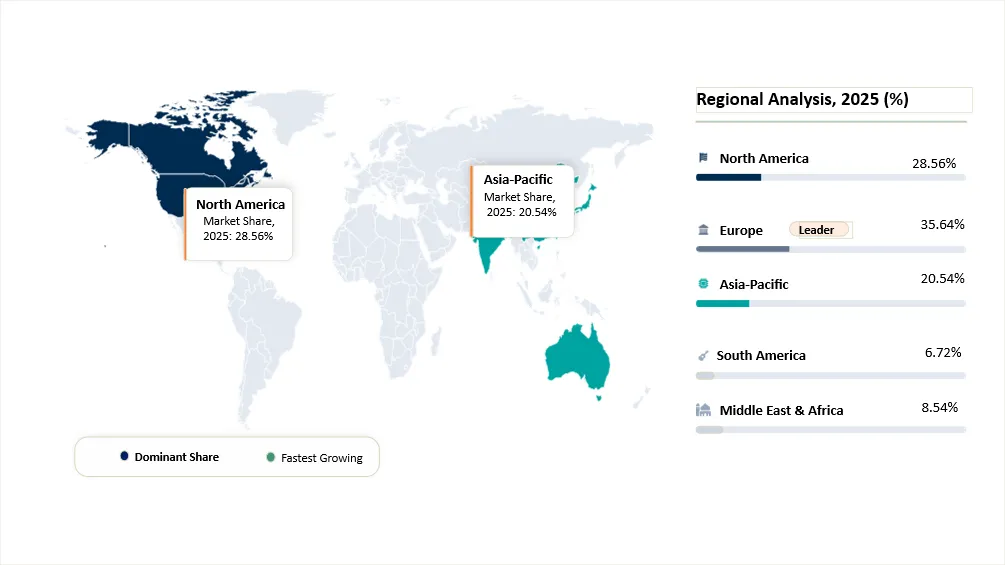
- In 2025, Europe had a controlling position in the global sovereign AI cloud market, holding a 35.64% market share supported by several factors, including strict data-sovereignty regulations, European cloud projects, digitalization of the public sector and increasing investment in sovereign AI infrastructure.
- The increasing use of sovereign foundation models and localized AI platforms is spurring governments and cloud service providers to build dedicated environments that have more control over the data used to train them, model hosting, key management for encryption, software stack and operational access.
- Increasing demand from the government, aerospace and defense, BFSI, healthcare, telecoms, energy and utilities, manufacturing, automotive, retail and research sectors is providing opportunities for integrated sovereign AI platforms that include GPU computing, cloud infrastructure, cyber security and AI governance.
Sovereign AI Cloud Industry Trends and Strategic Insights
- National AI Factories Are Becoming Core Sovereign Infrastructure: The trend is moving away from traditional cloud buying and towards national AI factories that will include large GPU clusters, networks, storage and AI software in order to develop a country’s compute capabilities.
- Sovereign AI Is Expanding Beyond Data Residency: AI sovereignty is now extending to all components of the stack, including GPU sovereignty, model hosting, data processing, cloud administration, encryption and AI infrastructure access.
- Localized Foundation Models Are Driving Sovereign Cloud Demand: Countries are developing foundation models that are trained using local datasets and local languages, leading to the requirement for cloud infrastructure that can train, fine-tune and perform inference on these models.
- Telecom Operators Are Emerging as Sovereign AI Infrastructure Providers: Telecommunications providers are using their local data centers, networks and governmental connections to develop sovereign GPU clouds and AI-as-a-service platforms.
- Regulated and Strategic Workloads Are Becoming the Primary Adoption Base: Defense, Government, Healthcare, BFSI, Energy and Critical Infrastructure will be driving adoption through sovereign AI environments that require data sets and AI workloads to be within designated jurisdictions.
Sovereign AI Cloud Market Scope
| Metrics | Details | |
| 2025 Market Size | US$ 149.57 Billion | |
| 2035 Projected Market Size | US$ 1,567 Billion | |
| CAGR (2026-2035) | 26.5% | |
| Largest Market | Europe | |
| Fastest Growing Market | Asia-Pacific | |
| By Offering | Sovereign AI Cloud Infrastructure, Sovereign AI Cloud Platforms, AI Compute Services, AI Platform Services, Managed Sovereign AI Services, Professional & Integration Services and AI Governance & Compliance Services | |
| By AI Infrastructure | GPU & AI Accelerator Infrastructure, AI Servers, AI Storage Infrastructure, AI Networking & Interconnects, AI Data Center Infrastructure, Power & Cooling Infrastructure, AI Supercomputing Infrastructure and Security Computing Infrastructure | |
| By Deployment Model | Sovereign Public Cloud, Sovereign Private Cloud, Sovereign Hybrid Cloud, Dedicated Sovereign Cloud and On-Premises Sovereign AI | |
| By Sovereignty Level | Data Sovereignty, Operational Sovereignty, Technical Sovereignty, Legal & Jurisdictional Sovereignty and Full-Stack AI Sovereignty | |
| By AI Technology | Generative AI, AI Agents, Machine Learning, Computer Vision, Natural Language Processing and Predictive Analytics | |
| By AI Workload | AI Model Training, Model Fine-Tuning, AI Model Inference, Retrieval-Augmented Generation (RAG), AI Agent Deployment, AI Application Hosting, AI Data Preparation and MLOps | |
| By Provider Type | Hyperscale Cloud Providers, Sovereign Cloud Providers, AI-Native GPU Cloud Providers, Telecom & Edge Cloud Providers, AI Infrastructure & Data Center Providers, Government-Owned Cloud Providers, System Integrators & Managed Service Providers and AI Platform & Foundation Model Providers | |
| By End-User | Government & Public Sector, Aerospace & Defense, Banking & Financial Services & Insurance (BFSI), Healthcare & Life Sciences, Telecommunications, Energy & Utilities, Manufacturing, Automotive, Media & Entertainment, Retail & E-Commerce, Transportation & Logistics, Research & Academia, Education, Technology & IT Services,, Legal & Professional Services, Mining & Natural Resources, Pharmaceuticals & Biotechnology, Agriculture & Food Processing, Travel & Hospitality and Critical Infrastructure | |
| By Region | North America | U.S., Canada, Mexico |
| Europe | Germany, UK, Russia, France, Spain, Italy, Poland | |
| Asia-Pacific | China, India, Japan, Australia, South Korea, Indonesia, Malaysia, Singapore, Vietnam, Thailand, Philippines, Taiwan | |
| South America | Brazil, Argentina | |
| Middle East and Africa | UAE, Saudi Arabia, South Africa, Israel, Turkiye, Nigeria | |
| Report Insights Covered | Competitive Landscape Analysis, Company Profile Analysis, Market Size, Share, Growth | |
Why does this report matter in 2026?
In 2026, the sovereign AI cloud market has emerged as a strategically significant entity as countries and businesses transition from traditional data residency to sovereignty over AI computation, GPU architecture, models, data and cloud operations for mission-critical applications. The quick development of national AI factories, constraints imposed on cross-border data flows and advanced computing techniques and the need for local governance of foundation models have led to greater investments in sovereign AI technology. Meanwhile, defense, health care, BFSI, telecom, energy and public sector firms are looking for safe domestic spaces for their AI training and inference, creating a need for sovereign GPU capacity and AI services.
Sovereign AI Cloud Market White Space & Investment Opportunities
- Sovereign GPU Capacity for Emerging AI Markets: Investing in domestic GPU farms and AI data centers in countries looking to become less reliant on hyperscale clouds and create their sovereign AI computing capability.
- Sovereign AI-as-a-Service Platforms: Investing in sovereign AI training, fine-tuning, inference and model hosting services that do not need the government and regulated businesses to develop their entire AI capabilities.
- National Foundation Model Infrastructure: Investing in cloud platforms designed to train and host locally sovereign, multilingual and industry-specific foundation models on nationally controlled datasets.
- Air-Gapped and Classified AI Clouds: Whitespace for highly isolated AI environments used for defense, intelligence, critical infrastructure and other tasks that require controlled networking and secure access.
- Sovereign AI Stack Integration: Opportunity to deliver AI stacks that integrate hardware like GPUs, networking, storage, management software, cybersecurity, models governance and compliance rather than just providing compute capabilities.
Sovereign AI Cloud Future Market Transformation
The sovereign AI cloud market is forecasted to evolve from jurisdiction-controlled cloud hosting to national AI infrastructure platforms that integrate sovereign GPU resources, high-speed networking, localized foundation models, data silos and AI orchestration under domestic governance. There will be an emergence of government anchor clients and infrastructure investors, while telecom providers, data centers, hyperscalers and dedicated AI vendors are becoming more common public-private partnerships in the construction of national AI factories. In addition, the market will evolve to sovereign AI-as-a-Service, which enables regulated enterprises to obtain training, fine-tuning and inference without building their own GPU cloud infrastructure, along with air-gapped and classified AI environments for defense and critical infrastructure applications. As the requirements of sovereignty evolve beyond data residency to hardware control, model governance, software dependencies and operational access, competitive differentiations will come down to the ownership of the end-to-end AI technology stack and not just the cloud.
Sovereign AI Cloud Market Buyer Decision-Making Criteria
The buyers in the sovereign AI cloud market do not view the cloud providers solely in terms of conventional cloud performance and pricing but rather concentrate on the aspects of jurisdiction, sovereignty of GPUs, compliance requirements, security infrastructure and autonomy. The regulated government agencies and firms are assessing the ability of the vendor to host AI data, models, compute capacity and management in a desired jurisdiction while providing adequate performance.
Major Decision-Making Criteria:
- Jurisdictional and data sovereignty
- Domestic GPU and AI compute capacity
- Sovereign control of cloud operations
- AI model hosting and localization
- Air-gapped/classified workload support
- Infrastructure resilience and energy availability
- Vendor lock-in and sovereign technology independence
Sovereign AI Cloud Market Economic & Investment Analysis
Sovereign AI cloud market is emerging as an important category of infrastructure investment strategy whereby investments are made in the form of local GPU cluster, AI optimized data centers, fast networks, energy and cooling systems. The economics of investment is heavily dependent on factors such as GPU usage, energy availability, costs of accelerators, capacity of data centers and government supported AI programs. The government procurements and national AI programs can act as anchor for demand and help make sovereign compute projects viable.
Opportunities for investment exist across the sovereign AI ecosystem value chain, including GPU cloud operators, data center builders for AI, sovereign clouds, cybersecurity firms, AI model builders and infrastructure integrators. Public-Private Partnerships are emerging as key funding structures and investment attractiveness in the long run will be dependent on government workloads, energy security, accelerator accessibility, use of AI computing power and critical layers of technology control, with sovereign AI infrastructure becoming increasingly pertinent to national digital competitiveness and investment portfolios.
Sovereign AI Cloud Investment Trends in the Market
- Government-Backed AI Infrastructure Funding: The government is now investing more in national GPU clouds, AI factories and sovereign data centers in order to build compute power within the country.
- Strategic Investment in Sovereign GPU Clouds: Investments are being made in GPU-as-a-service clouds that offer jurisdiction-controlled training, tuning and inference capabilities to governments and regulatory-compliant firms.
- Telecom and Data-Center Partnerships: Telecom and data center providers are collaborating with AI technology vendors to set up sovereign GPU infrastructure through existing connectivity and data center capabilities.
- Investment in Sovereign Foundation-Model Ecosystems: Funding is increasingly being directed towards locally run foundation model approaches, native language models and compute infrastructure necessary for their development and implementation.
- Defense-Grade and Air-Gapped AI Infrastructure: Investors are targeting isolated AI environments meant to serve defense, intelligence, critical infrastructure and classified workloads with specific jurisdictional and access control requirements.
Strategic Indicators For the Sovereign AI Cloud Market
High Regulation Impact
The sovereign AI cloud market is significantly influenced by regulations core value proposition depends on national power over AI datasets, computing infrastructure, models and cloud services. Data-residency requirements, national security regulations, AI management systems, cross-border data limitations, public entity buying methods and bans on modern AI processing units affect, in a direct way, locations for establishing sovereign GPU clusters and the type of work carried out. So, the regulations impact the whole spectrum of activities taking place in sovereign AI ecosystems not only in terms of compliance but also referring to entering the market, localization of infrastructure, eligibility of providers, technology sourcing and making investment decisions.
High Investment Activity
Investments in the sovereign AI cloud market are on the rise as government bodies, hyperscalers, telecom operators, data center builders and technology firms invest in local GPU clusters, AI factories, sovereign data centers and AI computing platforms. Capital investments are not only directed towards infrastructure that can support massive model training and inference but also in high-speed network, advanced cooling, power, cybersecurity and sovereign AI software stack capabilities. Increasing use of government-sponsored capital investments, public-private collaborations and compute commitments from the long term will lower the risk of infrastructure investments even further.
Supply Chain Disruption
The market for Sovereign AI Cloud continues to be vulnerable to disruptions in the supply chain because the successful roll-out of AI sovereign clouds at scale requires state-of-the-art GPU cards, bandwidth memory, AI servers, network devices, semiconductor parts and power and cooling infrastructure, all of which are available from only a small number of global suppliers. Export restrictions, geopolitical friction, scarcity of semiconductors, logistical challenges and limitations in terms of access to advanced AI accelerators can delay national AI infrastructure projects and increase deployment costs. This has led to the development of a strategy of buying accelerators strategically, diverse hardware sourcing, indigenous manufacturing of AI servers and long-term contracts as ways of increasing compute availability and reducing reliance on external technology supply chains.
Pricing Volatility
Sovereign AI cloud pricing is very much dependent on the cost and supply of AI accelerators, electricity, capacity in the data center, networking and cooling infrastructure. High-end AI computing machines may require roughly 5-8 kW per one 8-GPU server and one thousand GPUs in a sovereign cloud may require several megawatts of IT power even before considering the facility cost. Instability in the supply of GPUs, electricity, interest rates, semiconductors and construction cost in the data center could make a considerable impact on the cost of sovereign AI compute. There will be large price variations between national AI infrastructures of the governments, sovereign clouds and GPU-as-a-Service companies.
Procurement Pressure
The pressure in the sovereign AI cloud market is becoming intense for government agencies and regulated corporations to obtain GPU capabilities, sovereign data center facilities, electricity access, networking equipment and longer-term AI computing contracts due to limited supply of accelerators and escalating workloads from AI processing. The need to prove that the provider can offer ownership/control of infrastructure within the nation, data residence in the jurisdiction, jurisdictional management of the infrastructure, adherence to the security needs of the country and assured supply of accelerators is forcing providers to make long-term procurement arrangements, reserved GPU capability, hardware sourcing and infrastructure partnerships between the government and private sector, whereas buyers are focusing more on supply assurance and technology independence.
New Technology Adoption
Adoption of new technologies is rapidly gaining traction in the sovereign AI cloud market through innovations such as AI-optimized GPUs, liquid-cooled data centers, fast networks, confidential computing and sovereign AI orchestration solutions. There is increasing deployment of high-performance accelerator clusters for model training and inference along with liquid cooling to address the heat density problem of future AI servers. In terms of software, sovereign cloud environments are being enhanced through the inclusion of features such as AI workload orchestration, model governance, confidential computing and automated security measures to ensure that all data, models and administrative activities remain inside prescribed geographical boundaries.
Regional Expansion Opportunity
The regional expansion of the sovereign AI cloud market is highest in countries pursuing national AI strategies, domestic GPU capacity and tighter control over sensitive data and AI workloads. The growth opportunities in the Asia-Pacific region and the Middle East are considerable due to investments by governments into the creation of AI factories, sovereign data centers and localized AI foundation models, whereas Europe is growing because of its stricter data sovereignty and digital regulation laws. Opportunities for the sovereign GPU cloud in Latin America and Africa are emerging as nations try to adopt the capability to use AI without completely using foreign hyperscale cloud capacity.
Government Policy Support
Government policy support is a major catalyst in the sovereign AI cloud market as countries are implementing their national AI strategy, public financing, domestic compute policies, data localization policies and procurement processes to develop their own AI abilities. The policies will favor the development of national GPU infrastructure, AI factories, sovereign data centers and foundation models and there will be barriers for cross-border data flows and advanced AI accelerator technology usage. Governments will be adopting other measures like partnerships between the public and private sectors, tax breaks, infrastructure financing and public sector AI contracts to mitigate risks and build sovereign AI infrastructure.
Pricing Intelligence
The Pricing intelligence of sovereign AI cloud market is becoming increasingly dependent on GPU hour economics, job load, reservation duration, security needs and sovereign tiers of service instead of relying exclusively on cloud compute pricing. A 1,000-GPU cloud setup will need several megawatts of IT energy to run effectively, but an 8-GPU AI server will require about 5–8 kW of IT energy to run effectively, making utilization an important component in assessing compute economics. This means that the providers are beginning to offer solutions based on reserved GPUs, dedicated sovereign clusters, pay per inference, hours of training charges and sovereign tiers or levels of isolation/security, while the buyer measures each provider based on GPU hour cost, rate of utilization, training job cost and overall AI workload cost.
| HS Code | Reporter | Trade Flow | 2025 Trade Value | Interpretation |
854231 (Electronic integrated circuits-processors and controllers) | China | Imports | US$173.39 Billion | Major demand for processors and controllers supporting domestic AI and computing infrastructure |
854231 (Electronic integrated circuits-processors and controllers) | Singapore | Imports | US$47.63 Billion | Strong semiconductor import activity supporting advanced computing and AI infrastructure |
854231 (Electronic integrated circuits-processors and controllers) | United States | Imports | US$34.58 Billion | Significant demand for processor components used in high- performance computing and AI systems |
854231 (Electronic integrated circuits-processors and controllers) | South Korea | Imports | US$32.27 Billion | Reflects substantial demand for advanced semiconductor components supporting AI compute infrastructure |
AI Impact Analysis of Sovereign AI Cloud Market
AI is contributing to the growth of the sovereign AI cloud market through the growing demand for domestic GPU capability, model training, fine-tuning and inference under jurisdiction control. Growing adoption of generative AI, agentic AI and sector-specific models has led to the need for countries and regulated firms to develop an infrastructure for AI within the national borders to ensure that sensitive workloads and data sets stay in national jurisdictions.
AI is also transforming the technical needs of sovereign clouds through higher demand for dense compute, liquid cooling, confidential computing, AI workload management, model management and automation of security. Sovereignty is thus moving from just being about data residency to being able to govern the full AI stack of accelerators, models, data sets, software, administration and AI operations, enabling new possibilities for sovereign AI as a service and AI platforms.
Disruption Analysis of Sovereign AI Cloud Market
The sovereign AI cloud market is disrupting the existing hyperscale cloud paradigm by moving the purchasing of the AI infrastructure from centralized cloud regions across the globe to locally controlled GPU infrastructure and local AI platforms. The governments and regulated companies are increasingly becoming interested in controlling the location of processing AI data, location of models, management of infrastructure and governing law of technology stack. This is giving rise to a need for national AI factories, sovereign GPU clouds, localized foundation models infrastructure and localized AI environments that can be decoupled from the existing cloud paradigm.
The disruption is also changing the competitive dynamics by providing telecom providers, national data center firms, defense technology companies and specific sovereign cloud providers with a platform to compete against the hyperscalers. Public-private partnerships and government-led infrastructure initiatives are driving this change, while needs for domestic accelerator access, air-gapped setups, confidential computing and local AI model management are differentiating their offerings. The consequence of this change is that competitive advantage is being defined by sovereign compute availability and jurisdiction control rather than cloud scalability and global presence.
Sovereign AI Cloud Market BCG Matrix: Company Evaluation
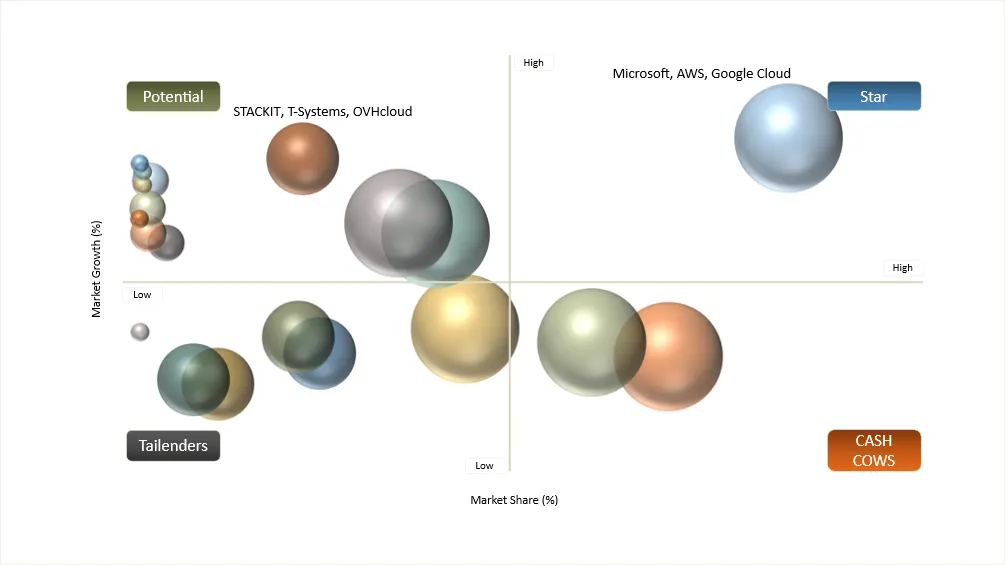
STAR
Microsoft, AWS, Google Cloud, Oracle and Core42 belong to the Star segment due to their capabilities in terms of sovereign cloud, investments in AI infrastructure and participation in the growing government and regulated workloads. The combination of hyperscale/national scale computing capacity with sovereign capability, AI platform, cybersecurity and localized infrastructure makes these vendors well positioned to benefit from increasing interest in sovereign AI deployments. Investment in GPU capacity, specialized cloud regions and national AI collaborations will support future growth of their markets.
POTENTIAL
Potential firms like STACKIT, T-Systems, OVHcloud, NTT DATA, Yotta Data Services and TCS have significant potential to capture market share because of growing preference by governments for building up their own AI infrastructure. Regional presence, sovereign cloud services, integration services and partnerships with government bodies provide these companies with a base for growth despite their smaller size and lower AI computing power compared with hyperscalers. Growth prospects for these firms include scaling up GPU infrastructure, winning government deals and developing sovereign AI platforms.
Sovereign AI Cloud Market Dynamics
Driver Impact Analysis
| Driver | Market Growth Impact (%) | Demand Concentration | Impacted Use Case | Strategic Impact |
National AI Infrastructure Investment | 28.50% | Government & Public Sector | National AI Factories | Accelerates sovereign GPU and AI data-center deployment |
Data Sovereignty & Localization Requirements | 26.00% | Government, BFSI & Healthcare | Sovereign Data Processing | Drives migration of sensitive AI workloads to in-country infrastructure |
Government AI Funding & Procurement | 24.00% | Government & Defense | Public-Sector AI Platforms | Creates anchor demand and reduces infrastructure investment risk |
Local Foundation Model Development | 21.50% | Government & Regulated Enterprises | AI Training & Fine-Tuning | Increases demand for sovereign GPU clusters and localized model infrastructure |
Driver: National AI Infrastructure Investment
Investments by government entities in GPU clusters, AI factories and AI data centers that will be owned by the country are an important catalyst in the sovereign AI cloud market. Countries are looking at their AI computing capabilities as strategic infrastructure and investing money into public procurements and partnerships to develop domestic capacities for training and inference of models. Such investments are especially crucial for areas like defense, public sector, healthcare, finance services and critical infrastructure, where AI computations might need to be done with national data residing in the country. The desire to become independent of foreign hyperscalers and access state-of-the-art AI computing capacity translates into investments in GPU capacity, fast connectivity, electricity and cooling and leads to expansion of the market size.
Restraint Impact Analysis
| Restraint | Drag on Market Growth (%) | Primary Impact Area | Impacted Use Case | Strategic Impact |
High Cost of AI GPU Infrastructure | 32.00% | Capital Expenditure | Large-Scale AI Training | Encourages shared GPU clusters and public-private infrastructure models |
Limited Availability of Advanced AI Accelerators | 27.00% | Hardware Supply | Sovereign AI Compute | Drives long-term procurement agreements and diversified accelerator sourcing |
High Power and Cooling Requirements | 22.00% | Data-Center Operations | High-Density AI Clusters | Increases focus on energy-efficient facilities and liquid-cooling deployment |
Shortage of Specialized AI Infrastructure Talent | 19.00% | Operations & Deployment | AI Cloud Management | Encourages partnerships with hyperscalers, telecom operators and specialized AI providers |
Restraint: High Cost and Limited Availability of AI Compute Infrastructure
The cost of capital and operations involved in creating GPU infrastructure within a nation is one of the major factors limiting the growth of the sovereign AI cloud market. The construction of a nation’s AI factory requires considerable costs in the form of advanced accelerators, high density servers, networking capabilities, power generation capabilities and cooling capabilities, with access to the latest GPUs restricted only to a few suppliers. Such limitations could add up to time taken for deployment and increase the cost of sovereign AI computing much higher than that of shared hyperscale infrastructures, especially for countries having smaller AI workloads and fewer data center and energy capacities.
Sovereign AI Cloud Market Segmentation Analysis
The global sovereign AI cloud market is segmented based on the Offering, AI Infrastructure, Deployment Model, Sovereignty Level, AI Technology, AI Workload, Provider Type, End-User and region.
By Offering
Sovereign AI Cloud Infrastructure anchors sovereign AI cloud adoption
Sovereign AI Cloud Infrastructure is the leading market segment in 2025 with a share of about 42%, driven by the increasing need for local GPU cluster deployment, data centers that are AI ready, high speed network, storage, energy and cooling systems. There is an increased demand for governments and regulated entities to have greater control over the AI compute operations than just using traditional data center residency services. There have been significant investments made by countries in AI infrastructure and sovereign data centers and GPU capacity.
By Offering
AI Compute Services show the strongest growth outlook
AI Compute Services are projected to be the fastest-growing offering segment with 29.5% CAGR from 2026 through 2035 on account of growing demand for AI training, fine-tuning, and inference with GPU acceleration in the respective national jurisdictions. This growth will be fueled by growing adoption of sovereign GPU clouds, national AI programs, and AI-as-a-Service programs, which will help government entities and regulated organizations leverage the computing power without having to build the entire AI stack of capabilities themselves. Growing need for data localization, isolation of workloads, secure execution of models, and overall control are also motivating organizations to purchase computing power from sovereign entities.
Sovereign AI Cloud Market Geographical Penetration
U.S. Sovereign AI Cloud Market Landscape
U.S. sovereign AI cloud market is evolving on the basis of domestic ownership of advanced AI compute, cloud infrastructure, sensitive datasets and strategic AI workloads, as influenced by government-led AI programs, defense needs and dependency on foreign technology supply chains. Leading cloud providers are scaling their U.S.-based AI infrastructure through GPU-enabled data centers, while their government and defense clients are becoming increasingly interested in secure, compliant and jurisdiction-based solutions for their classified and sensitive workloads. Another factor making the U.S. market unique is its vibrant domestic ecosystem including AI accelerators, hyperscale clouds, foundation models, cybersecurity, data centers and defense technologies, which make it possible for sovereign AI deployments to move beyond data residency into control of the entire AI technology stack.
Japan Sovereign AI Cloud Market Outlook
Japan’s sovereign AI cloud market is evolving with domestic cloud infrastructure, domestic foundation models and government-driven AI adoption through the Digital Agency’s trial of three domestic foundation models on SAKURA Cloud under the 2026 Government AI GENAI program. This market is witnessing significant private sector momentum with SoftBank planning to establish sovereign cloud and GPU infrastructure in Japan. SoftBank has its AI Data Center GPU Cloud leveraging NVIDIA GB200 NVL72 and Telco AI Cloud approach towards sovereign AI infrastructure. In addition to this, SoftBank is planning to set up an AI data center in Tomakomai of 50 MW capacity by FY2026 and an AI data center in Sakai of 140 MW capacity by FY2027.
China Sovereign AI Cloud Market Trends
China is stepping up efforts to develop a locally controlled AI cloud ecosystem through the establishment of national computing network centers, domestically built AI accelerators, localized foundation models and massive investments in large-scale data centers. The “East Data, West Computing” program will scale up national computing centers through high-speed fiber connections in AI-oriented computing facilities and efforts towards a coherent national cloud computing network are underway. In terms of enterprise strategy, Alibaba is investing 380 billion yuan ($56.4 billion) in AI and cloud infrastructure until 2029, with revenue from its AI cloud and compute services rising 45% to 48.44 billion yuan for the last quarter. China is at the same time stepping up its efforts to develop locally controlled AI chips against the background of export controls by building self-reliant AI accelerator ecosystems.
India Sovereign AI Cloud Market Trends
The India’s sovereign AI cloud market is growing rapidly through the IndiaAI Mission, domestic GPU Cloud infrastructure build-up and government-supported computing resources, with the focus of India’s AI infrastructure policy being the development of the “frugal, sovereign and scalable ecosystem” and increasing the GPU footprint in the country. The domestic companies are building sovereign infrastructure, where Yotta plans to increase the number of GPUs in its AI infrastructure in the state of Telangana from 32,768 and a new player like Utho Cloud plans to add another 10,000 GPUs over the next 7-8 quarters. The investment is also shifting towards sovereign AI data centers, where HCLTech announced the commitment of ₹14,257 crore ($1.48 billion) for the construction of an AI data center in the state of Odisha along with the company Sarvam AI and the Odisha government.
Sovereign AI Cloud Market Competitive Landscape
- Hyperscaler organizations are increasing their sovereign cloud offerings by using localized data centers, dedicated infrastructure, operation controls and restricted access environments for government and heavily regulated AI workloads.
- Regional players are competing through local control and using locally-owned data centers and operations, along with jurisdiction-based compliance requirements to minimize reliance on foreign clouds.
- GPU capabilities are turning out to be one of the key differentiators as regional players invest in dense GPU environments, AI accelerators, networking infrastructure and AI-ready data centers.
- Full-stack sovereign AI platforms are emerging with integration of training, fine tuning, inference, deployment of AI applications, security and governance within a sovereign-controlled environment.
- Collaboration of strategic government and telecommunications companies is redefining the industry landscape, with both cloud service providers and infrastructure providers working together to build national AI clouds, sovereign GPU capabilities and AI ecosystems.
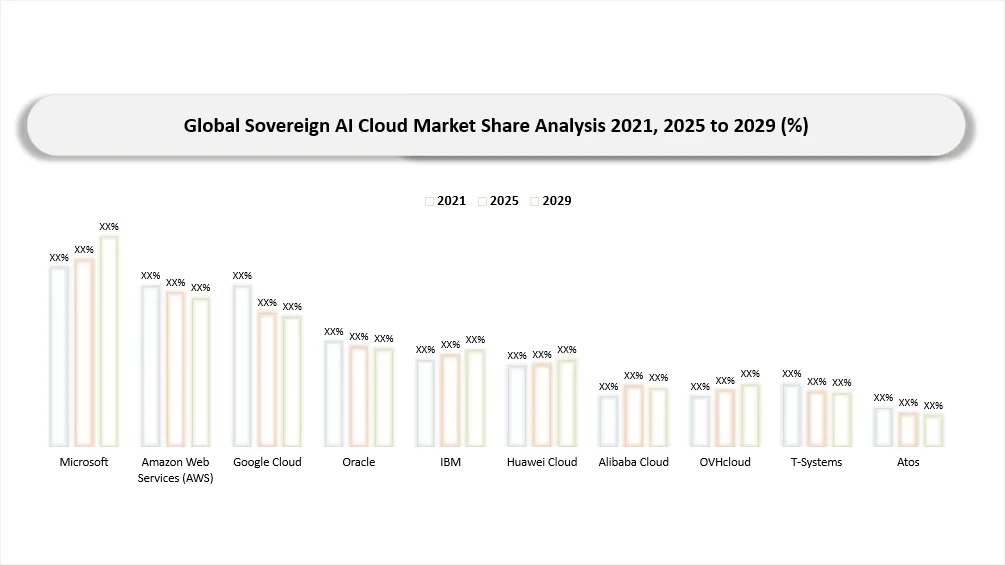
Public Company Q1-Q2 2026 Performance Comparison
The table below contains information on the financial and operating parameters for five companies currently listed on the public market and with a direct stake in the sovereign AI cloud market. Information about financial parameters is given for individual companies while operating parameters include sovereign cloud, AI cloud infrastructure, government clouds, localized data centers, GPU power and associated activities.
| Company | Q1–Q2 2026 Performance | Sovereign AI Cloud-Relevant Exposure | Key Performance Driver |
| Microsoft | Revenue: US$90.0 billion in Q2 FY2026, up 18% YoY; Microsoft Cloud revenue: US$59.3 billion, up 27% YoY. | Azure sovereign cloud, government cloud, AI infrastructure and localized data controls | Azure and AI infrastructure demand; Azure and other cloud services grew 43% in Q4 FY2026. |
| Amazon (AWS) | Q2 2026 net sales: US$200.6 billion, up 20% YoY; AWS revenue: approximately US$30 billion, up 37% YoY. | AWS sovereign cloud, government cloud, isolated infrastructure and AI compute | Accelerating AI workloads, cloud migration and AWS infrastructure demand |
| Alphabet (Google Cloud) | Q2 2026 Google Cloud revenue: US$24.8 billion, up 82% YoY. | Sovereign cloud, AI infrastructure, data-residency controls and regulated workloads | Enterprise AI adoption and accelerated Google Cloud infrastructure demand |
| Oracle | FY2026 Q4 revenue: US$19.2 billion, up 21% YoY; cloud revenue: US$9.9 billion, up 47% YoY. | Oracle Sovereign Cloud Regions, dedicated cloud infrastructure and AI workloads | OCI expansion and rapidly increasing AI infrastructure demand |
| IBM | Q2 2026 revenue: approximately US$17.2 billion, up 1% YoY. | Sovereign cloud, hybrid cloud, AI governance and regulated workloads | Hybrid cloud, enterprise AI and software-led growth |
Note: Financial periods differ because companies follow different fiscal calendars. Company-level revenue should not be interpreted as Sovereign AI Cloud revenue, since sovereign AI cloud revenue is generally not separately disclosed. The comparison combines reported financial performance with market-specific sovereign AI cloud exposure to assess each company's position in the market.
For AWS and Google Cloud, the publicly listed companies are Amazon.com, Inc. and Alphabet Inc., respectively. AWS and Google Cloud are their operating businesses, not separately listed companies.
Key Companies of the Sovereign AI Cloud Market
- Microsoft (United States)
- Amazon Web Services (AWS) (United States)
- Google Cloud (United States)
- Oracle (United States)
- IBM (United States)
- Alibaba Cloud (China)
- Huawei Cloud (China)
- Core42 (United Arab Emirates)
- OVHcloud (France)
- T-Systems (Germany)
- Orange (France)
- NTT DATA (Japan)
- Yotta Data Services (India)
- Atos (France)
- Tata Consultancy Services (TCS) (India)
- CoreWeave (United States)
- STACKIT (Germany)
- IONOS Cloud (Germany)
- Swisscom (Switzerland)
- STC Cloud (Saudi Arabia)
Company Profiles
Microsoft
Microsoft is one of the foremost providers of sovereign AI cloud solutions through its Azure platform, providing localized cloud environments, AI infrastructure, data residency control and operations controls for use by governments and regulated sectors.
Competitive objectives include building out more sovereign Azure implementations, adding capacity for AI/GPU, facilitating national AI programs, ensuring controls over data and operations and incorporating secure generative AI services.
Amazon Web Services (AWS)
Amazon Web Services is one of the most popular providers of cloud solutions on a global scale, offering sovereign clouds for governments, defense agencies and regulated enterprises. AWS provides dedicated infrastructure and isolated clouds as well as data residency, AI compute and security solutions.
The list of competitive initiatives includes the expansion of sovereign cloud availability zones, scaling of AI compute, government AI solutions, jurisdictional controls and generative AI solutions.
Google Cloud
Google Cloud offers sovereign cloud and AI capabilities with data residency, encryption, control, cybersecurity and AI-specific computing. The cloud capabilities allow government agencies and regulated organizations to use advanced AI while having more control over sensitive data and computing workloads.
Google Cloud strategic priorities are developing sovereign cloud partnerships, increasing AI compute capabilities, deploying localized AI infrastructure and supporting data governance and national AI initiatives.
Oracle
Oracle offers Sovereign Cloud services which ensure that critical applications and data remain within specific jurisdictions. Oracle’s product line is comprised of Oracle Cloud Infrastructure, sovereign cloud regions, database technology and artificial intelligence infrastructure for government and regulated sector loads.
Competitive differentiators would include sovereign cloud regions expansion, AI/GPU infrastructure enhancement, government & defense loads support, stronger data residency capabilities and AI-intensive enterprise loads capture.
IBM
The company has sovereign and hybrid clouds for use by governments, banks and health care organizations among others. It offers sovereign hybrid cloud, artificial intelligence, cybersecurity and data governance to help gain more control of the regulated workloads.
Some of its competitive priorities are to expand sovereign hybrid cloud deployments, incorporate AI in enterprise with regulated workloads, enhance AI governance and cybersecurity and localize cloud adoption.
Core42
Core42 is an AI and cloud infrastructure company based out of the United Arab Emirates and is dedicated to sovereign AI, GPUs, cloud platforms and national digital infrastructure. Their service offerings include sovereign cloud, HPC, AI services and data center infrastructure.
The competitive priorities for Core42 include increasing sovereign GPU computing, national AI infrastructure, government and enterprise utilization, regional cloud and foundation models.
Sovereign AI Cloud Market Major Pain Points
- Dependence on Foreign AI Accelerators: Over-reliance on centralized worldwide GPU and semiconductor supply chains prevents nations from exercising full control over sovereign AI compute.
- Power and Data-Center Capacity Constraints: Deployment of sovereign AI will demand power, dense data centers, cooling and infrastructure; hence, power is one of the limitations for the mass deployment of GPUs.
- High Capital Requirements and Long Infrastructure Lead Times: Setting up sovereign AI plants involves heavy costs, including GPUs, data centers, networking, energy and cooling and infrastructure deployment faces challenges related to power and long lead times.
- Limited Sovereign AI Talent and Operational Expertise: Running sovereign AI platforms entails unique skills for GPU orchestration, AI Infrastructure, cybersecurity, model operations and lifecycle management that may be hard to cultivate at home.
- Difficulty Achieving Full-Stack AI SovereigntySovereignty not only involves keeping data within a country’s boundary but also encompasses the hardware, software, control plane, models, supply chain, management and the entire life cycle of technology, making technological sovereignty very challenging.
Sovereign AI Cloud Market Recent Developments
- August 2026 - Microsoft: Microsoft enhanced its India cloud network through the introduction of the India South Central datacenter region in Hyderabad, enabling better localized cloud infrastructure and data governance and security for AI in India.
- May 2026 - STACKIT: STACKIT was chosen to deliver the sovereign, BSI-certified cloud base for Germany’s new federal AI platform, thus enhancing its involvement in the German public sector’s AI ecosystem.
- January 2026 - Amazon Web Services (AWS): AWS introduced the European Sovereign Cloud, which is a cloud platform that operates independently in Europe and is aimed at offering increased control and sovereignty over government workloads.
- October 2025 - Oracle: OCI Dedicated Region 25 was introduced by Oracle, which allowed for the deployment of more than 200 OCI cloud and AI services in the customer’s own data centers for workloads where there is a need for more control over the location of data.
- October 2025 - Yotta Data Services: Yotta scaled its Shakti Cloud using a DDN solution for 8,000 NVIDIA B200 GPUs to boost AI-compute capabilities in India for government-driven AI initiatives.
Analyst View / Opinion on Sovereign AI Cloud Market
- The Sovereign AI Cloud is moving away from being a regulatory necessity towards being a priority for national infrastructure, as governments begin to realize the importance of controlling their own AI compute, data and models for economic and technological sovereignty.
- Availability of GPUs will become a key point of competition, putting the sovereign AI providers who can lock in long-term accelerator capacity, dense datacenter space and stable power at an advantage over those concentrating on cloud software alone.
- The industry is evolving from data residency to stack sovereignty, including AI accelerators, cloud, models, data, orchestration, security and administration; such evolution offers prospects for sovereign AI platforms as opposed to traditional localized cloud solutions.
- Public-private collaboration will be a key driver of market growth, since governments offer policy, funding and demand, whereas cloud, telecommunications, semiconductors and data centers supply the necessary infrastructure and capabilities for scaling.
- There will be regional sovereign AI clouds that will differentiate themselves by their abilities to compute and make models. Such countries will include India, Japan, China, USA and UAE, which will each have different models for their governments and cloud and AI strategies.
Sovereign AI Cloud Market Target Audience
| INDUSTRY | WHO SHOULD BUY THIS REPORT? | REASON TO BUY THIS REPORT |
| Government & Public Sector | Government AI & Digital Ministries | Assess national AI compute capacity, sovereign infrastructure strategies and policy-driven demand |
| Cloud Computing | Sovereign Cloud Providers | Evaluate opportunities in jurisdiction -controlled AI cloud and GPU services |
| AI Infrastructure | AI Cloud & GPU Providers | Assess demand for sovereign GPU clusters, AI factories and dedicated compute |
| Telecommunications | Telecom Operators | Identify opportunities to deploy sovereign AI infrastructure using domestic networks and data centers |
| Data Centers | AI Data Center Developers | Evaluate demand for high-density AI facilities, power and cooling infrastructure |
| Semiconductors | GPU & AI Accelerator Manufacturers | Assess regional demand for AI accelerators and sovereign compute deployments |
| AI Software | Foundation Model Developers | Evaluate infrastructure demand for sovereign model training, fine-tuning and inference |
| Defense & Aerospace | Defense AI Providers | Assess demand for classified, air-gapped and sovereign AI environments |
| Cybersecurity | AI & Cloud Security Providers | Identify opportunities in sovereign workload protection, encryption and compliance |
| Financial Services | Banks & Financial Institutions | Evaluate sovereign AI infrastructure for sensitive financial data and regulated workloads |
Why Choose DATAM?
- Data-Driven insights: Dive into detailed analyses with granular insights such as pricing, market shares and value chain evaluations, enriched by interviews with industry leaders and disruptors.
- Post-Purchase Support and Expert Analyst Consultations: As a valued client, gain direct access to our expert analysts for personalized advice and strategic guidance, tailored to your specific needs and challenges.
- White Papers and Case Studies: Benefit quarterly from our in-depth studies related to your purchased titles, tailored to refine your operational and marketing strategies for maximum impact.
- Annual Updates on Purchased Reports: As an existing customer, enjoy the privilege of annual updates to your reports, ensuring you stay abreast of the latest market insights and technological advancements. Terms and conditions apply.
- Specialized Focus on Emerging Markets: DataM differentiates itself by delivering in-depth, specialized insights specifically for emerging markets, rather than offering generalized geographic overviews. The approach equips our clients with a nuanced understanding and actionable intelligence that are essential for navigating and succeeding in high-growth regions.
- Value of DataM Reports: Our reports offer specialized insights tailored to the latest trends and specific business inquiries. The personalized approach provides a deeper, strategic perspective, ensuring you receive the precise information necessary to make informed decisions. The insights complement and go beyond what is typically available in generic databases.
What DATAM Uniquely Provides
- Sovereign AI Stack-Level Market Mapping; This report offers a detailed analysis of the market for AI, considering AI accelerators, GPU cloud computing, data centers, networking, foundations models, orchestration, cybersecurity and sovereign operations.
- Country-Level Sovereign AI Intelligence: This report analyzes sovereign AI markets in terms of their respective AI strategies, compute power within the country, data sovereignty considerations, procurement, cloud readiness and infrastructure investments.
- GPU Capacity and Infrastructure Economics: DATAM links GPU capability, power consumption, cooling capabilities, data center deployments, cost structure and economics of use to determine the areas where sovereign AI infrastructure is economically viable.
- Buyer and Procurement Intelligence: This report analyzes how governments, defense entities, regulated firms, telecommunication companies and AI vendors assess sovereign cloud service providers considering issues like governance, security, compliance, performance, resiliency and total cost of ownership.
- Strategic Ecosystem and Competitive Benchmarking: DATAM identifies hyperscalers, sovereign cloud vendors, GPU-cloud vendors, telecom operators, AI model builders, semiconductor vendors and data center operators, mapping the capabilities and connections of companies in relation to sovereign AI possibilities at the country level.


























































