


Southeast Asia Cables & Wires Market Size and Overview
The Southeast Asia cables and wires market across seven covered countries was valued at US$ 7.61 billion in 2025 and is forecast to reach US$ 11.01 billion in 2031, growing at 6.36% annually over 2025–2031. This market includes low-voltage building cables, medium- and high-voltage power cables, datacom cables and specialty cables.
Demand is shaped by factory investment, power-grid upgrades, urban construction, industrial estates, renewable interconnections and regional communications networks. Indonesia and Vietnam benefit from expanding industrial and energy infrastructure, while Thailand and Malaysia have important manufacturing demand. Singapore provides a specialized market for certified building wiring and high-performance connectivity, including data-center installations.
| 2025 MARKET SIZE | 2031 FORECAST | CAGR (2026–2031) |
|---|---|---|
| US$ 7.61 Billion | US$ 11.01 Billion | 6.36% |
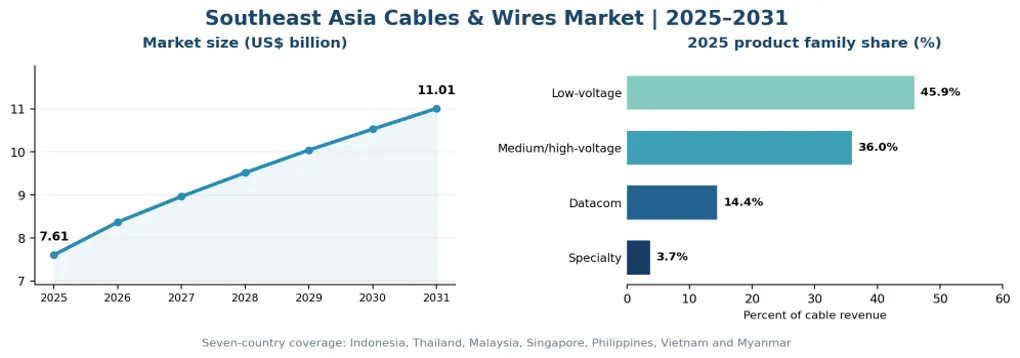
Southeast Asia cable and wire revenue grows by US$ 3.40 billion from 2025 to 2031 across the seven covered markets.
The aggregated endpoint-based growth rate is 6.36% annually, underpinned by power networks, industrial expansion and digital connectivity.
Low-voltage cables account for 45.92% of 2025 revenue, serving factories, building wiring, commercial facilities and distribution applications.
Medium- and high-voltage cables account for 35.96% of 2025 revenue, driven by utility reinforcement and renewable connections.
Datacom cables hold 14.42% of 2025 revenue, supported by fiber networks, enterprise installations and data centers.
Specialty cables hold 3.70% of 2025 revenue, spanning marine, oil and gas, mining and renewable applications.
Southeast Asia Cables & Wires Industry Trends and Strategic Insights
Distribution-grid reinforcement, renewable interconnections and industrial power upgrades create recurring demand for MV/HV products, tested accessories and reliable EPC supply arrangements.
Electronics, automotive, semiconductor and general manufacturing investment supports control, instrumentation, flexible industrial and high-specification low-voltage cabling.
Dense cities, new industrial estates and transportation projects increase requirements for fire-performance cables, compliant building wiring and durable underground installations.
Fiber-to-the-premises networks, cloud facilities and enterprise connectivity drive optical-fiber and structured copper demand, with specification consistency and installer support increasingly important.
Southeast Asia Cables & Wires Market Scope
| METRICS | DETAILS |
| 2025 Market Size | US$ 7.61 Billion |
| 2031 Projected Market Size | US$ 11.01 Billion |
| CAGR (2026–2031) | 6.36% |
| Geographic Coverage | Indonesia, Thailand, Malaysia, Singapore, Philippines, Vietnam and Myanmar (seven covered countries) |
| By Cable Type | Datacom Cables (Communication & Data Cables, Fiber Optic Cables); Low-Voltage Cables (Fire Resistant Cables, Low Smoke & Halogen Free Cables, Low Voltage Cables & Wires); Medium- and High-Voltage Cables (Medium Voltage Cables, High Voltage Cables); Special Cables (Mining Oil & Gas Cables, Photovoltaic Cables, Ship & Harbour Cables, Windmill Cables) |
| By Industry | Industrial — Discrete (Aerospace & Defense, Automotive, Batteries, Electrical & Electronics, Machine Building, Semiconductor); Process (Chemicals, Energy/Oil & Gas, Metal Processing); Hybrid (Food & Beverage, Lifesciences, Mining & Quarrying, Other Manufacturing). Non Industrial — Transportation (Air, Land, Rail, Marine Services); Infrastructure & Services (Commercial Real Estate, Data Centers, Healthcare, Hospitality & Entertainment, Public Sector/Research/Education, Residentials, Water & Waste, Others). Power Utilities — Power Generation (Coal, Conventional Excl. Coal, Renewables); Power Distribution & Transmission. |
| By Conductor / Transmission Medium | Copper; Aluminum; Optical Fiber; Composite / Hybrid Construction |
| By Voltage Rating (Power Cables) | Low Voltage (up to 1 kV); Medium Voltage (above 1 to 35 kV); High Voltage (above 35 to 230 kV); Extra-High Voltage (above 230 kV) |
| By Insulation and Sheathing Material | Cross-Linked Polyethylene (XLPE); Polyvinyl Chloride (PVC); Ethylene Propylene Rubber (EPR/EPDM); Polyethylene (PE); Low Smoke Zero Halogen (LSZH); Other Materials |
| By Installation Method | Overhead; Underground / Buried; Submarine / Underwater; Indoor / Building; Outdoor / Industrial |
| Competitive Landscape | Company positioning, 10 company profiles, recent developments and partnerships |
| Market Data Coverage | Cables and wires market value by covered country and cable subtype, 2025–2031 (US$ million); end-market and technical segmentation framework |
The study covers the combined markets of Indonesia, Thailand, Malaysia, Singapore, the Philippines, Vietnam and Myanmar, plus country-level opportunity comparisons. Market values are aggregated from each country’s cable-specific series for 2025–2031. Segmentation covers cable family, industry application, conductor, voltage, insulation and installation method.
Southeast Asia Cables & Wires Market White Space & Investment Opportunities
Industrial estates and manufacturing clusters: Electronics, assembly, food processing and export-oriented investment generate demand for industrial power, controls and low-smoke cables.
Power-network resilience: Grid modernization, rural electrification and renewable integration open opportunities in MV/HV, underground, photovoltaic and wind-related cable systems.
Digital infrastructure: Fiber-backbone upgrades, metro connectivity and data-center expansion support optical fiber, copper datacom and fire-performance cabling.
Indonesia and Vietnam offer large expansion opportunities in power and manufacturing infrastructure. Thailand and Malaysia provide established industrial and construction demand, while Singapore favors higher-value, tightly specified products. The Philippines has opportunities in electricity distribution, connectivity and island infrastructure. Myanmar represents a smaller market with higher project and execution uncertainty.
Driver Impact Analysis
Manufacturing relocation, industrial-estate construction and continued investments in electronics, automotive and other factories are important demand drivers. They stimulate low-voltage distribution cables, automation wiring and control circuits, with procurement favoring tested quality, availability and local technical support. Suppliers can improve market access by partnering with established industrial contractors and distributors.
| DRIVER | AFFECTED PRODUCT / SIGNAL | IMPACT | STRATEGIC IMPACT |
| Industrial and manufacturing growth | Low-voltage, control and flexible cables | High | Build relationships with industrial contractors and production zones. |
| Power-grid reinforcement | MV/HV and underground cables | High | Secure utility qualification and strengthen EPC partnerships. |
| Telecom and data-center infrastructure | Optical fiber, copper datacom, fire-performance cables | Moderate–High | Develop specialist installer and systems-integrator channels. |
| Construction and urbanization | Building wiring and fire-safe products | Moderate–High | Expand distributor inventory and compliance support. |
Power networks and renewables offer a second growth stream. Distribution upgrading, connection of solar and wind capacity, and cross-region energy infrastructure require medium- and high-voltage systems. On-site demand from buildings, logistics facilities, communications networks and data centers expands product opportunities beyond conventional utility procurement.
Restraint Impact Analysis
Copper and aluminum price swings can compress cable-maker margins and delay purchasing when tenders lack price-adjustment terms. Regional suppliers face varying import duties, conformity requirements and exchange-rate exposures. Maintaining qualified alternative supply, disciplined quotations and forward procurement can reduce the effects on execution.
| RESTRAINT | PRIMARY EXPOSURE | RISK LEVEL | STRATEGIC IMPACT |
| Metal price and currency volatility | Copper, aluminum and imported cable inputs | High | Use transparent pricing clauses and purchasing discipline. |
| Project approval and grid bottlenecks | Utility and renewable installations | High | Follow tender milestones and project qualification gates. |
| Variable standards and certification | Industrial and building applications | Moderate–High | Localize test documentation and installer support. |
| Cross-border logistics and low-cost competition | Specialty imports and standard low-voltage products | Moderate | Improve service levels and supply options. |
Large utility and construction projects can encounter connection bottlenecks, lengthy engineering approvals and uneven contractor capacity. Competitive pricing from regional and international manufacturers adds pressure, especially in standard low-voltage products. Differentiation through product testing, warranty support, dependable lead times and compliance documentation becomes more important as projects scale.
Southeast Asia Cables & Wires Market Competitive Landscape
The competitive landscape includes diversified global cable suppliers, large Asia-based cable groups and established national manufacturers. Competitive capabilities differ by product category: utility qualification is critical in MV/HV projects, while brand recognition, channel access and speed of delivery are especially relevant in low-voltage and construction cable.
| COMPANY | SOUTHEAST ASIA CABLES & WIRES POSITIONING |
| Prysmian Group | Regional power, building and high-voltage cable supply; global manufacturing network. |
| Nexans | Power distribution and specialty cable portfolio for infrastructure and industrial projects. |
| LS Cable & System | Large Asian power-cable producer with MV/HV and specialty product capabilities. |
| Hengtong Group | Power cables, fiber-optic cables and offshore/submarine technology serving Asian markets. |
| ZTT Group | Optical-fiber, power cable and submarine-cable products across Asian infrastructure applications. |
| Thai-Yazaki Electric Wire | Thai manufacturer serving industrial, building and utility cabling demand. |
| Bangkok Cable | Thailand-based wire and cable production for utility, construction and industry. |
| PT Kabelindo Murni | Indonesian electrical cable supplier for distribution and building applications. |
| Southern Cable Group | Malaysia-based supplier of power cables for infrastructure and electrical applications. |
| Viet Nam Electric Cable Corporation (CADIVI) | Vietnam-based electric cable producer supplying construction and industrial markets. |
Manufacturers compete through local production, regional distribution, copper and aluminum sourcing, quality certifications and project partnerships. Thailand, Indonesia, Malaysia and Vietnam host important manufacturing or assembly capabilities; international producers also supply specialty power cables and high-performance communications cabling into the region.
Southeast Asia Cables & Wires Market Recent Developments
2026: Power-grid reinforcement and renewable interconnection programs continue to create procurement opportunities for MV/HV and specialty cables across covered Southeast Asian markets.
2026: Factory and industrial-estate development sustains demand for building power, control and flexible industrial cabling in key manufacturing hubs.
2026: Fiber-network deployment and data-center development increase specification requirements for optical fiber and structured copper products.
2026: Regional suppliers continue emphasizing qualified manufacturing capacity, distribution coverage and industrial project support.
2026: Fire-safety expectations and product compliance requirements influence cable selection in industrial, commercial and infrastructure applications.
2026: Metals price volatility, execution schedules and cross-border supply risks remain important commercial considerations for cable procurement.


























































