


South Korea PFAS CRM Market Size and Overview
The South Korea PFAS CRM market reached USD 1.14 million in 2025 and is expected to reach USD 3.94 million by 2035, growing with a CAGR of 13.2% during the forecast period 2026-2035. The market demand is expected to strengthen as regulatory monitoring expands and laboratories require reliable reference materials for low-concentration PFAS analysis, calibration, and analytical quality control. In October 2025, the Ministry of Climate, Energy and Environment (MCEE) announced plans to establish PFAS drinking-water quality standards by 2028 and expand monitoring coverage from 101 large water-treatment plants to all 427 plants nationwide.
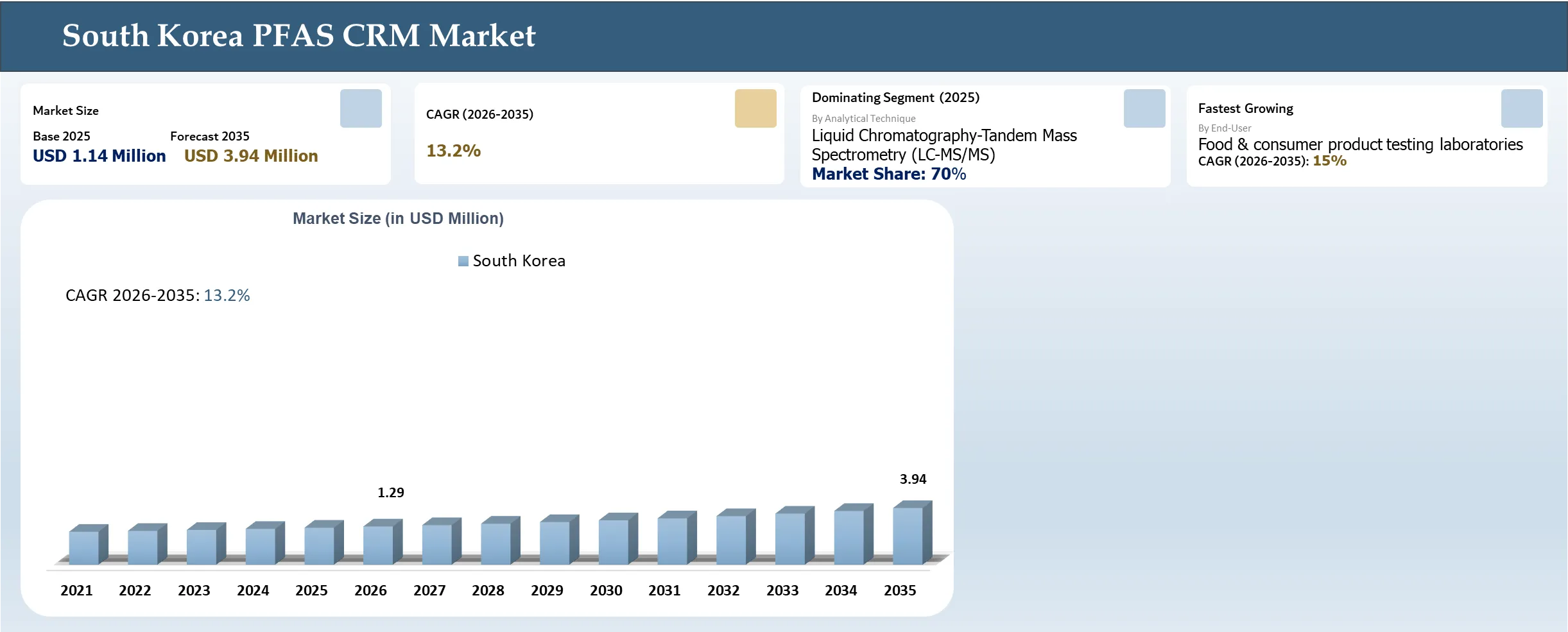
The ministry also outlined plans to improve PFAS analytical capability from 5 ng/L to 1 ng/L, increasing the importance of accurate, traceable reference standards for method validation and measurement reliability. The planned measures represent a potential demand driver for PFAS-specific CRMs as South Korea strengthens drinking-water surveillance.
South Korea PFAS CRM Market Key Takeaways
- Liquid Chromatography–Tandem Mass Spectrometry (LC-MS/MS) dominated the market with a 70% share in 2025. Its dominant market position is driven by its high precision in detecting targeted compounds like PFOS and PFOA.
- Environmental monitoring surveys conducted in 2025 revealed a mean PFAS concentration of 2,803 ng/L at a site receiving semiconductor effluent. Ultra-short-chain PFAS comprised 58.9% of the total monitored PFAS composition at this site.
- RNS Science reported producing certified reference materials using geosmin and 2-MIB extracted from natural blue-green algae at over 95% purity. The resulting reference materials achieved over 98% accuracy and precision.
- Expanding ISO 17034-accredited production serves as a core market expansion driver alongside stricter water monitoring regulations. Increased environmental monitoring budgets further accelerate market adoption across end-users.
South Korea PFAS CRM Market Scope
| Metrics | Details |
| 2025 Market Size | USD 1.14 Million |
| 2035 Projected Market Size | USD 3.94 Million |
| CAGR (2026-2035) | 13.2% |
| By Product Type | Native PFAS CRMs, Stable Isotope-Labeled (SIL) PFAS CRMs, Others |
| By PFAS Chemical Class | Perfluoroalkyl Carboxylic Acids (PFCAs), Perfluoroalkane Sulfonic Acids (PFSAs), Fluorotelomer Compounds (FTs), Perfluoroalkane Sulfonamides & Sulfonamidoethanols (FOSAs & FOSEs), Others |
| By Matrix | Water, Soil & Sediment, Biological Samples, Food & Feed, Consumer Products & Packaging, Aqueous Film-Forming Foam (AFFF), Others |
| By Regulatory Method | EPA Method, ASTM Methods, ISO Methods, DIN Methods, AOAC Methods, Others |
| By Analytical Technique | Liquid Chromatography-Tandem Mass Spectrometry (LC-MS/MS), Liquid Chromatography-High Resolution Mass Spectrometry (LC-HRMS), Gas Chromatography-Mass Spectrometry (GC-MS), Other Analytical Techniques |
| By End-User | Environmental Testing Laboratories, Government & Regulatory Laboratories, Food & Consumer Product Testing Laboratories, Pharmaceutical & Biotechnology Laboratories, Industrial Manufacturing Laboratories, Academic & Research Institutes, Contract Research Organizations (CROs) |
| Report Insights Covered | Competitive Landscape Analysis, Company Profile Analysis, Market Size, Share, Growth |
South Korea PFAS CRM Market Disruption Analysis
Shift Toward Ultra-Trace PFAS Analysis Reshaping South Korea’s PFAS CRM Market
The disruption in the South Korean PFAS CRM market is driven by the shift toward more sensitive analytical methods capable of quantifying PFAS at increasingly low concentrations. With the growing need for environmental labs to meet more stringent monitoring regulations, traditional reference materials might not be sufficient to cover all emerging compounds and requirements for ultra-trace analyses. It is making certified reference materials with well-defined concentration, measurement uncertainty, and traceability highly relevant as calibration and validation tools for instruments and analytical methods.
Improved detection sensitivity is increasing the need for specialised PFAS reference materials in South Korea’s semiconductor wastewater monitoring. In January 2026, according to the KOAJ Korea Open Access Journal, published in Environmental Analysis, Health and Toxicology has investigated 28 PFAS compounds and demonstrated how optimised analytical conditions have improved signal intensity by 4.9 times for TFMS, 13.9 times for PFEtS, 13.0 times for PFPrA, and 23.4 times for PFPrS. The study consisted of five monitoring surveys conducted in 2025 and demonstrated that the mean concentration of PFAS at one of the monitoring sites receiving effluent from the semiconductor industry was 2,803 ng/L. Ultra-short-chain PFAS made up 58.9% of the overall composition of the monitored PFAS.
South Korea PFAS CRM Market BCG Matrix: Company Evaluation
Stars include KOTITI Testing & Research Institute because it offers PFAS-related reference materials and has direct relevance to South Korea’s domestic PFAS testing requirements. Question Marks include CPAchem Ltd. and Chiron AS because both supply specialised analytical standards and reference materials that may serve South Korea’s expanding PFAS testing requirements.
Potential includes LGC Standards and Merck KGaA, which benefit from broad reference-material portfolios, international distribution networks, and established laboratory customer bases. Tailenders are not assigned among the five selected companies because there is insufficient publicly available evidence to establish that any of them has both a limited competitive position and low growth in South Korea’s PFAS CRM market.
South Korea PFAS CRM Market Segment Analysis
The South Korea PFAS CRM market is segmented based on product type, PFAS chemical class, matrix, regulatory method, analytical technique, end-user, and region.
Dominance of Liquid Chromatography–Tandem Mass Spectrometry (LC-MS/MS) in South Korea’s PFAS CRM Market
The liquid chromatography-tandem mass spectrometry (LC-MS/MS) segment holds the dominant position in Japan’s PFAS certified reference material (CRM) market, with a market share of 70% in 2025, due to its capability to achieve precise and specific detection of PFAS in water and environmental samples. The ability of the method to conduct targeted analysis of PFAS like perfluorooctanesulfonic acid (PFOS), perfluorooctanoic acid (PFOA), among others, results in high demand for CRMs for calibration, validation, and quality control purposes.
Improved low-concentration detection is driving demand for precise, traceable CRMs to validate advanced PFAS testing methods in South Korea. In January 2025, according to the KOAJ Korea Open Access Journal, published in Environmental Analysis and Health and Toxicology, the study developed methods to quantify 39 PFAS compounds and found that online solid-phase extraction (SPE) achieved PFAS method detection limits of 0.179-4.72 ng/L, compared with 3.27-31.3 ng/L using direct injection. In samples from the Nakdong River, online SPE detected eight PFAS compounds, while direct injection detected only one.
South Korea PFAS CRM Market Competitive Landscape
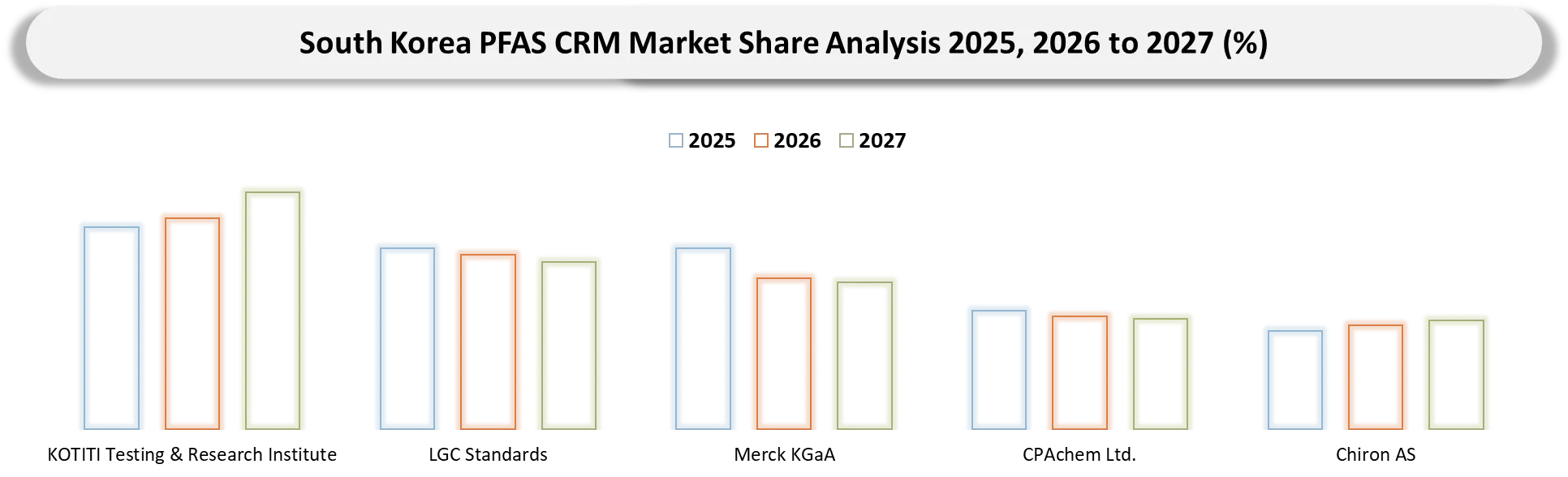
- The market is characterized by three key participant groups: domestic testing and reference-material providers, multinational certified reference material suppliers, and specialised analytical-standard manufacturers. KOTITI Testing & Research Institute is particularly relevant to the South Korean market through its PFAS-related reference-material offering, while LGC Standards and Merck KGaA serve laboratory customers through broad analytical-standard and reference-material portfolios. CPAchem Ltd. and Chiron AS add competition through specialised analytical standards for chemical and environmental testing. The landscape is shaped by PFAS monitoring requirements, the need for reliable calibration materials, product availability, analytical traceability, and access to local laboratory customers.
- Key players include KOTITI Testing & Research Institute (South Korea), LGC Standards (United Kingdom), Merck KGaA (Germany), CPAchem Ltd. (Bulgaria), and Chiron AS (Norway).
Key Developments
- June 2025: SGS, a Switzerland-based testing, inspection, and certification company, published a PFAS environmental testing update, highlighting its capabilities for detecting per- and polyfluoroalkyl substances (PFAS) in environmental samples.
- June 2025: Restek Corporation, a U.S.-based analytical laboratory products manufacturer and supplier of chromatography columns, accessories, and certified reference materials (CRMs), announced two new PFAS reference standards.
- November 2025: KOTITI Testing & Research Institute, a South Korea-based testing, inspection, research, and certified reference material (CRM) producer, announced a Global Market Entry and Regulatory Trends (PFAS) Seminar.
- February 2026: RNS Science, a South Korea-based environmental measurement and analytical technology company specialising in certified reference materials (CRMs) and water-quality monitoring equipment, reported that it produces CRMs using geosmin and 2-MIB extracted from natural blue-green algae at over 95% purity, achieving over 98% accuracy and precision in its reference materials.
Why Choose DataM?
- Technological Innovations: Explores advancements in PFAS certified reference materials (CRMs), including ultra-trace concentration standards, compound-specific reference materials, and materials compatible with advanced analytical techniques such as LC-MS/MS, supporting improved detection accuracy and analytical reliability.
- Product Performance & Market Positioning: Evaluates PFAS CRM suppliers based on certified concentration ranges, measurement traceability, documentation quality, matrix compatibility, and suitability for environmental testing, drinking-water analysis, and industrial wastewater monitoring.
- Real-World Evidence: Examines the application of PFAS CRMs in laboratory calibration, analytical method validation, quality control, and environmental monitoring, including testing requirements associated with semiconductor manufacturing and water-treatment processes in South Korea.
- Market Updates & Industry Changes: Tracks regulatory developments, PFAS monitoring initiatives, analytical-method updates, and reference-material product developments during 2025–2026 to identify changing requirements across South Korea’s environmental testing ecosystem.
- Competitive Strategies: Assesses the competitive positioning of KOTITI Testing & Research Institute, LGC Standards, Merck KGaA, CPAchem Ltd., and Chiron AS, focusing on product portfolios, domestic availability, distribution networks, and capabilities relevant to PFAS analysis.
- Pricing & Market Access: Examines price differences associated with analyte coverage, concentration levels, certification, matrix composition, packaging size, and import requirements, alongside the availability of PFAS reference materials through domestic and international suppliers.
- Market Entry & Expansion: Identifies opportunities arising from increased demand for ultra-trace PFAS analysis, broader environmental monitoring, laboratory quality assurance, and specialised reference materials, while evaluating strategies for domestic product development, local distribution partnerships, and expansion into South Korea’s environmental testing market.
Target Audience 2026
- PFAS Certified Reference Material Manufacturers
- National Metrology and Standardisation Institutions
- Environmental Testing Laboratories
- Water Utilities and Water Quality Management Organisations
- Government and Regulatory Authorities
- Analytical Instrument Manufacturers
- Chemical and Speciality Chemical Companies


























































