


South Korea Certified Reference Materials (CRM) Market Size and Overview
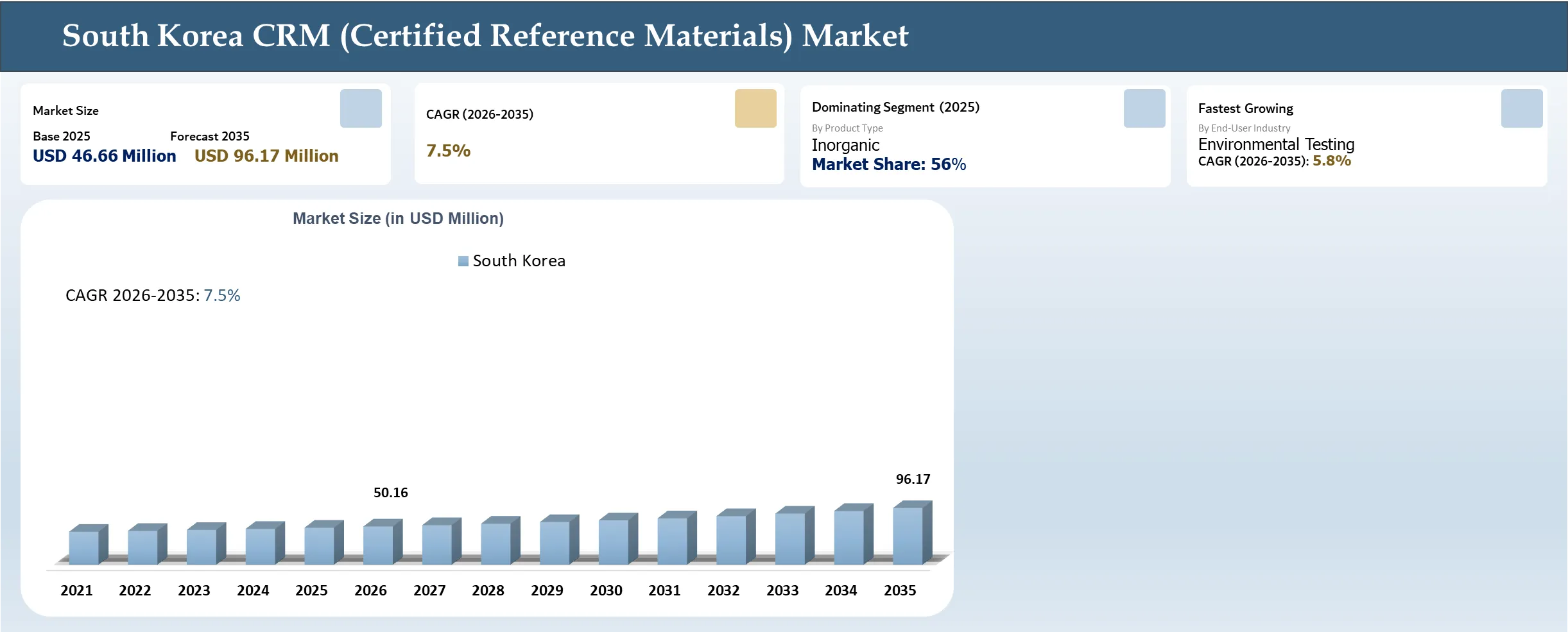
The South Korea certified reference materials (CRM) market reached USD 46.66 million in 2025 and is expected to reach USD 96.17 million by 2035, growing with a CAGR of 7.5% during the forecast period 2026-2035. The market demand is supported by the need for reliable analytical measurements in semiconductor fabrication, quality control in pharmaceuticals, secondary batteries, biotechnology, food safety and environmental analysis.
A critical advancement came from the announcement made by South Korea’s Ministry of Trade, Industry and Energy through the Korean Agency for Technology and Standards, which stated that it would finance 10 new reference material development programs for a total of KRW 3.3 billion (USD 2.3 million) for 2025, which would cover semiconductors, displays, secondary batteries, and biotechnology in a national program from 2025 to 2028. The program seeks to increase reliability in measurements, enhance technological capabilities within the country, and minimise the dependence on imported standards.
South Korea Certified Reference Materials (CRM) Market Key Takeaways
- Inorganic certified reference materials held a dominant 56% share of the overall South Korean CRM market in 2025. This segment remains essential for elemental impurity testing and metal analysis across environmental, clinical, and industrial sectors.
- In January 2026, the Ministry of Trade, Industry and Resources announced funding of KRW 4.8 billion (USD 3.36 million) across 15 new development projects. This initiative represents a 50% year-over-year increase in supported projects compared to the 10 funded in the previous year.
- In October 2026, South Korea's Ministry of Food and Drug Safety began supplying 882 types of pharmaceutical and healthcare reference materials. This comprehensive supply expansion included the introduction of 24 newly added reference items.
- In February 2026, KRISS collaborated with the Pohang Accelerator Laboratory (PAL) to address environmental compliance. Together, they developed a diatomaceous-earth powder CRM specifically designed for hexavalent chromium analysis.
South Korea Certified Reference Materials (CRM) Market Scope
| Metrics | Details |
| 2025 Market Size | USD 46.66 Million |
| 2035 Projected Market Size | USD 96.17 Million |
| CAGR (2026-2035) | 7.5% |
| By Product Type | Organic, Inorganic |
| By Application | Quality Control & Assurance, Method Validation, Regulatory Compliance Testing, R&D & Analytical Development, Calibration & Instrument Validation |
| By End-User Industry | Consumer Industry, Contract Testing, University / Non-Profit, Energy Industry, Environmental Testing, Health Care, Industrial / Manufacturing, Materials / Mining |
| Report Insights Covered | Competitive Landscape Analysis, Company Profile Analysis, Market Size, Share, Growth |
South Korea Certified Reference Materials (CRM) Market Disruption Analysis
Domestic CRM Development and Advanced-Industry Requirements Reshaping South Korea’s Certified Reference Materials Market
The disruption in South Korea’s certified reference materials (CRM) market is primarily associated with the shift toward domestically developed reference materials and increasingly specialized measurement requirements in strategic industries. Semiconductor manufacturing, advanced displays, secondary batteries, and biotechnology require highly precise standards for verifying material composition, detecting trace impurities, and validating analytical methods.
A further disruption in South Korea’s certified reference materials (CRM) market is being driven by the accelerated development of standards for advanced industrial materials. In January 2026, according to the Ministry of Trade, Industry and Resources (MOTIR), South Korea announced 15 new projects with total funding of KRW 4.8 billion (USD 3.36 million), representing a 50% increase in the number of supported projects compared with the previous year’s 10 projects. The initiative targets semiconductors, displays, secondary batteries, and biotechnology, with particular emphasis on reference materials for AI semiconductors and next-generation solid-state battery materials.
South Korea Certified Reference Materials (CRM) Market BCG Matrix: Company Evaluation
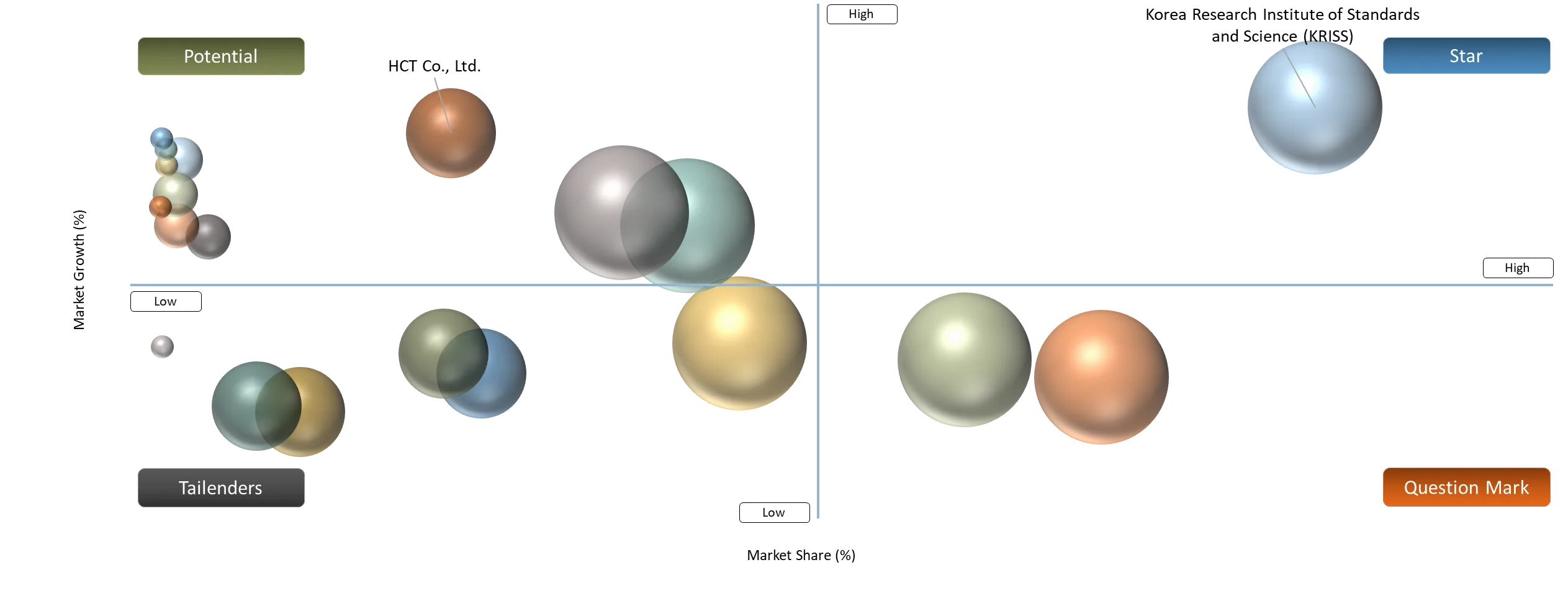
Stars include the Korea Research Institute of Standards and Science (KRISS) and Korea Testing & Research Institute (KTR), which are positioned favourably due to their roles in measurement standards, reference-material development, and laboratory testing. Question Marks include Kims Reference Corp. and RIGAS Co., Ltd., which may benefit from increasing demand for specialised reference materials and analytical testing.
Potential includes HCT Co., Ltd. and KOTITI Testing & Research Institute, which have opportunities to benefit from the growing need for dependable testing, calibration, and quality-assurance services across industrial and consumer-product sectors. Tailenders include Kemidas, which is considered a smaller or more specialised participant in this preliminary assessment compared with established national measurement and testing organisations.
South Korea Certified Reference Materials (CRM) Market Segment Analysis
The South Korea certified reference materials (CRM) market is segmented based on product type, application, end-user industry, and region.
Inorganic CRMs Dominate the Market Due to Extensive Use in Elemental Analysis and Pharmaceutical Quality Control
The inorganic segment holds a dominant position in the certified reference materials (CRMs) market, with a market share of 56% in 2025. Inorganic certified reference materials (CRMs) constitute the analytical foundation for elemental and metal analysis across environmental monitoring, pharmaceutical quality control, food safety, geological surveys, industrial metals testing, and clinical chemistry.
The scale of inorganic elemental impurity testing in pharmaceuticals is substantial. USP maintains more than 4,000 drug monograph standards in USP-NF, with over 200 FDA staff embedded in USP expert committees helping to develop and update those standards, including elemental impurity limits. Each new pharmaceutical NDA or ANDA submission must include certified elemental impurity characterisation, ensuring that inorganic CRM usage is hardwired into every drug approval pipeline.
South Korea Certified Reference Materials (CRM) Market Competitive Landscape
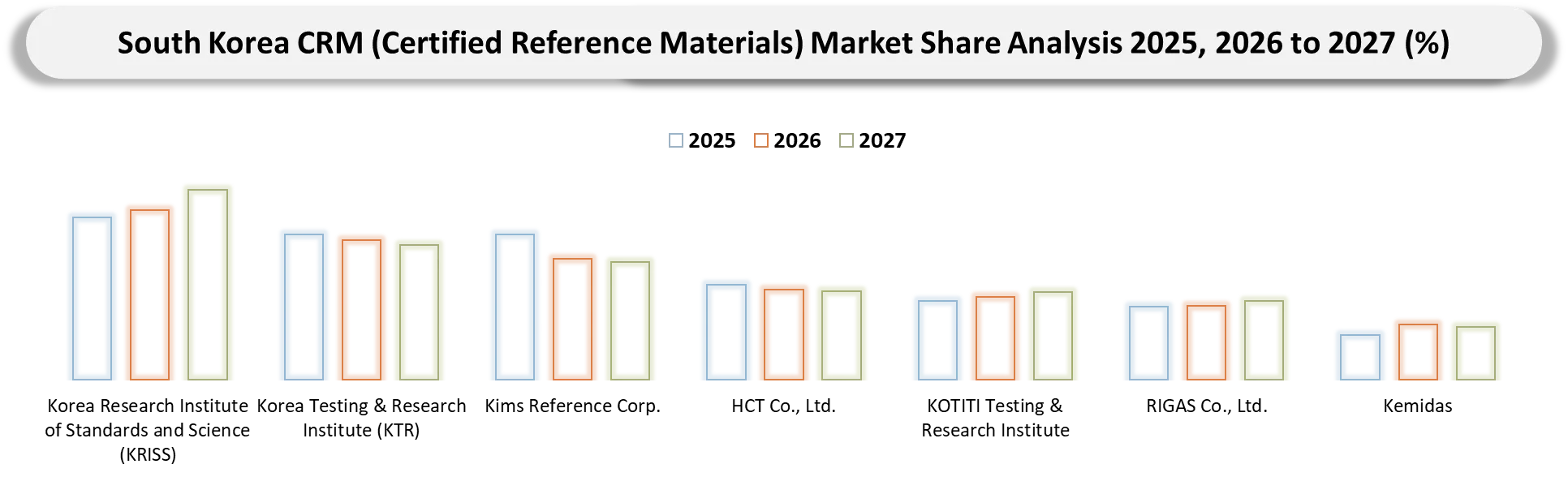
- The South Korea certified reference materials (CRM) market is characterised by testing and research institutes, specialised reference-material producers, and analytical testing and supply companies. Korea Testing & Research Institute (KTR) provides a dedicated CRM portfolio for industrial and analytical applications, while Kims Reference Corp., HCT Co., Ltd., KOTITI Testing & Research Institute, and RIGAS Co., Ltd. have roles in the reference-material and testing ecosystem. The companies serve demand associated with chemical analysis, environmental monitoring, food safety, pharmaceuticals, and industrial materials, where accreditation, measurement traceability, product reliability, and specialised CRM availability influence competitiveness. South Korea’s KOLAS maintains an official register of accredited reference-material producers; however, accreditation records do not establish company market shares.
- Key players include Korea Research Institute of Standards and Science (KRISS) (South Korea), Korea Testing & Research Institute (KTR) (South Korea), Kims Reference Corp. (South Korea), HCT Co., Ltd. (South Korea), KOTITI Testing & Research Institute (South Korea), RIGAS Co., Ltd. (South Korea), and Kemidas (South Korea).
Key Developments
- August 2026: Korea Research Institute of Standards and Science (KRISS), a South Korea-based government-funded national metrology and measurement standards research institute, established purity-testing services for 15 high-purity semiconductor gases and developed 6 certified reference materials (CRMs), enabling objective quality verification and improving measurement accuracy in South Korea’s semiconductor supply chain.
- February 2026: The Korea Research Institute of Standards and Science (KRISS), a South Korea-based government-funded national metrology and measurement standards research institute, collaborated with Pohang Accelerator Laboratory (PAL), a South Korean-based research facility specializing in accelerator science, to develop a diatomaceous-earth powder certified reference material (CRM) for hexavalent chromium analysis in environmental samples.
- April 2026: Kim's Reference Corp., a South Korea-based private company specializing in nanotechnology-based certified reference materials (CRMs), showcased its 10 nm Nano CD Calibrator (NCC) for critical-dimension scanning electron microscopes and AFM Tip Characterizer (ATC) for atomic force microscopes at the FCMN 2026 conference in the United States.
- October 2026: The Ministry of Food and Drug Safety (MFDS), a South Korea-based government regulatory agency responsible for food and pharmaceutical safety, through its National Institute of Food and Drug Safety Evaluation (NIFDS), began supplying 882 types of pharmaceutical and healthcare reference materials, including 24 newly added items.
Why Choose DataM?
- Technological Innovations: Explores advancements in certified reference materials (CRMs), including matrix-matched reference materials, high-purity chemical standards, semiconductor material standards, battery material CRMs, and pharmaceutical reference standards, supporting accurate measurement and quality control across South Korea’s advanced industries.
- Product Performance & Market Positioning: Evaluates CRM suppliers based on product range, certified property values, measurement uncertainty, traceability, homogeneity, stability, and accreditation, highlighting how companies differentiate their offerings for industrial laboratories, pharmaceutical manufacturers, environmental testing, and semiconductor applications.
- Real-World Evidence: Examines the use of CRMs in pharmaceutical quality control, food contaminant analysis, environmental monitoring, chemical composition testing, semiconductor manufacturing, and secondary battery material characterisation, demonstrating their role in improving analytical accuracy, laboratory reliability, and regulatory compliance.
- Market Updates & Industry Changes: Tracks developments in South Korea’s CRM sector, including government-supported reference-material development, domestic production initiatives, accreditation developments, and new standards for AI semiconductors, displays, secondary batteries, and biotechnology, helping identify emerging market opportunities.
- Competitive Strategies: Analyzes how key participants, including Korea Testing & Research Institute (KTR), Kims Reference Corp., HCT Co., Ltd., KOTITI Testing & Research Institute, RIGAS Co., Ltd., and other suppliers, compete through specialized product portfolios, technical expertise, accreditation, product development, and collaboration with industrial and research organizations.
- Pricing & Market Access: Assesses factors influencing CRM pricing, including material composition, purity, matrix complexity, certification requirements, production scale, stability testing, and documentation, while examining access through specialised producers, laboratory suppliers, and distribution channels.
- Market Entry & Expansion: Identifies growth opportunities in semiconductor and battery materials, pharmaceutical and biotechnology standards, environmental contaminants, food safety testing, and advanced industrial applications, while evaluating strategies such as domestic CRM development, accreditation expansion, research partnerships, and specialized product diversification.
Target Audience 2026
- CRM Manufacturers and Producers
- Analytical Testing Laboratories
- Government and Regulatory Agencies
- Pharmaceutical and Biotechnology Companies
- Food and Beverage Companies
- Environmental Monitoring and Water Testing Organizations
- Mining, Metals, and Critical Minerals Companies


























































