


South Korea Cables & Wires Market Size and Overview
The South Korea cables and wires market reached US$ 9.97 billion in 2025 and is projected to reach US$ 11.80 billion by 2031, implying 2.84% annualized growth from 2025 to 2031. The market covers low-voltage building and industrial cables, medium- and high-voltage power cables, datacom cabling and specialty applications.
South Korea’s demand is supported by modernization of utility networks, offshore wind grid connections, semiconductor and battery manufacturing, shipbuilding and high-density digital infrastructure. Supplier opportunities center on high-voltage transmission, application-specific fire performance, reliable fiber networks and flexible industrial cables.
| 2025 MARKET SIZE | 2031 FORECAST | CAGR (2026–2031) |
|---|---|---|
| US$ 9.97 Billion | US$ 11.80 Billion | 2.84% |
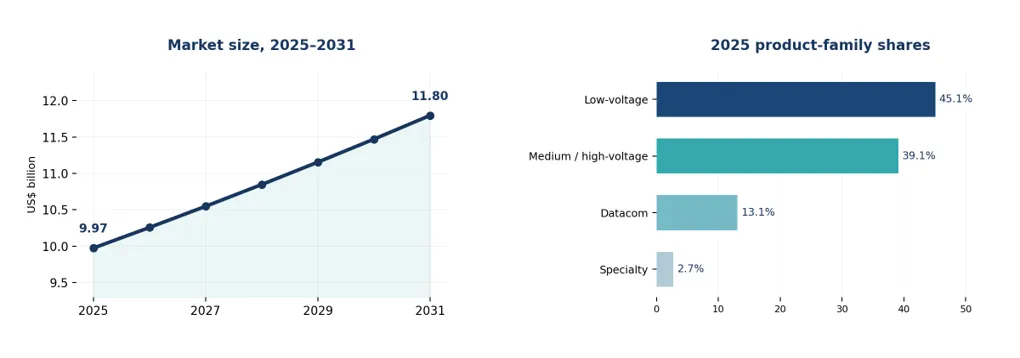
South Korea cables and wires revenue increases from US$ 9.97 billion in 2025 to US$ 11.80 billion in 2031, an absolute increase of US$ 1.82 billion.
The implied annualized growth rate of 2.84% reflects a mature manufacturing base supported by specialized power and communications infrastructure investment.
Low-voltage cables comprise 45.08% of 2025 market value, serving buildings, factory wiring, industrial systems and distribution connections.
Medium- and high-voltage cables represent 39.11% of the market, serving utility reinforcement, transmission capacity and renewable-energy interconnection.
Datacom cables represent 13.10% of 2025 revenue, supported by enterprise networks, optical fiber, hyperscale facilities and telecom upgrades.
Special cables represent 2.71% of the market, supported by shipbuilding, offshore installations and demanding industrial applications.
South Korea Cables & Wires Industry Trends and Strategic Insights
Grid-strengthening investment and renewable integration favor medium- and high-voltage systems with proven insulation reliability, installation capability and engineering qualification.
Offshore wind development, shipbuilding and marine industries sustain demand for subsea, marine-grade, low-smoke and flame-resistant specialty cables.
Semiconductor fabs, advanced electronics, battery plants and automated industrial lines require reliable power distribution plus precision control and signal wiring.
Data centers, mobile-network modernization and fiber infrastructure growth support optical and copper connectivity products with high density and fire-safety compliance.
South Korea Cables & Wires Market Scope
| METRICS | DETAILS |
| 2025 Market Size | US$ 9.97 Billion |
| 2031 Projected Market Size | US$ 11.80 Billion |
| CAGR (2026–2031) | US$ 11.80 Billion |
| Geographic Coverage | South Korea (national market and principal industrial / utility demand clusters) |
| By Cable Type | Datacom Cables (Communication & Data Cables, Fiber Optic Cables); Low-Voltage Cables (Fire Resistant Cables, Low Smoke & Halogen Free Cables, Low Voltage Cables & Wires); Medium- and High-Voltage Cables (Medium Voltage Cables, High Voltage Cables); Special Cables (Mining Oil & Gas Cables, Photovoltaic Cables, Ship & Harbour Cables, Windmill Cables) |
| By Industry | Industrial — Discrete (Aerospace & Defense, Automotive, Batteries, Electrical & Electronics, Machine Building, Semiconductor); Process (Chemicals, Energy/Oil & Gas, Metal Processing); Hybrid (Food & Beverage, Lifesciences, Mining & Quarrying, Other Manufacturing). Non Industrial — Transportation (Air, Land, Rail, Marine Services); Infrastructure & Services (Commercial Real Estate, Data Centers, Healthcare, Hospitality & Entertainment, Public Sector/Research/Education, Residentials, Water & Waste, Others). Power Utilities — Power Generation (Coal, Conventional Excl. Coal, Renewables); Power Distribution & Transmission. |
| By Conductor / Transmission Medium | Copper; Aluminum; Optical Fiber; Composite / Hybrid Construction |
| By Voltage Rating (Power Cables) | Low Voltage (up to 1 kV); Medium Voltage (above 1 to 35 kV); High Voltage (above 35 to 230 kV); Extra-High Voltage (above 230 kV) |
| By Insulation and Sheathing Material | Cross-Linked Polyethylene (XLPE); Polyvinyl Chloride (PVC); Ethylene Propylene Rubber (EPR/EPDM); Polyethylene (PE); Low Smoke Zero Halogen (LSZH); Other Materials |
| By Installation Method | Overhead; Underground / Buried; Submarine / Underwater; Indoor / Building; Outdoor / Industrial |
| Competitive Landscape | Competitive positioning, 10 company profiles, recent developments and partnerships |
| Market Data Coverage | Cable-type and cable-subtype market values, 2025–2031 (US$ million); industry, material, voltage and installation breakdowns within the defined report scope |
The study covers South Korea cable and wire revenue by cable family and subtype, with multilevel segmentation across industrial, non-industrial and utility end markets. Other dimensions include conductor medium, voltage rating, insulation material and installation method.
South Korea Cables & Wires Market White Space & Investment Opportunities
Transmission and offshore interconnection: Advanced HV/EHV and submarine-cable solutions offer opportunities as power grids reinforce links between industrial loads and renewable generation.
Semiconductor and battery plants: Manufacturing facility expansion opens specification-led sales for screened control wiring, fire-performance cables and power distribution.
Data and connectivity: Cloud infrastructure and telecom networks create whitespace in high-fiber-count optical cables, structured copper and resilient indoor connectivity.
Industrial activity is concentrated around the Seoul-Incheon-Gyeonggi technology corridor, Ulsan and Busan shipbuilding and petrochemical zones, the Chungcheong semiconductor and battery supply chain, and coastal utility and renewable developments. Procurement strategies should reflect utility qualification cycles, industrial engineering specifications and EPC channel access.
Driver Impact Analysis
South Korea’s transmission and distribution investment supports cable renewal, capacity reinforcement and resilience. Higher-voltage equipment procurement is influenced by technical qualification, conductor quality, installation conditions and lifecycle loss reduction. Large grid projects can provide multi-year visibility to manufacturers with established utility relationships.
| DRIVER | AFFECTED PRODUCT / SIGNAL | 2026–2031 CAGR | STRATEGIC IMPACT |
| Grid renewal and resilience upgrades | MV/HV, utility distribution and cable accessories | Moderate | Develop long-term utilities and contractor qualification. |
| Renewables and offshore wind | Submarine, offshore and grid cables | Moderate–High | Coordinate with renewable EPC and grid connection projects. |
| Advanced industry and factory automation | Flexible, shielded and control wiring | Moderate | Target machinery suppliers and manufacturing upgrades. |
| Fiber and digital networks | Optical fiber and structured copper | Moderate | Engage datacenter integrators and network owners. |
Factory investment also shapes demand. Semiconductor manufacturing, batteries, electric vehicle supply chains and automated facilities require high-reliability distribution, fire-resistant cable construction, shielded signal lines and network cabling. To secure these orders, suppliers increasingly collaborate with EPC contractors and plant engineering teams at an early design stage.
Restraint Impact Analysis
Copper and aluminum price volatility influences cable production costs, contract pricing and working capital. Competitive tendering on standardized products can restrict margin recovery, while import exposure and currency movements affect selected inputs and export-oriented projects. Manufacturers benefit from indexed pricing and disciplined procurement.
| RESTRAINT | PRIMARY EXPOSURE | RISK LEVEL | STRATEGIC IMPACT |
| Copper and aluminum price changes | Materials margins, quotations and working capital | High | Use transparent index-linked procurement terms. |
| Long product qualification cycles | Power utilities and specialty cable acceptance | Moderate–High | Invest in testing, standards and early technical engagement. |
| Project scheduling and installation constraints | Offshore, underground and transmission projects | Moderate–High | Plan lead times and installation partnerships. |
| Cost competition for standardized wire | Low-voltage and basic industrial cabling | Moderate | Differentiate through quality, support and high-value products. |
Other restraints include transmission permitting, specialty cable capacity bottlenecks and strict qualification requirements for utility, offshore and semiconductor environments. Installation resource constraints may delay contract realization. Suppliers can reduce exposure through product standardization, qualification investment, contractor partnerships and phased production planning.
South Korea Cables & Wires Market Competitive Landscape
South Korea’s competitive landscape combines integrated power cable producers, optical and industrial cable manufacturers and companies supplying advanced utility and export markets. Domestic participants compete on high-voltage engineering, large-project delivery, installation services, certifications and cost-effective production.
| COMPANY | SOUTH KOREA CABLES & WIRES POSITIONING |
| LS Cable & System | Integrated HV, EHV, submarine, fiber and industrial cable systems. |
| Taihan Cable & Solution | Transmission, submarine and utility power cable solutions. |
| Gaon Cable | Power cables, building wires and industrial electrical applications. |
| Iljin Electric | Power transmission systems and engineered cable solutions. |
| Daewon Cable | Low-voltage and industrial cable manufacturing. |
| KUKDONG Electric Wire | Electrical wire and specialty industrial cable offerings. |
| Nexans Korea | Power and industrial cables for Korean project demand. |
| LS Eco Energy | Cable manufacturing and regional production platform serving Korean supply chains. |
| TMC | Marine and industrial cable systems. |
| Samwon Electric Wire | Industrial and building wire manufacturing. |
The market includes LS Cable & System, Taihan Cable & Solution, Gaon Cable and Iljin Electric alongside industrial and specialist suppliers. Manufacturers use domestic project references, product qualifications, EPC relationships and regional manufacturing networks to pursue grid, manufacturing and connectivity demand.
South Korea Cables & Wires Market Recent Developments
2026: Grid reinforcement and renewable integration continue to shape procurement for high-voltage and distribution cables.
2026: Korean offshore wind and related transmission planning create demand potential for submarine, export and onshore connection cables.
2026: Advanced manufacturing investment in semiconductors and batteries supports industrial power, control and automation cabling.
2026: AI data-center development and telecom modernization encourage investment in optical fiber and structured networking cables.
2026: Cable suppliers focus on high-performance insulation, qualification requirements and reliable delivery for utility and industrial accounts.
2026: Copper pricing, labor availability and project execution schedules remain key considerations for cable procurement and contract terms.


























































