


Solid State Relay Market Size and Overview
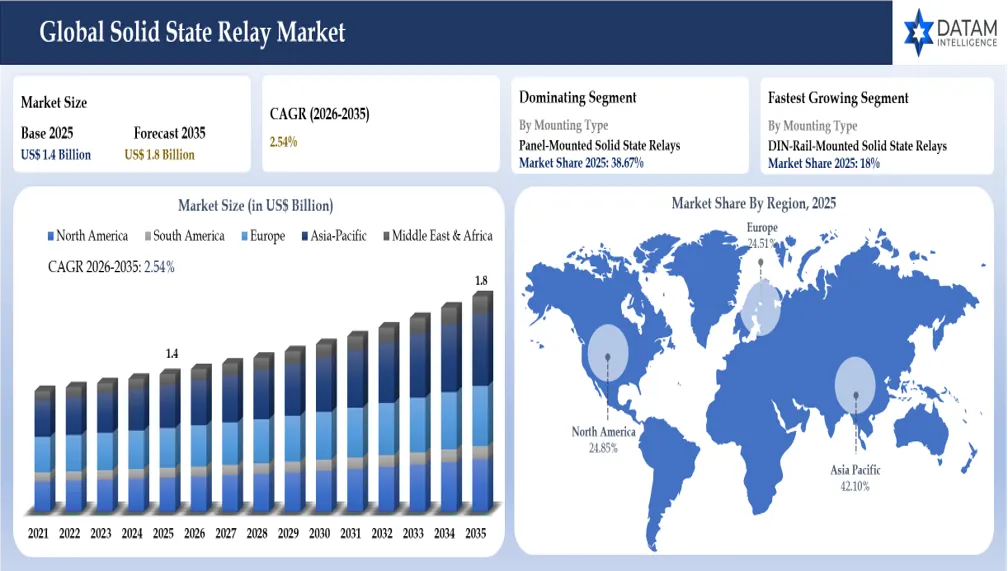
The global solid-state relay market reached US$ 1.4 billion in 2025 and is expected to reach US$ 1.8 billion by 2035, growing with a CAGR of 2.54% during the forecast period 2026-2035.
The market is fueled by an increasing use of solid-state relays in heating applications, plastic injection molding machines, packaging equipment, semiconductors manufacturing processes, and automation lines. Solid-state relays used in industry are offered in a broad range of current ratings from less than 20 A to more than 100 A, while those with high currents are used in heating ovens, furnaces and temperature control systems. Frequent switching applications are a good choice for using SSRs due to their fast action, silent operation and low contact wear compared with electromechanical relays. Increasing adoption of automatic machinery and continuous manufacturing processes has added to the need for dependable switch mechanisms.
Technical innovations have created possibilities with the advent of compact relays on PCBs, three-phase switches and SSRs that can handle DC for battery testing and energy storage applications. Zero cross and random turn on types of products are available; switching is determined by the characteristics of the load and control requirements. Diagnostic outputs are being included along with temperature detection for identifying load failure and minimizing equipment down-time. Nevertheless, issues with semiconductor heating, current surges and off-state leakage continue to pose problems. Therefore, it becomes increasingly critical for products to stand out in terms of their current capacity, thermal behavior, electrical insulation, load suitability and protection features.
Solid State Relay Market Key Takeaways
- In 2025, panel-mounted solid state relays held the highest market share among solid state relays at 38.67%. This was attributed to their extensive application in the field of industrial control panels, heating applications, process automation and heavy current switching applications.
- DIN-rail-mounted solid state relays are forecasted to grow at the highest CAGR rate of 7.11%, due to factors like increasing use of modular control cabinets, ease of installation and automation of industries.
- In 2025, Asia-Pacific dominated the global market for solid state relays with 42.10% market share, attributed to the presence of electronics production, semiconductor production, industrial automation and manufacturing activities in China, Japan, South Korea and India.
- Increased usage of highly reliable SSRs with diagnostics and temperature management systems has prompted manufacturers to come up with relay products that enhance detection of faults, switching accuracy and operational lifespan of relay devices used in industrial heating equipment and automatic production machines.
- Increasing need in industrial automation systems, semiconductors production, heating ventilation air conditioning (HVAC), automotive industry and energy storage systems has generated market potential for application-specific SSRs.
Solid State Relay Industry Trends and Strategic Insights
- Manufacturers are creating small-sized SSRs mounted on PCBs to save space in control panels and simplify integration in automated machines and electronic devices.
- High demand for solid-state relay is growing in industrial heaters, plastic machines, as well as temperature control systems, which leads to advancements.
- The adoption of Industry 4.0 technologies is leading to an increase in the integration of SSR diagnostics and load failure monitoring systems in order to minimize downtimes and enable predictive maintenance.
- Due to the rise of electrification, the demand for DC solid-state relays is also increasing while silicon carbide and gallium nitride technologies are presenting opportunities for specialized applications.
- SSR manufacturers have differentiated SSRs using switching methods, surge protection capability, electrical insulation and load matching capabilities to satisfy particular needs in industrial automation, HVAC and semiconductor fabrication.
Solid State Relay Market Scope
| Metrics | Details | |
| 2025 Market Size | US$ 1.4 Billion | |
| 2035 Projected Market Size | US$ 1.8 Billion | |
| CAGR (2026-2035) | 2.54% | |
| Largest Market | Asia-Pacific | |
| Fastest Growing Market | North America | |
| By Type | Opto-Coupled Solid State Relays, Transformer-Coupled Solid State Relays, Reed-Relay-Coupled Solid State Relays and Other Types | |
| By Mounting Type | Panel-Mounted Solid State Relays, PCB-Mounted Solid State Relays, DIN-Rail-Mounted Solid State Relays, Plug-in / Socket-Mounted Solid State Relays and Other Mounting Types | |
| By Output Type | AC Output Solid State Relays, DC Output Solid State Relays and AC/DC Output Solid State Relays | |
| By Load Current Rating | Low Current (Up to 20 A), Medium Current (21–50 A) and High Current (Above 50 A) | |
| By Switching Mode | Zero-Cross Switching, Random-Turn-On (Instantaneous) Switching and Proportional / Phase-Angle Switching | |
| By Application | Industrial Automation and Process Control, Industrial Machinery and OEM Equipment, HVAC and Building Automation, Energy and Power Systems, Automotive and Electric Vehicle Systems, Semiconductor and Electronics Manufacturing, Medical Equipment, Food and Beverage Processing, Lighting Control and Other Applications | |
| By End-Use Industry | Manufacturing and Industrial Processing, Automotive and Transportation, Energy and Utilities, Semiconductor and Electronics, Building and Construction, Healthcare and Pharmaceuticals, Food and Beverage and Other Industries | |
| By Region | North America | U.S., Canada, Mexico |
| Europe | Germany, UK, Russia, France, Spain, Italy, Poland | |
| Asia-Pacific | China, India, Japan, Australia, South Korea, Indonesia, Malaysia, Singapore, Vietnam, Thailand, Philippines, Taiwan | |
| South America | Brazil, Argentina | |
| Middle East and Africa | UAE, Saudi Arabia, South Africa, Israel, Turkiye, Nigeria | |
| Report Insights Covered | Competitive Landscape Analysis, Company Profile Analysis, Market Size, Share, Growth | |
Why does this report matter in 2026?
The solid state relay market report becomes significant in 2026 as industrial companies become increasingly concerned about switching reliability, less maintenance and load control. The use of SSR is becoming application-oriented as factors such as current rating, maximum surge current rating, thermal characteristics, leakage at off state and AC/DC capability determine the equipment design and performance. When the industry starts updating its controls systems, this report assists in analyzing the scenarios where the SSR gives an edge over electromechanical relay and those situations where installation costs, need for heat sink and low switching frequency become a constraint.
In 2026, the report will assist producers and investors in identifying opportunities in high current SSRs, miniaturized PCB mounted SSRs, DC switching solutions and relay modules with diagnostic capabilities. With competition between existing suppliers and regional manufacturers, differentiating factors such as cost, availability of components and technical support become important aspects of purchasing decisions. The report uses application demand, supplier capacity within a region, demand for electronics manufacturing, competitive advantage and technical challenges as decision-making tools for product development, entering markets, distributorships and investments, as well as differentiating high-value applications from low-value ones.
Solid State Relay Market White Space & Investment Opportunities
- The design of SSRs that have higher currents with proper heat management and overload protection is an area to explore in industrial heating, injection molding and equipment requiring high temperatures.
- Compact SSRs with low leakage current and effective electrical insulation can be developed for applications in semiconductor manufacturing, instrumentation and medical devices.
- The inclusion of diagnostics, temperature sensing and load failure detection functions within SSR modules offers product development opportunities for smart manufacturing facilities that wish to monitor their equipment efficiently.
- The development of custom DC SSRs for battery testing, energy storage applications and electric vehicles can provide the chance to tackle specific DC switching needs.
- There is an opportunity to invest in the expansion of manufacturing, distribution and application engineering facilities within India and South East Asia to meet local automation needs.
Solid State Relay Future Market Transformation
The solid state relay industry will move towards the development of smaller, higher-current and customized switching products due to the increased automation and electronic control of industrial machinery in the future. The future product developments are likely to include higher thermal efficiency, increased capacity of handling surges of current, lower leakage of current when not in operation and integrated diagnostics to overcome some of the challenges that solid state relays have been facing in tough industrial conditions. The use of DC-powered systems in applications such as battery testing, energy storage and specialized electrification equipment may increase the demand for DC solid state relays while developments in semiconductor encapsulation technology may make possible smaller modules that integrate easily within the industrial systems. The manufacturers of solid state relays who are capable of offering both switching capabilities and customized protection and diagnostics will be better prepared to meet the needs of OEM customers. However, implementation will continue to depend on system costs, thermal requirements and the suitability of SSRs in particular applications.
Solid State Relay Market Buyer Decision-Making Criteria
Potential buyers consider such features as electrical compatibility, switching characteristics, heat resistance, safety and overall cost during the evaluation process of solid state relays. OEM companies tend to prefer SSRs that fit the needs for the load in terms of voltage and current, can handle inrush current and are reliable in frequent switching applications. Selection is further dependent on the type of loading, leakage current in the off state, space available for mounting and technical assistance from the manufacturer.
Major Buyer Decision-Making Criteria
- Rated Load Voltage and Current
- Thermal Management
- Surge and Inrush Current Capability
- Switching Mode
- Load Compatibility
- Off-State Leakage Current
- Electrical Isolation and Safety
- Overcurrent Protection Coordination
- Installation and Integration
- Total Cost of Ownership
- Supplier Reliability and Support
Solid State Relay Market Economic & Investment Analysis
Investments in the solid state relay industry depend upon demand coming from applications in industrial automation, semiconductor equipment manufacturing, industrial heating and control circuitry applications, in which case switching performance and maintenance costs will be important factors to the cost of ownership of the equipment. It will be incumbent upon manufacturers to strike a balance between capital expenditures associated with the automation of production, semiconductor technology, thermal management technology and quality testing processes with production volume, pricing considerations and returns. The possibilities associated with high current SSRs and custom application modules, along with heat sinking and protection circuits, may add to the cost of installed systems and thus have an impact on investment. Expansion of electronics manufacturing in various regions provides business opportunities for firms who can ensure component availability, meet OEM specifications and deliver competitively.
Solid State Relay Investment Trends in the Market
- Automation of assembly lines and use of precise testing facilities to enhance manufacturing consistency, electrical isolation and reliability along with reduction in defect rate of SSRs.
- R&D expenditures have been focused on high current SSRs, thermal management solutions and surge protection to address tough industrial load switching applications.
- Capital investments in the area of miniaturized SSR package and PCB mount manufacturing for electronics makers, industrial control equipment manufacturers and semiconductor equipment original equipment manufacturers (OEMs).
- Collaboration among SSR makers, semiconductor vendors and industrial automation companies is providing help in sourcing components, integration of products and developing application-specific switching products.
- Companies and their distributors are extending their regional coverage in Asia-Pacific for better sales, support and distribution capabilities in reaching industrial automation customers and electronics manufacturing centers.
Strategic Indicators for Solid State Relay Market
High Regulation Impact
SSR market is driven by factors such as electrical safety, electromagnetic compatibility and environmental compliance considerations which influence the design, testing and regulatory compliance aspects of the products. The manufacturers are required to comply with IEC and UL insulation standards for electrical properties, dielectric properties, temperature rise and electrical performance of the SSRs. RoHS and REACH compliance needs will depend on the type of SSR, operating conditions, targeted market and the end-application equipment in which SSRs will be used. These compliance factors can result in additional costs for product validation and qualification. The suppliers having testing capability, traceability of components and electrical/thermal performance data are well placed to serve customers' qualification requirements.
High Investment Activity
The major areas of investment in the solid state relay industry include automation of manufacturing process, semiconductors supply, size reduction of products and improvement of thermal performance. It is also advantageous for manufacturers to invest in testing procedures to test switching abilities, insulation of electricity and tolerance to surge current, while research and development should be aimed at developing high current SSRs and smaller PCB mounted modules for industrial applications and semiconductor equipment. Application engineering and regional distribution investments will allow manufacturers to comply with OEM standards and deliver their products faster. In addition, capital expenditure is important since it affects manufacturing cost and product quality.
Supply Chain Disruption
The solid state relay market is susceptible to supply chain risks related to power semiconductors, optocouplers, lead frames, isolation components and heat management parts in relay assemblies. The shortage or long delivery time of MOSFETs, thyristors, triacs and optoelectronic parts may disrupt the manufacturing process and deliveries of OEM products, especially SSRs with high currents and industrial applications. Risks associated with the limited semiconductor manufacturing industry and international shipping include possible import restrictions and fluctuations of prices on components. Manufacturers could reduce these risks by means of competent alternative suppliers, proper stock of necessary components and product design flexibility. Nevertheless, substitution of the components would need engineering approval to maintain electrical, thermal, switching compatibility and safety considerations.
Pricing Volatility
Price variations in the solid state relay market are driven by variations in the price of semiconductors, optocouplers, copper terminals, isolation materials and thermal management components. Based on indicative online prices, prices for standard SSR-25DA and SSR-40DA relays in India, whose value was earlier pegged at ₹260-₹500 each, amount to around US$3-US$6 each. Prices for branded industrial products depend on various specifications and product positioning. The price will also depend on the technology used for switching, insulation, ability to cope with surge currents, certification and thermal requirements. The prices of semiconductor components, dependency on imports, exchange rates and supplier prices may impact budget and profits and therefore comparisons should be done on specification and total installation cost basis.
Procurement Pressure
The manufacturers of solid state relays have procurement pressures for power semiconductors, optocouplers, isolation and thermal management components whose price changes impact the manufacturing cost and the profits of the manufacturers. The pricing of the products is made taking into consideration the quantity of the order, current ratings, switching capacity, warranty period and the availability of the product in the future. Cost considerations are increased for specialized high current SSRs due to the fact that its semiconductor ratings, thermal needs and protective capabilities reduce the option of using cheaper components. In any case, the manufacturer needs to reconcile competitive quotes with the quality of components and the need for testing.
New Technology Adoption
SSR makers are investigating and utilizing the latest advancements in semiconductor package technology, PCB integration and protective circuitry in order to increase efficiency and reliability in industrial uses. Innovations in the area of MOSFET-based DC SSRs, diagnostic output availability and temperature measurement have created more design opportunities in the fields of battery test equipment, semiconductor manufacturing equipment and heating system automation. Implementation will depend upon the ability to manage on-state dissipation, off-state leakage, surge currents and junction temperature within the parameters of the specific application. The inclusion of programmable logic controllers (PLCs) and industrial monitoring systems is also adding value to diagnostic-enabled SSRs, though additional sensors may increase product cost and necessitate compatibility testing with existing control systems.
Regional Expansion Opportunity
The opportunities that the solid state relay market has in terms of regional expansion depend on the growth in electronics manufacturing and industrial automation activities in India and Southeast Asia. The possible opportunities in India include the possibilities that exist in the areas of industrial heating and packaging machinery applications, whereas production facilities in countries like Vietnam, Thailand and Malaysia will require compact SSRs due to the automation in assembly and temperature control systems. Manufacturers can ensure easy access to the market in this region through the help of distributors, application engineering capabilities and equipment manufacturers. Achieving success requires the right combination of competitive pricing in addition to proper ratings and thermal management, certification and access to replacement units.
Government Policy Support
Government programs aimed at encouraging the growth of industrial automation, domestic electronics manufacturing, semiconductor fabrication and energy efficiency might indirectly result in a greater demand for solid-state relays due to the promotion of investments into the acquisition of equipment requiring a reliable electronic load switching mechanism. Incentive programs for semiconductor fabrication and electronics manufacturing give SSR providers opportunities to supply their products to equipment used in those processes. Yet, such advantages will be realized only if investments stimulated by the government will lead to purchases of new equipment and development of domestic suppliers of that equipment since SSRs usually benefit from other industrial programs. Conformance to regulations concerning electrical safety, electromagnetic compatibility and the environment is also crucial for those who seek to make their devices available to industrial OEMs.
Pricing Intelligence
Pricing intelligence in the solid state relay industry is based on evaluating products in terms of load current rating, AC/DC output capability, switching method, electrical isolation and protection rather than just price comparison per unit. While standard PCB-mounted SSRs are mostly used by OEMs for equipment that is not too expensive, branded industrial SSRs with better current ratings, safety certificates and thermal applications should be chosen for more challenging applications. Procurement process can be improved by comparison of the quotes according to the same electrical parameters, exclusion of the relay prices from the cost of heat sinks and protective elements and estimation of the warranty and longevity. This method enables OEMs to find suitable SSR technologies at minimal costs without affecting their performance characteristics.
| HS Code | Reporter | Trade Flow | 2025 Trade Value | Interpretation |
| 853649 | China | Export | US$967 Million | Reflects China's strong electrical relay manufacturing base and export capabilities. |
| 853649 | Germany | Export | US$779 Million | Indicates Germany's established electrical engineering and industrial control equipment manufacturing capabilities. |
| 853649 | United States | Import | US$733 Million | Reflects demand for electrical relays across industrial automation, manufacturing and electrical equipment applications. |
| 853649 | Germany | Import | US$484 Million | Indicates demand for electrical switching components across industrial machinery and automation applications. |
Note: HS Code 853649 covers electrical relays for voltages exceeding 60 V and does not exclusively represent solid state relays. Therefore, the 2025 import and export values are used as broader electrical relay trade indicators to assess international trade activity, manufacturing capabilities and supply-chain dynamics relevant to the solid state relay market.
AI Impact Analysis of Solid State Relay Market
AI has been affecting the solid state relay market through intelligent industrial controls, predictive maintenance and monitoring of equipment in real-time. AI-based manufacturing technologies can evaluate data on temperatures, load currents, switching cycles and faults that occur in equipment being controlled by SSRs to detect abnormalities before they lead to downtime. In the case of industrial heating, injection molding and semiconductor manufacturing, it can be useful for optimizing the load control strategy through connected controllers, detecting heater failure and thermal stresses leading to shorter life of the relay. Nevertheless, AI works through connected controllers and sensors and not through SSRs.
AI technology also offers possibilities for SSR manufacturing firms to build more intelligent relay modules with diagnostic outputs and the ability to monitor temperatures as well as being compatible with industrial automation systems. Utilizing AI technology and the information from SSR performance will assist in enhancing maintenance plans of equipment, detecting unnecessary inrush currents and cutting down unscheduled downtime. The use of the technology will depend on the availability of sensors, costs of integration, data quality and compatibility with the current control systems. Although the use of AI does not negate the need for proper heat sinks, surge protection, electrical isolation, or proper SSRs, it only augments good electrical practices with enhanced fault diagnosis and decision-making.
Disruption Analysis of Solid State Relay Market
Solid state relays market is evolving due to the progress in power semiconductor devices, miniaturization of electronic packaging and built-in protection techniques. New MOSFETs, thyristors and triacs may provide improved solid state relay design in terms of switching capability, minimized conduction losses in particular configurations, as well as reduced size. New developments in components allow solid-state relay makers to develop smaller and more efficient relay modules for dense installations in control panels, semiconductor devices manufacturing facilities and precise temperature control systems. Solid state relays which incorporate switching, protection and diagnostics modules into single electronic module represent additional competitive challenge to traditional SSR devices.
The combination of solid-state switching technology with digital feedback and application-oriented power control is set to cause more upheaval. SSR devices with diagnostic output, current sensing and thermal monitoring capability can assist in the identification of abnormal operation for the benefit of industrial users and better planning of maintenance activities. Semiconductor material such as silicon carbide and gallium nitride could be an alternative source of switching technology for high-frequency and specific power control needs, although their utilization will depend upon costs, voltage and heat dissipation. However, there are still several issues that must be overcome by SSRs concerning heat dissipation, off-state leakage currents and surge currents, while EORs remain relevant for cases when low cost and zero off-state leakage are critical considerations.
Solid State Relay Market BCG Matrix: Company Evaluation
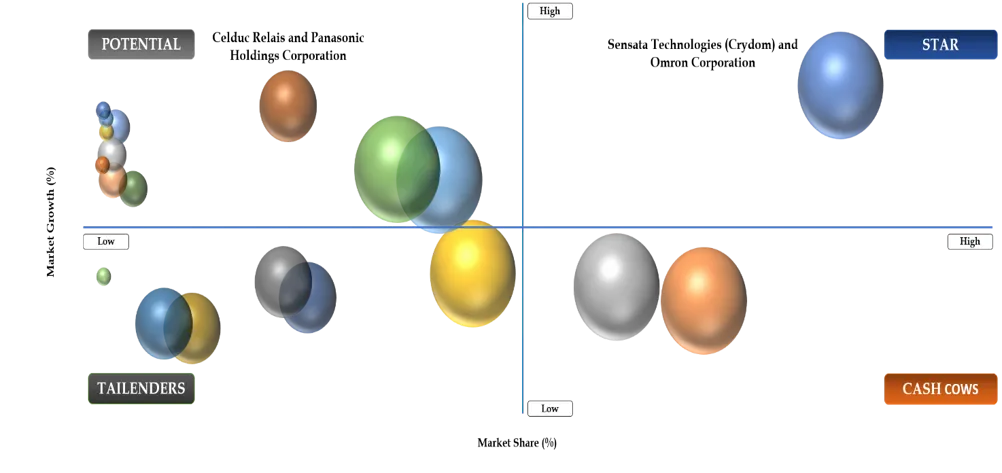
STAR
Sensata Technologies (Crydom), Omron Corporation and Carlo Gavazzi Holding AG have been categorized as Stars based on their successful solid state relay offerings and good customer relations in the industrial market and their presence in applications like industrial heating, temperature control, plastics molding and factory automation. The competitive advantages that these firms possess are the ability to switch high currents, having AC/DC relay types, having mounting arrangements and offering load-control products based on their applications. There is increasing demand for automated manufacturing machinery and cycle switching systems that can help build on their market position.
POTENTIAL
Celduc Relais and Panasonic Holdings Corporation are companies that offer growth prospects owing to their unique solid state relay technology and electronic components respectively. Celduc will benefit from its high-voltage DC relays, three-phase switching products and diagnostics capable SSRs, whereas Panasonic will benefit from its PhotoMOS and mini semiconductor relay technologies for confined applications within the electronics and industrial controls market. The future growth of these companies will be dependent on OEM usage in the industries, switching efficiency and application needs of thermal management, electrical isolation and load control.
Solid State Relay Market Dynamics
Driver Impact Analysis
| Driver | Market Growth Impact (%) | Demand Concentration | Impacted Use Case | Strategic Impact |
Increasing Adoption of Industrial Automation | 28% | Manufacturing hubs across Asia-Pacific, North America and Europe | Automated production lines, packaging machinery and process control | Accelerates replacement of electromechanical relays in high-cycle switching applications |
Rising Demand for Industrial Heating and Temperature Control | 25% | Plastics processing, food processing and industrial heating facilities | Injection molding, industrial ovens, furnaces and heating systems | Supports demand for high-current SSRs with improved thermal management |
Expansion of Semiconductor and Electronics Manufacturing | 22% | China, Japan, South Korea, Taiwan and the United States | Semiconductor fabrication equipment, electronic testing and precision temperature control | Creates demand for compact PCB-mounted SSRs and high-reliability switching modules |
Growing Electrification and DC Power Applications | 15% | Battery manufacturing, energy storage and electric vehicle supply chains | Battery testing, DC load control and specialized electrical systems | Encourages development of DC-capable SSRs and application-specific switching solutions |
Driver: Rising Demand for Reliable Switching in Industrial Automation
Increasing applications for automated production lines, industrial heating systems and semiconductor fabrication equipment have increased the need for solid-state relays which can be switched repeatedly without causing any mechanical wear due to lack of mechanical contact. The advantages of SSRs include silent operation and a simple maintenance process in sectors like injection molding, packaging machines and temperature management. With the wish to reduce downtime in production and ensure efficient work of equipment, companies tend to resort to the combination of SSRs in some fast-switching production capacities where standard electromechanical relays become less efficient, taking into account the fact that mechanical contacts tend to wear out.
Restraint Impact Analysis
| Restraint | Drag on Market Growth (%) | Primary Impact Area | Impacted Use Case | Strategic Impact |
High Initial Cost Compared with Electromechanical Relays | 25% | Price-sensitive industrial equipment and OEM procurement | General-purpose switching, low-frequency industrial control and cost-sensitive machinery | Limits SSR adoption where conventional relays offer sufficient performance at lower purchase costs |
Heat Dissipation and Thermal Management Requirements | 23% | High-current switching and compact control-panel installations | Industrial heating, injection molding and high-load temperature-control systems | Increases installation costs through additional heat sinks, ventilation and thermal protection |
Off-State Leakage Current and Limited Surge Withstand Capability | 18% | Sensitive electronic loads and demanding electrical environments | Low-power control circuits, inductive loads and transformer switching | Requires additional circuit protection and careful load compatibility assessment |
Load Compatibility and Application-Specific Design Constraints | 14% | AC/DC switching configurations and specialized industrial applications | Motor control with appropriately rated SSRs, capacitive loads and DC power-control systems | Increases engineering complexity and restricts the use of standardized SSR configurations |
Restraint: Heat Dissipation and Thermal Management Requirements
Heat produced due to semiconductor on-state losses continues to be one of the key barriers in the solid-state relay industry. The SSRs may need heat sinks of the correct size, sufficient air circulation, among others, to ensure that the junction does not become too hot and cause premature failure. These conditions increase the cost of installation, occupy more space in the control panels and make it difficult to integrate them in the system, especially when using small control panels. Therefore, thermal-management considerations may affect the cost-effectiveness of SSRs compared to their electromechanical counterparts when used in systems with reduced switching frequencies and smaller loads.
Solid State Relay Market Segmentation Analysis
The global solid state relay market is segmented based on the type, mounting type, output type, load current rating, switching mode, application, end-use industry and region.
By Mounting Type
Panel-Mounted Solid State Relays Accounted for the Largest Market Share in 2025
Panel-mounted solid state relays had the highest market share in the solid state relay market in 2025, with about 38.67% market share. The popularity of panel-mounted solid state relays was based on their wide deployment in industrial control panels, heaters, process automation and heavy-duty switching. These relays are well suited for mounting and dissipating heat, making them ideal for use in industrial machines.
By Mounting Type
DIN-Rail-Mounted Solid State Relays to Register the Fastest Growth Through 2035
DIN rail mounted solid state relays will witness the highest growth rate in terms of mounting, with a CAGR of 7.11% through 2035. This trend is driven by growing usage of modular industrial control panels, automation in factories and space saving electrical installations. The standard mounting arrangement makes their installation, removal and maintenance easy and thus suits manufacturing plants, food processing machinery and automatic production systems.
Solid State Relay Market Geographical Penetration
China Solid State Relay Market Trends
The China solid state relay market is motivated by the large manufacturing sector, automation projects in industries and need for temperature control systems in plastic processing equipment, packaging machinery and industrial furnaces. The domestic players compete with each other in terms of cost-effectiveness, availability of products and customizing, while the foreign players focus on applications where precision switching, electrical insulation and thermal stability are critical. Rising manufacturing of semiconductors and electronics boosts the demand for smaller PCB-based SSRs and load control modules. Market competitiveness is becoming increasingly important in terms of efficient heat dissipation, surge current handling capacity and reliability during frequent switching operations.
U.S. Solid State Relay Market Landscape
The U.S. market for solid state relays will be influenced by the demand coming from the semiconductor fabrication equipment industry, industrial automation controls, aerospace electronics, medical electronics and sophisticated temperature-control applications. For manufacturers and equipment makers, the priority would be solid state relays that can deliver accurate switch performance, electrical isolation, surge current resistance and good heat dissipation, especially in systems where relay failure could have an impact on valuable operations. The increasing fabrication capacity of semiconductors within the country and the upgrade of industrial plants will favor the demand for small and PCB-mounted relays, as well as high current modules. Suppliers will also compete on the basis of application engineering, conformance to applicable safety standards, availability of product and technical support; however, the high upfront cost and need for heat dissipation continue to be factors in replacing electromechanical relays.
Japan Solid State Relay Market Outlook
The strong position of the solid state relay industry in Japan is reinforced due to its robotics, automated manufacturing, semiconductor equipment manufacturing and precision manufacturing sectors. The demand is driven by the use of solid state relays in automatic assembly line machinery, industrial heating devices, testing devices for electronic equipment and temperature control systems that require high-frequency switching and stable operation. Japanese companies such as Omron and Panasonic increase competition in the market through their range of control components and industrial clients. Modernization of manufacturing plants and demands for small-size control systems are driving the demand for PCB-mounted SSRs and reliable switching modules with higher heat dissipation characteristics. Suppliers must also take into account heat removal, off-state leakage currents and reliable operation in order to satisfy the stringent performance demands of Japanese industry equipment manufacturers.
Solid State Relay Market Competitive Landscape
- Some of the manufacturers in the market are Sensata Technologies (Crydom), Omron, Panasonic and Carlo Gavazzi, which compete based on reliability of products, expertise of application and diversified range of solid state relays.
- The competition will be driven by rated currents and voltages, AC and DC switching capacity, zero-cross and random turn-on function, electrical isolation and suitability for certain industrial loads.
- Manufacturers are introducing more diversified portfolio, including small sized SSR for mounting on printed circuit boards, high current SSR modules and application oriented SSRs.
- The competition among global suppliers is with regional suppliers in the price range, customization, time of deliveries and technical support in the fields of industrial automation and electronics manufacturing in Asia-Pacific.
- Effective partnerships with distributors, knowledge of applications engineering, qualification, regulatory requirements and post-sales services enable manufacturers to get OEM deals and good customer relationships.
Public Company Q1-Q2 2026 Performance Comparison
The table below compares five publicly listed companies with direct or strategically relevant exposure to the Solid State Relay (SSR) market. Financial metrics are company-wide or segment-level because standalone SSR revenue is generally not separately disclosed. Performance drivers therefore distinguish overall corporate results from direct solid-state relay product exposure.
| Company | Q1–Q2 2026 Performance | Solid State Relay Exposure | Key Performance Driver |
| Sensata Technologies (Crydom) | Q1 2026 revenue: US$934.8 million; Adjusted EPS: US$0.86. Q2 2026 revenue: US$990.6 million; Adjusted EPS: US$0.98. | Direct SSR exposure through its Crydom solid state relay product portfolio. | Growth in automotive and aerospace and defense markets, alongside improved adjusted operating margins and business restructuring. |
| Littelfuse, Inc. | Q1 2026 revenue: US$657 million; Q2 2026 revenue: US$797 million | Strategic exposure through industrial and electronic switching, circuit protection and power semiconductor components. | Strong reported revenue growth, supported by the Basler acquisition and demand for power semiconductor solutions in data center infrastructure. |
| ABB Ltd. | Q1 2026 revenue: US$8.73 billion; Net income: US$1.32 billion. Q2 2026 revenue: US$9.48 billion; Basic EPS: US$0.68. | Strategic exposure through industrial automation, power electronics and electrical switching solutions. | Strong order intake, record order backlog and demand for grid infrastructure, electrification and industrial automation. |
| TE Connectivity plc | Q1 2026 revenue: US$4.70 billion; Adjusted EPS: US$2.72 Q2 2026 revenue: US$4.74 billion; Adjusted EPS: US$2.73. | Adjacent exposure through industrial connectivity, sensors and electronic components used in control systems. | Growth in industrial solutions, AI data center infrastructure, electrification and utility-grid investments. |
| Omron Corporation | Q1 2026 revenue: US$1.40 billion; Profit: US$70.8 million | Direct SSR exposure through its solid state relay and industrial control product portfolio. | Industrial automation demand, structural reforms and improved profitability. |
Note: Company-level revenue should not be interpreted as standalone solid state relay revenue, as SSR-specific financial contributions are generally not separately disclosed. Financial periods differ because companies follow different fiscal calendars.
Key Companies of Solid State Relay Market
- Sensata Technologies (Crydom) (United States)
- Omron Corporation (Japan)
- Panasonic Holdings Corporation (Japan)
- Carlo Gavazzi Holding AG (Switzerland)
- ABB Ltd. (Switzerland)
- TE Connectivity Ltd. (Switzerland)
- Vishay Intertechnology, Inc. (United States)
- Fujitsu Limited (Japan)
- Broadcom Inc. (United States)
- Littelfuse, Inc. (United States)
- Schneider Electric SE (France)
- Rockwell Automation, Inc. (United States)
- Infineon Technologies AG (Germany)
- Autonics Corporation (South Korea)
- Toshiba Corporation (Japan)
- Siemens AG (Germany)
- Celduc Relais (France)
- Crouzet Automatismes (France)
- FOTEK Controls Co., Ltd. (Taiwan)
- HONGFA Technology Co., Ltd. (China)
Company Profiles of Solid State Relay Market
Sensata Technologies (Crydom)
Sensata Technologies is one of the global leaders in the production of solid state relays under the Crydom brand name, having a wide variety of AC/DC switching devices. The company manufactures panel, PCB, DIN rail and high current SSRs which have features of reliable switching, electrical isolation and longevity. The Crydom devices find application in industries like automation systems, temperature control, plastics industry, food processing and semiconductor industries.
The competitive priorities for the company are related to development of the range of high current and miniature SSRs, improving the thermal management and switching performance of the products, developing application-specific products and supporting industrial OEM customers.
Omron Corporation
Omron is a key supplier of industrial automation and electronics component products, including the established line of solid-state relays. Among the products that it offers, there are PCB and power SSRs applied in industrial heating, temperature control, manufacturing machinery and automated manufacturing processes. The company integrates the technologies for SSRs into the company's lineup of sensors, controllers and other automation components.
Competitive priorities of the company are aimed at development of small-size and high-performance SSRs, increasing the precision of SSR switching and reliability, widening industrial heating and automation applications and integration with temperature controllers and industrial control systems.
Panasonic Holdings Corporation
Panasonic is a diversified company that produces electronics including solid state relays used in industrial machines, electronic control units and automated machines. Panasonic manufactures compact solid-state relays and switching devices for use in applications where quietness, quickness and low mechanical stress are required. Panasonic’s component manufacturing capability is geared towards producing space-saving switching devices for equipment makers.
The competitive strategies of Panasonic include improving its compact SSR design and electrical reliability, finding more applications for SSRs in industrial machines and electronic devices and using its component manufacturing capability in serving OEM customers.
Carlo Gavazzi Holding AG
Carlo Gavazzi is a global producer of electronic components and automation systems, which include solid state relays as one of their most significant products within the industrial control line. The company provides single phase and three-phase relays, panel mount and DIN rail mounted relays, as well as relays for use in resistive and inductive loads. Such products are applied in industrial heating, plastics industry, packaging machines, HVAC and process automation.
Priorities within the competition involve the expansion of its industrial SSR line up, improvement of thermal efficiency and switching reliability, development of three-phase and heavy current products and increasing its market share in industrial automation and temperature controls sectors.
Littelfuse, Inc.
Littelfuse is an international producer of circuits protection, power controls and electronic components with strategic presence in solid state relay environment. Power semiconductors and circuit protection products from Littelfuse can be used in cases of industrial automation, power conversion, electronic apparatus and electrical controls. Though Littelfuse is not a pure producer of SSRs, the technologies and components developed by Littelfuse are applicable in a broader context of solid state relays industry.
The competitive priorities of the company include development of power semiconductors, integration of protection products, industrial and power controls applications and provision of high quality components for electrical switching environment.
Celduc Relais
The Celduc Relais Company specializes in the design and production of solid-state relays and electronic switching solutions used in industrial automation and power-control purposes. Its product lines consist of AC/DC solid state relays, single and three-phase switching, printed circuit board-based products and industrial heating and temperature control products. It is specialized in applications needing frequent switching, electrical isolation, silent switching and high durability.
The competition among this firm consists of making smaller and higher current SSRs, better thermal management, surge protection, customization of the switching products and increasing its market share in the industrial heating and automation industry.
Solid State Relay Market Major Pain Points
- Due to semiconductor state losses, SSRs produce heat and must be provided with proper heat sinks and thermal management systems to avoid overheating and breakdown during high current industrial usage.
- Leakage currents in the off state can disrupt sensitive control systems and light loads, causing problems in uses where low residual or total disconnection is required.
- Inrush currents from engines, transformers and capacitive systems may surpass the surge ratings of an SSR, which will create the possibility for semiconductor issues and demand the use of protective devices.
- SSRs may cost more than comparable electromechanical relays especially when there is need to add extra heat sink and protection circuitry in high current applications, which restricts their use by cost-sensitive equipment manufacturers.
- The choice of SSRs for use in inductive loads, low current applications and specialized AC/DC switchings involves engineering judgment because failure of the semiconductor elements may render the SSR permanently conductive.
Solid State Relay Market Recent Developments
- September 2026 - Littelfuse, Inc.: Enhanced its solid-state switching range with the introduction of SCD and SCP solid-state contactors suitable for heating applications and control of single-phase and three-phase motors.
- September 2026 - Infineon Technologies AG: Extended its partnership with SolarEdge Technologies through the development of solid-state circuit-breaker technology to power data center applications with 800 VDC AI using silicon carbide JFET technology.
- August 2026 - Celduc Relais: Showcased its collection of diagnostic-capable solid state relays with built-in diagnostics capabilities that allow for real-time monitoring of operating conditions in industrial machinery.
- July 2026 - Celduc Relais: Launched the SMQR Quad Series, an array of four-channel AC output solid state relays offering independent four-channel outputs for use in industrial switching operations.
- July 2026 - Celduc Relais: Enhanced its SOBR series by introducing dual two-phase solid state relays with push-in spring power terminals that help facilitate wiring in industrial control applications.
Analyst View / Opinion on Solid State Relay Market
- The demand for solid state relays is expected to continue from industrial automation, temperature-control systems and semiconductor equipment applications, where there is a need for frequent switching and silent switching with lower mechanical wear than that offered by electromechanical relays.
- Industrial heating and plastic processing applications with high currents are good sources of income, with thermal characteristics, load-cycle considerations and inrush current tolerance becoming critical factors in decision-making.
- SSRs mounted on PCBs and application-specific modules are possible sources of growth in control systems with strict size limitations, even though high initial costs may reduce their application in systems that switch rarely and require little maintenance.
- Increased use of electricity makes applications for DC-compatible SSRs possible in battery testing, energy storage and electrical system applications. Yet there are significant differences in terms of switching AC vs. DC currents that necessitate special consideration.
- Long-term competitiveness would rely on thermal reliability, voltage protection, application engineering skills and technical support. Companies who help OEMs increase equipment reliability, simplify installation and decrease downtime stand better chances at gaining repeat business.
Target Audience of Solid State Relay Market
| INDUSTRY | WHO SHOULD BUY THIS REPORT? | REASON TO BUY THIS REPORT |
| Industrial Automation and Control Systems | Industrial automation equipment manufacturers and system integrators | Identify SSR demand across automated production lines, PLC-controlled systems and industrial process-control applications. |
| Electrical and Electronic Components | Relay, switching device and electrical control component manufacturers | Evaluate product positioning, competing SSR technologies and opportunities for portfolio expansion. |
| Electrical Panels and Switchgear | Electrical panel builders, control panel manufacturers and switchgear suppliers | Assess opportunities for integrating SSRs into industrial control panels and electronic switching assemblies. |
| Semiconductor and Electronics Manufacturing | Semiconductor equipment manufacturers and electronics OEMs | Assess demand for compact, high-reliability SSRs used in fabrication, testing and temperature-control equipment. |
| Automotive and Electric Vehicles | Automotive component manufacturers and EV system suppliers | Identify opportunities for DC-capable SSRs in battery testing, auxiliary power systems and electrification applications. |
| Industrial Heating and Temperature Control | Industrial heater and temperature-controller manufacturers | Understand demand for high-current SSRs in furnaces, industrial ovens and precision heating systems. |
| Plastic Processing and Packaging | Injection molding and packaging machinery manufacturers | Evaluate SSR requirements for frequent switching, heater control and automated processing equipment. |
| HVAC and Building Automation | HVAC equipment manufacturers and building automation solution providers | Assess SSR adoption in heating control, ventilation systems and automated electrical load management. |
| Energy Storage and Power Electronics | Battery manufacturers and energy storage system integrators | Identify emerging applications for DC switching and specialized solid-state power-control devices. |
| Investment and Consulting | Investors, private equity firms, strategy consultants and market research organizations | Assess market attractiveness, competitive positioning, regional opportunities, investment potential and industry risks. |
Why Choose DATAM?
- Data-Driven insights: Dive into detailed analyses with granular insights such as pricing, market shares and value chain evaluations, enriched by interviews with industry leaders and disruptors.
- Post-Purchase Support and Expert Analyst Consultations: As a valued client, gain direct access to our expert analysts for personalized advice and strategic guidance, tailored to your specific needs and challenges.
- White Papers and Case Studies: Benefit quarterly from our in-depth studies related to your purchased titles, tailored to refine your operational and marketing strategies for maximum impact.
- Annual Updates on Purchased Reports: As an existing customer, enjoy the privilege of annual updates to your reports, ensuring you stay abreast of the latest market insights and technological advancements. Terms and conditions apply.
- Specialized Focus on Emerging Markets: DataM differentiates itself by delivering in-depth, specialized insights specifically for emerging markets, rather than offering generalized geographic overviews. The approach equips our clients with a nuanced understanding and actionable intelligence that are essential for navigating and succeeding in high-growth regions.
- Value of DataM Reports: Our reports offer specialized insights tailored to the latest trends and specific business inquiries. The personalized approach provides a deeper, strategic perspective, ensuring you receive the precise information necessary to make informed decisions. The insights complement and go beyond what is typically available in generic databases.
What DATAM Uniquely Provides
- Analysis of the solid-state relay requirements in industrial heating applications, semiconductors production equipment, plastic processing equipment, HVAC and industrial automation sectors in detail.
- Comparative assessment of SSR groups by output type, current measurement, method of installation and switching principle gave insight on commercially viable market segments and application differences.
- This report presents competitive benchmarking of major producers such as Sensata Technologies (Crydom), Omron, Panasonic and Carlo Gavazzi, which includes their product range, their technical capabilities, their scope of applications and their presence in regional markets.
- The report analyses customer needs in terms of thermal management, surge-current withstand, off-state leakage, electrical insulation and compatibility with loads in order to come up with an understanding of the technical aspects affecting customers in terms of the selection of Solid State Relay and differentiation between suppliers.
- An evaluation of demand trends in the region, purchasing criteria of OEMs, pricing issues and logistics capabilities to assist in deciding on entry into the market and target industry selection for SSR suppliers.


























































