


Smart Network Interface Card (SmartNIC) Market Size and Overview
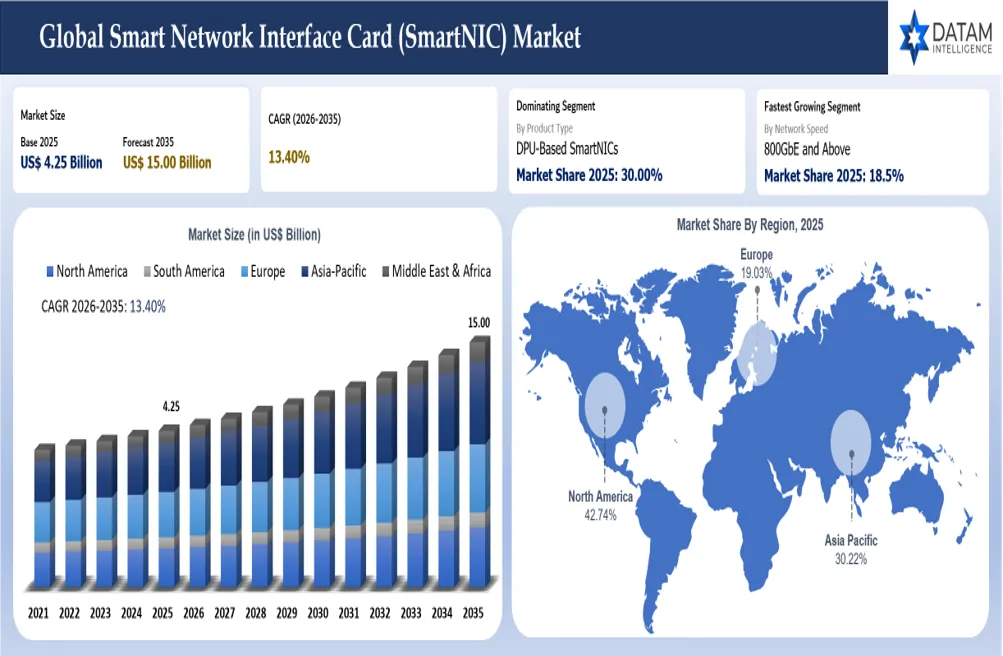
The global smart network interface card (SmartNIC) market reached US$ 4.25 billion in 2025 and is expected to reach US$ 15.00 billion by 2035, growing with a CAGR of 13.40% during the forecast period 2026-2035.
The SmartNIC market is influenced by the major move towards AI infrastructure based on 400GbE and 800GbE networks, in addition to the above mentioned market size growth prospects. NVIDIA has already launched the 400 Gb/s BlueField-3 DPUs and the 800 Gb/s BlueField-4 platforms, as well as the ConnectX-8/9 SuperNIC products that run at 800 Gb/s. Thus, it is becoming clear that high-speed AI clusters acquire ever-increasing importance for SmartNIC parts. The increasing size of GPU clusters, along with RDMA-based data moving capabilities and a significant amount of low-latency east-west traffic generates the requirement of transferring networking workloads from host CPUs to dedicated infrastructure-processing units.
The capabilities of SmartNIC are evolving, including data storage, cybersecurity, virtualization and supporting multiple tenants with resource management. Current DPU technology involves integrated solutions for networking together with NVMe-oF, GPUDirect Storage, security features, telemetry and work isolation. The programmable software allows the operation of infrastructure services without the involvement of host CPUs. One of the examples of such technology is NVIDIA’s BlueField-4, which features 800Gb/s networking, PCIe Gen6 host connectivity and dedicated acceleration for security and data transfer.
Smart Network Interface Card (SmartNIC) Market Key Takeaways
- DPU-Based SmartNICs captured a 30.0% share of the SmartNIC market globally in 2025 owing to the increasing demand for CPU offloading, virtualization, storage acceleration, security processing and workload infrastructure management in AI and hyperscale data centers.
- The 800GbE and Above was the fastest growing network speed segment, recording an estimated 20.5% CAGR during the forecast period fueled by AI/GPU clusters, high-speed east-west data center traffic, RDMA data movement and demand for low latency and high throughput data center networking.
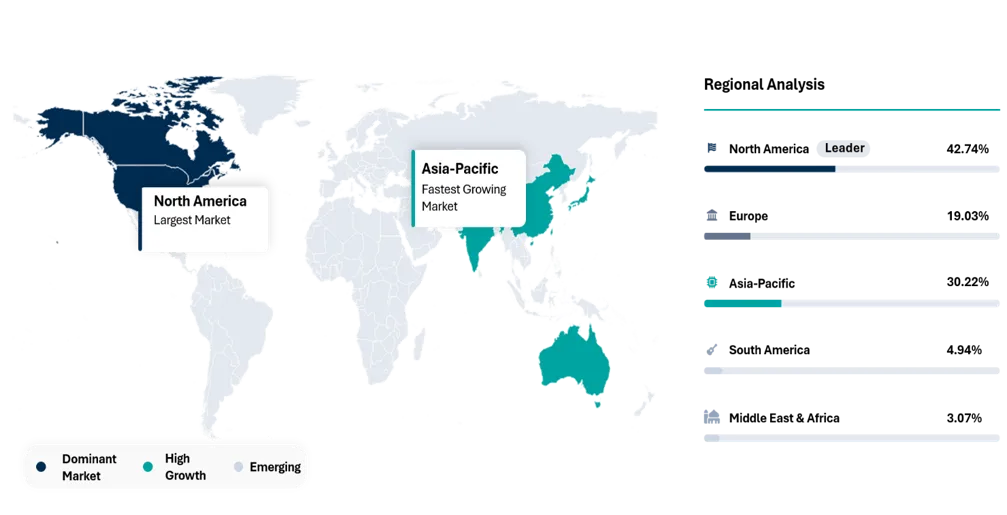
- North America had the dominant share of the SmartNIC market in 2025 with a market share of 42.74%, attributable to its strong presence of hyperscale cloud operators, AI data centers, HPC infrastructure and 400GbE and 800GbE networking.
- Increasing use of DPU/IPU architecture is enabling the capability of SmartNIC to extend beyond traditional packet-processing offload into network, storage, security, virtualization, telemetry and workload-isolation offload tasks, minimizing the infrastructure load on host CPUs.
- Due to rising deployment of AI and machine-learning infrastructure, there is a increasing need for SmartNICs that support RDMA, GPU transfers, NVMe-oF, programmable data planes, congestion control and inline security, especially in hyperscale, cloud and HPC systems.
Smart Network Interface Card (SmartNIC) Industry Trends and Strategic Insights
- AI Data-Center Networking Acceleration: The fast adoption of AI clusters has driven the need for 400 GbE and 800 GbE SmartNICs that can accelerate packet processing, RDMA, GPU-to-GPU communications and infrastructure workloads.
- Convergence of SmartNIC, DPU and IPU Architectures: Companies are combining programmable CPUs, accelerators and networking chips into an infrastructure processor that can offload tasks such as networking, storage, security and virtualization from the host CPU.
- Programmable Data-Plane Processing: The use of more programmable ASICs, FPGAs and processor-based SmartNICs has allowed users to program their packet processing for cloud networking, monitoring, security and workload acceleration.
- Infrastructure Security Offloading: SmartNICs have been found increasingly useful in inline encryption, microsegmentation, firewalling, zero trust security enforcement and multi-tenant isolation without making use of any additional processing from host CPUs.
- SmartNIC Deployment in Hyperscale and Cloud Infrastructure: Cloud providers and hyperscalers have been increasingly including SmartNIC/DPU functionality within their servers for enhancing CPU utilization and efficiency in networking and storage.
Smart Network Interface Card (SmartNIC) Market Scope
| Metrics | Details | |
| 2025 Market Size | US$ 4.25 Billion | |
| 2035 Projected Market Size | US$ 15.00 Billion | |
| CAGR (2026-2035) | 13.40% | |
| Largest Market | North America | |
| Fastest Growing Market | Asia-Pacific | |
| By Product Type | Programmable SmartNIC, DPU-Based SmartNIC, FPGA-Based SmartNIC, ASIC-Based SmartNIC, SuperNIC / AI NIC, IPU-Based NIC and Others | |
| By Network Speed | Up to 25GbE, 50GbE, 100GbE, 200GbE, 400GbE and 800GbE & Above | |
| By Technology | RDMA, DPDK, SR-IOV, NVMe-oF, Programmable Data Plane, TCP/IP Offload and Others | |
| By Offload Function | Network Offload, Storage Offload, Security Offload, Virtualization Offload, AI Data Movement Offload and Others | |
| By Host Interface | PCIe 3.0, PCIe 4.0, PCIe 5.0, PCIe 6.0, CXL-Enabled Interface and Others | |
| By Application | AI & Machine Learning, High-Performance Computing, Cloud Computing, Data Center Networking, Network Security, Telecommunications & 5G, Edge Computing and Others | |
| By Deployment | Hyperscale Data Centers, Cloud Data Centers, Enterprise Data Centers, Colocation Data Centers, Edge Data Centers and Others | |
| By End-User | Cloud Service Providers, Telecommunications Operators, Enterprise IT, Financial Institutions, Government & Defense, Research & Academic Institutions and Others | |
| By Region | North America | U.S., Canada, Mexico |
| Europe | Germany, UK, Russia, France, Spain, Italy, Poland | |
| Asia-Pacific | China, India, Japan, Australia, South Korea, Indonesia, Malaysia, Singapore, Vietnam, Thailand, Philippines, Taiwan | |
| South America | Brazil, Argentina | |
| Middle East and Africa | UAE, Saudi Arabia, South Africa, Israel, Turkiye, Nigeria | |
| Report Insights Covered | Competitive Landscape Analysis, Company Profile Analysis, Market Size, Share, Growth | |
Why does this report matter in 2026?
The SmartNIC market will be of particular importance in 2026 when artificial intelligence data centers progress toward faster network speeds along with larger GPU clusters along with more dispersed computing. The evolution to 400G and 800G Ethernet together with the RDMA-based AI networking and rise in east-west traffic brings a higher demand for the offloading of packet processing and virtualization along with data protection and data moving from host CPUs. In this way, we can say that SmartNICs gather at an important junction of fast network connection and computing efficiency.
2026 has great significance as the market increasingly converges around architectures like SmartNIC, DPU and IPU. This altered the criteria for vendors and data-center operators when they evaluate the infrastructure acceleration. Investments are being done not only in basic network offload solutions but also in AI-cluster networking, NVMe-oF storage acceleration, encryption, microsegmentation, telemetry and multi-tenancy isolation. Thus, being aware of these technology trends, vendor strategies, requirements for workload and geographical spread of technology adoption is essential when analyzing SmartNIC deployment and possible investments in the course of the next round of the data-center infrastructure evolution.
Smart Network Interface Card (SmartNIC) Market White Space & Investment Opportunities
- AI Cluster Networking Offload: An opportunity to create the SmartNICs that work for AI clusters of 400G/800G speeds using RDMA, GPU data movement and giving the possibility of low latency east-west data transfer.
- Integrated Network Security Acceleration: There is white space in the area of SmartNICs that offer packet processing along with encryption, firewall, micro-segmentation and zero trust security in-line.
- Storage & NVMe-oF Acceleration: Opportunities for investment are available in SmartNIC platforms that accelerate NVMe-oF, compression, erasure coding and storage virtualization workloads.
- Programmable SmartNIC Platforms for Cloud Providers: The demand for customizable data plane architectures presents an opportunity for suppliers of programmable hardware and software stacks for hyperscale and multi-tenant clouds.
- Edge and Telecom SmartNIC Deployment: Opportunities exist in 5G, edge computing and distributed data centers for compact SmartNICs capable of packet processing, network functions virtualization, telemetry and traffic management.
Smart Network Interface Card (SmartNIC) Future Market Transformation
It is anticipated that the SmartNIC industry will evolve from acceleration through a network interface to programming infrastructure processes. Future SmartNIC will merge Ethernet and new capabilities of DPU/IPU computing, as well as networking clusters with AI, acceleration of storage, security tasks processing and offloading of virtualization-related tasks. The growing deployment of 800G standard unites Ethernet and generational upgrades of the Ethernet standard with its GPU-focused AI infrastructure as well as NVMe-oF technology. A great demand will emerge for SmartNICs that are able to endure more traffic and experience a smaller delay while having a lower CPU consumption. Competition is going to shift towards hardware-software solutions, where programmable data planes, Software Development Kits, integration of orchestration into the lower layers, hardware acceleration for specific types of traffic, as well as secure infrastructure of multi-tenancy become as essential as the throughput of the network itself.
Smart Network Interface Card (SmartNIC) Market Buyer Decision-Making Criteria
SmartNIC buyers assess products not just in terms of throughput but also in terms of its capacity to offload networking, storage, security and virtualization processing from host CPUs. For AI data centers, hyperscalers and cloud service providers, purchase decisions are influenced by parameters like 400G/800G capacity, latency, RDMA features, programmability, DPU/IPU capabilities, software compatibility, security acceleration, energy efficiency and integration with existing servers and orchestration systems. Also, buyers look for support for software over an extended period, complexity of deployment, compatibility with other solutions, vendor’s strength and overall cost of ownership.
Major Buyer Decision Criteria
- Network Throughput: 100G/200G/400G/800G Ethernet capability
- Latency & Packet Processing: Low-latency, high-rate packet processing
- CPU Offload Efficiency: Reduction in host-CPU utilization
- RDMA Support: RoCE/RDMA capabilities for AI and HPC workloads
- Programmability: Programmable data-plane and workload customization
- DPU/IPU Capabilities: Networking, storage, security and virtualization acceleration
- Security Offload: Encryption, firewalling, microsegmentation and secure isolation
- Storage Acceleration: NVMe-oF and storage virtualization support
- Software Ecosystem: SDK, drivers, APIs, DPDK, orchestration and virtualization compatibility
- Power Efficiency: Performance per watt at high network speeds
- Interoperability: Compatibility with servers, switches, operating systems and cloud platforms
- Total Cost of Ownership: Hardware, software, integration, maintenance and deployment costs
- Vendor Support: Product roadmap, firmware updates, technical support and ecosystem maturity
Smart Network Interface Card (SmartNIC) Market Economic & Investment Analysis
The future of the SmartNIC market heavily depends on the capital spending in AI systems, large data centers, the cloud and fast networking. The deployment of the workloads that utilize GPUs increases the demand for 400G/800G technology, CPU offload functions, RDMA, storage speedup and infrastructure protection. SmartNICs allow companies running data centers to increase their server performance by removing some of the infrastructure tasks from the CPUs. With the increasing importance of performance per server and efficiency of the infrastructure, the implementation of SmartNICs becomes an integral part of the server and networking investments.
The investment activity in the sector is gradually moving from conventional hardware for network interface abstraction to Smart adapters, digital-processing units and intelligent processing units that integrate networking, storing, security aspects and virtualization acceleration function. The main areas for investment cover rapid Ethernet processing, networking in AI clusters, speedup in NVMe over fabric systems, programmability of data plains and security offload technologies. The market promises great chances for investors and IT providers in such sectors as the development of semiconductors, SmartNIC ecosystems, server-based integration, infrastructures of clouds and specific solutions for AI infrastructure and hyper-scale data centers.
Smart Network Interface Card (SmartNIC) Investment Trends in the Market
- Investment in AI-Optimized SmartNICs: Funds are being allocated to SmartNIC concepts that operate with 400G/800G Ethernet technologies and for RDMA and AI-equipped clusters.
- Expansion of DPU and IPU Capabilities: Providers invest in converged SmartNIC/DPU/IPU solutions that merge all features of networking technologies alongside storage, security and virtualization capabilities.
- Investment in Programmable Networking Silicon: The investments are aimed at evolutionary solutions based on programmability of ASIC, FPGA and processor architecture that can meet the needs of data center providers.
- Growth of Security-Offload Solutions: Investment is growing in SmartNIC-enabled encryption, firewalling, micro-segmentation and zero-trust processing, which help relieve the host CPU of security tasks.
- Hyperscaler and Cloud Infrastructure Deployment: Growing investment made by cloud and data-center operators boosts the implementation of SmartNIC technology for CPU off-loading, tenant isolation, acceleration of storage and network performance.
Strategic Indicators for Smart Network Interface Card (SmartNIC) Market
High Regulation Impact
The SmartNIC market is under increasing influence by regulatory considerations due to the use of data center cybersecurity, network security, data sovereignty, export control and semiconductor regulations, especially those that apply to SmartNICs employed in hyperscale cloud, telecom, governmental and critical infrastructure deployments. Regulatory considerations concerning encryption, hardware security, trusted computing and cross-border movement of networking technology may have an effect on SmartNIC design, firmware, software capabilities and geographic location of deployment. Moreover, export restrictions on cutting-edge semiconductor and computing technology can also impact the availability of high-end SmartNIC/DPU technology and its implementation in the field of artificial intelligence/data center infrastructure.
High Investment Activity
Investment efforts regarding the SmartNIC sector are mostly being directed towards AI data-center connectivity, DPU/IPU technologies, 400G/800G Ethernet, adaptive silicon used for the data plane and infrastructure offload technologies. Solution providers and data-center infrastructure companies are directing funds towards solutions like SmartNIC that would make possible the improvement of AI-cluster networking, as well as its components and technologies, such as RDMA, NVMe-oF storage, security processing, virtualization and other technologies that allow to minimize host-CPU effort. Investment efforts are also expanding towards such fields as SmartNIC software, SDKs, firmware, server integration and application-oriented acceleration.
Supply Chain Disruption
The SmartNIC industry faces supply chain risks from semiconductor manufacturing, high speed Ethernet controllers, memory chips, optical and electronic connectors, PCB assembly and advanced packaging. The reliance on semiconductor fabs and packaging capability for high bandwidth 400G/800G SmartNICs and DPU-level parts may lead to lead time issues and potential shortages of these types of devices. Trade barriers and export controls on advanced compute hardware, foundry fab allocation and availability of high speed semiconductors may impact the manufacturing schedules and cost structures of the SmartNIC suppliers and data centers.
Pricing Volatility
Market volatility for SmartNIC pricing is created by high-end chip prices, 40-Gbps Ethernet controllers, required FPGA/ASIC capacity, high-level packaging, memory needs and component availability for 400G/800G. SmartNICs and DPUs are usually more expensive than conventional NICs due to the special features they have like programmability and infrastructure offload capabilities. At the deployment level, even a small adjustment upwards, by 5-10%, in the price of a SmartNIC can have a substantial impact on an overall budget for hyperscalers and AI data centers because thousands of accelerator cards may need to be deployed. Therefore, pricing fluctuations are strongly correlated with and largely dependent on semiconductor supply conditions, bandwidth upgrades, architecture complexity, software licensing and hyperscaler buying volumes.
Procurement Pressure
SmartNIC market procurement pressure is mounting due to the need for speedy implementation of 400G/800G networks while keeping costs in check and managing power consumption for AI data centers, cloud providers and hyperscalers. Buyers are requesting high levels of throughput and low latency with support for RDMA, efficiency of CPU offload, DPU/IPU capabilities, security acceleration and compatibility with software. Meanwhile, procurement teams are under pressure to maintain required semiconductor and advanced packaging capabilities, ensure compatibility with existing servers and switches and avoid vendor lock-in. As a result, buyers have no option but to undertake stringent evaluations of performance-per-dollar and performance-per-watt before finalizing SmartNIC purchases.
New Technology Adoption
Adoption of new technologies in the SmartNIC space has revolved around the shift from legacy network interface cards to SmartNICs that support various networking, storage, security and virtualization workloads using programmable SmartNICs, DPUs and IPUs. Adoption continues to be driven by technologies such as 400G/800G Ethernet, Remote Direct Memory Access, programmable packet processing, NVMe-over-Fabrics, inline encryption and traffic acceleration of AI clusters. Buyers are equally looking for software-defined data plane, SDK programmability, telemetry and orchestration capabilities, making the presence of fast hardware and flexible software architecture an important consideration for the next generation of SmartNICs.
Regional Expansion Opportunity
The opportunities that exist with regard to regional growth in the SmartNIC market are located in North America, East Asia and in developing data center regions within Asia-Pacific. In North America, there are opportunities related to AI/HPC clusters and hyperscale data centers, while in China, Japan, South Korea, Taiwan and India there are opportunities related to cloud infrastructure, semiconductors, telecom networks and growing enterprise data centers. There is also growing opportunity in the Middle East and Southeast Asia where hyperscale and edge data center deployments are creating additional demand for 400G/800G network connectivity, CPU offload, security acceleration and programmable infrastructure processing.
Government Policy Support
Support from the government is playing a more significant role in the SmartNIC market by linking its growth to the development of AI computing infrastructure, high-speed networking, semiconductor technology and national computing capacity programs. In China, the “AI + Information and Communications” initiative for 2026-2028 aims at achieving 400Gbps/800Gbps backbone networks, high-speed switching and forwarding chips and optical interconnection technology and strengthening computing network infrastructure, hence boosting the SmartNIC and DPU market development potential. The 2026-2030 development strategy for China also emphasizes supercomputing infrastructure, advanced chips, cloud computing and self-sufficient software and hardware ecosystems.
Pricing Intelligence
Price intelligence in the SmartNIC market increasingly centers on price-per-performance, bandwidth efficiency and bulk volume pricing, not simply individual card prices. Supplier price list examples reveal that 200G SmartNICs cost about US$1,080 each, while 400G models are about US$1,800 and 800G models are about US$3,600 each. However, real prices will vary based on configuration, supplier and volume of purchase. Purchase in bulk may even help cut down costs further, where price lists have shown about a 15% discount for purchases above 10,000 units. Purchasers now take into account prices per Gb/s, CPU offloading, power efficiency, software/SDK prices and bulk volume pricing.
| HS Code | Reporter | Trade Flow | 2025 Trade Value | Interpretation |
| 851762 | China | Exports | US$39.40 Billion | Reflects China’s large export base for switching, routing and data-transmission equipment relevant to the broader SmartNIC supply ecosystem. |
| 851762 | United States | Imports | US$84.95 Billion | Indicates substantial U.S. demand for networking and data-transmission equipment relevant to data-center infrastructure. |
| 851762 | Japan | Imports | US$7.20 Billion | Indicates Japan’s import demand for broader networking and data-transmission equipment supporting enterprise and data-center infrastructure. |
| 851762 | European Union | Imports | US$37.30 Billion | Represents EU-wide imports of switching, routing and data-transmission equipment relevant to the European networking infrastructure ecosystem. |
Note: HS 851762 is a trade proxy, not a SmartNIC-specific HS code. It covers machines for reception, conversion, transmission or regeneration of data, including switching and routing apparatus.
AI Impact Analysis of Smart Network Interface Card (SmartNIC) Market
The demand for SmartNICs is on the rise because of AI technology being utilized in data centers, where a number of GPUs creates a high amount of east-to-west traffic along with the need for quick and efficient data transfer. With the help of SmartNICs, the processes such as RDMA, packet processing, virtualization, telemetry, encryption and congestion control can be transferred away from the main CPU so that the CPU can work only on the applications work. Moreover, the increasing use of Ethernet equipment with higher capacity indicates the demand for SmartNICs due to the general effectiveness of such technology.
Moreover, the workloads in artificial intelligence are pushing the traditional networking unit to perform more than pure networking acceleration through moving towards the infrastructure processing of technology called DPU/IPU. Companies are developing ready-to-program platforms of SmartNICs by making them capable of computing, storing and processing security and networking. In such a way, we obtain the designs of SmartNICs that are specifically composed to allow communication from GPU to GPU, running AI workloads in the cluster and providing secure data traffic by using software programming.
Disruption Analysis of Smart Network Interface Card (SmartNIC) Market
The SmartNIC market is undergoing changes as it moves away from traditional NICs and toward programmable infrastructure processors, especially DPUs and IPUs. New technology is focusing on more than just packet transfer, as modern platforms bring networking elements together with virtualization, storage and security to the network interface. The jump to 400G and 800G Ethernet, RDMA-based AI networking and dense GPU arrays is redefining the performance requirements of SmartNICs and programmable data planes implement packet processing dedicated to certain cloud, AI and storage tasks.
The second disruption to take place involves the progressive merging of SmartNIC functions into more general server and artificial intelligence infrastructure frameworks. Providers of infrastructure along with hyperscale companies are utilizing infrastructure processors more and more as their means of isolating workloads, speeding up NVMe-oF storage, implementing security rules and controlling data transfer without loading the host's CPU. This means that competition is no longer between different types of NIC hardware but is moving towards hardware-software platforms with features like software development kits (SDKs), programmability, orchestration compatibility, security options and various workload-specific acceleration technologies becoming more significant along with network bandwidth.
Smart Network Interface Card (SmartNIC) Market BCG Matrix: Company Evaluation
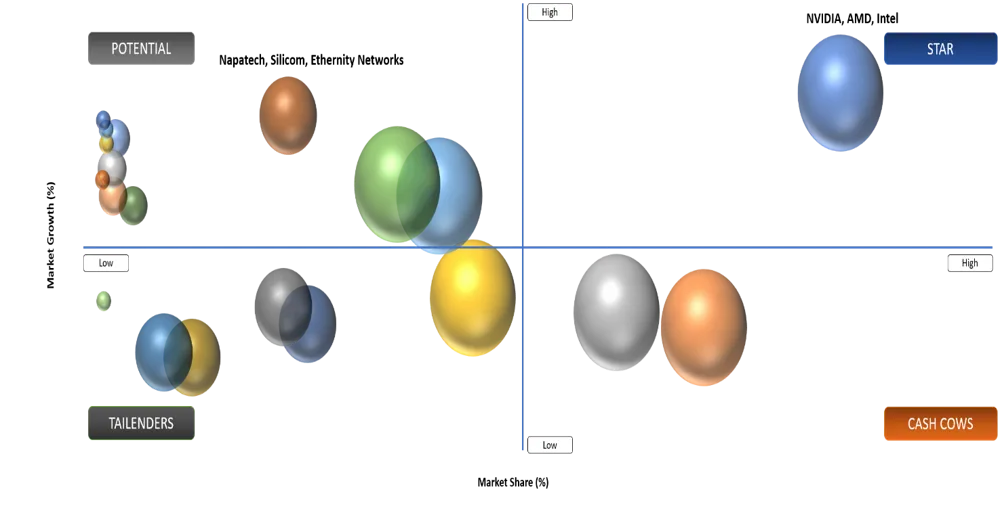
STAR
Firms that are strategically placed in the Star segment of the SmartNIC industry enjoy both the advantage of being well-established competitors as well as having access to the most rapidly-growing areas of demand. Specifically, firms such as NVIDIA, AMD, Intel, Broadcom and Marvell Technology leverage their experience in networking silicon products, relationships with hyperscalers and use of SmartNICs and DPUs/IPUs. Their positioning is bolstered through their capabilities that range from RDMA, programmable packet processing, storage offloading, security acceleration and high-performance Ethernet, enabling them to cover more infrastructure-intensive AI and cloud workloads.
POTENTIAL
The Potential quadrant companies work in niche SmartNIC segments or possess technologies which will allow them to capture market shares as market uptake grows, but which have a lower business presence compared to larger platform vendors. Examples of companies positioned in such areas include Napatech, Silicom, Ethernity Networks, LDA Technologies, Achronix and Xsight Labs. These companies have growth opportunities related to rising demand for specialized networking solutions in applications such as AI/HPC, financial services, telecommunications, edge infrastructure and high-performance data centers, particularly where programmable and application-specific acceleration provides differentiation.
Smart Network Interface Card (SmartNIC) Market Dynamics
Driver Impact Analysis
| Driver | Market Growth Impact (%) | Demand Concentration | Impacted Use Case | Strategic Impact |
| AI & GPU Data Center Expansion | 32% | Hyperscale & AI Data Centers | AI Cluster Networking | Drives demand for high-bandwidth SmartNICs, RDMA and GPU data-movement acceleration |
| Growth of 400G/800G Ethernet | 27% | Hyperscale & Cloud Data Centers | High-Speed Network Offload | Accelerates adoption of high-throughput SmartNICs and next-generation DPU platforms |
| Increasing CPU Offloading Requirements | 23% | Cloud & Enterprise Data Centers | Network, Storage & Virtualization Offload | Improves server utilization by transferring infrastructure workloads from host CPUs |
Rising Network Security & Multi-Tenant Requirements | 18% | Cloud, Telecom & Enterprise | Security Offload & Workload Isolation | Expands demand for SmartNIC-based encryption, microsegmentation and secure infrastructure processing |
Driver: AI Data Center and High-Speed Networking Expansion
AI advancements and GPU-driven data center technology are propelling the SmartNIC market, which necessitates rapid transfer of data between servers, GPUs, storage systems and networks. SmartNICs facilitate RDMA function, packet handling, congestion control, virtualization, data telemetry and CPU offloading as developments move towards 400GbE and 800GbE, thus creating a need for skilled network acceleration. Therefore, SmartNIC is increasingly becoming popular in new technological environments including AI services, HPC technology spaces, cloud technologies and large-volume storage system architectures.
Restraint Impact Analysis
| Restraint | Drag on Market Growth (%) | Primary Impact Area | Impacted Use Case | Strategic Impact |
| High SmartNIC/DPU Hardware Costs | 30% | Procurement & Infrastructure CapEx | Hyperscale & Enterprise Data Centers | Increases deployment barriers and extends infrastructure investment cycles |
| Software Ecosystem & Integration Complexity | 27% | Software Development & Integration | Cloud Networking & Virtualization | Increases deployment effort and creates demand for mature SDKs and standardized interfaces |
| Power & Thermal Requirements at 400G/800G | 23% | Data Center Power & Cooling | AI/HPC Networking | Raises operating costs and complicates high-density SmartNIC deployment |
| Limited Cross-Platform Interoperability | 20% | Architecture & Vendor Integration | Multi-Vendor Data Center Networks | Can increase switching costs and restrict adoption across heterogeneous infrastructure |
Restraint: Hardware, Software and Integration Complexity
One significant limitation is the expensive and technically complicated nature of implementing SmartNIC and DPU-based solutions, especially where there are large-scale needs that demand special hardware, firmware, software development kits, drivers and orchestration integration. The SmartNIC has to work in different environments including servers, hypervisors, operating systems, switches, cloud platforms and workload orchestrators, whereas 400G/800G high-speed solutions present extra power and cooling challenges. They can lead to higher deployment and engineering expenses and cause complexities in migration from traditional NIC design, especially for organizations with heterogeneous data centers involving multiple vendors.
Smart Network Interface Card (SmartNIC) Market Segment Analysis
The global smart network interface card (SmartNIC) market is segmented based on the product type, network speed, technology, offload function, host interface, application, deployment, end-user and region.
By Product Type
DPU-Based SmartNICs Dominate the Market Through Broad Infrastructure Offloading Capabilities
DPU-Based SmartNICs constituted around 30.0% of the total global market for SmartNICs in the year 2025, indicating a significant uptake in adoption in hyperscale and cloud data centers. The ability of DPU SmartNICs to handle the key workloads of network processing, virtualization of services, storage, security and infrastructure management prove their relevance especially throughout AI-driven environments. Market forecasts also suggest that the stand-alone DPU SmartNIC market was worth $1.27 billion in 2025, reflecting the rising importance of the DPU-enabled network architecture.
By Network Speed
800GbE and Above Is the Fastest-Growing Network-Speed Segment as AI Clusters Scale
800GbE and Above is predicted to grow at a CAGR of about 20.5%, which makes it the most rapidly growing segment among different network speeds in the SmartNIC market. The development of AI/GPU clusters, increased east-west network bandwidth, GPU communication using RDMA technology and density of accelerators are some factors that have resulted in a higher pace of adoption of 800GbE. The shift toward 800GbE has resulted in a growing demand for SmartNICs that support high-performance packet processing and congestion control, along with low latency infrastructure offload.
Smart Network Interface Card (SmartNIC) Market Geographical Penetration
U.S. Smart Network Interface Card (SmartNIC) Market Landscape
The landscape of the U.S. smart network interface card (SmartNIC) industry is shaped by the rapid deployment of AI technologies and the growth of hyperscale data centers as well as the need for 400G/800G Ethernet and offloading network, storage, security and virtualization tasks to the network cards. In the U.S., we find a robust ecosystem of suppliers of SmartNIC devices and DPU and IPU infrastructure, where hyperscalers and cloud service providers are vital partners for big infrastructure projects. The demand also rises in the field of RDMA technology, GPU-to-GPU data transfers, NVMe over Fabrics, network security acceleration technologies and interaction among multiple tenants by using common infrastructure.
Japan Smart Network Interface Card (SmartNIC) Market Outlook
The growth of the SmartNIC industry in Japan is largely tied to the upgrade of data centers, the emergence of high-performance computing, the use of cloud technology for corporate purposes and increased AI workloads that require low-latency, high-speed networks. The demand in the area is supported by the growing incorporation of arrays offering 100/200/400G Ethernet technology, RDMA-enabled infrastructure, security offloading from the networks and storage acceleration. Japanese technology and electronics firms are also participating in the ecosystem by providing capabilities in networking, semiconductors and data centers, while increasing AI compute demands present opportunities in programmable SmartNICs and DPUs that reduce host-CPU workloads and improve infrastructure efficiency.
China Smart Network Interface Card (SmartNIC) Market Trends
The growth drivers for China’s SmartNIC market include growth in hyperscale and enterprise data centers, artificial intelligence infrastructure, cloud offerings and high-speed networking. The market demand is increasingly centering on 200G/400G Ethernet, RDMA (remote direct memory access), programmable packet processing, storage offloading and network security acceleration, especially as organizations are looking to optimize their servers and reduce CPU loads. The Chinese SmartNIC market also includes an increasing focus on local networking and semiconductors, opening up opportunities for the development of local SmartNICs, DPUs and programmable accelerators for cloud, telecom, AI clusters and distributed data center environments.
Smart Network Interface Card (SmartNIC) Market Competitive Landscape
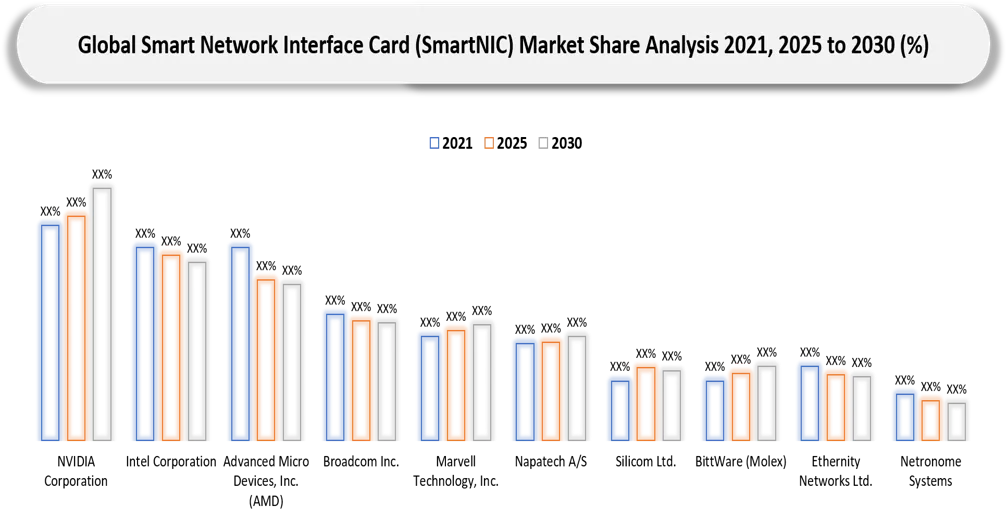
- NVIDIA, Intel, AMD, Broadcom and Marvell have a fierce competition among SmartNIC, DPU, IPU and fast Ethernet solutions with growing differences that lie in artificial intelligence, data center networking, CPU offloading and programmable infrastructure processing.
- NVIDIA consolidates itself by offering BlueField DPUs, ConnectX networking and SuperNIC platforms aimed at GPU clusters, RDMA, 400GbE/800GbE networking and AI data transfer.
- The competition from Intel and AMD involves infrastructure acceleration via IPUs/DPUs and concentrates on virtualization, network offloading, storage acceleration, security and workload isolation.
- Key areas of focus for Broadcom and Marvell include high-speed Ethernet connectivity, networking silicon, infrastructure processors and programmable acceleration targeting hyperscale AI network applications and bandwidth-intensive data center design.
- SmartNIC vendors like Napatech, Silicom, Ethernity Networks, LDA Technologies, Achronix and Xsight Labs leverage differentiation based on FPGA-accelerated processing, programmable data planes, low latency processing and networking for specific workloads, including AI, HPC, finance, telecom and edge applications.
Public Company Q1-Q2 2026 Performance Comparison
The table below compares five publicly listed companies with direct or strategically relevant exposure to the smart network interface card (SmartNIC) market. Financial metrics are company-wide because SmartNIC, DPU, IPU and related networking revenue is generally reported within broader data-center or infrastructure segments.
| Company | Q1–Q2 2026 Performance | Smart Network Interface Card (SmartNIC) Exposure | Key Performance Driver |
| NVIDIA Corporation | US$177.84 Billion revenue | BlueField DPUs, ConnectX SmartNICs and SuperNIC platforms | AI infrastructure expansion and accelerated data-center networking |
| Intel Corporation | US$29.40 Billion revenue | IPUs and Ethernet networking solutions for cloud, AI, enterprise and edge infrastructure | AI-driven data-center demand and infrastructure networking |
| Advanced Micro Devices, Inc. (AMD) | US$21.79 Billion revenue | Pensando DPUs and networking solutions for cloud, enterprise and AI infrastructure | Data Center growth and accelerating AI deployments |
| Broadcom Inc. | US$41.85 Billion revenue | Ethernet networking, switching ASICs and infrastructure solutions supporting AI/data-center connectivity | AI semiconductor demand and hyperscale networking investment |
| Marvell Technology, Inc. | US$5.16 Billion revenue | OCTEON DPUs and infrastructure processors for networking, storage and security offload | AI-related data-center demand and high-speed connectivity |
Note: Company-level revenue should not be interpreted as SmartNIC revenue unless separately disclosed. Financial periods and reporting calendars differ across companies and SmartNIC/DPU revenue is generally reported within broader data-center, networking, or infrastructure semiconductor segments.
Key Companies of Smart Network Interface Card (SmartNIC) Market
- NVIDIA Corporation (United States)
- Intel Corporation (United States)
- Advanced Micro Devices, Inc. (AMD) (United States)
- Broadcom Inc. (United States)
- Marvell Technology, Inc. (United States)
- LDA Technologies (Canada)
- Napatech A/S (Denmark)
- Silicom Ltd. (Israel)
- Ethernity Networks Ltd. (Israel)
- BittWare (Molex) (United States)
- Chelsio Communications, Inc. (United States)
- Achronix Semiconductor Corporation (United States)
- Netronome Systems (United States)
- Kalray S.A. (France)
- Corigine (United States)
- Xsight Labs (Israel)
- Asterfusion (China)
- Lanner Electronics Inc. (Taiwan)
- Liquid Market Solutions (United States)
- Jaguar Microsystems (United States)
Company Profiles of Smart Network Interface Card (SmartNIC) Market
NVIDIA Corporation
NVIDIA is a prominent vendor of accelerated networking solutions that offers the company's line of SmartNICs and DPUs comprising ConnectX network interfaces, BlueField DPUs and Ethernet SuperNICs. The platforms address AI factories, hyperscale cloud data center operations and GPU clusters enabling high-bandwidth GPU-to-GPU interconnectivity, RDMA, network offloading and multi-tenant infrastructure with high security. The ConnectX-9 SuperNIC platform delivers up to 1.6 Tb/s of bandwidth, whereas ConnectX-8 allows delivering up to 800 Gb/s of throughput.
Competitor priorities encompass growing usage of the company's SuperNIC in AI clusters, growth of 800GbE and above connectivity, expansion of BlueField DPU deployments and development of DOCA ecosystem for programmable infrastructure processing, security, storage and AI data movement.
Intel Corporation
Intel offers products in the SmartNIC space through its IPU and Infrastructure Acceleration portfolio to address networking, storage and virtualization offload needs in cloud and data-center workloads. The approach Intel takes is focused on programmable infrastructure processing where infrastructure functions are separated from application functions, leading to better utilization of host CPUs and more control in multi-tenant data-center scenarios.
Competitive focus areas include wider adoption of IPU in cloud infrastructures, enhanced programmable packet processing and virtualization, high speed Ethernet architecture and robust software ecosystem for heterogeneous data-centers.
Advanced Micro Devices, Inc. (AMD)
AMD is an industry competitor in the field of SmartNICs and DPUs by virtue of its Pensando DPU technology, which serves high bandwidth data movement for AI training, inference and the new age cloud-based workloads. The Pensando DPU offers programmable networking, multi-tenant SDN, security services acceleration and observability for the network, storage and security.
The competitive focus is to increase adoption of Pensando DPU in AI data centers, accelerate front-end networking for GPU infrastructure, increase security and observability offload and offer programmable networking within the AMD data center compute and accelerator suite.
Broadcom Inc.
Broadcom is a key semiconductor provider within the networking field and its exposure to the SmartNIC market space comes through its high-speed Ethernet connections, switching and programmable networks within the AI and hyperscale data centers architecture. This company's competitive positioning is based on the growing requirement for the high bandwidth data transfer and network acceleration.
The competitive priorities of Broadcom are high-speed Ethernet, support for the 400GbE and 800GbE AI networks architecture, network performance and power efficiency improvements and enhanced connectivity solutions for hyperscale AI clusters and next-generation data centers.
Marvell Technology, Inc.
Marvell is a direct participant in the SmartNIC and DPU industry via the OCTEON product line that includes SmartNICs, Networking, Security, Storage and Infrastructure Processing solutions. OCTEON 10 DPUs utilize Arm Neoverse N2 cores, programmable packet processing, inline cryptography, AI/ML acceleration and data paths of more than 400G, while Marvell’s LiquidIO III is an inline DPU-based SmartNIC for Cloud Networking and Security Acceleration.
Market competition priorities include expanding OCTEON DPU use cases in hyperscale and enterprise datacenters, adding networking and security offloads, AI and 5G Infrastructure and improving unified SDK capability for networking, storage and security workloads.
Napatech A/S
Napatech is a highly specialized SmartNIC and DPU vendor that focuses on programmable FPGA networking for cloud, enterprise, telecom and financial services infrastructures. The company’s product line encompasses SmartNICs offering packet capture, virtualization, programmable data plane processing and 400G networking solutions, whereas the software portfolio is built around security, storage, virtualization and DPU offload offerings. Napatech received a multiyear design win from a Tier-1 financial institution worth over US$3 million for a two-year period in 2026, with US$1.5 million committed for 2026 alone.
The competitive priorities are to increase adoption of FPGA-based SmartNICs in low-latency applications, expand 400G solutions deployments, advance programmable networking software and boost DPU offload in financial services, telecom and data center workloads.
Smart Network Interface Card (SmartNIC) Market Major Pain Points
- High Hardware and Deployment Costs: Advanced SmartNICs with programmable processors and accelerators in addition to high speed Ethernet connections may significantly drive up costs associated with server infrastructures.
- Software Ecosystem Complexity: The introduction of SmartNICs into hypervisors, operating systems, cloud platforms and orchestration environments increases not only development but also integration challenges.
- Limited Software Portability Across Architectures: The applications for SmartNICs as well as their data-plane programs may require optimization tailored to each architecture resulting in challenges migrating between ASIC-, FPGA- and processor-based solutions.
- High-Speed Thermal and Power Constraints: In terms of power consumption and thermal management, it can be said that 400G/800G SmartNICs present certain issues for installations of artificial intelligence and hyperscale servers.
- Workload and Performance Optimization Challenges: The usability of SmartNIC also depends on their ability to offload relevant workloads related to networking and storage since the poor performance of workloads can impact the CPU use significantly.
Smart Network Interface Card (SmartNIC) Market Recent Developments
- Marvell Technology, Inc. - September 2026: Marvell broadened the application of its OCTEON DPU in order to accelerate networking and storage in AI clusters where the networking, storage and security processing can be offloaded from host CPUs.
- Napatech A/S - September 2026: Napatech introduced Link-Capture Linux v12.16.8.1 which included buffer-overflow handling in IPC and VPD fixes, along with updates to the FPGA image for the company’s NT400D11 SmartNIC platform.
- NVIDIA Corporation - September 2026: NVIDIA made further developments to its Spectrum-X AI Networking platform through the introduction of ConnectX-8, BlueField-3 DPUs, DOCA and NCCL, aimed at large AI-factory networking and GPU-cluster architecture.
- Broadcom Inc. - August 2026: Broadcom announced its Thor Ultra 800GbE Ethernet NIC, featuring RoCE improvements, programmable congestion management, GPU peer memory copy features and AI/HPC networking security & telemetry.
- Advanced Micro Devices, Inc. (AMD) - July 2026: AMD launched an expansion of its AI-networking product range by introducing the Pensando Vulcano 800 AI Network Interface Card (NIC), with 800Gbps capacity.
Analyst View / Opinion on Smart Network Interface Card (SmartNIC) Market
- AI Infrastructure Is Expanding the Addressable Workload: The implementation of SmartNIC technology is transitioning from traditional packet offloading to the use of AI-cluster networking, RDMA, telemetry, storage and acceleration of infrastructure.
- DPU/IPU Convergence Is Reshaping Product Positioning: The SmartNIC is being positioned by companies as a more comprehensive processor in terms of implementation of infrastructure solutions, where various forms of networking storage security and virtualization are performed.
- 800G Networking Is Increasing Performance Requirements: The emergence of 800GbE and faster data-center fabrics has created a demand for SmartNICs that can function effectively in high-throughput and low-latency operation.
- Software Ecosystems Are Becoming a Competitive Differentiator: Programmability, maturity of SDKs, support for virtualization, orchestration integration and compatibility with technologies such as DPDK and RDMA are gaining in significance alongside raw hardware performance.
- Hyperscale Deployment Will Influence Market Standardization: Leading cloud and hyperscale providers can affect SmartNIC architecture, software interfaces and deployment models in their quest for enhanced CPU efficiency, workload isolation and infrastructure control capabilities.
Target Audience of Smart Network Interface Card (SmartNIC) Market
| INDUSTRY | WHO SHOULD BUY THIS REPORT? | REASON TO BUY THIS REPORT |
| SmartNIC & DPU Manufacturers | CEOs, Strategy Heads, Product Managers, Business Development Leaders | Assess market demand, technology shifts, competitor positioning and product opportunities across SmartNIC, DPU and IPU architectures. |
| Semiconductor & Networking Chip Companies | Product Strategy, R&D, Technology & Market Intelligence Teams | Identify opportunities in programmable data-plane silicon, high-speed Ethernet, RDMA and infrastructure acceleration. |
| Hyperscale & Cloud Data Centers | CTOs, Infrastructure Architects, Procurement & Data Center Managers | Evaluate SmartNIC adoption, CPU offloading, 400G/800G networking, AI-cluster requirements and total infrastructure economics. |
| AI & HPC Infrastructure Providers | AI Infrastructure Leaders, HPC Architects, Engineering Heads | Assess SmartNIC requirements for GPU clusters, RDMA, low-latency networking, storage acceleration and high-bandwidth data movement. |
| Telecommunications & 5G Operators | Network Architects, Technology Directors, Infrastructure Procurement Teams | Analyze SmartNIC opportunities for 5G, edge computing, network-function acceleration and traffic processing. |
| Enterprise Data Center Operators | CIOs, CTOs, IT Infrastructure Heads, Network Architects | Evaluate SmartNIC deployment for virtualization, network security, storage offload and server CPU optimization. |
| Network Security Companies | Security Product Managers, CTOs, R&D and Strategy Teams | Identify opportunities for SmartNIC-based encryption, firewall acceleration, microsegmentation and zero-trust processing. |
| Cloud & Data Center Equipment Vendors | Product Directors, Strategy Teams, Partnership Managers | Understand SmartNIC integration opportunities across servers, switches, storage systems and data-center platforms. |
| Investors & Private Equity Firms | Investment Analysts, Portfolio Managers, Corporate Development Teams | Assess market growth areas, competitive dynamics, technology adoption, investment opportunities and industry risks. |
| System Integrators & Technology Distributors | Business Development, Sales Strategy & Solution Architects | Identify high-growth customer segments, regional opportunities, vendor ecosystems and SmartNIC deployment requirements. |
Why Choose DATAM?
- Data-Driven insights: Dive into detailed analyses with granular insights such as pricing, market shares and value chain evaluations, enriched by interviews with industry leaders and disruptors.
- Post-Purchase Support and Expert Analyst Consultations: As a valued client, gain direct access to our expert analysts for personalized advice and strategic guidance, tailored to your specific needs and challenges.
- White Papers and Case Studies: Benefit quarterly from our in-depth studies related to your purchased titles, tailored to refine your operational and marketing strategies for maximum impact.
- Annual Updates on Purchased Reports: As an existing customer, enjoy the privilege of annual updates to your reports, ensuring you stay abreast of the latest market insights and technological advancements. Terms and conditions apply.
- Specialized Focus on Emerging Markets: DataM differentiates itself by delivering in-depth, specialized insights specifically for emerging markets, rather than offering generalized geographic overviews. The approach equips our clients with a nuanced understanding and actionable intelligence that are essential for navigating and succeeding in high-growth regions.
- Value of DataM Reports: Our reports offer specialized insights tailored to the latest trends and specific business inquiries. The personalized approach provides a deeper, strategic perspective, ensuring you receive the precise information necessary to make informed decisions. The insights complement and go beyond what is typically available in generic databases.
What DATAM Uniquely Provides
- SmartNIC Technology-Level Market Segmentation: Provides a detailed analysis of SmartNIC technology market expenditures according to architecture (ASIC, FPGA, processor, DPU and IPU), applications, deployment modes and Ethernet speed.
- AI Data Center Demand Mapping: Provides the estimated SmartNIC demand generated by AI and HPC clusters data centers including 400G/800G networking, RDMA, GPU data transfer and infrastructure offload requirements.
- Vendor Capability and Positioning Analysis: Compares different SmartNIC vendors based on programmable processing capabilities, networking performance, security offload, storage acceleration, software ecosystem and DPU/IPU integration.
- SmartNIC Adoption and Workload Offload Assessment: Evaluates the transmigration of networking, storage, security, virtualization and telemetry workloads from host CPUs to SmartNIC frameworks.
- Regional Data Center Deployment Intelligence: Tracks SmartNIC opportunities in the hyperscale, cloud, telecom, enterprise and edge-based data center deployment to help in the examination of regional adoption trends and investment opportunities.


























































