


Smart Electrical Panel Market Size and Overview
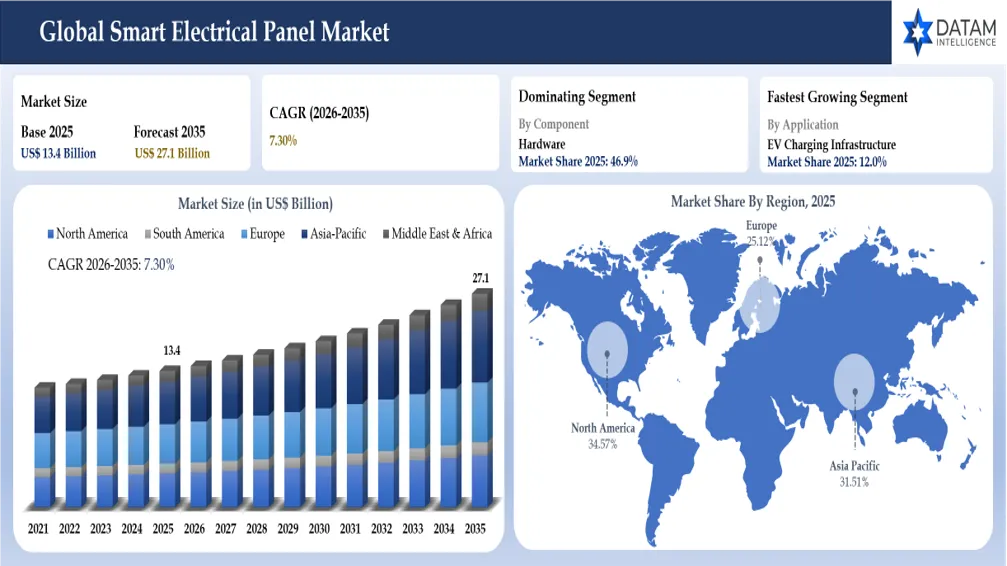
The global smart electrical panel market reached US$ 13.4 billion in 2025 and is expected to reach US$ 27.1 billion by 2035, growing with a CAGR of 7.30% during the forecast period 2026-2035.
The smart electrical panel market has been gaining momentum owing to the growth in building electrification leading to an increase in the need for smarter solutions to manage electrical capacity. EV charger, heat pump, electric cookware and battery storage use result in complicated needs from the electrical panel, especially in older buildings that have low electrical service capacity. With the use of smart panels, one can get circuit level energy monitoring, remote switching and automated load prioritization, which will help people to manage their high draw appliances and keep power in critical circuits. Intelligent load control systems can also aid in avoiding expensive upgrades to electrical services in proper installations.
Market competition is gradually becoming more inclined to the convergence of electrical protection products and software-based energy management systems. Companies are coming up with devices that will integrate rooftop solar energy, battery storage, EV charging and back-up power within a single interface. This trend has been further enhanced by partnerships. In March 2026, Eaton made a $75 million investment in SPAN and formed a partnership whereby SPAN’s energy intelligence platform will be integrated with Eaton’s electrical distribution technology. This trend is giving rise to chances for companies that can deliver interoperability and benefits to customers beyond standard circuit protection and energy monitoring.
Smart Electrical Panel Market Key Takeaways
- In 2025, hardware products constituted a significant chunk of the global smart electrical panel market share, occupyiny 46.9% of it due to the rising requirement of smart circuit breakers, sensors, controllers and connected electrical distribution products.
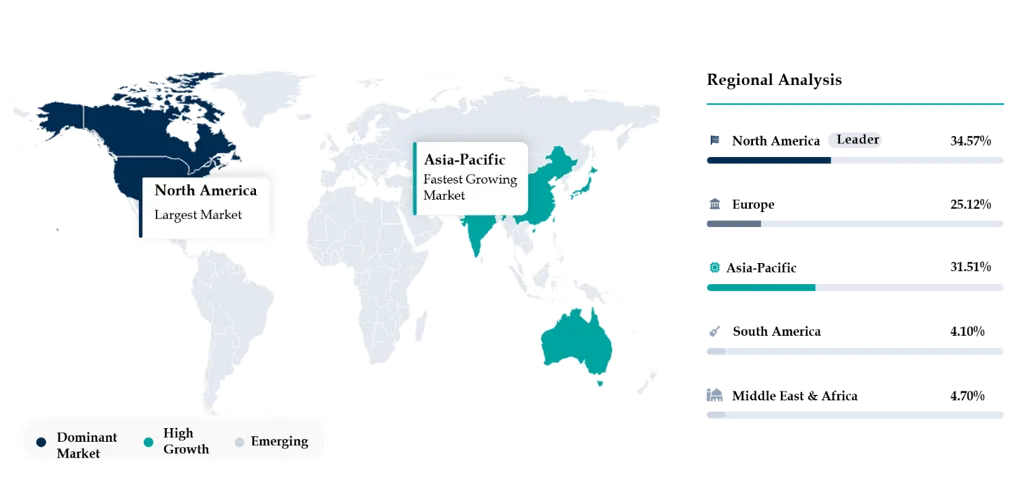
- North America is leading the global smart electrical panel market, occupying 34.57% of market share because of residential electrification, EV charger installation, battery storage and smart homes electricity management.
- The fastest-growing application segment of the global smart electrical panel market is EV charging infrastructure with an indicative CAGR of 9.8% from 2026 to 2035 due to growing EV charger installation and the need for smart electrical load management.
- The rise in the use of solar-powered smart integrated panels is prompting developers to create products that manage energy consumption and support the use of high-power devices due to the synergy of battery storage and load prioritization.
- The growing popularity of smart panels equipped with circuit monitoring, remote control, safety features and integration with power management systems is driven by the needs of residential and commercial properties, data centers and electric vehicle charging stations.
Smart Electrical Panel Industry Trends and Strategic Insights
- The advanced electrical panels are starting to utilize automatic load prioritization as a means of controlling EV charging and heat pumps and any other high-demand appliances within the available electricity supply without necessitating service upgrade for suitable homes.
- Companies are designing smart panels capable of linking rooftop solar, battery storage and backup power so that the users can be able to prioritize their necessary circuits and control their electricity usage through energy systems.
- There is an increased demand for retrofittable panels, forcing manufacturers to enhance the compatibility of their products with the current wiring, circuit breakers and distribution boards.
- Monitoring, switching, analysis and control of power at circuit level are moving the competition from hardware parameters to software functionality and better energy management.
- Manufacturers are focusing on compatibility with third-party inverters, batteries, electric vehicle charging equipment and building energy management systems, providing possibilities for smart panels that can regulate the electricity consumption.
Smart Electrical Panel Market Scope
| Metrics | Details | |
| 2025 Market Size | US$ 13.4 Billion | |
| 2035 Projected Market Size | US$ 27.1 Billion | |
| CAGR (2026-2035) | 7.30% | |
| Largest Market | North America | |
| Fastest Growing Market | Asia-Pacific | |
| By Product Type | Integrated Smart Electrical Panels, Retrofit Smart Electrical Panels, Modular Smart Electrical Panels and Smart Electrical Panel Upgrade Kits | |
| By Component | Hardware, Software and Services | |
| By Communication Technology | Ethernet, RS-485, Wi-Fi, Cellular and Other Communication Technologies | |
| By Rated Current Capacity | Up to 100 A, Above 100 A to 200 A, Above 200 A to 400 A and Above 400 A | |
| By Electrical Phase | Single-Phase Smart Panels and Three-Phase Smart Panels | |
| By Application | Residential Buildings, Commercial Buildings, Industrial Facilities, Data Centers, Electric Utilities, Renewable Energy and Energy Storage, EV Charging Infrastructure and Public and Institutional Infrastructure | |
| By Distribution Channel | Direct Sales, Distributors and Wholesalers, Electrical Contractors and System Integrators and Retail & E-commerce | |
| By Installation Type | New Installations and Retrofit & Replacement Installations | |
| By Region | North America | U.S., Canada, Mexico |
| Europe | Germany, UK, Russia, France, Spain, Italy, Poland | |
| Asia-Pacific | China, India, Japan, Australia, South Korea, Indonesia, Malaysia, Singapore, Vietnam, Thailand, Philippines, Taiwan | |
| South America | Brazil, Argentina | |
| Middle East and Africa | UAE, Saudi Arabia, South Africa, Israel, Turkiye, Nigeria | |
| Report Insights Covered | Competitive Landscape Analysis, Company Profile Analysis, Market Size, Share, Growth | |
Why does this report matter in 2026?
The smart electrical panel market has become increasingly significant in 2026 because of the addition of advanced technologies within residential and commercial buildings such as electric vehicle chargers, heat pumps, solar systems and energy storage on the roofs of the structures, which may pose difficulties to current power supply capacities and make traditional distribution boards insufficient for managing competing loads. This report will assist in determining situations where smart panels will provide real value from a circuit level control of loads, load prioritization and backup power management, while being able to separate true upgrade needs from those applications that can use cheaper alternatives.
The report is also significant for the manufacturers, investors, utility companies and electrical distributors when considering competitive position and growth prospects in the year 2026. Success in the market will not only depend the panel technology itself, but also on the software features, compatibility with other energy systems and the cost involved in fitting the existing structures. Through an analysis of the factors behind the demand for the product, adoption constraints, market opportunities and competitive strategies, the report helps with the decision-making process regarding product development, channel partnerships and investments in a market where customer value and ease of integration will be important.
Smart Electrical Panel Market White Space & Investment Opportunities
- Manufacturers can venture into the retrofits market by introducing smart electrical panels, which will add circuit-level intelligence to the existing electrical system, without necessarily replacing the whole electrical panel system.
- Companies can venture into smart panels that integrate rooftop solar, batteries and EV charging, such that the system can prioritize load and make better use of the available electricity.
- There are possibilities for companies to target the commercial and light industrial markets, where the suppliers would introduce smart panels that come with remote monitoring and energy consumption analysis.
- Producers can enhance their reach into the market by cooperating with electrical contractors, solar energy suppliers and builders. They can also focus on training installers and offering online services that help customers.
- Suppliers of technology have the option to fund energy management systems which work with solar energy panels, converters from other companies, batteries, smart measuring devices and chargers for electric vehicles.
Smart Electrical Panel Future Market Transformation
The smart electrical panel market is anticipated to change from traditional circuit-level control into intelligent power distribution systems that would balance energy consumption with solar, battery backup and EV power sources. In the future, smart electrical panels will put more focus on automation of load prioritization, predictive management, remote software update capability and integration into home energy management systems. The collaboration between Eaton and SPAN in March 2026 is a demonstration of how the industry is moving towards integrating legacy circuit protection technologies with digital energy analytics. This will lead to smart panels being used as an active interface between buildings and the power grid and market penetration being dependent upon cost-effectiveness, cybersecurity and compatibility with existing electrical infrastructure.
Smart Electrical Panel Market Buyer Decision-Making Criteria
Smart electrical panel market consumers assess products according to their capability to handle rising loads, connect with renewable energy sources and enable effective circuit-level control without any changes made in the electrical systems. Home consumers prefer compatibility with rooftop solar, batteries and electric vehicle charging stations, while commercial and industrial consumers pay attention to the load capacity, reliability, monitoring capability and connectivity to the building management system. Buying decision will finally be determined by the possibility of installation, cost of ownership, safety of electrical systems and flexibility of the system.
Major Buyer Decision-Making Criteria
- Electrical Capacity and Load Management
- Integration Compatibility
- Installation and Retrofit Requirements
- Monitoring and Automation Capabilities
- Total Cost of Ownership
- Electrical Safety and Certification
- Software Reliability and Cybersecurity
- Interoperability and Future Scalability
- Warranty and Technical Support
Smart Electrical Panel Market Economic & Investment Analysis
The economic prospects for the market of smart electrical panels is tied to building electrification, increased electricity consumption and the development of rooftop solar systems, batteries and electric vehicle charging systems. Smart panels are more expensive than standard distribution boxes since smart panels integrate not only circuit breaker but also sensor and communication equipment. The economic value of smart panels is determined by their ability to save costs associated with additional electrical service upgrades, increase visibility and manage connected loads. Hence, adoption would be higher in cases where several electrification enhancements make a strong case for the necessity of enhanced electrical capacity management.
Increasingly, investments have been made into the development of smart panels by creating strategic alliances, integrating products and utilizing distribution networks for electricity. In March 2026, for instance, Eaton made an investment worth $75 million in SPAN while entering into an alliance to integrate SPAN's intelligent energy system into Eaton's circuit breakers and installation network. This development highlights investment prospects in the integration of intelligent hardware, software and distribution networks to facilitate deployment. Attractiveness of future investments will hinge on economies of scale, cost reduction in installation, compatibility and demonstration of economic benefits to the consumer, builders and utilities.
Smart Electrical Panel Investment Trends in the Market
- Manufacturers are investing in intelligent load management technologies where circuit monitoring, load prioritization and load control technologies are used in order to enable EV charging, heat pumps among other high-power electrical appliances.
- Partnerships are being used to get funding in the electrical equipment firms whereby conventional circuit protection is combined with smart panel technology. In March 2026, Eaton Corporation made an investment of $75 million in SPAN together with a partnership in order to integrate SPAN’s energy intelligence technology with that of Eaton’s circuit protection technology.
- More funding is being directed towards home energy management systems where there is integration between smart panels, rooftop solar, battery storage and EV chargers in order to optimize electricity usage, prioritize critical loads and backup power.
- Manufacturers are making investments in retrofittable products and installation facilities to tackle the problem with high costs of replacement of existing electrical panels. Simpler installation and training of installers together with the ability to use the product with the existing electrical system could increase its popularity among homeowners and property owners.
- Investments in software and connectivity solutions have brought other opportunities aside from hardware sales. There are companies that are developing platforms that will allow integrating the smart panel into an energy system from other providers and monitor energy consumption.
Strategic Indicators for Smart Electrical Panel Market
High Regulation Impact
Regulations related to energy efficiency and electrical safety have an enormous impact on the market for smart electrical panels since the smart electrical panels are expected to comply with such requirements related to circuit protection and load control, as well as the integration of distributed energy resources. In the USA, UL 67 is a standard for panel boards, whereas UL 916 is for energy management devices. The National Electrical Code (NEC) of 2026 sets out some requirements related to energy management and power control systems intended to manage electrical loads and prevent overload. These requirements will create more challenges regarding certification, testing and installation but at the same time, will provide opportunities for manufacturers who have smart panels that can be integrated with solar, battery storage and EV charging systems. Requirements will vary depending on the type of product and local code adoption.
High Investment Activity
Investments in the smart electrical panel market are increasingly geared towards scale-up through strategic partnerships and integration into products. On March 9, 2026, Eaton made an investment worth $75 million in SPAN while entering into a strategic partnership for the integration of SPAN’s energy intelligence technology along with Eaton’s circuit protection technologies and networks of installers and homebuilders. This is indicative of the trend being followed in this sector by manufacturers who are moving towards offering an integrated hardware and software solution that manages EV charging and battery storage along with electrification of the household. Due to their ability to control electrical loads, such systems have the potential to decrease installation costs and defer service upgrades where appropriate, thereby offering a competitive edge to companies that possess distribution networks and intelligent load control capabilities.
Supply Chain Disruption
Smart electrical panels face exposure to supply chain threats involving intelligent circuit breakers, current sensors, microcontrollers, communication modules and power management integrated circuits capable of providing digital monitoring and automation of loads. Electronic components have increased the supply chain exposures beyond the traditional supplies of metal plates, wires and paneling required for the production of smart panels, leaving the manufacture of smart panels open to shortages of semiconductor components and cost changes. Industrial research on the circuit breaker and fuse supply chain has indicated electronics-driven lead times to continue to 2026, along with increasing prices of certain protection and semiconductor components. Strategic alternatives for manufacturers include alternative suppliers, standard architecture of components and inventory of critical electronic components.
Pricing Volatility
The price of a smart electrical panel is determined by the circuit capacity, smart-breaker features, energy management software and effort in installation. In the US market, SPAN offers smart electrical panels at equipment price ranges of US$2,550-US$4,100 without installation, transportation and tax charges, while traditional full size electrical panel costs around US$400. The prices of copper busbars, circuit protection equipment and electronics will also influence production costs and price points. This cost-based incentive has led companies to introduce modular designs, retro-fit designs and energy management systems at reasonable prices but without compromising on their effectiveness.
Procurement Pressure
The pressure on procurement in the smart electrical panels industry comes from the requirement to procure circuit breakers, current sensors, communication devices, controllers and other electronic components in compliance with electrical safety standards. As opposed to traditional distribution panels, smart electrical panels integrate the power-distribution equipment with electronic load-monitoring and control capabilities, making it very important to ensure that all components are qualified and compatible. The manufacturers have to strike a balance between the availability of components, lead times and the cost of purchase without affecting the quality and compatibility of the product. Therefore, long-term contracts, standardization of design and alternative suppliers are very important factors for maintaining continuity of production, minimizing cost of bill of material and ensuring on-time delivery.
New Technology Adoption
Smart electrical panel market innovations include energy measurement at the circuit level, automatic load shedding, remote circuit management and coordinated control of solar power generation, battery storage and electric vehicle charging. For example, Eaton’s smart panel with SPAN Energy Intelligence combines energy measurement at the circuit level with SPAN PowerUp energy management software that helps optimize household loads to prevent electrical service upgrades and sets up backup priorities if integrated with batteries. Increasing adoption of such technologies leads to increased demand for electrical panels that combine protection with energy data and automation. Future innovation will rely on integration with other energy management systems, consistent performance even without connection and proven cost savings; AI-based optimization is still a emerging capability within the market.
Regional Expansion Opportunity
The regional growth of the smart electrical panel market can be facilitated by increased electrification, distributed solar power installation and the development of smart buildings in the Asia-Pacific region, including India, China and South-East Asia. Collaboration with electrical contractors, solar installers, home builders and energy managers will provide manufacturers with enhanced market entry opportunities by providing products which comply with regional electrical codes and are capable of being easily integrated into regional distribution networks. The cost-effective and retrofit-ready panels with circuit-level monitoring and automated load management have specific applications in price-sensitive environments, whereas Japan and Australia present potential markets related to residential energy management, battery integration and EV charging stations.
Government Policy Support
Government policies for modernizing the grid, electrifying buildings and integrating distributed energy sources are presenting opportunities in the smart electrical panel market. In Germany, under Section 14a of the Energy Industry Act (EnWG), the distribution system operator may impose temporary restrictions on the consumption of power by eligible load management devices, including heat pumps, electric vehicle charging stations and electricity storage, in case of congestion in the local grid. Such regulations present opportunities for smart electrical panels and energy management systems for balancing loads. However, the regulation does not require installation of smart panels, which makes their compatibility with current electrical systems an important consideration.
Pricing Intelligence
Pricing of products for the smart electrical panels market will be significantly dependent on the number of circuits that can be managed, panel capacity, its monitoring functionalities, software compatibility and interaction with solar panels, battery and charging systems for electric vehicles. Manufacturers will have to position their products based on the value they bring to customers in addition to traditional electricity protection features like circuit visibility and automated load prioritization. Different levels of product configurations, retrofit products and packages of hardware, software and installation can assist manufacturers in catering to various customer budgets and clarifying the advantages of smart panels.
| HS Code | Reporter | Trade Flow | 2025 Trade Value | Interpretation |
| 8536 | China | Exports | US$25 billion | Major global exporter of electrical switching, circuit protection and connection components used in smart electrical panel manufacturing |
| 8536 | United States | Imports | US$16 billion | Reflects demand for imported circuit breakers, switches, relays and other electrical protection components used in panel assemblies |
| 8537 | United States | Imports | US$22 billion | Indicates substantial import demand for assembled electrical control and distribution panels, including products potentially used in smart building and industrial applications |
| 8537 | Germany | Exports | US$18 billion | Highlights Germany's role in supplying assembled electrical control and distribution panels for industrial automation and building electrical infrastructure |
Note: HS 8536 covers electrical apparatus for switching, protecting and connecting electrical circuits, while HS 8537 covers boards, panels and cabinets equipped with electrical control or distribution apparatus. The 2025 trade values represent broader electrical equipment categories rather than smart electrical panels exclusively. These figures provide an indicative view of international trade in components and assembled panels relevant to the smart electrical panel supply chain.
AI Impact Analysis of Smart Electrical Panel Market
AI technologies are being used to improve smart electrical panels by load balancing, electricity usage prediction and automation of device operations. Using the analysis of electricity usage on circuit level, user occupancy patterns, electricity rates and presence of solar electricity generation or battery backups, AI-based energy management systems are capable of scheduling EV charging, load prioritization and reducing peak electricity usage. This is especially useful when dealing with buildings where there are many powerful pieces of equipment competing for electricity, which could be helpful to avoid expensive upgrades in service provision.
Moreover, there are prospects of prediction of faults and managing energy effectively among interconnected buildings through the use of AI. Through the detection of unusual energy consumption behavior and overload states, intelligent systems can aid operators to check out problems related to electricity before major disruptions occur. Nevertheless, AI technology has not been incorporated into all smart electrical panels, since many of the existing products are limited to providing only rule-based automation, circuit-level monitoring and remote-control features. Commercial viability will depend on the predictive analytics ability to be accurate, ability to function in times of connectivity disruptions, security measures and the actual energy savings achieved compared to traditional smart panels.
Disruption Analysis of Smart Electrical Panel Market
The disruption of the smart electrical panel market is taking place due to the evolution of electricity distribution systems from manual circuit protection to intelligent software-controlled electricity distribution, where the panels are responsible for managing the consumption of electricity instead of simply distributing it. The introduction of smart breakers, circuit level sensors and automation load controls allow selective load shedding, remote circuit switching and synchronized EV charging which may prevent total upgrade of the electrical system in appropriate cases. The shift has made it difficult for panel makers to incorporate digital control technology into their existing distribution systems and there are software-based companies that have carved out niches in this market.
Another factor that causes disruption is the advent of energy ecosystems where smart panels work together with rooftop solar power, energy storage systems, EV charging and energy management software. This development has moved the focus of competition from technical specifications to interoperability and software capabilities to manage more than one energy source via a common interface. However, proprietary communication technologies, cost of installation and dependency on connectivity may be a limiting factor. Manufacturers of electrical protection and reliable local controls that ensure compatibility with other vendors and offer retrofitting possibilities are better equipped as smart panels turn into an active control layer for electrifying buildings.
Smart Electrical Panel Market BCG Matrix: Company Evaluation
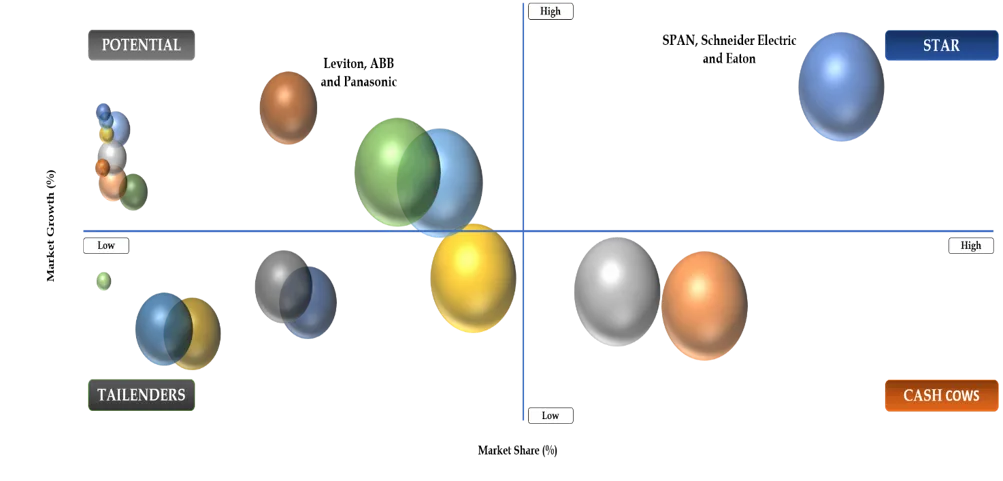
STAR
SPAN, Schneider Electric and Eaton make solid bets for Star products considering their ability to offer smart panel, electricity distribution services and integration into the home energy management system. SPAN distinguishes itself using its circuit-level control and integrated solutions for solar, battery storage and EV charging, while Schneider Electric and Eaton benefit from the already existing electrical equipment range and electricity distribution channels. Electrification of buildings and need for smart load management create favorable conditions for growth.
POTENTIAL
Leviton, ABB and Panasonic are examples of firms that have the potential to grow as a result of their residential electrical distribution products, smart panel technology and energy management solutions. The purchase of Lumin by ABB enhances its capabilities in intelligent residential load management, whereas Panasonic’s smart residential distribution panels help meet the requirements for home energy management in Japan. Enphase Energy is an adjacent player that offers a range of solutions in the area of solar, battery and home energy management systems that present integration possibilities, though it may not be regarded as a provider of smart panels. Their positioning in the future will be contingent upon several factors.
Smart Electrical Panel Market Dynamics
Driver Impact Analysis
| Driver | Market Growth Impact (%) | Demand Concentration | Impacted Use Case | Strategic Impact |
Electrification and Distributed Energy Integration | 30% | North America and Europe | Integration of rooftop solar, battery storage, EV chargers and intelligent circuit-level load management | Accelerates demand for smart panels with dynamic load prioritization, backup power control and distributed energy coordination |
Real-Time Energy Monitoring and Optimization | 25% | Residential and commercial buildings, particularly in North America and Europe | Circuit-level consumption monitoring, peak-demand management and identification of energy-intensive loads | Drives adoption of connected load centers, energy analytics and automated electrical controls |
Smart Grid Modernization and Digital Distribution | 25% | North America, Europe and Asia-Pacific | Digital power distribution, remote monitoring, fault detection and grid-connected energy management | Encourages investment in interoperable panels with advanced monitoring and communication capabilities |
Smart Building Adoption and Electrical Infrastructure Upgrades | 20% | Commercial buildings and existing residential properties across developed and emerging markets | Building automation integration, connected circuit control and retrofit upgrades | Creates opportunities for modular smart panels, retrofit solutions and integrated hardware-software offerings |
Driver: Integration of Distributed Energy Resources and Intelligent Load Management
The market of smart electrical panel is fuelled by the rising use of solar energy systems, battery systems, electric vehicle chargers and high-load home appliances. With more complexity of managing power loads, the application of smart panels ensures circuit-level monitoring and automatic load prioritisation of devices. They enable the consumers to carry out peak load management, maintain power backup and avoid needless electrical system upgrades. The capacity of smart panels to manage several power sources and loads through one single distribution system makes them more valuable compared to traditional breakers in buildings equipped with electric power systems.
Restraint Impact Analysis
| Restraint | Drag on Market Growth (%) | Primary Impact Area | Impacted Use Case | Strategic Impact |
High Initial Equipment and Installation Costs | 30% | Price-sensitive residential and small commercial markets | Replacement of conventional electrical panels with smart load centers and connected circuit-control systems | Slows adoption among budget-conscious buyers and increases the importance of affordable retrofit solutions and modular pricing |
Compatibility and Retrofitting Complexity | 25% | Existing buildings with legacy wiring, breakers and electrical infrastructure | Integration of smart panels with existing distribution boards, solar systems, batteries and EV chargers | Increases installation time and integration costs, encouraging manufacturers to develop standardized, retrofit-friendly products |
Cybersecurity and Data Privacy Concerns | 20% | Connected homes, commercial buildings and remotely managed electrical systems | Remote circuit control, cloud-based energy monitoring and connected building management | Raises requirements for secure communications, access controls, software updates and customer data protection |
Limited Installer Expertise and Interoperability | 25% | Emerging markets and regions with fragmented electrical contractor networks | Installation, commissioning and integration of smart panels with third-party energy management platforms | Can delay deployments and increase support costs, making installer training, certified integration and open communication standards important competitive differentiators |
Restraint: High Upfront Costs and Competition from Retrofit Alternatives
One of the biggest issues for the smart electrical panels market is the price, since smart panels are more expensive than normal distribution panels and their installation and configuration will also require professional assistance. The initial expense may be hard to justify for household consumers, especially when solutions like circuit-level energy monitors, smart breakers and retrofit load controllers offer similar features at a lower price. In this regard, Wood Mackenzie analysis published by Utility Dive indicated that smart panels had to prove that they offered better advantages compared to cheaper solutions. Therefore, the producers need to work on lowering prices and improving compatibility of their products with third-party devices in order to prove that the initial investment can help with saving money through avoiding service upgrades and optimizing electricity consumption and backup power.
Smart Electrical Panel Market Segment Analysis
The global smart electrical panel market is segmented based on the product type, component, communication technology, rated current capacity, electrical phase, application, distribution channel, installation type and region.
By Component
Hardware Maintains Its Dominant Position in Smart Electrical Distribution
The hardware segment was the largest among all other components segments in the smart electrical panel market in 2025, holding a share of 46.9%. The growth in the dominance of the hardware segment is attributed to the importance of components such as smart circuit breakers, sensors, metering units, communications modules and controllers in realizing the concept of smart electrical panel. They help in monitoring energy at the circuit level, remote switching, overload protection and load priority switching so that electricity can be controlled in a more effective way. With the rise in installations of electric vehicle chargers, heat pumps, roof-top solar and battery storage systems, there is an increased need for innovative hardware for managing multiple loads under existing service capacity. Innovation is driving continued growth in demand for hardware through connected breakers, smaller monitoring systems and control unit integration.
By Application
EV Charging Infrastructure Accelerates Demand for Intelligent Load Management
EV charging infrastructures are becoming one of the lucrative applications of smart electric panel which is expected to have a growth around 9.5% CAGR over the period of 2026-2035. Growth is driven by increasing installations in residences and utilization at commercial charging stations and fleet-depot system, which increases the need for smart capacity management. These smart electrical panels could help in managing the energy use related to EV charging along with building power usage, roof top solar production and battery storage systems to avoid circuit overload, manage peak demands and even avoid expensive electrical system upgrade costs. As more applications of automated charge load prioritization, time-of-use energy management and remote control become prevalent, there will be increasing demand for smart panels that can handle high-powered charging loads.
Smart Electrical Panel Market Geographical Penetration
U.S. Smart Electrical Panel Market Landscape
Drivers of the U.S. smart electrical panel market include residential electrification, use of electric vehicle chargers and home battery storage and need to handle increased electrical loads without service upgrades. Old homes offer a major opportunity for retrofitting especially when there is limited capacity for heating, cooking and charging of EVs from the existing panel. Smart panels help meet these requirements by having monitoring at the circuit level, automated load prioritization and backup power management that can be configured as needed. An important development in the industry took place on March 9, 2026, when Eaton formed a partnership with SPAN with an investment of $75 million into SPAN. This partnership merges SPAN's energy intelligence with Eaton's electrical protection and its electrical distribution, installation and homebuilding network, making smart-panel solutions more accessible. This development shows the increased significance of integration between electrical systems, smart load management and software in facilitating efficient home electrification in the U.S.
China Smart Electrical Panel Market Trends
The smart electrical panel market in China is now influenced by digital power distribution, industrial automation modernization and renewable power energy incorporation into electrical systems. These markets are growing in the fields of data centers, manufacturing plants, commercial buildings and energy storage facilities due to the ability of smart electrical panels to monitor electrical faults remotely, detect them automatically and control the loads remotely. According to the information provided in the March 2026 Hong Kong Stock Exchange filing based on Frost & Sullivan statistics, the overall market of smart power distribution equipment in China reached RMB 127.7 billion in 2025. This growth is estimated at 20.5% year-on-year; it represents not the smart electrical panels but all kinds of distribution equipment. Development of distributed solar panels, batteries and electric vehicles charging stations leads to new applications of digitally controlled panels to manage electrical loads. Local players such as CHINT have an advantage due to China's traditional electrical equipment manufacturing industry.
Germany Smart Electrical Panel Market Analysis
The German smart electrical panel market is affected by the installation of roof-mounted solar systems, heat pumps, electric vehicle charging stations and residential energy storage units within existing electrical systems. The smart meter installation in Germany and the regulation Section 14a of the Energy Industry Act (EnWG) are putting emphasis on intelligent load management especially of controllable appliances like EV chargers, heat pumps and energy storages. As from January 2024, all eligible new controllable devices with an interconnection capacity of 4.2kW are subjected to the network-based load control requirement which gives distribution network operators the ability to temporarily lower down electricity consumption of these devices in case of grid congestion in the area. The advancements provide a chance for developing intelligent electric panels which synchronize the load of circuits. They are sustained by utility management system and aid flexible energy usage. Nevertheless, the necessity of smart meter implementation does not imply immediate use of intelligent electric panels, which makes the ability to fit in currently used network controllers, costs related to their installation and interoperability significant in making these panels popular on the market.
Japan Smart Electrical Panel Market Outlook
The smart electrical panel industry in Japan is increasingly influenced by the introduction of home energy management systems (HEMS), solar roof installations, battery and EV charging at home. An important milestone was reached in January 2026, when Panasonic introduced the HEMS-compliant FLEXIID smart residential distribution board on April 1, 2026. The production of the device will be 23,000 units in fiscal 2026. The device allows for the measurement at the level of separate branch circuits and HEMS integration for the improvement of household electricity consumption tracking. Japan's migration to the second generation of smart meters, starting from January 2026, adds further benefits for household energy monitoring and integration of distributed energy resources. The mentioned events give rise to new opportunities for smart panels manufacturing companies that offer small distribution boards, measurement of energy use on the level of circuits and HEMS integration, especially when installing solar power generation and batteries at homes with limited spaces. However, smart meter installation does not necessarily imply smart panel installation, which makes compatibility of products and integration costs crucial to adoption.
Smart Electrical Panel Market Competitive Landscape
- Electrical equipment manufacturing firms utilize their experience in circuit protection, distribution channels and contractors to venture into smart electrical panels.
- Smart panel manufacturers compete through circuit level monitoring and load prioritization and integrate with solar, battery and electric vehicle charging stations.
- The collaboration between electrical equipment manufacturers and technology vendors is enhancing the competitive landscape with the integration of power distribution devices with digital energy management systems.
- The differentiation of products is becoming increasingly dependent on the ability to be retrofitted for compatibility, easy installation, third-party device interoperability and ability to handle electrical loads of high demand with existing service capabilities.
- Software capabilities, electrical safety certifications, availability of installers and after-sales service are becoming key competitive advantages in the efforts to increase adoption of products.
Public Company Q1-Q2 2026 Performance Comparison
The table compares five publicly listed companies with direct or strategically relevant exposure to the smart electrical panel market. Financial figures represent company-wide performance, as standalone smart-panel revenue is generally not separately disclosed.
| Company | Q1–Q2 2026 Performance | Smart Electrical Panel Exposure | Key Performance Driver |
| Eaton Corporation plc | Approx. US$15.98 billion H1 revenue | Electrical distribution systems and smart-panel partnerships | Data-center power demand, electrical infrastructure investment and intelligent load management |
| ABB Ltd. | US$18.21 billion H1 revenue | ReliaHome Smart Panel and residential energy management | Electrification demand, digital power distribution and residential energy optimization |
| Schneider Electric SE | Approx. US$22.93 billion H1 revenue | Square D Energy Center and connected electrical distribution | Building electrification, data-center expansion and integrated energy management |
| Siemens AG | Approx. US$42.01 billion H1 revenue | Intelligent electrical distribution, monitoring and building automation | Smart infrastructure investment, digitalization and building electrification |
| Legrand SA | Approx. US$5.40 billion H1 revenue | Connected electrical distribution, smart-building controls and energy management | Data-center infrastructure, smart buildings and energy-transition solutions |
Note: These figures represent overall company revenue, not smart electrical panel revenue. Reporting periods differ by company fiscal calendar.
Key Companies of Smart Electrical Panel Market
- Schneider Electric (France)
- SPAN.IO, Inc. (United States)
- Leviton Manufacturing Co., Inc. (United States)
- Eaton Corporation plc (Ireland)
- Siemens AG (Germany)
- SolarEdge Technologies, Inc. (Israel)
- ABB Ltd. (Switzerland)
- Legrand SA (France)
- Savant Systems, Inc. (United States)
- EcoFlow Technology (China)
- CHINT Group (China)
- Hager Group (Germany)
- Panasonic Corporation (Japan)
- Mitsubishi Electric Corporation (Japan)
- Rockwell Automation, Inc. (United States)
- NHP Electrical Engineering Products (Australia)
- Emerson Electric Co. (United States)
- WAGO GmbH & Co. KG (Germany)
- Aasa Technologies (United States)
- Enphase Energy, Inc. (United States)
- Rittal GmbH & Co. KG (Germany)
Company Profiles of Smart Electrical Panel Market
Schneider Electric
Schneider Electric is an international firm focused on energy management and distribution in terms of smart panels across residential load centers, connected protective devices and energy management integration. Their Square D Energy Center is an all-inclusive intelligent electrical panel system which is aimed at integrating solar production, electric vehicle charging, battery storage and backup systems with monitoring and control.
Competitive priorities include developing connected residential distribution systems, expanding installer network, increasing integration with distributed energy resources and providing solutions that would simplify electric home upgrades.
Eaton Corporation
Eaton is a global leader in power management systems that offer a wide range of products for the distribution of electricity and a growing focus on residential energy management systems. The Eaton Smart Panel integrates its SPAN Energy Intelligence technology, allowing homeowners to integrate their electrical demands along with controlling power backups through software that is compatible with batteries.
Competitive priorities include increased adoption of smart panels through electrical contractors and home builders, integration of circuit protection with digital energy management and managing EV and other high-energy loads without any unnecessary upgrades to services.
SPAN
The speciality of SPAN is the design and production of intelligent electrical panels, which can help in providing visibility and management at the level of circuit for residential electrical systems. They allow homeowners to track their circuits and also help them to control the loads connected through remote means in conjunction with their compatible home battery systems.
Some of the competitive priorities would be better integration with third party energy systems, more installer and builder partnerships, showcasing of tangible benefits for installation and backup power and finally better intelligence for circuit management.
ABB Ltd.
ABB is an international electrification and automation company, whose product portfolio comprises low voltage distribution solutions, digitally enabled electrical systems and intelligent energy management systems. ABB’s ReliaHome Smart Panel integrates residential electrical distribution and energy management into one solution for on- and off-grid energy optimization. The cooperation of ABB with Lumin contributed to the company’s success in residential load management.
Competitive priorities would include incorporating circuit protection with digital load control, adding to residential energy management capabilities, taking advantage of current distribution channels and incorporating distributed energy resources.
Leviton Manufacturing Co., Inc.
Leviton is a maker of electrical wiring and distribution systems, featuring residential load centers with connected energy management technology. The company's Smart Load Center integrates compatible smart circuit breakers and whole-house energy monitoring with My Leviton software, allowing customers to monitor electricity usage, control circuits and detect any abnormal activity in the electrical system. Smart technology can be incorporated into compatible Leviton load centers without changing the enclosure.
Competitive considerations are to increase the adoption of smart load centers, integrate better with connected home devices, simplify installation and offer products that work with residential electrification without any change to the existing electrical infrastructure.
Panasonic Corporation
Panasonic participates in intelligent residential electrical distribution through its Japanese Smart Cosmo series of distribution board, which allows for integration with home energy management systems. Panasonic’s energy solutions for residences revolve around measuring electricity consumption within a house as well as connecting different types of energy equipment, such as solar energy production and batteries.
The company’s competitive priorities include enhancing compatibility with home energy management systems, allowing for the integration of solar and residential batteries, enhancing energy visibility and providing compact solutions according to the needs of Japan’s residential buildings.
Smart Electrical Panel Market Major Pain Points
- The cost of installing a smart electric panel is higher than that of installing a standard distribution panel due to the hardware associated with it, its monitoring and control software.
- Connecting smart panels to current wiring, old breakers, solar inverters and battery systems may need more additions to be made, resulting in increased retrofit difficulty, cost and time.
- Communication standards and software used by different manufacturers make integration with independent electric vehicle charging stations, batteries, inverters and home energy management systems harder.
- Remote control and monitoring bring issues regarding security and reliability, such as hacking, energy data security, updates and operation without internet/cloud access.
- The lack of adequate knowledge about smart panel setup and energy management on the part of installers might lead to delayed implementation; customers might have difficulties justifying increased costs without any tangible benefit from the installation.
Smart Electrical Panel Market Recent Developments
- October 2026 - Leviton: Technology called TrueArc AFCI for Leviton’s load-center circuit breakers was introduced. It uses advanced sensing technology and machine learning algorithms to detect arcing faults and minimize false tripping.
- September 2026 - Schneider Electric: Software-defined medium voltage switchgear was unveiled by Schneider Electric that is able to monitor digitally, perform remote software updates and predict maintenance needs.
- August 2026 - Leviton: The Decora Smart High Current 50A Switch and 60A Controller from Leviton is being launched for remote control and monitoring of high current load residential applications within home energy management system.
- August 2026 - SPAN: SPAN refreshed its application for home energy management to include energy cost calculation at the circuit level, increasing transparency on electricity usage and costs.
- July 2026 - SPAN: Software updates by SPAN were launched for improving estimates of battery runtime, improving security of devices, WiFi performance and connectivity to backup power systems.
Analyst View / Opinion on Smart Electrical Panel Market
- The smart electrical panel market is expected to benefit from building electrification, especially as EV chargers, heat pumps and battery storage systems boost demand for intelligent electrical load management systems.
- Residential retrofits offer a huge potential, although the success of smart panels will hinge on their value proposition through savings from electrical service upgrades, backup power management and circuit-level monitoring.
- Electrical equipment suppliers have competitive advantage in terms of expertise in circuit protection and installer networks, while specialized firms have software and energy management capabilities as their differentiating factors.
- Market penetration for commercial products will rely heavily on successful integration into building management systems, as well as scalability and compatibility of the product with the electrical system of the building.
- Long term competitiveness in the future will probably lie in the hands of those manufactures who combine certified electrical protection, interoperable controls, ease of installation and benefits to the customer versus connectivity and energy monitoring alone.
Target Audience of Smart Electrical Panel Market
| INDUSTRY | WHO SHOULD BUY THIS REPORT? | REASON TO BUY THIS REPORT |
| Electrical Equipment Manufacturing | Smart electrical panel and load center manufacturers | Assess market size, competitive positioning, product innovation opportunities and demand for intelligent electrical distribution solutions. |
| Energy Management and Automation | Energy management system providers | Identify opportunities in circuit-level monitoring, intelligent load control and energy optimization technologies. |
| Solar Energy and Battery Storage | Solar inverter and battery storage manufacturers | Evaluate integration opportunities involving smart panels, renewable energy generation, battery storage and backup power management. |
| Electric Vehicle Charging | EV charger manufacturers and charging infrastructure providers | Analyze demand for intelligent load balancing, circuit prioritization and electrical capacity management for EV charging. |
| Residential Construction | Homebuilders and residential property developers | Assess adoption opportunities for smart electrical panels in new housing projects, smart homes and residential electrification. |
| Commercial Real Estate | Commercial property developers and facility management companies | Evaluate demand for energy monitoring, electrical load management and building automation integration. |
| Industrial Automation | Industrial electrical system integrators and automation solution providers | Identify opportunities in intelligent distribution panels, remote monitoring and automated electrical control systems. |
| Electrical Distribution and Contracting | Electrical contractors, distributors and panel installation specialists | Evaluate distribution opportunities, installation demand, retrofit requirements and customer adoption trends. |
| Utilities and Smart Grid Infrastructure | Electricity utilities and grid modernization companies | Assess the role of intelligent electrical distribution in grid-edge monitoring, distributed energy integration and demand management. |
| Investment and Financial Services | Private equity firms, venture capital firms and strategic investors | Evaluate market growth potential, competitive differentiation, investment opportunities and emerging business models. |
Why Choose DATAM?
- Data-Driven insights: Dive into detailed analyses with granular insights such as pricing, market shares and value chain evaluations, enriched by interviews with industry leaders and disruptors.
- Post-Purchase Support and Expert Analyst Consultations: As a valued client, gain direct access to our expert analysts for personalized advice and strategic guidance, tailored to your specific needs and challenges.
- White Papers and Case Studies: Benefit quarterly from our in-depth studies related to your purchased titles, tailored to refine your operational and marketing strategies for maximum impact.
- Annual Updates on Purchased Reports: As an existing customer, enjoy the privilege of annual updates to your reports, ensuring you stay abreast of the latest market insights and technological advancements. Terms and conditions apply.
- Specialized Focus on Emerging Markets: DataM differentiates itself by delivering in-depth, specialized insights specifically for emerging markets, rather than offering generalized geographic overviews. The approach equips our clients with a nuanced understanding and actionable intelligence that are essential for navigating and succeeding in high-growth regions.
- Value of DataM Reports: Our reports offer specialized insights tailored to the latest trends and specific business inquiries. The personalized approach provides a deeper, strategic perspective, ensuring you receive the precise information necessary to make informed decisions. The insights complement and go beyond what is typically available in generic databases.
What DATAM Uniquely Provides
- DATAM analyzes the smart electrical panel market base on product type, component, communication technology, electrical phase, application, distribution channel, installation type and region for potential growth opportunities.
- DATAM analyzes the technology differentiation along with the evolving customer needs, which include the monitoring at the circuit level, automated load management, remote control capabilities and integration with solar, batteries and electric vehicle charging systems.
- DATAM analyzes the competitive landscape by evaluating the established electrical equipment players as well as the specialist smart panels manufacturers.
- DATAM analyzes the prospects of adoption by assessing the degree of building electrification, regulations, distribution of renewable energy sources and existing electrical infrastructure in large markets.
- DATAM identifies business and investment opportunities in retrofitting, energy management systems, commercial applications, installer relationships and interoperability platforms to assist in the development and market entry of products.


























































