


Global Skid Steer Loader Market Size Overview
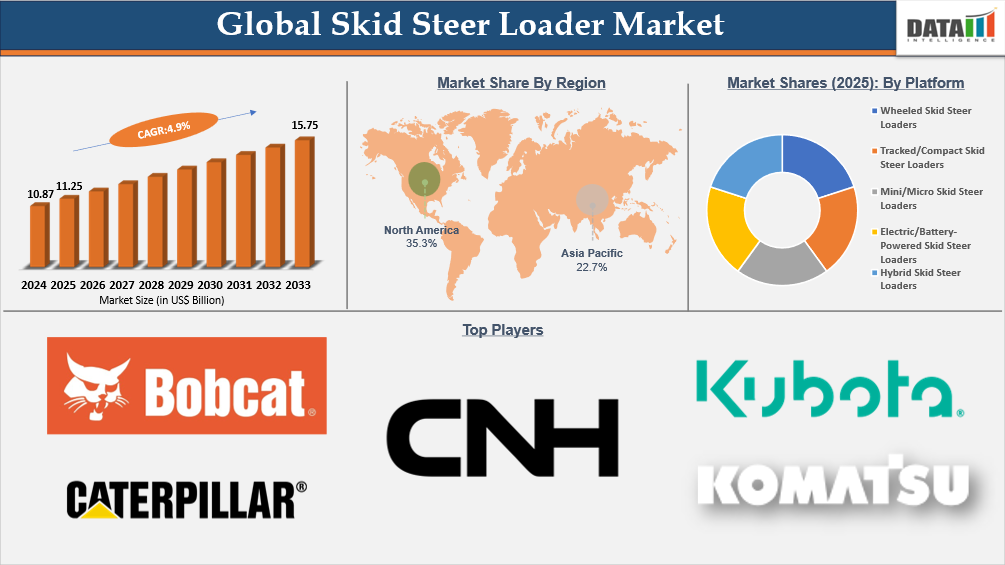
The global skid steer loader market reached US$ 11.24 billion in 2025 and is expected to reach US$ 15.75 billion by 2033, growing with a CAGR of 4.9% during the forecast period 2026-2033. Skid steer loaders have become a preferable choice due to their versatility and compact nature, which makes it possible to execute their purpose in confined areas compared to other construction machines. It is the versatility associated with skid steers that makes them indispensable construction machinery that is needed in many construction projects.
Technological advancement in the production of skid steers has also been another reason why there has been an increase in demand for skid steers. For instance, in April 2023, Bobcat Company introduced a new Machine IQ telematics system. The new system will make it easy for customers to monitor their machines through the collection of real-time data and information.
Skid Steer Loader Industry Trends and Strategic Insights
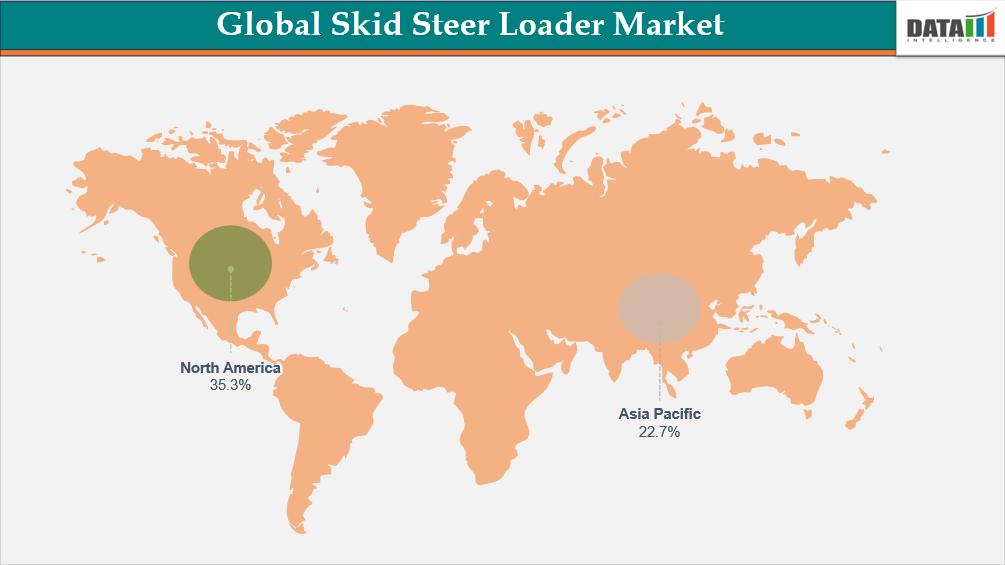
- Asia-Pacific is predicted to lead in growth among all the regions and will contribute nearly 22% towards global market revenue by 2025. Urbanization and infrastructural developments in countries like China and India will drive the market towards greater usage of more agile equipment for construction purposes.
- Wheeled skid steer loader will be considered the leading market by platform type. Advantages of wheeled skid steer loaders, such as easy mobility on harder surfaces and lower costs of maintenance and replacements than tracked skid steers, will drive the market towards wheeled skid steer loaders.
Global Skid Steer Loader Market Size and Future Outlook
- 2025 Market Size: US$ 11.25 Billion
- 2033 Projected Market Size: US$ 15.75 Billion
- CAGR (2026-2033): 4.9%
- Largest Market: North America
- Fastest Market: Asia-Pacific
Market Scope
| Metrics | Details | |
| By Platform | Wheeled Skid Steer Loaders, Tracked/Compact Skid Steer Loaders, Mini/Micro Skid Steer Loaders, Electric/Battery-Powered Skid Steer Loaders, Hybrid Skid Steer Loaders | |
| By Chassis | Vertical-Lift, Radial-Lift | |
| By Rated Operating Capacity (ROC) | Up to 500 Kg, 501–1,000 Kg, 1,001–1,500 Kg, 1,501–2,500 Kg, Above 2,500 Kg | |
| By Engine Power Output | Up to 35 HP, 36–50 HP, 51–70 HP, 71–100 HP, Above 100 HP | |
| By Operating Weight | Up to 2.5 Tons, 2.6–3.5 Tons, 3.6–4.5 Tons, Above 4.5 Tons | |
| By Hydraulic Performance | Standard-Flow Hydraulics, High-Flow Hydraulics, Super/Highest-Flow | |
| By Propulsion | Diesel, Gasoline/LPG, Battery-electric (BEV), Hybrid | |
| By Emissions Standard | Tier 4 Final / Stage V Compliant, Tier 3 / Stage IIIA And Below | |
| By Operator Station | Open Canopy (ROPS), Enclosed Cab (HVAC), Compact Stand-On | |
| By Control Systems | Mechanical / Foot-Hand, Telematics / Fleet Management, Operator Assistance, ADAS & Safety, Pilot / Electro-Hydraulic Controls | |
| By Distribution Channel | OEM Direct Sales, Authorized Dealer Networks, Rental Companies, E-Commerce, Others | |
| By Ownership Model | Owned, Rental / Leasing | |
| By End-User | Construction, Agriculture, Landscaping & Grounds Maintenance, Municipal & Utilities, Industrial & Warehousing, Forestry & Land Clearing Mining & Quarry, Defense & Emergency Services, Others | |
| By Region | North America | U.S., Canada, Mexico |
| Europe | Germany, UK, France, Spain, Italy, Poland | |
| Asia-Pacific | China, India, Japan, Australia, South Korea, Indonesia, Malaysia | |
| Latin America | Brazil, Argentina | |
| Middle East and Africa | UAE, Saudi Arabia, South Africa, Israel, Turkiye | |
| Report Insights Covered | Competitive Landscape Analysis, Company Profile Analysis, Market Size, Share, Growth | |
Market Dynamics
Surging Product Innovation and Electrification
The skid steer loader is fast evolving from its current position as simple earthmoving equipment into one that is technologically advanced. It was exemplified in the earlier part of 2026 when Bobcat introduced its CES 2026 technology in compact equipment, including AI, autonomy, electrification and connectivity into the skid steer loader category, indicating how the industry seeks to push the frontiers of skid steer loaders' capabilities. It cannot be simply seen as an introduction of new technology; rather, technologies like collision warning systems, improved display systems and autonomous assistance are being designed to improve safety and efficiency on the construction site, where efficiency becomes important.
Apart from control technology, another technological feature that is becoming increasingly popular is that of electrification. Many companies have introduced their electric skid steer loaders, which perform similarly to their gasoline counterparts, such as GS900E and GS950TE models set for production. Given that sustainability is becoming increasingly relevant in the decision to buy, especially in urban areas where there are laws restricting emissions, the incorporation of these new technologies makes the use of skid steer loaders attractive to contractors and rentals.
Safety Concerns and Operational Risks
Despite advances made, safety is still a serious consideration that limits the widespread application of technology since accidents continue to occur. An example of one of these accidents occurred recently in Minnesota, when one of the workers died after being crushed by the skid steer loader. In terms of the types of accidents, one may see the danger of operating compact equipment. Such type of equipment tends to cause accidents due to limited visibility and obstructions in the environment.
With regard to safety considerations, one must take into account the practical implications. Insurance fees, training and changes to improve visibility and balance of machines can affect whether the skid steer loaders remain economically feasible. Despite technological improvements like the development of collision avoidance sensors and better monitoring systems, the lingering image of risk prevents some industries from taking up this innovation. Industries like logistics, which need extremely safe workplaces, tend to be more conservative in their choices.
Segmentation Analysis
The global skid steer loader market is segmented based on platform, chassis, rated operating capacity (ROC), engine power output, operating weight, hydraulic performance, propulsion, emissions standard, operator station, control systems, distribution channel, ownership model, end-user and region.
Rising Efficiency and Lower Operating Cost Drive Adoption of Wheeled Skid Steer Loaders
There is no doubt that wheeled skid steers have advantages in terms of operation on hard surfaces because they offer higher transport speeds, less rolling resistance and much reduced costs associated with replacement or maintenance than tracked vehicles. Additionally, tires will play an important role in reducing friction between metal parts as well as in protecting undercarriages, thus allowing for more convenient vehicle servicing (easier, less frequently, cheaper spare parts). All this will definitely be an advantage for rental companies and small contractors.
However, improvements of products and ongoing trends toward the adoption of electrified solutions are likely to make wheeled loaders even more beneficial since new wheeled models will include advanced operator-friendly controls and modern engines that will make these machines more attractive for both use and resale. For example, according to CES 2026 announcements, Bobcat is about to introduce AI-based technologies into its compact equipment lines.
Geographical Penetration
Rising Construction and Regional Electric Equipment Launches in Asia-Pacific
Asia-Pacific skid steer loader market is the fastest-growing market globally, accounting for around ~23% of the total market in 2025. Indonesia, Malaysia, Thailand and Vietnam have also been investing in improving their urban road networks, business buildings and utilities, where wheeled skid steer loaders make more sense than tracked skid steer loaders since they can operate at a higher pace and lower cost.
The global industry players are also increasing production and localization in China by producing and introducing products such as wheeled skid steer loaders, such as the Earthforce wheeled skid steer loaders (S16 and S18 models) at their Suzhou factory that serves both China and other emerging markets. It is another strategy used by China to increase its local production of construction equipment while increasing its sophistication and applicability.
India Skid Steer Loader Market Outlook
Another potential area that can bring significant growth to the Indian market is the rise of local manufacturing and regional solutions in the booming markets. For example, in 2024, CASE Construction Equipment has just introduced a locally-made skid steer loader from their manufacturing facility in Madhya Pradesh, which will be the first step toward developing localized solutions for the booming market of infrastructure and urbanization development in India. In addition, local manufacturing will help reduce costs and enable OEMs to develop regional solutions.
China Skid Steer Loader Market Trends
There have been some unique advancements in the Chinese construction industry that would make the wheeled skid steer loader more attractive in the country. Some Chinese Original Equipment Manufacturers (OEMs) have already started manufacturing electric-powered skid steer loaders, some of which are able to work up to 9-11 hours in a row, which is the first time an electric-powered wheeled loader of its kind has been manufactured in the region. Electric-powered wheeled loaders capitalize on China's efforts to use renewable energy sources in construction and reduce CO2 emissions on construction sites in cities due to their efficiency.
Sustainability Analysis
Wheeled skid steers are increasingly adopting cleaner operations and quieter urban operations by using electric drives for compact skid steers and energy-efficient power trains for more conventional diesel units. The zero emissions of CO2 from the exhaust and local reduction in NOx/PM emissions from electric skid steer models make them ideal for use in high-density urban settings and inside buildings where indoor air quality becomes a concern. Telematics and advances in engine management systems are similarly reducing fuel usage among diesel-powered skid steer loaders.
Sustainable development needs a comprehensive outlook of sustainability that includes consideration of the lifecycle impacts of batteries, the recyclability of the batteries after their life and electrification of the distribution chain. Since electrification shifts emissions to electricity generation and manufacturing and recycling of batteries, access to sustainable power generation, battery recycling and weight reduction become key differentiators. Skid steer OEMs and rental companies will have to deploy electric models with accompanying charging facilities; battery recycling schemes and trained technicians to reap maximum benefit from this new development.
Competitive Landscape
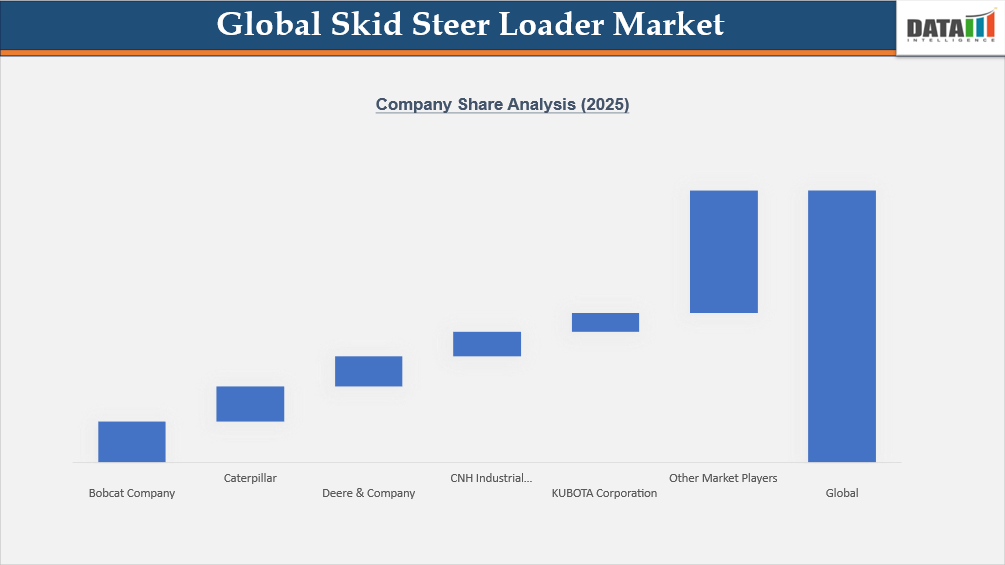
- The global skid steer loader market is characterized by a competitive landscape that includes both established and regional players.
- Key players include Bobcat Company, Caterpillar, Deere & Company, CNH Industrial America LLC (New Holland), KUBOTA Corporation, Komatsu, JC Bamford Excavators Ltd., Wacker Neuson SE, LiuGong, XCMG Group, Hyundai Construction Equipment, ASV, Manitou.com, Gehl Company, Lonking, SANY Group, Vert Equipment Pvt. Ltd., CASE Construction Equipment, Action Construction Equipment Ltd. and MIGLANI INTERNATIONAL.
Key Developments
- Bobcat Company initiated cases of patent infringement against Caterpillar in the month of December 2025 in U.S. and Europe. It indicates the rise in competition between players and the need to innovate and safeguard intellectual property rights in the industry.
- Komatsu introduced a new range of skid steer loaders and compact track loaders during the Bauma 2025 show in Germany in the month of April 2025. It increases the offering of Komatsu in the compact equipment market.
- TOBROCO-GIANT introduced its first electric-powered skid steer loaders, GS900E and GS950TE, in October 2024. The introduction will increase the offerings of the company and indicate its commitment to facilitating zero emissions on the construction sites.
- The Pithampur factory of CASE Construction Equipment launched its first range of Made-in-India skid steer loader in the month of June 2024. It would add to the market presence of CASE Construction Equipment in India, in accordance with the focus of CASE Construction Equipment on cost-effectiveness, among others.
- Caterpillar announced launch of five models of next-generation Cat skid-steer loader and compact track loaders, including Cat 250, 260 and 270 series in the month of March 2024. The five new models have been enhanced with operator stations, improved hydraulic systems and performance capabilities, aiming for increased productivity in the construction and landscaping industries.
Why Choose DataM?
- Technological Innovations: Explores the latest advancements in skid steer loader design, including improved hydraulic systems, advanced operator controls, telematics integration, electric and hybrid powertrains and enhanced attachment versatility that are driving higher productivity and lower operating costs across construction and industrial applications.
- Product Performance & Market Positioning: Evaluates how different OEMs perform in real-world construction, landscaping, agriculture and municipal environments. The analysis compares lifting capacity, breakout force, fuel efficiency, durability, operator comfort and attachment compatibility, highlighting how leading manufacturers differentiate themselves globally.
- Real-World Evidence: Highlights practical use cases of skid steer loaders across infrastructure development, road maintenance, warehouse handling and smart city projects. It demonstrates measurable improvements in jobsite efficiency, reduced labor dependency, faster material handling and optimized equipment utilization.
- Market Updates & Industry Changes: Tracks important industry developments such as new product launches, electrification initiatives, localized manufacturing expansions, tightening emission standards (Stage V, Tier 4 Final) and shifts in construction spending across major regions, including North America, APAC, China and India.
- Competitive Strategies: Analyzes how leading manufacturers are expanding their footprint through dealer network strengthening, localized production, electric model introductions, strategic partnerships and technology-driven differentiation such as AI-enabled monitoring and autonomous-ready platforms.
- Pricing & Market Access: Explains pricing structures across standard, high-capacity and electric skid steer models, including outright purchase, leasing and rental models. It also reviews regional availability, distribution networks and financing strategies that enhance market penetration.
- Market Entry & Expansion: Identifies growth opportunities in emerging economies driven by infrastructure development, urbanization, smart city programs and expanding rental ecosystems. It also outlines strategies for OEMs to scale operations globally through regional manufacturing hubs and after-sales service optimization.
Target Audience 2026
- Construction & Infrastructure Companies: EPC contractors, real estate developers, road construction firms and urban infrastructure agencies utilizing compact equipment for site preparation, excavation and material handling.
- Rental & Leasing Companies: Equipment rental providers expanding fleets to meet growing demand for compact, versatile machinery with high utilization rates.
- Agricultural & Landscaping Operators: Farm operators, orchard managers, landscaping firms and municipal maintenance departments using skid steer loaders for multipurpose operations.
- Government & Municipal Authorities: Public works departments, urban development authorities and smart city mission teams responsible for infrastructure upgrades and maintenance.
- OEMs & Equipment Manufacturers: Global and regional construction equipment manufacturers seeking competitive intelligence, innovation benchmarking and regional expansion strategies.
- Investors & Private Equity Firms: Investment groups tracking growth in construction equipment manufacturing, rental markets and electrification of compact machinery.
- Dealers & Distribution Networks: Authorized distributors, service providers and aftermarket suppliers involved in sales, financing, spare parts and maintenance services.


























































