

Global SiC Drives Market Overview
The global market for SiC drives is gaining momentum, as there is increasing demand for energy-efficient motor drives and power converters in the automotive, industrial and transportation applications. Silicon carbide (SiC) technology is superior compared to traditional silicon-based technologies with regard to high-frequency operation, low switching loss, increased power density and capability to work at high temperatures. These benefits make SiC materials attractive to use in electric vehicles traction inverters, where manufacturers apply high voltage solutions to increase powertrain efficiency. Moreover, market opportunities arise from industrial automation, energy-efficient production, electrification of railways and modernization of motor drives. Increasing attention to advanced inverter topologies, power modules and thermal management among automobile manufacturers, industrial equipment manufacturers and power electronics suppliers is observed in order to increase the performance of complete drive system. Yet, rising costs associated with the system, technical integration and qualification time remain influential. Within the forecasted period, increasing need for electric mobility, industrial electrification and efficient power conversion system is anticipated to drive the market growth.
Global SiC Drives Market Strategic Insights
- Electric Vehicle Electrification Driving SiC Traction Inverter Demand: The global sales of electric cars in 2025 were about 21 million, rising by more than 20% annually and representing 25% of total new cars sold, according to the International Energy Agency (IEA). This development made the demand for electric drive trains, traction inverters and improved motor controls systems higher. The use of SiC traction inverters is specifically significant in higher-voltage electric vehicles as they can minimize the switching losses and increase power conversion efficiency.
- Expansion of Electric Vehicle Manufacturing: In 2025, the production of electric cars around the world was at around 22 million units, marking an increase of over 25% when compared to that of 2024, according to the IEA. The production of about 16 million electric cars took place in China, which marked nearly 75% of global electric car production. This focus makes China better positioned in the chain for manufacturing of powertrain and inverter for traction. The increasing output levels provide prospects for traction inverter makers, power module makers and SiC makers targeting electric vehicles platforms.
- Industrial SiC Drive Efficiency and Energy-Saving Potential: In September 2025, the IEA 4E Electric Motor Systems Platform released results from a comparison between traditional IGBT and SiC MOSFET variable speed drives in pump systems. They found efficiency gains of up to 10 percentage points at partial load and 1 percentage point at nominal load. Its global extrapolation predicted the possibility of saving 17 to 25 TWh of electricity per year in comparable speed-controlled pump applications if the SiC technology was used. These findings highlight opportunities across industrial pumps, compressors, fans and fluid-handling equipment, although actual savings depend on operating conditions and system configuration.
- Commercial Vehicle Electrification Creating Additional Drive Opportunities: Global sales of electric trucks used in heavy freight applications had hit around 230,000 units by 2025, up nearly three times from 2024, based on the report by the IEA. Electric trucks comprised about 9% of truck sales worldwide owing to increasing electrification within commercial transport. These trends are providing an opportunity for the application of high-power traction motors and inverters. SiC technology could benefit these applications due to higher efficiency of power conversion, thermal management and power density but the choice would depend on the specific vehicle design, operating conditions and economics.
Why Choose Datam?
- Accelerated Customer Identification – Target 2.0× Qualified Sales Leads: Help SiC drive and traction inverter manufacturers expand their qualified customer pipeline through automotive OEM identification, industrial buyer profiling and application-based customer segmentation. DataM enables businesses to identify high-potential EV manufacturers, industrial equipment producers, railway OEMs and automation integrators, improve lead qualification and accelerate customer acquisition.
- Faster Market Entry & Business Expansion – Target 25% Reduction in Market Entry Time: Help SiC drive manufacturers reduce market-entry timelines through regional demand assessments, automotive and industrial application analysis, regulatory intelligence and distributor identification. DataM supports faster market penetration, strategic OEM partnerships and business expansion across electric mobility, industrial automation and railway electrification markets.
- Stronger Competitive Positioning – Target 25% Improvement in Sales Win Rate: Enable SiC drive and inverter manufacturers to improve sales win rates through competitor benchmarking, product performance comparisons, pricing intelligence and technology portfolio analysis. DataM helps identify competitive gaps, strengthen differentiation between SiC-based and conventional silicon-based drive systems and improve positioning among automotive, industrial and transportation customers.
- Higher Customer Revenue & Account Expansion – Target 1.25× Revenue per Key Account: Support a 25% increase in revenue from strategic accounts through automotive OEM wallet-share analysis, industrial customer demand assessment, cross-selling opportunities and product gap identification. DataM helps manufacturers identify additional traction inverter programmes, industrial drive requirements and opportunities for integrated electric powertrain solutions, strengthening long-term customer relationships.
- Improved Pricing & Profitability – Target 2 Percentage-Point Gross Margin Improvement: Help SiC drive manufacturers improve gross margins through complete inverter and drive-system pricing intelligence, component cost benchmarking, customer willingness-to-pay analysis and product positioning. DataM supports better pricing decisions by evaluating SiC semiconductor costs, power module integration, cooling requirements, thermal management and system-level efficiency benefits, enabling stronger commercial negotiations and improved profitability.
- Strategic Partnerships & Channel Expansion – Target 1.5× Customer Acquisition: Help SiC drive manufacturers increase channel-generated customer acquisition through automotive Tier-1 supplier mapping, industrial distributor identification, technology partner assessment and OEM ecosystem analysis. DataM supports stronger relationships with SiC semiconductor suppliers, power electronics integrators, motor manufacturers, railway technology providers and vehicle producers, expanding commercial reach across target applications.
- Improved Demand Forecasting & Revenue Protection – Target 25% Reduction in Forecast Errors: Help SiC drive manufacturers improve demand forecasting through electric vehicle production analysis, traction inverter adoption assessment, industrial motor-drive demand evaluation and regional supply-chain intelligence. DataM supports better production planning, inventory optimization, procurement decisions and capacity allocation while helping companies anticipate SiC component availability, automotive qualification cycles and changes in industrial automation demand.
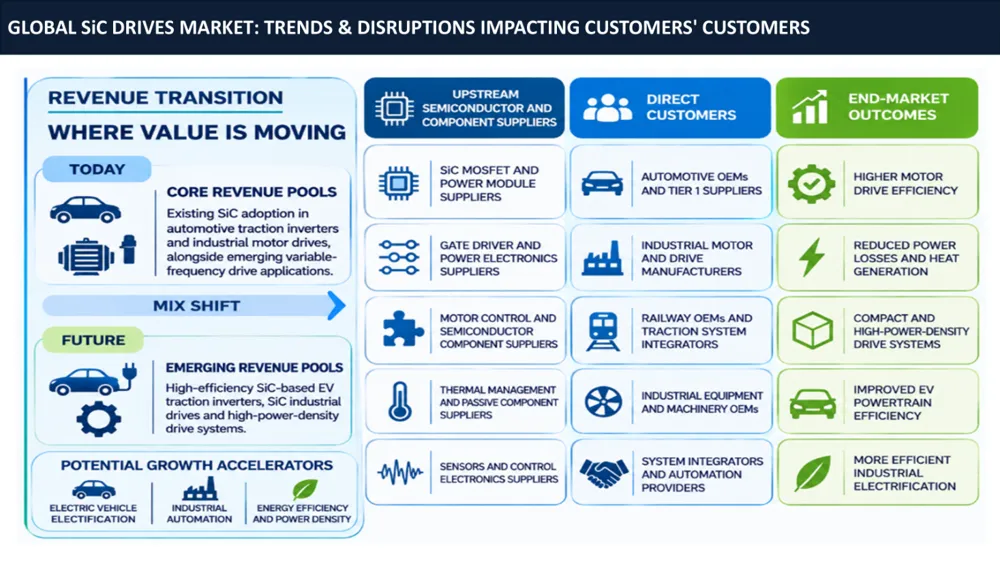
SiC Drives Market: Trends & Disruption Impacting Client Customers
Global Sic Drives Market: Commercial Use Cases Across Industries
| COMPANY | USE CASE DESCRIPTION | BENEFITS |
 | 800V SiC-based traction inverters for battery electric and plug-in hybrid vehicle powertrains, supporting high-voltage electric propulsion architectures. | Higher power density, reduced power losses, improved inverter efficiency, enhanced thermal management and potential improvements in vehicle driving range. |
 | SiC-based Clean Power variable frequency drives for controlling three-phase AC induction motors across industrial applications, including pumps, fans and HVAC systems. | Pure sine-wave motor output, reduced harmonics, elimination of external output filters in supported configurations and improved motor protection. |
 | SiC-based high-voltage inverters for commercial electric vehicles, designed for integration into scalable electric drivetrain platforms. | Efficient power utilization, optimized vehicle range, compact e-drive integration and reduced energy losses. |
 | SiC-enabled traction converter configurations for electric trains, metro systems and other railway applications, supporting advanced railway propulsion systems. | Higher switching frequencies, improved power conversion performance, potential reductions in transformer losses and enhanced traction-system efficiency. |
 | SiC-based VVVF traction inverters and railway power-conversion systems for electric railcars and other railway vehicles. | Reduced energy consumption, lower inverter losses, compact equipment design, reduced system weight and improved traction efficiency. |
Sic Drives Market Ecosystem
The global SiC drives market ecosystem comprises SiC wafer and substrate suppliers, power semiconductor manufacturers, power module developers, automotive traction inverter manufacturers, industrial motor-drive producers, railway traction system providers and downstream equipment manufacturers. Together, these stakeholders support the development, manufacturing, integration and commercialization of complete SiC-based motor drives and traction inverter systems across automotive, industrial, railway and other electrified applications.
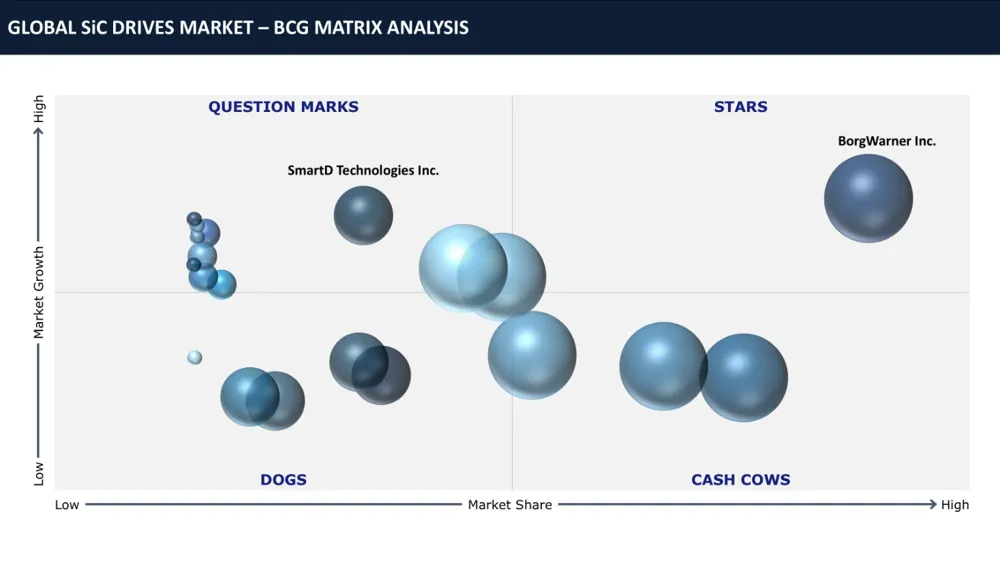
Sic Drives Market: BCG Matrix Analysis
- Stars: Established automotive traction inverter suppliers with commercial SiC-based inverter programmes, strong OEM relationships and exposure to growing electric vehicle demand, such as BorgWarner.
- Cash Cows: Established conventional motor-drive and traction-system businesses serving industrial automation, transportation and infrastructure applications, generating stable revenues through their existing customer base and installed systems.
- Question Marks: Emerging SiC industrial drive manufacturers and specialized technology providers, such as SmartD Technologies, targeting growing demand for energy-efficient motor-drive systems but having comparatively limited market penetration.
- Dogs: Older, less differentiated drive platforms with limited growth prospects in selected high-performance applications requiring higher efficiency, power density and advanced power-conversion capabilities.
SiC Drives Market: Key Market Players
- Robert Bosch GmbH (Germany)
- BorgWarner Inc. (United States)
- ZF Friedrichshafen AG (Germany)
- DENSO Corporation (Japan)
- Hitachi Astemo, Ltd. (Japan)
- Schaeffler AG (Germany)
- Marelli Holdings Co., Ltd. (Japan)
- Valeo SE (France)
- Mitsubishi Electric Corporation (Japan)
- SmartD Technologies Inc. (Canada)
- Siemens Mobility GmbH (Germany)
- BYD Company Limited (China)
- Tesla, Inc. (United States)
SiC Drives Market: Recent Developments
- October 28, 2026: BorgWarner and Wolfspeed announced a multiyear SiC device supply agreement to support BorgWarner's next-generation 800V SiC-based inverter platform. The agreement secures Wolfspeed's 1200V SiC technology for future electric vehicle power-conversion systems, supporting component availability and the development of high-efficiency traction inverters.
- August 3, 2026: BorgWarner secured extensions of multiple high-volume high-voltage inverter programmes with a major European automotive OEM, covering plug-in hybrid and 800V battery-electric vehicle applications. The 800V traction inverter incorporates the company's latest-generation Viper SiC power switches and a dual-sided-cooled power module. Production is planned to begin in 2029, strengthening its position in high-voltage electric vehicle propulsion systems.
- June 5, 2026: Siemens Mobility GmbH and Mitsubishi Electric Corporation strengthened their collaboration on high-voltage SiC technology for next-generation railway traction applications through a long-term agreement. The companies are advancing the development, qualification and industrialization of SiC-based power modules to support more energy-efficient and high-performance railway drive systems, including future commuter and regional train platforms.
- June 4, 2026: Mitsubishi Electric Corporation announced the shipment of samples of its fifth-generation SiC MOSFET bare dies for electric vehicle motor inverters and eAxles. The new devices achieve approximately 25% lower on-resistance than the company's previous generation, supporting improved inverter efficiency, reduced power losses and more compact electric vehicle drive systems.
- April 2, 2026: SmartD Technologies secured CAD 15 million in financing co-led by Hammond Power Solutions and Desjardins Capital to accelerate the commercial deployment of its silicon carbide (SiC)-based Clean Power variable frequency drives (VFDs). The investment will support product development and expansion across industrial applications, including water infrastructure and data centers. The company's VFD uses a three-level inverter with SiC technology and provides clean sine-wave output for industrial AC motors.
SiC Drives Market: Delivered Customization
| CLIENT REQUEST | CUSTOMIZATION DELIVERED | VALUE ADDS |
| Automotive Traction Inverter Manufacturer |
|
|
| Industrial Motor Drive Manufacturer |
|
|
| Electric Vehicle OEM |
|
|
| SiC Semiconductor and Power Module Supplier |
|
|
| Railway Traction System Manufacturer |
|
|
| Power Electronics and System Integrator |
|
|
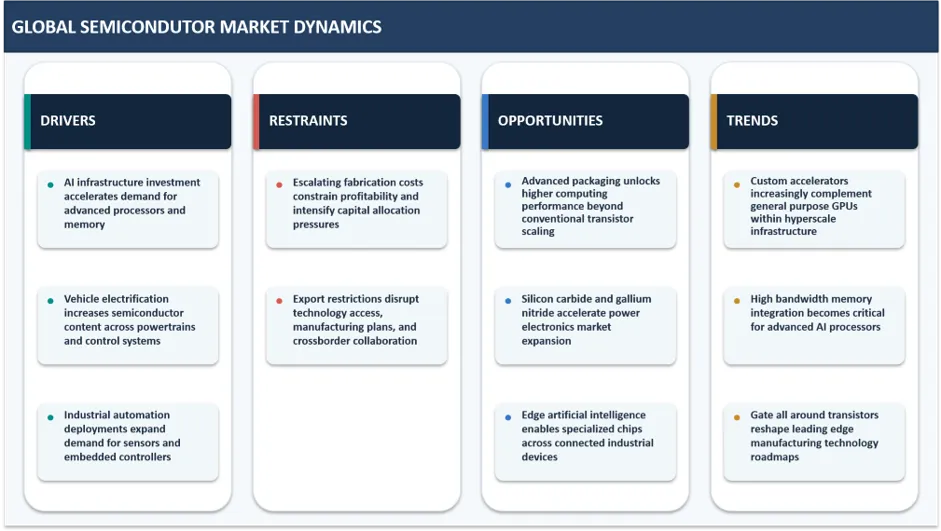
Global Sic Drives Market: Market Dynamics
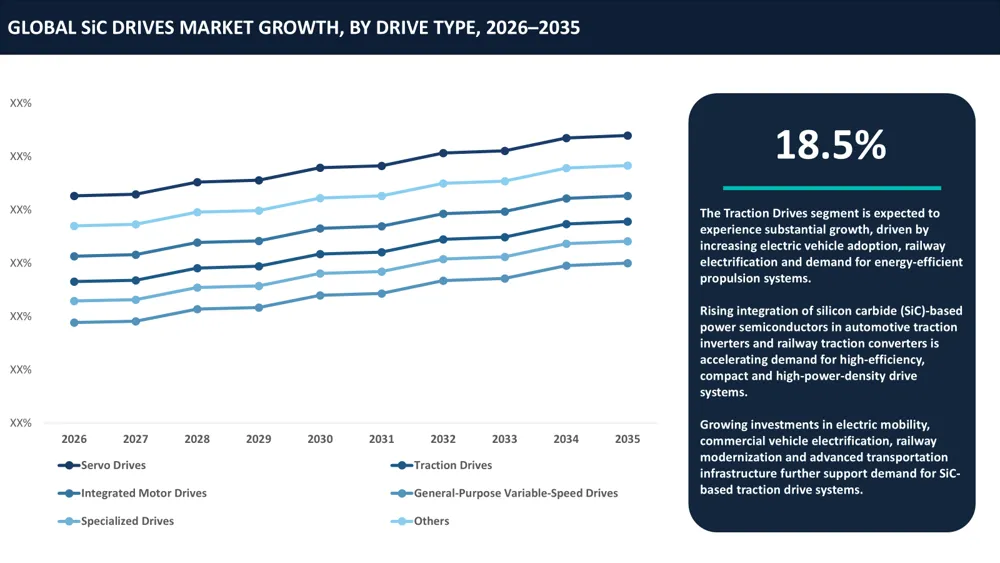
Global SiC Drives Market: Market Segment Analysis
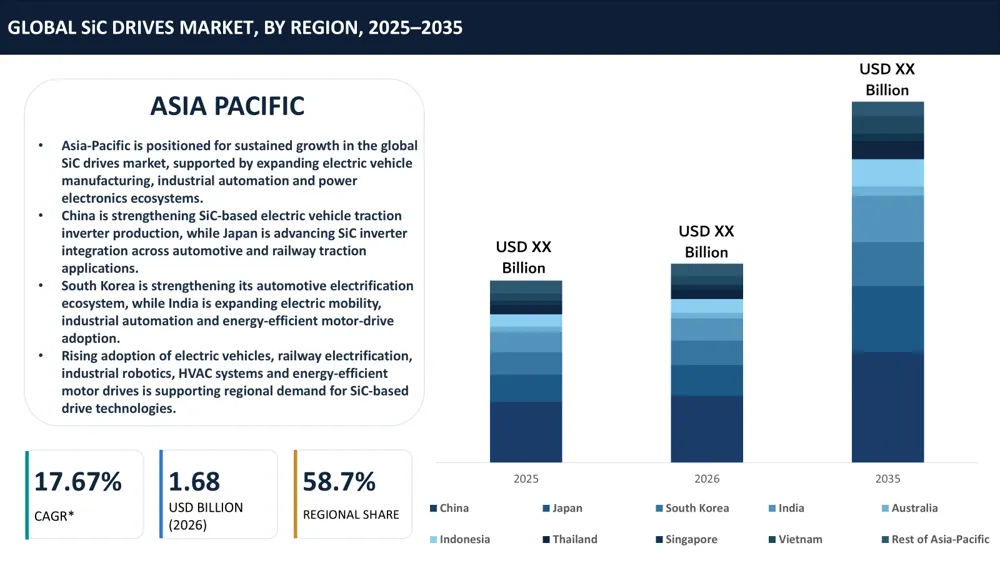
SiC Drives Market: Region Wise Analysis
Global SiC Drives Market: Market Scope
| Metrics | Details | |
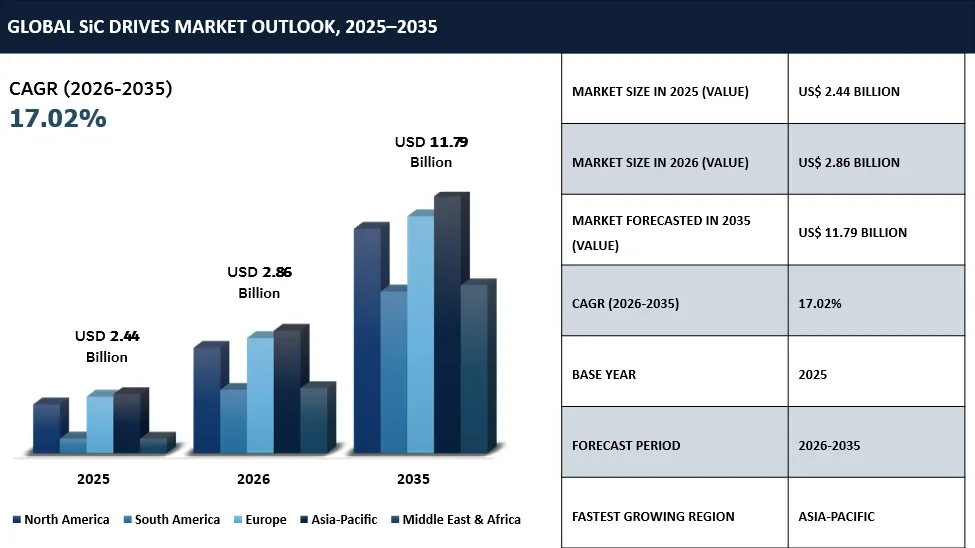
| Market Size in 2025 (Value) | USD 2.44 Billion | |
| Market Size in 2026 (Value) | USD 2.86 Billion | |
| Market Forecasted in 2035 (Value) | USD 11.79 Billion | |
| CAGR (2026-2035) | 17.02% | |
| Years Considered | 2024-2035 | |
| Base Year | 2025 | |
| Forecast Period | 2026-2035 | |
| By Drive Type | Servo Drives Traction Drives Integrated Motor Drives General-Purpose Variable-Speed Drives Specialized Drives Others | |
| By Drive Current Type | AC Drives DC Drives | |
| By Power Rating | Below 10 kW 10–50 kW 51–150 kW 151–350 kW 351–1,000 kW Above 1,000 kW | |
| By Voltage Rating | Low Voltage (Up to 1 kV) Medium Voltage (Above 1 kV to 35 kV) High Voltage (Above 35 kV) | |
| By SiC Configuration | Full-SiC Drives Hybrid-SiC Drives | |
| By Inverter Topology | Two-Level Inverters Three-Level Inverters Multilevel Inverters | |
| By Cooling Type | Air-Cooled Drives Liquid-Cooled Drives | |
| By Drive Configuration | Standalone Drives Integrated Drives Modular Drives | |
| By Application | Pumps Fans and Blowers Compressors Conveyors and Material Handling Systems Machine Tools Robotics and Automated Machinery Extruders, Mixers and Processing Equipment Crushers, Mills and Grinding Systems Hoists, Cranes and Winches Electric Vehicle Propulsion Systems Railway Traction Systems HVAC Chillers and Cooling Systems Winding and Rewinding Systems Other Driven Equipment | |
| By End-User | Automotive and Electric Vehicles Industrial Manufacturing Water and Wastewater Treatment Power Generation Oil and Gas Mining and Metals Chemicals and Petrochemicals Railways and Transportation Commercial Buildings and Infrastructure Food and Beverage Pulp and Paper Others | |
| By Sales Channel | Direct Sales Distributors and Dealers Original Equipment Manufacturer (OEM) Sales System Integrators and EPC Contractors | |
| By Region | North America | U.S., Canada, Mexico |
| Europe | Germany, UK, France, Spain, Italy, Poland | |
| Asia-Pacific | China, India, Japan, Australia, South Korea, Indonesia, Malaysia, Singapore, Vietnam, Thailand, Philippines, Taiwan | |
| South America | Brazil, Argentina | |
| Middle East and Africa | UAE, Saudi Arabia, South Africa, Israel, Turkiye | |
| Report Insights Covered | Competitive Landscape Analysis, Company Profile Analysis, Market Size, Market Share, Market Growth | |
Global SiC Drives Market: Target Audience
| INDUSTRY | WHO SHOULD BUY THIS REPORT? | REASON TO BUY THIS REPORT |
| AUTOMOTIVE TRACTION INVERTER MANUFACTURERS | SiC traction inverter developers, electric powertrain manufacturers and automotive Tier-1 suppliers | Evaluate traction inverter demand, SiC technology adoption, OEM partnerships, product positioning and emerging vehicle platform opportunities. |
| INDUSTRIAL MOTOR DRIVE MANUFACTURERS | AC drive, variable frequency drive and servo drive manufacturers | Assess industrial SiC drive adoption, product development opportunities, efficiency requirements and competitive positioning. |
| AUTOMOTIVE OEMs AND ELECTRIC VEHICLE MANUFACTURERS | Electric vehicle manufacturers, vehicle platform developers and powertrain engineering teams | Evaluate SiC traction inverter integration, higher-voltage architectures, powertrain efficiency and technology sourcing opportunities. |
| INDUSTRIAL EQUIPMENT AND MACHINERY OEMs | Robotics, machine-tool, pump, compressor and automated equipment manufacturers | Identify opportunities to integrate SiC-based motor drives and improve equipment efficiency, power density and operational performance. |
| RAILWAY TRACTION SYSTEM MANUFACTURERS | Railway propulsion equipment suppliers, locomotive manufacturers and traction system integrators | Assess SiC traction conversion opportunities, railway electrification demand, product qualification requirements and modernization projects. |
| SiC SEMICONDUCTOR AND POWER MODULE SUPPLIERS | SiC MOSFET, power module, gate driver and power electronics component manufacturers | Understand downstream drive-system requirements, customer demand, component specifications and opportunities for strategic supply agreements. |
| ELECTRIC MOTOR MANUFACTURERS | AC motor, permanent magnet motor, induction motor and high-performance motor manufacturers | Evaluate motor-drive integration opportunities, efficiency improvements, compatibility requirements and demand across electrified applications. |
| POWER ELECTRONICS AND SYSTEM INTEGRATORS | Inverter developers, power conversion specialists and industrial automation system integrators | Identify application-specific opportunities, integration requirements, thermal management needs and emerging SiC drive architectures. |
| INDUSTRIAL AUTOMATION AND ENERGY SYSTEM PROVIDERS | Automation solution providers, HVAC equipment manufacturers and energy-efficiency technology companies | Track demand for efficient motor-drive systems across manufacturing, HVAC, pumping and other industrial applications. |
| INVESTORS AND POLICYMAKERS | Strategic investors, private equity firms, government agencies and industry advisors | Assess market growth opportunities, competitive exposure, manufacturing investments, regional supply chains and industrial electrification policies. |
WHY DOES THIS REPORT MATTER IN 2026?
The global market of SiC drives is entering into an important strategic phase in 2026 owing to increasing preference towards energy efficient power conversion system among manufacturers of electric vehicles, industrial equipment and transportation technologies. Increasing usage of electric vehicles especially the higher voltage power train architectures, is boosting the requirement of SiC based traction inverters due to their advantages such as lower switching losses, higher power density and high efficiency. Simultaneously, increasing application areas of industrial automation, energy-efficient manufacturing and railway electrification have been opening new avenues for advanced SiC based motor drives and traction systems.
However, market players encounter challenges associated with increased system costs, availability of SiC components, thermal management issues, engineering complexities and long qualification cycles for automobiles and railways. Companies have to analyze whether using SiC is economically feasible in comparison with traditional silicon solutions, especially across cost-sensitive industries. Innovations in the area of SiC power modules, inverters, motor control and thermal management impact products and their competitive position. Therefore, automotive OEMs, industrial drives producers, technology providers and investors need detailed information on the product portfolio, production, customer base, industry specific use, supply chains and technology roadmaps in order to better analyze business opportunities, competitive positioning, adoption challenges and growth prospects of the global SiC drives market through 2035.
GLOBAL SiC DRIVES MARKET: ANALYST VIEW / OPINION
In the global SiC drives market, two concurrent pathways of demand are becoming prominent: automotive electrification enabled by the use of traction inverters based on SiC technology and industrial electrification backed by the need for efficient motor drive solutions. These segments should not be considered on the basis of one specific assumption regarding adoption and pricing. For automobiles, inverter efficiency, density, thermal management and high voltage capability together determine competitiveness. For industrial applications, buyers are more concerned about reliability, life cycle, cost of operation, equipment compatibility, efficiency and availability of supply.
There are three competitive challenges that need consideration. One is that the higher costs involved in the fabrication of SiC power devices and associated driver components may limit implementation of the technology, especially for cost-conscious industrial applications. It is important to show efficiency benefits in system performance and long-term operations to offset the initial high costs. The second challenge relates to production scalability due to dependence on availability of supply chain of components, such as power modules, specialized SiC parts and thermal management systems. Lastly, fast evolving technologies in relation to SiC devices, inverter technologies and motor control technologies may limit competitiveness of the products developed due to obsolescence prior to return on development investments. Using modular designs, scalable propulsion systems and reliable product development roadmaps contributes to the reduction of such risks. In conclusion, companies have to find the optimal balance between technology development, system costs, applicability and scalability in order to create competitive advantages in the field of electric mobility and industrial electrification.