


SerDes Market Size and Overview
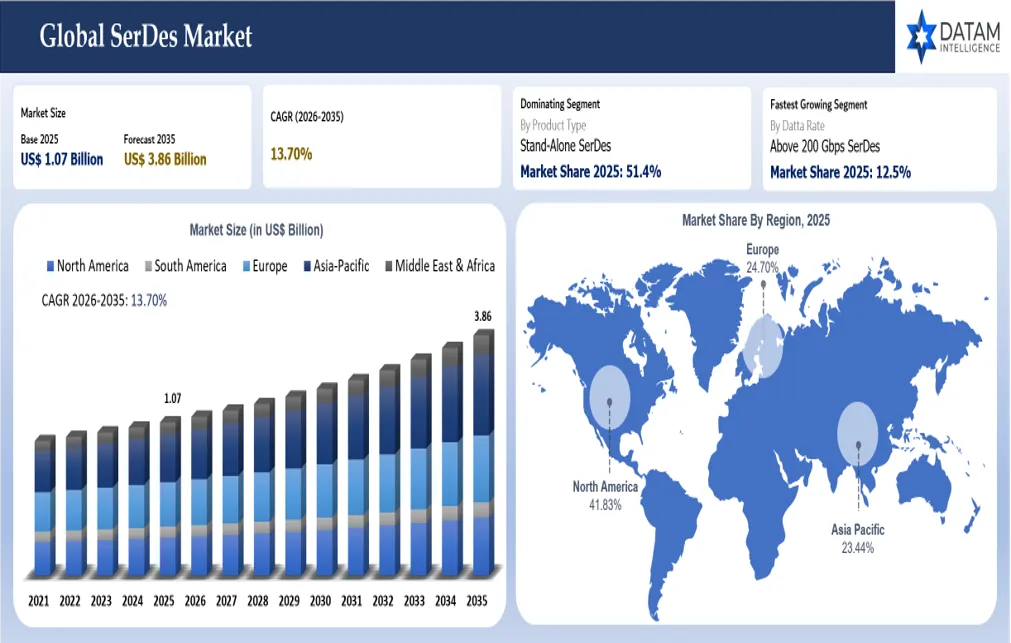
The global SerDes market reached US$ 1.07 billion in 2025 and is expected to reach US$ 3.86 billion by 2035, growing with a CAGR of 13.70% during the forecast period 2026-2035.
The SerDes industry is growing quickly due to the need for higher bandwidth and lesser latency brought forth by AI processors, GPUs, custom chips and fast Ethernet switches. The move to 112G and 224G SerDes with the use of PAM-4 signaling, advanced equalization and retiming in turn aids in establishing fast network infrastructure including 800G and even nascent 1.6T connectivity. Moreover, the development of PCIe, CXL, UCIe and UALink contributes to the growth of SerDes applications in various chip-to-chip interconnnects, die-to-die interconnects and accelerators where the movement towards chiplets increases the demand for compact and energy efficient SerDes PHYs.
The market comprises both individual and integrated SerDes solutions along with SerDes intellectual property offered under licenses mostly created by semiconductor, connectivity and EDA players. High demand is characteristic for data centers, Artificial Intelligence/High-Performance Computing possibly coupled with other similar technologies, telecommunications, networking equipment and automotive electronics with the utmost attention being paid to a variety of critical parameters such as bandwidth per watt, signal integrity, latency, interoperability and channel reach. The competitive environment also widens to include retimers, optical connectivity and advanced interconnect solutions thus allowing SerDes to be seen as a key technology in the field of connectivity.
SerDes Market Key Takeaways
- The Stand-Alone SerDes held the largest market share of about 51.4% in the SerDes market throughout 2025 on account of the growing need for standalone high-speed connectivity solutions for networking equipment, optical systems, data centers and high-performance computing.
- Above 200 Gbps SerDes Segment is forecasted to have the highest growth rate of 23.0% CAGR in the SerDes market, led by the move to 224G and other faster data rates for AI accelerators, switch ASICs, optical connectivity and future computing.
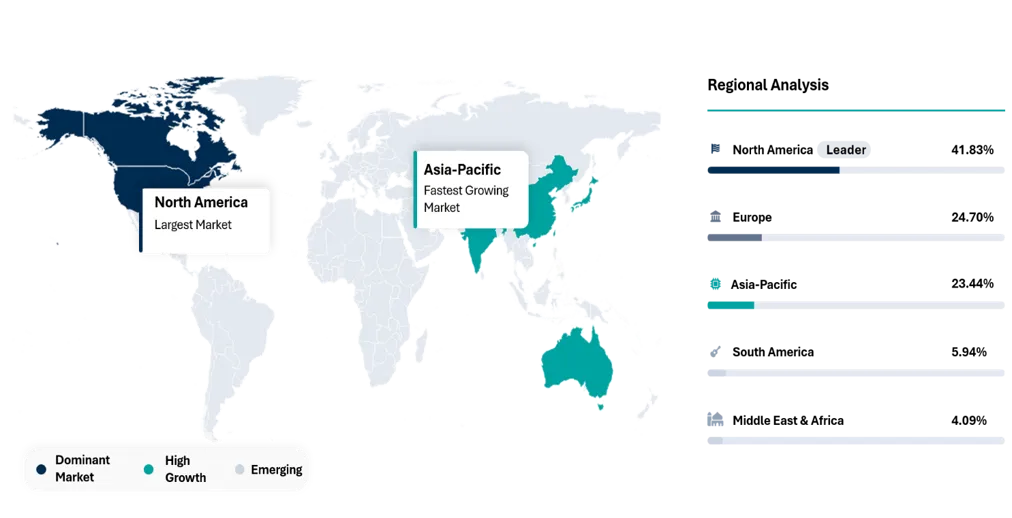
- North America led the SerDes market globally with a market share of 41.83% in 2025 on account of its robust AI data center infrastructure, advanced hyperscale computing, semiconductor design and high-speed Ethernet.
- The widespread use of PAM-4 signaling is enabling the use of more bandwidth per lane on 800G Ethernet, AI networking and optical interconnects, with advanced equalization and retiming techniques helping to overcome the difficulties faced when dealing with higher-speed signals.
- Chiplet and die-to-die integration is creating new opportunities for SerDes use through UCIe, UALink, PCIe and CXL, while AI infrastructure and automotive electronics are driving a need for more bandwidth and low-power SerDes.
SerDes Industry Trends and Strategic Insights
- 224G SerDes transition for AI infrastructure: The growth of AI accelerators, specifically AI ASICs and next-gen Ethernet switches, is resulting in more stringent demands for signal integrity, advanced equalization techniques, proficient power efficiency and advanced packaging solutions.
- PAM-4 adoption in high-speed links: The exchange of NRZ signaling for PAM-4 technology permits the transmission of larger volumes per lane, thereby facilitating the international processing speed.
- Expansion into chiplet and die-to-die architectures: Chiplet CPU, GPU and AI accelerator increases the need for high-speed die-to-die and chip-to-chip SerDes PHY with a focus on customizable and process-node-optimized IP.
- Integration with optical connectivity: The development of 800G and the start of 1.6T networking are enhancing the process of integration between electrical SerDes and optical DSPs, retimers, in addition to optics transducers in hyperscale data center infrastructure.
- Automotive SerDes adoption beyond camera links: Centralized and zonal vehicle technologies are increasing SerDes applications in ADAS sensors, high-resolution cameras, displays and digital.
SerDes Market Scope
| Metrics | Details | |
| 2025 Market Size | US$ 1.07 Billion | |
| 2035 Projected Market Size | US$ 3.86 Billion | |
| CAGR (2026-2035) | 13.70% | |
| Largest Market | North America | |
| Fastest Growing Market | Asia-Pacific | |
| By Product Type | Stand-Alone SerDes, Integrated SerDes and SerDes IP Core | |
| By Data Rate | Up to 10 Gbps, 10-25 Gbps, 25-50 Gbps, 50-100 Gbps, 100-200 Gbps and Above 200 Gbps | |
| By Signaling Technology | NRZ, PAM-4, PAM-6 and Other Multi-Level Signaling | |
| By SerDes Architecture | Serializer/Deserializer, Retimer-Based, Gearbox-Based, Multi-Lane SerDes and Adaptive SerDes | |
| By Interconnect | Chip-to-Chip, Die-to-Die, Chip-to-Module, Chip-to-Optical Module, Board-to-Board and Backplane | |
| By Channel Reach | VSR (Very Short Reach), XSR (Extra Short Reach), Short Reach, Medium Reach, Long Reach and ELR (Extra Long Reach) | |
| By Interface / Protocol | Ethernet, PCIe, CXL, UALink, UCIe, USB, DisplayPort, HDMI, MIPI, SAS/SATA, InfiniBand, Automotive SerDes, Proprietary Interfaces and Others | |
| By End Use Industry | Data Center & Cloud Infrastructure, AI & High-Performance Computing, Telecommunications & Optical Networking, Networking & Switching Equipment, Automotive Electronics, Consumer Electronics, Industrial Electronics, Aerospace & Defense Electronics and Others | |
| By Region | North America | U.S., Canada, Mexico |
| Europe | Germany, UK, Russia, France, Spain, Italy, Poland | |
| Asia-Pacific | China, India, Japan, Australia, South Korea, Indonesia, Malaysia, Singapore, Vietnam, Thailand, Philippines, Taiwan | |
| South America | Brazil, Argentina | |
| Middle East and Africa | UAE, Saudi Arabia, South Africa, Israel, Turkiye, Nigeria | |
| Report Insights Covered | Competitive Landscape Analysis, Company Profile Analysis, Market Size, Share, Growth | |
Why does this report matter in 2026?
The market for SerDes is increasingly becoming strategically relevant in 2026 because of increased demands by AI accelerators, GPUs, customized ASICs and high-speed Ethernet switches for more bandwidth in order to facilitate interconnect in data centers and computing systems. The industry is evolving from 112G to 224G SerDes as well as higher speed SerDes architectures, but the need for high-density and low-power electrical connectivity is rising due to 800G network and 1.6T optical connectivity. Additionally, the increasing utilization of chiplets and PCIe/CXL connectivity is expanding the applicability of SerDes beyond conventional chip-to-chip connectivity.
This report holds significant importance in 2026 due to the influence of developments in AI technologies on purchasing and investment decisions made in the fields of SerDes. Companies engaged in semiconductor design and infrastructure need to be aware of the knowledge of firms manufacturing SerDes ICs and PHY/IPs, their capacity for supporting 112G/224G data rates and working with major protocols and prospects related to chiplet, retimer and automotive applications. The report provides companies with insights into the state of the market, including regional supply-chain processes, adoption of technologies and application-specific demand that are important when planning the strategy of companies operating on the market.
SerDes Market White Space & Investment Opportunities
- 224G and Next-Generation SerDes PHY IP: There are opportunities to develop low-power 224G and next-generation SerDes PHYs targeted at AI accelerators, custom ASICs, Ethernet switch and optical interconnect applications.
- Chiplet and Die-to-Die SerDes Solutions: Higher utilization of chiplets provides opportunities to develop interoperable and low-latency SerDes IP for communications within die-to-die architectures.
- AI-Era Retimers and Signal-Integrity Solutions: Increased data rates and channel attenuation create opportunities for advanced retimers, equalizers and signal conditioning solutions for GPU to switch, accelerator to accelerator and PCIe/CXL links.
- Automotive High-Speed SerDes Platforms: The implementation of centralized as well as zonal vehicle architectures enables the design and use of automotive-grade SerDes supporting high-definition image sensors, displays and ADAS technologies.
- SerDes-Optical Integration for 800G/1.6T Networks: By increasing the processing capabilities of AI clusters, it becomes feasible to integrate electrical SerDes, DSP and optical transceiver technologies in order to achieve significant improvements in data transmission.
SerDes Future Market Transformation
The future growth of the SerDes market will shift from the traditional chip-to-chip communication methods towards ultra-fast and efficient connectivity schemes that cater to the AI and next-generation computing requirements. The evolution from the 112G to 224G SerDes and future generation higher-speed SerDes will result in an increasing need for advanced PAM-4 signaling schemes, adaptive equalization, low-power CDRs, retimers and better signal integrity architecture. From a systems perspective, the usage of chiplets, die-to-die communication, PCIe/CXL, 800G and future generation 1.6T optical communication technologies will further increase the applicability of SerDes within AI accelerators, GPUs, custom ASICs, Ethernet switches and optical transceivers. Adoption of automotive will concurrently push the use of SerDes outside of conventional camera applications to ADAS sensors, higher resolution displays and zonal/centralized car architectures, thereby rendering bandwidth efficiency, power per bit, compatibility and automotive-grade reliability crucial market differentiators.
SerDes Market Buyer Decision-Making Criteria
Buyers in the SerDes market rate vendors largely on their ability to provide the needed bandwidth at low power consumption and ensure that the signals meet their integrity and protocol standards in highly sophisticated applications involving AI, networks, optics and automotive technology. For 112G and 224G deployment, the choice has been more and more driven by the sensitivity of the receiver, equalizer capability, jitter characteristics, latency, density of the lanes and interoperability with existing switch ASICs, accelerators, optical DSPs and interface standards. The buyer is also concerned with the technology node compatibility, the SerDes PHY/IP customization, the silicon qualification and the availability of the product.
Major Buyer Decision-Making Criteria
- Data-Rate Capability
- Power per Bit
- Signal Integrity
- Protocol Compatibility
- Latency
- Lane Density
- SerDes PHY/IP Customization
- Interoperability & Compliance
- Reliability & Qualification
- Supplier Technology Roadmap
- Total Cost of Ownership
- Supply Continuity
SerDes Market Economic & Investment Analysis
The economic perspective of the growth in the SerDes industry depends on the investments into the AI data center infrastructure, hyperscale clouds infrastructure, high-speed Ethernet networks and the latest generation of semiconductor technologies. The use of AI accelerators and HPC infrastructure leads to the necessity to increase the number of connections using high-bandwidth SerDes between GPUs, CPUs, switch ASICS and optical modules; that drives the industry to move from 56G and 112G to 112G and 224G. On the other hand, investment into 800G and upcoming 1.6T optics infrastructure, PCIe/CXL connectivity solutions and chiplets architecture expands the demand for high-speed SerDes, re-timers and related signal integrity technology. This increased need for high-bandwidth per rack and more efficient connectivity has led to semiconductor investments in higher-speed and low-power SerDes.
In addition, investments in SerDes IP, advanced packaging, optical connectivity and automotive ecosystems are gaining pace. Companies operating in the semiconductor industry and IP companies are allocating higher investments in research and development for 224G-class PHYs, PAM-4 signaling, advanced equalizations and die-to-die connectivity, while investments in AI infrastructure are paving way for investments in retimers, optical DSPs and interconnect devices. On the other hand, investments in centralized and zonal architectures in the automotive industry are creating demand for qualified SerDes products in cameras, display systems and ADAS. These trends are changing the focus of investments from traditional chip-to-chip connectivity to bandwidth and power-efficient SerDes platforms. These trends have changed investment focus from conventional connectivity between chips to high bandwidth, energy-efficient and application-specific SerDes technologies, where investments are being made in artificial intelligence infrastructure, semiconductor designs and future networking technology.
SerDes Investment Trends in the Market
- Investment is shifting toward 224G and higher-speed SerDes: Funds are increasing in 224G and the upcoming advanced SerDes PHYs required for AI accelerators, Ethernet switches and new aged-optical systems.
- SerDes PHY/IP portfolios are expanding: Vendors in semiconductor IPs and EDA have been investing in reusable SerDes PHYs for Ethernet, PCIe, CXL and die-to-die interfaces in order to develop advanced ASIC and SoCs quicker.
- AI data-center connectivity is attracting capital: Demand for AI clusters is leading to high investments aimed at high-speed switches, optical interconnections, retimers and any other technologies based on SerDes.
- Signal-integrity and retimer technologies are gaining investment: With channels getting faster, a boom in advanced equalization, clock recovery, retimer and signal-conditioning technologies is witnessed for PCIe, CXL and accelerator interconnects.
- Automotive SerDes platforms are receiving targeted investment: Semiconductor market players are focusing on automotive grade SerDes for own camera and display systems, ADAS and zonal architectures where performance and reliability along with functional safety are core requirements.
Strategic Indicators for SerDes Market
High Regulation Impact
The SerDes industry is heavily regulated by standards and technology control measures because any high-speed SerDes product must be compliant with interface specifications, electromagnetic compatibility regulations and, in the case of automotive SerDes products, with functional safety and automotive qualification standards. Regulations such as PCIe, Ethernet, CXL and MIPI have an impact on SerDes PHY design and testing, while semiconductor export regulations may limit access to advanced semiconductor fabrication processes, EDA tools and connectivity devices. Automotive SerDes is also subjected to very stringent functional safety, EMC and reliability standards that increase qualification difficulties and development costs.
High Investment Activity
Innovation within the SerDes industry is concentrating on 112G/224G high-speed PHYs, AI-based connectivity, optical links and retimers/chiplet interconnect. While semiconductor and connectivity firms are concentrating their research and development efforts on high-performance SerDes that provide better signal integrity, lower power consumption and increased bandwidth density, SerDes IP firms are growing their portfolios of reusable PHYs for Ethernet, PCIe, CXL and die-to-die interconnects. There is also funding moving towards advanced packaging, optical DSP integration and automotive SerDes, as the need to address increased bandwidth and complex interconnect designs in AI data centers, networking systems and next-generation vehicles.
Supply Chain Disruption
SerDes market faces risk due to supply chain disruption owing to the fact that advanced SerDes technology requires advanced semiconductor manufacturing, specialized analog/mixed signal intellectual property, advanced packaging and high speed test capability. Advanced foundries might have issues in terms of capacity constraints which might impact the availability of SerDes enabled Application Specific Integrated Circuits (ASICs), networking semiconductors and optics. Disruptions related to semiconductor equipment, substrates and advanced packaging could increase the lead times. Advanced semiconductor technology constraints due to geopolitical limitations may also impact availability of advanced process nodes, EDA and high-speed interface components, leading to a push by SerDes manufacturers and systems companies toward alternative foundry arrangements and more regional procurement policies.
Pricing Volatility
Factors influencing pricing volatility in the SerDes market include advanced node wafer costs, SerDes PHY/IP license, high-speed packaging needs, test demands and AI and networking demand volatility. The move from 112G to 224G SerDes will bring added complexity in design and will result in higher engineering, test and manufacturing costs, along with additional costs associated with advanced chipmaking and packaging technology. Additionally, the scarcity of advanced node fab capacity and high-end packaging may result in price volatility in the ASICs, networking chips and optical connectivity parts equipped with SerDes solutions. Consequently, the prices associated with SerDes solutions may range widely according to several factors such as the speed of data transfer, number of lanes, process technology node, IP structure, packaging technology and manufacturing volumes.
Procurement Pressure
The procurement pressure in the SerDes market is growing since artificial intelligence accelerators, networking ASICs, optical transceivers and high-performance computing platforms demand faster and more lanes of connectivity. Increasingly, buyers are assessing SerDes providers not by the price but according to their ability to deliver data rate, efficiency, performance and signal integrity. This situation, along with the relatively small number of vendors that offer 112G/224G SerDes PHYs or high-performance SerDes IP, can lead to qualification dependencies and switching costs; furthermore, the automotive clients have additional requirements on reliability and lifetime of the products. Hence, there is an emphasis on multi-sourcing, IP portability, capacity commitment and total cost of ownership by procurement professionals.
New Technology Adoption
In the SerDes market, new technology adoption is speeding up towards 224G and beyond, being fueled by AI accelerators, hyperscale networking and optical connectivity. The latest SerDes design includes PAM-4 signaling, FFE/DFE equalizers, low-power CDR designs, retimers and optics to solve channel loss and bandwidth problems at higher speeds. In terms of systems, the adoption of chiplets, die-to-die connections and PCIe/CXL architectures increases the applications of SerDes from chip-to-chip communication to more advanced solutions. Additionally, the application of SerDes for automotive platforms is becoming more frequent for camera, display, ADAS and zonal connectivity.
Regional Expansion Opportunity
The opportunities for regional expansion in the SerDes market exist mostly in North America, Asia Pacific and Europe, with different clusters of applications in each region. The North American region presents opportunities for the adoption of artificial intelligence data centers, high-speed Ethernet and optical interconnects in addition to hyperscale computing. On the other hand, the Asian region including China, Taiwan, South Korea and Japan presents opportunities in terms of semiconductor fabrication, advanced packaging, AI infrastructure, automotive electronic systems and high-speed networks. There are possibilities for Europe in Automotive SerDes, Industrial Automation and Optical Communications since the adoption of centralized and zoned vehicle architecture. SerDes providers may enhance their regional expansion efforts through localized design services, automotive qualification, application engineering, IP partnerships and semiconductor diversification.
Government Policy Support
Government support for the SerDes market is mostly indirect, working through semiconductors, chip design, AI infrastructure and supply chain resilience initiatives. In the United States, EU, China, Taiwan, Japan and South Korea, there are semiconductor policies which are facilitating fabrication, advanced packaging, chip design and high-performance computing for SerDes. Policies like the U.S. CHIPS and Science Act and EU Chips Act enhance investments in semiconductor ecosystems and national AI and data center policies create more demand for high-bandwidth computing and network infrastructure. These policies provide favorable environment for 112G/224G SerDes, chiplets, optical interconnections and next generation semiconductor packaging, though they are not necessarily SerDes incentives.
Pricing Intelligence
Pricing of SerDes has been driven more by data rates, lane density, process node optimization, protocol support and customization in recent times compared to a fixed pricing formula based on unit prices. Advanced 112G and 224G SerDes have higher development and licensing fees compared to 10-56G due to their complexities involving equalization, clock-data recovery and signal integrity. The price is also determined per lane and per Gbps, especially in cases of AI accelerators, Ethernet switch ASICs, optical DSP and PCIe/CXL interfaces since the addition of more lanes may add to overall connection cost. SerDes used in automotive industry are priced higher due to AEC-Q100 certification, functional safety support and longevity of products whereas customized SerDes PHY IP requires more engineering and integration expenses. Therefore, buyers now consider the SerDes pricing along with power efficiency, bandwidth density, protocol support, certification criteria and integration efforts while selecting vendors.
| HS Code | Reporter | Trade Flow | 2025 Trade Value | Interpretation |
| 854231 | China | Exports | US$71.4 Billion | Indicates China's significant export activity in processor and controller ICs relevant to high-speed computing and connectivity. |
| 854231 | Taiwan | Exports | US$17.13 Billion | Reflects Taiwan's semiconductor manufacturing and export ecosystem supporting high-speed IC applications. |
| 854231 | United States | Exports | US$34.58 Billion | Demonstrates the scale of U.S. processor/controller IC exports used across computing and networking infrastructure. |
| 854231 | Singapore | Exports | US$57.98 Billion | Represents Singapore's role in semiconductor manufacturing, assembly, testing and distribution. |
Note: HS Code 854231 - Electronic integrated circuits: processors and controllers is used as a trade proxy for the SerDes market, as SerDes products are not separately classified under a dedicated HS code. The trade values represent the broader category of processor and controller integrated circuits and therefore do not represent direct SerDes trade values.
AI Impact Analysis of SerDes Market
AI infrastructure is driving the adoption of SerDes due to its growing need for bandwidth between GPUs, AI accelerators, CPUs, switch ASICs and optical transceivers. An AI cluster needs high-bandwidth links with low latency to transfer model parameters, training data and inferencing workloads across computing and network fabrics, thus enabling the use of 112G and 224G SerDes, PAM-4 and enhanced equalization. Increased use of 800G technology and upcoming 1.6T optical technology is further escalating the demand for high-performance SerDes interfaces that can provide higher bandwidth density without compromising on power efficiency and signal integrity.
The growth of AI is also shifting the focus of SerDes technology, which includes an increased need for energy-efficient PHYs, retimers, chiplet connectivity and die-to-die connections. There is a growing emphasis on optimizing SerDes technology from the perspective of bandwidth per watt, latency and interconnects at the package level. This includes the ability of advanced retimers and signal conditioning to ensure that the link remains healthy in long and complex channels. As AI systems scale up to more accelerators and heterogeneous designs, SerDes is emerging as an important connectivity layer that includes compute, switching, memory expanders and optics, presenting an opportunity for suppliers with scalable high-speed PHY and IP portfolios.
Disruption Analysis of SerDes Market
The SerDes market is undergoing changes due to the fast transition to 224G and new high-speed interconnection technologies, which causes changes in the performance, power and complexity of traditional SerDes products. This disruption will affect the performance and power needs of existing SerDes technologies. Artificial intelligence accelerator cards, graphics processing units (GPU) and high bandwidth switch ASICs have been the major forces behind the need for higher lane speeds and PAM-4 encoding schemes. Moreover, increasing channel loss is making adaptive equalization, advanced clock-data recovery and retimers necessary. At the same time, chiplets and die-to-die architectures have broadened the scope of SerDes.
The second disruption is happening at the interface of electrical SerDes and optics, as more efficient electrical to optical interfaces are required for 800G and new 1.6T systems. It creates competitive conditions with regard to bandwidth density, power/bit, latency and signal integrity, while the combination of integrated SerDes, optical DSP and retimer technology can change the component boundaries. In the field of automobiles, there is a trend to expand the use of zonal and centralized architectures which is making the usage of SerDes go beyond the camera links into the connectivity of ADAS cameras, displays and computer platforms.
SerDes Market BCG Matrix: Company Evaluation
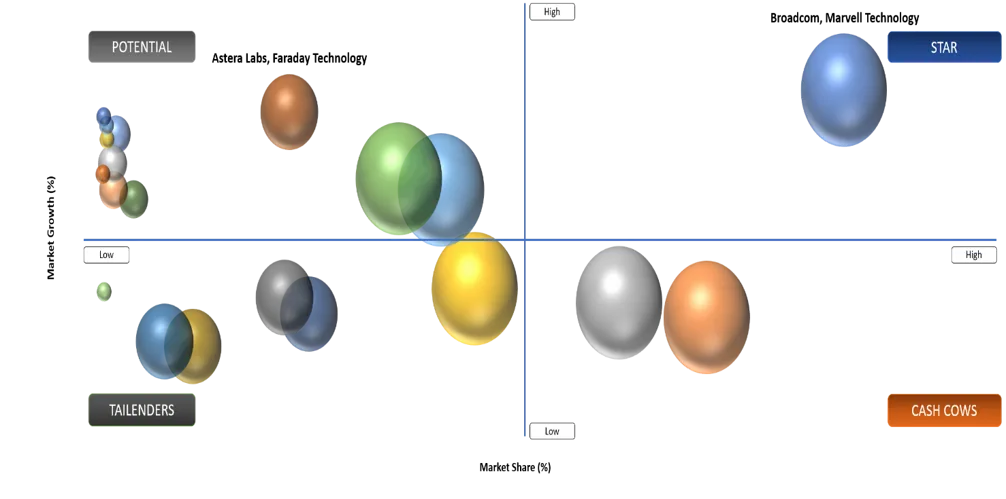
STAR
Broadcom, Marvell Technology and Credo Technology Group are classified in the Star category because of the strong involvement in high growth SerDes applications, as well as capabilities in AI infrastructure, Optical Connectivity and Ethernet Switching. Their product portfolios are increasingly aligned to 112G/224G SerDes, PAM-4 technology, retimers, optical DSPs and custom connectivity solutions due to increasing demand coming from AI data centers and 800G networking. The trends toward higher bandwidth per channel will assist those companies in developing the presence on the advanced SerDes market.
POTENTIAL
Astera Labs, Faraday Technology, Lattice Semiconductor and Semtech are categorized as Potential firms due to their involvement in high-growth SerDes applications as well as their chances for market expansion in the future. Their competence in areas such as PCIe/CXL connectivity, retimers, signal integrity solutions, SerDes IP, optical connectivity and high-speed data-center interconnect. The rise of adoption of chiplets, UCIe, UALink, AI acceleration platforms and 224G-class connectivity creates further opportunities for developing special, power-efficient and application-optimized SerDes solutions.
SerDes Market Dynamics
Driver Impact Analysis
| Driver | Market Growth Impact (%) | Demand Concentration | Impacted Use Case | Strategic Impact |
| AI & Hyperscale Data Center Expansion | 32% | North America, Asia Pacific | AI Accelerators, GPUs, Ethernet Switches, AI Servers | Drives adoption of 112G/224G high-speed SerDes and increases demand for high-bandwidth, low-latency interconnects |
| High-Speed Ethernet Adoption | 27% | North America, Asia Pacific, Europe | 400G/800G/1.6T Networking, Optical Transceivers | Accelerates migration toward higher-speed SerDes, PAM-4 signaling and advanced connectivity architectures |
| Chiplet & Die-to-Die Architecture Adoption | 23% | North America, Asia Pacific | AI/CPU/GPU Chiplets, Custom ASICs, HPC Systems | Increases demand for high-density, low-power SerDes PHYs and advanced die-to-die connectivity |
| Automotive High-Speed Networking | 18% | Europe, Asia Pacific, North America | ADAS, Cameras, Displays, Digital Cockpits | Expands SerDes deployment in vehicle architectures and increases demand for automotive-grade high-speed links |
Driver: AI and High-Speed Data-Center Infrastructure Expansion
The swift implementation of AI processors like GPUs, ASICs and fast Ethernet switches is resulting in a higher demand for high-bandwidth SerDes links. AI clusters utilize quicker links connecting processing strings, switches and optical transmitters, promoting the movement to 112G and 224G SerDes technologies and intensifying the need for PAM-4 signals, modern equalization and power-efficient PHY designs. The technique towards 800G and 1.6T networking supports further demand for SerDes solutions since the electrical solutions are needed to handle higher rates of bandwidth.
Restraint Impact Analysis
| Restraint | Drag on Market Growth (%) | Primary Impact Area | Impacted Use Case | Strategic Impact |
High Design Complexity & Signal Integrity Requirements | 30% | R&D and System Design | 112G/224G SerDes, AI Accelerators, High-Speed Switches | Increases development time, validation requirements and engineering costs |
High Power Consumption at Higher Data Rates | 25% | Power Efficiency & Thermal Management | AI/HPC Systems, Data-Center Networking | Drives demand for low-power SerDes architectures and advanced process technologies |
High Development & IP Licensing Costs | 23% | Semiconductor Development Costs | Custom ASICs, SoCs, Networking Chips | Raises entry barriers and encourages reliance on established SerDes IP suppliers |
Compatibility & Interoperability Challenges | 22% | System Integration | Chip-to-Chip, PCIe, Ethernet, CXL and Optical Interconnects | Increases qualification requirements and can slow deployment of new SerDes technologies |
Restraint: Signal Integrity and Power Constraints at Higher Data Rates
The move to higher SerDes speeds brings challenges of signal integrity, power dissipation and heat generation, especially when it comes to 112G and 224G SerDes technology. At higher speeds, channel losses, crosstalk, reflection and jitter become even more challenging and require advanced clock data recovery, equalization and retiming methods. At the same time, the growing number of lanes of SerDes in AI accelerators, networking ASICs and optical systems leads to higher power dissipation and heat generation. The requirements may increase the cost associated with design, validation and qualification of advanced SerDes technologies.
SerDes Market Segment Analysis
The global SerDes market is segmented based on the product type, data rate, signaling technology, SerDes architecture, interconnect, channel reach, interface / protocol, end use industry and region.
By Product Type
Stand-Alone SerDes Leads High-Speed Connectivity Adoption
Stand-Alone SerDes held a significant position in the global SerDes market in 2025, with about 51.4% share of the total market, as they are being used in the networking devices, data-center interlinks, fast backplane connectivity and optical connectivity. The strong market share shows the continued need for the dedicated SerDes technology which has an ability to offer flexible high-speed connectivity options across the entire spectrum of data rate and conditions of channels.
By Data Rate
Above 200 Gbps SerDes Expands Rapidly Across AI and Networking
The segment of 200 Gbps and above SerDes is expected to grow rapidly in terms of data rates, with estimates revealing an approximate CAGR of 23.0% due to the shift to 224G and next-generation higher speed architectures. The rise in AI accelerator cluster deployment, 800G and upcoming 1.6T networks, along with the PCIe/CXL connectivity and chiplet technology has invariably augmented the need for bandwidth per lane, PAM-4 innovations, equalization and retiming technology.
SerDes Market Geographical Penetration
U.S. SerDes Market Landscape
In the United States, the market for SerDes technology is largely driven by innovations related to artificial intelligence and hyperscale data center infrastructure, fast Ethernet, custom ASICS and semiconductor design technologies provided by Broadcom, Marvell, Credo, Intel, Synopsys and Cadence. The demand is increasingly becoming associated with SerDes technologies running at 112G and 224G speeds for artificial intelligence accelerators, graphics processing units, network switching chips, optical transceivers and PCIe / CXL interfaces, with the adoption of chiplets being another emerging source of demand for high-speed die-to-die physical layer interconnects. The U.S. market of SerDes technologies is also notable for investments in signal integrity, power-efficient SerDes solutions, retimers, advanced equalizers and electro-optic connectivity, making high bandwidth-per-watt a key technology consideration for next-generation computing and networking systems.
Japan SerDes Market Outlook
The Japan SerDes industry is supported by a strong demand in industries such as automotive electronics, industrial automation, semiconductor production and high-speed networking with companies such as Renesas Electronics and ROHM contributing to the domestic connectivity market. The importance of automotive comes from the fact that there is a need for high-speed links in the automobile industry in Japan due to the increasing application of ADAS cameras, display, digital cockpit and zonal/centralized architectures in vehicles produced by Japanese manufacturers. Also, the industrial equipment and machine vision systems will find the need for high-speed data transmission from sensors, controllers and processing systems. The long-established base of automotive and electronics manufacturing in Japan has resulted in the demand for automotive grade SerDes, low power design, high reliability, long distance signal transmission and future development of sophisticated high-speed technologies.
China SerDes Market Trends
SerDes market in China is becoming more and more driven by the increasing need for the deployment of AI computing, hyperscale data center, high-speed network and optical communications, along with the initiatives to develop the capability of domestic semiconductors. There is a rising demand for SerDes PHYs, retimers, AI accelerator, switch ASIC, optical transceiver and HPC systems; meanwhile, local semiconductor suppliers are designing high-speed SerDes PHYs and retimers and other connectivity products. The higher demands for the 112G/224G-class interface, power efficiency, signal integrity and advanced package are driving the product design; and the need for domestic SerDes IP and connectivity is becoming a strategic priority.
Taiwan SerDes Market Analysis
The SerDes market in Taiwan is dependent on the semiconductor foundry ecosystem, IC design, advanced packaging and electronic manufacturing ecosystem in the region, which makes Taiwan a key platform for developing and manufacturing high-speed interconnect solutions. Applications of demand include AI accelerators, networking ASICs, GPUs, high-speed Ethernet switches and optical transceivers, which involve highly advanced process nodes and chiplet designs, which require highly advanced SerDes PHYs. Taiwan’s semiconductor ecosystem also provides process-optimized 112G/224G SerDes IP, along with advanced packaging and die-to-die interconnect solutions and the seamless integration of foundries, IC design houses and systems companies enables next-generation high-speed interconnect solutions to be developed and commercialized.
SerDes Market Competitive Landscape
- Competition becomes focused on 112G and 224G SerDes functions. Different companies use PAM-4 signaling, advanced equalization, retimers, CDR performance and power efficiency as tools for differentiation in AI accelerators, Ethernet switch ASICs and optical communications.
- The industry comprises numerous competing models, such as stand-alone SerDes IC, integrated technologies and SerDes PHY IP for licensing business, which leads to competition between semiconductor vendors, communication-related businesses and EDA/IP developers.
- AI data center technology is changing the competitive landscape, where Broadcom, Marvell, Credo and other vendors are developing solutions for high-speed Ethernet networks, optical devices, integrated chips and interconnects for accelerators.
- Connectivity through chiplets and die-to-die is developing a new competitive level, as technologies like UCIe, UALink, PCIe and CXL drive the need for SerDes architecture with several essential features - low latency, high data density and low power consumption.
- Differentiation will be moving from connectivity solutions to full platforms, leveraging PHYs with retimers, signal conditioning, optical DSP and protocols, whereas automotive suppliers will be competing for high speed camera/display connectivity, functional safety and qualification.
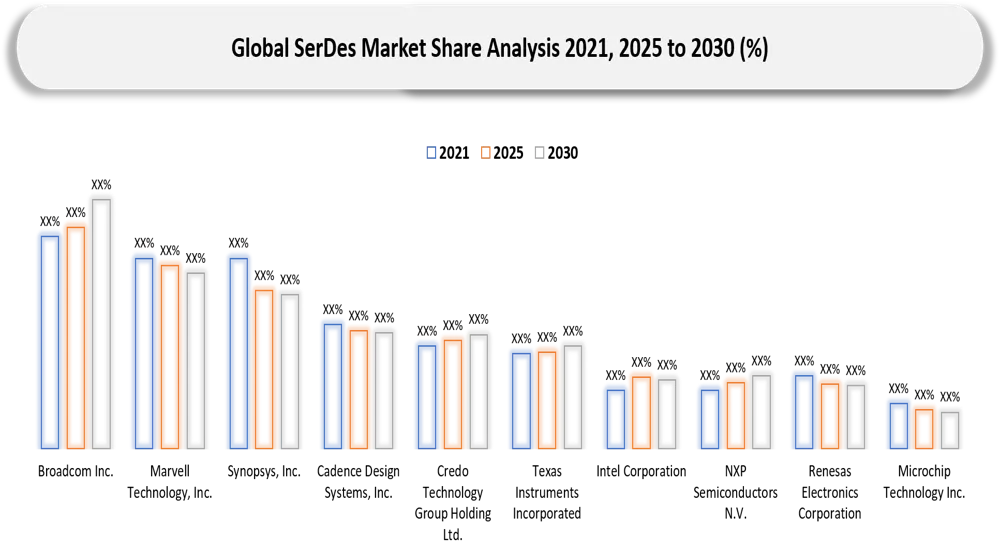
Public Company Q1-Q2 2026 Performance Comparison
The table below compares five publicly listed companies with direct or strategically relevant exposure to the SerDes market. Financial metrics are company-wide because standalone SerDes revenue is generally not separately disclosed. The performance drivers therefore distinguish overall company performance from direct SerDes and high-speed connectivity exposure.
| Company | Q1–Q2 2026 Performance | SerDes Exposure | Key Performance Driver |
| Broadcom Inc. | US$41.50 Billion revenue | High-speed SerDes embedded in AI accelerators, Ethernet switching, optical connectivity and custom ASIC platforms | AI semiconductor demand, custom accelerators and AI networking; Q1 AI semiconductor revenue reached US$8.4B and Q2 reached US$10.8B |
| Marvell Technology, Inc. | US$5.16 Billion revenue | 112G/224G-class SerDes, electro-optics, custom silicon and high-speed data-center connectivity | AI-driven data-center demand; first-half fiscal 2027 revenue increased 32.2% YoY, with data-center sales benefiting from AI demand |
| Credo Technology Group Holding Ltd. | US$479 Million latest reported Q1 FY2027 revenue | High-speed SerDes, retimers, DSPs, active electrical cables and optical interconnects supporting AI infrastructure | AI-cluster expansion and higher data rates; Q1 FY2027 revenue grew 114.7% YoY, with record retimer and optical DSP revenue |
| Astera Labs, Inc. | US$700.8 Million revenue | PCIe/CXL connectivity, retimers, AI fabric switches and signal-conditioning solutions closely linked to high-speed SerDes architectures | Rack-scale AI infrastructure and PCIe 6 connectivity; Q1 revenue was US$308.4M and Q2 reached US$392.4M, up 93% and 104% YoY, respectively |
| Semtech Corporation | US$291 Million latest reported Q1 FY2027 revenue | Signal-integrity and high-speed connectivity solutions, including data-center SerDes-related technologies and 1.6T connectivity | Data-center networking and high-speed optical/electrical connectivity; Q1 FY2027 revenue increased 16% YoY, with FiberEdge and CopperEdge 1.6T products contributing to the growth outlook |
Note: Company-level revenue should not be interpreted as SerDes revenue unless separately disclosed. Fiscal periods differ across companies; therefore, “Q1-Q2 2026” reflects the latest two-quarter/2026 reporting periods available for each company. For companies where Q2 2026 results were not yet reported by September 2026, the latest reported quarter is shown.
Key Companies of SerDes Market
- Broadcom Inc. (United States)
- Marvell Technology, Inc. (United States)
- Synopsys, Inc. (United States)
- Cadence Design Systems, Inc. (United States)
- Qualcomm Incorporated (United States)
- Credo Technology Group Holding Ltd. (United States)
- Texas Instruments Incorporated (United States)
- Intel Corporation (United States)
- Lattice Semiconductor Corporation (United States)
- Microchip Technology Inc. (United States)
- Analog Devices, Inc. (United States)
- Semtech Corporation (United States)
- Renesas Electronics Corporation (Japan)
- NXP Semiconductors N.V. (Netherlands)
- STMicroelectronics N.V. (Switzerland)
- Realtek Semiconductor Corp. (Taiwan)
- Astera Labs, Inc. (United States)
- ROHM Co., Ltd. (Japan)
- onsemi (United States)
- Faraday Technology Corporation (Taiwan)
Company Profiles of SerDes Market
Broadcom Inc.
Broadcom is a major semiconductor and connectivity firm that incorporates SerDes technology in all its Ethernet switching, AI networking, custom ASIC and optical connectivity products. The company offers high-speed connectivity solutions capable of supporting 112G and 224G SerDes for artificial intelligence infrastructure, data center switching and optical interconnects with particular focus on bandwidth per lane and switch density.
Competitive strategies in place include innovation in 224G and beyond SerDes, improvement in density of bandwidth, energy efficiency and signal integrity and incorporation of SerDes with switching, optical and custom silicon technologies. Additionally, the company is concentrating on supporting the development of AI scale-up and scale-out solutions that require high lane density and low latency.
Marvell Technology, Inc.
The firm specializes in fast connectivity and custom silicon products through SerDes technology that is used in AI infrastructure, Ethernet network, optical connectivity and cloud solutions. Marvell's product offerings feature 112G and 224G class SerDes with long reach capabilities to facilitate fast electrical connectivity in AI servers, racks and network components.
The firm is keen on extending the reach of its 224G SerDes, minimizing power dissipation and signal attenuation over electrical channels, integration of fast SerDes with custom ASIC and optical solutions and fast electrical connectivity of AI infrastructure in the context of power, latency, bandwidth density and total cost of system.
Credo Technology Group Holding Ltd.
Credo is a company that specializes in fast connectivity solutions, including SerDes, DSPs, retimers, gearboxes, active electrical cables and optical interconnects for AI and hyperscale infrastructures. Its technology offering includes SerDes up to 112G/224G per lane, providing fast connectivity for AI scale-up, scale-out and chip-to-chip interconnections.
Competitive focus areas are to develop 224G and future generation connectivity, improve energy efficiency and robustness of signals and develop SerDes technology for chiplet, memory and accelerator interconnections. Credo is developing its connectivity offering by including optical DSPs, PCIe/CXL retimers and active electrical connectivity for AI infrastructure.
Synopsys, Inc.
The SerDes offerings from Synopsys come in the form of its DesignWare SerDes and high-speed PHY IP portfolio, which are aimed at semiconductor design engineers working on SoCs for artificial intelligence, data center, networking and HPC applications. Synopsys' high-speed Ethernet PHY IP portfolio can deliver speeds up to 224 Gbps per lane with PAM-4 and NRZ protocols for chip-to-chip, chip-to-module and long reach connections.
Competitive challenges include expanding silicon proven 224G PHY IP for Ethernet, UALink, PCIe, CXL and other high-speed interconnect standards, signal integrity and power efficiency at advanced nodes and extending the company's IP portfolio into multi-die and chiplet architecture, making SerDes IP even more relevant in future AI and data center solutions.
Cadence Design Systems, Inc.
Cadence’s SerDes business is mostly built around its Design IP offerings of high-speed SerDes IP portfolio, such as 224G SerDes PHY offering for hyperscale data center AI infrastructure and high performance computing. It supports multiple configurations and data rate support for 200G, 400G, 800G and 1.6T Ethernet standards.
Cadence’s priorities in competition include providing power, performance and area optimized SerDes IP for advanced semiconductor processes and developing standards for new interconnects for AI. The company is also developing its connectivity platform with the development of UALink, UCIe, PCIe, CXL and die-to-die connectivity solutions.
Qualcomm Incorporated
Participation of Qualcomm in fast connectivity occurs through semiconductor and custom-silicon operations, with its data center product portfolio having fast SerDes, optical DSP and signal integrity. Connectivity offerings by Qualcomm cater to fast data center architecture, which includes 800G and 1.6T optical connectivity as well as fast electrical interconnects for AI infrastructures.
Competitive strengths lie in the integration of fast SerDes and custom AI silicon, optical connectivity, as well as high bandwidth density packaging and data center interconnect solutions. Higher bandwidth density, scalability up and out, high bandwidth connectivity and signal integrity are the trends in Qualcomm’s focus area.
SerDes Market Major Pain Points
- Signal integrity degradation at 112G/224G speeds: The design and validation process is complicated by the increasing difficulty of controlling channel losses, crosstalk, reflection and jitter.
- Power and thermal constraints in high-density systems: The use of multiple channels in networking switches, AI accelerators and optical systems increases the heat produced by SerDes.
- Interoperability across heterogeneous interfaces: The use of various interfaces such as PCIe, Ethernet, die-to-die and proprietary protocols add to the complexity of validation and integration.
- Specialized expertise and extended development cycles: The design of sophisticated SerDes calls for an understanding of analog/mixed-signal design, complex modeling and compliance checks, as well as an in-depth assessment of the actual system.
- Rising cost of advanced SerDes implementation: The use of advanced process nodes, packaging and semiconductor intellectual property along with testing and signal integrity verification leads to increased development and implementation expenses.
SerDes Market Recent Developments
- Marvell Technology, Inc. - September 2026: Marvell demonstrated 2nm optical interconnect solutions for AI data centers which include 400G/lane optical PAM-4, 800G pluggable and 1.6T optical solutions. Moreover, Marvell is demonstrating its wide range of solutions which includes 224G SerDes and 1.6T optics solutions aimed at providing increased bandwidth density and reduced power consumption in AI infrastructure.
- Qualcomm Incorporated - September 2026: Qualcomm made an announcement regarding the multi-generation partnership with Amazon for customized AI data-center silicon and high-bandwidth optical solutions up to 1.6T. Qualcomm is particularly leveraging its SerDes and optical DSP solutions for this purpose.
- Credo Technology Group Holding Ltd. - September 2026: Credo announced its release of a 1.6T ZeroFlap optical transceiver series based on 224G technology, using a combination of a 224G optical DSP and its Kfir200 silicon-photonics PIC. The new devices were designed for AI scale-out networks and are extensions to Credo's family of SerDes-based connectivity devices.
- Astera Labs, Inc. - August 2026: Astera Labs extended its portfolio of Taurus signal-conditioning devices by offering 3.2T Smart Retimers and Redrivers for 224G Ethernet and UALink as well as 200G/lane SerDes diagnostics and 1.6T Smart Ethernet Retimers for AI rack-scale connectivity.
- Synopsys, Inc. - July 2026: Synopsys extended its collaboration with Intel Foundry for Intel 14A and is now offering interface IPs like 224G SerDes, PCIe 7.0, USB4 and eUSB for new generations of AI and HPC chips. This is beneficial for Synopsys' presence in SerDes IPs.
Analyst View / Opinion on SerDes Market
- AI infrastructure is becoming a major demand driver: There is a notable demand for technology such as AI accelerators, GPUs and high-speed Ethernet switches, resulting in an increasing requirement for 112G and 224G SerDes architecture.
- Bandwidth-per-watt is becoming a critical design metric: As the number of lanes increases, power consumption, thermal loading and signal integrity become as important as throughput performance in the selection of SerDes.
- SerDes IP is gaining strategic importance in custom silicon: The growth of AI-specific application processor ICs and chiplets has led to increased interest in SerDes PHY IPs that can be incorporated in custom silicon platforms.
- Electrical SerDes and optical connectivity are increasingly converging: The extension of 800G and the introduction of 1.6T networking have underscored the significance of SerDes in the connection of switch ASICs, optical DSPs and transceiver components.
- Automotive is expanding the addressable SerDes opportunity: The development of centralized and zonal architectures of the vehicles allows for the SerDes applications to be implemented in ADAS, the use of high-resolution cameras, displays and digital cockpits.
Target Audience of SerDes Market
| INDUSTRY | WHO SHOULD BUY THIS REPORT? | REASON TO BUY THIS REPORT |
| Semiconductor & IC Manufacturers | SerDes IC, PHY, ASIC, FPGA and SoC manufacturers | Assess market size, data-rate trends, competitive positioning and technology opportunities |
| SerDes IP Providers | SerDes PHY/IP developers and licensing companies | Identify demand for 112G/224G-class IP, protocol requirements and customer opportunities |
| Data Center, AI & HPC Infrastructure | Hyperscalers, cloud providers, AI accelerator and HPC system developers | Evaluate high-speed interconnect demand driven by AI servers, GPUs, accelerators and high-performance computing |
| Networking & Telecom Equipment | Switch, router, optical networking and telecom equipment manufacturers | Analyze Ethernet speed transitions, SerDes requirements and high-speed connectivity opportunities |
| Automotive Electronics | Automotive OEMs, Tier-1 suppliers and ADAS/electronics manufacturers | Assess adoption of automotive SerDes for cameras, displays, ADAS and zonal architectures |
| Optical Communication | Optical transceiver, DSP and fiber-optic equipment manufacturers | Identify demand from 400G, 800G and emerging 1.6T optical connectivity |
| Consumer Electronics | PC, display, gaming and consumer-device manufacturers | Evaluate demand for high-speed interfaces and next-generation connectivity |
| Industrial Electronics | Industrial automation, robotics and machine-vision companies | Assess opportunities for high-speed data transmission in industrial systems |
| Investors & Private Equity Firms | Technology-focused investors and PE firms | Evaluate market growth, competitive landscape, investment opportunities and technology trends |
| Semiconductor Technology Suppliers | Foundries, EDA, testing and semiconductor technology suppliers | Understand SerDes technology adoption, process-node trends and future semiconductor demand |
Why Choose DATAM?
- Data-Driven insights: Dive into detailed analyses with granular insights such as pricing, market shares and value chain evaluations, enriched by interviews with industry leaders and disruptors.
- Post-Purchase Support and Expert Analyst Consultations: As a valued client, gain direct access to our expert analysts for personalized advice and strategic guidance, tailored to your specific needs and challenges.
- White Papers and Case Studies: Benefit quarterly from our in-depth studies related to your purchased titles, tailored to refine your operational and marketing strategies for maximum impact.
- Annual Updates on Purchased Reports: As an existing customer, enjoy the privilege of annual updates to your reports, ensuring you stay abreast of the latest market insights and technological advancements. Terms and conditions apply.
- Specialized Focus on Emerging Markets: DataM differentiates itself by delivering in-depth, specialized insights specifically for emerging markets, rather than offering generalized geographic overviews. The approach equips our clients with a nuanced understanding and actionable intelligence that are essential for navigating and succeeding in high-growth regions.
- Value of DataM Reports: Our reports offer specialized insights tailored to the latest trends and specific business inquiries. The personalized approach provides a deeper, strategic perspective, ensuring you receive the precise information necessary to make informed decisions. The insights complement and go beyond what is typically available in generic databases.
What DATAM Uniquely Provides
- SerDes Technology & Data-Rate Mapping: Comprehensive study of NRZ, PAM-4, rate applications, protocols and other features with reference to the emerging fast rates of SerDes.
- AI Infrastructure SerDes Demand Intelligence: Review of SerDes needs for GPUs, AI accelerators, customized ASICs, Ethernet switches and optical transceivers relating to the requirement of bandwidth, latency and power efficiency.
- Protocol-Level Market Opportunity Mapping: In-depth review of Ethernet, PCIe, CXL, InfiniBand, MIPI and automotive SerDes interfaces in order to find out specifics of demand per application.
- Competitive Capability Benchmarking: Comparison of top SerDes firms based on such variety of factors as data rate capabilities, SerDes PHY/IP portfolio, signaling technologies, targeted applications and connectivity solutions.
- White-Space & Investment Opportunity Identification: Identification of emerging markets for opportunities related to 224G SerDes application, chiplet/die-to-die connection, AI retimers, 800G/1.6T optical framework and zonal architecture of automotive vehicles.


























































