


Semiconductor Vacuum Pump Market Size and Overview
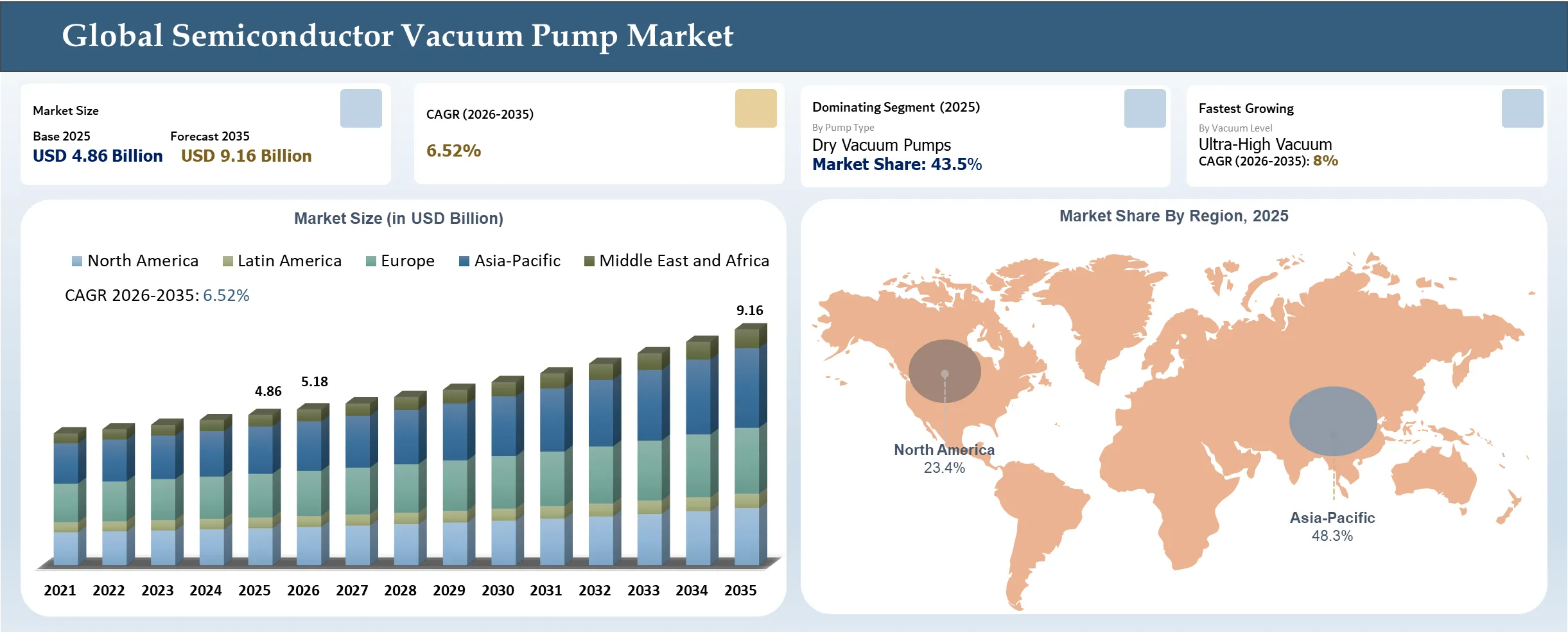
The global semiconductor vacuum pump market reached USD 4.86 billion in 2025 and is expected to reach USD 9.16 billion by 2035, growing with a CAGR of 6.52% during the forecast period 2026-2035. The market is experiencing sustained growth as semiconductor manufacturers increase investment in wafer-fabrication capacity and advanced process technologies that require stable, contamination-controlled vacuum environments. According to SEMI, global semiconductor equipment billings reached USD 135.1 billion by 2025, up 15% year-on-year, while wafer processing equipment sales grew 12%.
The expansion of semiconductor vacuum pump remanufacturing and local service infrastructure is also supporting the market. In November 2025, according to the Vacuum Equipment Branch of the China General Machinery Industry Association, EDWARDS, which was acquired by Atlas Copco in 2014, is setting up a semiconductor vacuum pump remanufacturing facility in Wuhan's Optics Valley and is expected to start its operations in Q2 2026.
The source indicates that EDWARDS commands around 80% market share in the global semiconductor vacuum pumps market and has even established relationships with Wuhan Xinxin Semiconductor Manufacturing and Tianma Microelectronics. Optics Valley is home to more than 300 semiconductor companies, whose semiconductor industry is valued at around RMB 80 billion (USD 11.93 billion) in 2024 and is forecast to cross RMB 100 billion (USD 14.92 billion) in 2025.
White-Space Opportunities for Semiconductor Vacuum Pump Market - Domestic Semiconductor Manufacturing Capacity Expansion
In January 2025, the U.S. Department of Commerce, through the CHIPS Incentives Program, announced up to USD 311 million in direct funding across Edwards Vacuum, Corning, Infinera, and GlobalFoundries, creating opportunities across the semiconductor manufacturing and equipment supply chain. The highest individual investment is USD 93 million for Infinera, supporting a new semiconductor fabrication facility in San Jose, California, and an advanced test and packaging facility in Bethlehem, Pennsylvania, with the investment expected to increase its domestic manufacturing capacity by approximately 10 times.
For the semiconductor vacuum pump market, the most directly relevant investment is up to USD 18 million for Edwards Vacuum to construct a new manufacturing facility in Genesee County, New York, specifically for dry vacuum pumps required in semiconductor production.
The investments create opportunities across several semiconductor technology areas, with semiconductor fabrication, advanced packaging, photonics, lithography materials, and semiconductor manufacturing equipment generating demand across the supply chain. In the vacuum-equipment area, Edwards Vacuum benefits from expanded domestic production of dry vacuum pumps used to maintain semiconductor processing environments, while companies such as Pfeiffer Vacuum, ULVAC, Busch Vacuum Solutions, and Ebara Corporation can benefit from broader demand for semiconductor vacuum systems and related equipment.
In advanced semiconductor fabrication and packaging, companies such as Applied Materials, Lam Research, KLA, ASMPT, and BESI can benefit from increased requirements for wafer-processing, inspection, deposition, etching, and packaging equipment. In the photonic semiconductor and optical-component area, Coherent, Lumentum, ams-OSRAM, and MACOM Technology Solutions can benefit from expanding demand for photonic integrated circuits and optical semiconductor components.
Semiconductor Vacuum Pump Market Key Takeaways
- Asia-Pacific dominated the market with a 48.3% share in 2025, driven by major fabrication bases in China, Taiwan, South Korea, and Japan. North America is positioned as the fastest-growing region owing to expanding local capacity.
- The dry vacuum pumps segment held a leading 43.5% market share in 2025 due to strong demand for oil-free operation. Pumping systems are essential across semiconductor processes like chemical vapour deposition and etching.
- High-NA EUV lithography systems manufactured by ASML carry an approximate price tag of USD 400 million each. Demand remains strong as current USD 200 million EUV tools are nearly sold out through 2027.
- Under the U.S. CHIPS Incentives Program, up to USD 311 million in direct funding was announced in January 2025 across multiple industry leaders. It includes up to USD 18 million allocated to Edwards Vacuum for a dry vacuum pump facility in Genesee County, NY.
Semiconductor Vacuum Pump Market Industry Trends and Strategic Insight
- Transition toward high-flow, contamination-resistant dry pumps. Advanced ALD, CVD, and etching processes are pushing manufacturers toward dry pumps capable of handling higher gas loads while resisting process by-product accumulation.
- Acceleration of AI-enabled predictive maintenance. Vacuum-pump suppliers are integrating equipment data, sensors, edge analytics, and AI to identify abnormal operating conditions before failures affect semiconductor production.
- Greater emphasis on energy-efficient pumping. Semiconductor fabs are increasingly evaluating pumps based on energy consumption, operating efficiency, and total cost of ownership, encouraging development of optimised dry and multi-stage pumping architectures.
- Localisation of vacuum-pump manufacturing and services is gaining strategic importance. Semiconductor manufacturers and equipment suppliers are strengthening regional production, refurbishment, and technical-support capabilities to reduce dependence on long global supply chains.
- Sustainability is moving beyond energy efficiency toward resource optimisation. New vacuum solutions are increasingly designed to reduce electricity, nitrogen, water, and emissions associated with sub-fab operations rather than optimising pump performance alone.
Semiconductor Vacuum Pump Market Scope
| Metrics | Details | |
| 2025 Market Size | USD 4.86 Billion | |
| 2035 Projected Market Size | USD 9.16 Billion | |
| CAGR (2026-2035) | 6.52% | |
| Largest Market | Asia-Pacific | |
| Fastest Growing Market | North America | |
| By Pump Type | Dry Vacuum Pumps, Turbo Molecular Pumps, Cryogenic Pumps, Scroll Pumps, Other Vacuum Pumps | |
| By Vacuum Level | Low Vacuum, Medium Vacuum, High Vacuum, Ultra-High Vacuum | |
| By Application | Etching, Deposition (CVD, PVD, ALD), Lithography, Ion Implantation, Metrology & Inspection, Others | |
| By End User | Integrated Device Manufacturers (IDMs), Foundries, Semiconductor Equipment OEMs, Others | |
| By Region | North America | U.S., Canada, Mexico |
| Europe | Germany, UK, France, Spain, Italy, Poland, Netherlands, Switzerland | |
| Asia-Pacific | China, India, Japan, Australia, South Korea, Indonesia, Malaysia | |
| Latin America | Brazil, Argentina | |
| Middle East and Africa | UAE, Saudi Arabia, South Africa, Israel, Türkiye | |
| Report Insights Covered | Competitive Landscape Analysis, Company Profile Analysis, Market Size, Share, Growth | |
Semiconductor Vacuum Pump Market Disruption Analysis
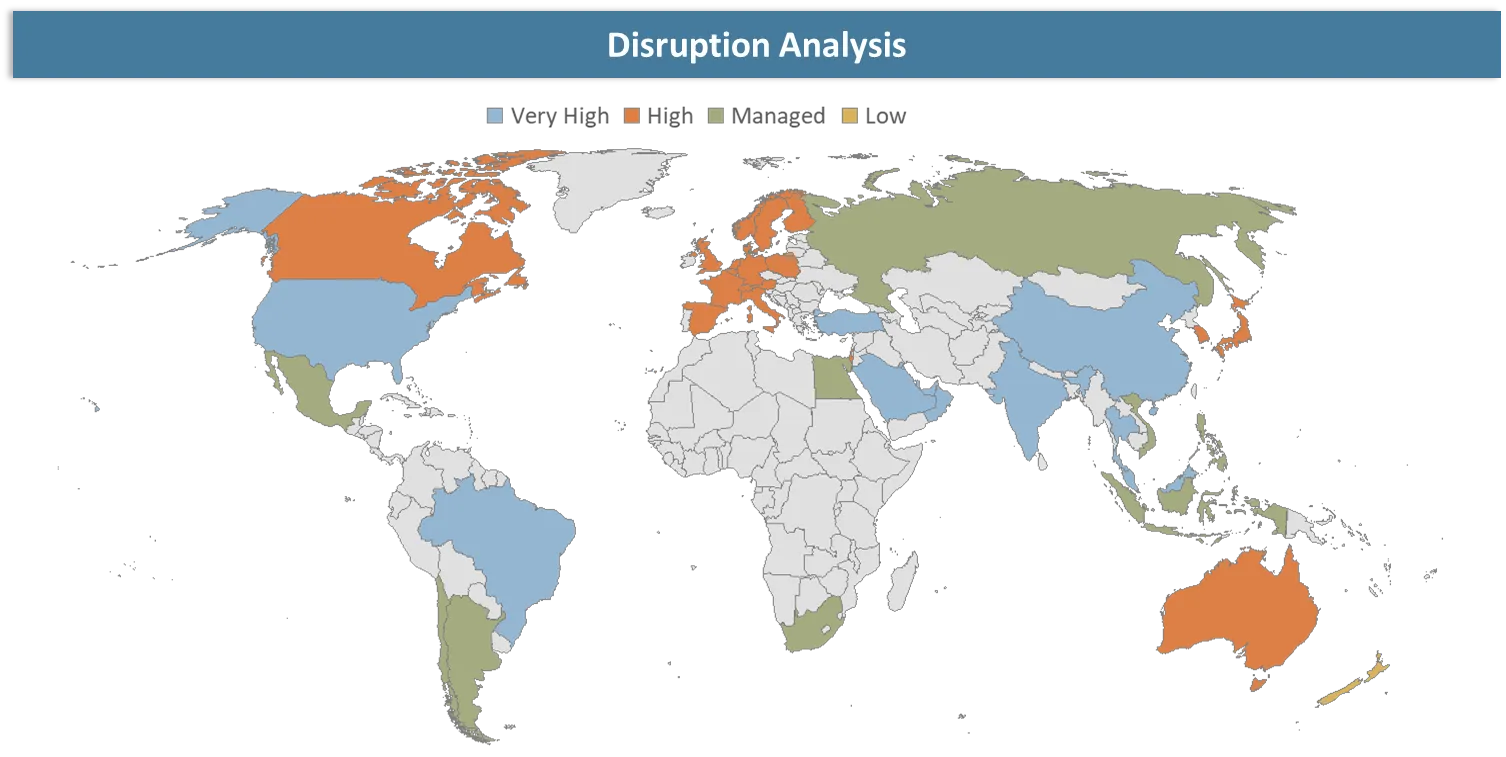
Shift Toward Intelligent, Energy-Efficient and High-Performance Dry Vacuum Pumping Systems Reshaping Semiconductor Vacuum Infrastructure
The disruptor in the semiconductor vacuum pump market is primarily associated with the rapid transition from conventional vacuum equipment toward advanced dry, energy-efficient, contamination-resistant, and process-specific pumping technologies. Fabrication of semiconductors is becoming more and more challenging; therefore, the pumps used in this industry need to be able to operate under difficult conditions with corrosive gases, high gas flows, powders, and process waste products.
The disruption is further fueled by the development of the next generation of dry pumps that incorporate energy efficiency, process robustness, and intelligent monitoring. According to Edwards Vacuum, the company introduced its Ganymede harsh-duty dry vacuum pump family platform with higher energy efficiency, sensor monitoring and enhanced powder handling capabilities. According to the company, there is a significant saving of energy up to 60%, 40% less process cooling water, 25% less nitrogen use, and 30% less space footprint as compared to the previous generation of the iXH platform.
Semiconductor Vacuum Pump Market BCG Matrix: Company Evaluation
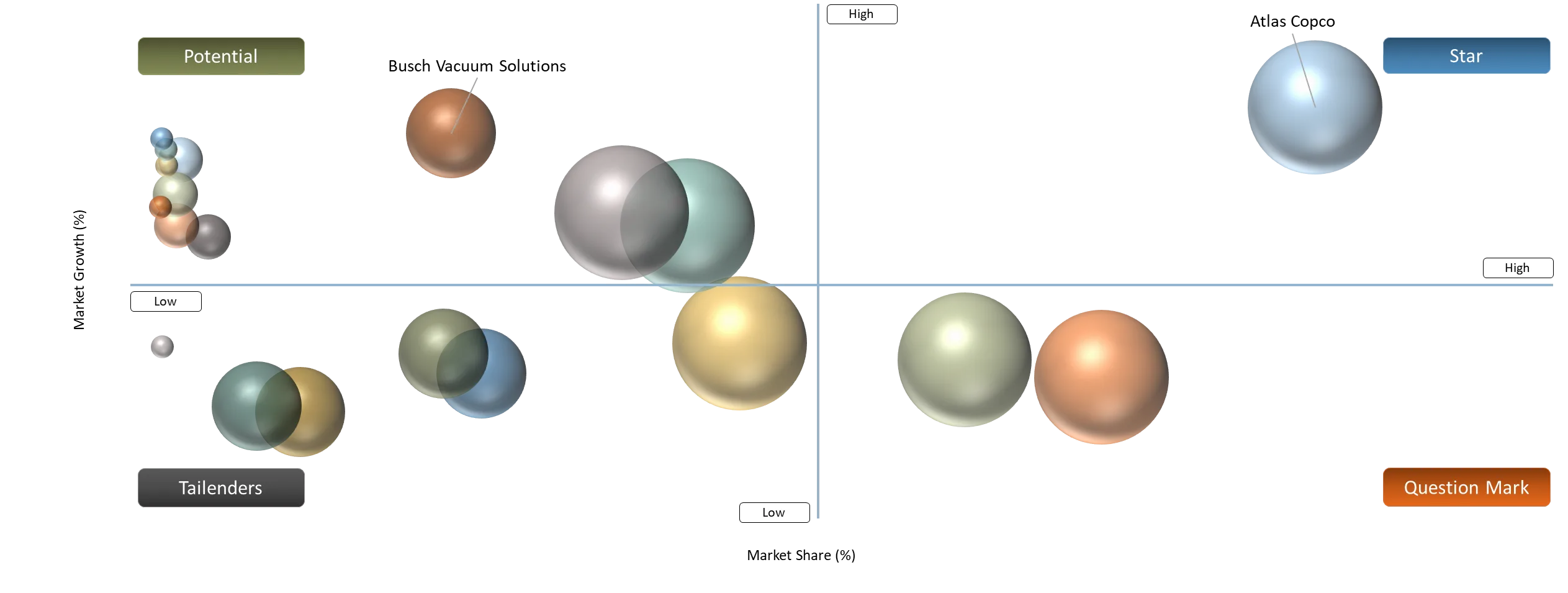
Stars include Atlas Copco, Ebara Corporation, and ULVAC, Inc., as these companies have strong positions in semiconductor vacuum technologies and benefit from growing demand for dry vacuum pumps, advanced process equipment, and integrated vacuum solutions. Question Marks include Pfeiffer Vacuum, Kashiyama Industries, and Leybold GmbH because they possess established vacuum technologies and semiconductor applications but face strong competition from the leading suppliers in semiconductor-specific pumping solutions.
Potential includes Busch Vacuum Solutions, Osaka Vacuum, and Taiko Kikai Industries Co., Ltd. These companies benefit from the increasing adoption of oil-free and dry vacuum technologies and the broader expansion of semiconductor manufacturing capacity. Tailenders include LOTVACUUM Co., Ltd., whose semiconductor vacuum activities are more concentrated geographically and remain smaller in scale compared with the major global suppliers.
Semiconductor Vacuum Pump Market Dynamics
Driver Impact Analysis
| Driver | Market Growth Impact (%) | Demand Concentration | Impacted Use Case | Strategic Impact |
Rising adoption of EUV and next-generation lithography is supporting demand for ultra-high-vacuum systems and associated pumping technologies. | 22% | East Asia, particularly Taiwan, South Korea and Japan; North America | EUV/High-NA EUV lithography, wafer fabrication, ultra-high-vacuum environments, hydrogen handling and exhaust management | Drives demand for high-performance dry pumps, integrated EUV sub-fab systems, hydrogen-management capabilities, high reliability and predictive maintenance. |
Expansion of semiconductor fabrication capacity is increasing demand for vacuum pumps across wafer-processing and fabrication facilities. | 26% | Asia Pacific, North America and Europe | New fabs, wafer-processing equipment, deposition, etching, load-lock and wafer-transfer systems | Expands the installed base of vacuum pumps and creates recurring demand for equipment, replacement pumps, spare parts, refurbishment and service contracts. |
Growing AI, HPC, and advanced-memory chip demand is accelerating investment in semiconductor manufacturing equipment, supporting vacuum-pump requirements. | 24% | Taiwan, South Korea, United States and Japan | AI processors, GPUs, HBM, advanced DRAM, logic and high-performance semiconductor manufacturing | Increases demand for high-throughput and highly reliable pumps capable of supporting intensive deposition and etching processes while minimizing production downtime. |
Migration toward advanced semiconductor nodes such as 3 nm and GAA architectures is increasing the need for highly precise and stable vacuum environments. | 20% | Taiwan, South Korea and United States | Advanced-node logic, GAA transistor fabrication, ALD, CVD, etching and wafer processing | Favors process-specific dry vacuum pumps with tighter pressure control, higher chemical resistance, lower contamination and greater operational stability. |
Rising adoption of EUV and next-generation lithography is supporting demand for ultra-high-vacuum systems and associated pumping technologies
The rapid adoption of EUV and next-generation lithography technology is becoming a key driver for the semiconductor vacuum pump market, as modern lithography processes need a highly controlled vacuum environment to ensure process stability and contamination control. With the move towards smaller process nodes as well as development of AI, HPC and memory chips, the technological demands from the semiconductor manufacturing equipment have grown. As the chip makers move towards High-NA EUV technology, the importance of vacuum infrastructure has increased significantly since modern lithography equipment needs specialised pumping technology.
In parallel, the adoption of High-NA EUV by customers is progressing rapidly, thus generating demand for infrastructure that supports ultra-high-vacuum. In September 2026, according to the Reuters, the current EUV tools supplied by ASML at a price tag of about USD 200 million are sold out almost until 2027, but at the same time the customers have already ordered next generation of ASML's High-NA EUV systems at a cost of approximately USD 400 million each. High-NA EUV can print features that are approximately 40% smaller than features printed by traditional EUV systems. TSMC will employ High-NA EUV from 2030, whereas Samsung and SK Hynix will start utilising this technology from 2028; already, Intel has processed over one million wafers using High-NA EUV.
Restraint Impact Analysis
| Restraint | Drag on Market Growth (%) | Primary Impact Area | Impacted Use Case | Strategic Impact |
Increasing complexity of advanced semiconductor processes requires pumps to withstand harsher chemistries, higher temperatures, and greater powder loads. | 22% | Pump durability, maintenance, process reliability | CVD, ALD, PVD, etching, advanced deposition | Drives investment in corrosion-resistant materials, powder-management systems, thermal control, and process-specific pump designs, increasing equipment and lifecycle costs. |
High energy consumption of vacuum pumps increases semiconductor fab operating costs and creates pressure to adopt more energy-efficient alternatives. | 19% | Fab operating expenditure and energy efficiency | Continuous vacuum operation, dry-pump systems, sub-fab infrastructure | Accelerates replacement of conventional pumps with energy-efficient dry pumps, variable-speed systems, and intelligent power-management technologies. |
High maintenance and pump replacement costs can constrain adoption, particularly because semiconductor fabs operate large numbers of pumps continuously. | 18% | Maintenance expenditure, uptime and total cost of ownership | Fab vacuum infrastructure, preventive maintenance, pump refurbishment | Increases demand for predictive maintenance, remanufacturing, longer-life components and service contracts while raising the importance of lifecycle cost in procurement decisions. |
Corrosive gases and reactive process by-products can degrade pump components, increasing maintenance requirements and reducing equipment service life. | 17% | Component reliability, service life and contamination control | Etching, CVD, ALD and other harsh-duty process exhaust applications | Encourages adoption of corrosion-resistant coatings, advanced materials, purge systems and specialized exhaust-management technologies, while increasing differentiation among pump suppliers. |
Increasing complexity of advanced semiconductor processes requires pumps to withstand harsher chemistries, higher temperatures, and greater powder loads
One of the major restraints affecting the semiconductor vacuum pump market is the growing intricacy of advanced semiconductor processes, which entails pumps having to endure increasingly corrosive chemistries, elevated temperatures, condensable side products, and increased powder loads. Such advanced semiconductor processes as chemical vapor deposition (CVD), atomic layer deposition (ALD), physical vapor deposition (PVD), etching, and advanced deposition produce highly problematic process materials that pose risks to corrosion, particle buildup, deposition, and diminished performance of traditional vacuum pumps.
In addition, the development of more robust vacuum technology systems indicates the increased engineering standards required in modern semiconductor fabrication. In February 2026, according to Pfeiffer Vacuum+Fab Solutions, its UltiDry multi-stage Roots vacuum pumps are resistant to corrosive gases, aggressive by-products, and high powder loads in a temperature range of 50°C to 270°C. The company has achieved an energy saving rate of up to 87% in comparison with other similar vacuum pumps while using its patented purging injection technique to clear any powder or contaminant from the pump. The UltiDry vacuum pumps are suitable for use in CVD, ALD, and PVD processes.
Semiconductor Vacuum Pump Market Segment Analysis
The global semiconductor vacuum pump market is segmented based on pump type, vacuum level, application, end user, and region.
Dry Vacuum Pumps Driving Dominance Through Clean, Energy-Efficient and High-Performance Semiconductor Processing
The dry vacuum pumps segment dominates the semiconductor vacuum pump market, with a market share of 43.5% in 2025. It is aided in its dominance by the rising need for oil-free vacuum production in semiconductor manufacturing, which requires clean processing, uninterrupted vacuum production, and process gas compatibility. Additionally, the rising adoption of dry pumps in etching and deposition processes increases their significance owing to the need for vacuum production without increased energy requirements.
In May 2025, according to ULVAC, Inc., the semiconductor and electronics market is forecasted to have a total size of USD 1 trillion in 2030 due to growth in data centres, AI, EVs, digital transformation, and green transformation. Among those areas that ULVAC is contributing to as part of its expanding semiconductor and electronics manufacturing equipment and peripheral equipment, dry pumps and cryopumps can be highlighted. Additionally, it can be mentioned that ULVAC expects a large development of its AI-related semiconductor business, where orders in the memory business should increase 3.6 times up to FY2031/6 in comparison with FY2025/6, whereas orders in the logic/foundry and packaging businesses are expected to increase by 2.4 times and 2.2 times, respectively.
Semiconductor Vacuum Pump Market Geographical Penetration
Rapid Semiconductor Capacity Expansion and AI-Driven Manufacturing Investment in Asia-Pacific
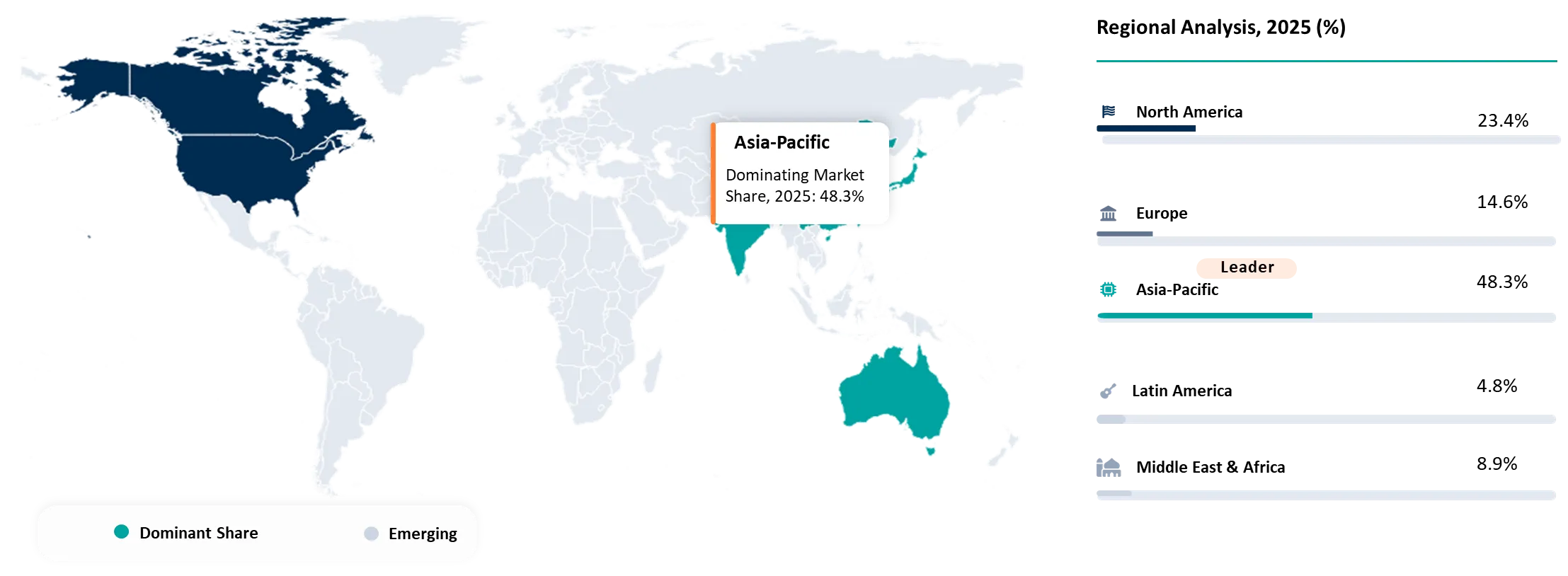
The Asia-Pacific region dominates the semiconductor vacuum pump market, accounting for 48.3% of the global market in 2025. The region maintains its leading position because it contains the world's largest concentration of semiconductor fabrication capacity, particularly across China, Taiwan, South Korea, and Japan. The combination of leading-edge foundries, memory manufacturers, mature-node fabs, and semiconductor equipment ecosystems creates substantial demand for vacuum infrastructure used in wafer processing, deposition, etching, and other fabrication operations.
China is strengthening its domestic semiconductor equipment ecosystem by attracting localised manufacturing of high-end vacuum technologies. In November 2025, LOT Vacuum Co., Ltd., a South Korea-based semiconductor vacuum-equipment manufacturer specialising in dry vacuum pumps, signed an agreement to establish a manufacturing project in Xi’an High-Tech Zone, China, with approximately RMB 50 million (USD 7.5 million) planned for Phase I. The facility will serve as an R&D, design, manufacturing, and repair base for semiconductor vacuum pumps, with planned production of approximately 150 high-end semiconductor vacuum pumps per month, expected annual additional output of at least RMB 250 million (USD 37.3 million), and around 100 new jobs.
China Semiconductor Vacuum Pump Market Trends
China holds a dominant position in the Asia-Pacific semiconductor vacuum pump market, supported by its large semiconductor manufacturing base, extensive wafer-fabrication capacity, growing domestic semiconductor-equipment ecosystem, and continued localisation of chip production. The country’s concentration of foundries, memory manufacturers, semiconductor equipment suppliers, and supporting component companies creates a broad installed base for vacuum systems used in etching, deposition, lithography, and other wafer-processing applications.
China is accelerating the localisation of high-end semiconductor vacuum technologies to reduce reliance on imported critical equipment. In December 2025, Huayuan Holdings Co., Ltd., a China-based semiconductor and industrial equipment company, established Suzhou Zhiyuan Vacuum Technology Co., Ltd. with Shanghai Zhiding Trading Co., Ltd., a China-based vacuum-equipment service and technology company, to enter the semiconductor molecular-pump market. The joint venture has RMB 50 million (USD 7.0 million) registered capital, with Huayuan Semiconductor contributing RMB 25.5 million (USD 3.80 million) for a 51% stake and Shanghai Zhiding contributing RMB 24.5 million (USD 3.65 million) for 49%.
Japan Semiconductor Vacuum Pump Market Outlook
Japan is a major country in the Asia-Pacific semiconductor vacuum pump market due to its established semiconductor manufacturing ecosystem, strong vacuum-technology capabilities, advanced equipment industry, and government-supported efforts to rebuild domestic semiconductor production. The country has a long-standing presence in semiconductor equipment and vacuum technologies, supported by manufacturers such as ULVAC, which provides vacuum equipment and related technologies for semiconductor and electronics applications.
Japan is advancing next-generation vacuum technologies to support higher-performance and more demanding semiconductor manufacturing processes. In December 2025, EBARA Corporation, a Japan-based manufacturer of semiconductor manufacturing and vacuum equipment, announced the new EV-H dry vacuum pump and ELF plasma abatement system, with mass production and sequential release planned from 2026. The EV-H is designed for semiconductor ALD and CVD deposition equipment, offering higher gas-flow handling and improved resistance to process by-products, while planned digital functions include failure prediction and utility-consumption monitoring.
Strong Semiconductor Manufacturing Investment and Advanced Fab Expansion in North America
North America is the fastest-growing region in the semiconductor vacuum pump market, supported by the region’s expanding semiconductor manufacturing capacity, strong presence of leading chip manufacturers and equipment suppliers, and increasing efforts to localise semiconductor production. The combination of advanced foundries, memory fabs, AI-chip manufacturing, and semiconductor equipment infrastructure is generating demand for reliable vacuum systems used in deposition, etching, lithography, wafer handling, and other fabrication processes.
The U.S. semiconductor supply chain is expanding its localised high-vacuum infrastructure to support increasingly stringent contamination and process-control requirements. In September 2026, DM Vacuumsystems USA, LLC, a U.S.-based high-vacuum technology and testing company, established a new operation in Oxford, Connecticut, through a partnership with D&M Vacuumsystemen B.V., a Netherlands-based high-vacuum systems manufacturer founded in 1992. The facility serves as a U.S. hub for residual gas analysis, ultra-high-vacuum compatibility testing, contamination-control testing, sales, and service for the semiconductor industry.
U.S. Semiconductor Vacuum Pump Market Trends
The U.S. is a dominant country in the North American semiconductor vacuum pump market, supported by its advanced semiconductor manufacturing ecosystem, strong presence of leading-edge foundries and integrated device manufacturers, and increasing investment in domestic chip-production capacity. The country combines semiconductor fabrication, equipment manufacturing, process-technology development, and a large base of AI and high-performance computing customers, creating sustained demand for high-performance vacuum systems used in etching, deposition, lithography, and other wafer-processing applications.
The expansion of semiconductor manufacturing in the U.S. is increasing demand for localised vacuum equipment maintenance and specialised service capabilities. In August 2025, Busch Vacuum Solutions, part of the Busch Group, a Germany-based vacuum technology and equipment manufacturer, announced the development of a nearly 60,000-square-foot service centre in Tempe, Arizona, U.S. The facility, which opened in October 2025, provides repair, servicing, and overhaul of vacuum pumps, vacuum systems, turbomolecular pumps, leak detectors, valves, and accessories, supporting semiconductor and other high-technology industries across the U.S.
Semiconductor Vacuum Pump Market Competitive Landscape
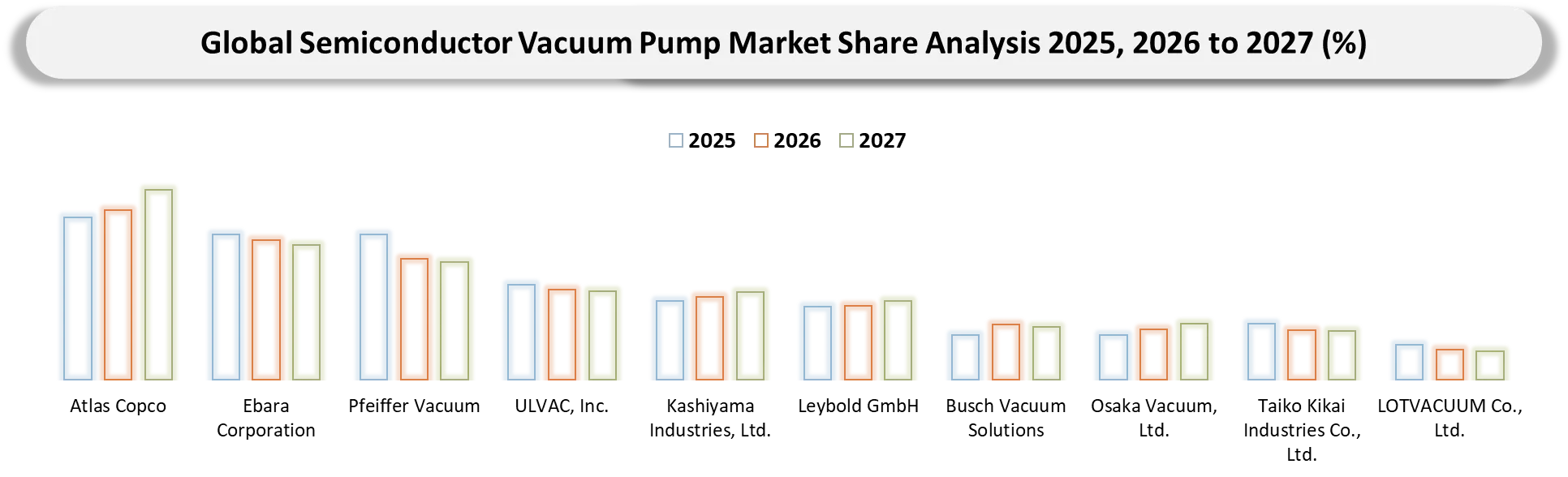
- The semiconductor vacuum pump market is characterised by a highly competitive ecosystem comprising global vacuum-technology manufacturers, semiconductor-focused vacuum specialists, and established industrial pump suppliers. Atlas Copco, Ebara Corporation, Pfeiffer Vacuum, ULVAC, Inc., Kashiyama Industries, Ltd., Leybold GmbH, Busch Vacuum Solutions, Osaka Vacuum, Ltd., Taiko Kikai Industries Co., Ltd., and LOTVACUUM Co., Ltd. compete across dry vacuum pumps, turbomolecular pumps, cryogenic pumps, and other vacuum technologies used in semiconductor fabrication. Competitive differentiation is increasingly driven by pump reliability, contamination control, corrosion resistance, energy efficiency, powder-handling capability, process compatibility, and localised technical support. The expansion of advanced-node, memory, AI, and high-performance semiconductor manufacturing is also encouraging suppliers to develop process-specific vacuum solutions and stronger lifecycle-service capabilities.
- Key players include Atlas Copco (Sweden), Ebara Corporation (Japan), Pfeiffer Vacuum (Germany), ULVAC, Inc. (Japan), Kashiyama Industries, Ltd. (Japan), Leybold GmbH (Germany), Busch Vacuum Solutions (Germany), Osaka Vacuum, Ltd. (Japan), Taiko Kikai Industries Co., Ltd. (Japan), and LOTVACUUM Co., Ltd. (South Korea).
Key Developments
- January 2026: Pfeiffer Vacuum+Fab Solutions, a Germany-based vacuum technology and semiconductor equipment manufacturer and member of the Busch Group, announced its participation in SEMICON Korea 2026 in Seoul, South Korea, where it showcased advanced vacuum solutions for semiconductor manufacturing.
- February 2026: Bestech Co., Ltd., a South Korea-based vacuum-pump and vacuum-equipment manufacturer, unveiled a new semiconductor dry vacuum pump for semiconductor manufacturing applications.
- May 2025: LOT Vacuum Co., Ltd., a South Korea-based semiconductor vacuum-pump manufacturer, completed the absorption merger of its subsidiary LOTTS Co., Ltd., a vacuum-pump repair and service company, with LOTTS ceasing to exist as a separate entity.
- July 2025: Atlas Copco Holding China Co., Ltd., the Chinese investment subsidiary of Atlas Copco AB, a Sweden-based industrial technology and vacuum-solutions manufacturer, agreed to acquire a 70% stake in Shanghai Shareway Environment Technology Co., Ltd., a China-based semiconductor and environmental equipment manufacturer.
Key Procurement Priorities and Buyer Evaluation Criteria
- Organisations investing in the Semiconductor Vacuum Pump Market increasingly select suppliers based on their ability to provide high-performance vacuum pumps that deliver stable pressure control, low contamination, high reliability, and compatibility with demanding semiconductor manufacturing processes.
- The procurement decision-making process is increasingly influenced by the growing adoption of advanced semiconductor nodes, AI and HPC chips, HBM, 3D NAND, and advanced packaging, which require vacuum systems capable of supporting complex deposition, etching, lithography, and other wafer-processing operations.
- Buyers consider factors such as pump reliability, vacuum performance, contamination control, corrosion resistance, powder-handling capability, energy efficiency, maintenance requirements, operating life, and total cost of ownership when selecting semiconductor vacuum-pump suppliers.
Why Choose DataM?
- Technological Innovations: Explores advancements in semiconductor vacuum-pump technologies, including dry vacuum pumps, multi-stage Roots pumps, turbomolecular pumps, cryogenic pumps, and intelligent monitoring systems, enabling improved contamination control, energy efficiency, reliability, and process stability across advanced semiconductor manufacturing.
- Product Performance & Market Positioning: Evaluates vacuum-pump technologies based on vacuum performance, pumping speed, pressure stability, corrosion resistance, powder-handling capability, energy consumption, operating life, maintenance requirements, and compatibility with demanding deposition, etching, lithography, and other semiconductor processes.
- Real-World Evidence: Highlights the adoption of semiconductor vacuum pumps across wafer fabrication, advanced logic, memory, HBM, 3D NAND, AI-chip, and advanced-packaging manufacturing, demonstrating their role in maintaining controlled vacuum environments, reducing contamination risks, and supporting stable semiconductor production.
- Market Updates & Industry Changes: Tracks key developments such as semiconductor-fab capacity expansions, new dry-pump technologies, localised manufacturing and refurbishment facilities, advanced-node investments, and regional semiconductor-equipment expansion across Asia-Pacific, North America, and Europe.
- Competitive Strategies: Analyses how leading companies such as Atlas Copco, Ebara Corporation, Pfeiffer Vacuum, ULVAC, Kashiyama Industries, Leybold, Busch Vacuum Solutions, Osaka Vacuum, Taiko Kikai, and LOTVACUUM strengthen their positions through technology development, semiconductor-specific product portfolios, localised service networks, aftermarket support, and strategic capacity expansion.
- Pricing & Market Access: Examines the factors influencing semiconductor vacuum-pump procurement costs, including pump type, vacuum level, pumping capacity, process compatibility, materials, energy efficiency, maintenance requirements, and lifecycle costs, while assessing access through semiconductor equipment OEMs, foundries, IDMs, and specialised vacuum-equipment suppliers.
- Market Entry & Expansion: Identifies growth opportunities arising from advanced semiconductor fabrication, AI and HPC chips, HBM and advanced memory, 3D NAND, EUV lithography, advanced packaging, and semiconductor supply-chain localisation, while outlining strategies such as process-specific product development, regional manufacturing, service expansion, and partnerships with semiconductor manufacturers and equipment companies.
Target Audience 2026
- Semiconductor Manufacturers and Foundries
- Semiconductor Equipment Manufacturers
- Vacuum Pump Manufacturers
- Semiconductor Equipment Distributors & Service Providers
- Procurement & Supply-Chain Managers
- R&D and Process Engineering Teams
- Investors and Financial Institutions


























































