


Semiconductor Thermal Management Materials Market Size and Overview
The global Semiconductor Thermal Management Materials market reached an estimated US$ 2.18 billion in 2025 and is expected to reach US$ 5.68 billion by 2035, growing with a CAGR of 10.1% during the forecast period 2026-2035. Growth is being driven by the rapid increase in semiconductor heat flux associated with AI accelerators, HBM-equipped packages, high-core-count CPUs, power modules, 5G infrastructure and increasingly compact consumer devices. The market is shifting from conventional low-cost thermal greases and pads toward engineered interfaces that combine high thermal conductivity with ultra-thin bond lines, low modulus, electrical insulation, low bleed and pump-out resistance.
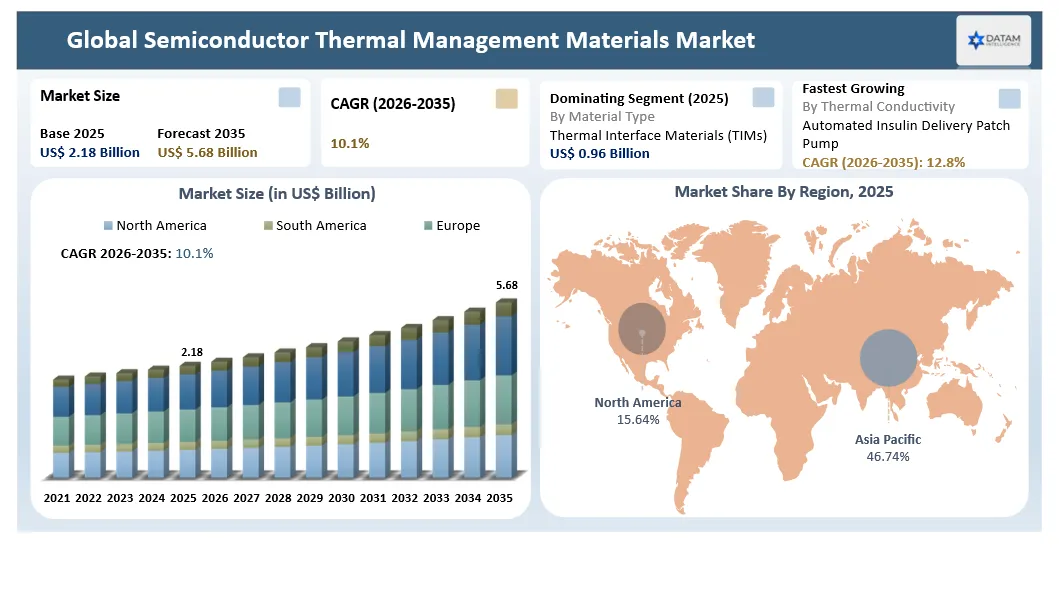
AI and advanced packaging are changing the value equation for thermal materials. A thermal interface that reduces junction temperature by only a few degrees can improve frequency headroom, reliability and cooling-system efficiency across large accelerator fleets. This raises willingness to pay for materials that maintain consistent thermal impedance over thousands of power cycles. At the same time, chiplet and 2.5D/3D packaging create non-uniform package topography, larger lid areas and tighter warpage tolerances, increasing demand for compliant gap fillers, low-stress adhesives and materials optimized for automated dispense.
| Metric | Details |
| 2025 Market Size | US$ 2.18 Billion |
| 2035 Projected Market Size | US$ 5.68 Billion |
| CAGR (2026-2035) | 10.1% |
| Largest Market | Asia-Pacific |
| Fastest Growing Market | North America / Asia-Pacific AI & advanced packaging clusters |
| Dominating Material Type | Thermal Interface Materials (TIMs) |
| Fastest-Growing Performance Tier | Above 20 W/mK and advanced phase-change / metal-based materials |
| Key Demand Engines | AI/HPC, HBM, chiplets, SiC/GaN power electronics and automotive electronics |
Semiconductor Thermal Management Materials Market Key Takeaways
- Thermal interface materials remain the largest product category because nearly every high-power semiconductor package requires a controlled thermal path between die, lid, heat spreader and cooling hardware.
- Asia-Pacific leads the market through semiconductor fabrication, packaging and electronics manufacturing concentration in Taiwan, South Korea, China, Japan and Southeast Asia.
- AI accelerators and HBM are moving the highest-value opportunity toward materials that support very thin bond lines, low thermal resistance and high reliability under rapid temperature cycling.
- Power semiconductors create a separate premium opportunity for sintered silver, high-temperature die attach and electrically insulating thermal materials used in EV inverters, charging and industrial power conversion.
- Customer qualification is a major competitive moat. Once a material is designed into a package, switching can require repeat reliability testing, dispense optimization and process validation.
- Electrical insulation, mechanical compliance and manufacturability are as important as bulk thermal conductivity; the best-performing material is not necessarily the material with the highest stated W/mK value.
- Sustainability pressure is increasing interest in solvent reduction, lower-temperature cure systems, material-use optimization and longer-life thermal interfaces that reduce electronic waste.
- Competitive leadership will depend on co-development with semiconductor and system customers, local technical support in Asian packaging hubs and the ability to scale new formulations with consistent lot-to-lot performance.
Semiconductor Thermal Management Materials Industry Trends and Strategic Insights
- TIM1 materials between die and integrated heat spreader are becoming more demanding as package power rises and bond-line thickness is reduced to minimize thermal resistance.
- TIM2 materials between lid and cold plate or heat sink are being redesigned for larger AI packages and higher mounting pressures, with phase-change and advanced pad solutions gaining importance.
- Hybrid filler systems combining ceramic particles, carbon materials and engineered polymers are being used to improve thermal conductivity without creating electrical leakage paths.
- Sintered silver and other metal-based attach technologies are expanding in high-temperature power modules because they can offer lower thermal resistance and higher reliability than conventional solder in demanding applications.
- Material suppliers are increasingly selling application engineering, dispensing guidance and reliability support together with the chemistry, making technical service a major source of differentiation.
- Advanced package warpage and surface flatness are creating demand for lower-modulus interfaces that can maintain contact across non-planar assemblies without excessive mechanical stress.
Semiconductor Thermal Management Materials Market Scope
| Metrics | Details |
| 2025 Market Size | US$ 2.18 Billion |
| 2035 Projected Market Size | US$ 5.68 Billion |
| CAGR (2026-2035) | 10.1% |
| Largest Market | Asia-Pacific |
| By Material Type | TIMs, Conductive Adhesives & Encapsulants, Gap Fillers, Phase-Change Materials, Graphite Films, Metal-Based Attach and Others |
| By Composition | Silicone, Epoxy/Acrylic, Carbon/Graphite, Ceramic-Filled Polymer, Metallic and Hybrid |
| By Product Form | Greases/Pastes, Pads/Sheets, Gels, Adhesives, Phase-Change Films and Die-Attach Materials |
| By Thermal Conductivity | Below 5, 5-10, 10-20 and Above 20 W/mK |
| By Packaging Level | TIM1, TIM2, Package/Substrate and Module/Board |
| By Semiconductor Device | CPUs/GPUs/AI, Memory/HBM, Power, RF/Telecom, Sensors/MEMS and Optoelectronics |
| By Application | Data Centers & AI, Consumer Electronics, Automotive, Telecom, Industrial, Aerospace/Defense and Healthcare |
| By Distribution Channel | Direct, Specialty Distributors, Application Partners and Online/Catalog |
| Report Insights Covered | Market Size, Share, Growth, Materials Technology, Ecosystem, Competitive Landscape and Country-Level Opportunity |
Why does this report matter in 2026?
The year 2026 is a strategic inflection point because thermal constraints are increasingly limiting the performance and deployment economics of advanced computing. AI accelerator platforms continue to increase package power and memory density, while liquid cooling removes heat more efficiently at the system level. That shift does not reduce the need for thermal materials; instead, it makes package-to-cold-plate thermal resistance more visible. Materials that reduce interface resistance can improve cooling effectiveness and help operators extract more compute from fixed power and cooling infrastructure.
At the semiconductor level, 2.5D/3D integration and HBM create larger, more mechanically complex packages. This increases demand for materials that can accommodate warpage and differential expansion without cracking, delamination or pump-out. In automotive and industrial systems, SiC and GaN devices are raising switching frequency and power density, while qualification requirements remain stringent. The market therefore rewards suppliers capable of combining materials science with process engineering, reliability data and global technical support.
Semiconductor Thermal Management Materials Market White Space & Investment Opportunities
- Ultra-thin, low-resistance TIM1 formulations for AI accelerator packages and chiplet-based processors represent one of the highest-value white spaces.
- Electrically insulating materials with thermal conductivity above 10-20 W/mK can address designs where metal-filled systems create unacceptable electrical risk.
- High-temperature die-attach materials for SiC and GaN power modules offer growth through EV traction inverters, fast charging, renewable energy and industrial drives.
- Low-modulus gap fillers for large, uneven packages and dense boards can capture value as component height variation and mechanical stress increase.
- Reworkable and low-outgassing formulations create opportunities in aerospace, defense and premium compute where serviceability and contamination control are critical.
- Local technical centers in Taiwan, South Korea, Japan, China and Southeast Asia can shorten customer qualification cycles and improve design-win conversion.
Semiconductor Thermal Management Materials Future Market Transformation
The market will move from generic thermal compounds toward package-specific engineered interfaces. Future materials will be specified through a combined set of metrics including thermal conductivity, contact resistance, bond-line thickness, rheology, cure profile, pump-out resistance, dielectric strength and thermal cycling. AI and advanced packaging will push TIM performance upward, while power electronics will increase demand for high-temperature attach technologies and insulating thermal paths.
Integration with manufacturing will also become more important. Automated jetting, screen printing, film placement and precision dispense require materials with tightly controlled viscosity and particle size. Suppliers that design materials around high-throughput assembly will gain an advantage over formulations that perform well in laboratory testing but create yield or equipment challenges in production.
Semiconductor Thermal Management Materials Market Buyer Decision-Making Criteria
Semiconductor and electronics buyers prioritize total thermal resistance rather than headline conductivity alone. They evaluate bond-line thickness, contact resistance, surface wetting, application uniformity, voiding, modulus, coefficient of thermal expansion, dielectric properties and long-term stability. Materials must survive thermal cycling, power cycling, humidity, reflow exposure and mechanical shock while preserving thermal performance.
Commercial qualification also depends on supply assurance, formulation consistency, change-control discipline and local technical support. Large semiconductor and automotive customers frequently require multiple years of reliability data and strict notification of raw-material or process changes. Suppliers with redundant manufacturing, local inventory and experienced application engineers can therefore win share even when competing materials have similar laboratory specifications.
Semiconductor Thermal Management Materials Market Economic & Investment Analysis
The market offers attractive value density because advanced thermal materials represent a small portion of total semiconductor or system cost but can influence device performance and warranty risk. Gross-margin potential is strongest in proprietary high-conductivity and high-reliability formulations with long qualification cycles. However, development costs are rising because materials must be validated against increasingly complex package geometries, new cold-plate interfaces and higher operating temperatures.
Investment is concentrating in filler technology, polymer chemistry, sintered attach systems, high-performance graphite, application laboratories and capacity close to semiconductor packaging clusters. Acquisition interest is also supported by strategic buyers seeking broader electronics-material portfolios. The most valuable targets typically combine differentiated chemistry, protected formulation know-how, qualified customer positions and application expertise.
Semiconductor Thermal Management Materials Investment Trends in the Market
- Capital is moving toward advanced packaging materials that support AI, HBM and chiplet integration.
- Electronics-material suppliers are expanding application laboratories near major Asian semiconductor customers to accelerate qualification.
- Investment in sintered silver, copper-based attach and high-temperature adhesives is increasing with SiC power-module adoption.
- Formulators are developing hybrid ceramic and carbon filler systems to improve conductivity while maintaining electrical insulation.
- Automated dispense compatibility and low-void process windows are becoming investment priorities because manufacturing yield increasingly determines commercial success.
Strategic Indicators For the Semiconductor Thermal Management Materials Market
High Regulation Impact
Chemical-content rules, electronics substance restrictions, automotive qualification and customer-specific reliability standards create meaningful compliance requirements. Suppliers must maintain traceability, material declarations, controlled change procedures and documentation for global electronics production.
High Investment Activity
AI infrastructure, advanced packaging and power electronics are driving investment in new materials, application labs, production lines and acquisitions. Premium segments are growing faster than conventional thermal compounds.
Supply Chain Disruption
Specialty fillers, silicones, silver, graphite and ceramic powders can face regional concentration and price volatility. Semiconductor customers increasingly require dual sourcing, local inventory and business-continuity plans.
Pricing Volatility
Commodity pads and greases face price pressure, while high-performance TIMs and metal-based attach materials can command significant premiums. Silver content, specialty filler purity and customer qualification influence pricing.
Procurement Pressure
Major semiconductor and automotive buyers demand lot consistency, long-term supply assurance and strict change control. Procurement decisions combine cost with reliability data and process yield.
New Technology Adoption
AI packages, liquid-cooled servers, HBM, chiplets, SiC and GaN are accelerating adoption of higher-performance thermal materials. Qualification timing determines how quickly new chemistry converts into revenue.
Regional Expansion Opportunity
Taiwan, South Korea, Japan, China and Southeast Asia offer the largest packaging-related opportunity, while the U.S. benefits from AI infrastructure and semiconductor reshoring investment.
Government Policy Support
Semiconductor incentive programs in the U.S., Europe, Japan, South Korea and India are expanding fabrication and packaging capacity, indirectly supporting local demand for thermal materials.
Pricing Intelligence
Pricing is increasingly segmented by performance and qualification. Advanced phase-change, ultra-low-BLT and metal-based systems can carry multiples of conventional thermal grease or pad pricing when they solve high-value reliability constraints.
Disruption Analysis of Semiconductor Thermal Management Materials Market
The largest disruption is the transition from air-cooled, moderate-power packages toward liquid-cooled AI systems and advanced packages with very high local heat flux. This changes the location and importance of thermal interfaces. Better cold plates increase the need for reliable package-to-cold-plate contact, while larger packages create new mechanical challenges. Materials are therefore being designed as part of the package and cooling stack rather than selected late in system integration.
A second disruption comes from wide-bandgap power semiconductors. SiC and GaN devices can operate at higher temperatures and power densities, exposing limitations in conventional solders and polymer interfaces. Sintered metals, high-temperature adhesives and advanced insulating materials can capture share as module makers redesign for longer life and higher junction temperature.
Semiconductor Thermal Management Materials Market BCG Matrix: Company Evaluation
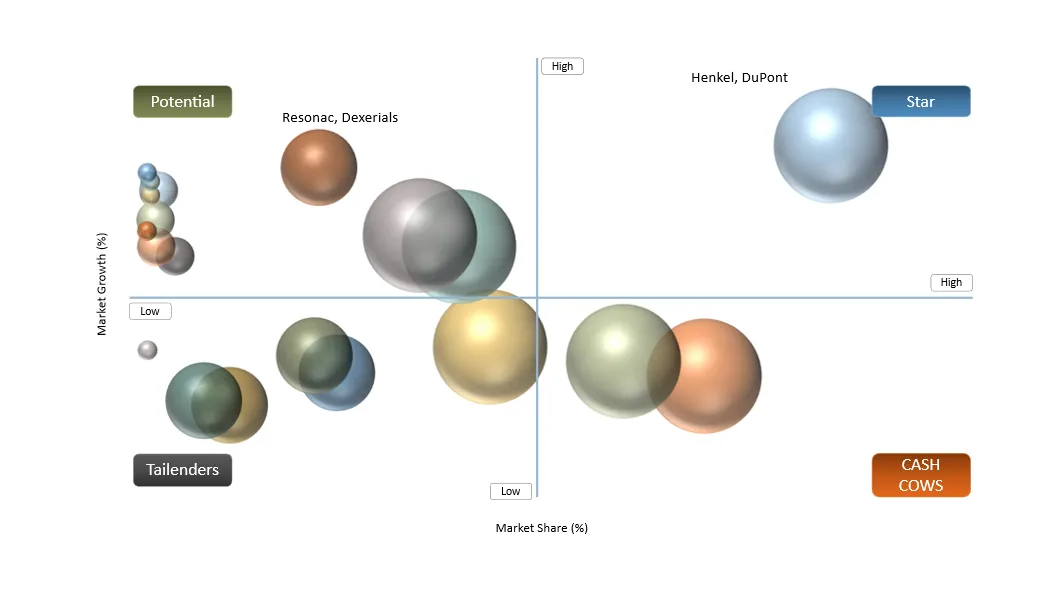
STAR
Henkel, DuPont and Shin-Etsu Chemical are positioned as Star companies because they combine broad electronics-material portfolios, global customer access, large-scale manufacturing and established application support. Their ability to participate in advanced packaging, adhesives, silicone materials and semiconductor ecosystems creates multiple routes to growth as AI and power-electronics demand expands.
POTENTIAL
Resonac, Dexerials, Sekisui Chemical, Indium Corporation, Fujipoly and specialist materials companies are positioned as Potential players where differentiated products, high-performance filler technology or strong regional customer relationships can translate into share gains. Their trajectory depends on successful qualification in advanced AI packages, power modules and other fast-growing semiconductor applications.
Semiconductor Thermal Management Materials Market Dynamics
Driver Impact Analysis
| Driver | Market Growth Impact | Demand Concentration | Impacted Use Case | Strategic Impact |
| AI accelerators and HBM | High | U.S., Taiwan, South Korea | TIM1/TIM2 for GPUs and AI accelerators | Raises thermal-performance requirements and average selling price. |
| Advanced 2.5D/3D packaging | High | Taiwan, South Korea, Japan | Chiplets, HBM, large packages | Creates demand for low-BLT, low-modulus and warpage-tolerant materials. |
| SiC and GaN power electronics | Medium-High | China, Europe, Japan, U.S. | EV inverters, charging, industrial drives | Expands high-temperature die attach and insulating interface demand. |
| Data-center liquid cooling | Medium-High | North America, Europe, Asia | Package-to-cold-plate interfaces | Makes interface resistance more visible in total cooling efficiency. |
Driver: AI Accelerators and Advanced Packaging Increase Heat Flux
AI accelerators are rapidly increasing package power while HBM stacks and chiplet integration enlarge package footprint and create uneven heat distribution. As thermal resistance in the silicon-to-coolant path becomes a performance bottleneck, material suppliers can capture greater value by reducing interface resistance and maintaining stable contact over repeated power cycles. The result is a shift toward premium formulations with controlled bond-line thickness, high conductivity and stronger pump-out resistance.
Restraint Impact Analysis
| Restraint | Drag on Market Growth | Primary Impact Area | Impacted Use Case | Strategic Impact |
| Long customer qualification cycles | High | Commercialization | Advanced package TIMs | Slows conversion of new formulations despite strong technical performance. |
| Cost of high-performance fillers | Medium-High | Pricing | Silver, BN, AlN and specialty graphite systems | Can limit adoption in cost-sensitive devices. |
| Thermal vs mechanical trade-offs | High | Product design | Ultra-thin interfaces | Higher conductivity can increase stiffness or electrical risk. |
| Supplier concentration and change control | Medium | Supply assurance | Automotive and semiconductor production | Encourages dual sourcing and localized manufacturing. |
Restraint: Qualification Complexity and Multi-Variable Reliability Trade-Offs
New materials must be proven across thermal, mechanical, electrical and process dimensions. A formulation that improves thermal conductivity may introduce higher modulus, poor reworkability, pump-out or electrical conductivity. This creates lengthy qualification programs and favors incumbent suppliers with extensive reliability data and close customer engineering relationships.
Semiconductor Thermal Management Materials Market Segment Analysis
The global Semiconductor Thermal Management Materials market is segmented based on Material Type, Composition, Product Form, Thermal Conductivity, Packaging Level, Semiconductor Device Type, Application, Distribution Channel and region.
By Material Type
Thermal Interface Materials Will Continue to Lead
TIMs remain the largest category because they are required across processors, accelerators, memory, power modules and other high-heat components. The fastest value growth is occurring in advanced phase-change, high-conductivity and low-bond-line systems used in AI and premium electronics. Metal-based attach materials also gain share in power devices.
By Composition
Ceramic-Filled and Hybrid Systems Will Gain Value
Silicone systems remain important for flexibility and processability, while ceramic-filled polymers such as boron nitride and aluminum nitride systems provide a path to higher conductivity with electrical insulation. Hybrid carbon/ceramic systems are being explored for even higher performance.
By Product Form
Pastes, Gels and Films Will Serve Different Assembly Needs
Pastes and greases support conformal contact and thin interfaces, pads and films simplify assembly, and gels address large gaps or uneven surfaces. Phase-change films provide controlled placement and low resistance after activation, while die-attach pastes support high-temperature power modules.
By Thermal Conductivity
Above 20 W/mK Will Be the Fastest-Growing Performance Tier
Materials above 20 W/mK are growing from a smaller base as AI accelerators and premium power electronics justify higher cost. Many mainstream applications will remain in lower ranges where insulation, compliance and price are more important than maximum conductivity.
By Packaging Level
TIM1 Will Capture the Highest Technical Value
Die-to-lid interfaces are closest to the heat source and therefore face the most demanding thermal and reliability requirements. TIM2 remains a large volume opportunity as heat sinks and cold plates interface with larger packages and modules.
By Semiconductor Device Type
CPUs, GPUs and AI Accelerators Will Drive the Fastest Growth
Accelerated computing is the strongest growth engine because of rapidly rising package power and HBM integration. Power semiconductors represent another high-growth category through EV and industrial electrification.
By Application
Data Centers & AI Computing Will Be the Fastest-Growing Application
AI servers create premium demand across die, package and cold-plate interfaces. Automotive electronics remains a major recurring opportunity through traction inverters, onboard chargers, ADAS and high-performance compute modules.
By Distribution Channel
Direct Strategic Account Sales Will Dominate Advanced Materials
High-value semiconductor thermal materials are typically co-developed and qualified directly with large customers. Specialty distributors remain important for regional access, prototyping, industrial electronics and mid-volume accounts.
Thermal Material Architecture Comparison
| Parameter | Conventional TIM | Advanced AI TIM | Power-Semiconductor Attach |
| Primary Function | Fill interface voids | Minimize package-to-cooling resistance | Attach die while conducting heat |
| Typical Priority | Cost and ease of use | Low BLT, high conductivity, pump-out resistance | High-temperature reliability and cycling |
| Common Form | Grease, pad | Phase-change, advanced grease/gel, film | Sintered metal paste/film, high-temp adhesive |
| Electrical Requirement | Often insulating | Application dependent | Often conductive attach plus insulating substrate |
| Qualification Intensity | Moderate | High | Very high automotive/industrial |
Semiconductor Thermal Management Materials Market Geographical Penetration
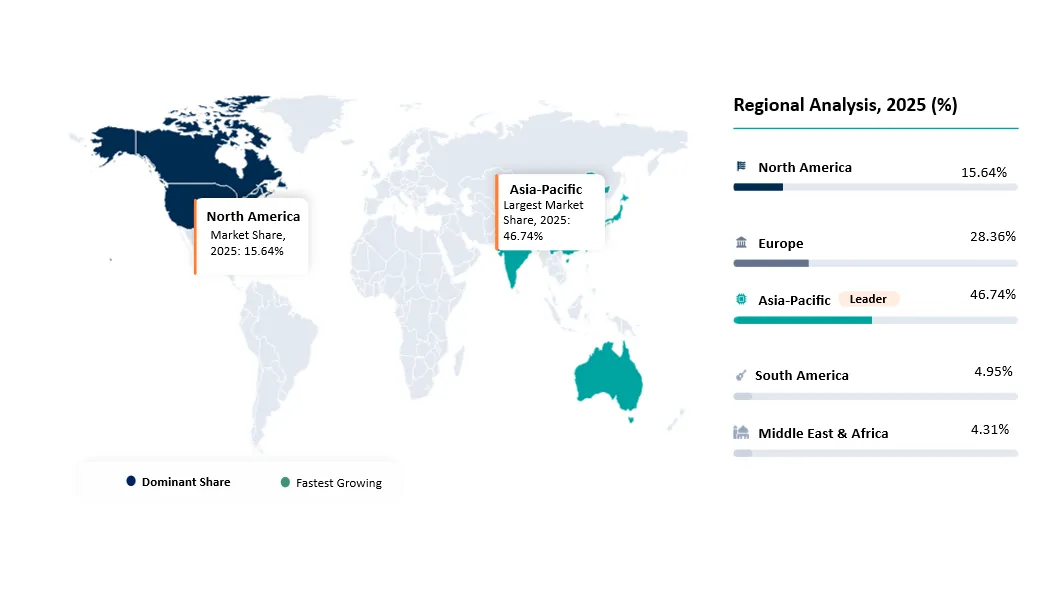
Asia-Pacific is the largest regional market because it contains the majority of semiconductor packaging, memory, foundry and electronics manufacturing capacity. North America is a high-growth value market through AI data centers, leading semiconductor design companies and advanced packaging investment. Europe is important for automotive power electronics, industrial semiconductors and high-reliability materials, while Japan remains a major supplier and consumer of specialty electronic materials.
U.S. Semiconductor Thermal Management Materials Market Landscape
The U.S. market is driven by AI accelerator design, data-center infrastructure, advanced packaging investment, semiconductor reshoring and automotive power electronics. Large chip and server companies influence material specifications globally. The highest-value opportunity is in low-resistance interfaces for AI packages and cold plates, with additional demand from aerospace, defense and EV systems.
Taiwan Semiconductor Thermal Management Materials Market Trends
Taiwan is a critical demand center because of advanced foundry and packaging capacity. Leading-edge 2.5D/3D integration, AI accelerator packaging and OSAT activity create strong demand for TIM1, TIM2, underfill-adjacent thermal materials and process support. Suppliers with local laboratories and fast technical response have a competitive advantage.
South Korea Semiconductor Thermal Management Materials Market Outlook
South Korea combines HBM and memory leadership with advanced packaging, consumer electronics and power electronics. Growth is linked to HBM-equipped AI packages, high-performance mobile devices and local semiconductor investment. Qualification with major memory and electronics companies can create long product lifecycles.
Japan Semiconductor Thermal Management Materials Market Outlook
Japan is both a major supplier and consumer of advanced electronic materials. Strong capabilities in silicones, adhesives, graphite, ceramics and specialty chemicals support innovation in high-reliability thermal materials. Automotive power modules and semiconductor equipment also reinforce domestic demand.
China Semiconductor Thermal Management Materials Market Trends
China has large electronics, power semiconductor and EV production, with expanding domestic semiconductor packaging. The market is price competitive in conventional materials but increasingly attractive for high-performance local formulations. Supply-chain localization and domestic substitution are important strategic themes.
Europe Semiconductor Thermal Management Materials Market Outlook
Europe is anchored by automotive and industrial power electronics, with significant SiC investment and high reliability requirements. Germany, France and Italy contribute demand through automotive electronics, industrial automation and power conversion. Sustainability and chemical compliance influence supplier selection.
Semiconductor Thermal Management Materials Market Competitive Landscape
- Competition spans diversified chemical companies, electronics-material specialists, silicone suppliers, thermal-material formulators and metal-attach companies. Henkel, DuPont, Shin-Etsu, Parker Hannifin and 3M benefit from global customer access and broad technical capabilities, while specialist companies can compete through higher-performance formulations and faster application support.
- Customer qualification creates sticky market positions. A supplier that is qualified for a high-volume semiconductor package can retain business for the life of the platform, provided quality and supply remain stable.
- Advanced AI and power applications are increasing collaboration between material suppliers, semiconductor package designers, cooling companies and assembly-equipment vendors.
- Competitive differentiation increasingly depends on thermal resistance at application thickness, reliability after cycling, process yield, automated dispense compatibility and global change-control discipline.
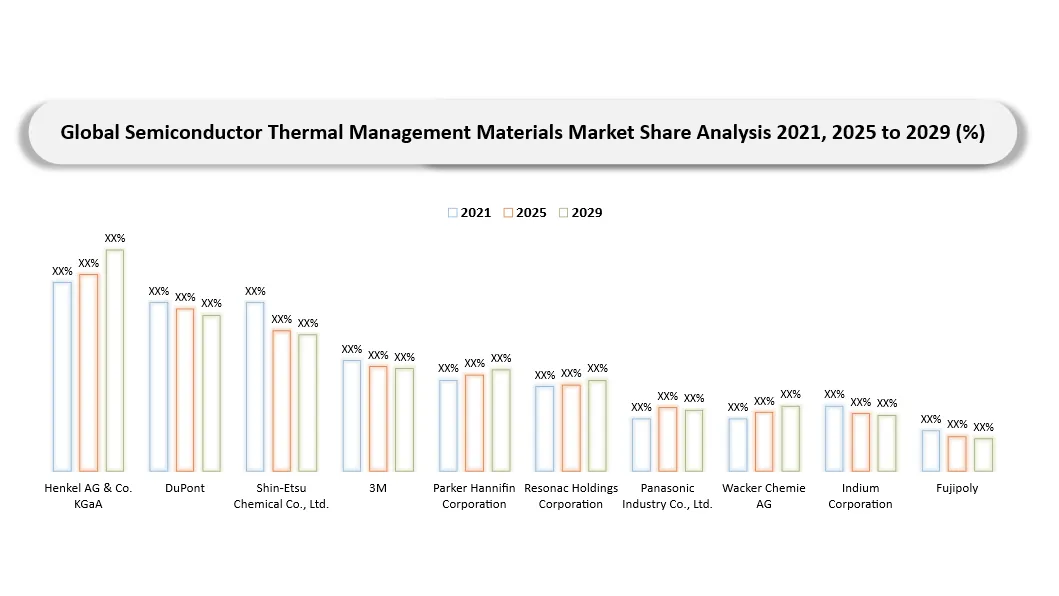
Public Company Q1-Q2 2026 Performance Comparison
| Public Company | Q1-Q2 2026 Performance | Thermal-Materials Exposure | Key Growth Drivers |
| Henkel AG & Co. KGaA | Q1 2026 group sales €4.95B with +1.7% organic growth. Adhesive Technologies sales were €2.63B with +1.7% organic growth; Mobility & Electronics organic growth was +6.7%. | Direct electronics exposure through thermal interface materials, adhesives, encapsulants and semiconductor packaging solutions. | AI/electronics demand, semiconductor packaging, Mobility & Electronics growth, application engineering and premium material mix. |
| DuPont | Q1 2026 net sales US$1.68B, +4% YoY and +2% organic; operating EBITDA US$414M, +15%. | Electronic materials and thermal-management solutions, including Laird Performance Materials portfolio and advanced materials used around electronics and semiconductor systems. | Microelectronics demand, AI infrastructure, portfolio focus, productivity and premium industrial materials. |
| Shin-Etsu Chemical | Q1 FY2026 results for quarter ended June 30, 2026 were released July 24; semiconductor and silicone businesses remain strategically relevant to thermal materials and packaging. | Silicone-based thermal interface materials, encapsulation and electronics materials used in semiconductor and device assembly. | AI/semiconductor demand, silicone formulation capability, wafer and electronic-material ecosystem, Asian customer proximity. |
| Parker Hannifin | Fiscal Q3 2026 sales were a record US$5.5B, +11% reported and +6.5% organic; adjusted EPS rose 18%. | Chomerics thermal interface materials, gap fillers, pads and EMI/thermal solutions for electronics. | Data centers, aerospace and industrial demand, engineered-material cross-selling, electronics thermal/EMI integration. |
| 3M | Q1 2026 GAAP sales were US$6.0B, +1.3%; adjusted organic sales grew 1.2% and adjusted EPS increased 14%. | Thermally conductive tapes, interface pads, films and electronics materials used in devices and assemblies. | Electronics recovery, product innovation, portfolio productivity, thermal and electrical insulation needs. |
Market Ecosystem Table
| Value Chain Sector | Representative Companies | Role in Semiconductor Thermal Management Materials Ecosystem |
| Specialty fillers & raw materials | Denka, 3M, Resonac, Imerys, Saint-Gobain, graphite and metal powder suppliers | Supply boron nitride, aluminum nitride, alumina, graphite, silver and other conductive fillers used in thermal formulations. |
| Polymer & silicone platforms | Shin-Etsu Chemical, Wacker Chemie, Momentive, Dow | Provide silicone, polymer and resin systems that determine compliance, cure, adhesion and reliability. |
| Thermal-interface formulators | Henkel, DuPont/Laird, Parker Chomerics, Fujipoly, Dexerials, 3M | Formulate greases, gels, pads, films and phase-change systems for semiconductor and electronics interfaces. |
| Metal-based die attach | Indium Corporation, Heraeus Electronics, MacDermid Alpha, Tanaka Precious Metals | Provide sintered silver, solder and advanced die-attach systems for power semiconductor modules. |
| Semiconductor foundries & IDMs | TSMC, Samsung Electronics, Intel, SK hynix, Micron, Infineon, STMicroelectronics | Define package requirements and qualify thermal materials for leading-edge logic, memory and power devices. |
| OSAT & advanced packaging | ASE Technology, Amkor Technology, JCET, Powertech, ChipMOS | Integrate materials into package assembly and advanced packaging production. |
| Server & device OEMs | NVIDIA, AMD, Dell, HPE, Lenovo, Apple, Samsung Electronics | Set system thermal targets and influence TIM2, cold-plate and module-level material selection. |
| Automotive & power module ecosystem | Bosch, Denso, ZF, Infineon, onsemi, Wolfspeed, Mitsubishi Electric | Use high-reliability thermal and die-attach materials in inverters, chargers and high-power electronics. |
| Specialty distributors | MacDermid Alpha distribution partners, Ellsworth Adhesives, RS, Mouser, regional electronic-material distributors | Provide regional stocking, technical sales and access for prototyping and mid-volume customers. |
| Standards & qualification bodies | JEDEC, IEC, UL, AEC, IEEE | Define reliability, material, component and automotive qualification frameworks influencing adoption. |
Key Companies
- Henkel AG & Co. KGaA
- DuPont
- Shin-Etsu Chemical Co., Ltd.
- Parker Hannifin Corporation
- 3M
- Resonac Holdings Corporation
- Sekisui Chemical Co., Ltd.
- Panasonic Industry Co., Ltd.
- Wacker Chemie AG
- Momentive Performance Materials
- Indium Corporation
- Fujipoly
- Dexerials Corporation
- Denka Company Limited
- Boyd Corporation
Company Profiles
Henkel AG & Co. KGaA
Henkel is a leading global adhesive and electronic-material supplier with a broad portfolio for semiconductor packaging, thermal interface management, underfills, encapsulants and assembly. Its Mobility & Electronics business provides direct exposure to data centers, consumer electronics, automotive electronics and industrial applications. Competitive strengths include global application labs, formulation expertise and deep customer qualification relationships.
Competitive priorities include increasing thermal performance without sacrificing manufacturability, building qualified positions in AI and power-electronics platforms, expanding local technical support near Asian packaging customers and maintaining supply consistency. Recent market growth also favors partnerships with semiconductor package designers, cold-plate suppliers and automated dispensing equipment companies.
DuPont
DuPont participates through advanced electronic materials and the Laird Performance Materials portfolio, providing thermal and electromagnetic solutions used in computing, telecom, automotive and industrial electronics. Its semiconductor and microelectronics exposure supports cross-selling around advanced packaging and high-performance systems.
Competitive priorities include increasing thermal performance without sacrificing manufacturability, building qualified positions in AI and power-electronics platforms, expanding local technical support near Asian packaging customers and maintaining supply consistency. Recent market growth also favors partnerships with semiconductor package designers, cold-plate suppliers and automated dispensing equipment companies.
Shin-Etsu Chemical Co., Ltd.
Shin-Etsu combines silicone chemistry, semiconductor materials and global electronics relationships. Its silicone-based thermal interface and encapsulation products are relevant for power devices, processors and electronic assemblies. Vertical materials expertise and strong Asian manufacturing proximity support customer qualification.
Competitive priorities include increasing thermal performance without sacrificing manufacturability, building qualified positions in AI and power-electronics platforms, expanding local technical support near Asian packaging customers and maintaining supply consistency. Recent market growth also favors partnerships with semiconductor package designers, cold-plate suppliers and automated dispensing equipment companies.
Parker Hannifin Corporation
Parker participates through its Chomerics division, supplying thermal interface materials, gap fillers, pads, gels and EMI/thermal solutions. The platform benefits from Parker’s engineered-material capabilities and exposure to data centers, aerospace, industrial electronics and other high-reliability applications.
Competitive priorities include increasing thermal performance without sacrificing manufacturability, building qualified positions in AI and power-electronics platforms, expanding local technical support near Asian packaging customers and maintaining supply consistency. Recent market growth also favors partnerships with semiconductor package designers, cold-plate suppliers and automated dispensing equipment companies.
3M
3M supplies thermally conductive tapes, interface pads, films and insulating materials used in electronics assembly and heat spreading. Its broad manufacturing and materials-science platform supports cross-functional designs requiring thermal, adhesive and dielectric performance.
Competitive priorities include increasing thermal performance without sacrificing manufacturability, building qualified positions in AI and power-electronics platforms, expanding local technical support near Asian packaging customers and maintaining supply consistency. Recent market growth also favors partnerships with semiconductor package designers, cold-plate suppliers and automated dispensing equipment companies.
Resonac Holdings Corporation
Resonac is a major Japanese electronic-material supplier with strong positions in semiconductor packaging materials. Its portfolio and research capabilities make it relevant to advanced package heat management and high-performance materials integration.
Competitive priorities include increasing thermal performance without sacrificing manufacturability, building qualified positions in AI and power-electronics platforms, expanding local technical support near Asian packaging customers and maintaining supply consistency. Recent market growth also favors partnerships with semiconductor package designers, cold-plate suppliers and automated dispensing equipment companies.
Sekisui Chemical Co., Ltd.
Sekisui provides high-performance tapes, films, adhesives and electronic materials. Its precision polymer and functional-film capabilities position it for thermal interfaces, heat spreading and semiconductor/electronics assembly applications.
Competitive priorities include increasing thermal performance without sacrificing manufacturability, building qualified positions in AI and power-electronics platforms, expanding local technical support near Asian packaging customers and maintaining supply consistency. Recent market growth also favors partnerships with semiconductor package designers, cold-plate suppliers and automated dispensing equipment companies.
Panasonic Industry Co., Ltd.
Panasonic Industry supplies electronic materials, thermal solutions and components used in automotive, industrial and computing applications. Its system-level understanding supports materials integration where thermal and electrical requirements must be balanced.
Competitive priorities include increasing thermal performance without sacrificing manufacturability, building qualified positions in AI and power-electronics platforms, expanding local technical support near Asian packaging customers and maintaining supply consistency. Recent market growth also favors partnerships with semiconductor package designers, cold-plate suppliers and automated dispensing equipment companies.
Wacker Chemie AG
Wacker is a major global silicone producer supplying materials relevant to thermal compounds, encapsulation and electronic protection. Silicone chemistry supports compliant, thermally conductive formulations that can tolerate thermal cycling and vibration.
Competitive priorities include increasing thermal performance without sacrificing manufacturability, building qualified positions in AI and power-electronics platforms, expanding local technical support near Asian packaging customers and maintaining supply consistency. Recent market growth also favors partnerships with semiconductor package designers, cold-plate suppliers and automated dispensing equipment companies.
Momentive Performance Materials
Momentive provides advanced silicones used in electronics, including thermally conductive compounds, adhesives and encapsulants. The company’s application expertise is relevant to power electronics, automotive and high-performance computing.
Competitive priorities include increasing thermal performance without sacrificing manufacturability, building qualified positions in AI and power-electronics platforms, expanding local technical support near Asian packaging customers and maintaining supply consistency. Recent market growth also favors partnerships with semiconductor package designers, cold-plate suppliers and automated dispensing equipment companies.
Indium Corporation
Indium Corporation is a specialist in solders, thermal interface materials and metal-based materials for semiconductor and power-electronics assembly. It is particularly important in high-performance TIM and die-attach applications where metal systems provide very low thermal resistance.
Competitive priorities include increasing thermal performance without sacrificing manufacturability, building qualified positions in AI and power-electronics platforms, expanding local technical support near Asian packaging customers and maintaining supply consistency. Recent market growth also favors partnerships with semiconductor package designers, cold-plate suppliers and automated dispensing equipment companies.
Fujipoly
Fujipoly is a specialist supplier of thermal interface pads and gap fillers known for high-conductivity elastomer materials. Its products are used across computing, power electronics, telecom and industrial systems requiring conformal heat transfer.
Competitive priorities include increasing thermal performance without sacrificing manufacturability, building qualified positions in AI and power-electronics platforms, expanding local technical support near Asian packaging customers and maintaining supply consistency. Recent market growth also favors partnerships with semiconductor package designers, cold-plate suppliers and automated dispensing equipment companies.
Dexerials Corporation
Dexerials develops functional materials, adhesives and films for electronics. Its precision materials capabilities and strong relationships in Japanese and Asian electronics markets support thermal and assembly applications.
Competitive priorities include increasing thermal performance without sacrificing manufacturability, building qualified positions in AI and power-electronics platforms, expanding local technical support near Asian packaging customers and maintaining supply consistency. Recent market growth also favors partnerships with semiconductor package designers, cold-plate suppliers and automated dispensing equipment companies.
Denka Company Limited
Denka is a major supplier of advanced ceramic and electronic materials, including high-thermal-conductivity fillers and substrates. It sits upstream in the ecosystem and supports formulators seeking electrically insulating thermal performance.
Competitive priorities include increasing thermal performance without sacrificing manufacturability, building qualified positions in AI and power-electronics platforms, expanding local technical support near Asian packaging customers and maintaining supply consistency. Recent market growth also favors partnerships with semiconductor package designers, cold-plate suppliers and automated dispensing equipment companies.
Boyd Corporation
Boyd is a thermal-management specialist supplying interface materials, heat spreaders and integrated thermal solutions. Its ability to combine materials with mechanical and cooling components makes it relevant to AI, telecom, automotive and industrial electronics.
Competitive priorities include increasing thermal performance without sacrificing manufacturability, building qualified positions in AI and power-electronics platforms, expanding local technical support near Asian packaging customers and maintaining supply consistency. Recent market growth also favors partnerships with semiconductor package designers, cold-plate suppliers and automated dispensing equipment companies.
Semiconductor Thermal Management Materials Market Major Pain Points
- Thermal conductivity claims measured under laboratory conditions may not translate directly into low interface resistance in a real package.
- Pump-out, dry-out, delamination and voiding can degrade performance over long power-cycling periods.
- Advanced fillers can raise viscosity, modulus, cost and electrical-conductivity risk.
- Large AI packages and HBM create warpage and non-uniform pressure that complicate TIM contact.
- Long semiconductor and automotive qualification cycles delay commercialization of new materials.
- Raw-material concentration in specialty ceramics, graphite and precious metals creates supply risk.
- Automated dispense and high-volume manufacturing require tight rheology control and lot consistency.
- Customers demand strict change control, making formulation or supplier changes expensive after qualification.
Semiconductor Thermal Management Materials Market Recent Developments
- July 2026: Shin-Etsu Chemical released first-quarter FY2026 financial data as semiconductor and silicone demand remained central to its electronic-material portfolio and investment outlook.
- May 2026: Henkel reported 6.7% organic growth in Mobility & Electronics during Q1, supported by its electronics and industrial businesses, reinforcing momentum in adhesive and thermal-material applications.
- May 2026: DuPont reported Q1 2026 sales growth and continued microelectronics strength within its focused materials portfolio following portfolio restructuring.
- April 2026: Parker Hannifin reported fiscal Q3 2026 record sales and strong order growth, supporting continued investment across engineered materials and high-performance industrial/electronics applications.
- April 2026: 3M reported Q1 2026 results with adjusted organic growth and continued focus on portfolio productivity and innovation in electronics and industrial materials.
Analyst View / Opinion on Semiconductor Thermal Management Materials Market
- The semiconductor thermal-management-materials market is moving from a component-support category into a performance-critical part of advanced package design.
- AI accelerators and HBM will create the strongest near-term value growth because thermal resistance directly affects performance, reliability and data-center cooling economics.
- Power electronics will provide a second durable growth engine through SiC and GaN modules that require high-temperature attach and insulating thermal materials.
- The highest-value suppliers will not compete on W/mK alone; they will combine low application resistance, process yield, reliability data and local engineering support.
- Qualification depth and customer intimacy create substantial barriers to entry, particularly for automotive and leading-edge semiconductor packages.
- Asia-Pacific will remain the manufacturing center of gravity, but North American AI infrastructure and semiconductor reshoring will support faster value growth and local technical investment.
- Companies that can co-optimize materials with cold plates, package lids, dispense equipment and advanced packaging processes will be better positioned than standalone chemistry vendors.
Semiconductor Thermal Management Materials Market Target Audience
| INDUSTRY | WHO SHOULD BUY THIS REPORT? | REASON TO BUY THIS REPORT |
| Semiconductor Materials | Thermal-material suppliers, silicone producers, specialty chemical companies | Assess fast-growing material types, performance tiers and qualification requirements. |
| Foundries & OSATs | Packaging leaders, process engineers, sourcing teams | Benchmark thermal material options for advanced packaging and high-volume assembly. |
| AI & Data Centers | GPU/server OEMs, cooling suppliers, hyperscalers | Understand package-to-cooling interface trends and material constraints at high heat flux. |
| Automotive & Power Electronics | Tier-1s, power-module makers, EV platform teams | Evaluate high-temperature attach, gap fillers and insulating thermal materials. |
| Electronics OEMs | Consumer device, telecom, industrial and medical OEMs | Track high-performance thermal material choices and supplier landscape. |
| Investors & Consulting | Private equity, corporate strategy, consultants | Assess competitive position, growth segments, ecosystem partnerships and M&A opportunities. |
Why Choose DATAM?
- Data-driven insights combining market sizing, semiconductor packaging trends, materials technology, buyer requirements and country-level manufacturing exposure.
- Post-purchase analyst consultations for product positioning, technology benchmarking, market entry and account prioritization.
- Annual updates covering semiconductor roadmaps, advanced packaging, material launches, capacity expansion and competitive developments.
- Specialized focus on emerging semiconductor manufacturing clusters and advanced packaging ecosystems rather than generic regional summaries.
- Actionable analysis connecting material properties with package architecture, manufacturing yield, cooling design and procurement decisions.
What DATAM Uniquely Provides
- Forecasts across material type, composition, product form, thermal conductivity, packaging level, semiconductor device, application and distribution channel.
- AI/HPC-specific analysis separating TIM1, TIM2 and package-to-cold-plate requirements.
- Power-semiconductor coverage of sintered attach, high-temperature materials and electrically insulating thermal paths.
- Market ecosystem mapping from filler and polymer suppliers through foundries, OSATs, OEMs and application channels.
- Public-company 2026 performance comparison linked to semiconductor and electronics thermal-material exposure.
- Country-level opportunity assessment for major semiconductor packaging and electronics manufacturing markets.


























































