


Semiconductor Precursor Market Size and Overview
The global Semiconductor Precursor market reached an estimated US$ 3.18 billion in 2025 and is projected to reach US$ 7.01 billion by 2035, expanding at a CAGR of 8.2% during 2026-2035. The market covers ultra-high-purity chemical compounds used to deposit, dope, etch or modify thin films during semiconductor manufacturing. These materials include silicon, metal, high-k dielectric, low-k dielectric, dopant, compound-semiconductor and advanced packaging precursors supplied for atomic layer deposition, chemical vapor deposition, epitaxy and related processes.
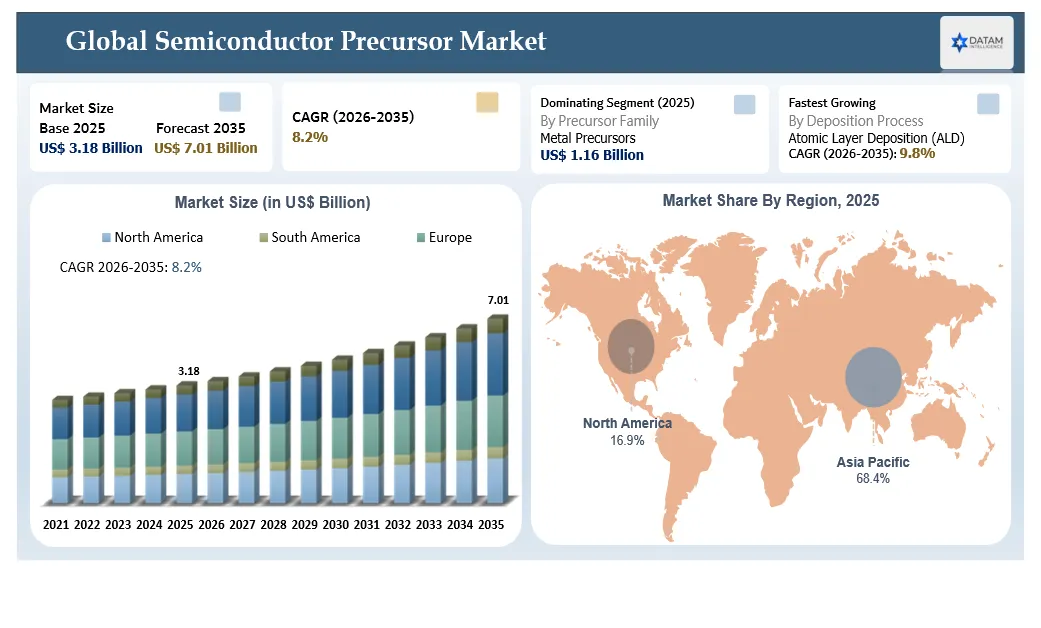
Demand is being reshaped by three structural changes. Logic and memory architectures are becoming more three-dimensional, which increases the number of deposition steps and the need for highly conformal films. AI accelerators and high-bandwidth memory are raising the value of low-resistance interconnects, high-k dielectrics and advanced metallization. Regional fab expansion is also encouraging local precursor production, dual sourcing and long-term supply contracts. The commercial value of a precursor therefore extends beyond the molecule itself to include purity control, packaging, delivery hardware, application engineering, qualification support and continuity of supply.
Asia-Pacific remains the largest market because Taiwan, South Korea, China and Japan host the deepest concentration of advanced logic, memory and materials manufacturing. North America is gaining share as new fabs, CHIPS-linked investments and local materials ecosystems progress. Europe remains important in specialty materials, power semiconductors and R&D, while South America and the Middle East and Africa are smaller but developing through packaging, compound semiconductors and national industrial programs.
| Metric | Details |
| 2025 Market Size | US$ 3.18 Billion |
| 2035 Projected Market Size | US$ 7.01 Billion |
| CAGR (2026-2035) | 8.2% |
| Largest Region | Asia-Pacific |
| Fastest-Growing Region | North America |
| Largest Precursor Family | Metal Precursors |
| Fastest-Growing Process | Atomic Layer Deposition |
| Study Period | 2024-2035 |
Semiconductor Precursor Market Key Takeaways
- Asia-Pacific accounted for an estimated 68.4% of global revenue in 2025, reflecting the concentration of advanced logic, DRAM, NAND and foundry capacity in Taiwan, South Korea, China and Japan.
- Metal precursors represented approximately 34.7% of the market in 2025 as copper, cobalt, ruthenium, tungsten, molybdenum and other metals gained importance in advanced interconnect and electrode structures.
- Atomic layer deposition applications held about 42.3% of 2025 demand and are forecast to expand at a CAGR of 9.6% through 2035 due to conformality requirements in gate-all-around logic, 3D NAND and advanced capacitors.
- Memory semiconductor applications represented nearly 38.6% of 2025 demand, supported by rising layer counts in 3D NAND and investment in high-bandwidth memory.
- Molybdenum and ruthenium precursor platforms are expected to grow above 12% annually from a small base as chipmakers evaluate lower-resistance alternatives for advanced nodes.
- North America held an estimated 16.9% share in 2025 and is projected to grow at 9.1% through 2035 as domestic fab and materials capacity expands.
- Silicon precursors remained a core volume category with about 24.8% share in 2025 because silicon oxide, silicon nitride and epitaxial layers are used across nearly every device platform.
- Advanced packaging and heterogeneous integration are expected to record a 10.4% CAGR, creating new demand for barrier, seed, dielectric and surface-treatment chemistries.
Semiconductor Precursor Industry Trends and Strategic Insights
- Precursor qualification is becoming a co-development process involving chemical suppliers, deposition-tool vendors and chipmakers. Molecule performance must be validated together with vapor delivery, chamber behavior, film properties and defect control.
- High-volume manufacturing is shifting from small laboratory cylinders toward bulk delivery and sublimation systems for difficult solid precursors. This change improves flow stability and enables new metal chlorides to move from development into production.
- Molybdenum, ruthenium and cobalt are receiving attention as scaling makes conventional tungsten and copper integration more difficult. Commercial adoption will depend on resistance, nucleation, selectivity and compatibility with existing process modules.
- Low-temperature deposition is gaining importance because sensitive device layers and advanced packaging stacks have tighter thermal budgets. This supports new silicon, dielectric and plasma-enhanced ALD precursor combinations.
- Geographic localization is accelerating. Suppliers are building advanced-materials plants near major fabs in Taiwan, South Korea, Japan and the United States to shorten lead times and reduce exposure to cross-border disruption.
- Purity requirements are becoming more stringent as defect budgets shrink. Metallic impurities, moisture, particles and decomposition products must be controlled at parts-per-billion levels, increasing the value of analytical capability and closed-loop quality systems.
- Sustainability is moving into precursor selection through lower global-warming-potential chemistries, improved utilization, abatement compatibility, solvent reduction and recovery of high-value containers.
- AI-enabled materials discovery and process modeling are shortening screening cycles by predicting volatility, adsorption, decomposition and film properties before full fab qualification.
FOR INSTANCE: Air Liquide reported that it had developed molybdenum-based precursors with customers for more than a decade before moving from feasibility work to high-volume production, showing why precursor commercialization requires long qualification cycles and close fab collaboration.
Semiconductor Precursor Market Scope
| Metrics | Details |
| 2025 Market Size | US$ 3.18 Billion |
| 2035 Projected Market Size | US$ 7.01 Billion |
| CAGR | 8.2% |
| By Precursor Family | Silicon, Metal, High-k, Low-k, Dopant, Compound Semiconductor and Emerging 2D |
| By Process | ALD, CVD, PECVD, Epitaxy and Area-Selective Deposition |
| By Device | Logic, Memory, Analog, Power, RF, Display and Advanced Packaging |
| Regions | North America, Europe, South America, Asia-Pacific and Middle East & Africa |
| Report Insights | Size, Share, Growth, Pricing, Qualification, Supply Chain, Competition and Country Opportunity |
Why does this report matter in 2026?
2026 is a critical planning year because AI infrastructure, high-bandwidth memory and advanced logic are increasing deposition intensity at the same time that governments are encouraging regional fab ecosystems. Materials decisions made during this period will influence supplier qualification and capacity positioning through the remainder of the decade. Unlike commodity chemicals, semiconductor precursors can require several years of joint development before they are approved for high-volume manufacturing.
The report matters because precursor opportunity is highly specific to device architecture and process step. A metal chloride developed for a 3D NAND electrode has different vapor-delivery, impurity and throughput requirements from a hafnium precursor used in logic gate dielectrics or a silicon precursor used in low-temperature packaging. Market size alone does not reveal where qualification barriers, pricing power or supply risk are concentrated.
The study therefore connects material families with deposition processes, device types, nodes and regional fab investments. It helps suppliers prioritize R&D and manufacturing, supports investors evaluating specialized materials platforms and allows chipmakers to assess supply resilience, alternate sourcing and emerging technology readiness.
Semiconductor Precursor Market White Space & Investment Opportunities
- Molybdenum precursor platforms for advanced memory and logic metallization, including solid precursor delivery and high-throughput sublimation systems.
- Ruthenium, cobalt and other low-resistance metal chemistries for interconnect, liner, electrode and contact applications.
- Low-temperature silicon and dielectric precursors for thermal-sensitive logic, 3D integration and advanced packaging stacks.
- Area-selective deposition materials that reduce patterning steps and improve placement control at advanced nodes.
- Regional production and purification in the United States, Japan, Taiwan and South Korea to meet local-content and continuity requirements.
- Closed-loop containers, remote inventory monitoring and returnable packaging systems for hazardous or high-value materials.
- Lower-emission and higher-utilization precursor systems aligned with fab carbon, abatement and chemical-waste targets.
- AI-assisted molecule screening, digital twins and process modeling that shorten the path from laboratory candidate to fab qualification.
FOR INSTANCE: Air Liquide started the world’s largest dedicated molybdenum precursor plant in South Korea in 2025 and indicated that additional production was available in Japan, Taiwan and the United States, highlighting the move from laboratory-scale innovation to a multi-region supply platform.
Semiconductor Precursor Future Market Transformation
The market will move from catalog-based chemical selling toward integrated materials platforms. Suppliers will combine molecule design, purification, packaging, delivery hardware, process recipes and analytical services. This model is necessary because advanced precursors must perform consistently across transport, storage, vaporization and chamber reaction. A molecule with strong laboratory properties can fail commercially if delivery stability or residue control is inadequate.
By 2035, precursor demand will be more diversified across logic, memory, power, compound semiconductors and advanced packaging. Gate-all-around transistors, backside power delivery, 3D DRAM, taller NAND structures and chiplet integration will each create additional deposition steps. The value pool will shift toward precursors that enable lower resistance, improved selectivity, reduced thermal budgets and defect-free conformal films.
Supply chains will also become more regional. Major suppliers are expected to operate application labs and manufacturing sites close to fab clusters, supported by long-term agreements and redundant capacity. Digital inventory, predictive quality control and automated container tracking will become standard. Competitive advantage will depend on the ability to move a chemistry from discovery to high-volume manufacturing without compromising purity or supply reliability.
Semiconductor Precursor Market Buyer Decision-Making Criteria
Chipmakers prioritize film quality, impurity control, process-window stability, particle performance, shelf life and reproducibility across lots. A precursor must deliver target electrical and structural properties at acceptable throughput. Buyers also assess vapor pressure, decomposition behavior, container compatibility, delivery-system requirements and abatement impact.
Commercial decisions are strongly influenced by qualification cost and switching risk. Once a chemistry is integrated into a production process, changing suppliers can require extensive revalidation. This creates sticky customer relationships but also raises the threshold for new entrants. Buyers therefore examine supplier financial strength, capacity redundancy, regional manufacturing, emergency response and willingness to maintain dedicated inventory.
For emerging materials, the quality of technical collaboration is decisive. Suppliers that can provide deposition-tool access, film analytics, modeling and on-site application support are better positioned than molecule-only vendors. Procurement teams increasingly combine technical scoring with geopolitical, ESG and business-continuity criteria.
Semiconductor Precursor Market Economic & Investment Analysis
The market has attractive economics because approved semiconductor precursors are high-value, low-volume materials with significant switching barriers. Gross margin potential is strongest where a supplier owns differentiated synthesis, purification and delivery intellectual property. However, returns must account for long qualification cycles, small initial volumes, application-specific capital and the possibility that a device architecture changes before full commercialization.
Investment should be evaluated through technology-adjusted demand rather than aggregate wafer capacity. Advanced nodes and 3D memory can consume more precursor per wafer because they require repeated conformal deposition. Mature-node expansion supports volume for established silicon and dopant chemistries, while advanced logic and HBM create smaller but faster-growing opportunities in specialty metals and high-k materials. A balanced portfolio combines dependable base demand with high-upside emerging chemistries.
Capital requirements include synthesis reactors, purification, analytical laboratories, semiconductor-grade filling, hazardous-material handling and dedicated containers. Regional facilities may initially operate below optimal utilization but create strategic value by reducing lead times and supporting customer qualification. Long-term contracts, co-investment and anchor-customer agreements can improve project economics.
Investors should model revenue through qualification milestones. Discovery and sampling generate limited sales, pilot qualification creates application revenue, and high-volume adoption produces the main value inflection. The probability of success varies by material maturity, customer count and competing integration routes. Portfolios with several molecules, common purification infrastructure and reusable delivery systems provide better risk-adjusted economics than single-precursor companies.
Semiconductor Precursor Investment Trends in the Market
- Capital is flowing into advanced-materials plants located close to large fab clusters in Taiwan, South Korea, Japan and the United States.
- Molybdenum and ruthenium platforms are attracting investment as chipmakers seek lower-resistance materials for advanced electrodes and interconnects.
- Suppliers are expanding analytical laboratories and pilot deposition capabilities to shorten customer qualification and support application engineering.
- Long-term supply contracts are increasingly paired with dedicated capacity and on-site or near-site inventory models.
- Governments are extending semiconductor incentives beyond fabs to include high-purity materials, specialty gases and critical chemical infrastructure.
- Investment is rising in low-temperature ALD and plasma-enhanced precursor systems for advanced logic, memory and packaging.
- Container, vaporizer and bulk sublimation technologies are receiving capital because delivery performance can be as important as molecule chemistry.
- Companies are investing in digital quality systems, predictive maintenance and AI-based molecule screening to improve development efficiency.
FOR INSTANCE: In March 2026, Air Liquide opened its first large-scale advanced-materials manufacturing plant in Taiwan, while in April 2026 it announced a EUR 200 million investment in Japan for new ultra-pure gas units supporting next-generation AI chip production. These projects show how suppliers are clustering critical materials infrastructure around advanced fabs.
Strategic Indicators for the Semiconductor Precursor Market
High Regulation Impact
Hazardous-chemical transport, occupational exposure, environmental emissions, waste handling and export controls shape precursor production and trade. Suppliers need compliant packaging, documentation and emergency-response systems across each operating region.
High Investment Activity
Fab construction and advanced-node investment are creating new demand for qualified precursor capacity. Capital is concentrated in Asia and the United States, with growing attention to local materials ecosystems.
Supply Chain Disruption
Many specialized molecules have limited qualified sources. A plant outage, container shortage or cross-border restriction can interrupt customer production, making dual sourcing and regional redundancy strategic priorities.
Pricing Volatility
Prices are influenced by rare-metal inputs, purification yield, customer-specific packaging and qualification status. Emerging precursors can command premium pricing, while mature silicon and dopant chemistries face stronger procurement pressure.
Procurement Pressure
Large foundries and memory producers use strict supplier scorecards covering quality, delivery, cost and sustainability. Procurement may seek multi-year price agreements while requiring substantial inventory and technical support.
New Technology Adoption
Gate-all-around logic, 3D NAND, HBM, backside power delivery and chiplets are expanding deposition complexity. Adoption depends on electrical performance, tool compatibility and scalable delivery.
Regional Expansion Opportunity
North America and Japan offer growth through new fabs and localization, while Taiwan and South Korea remain critical for advanced-node qualification and high-volume demand.
Government Policy Support
CHIPS-related incentives and national semiconductor strategies increasingly support materials and chemical infrastructure alongside wafer fabs.
Pricing Intelligence
Suppliers should benchmark pricing by purity, package size, consumption rate, qualification status and service intensity rather than by molecule name alone.
AI Impact Analysis of Semiconductor Precursor Market
AI can accelerate precursor discovery by predicting volatility, adsorption energy, decomposition pathways and film composition. Machine-learning models can screen large chemical spaces before expensive synthesis and deposition trials. In manufacturing, AI supports impurity detection, batch-release analytics, predictive equipment maintenance and anomaly identification across filling and delivery systems.
At the fab level, digital twins can connect precursor flow, chamber conditions and film metrology to optimize recipes. This reduces experimental wafers and helps identify process drift. Adoption will depend on high-quality datasets, protection of customer process information and validation of models under real manufacturing conditions.
Disruption Analysis of Semiconductor Precursor Market
New metals, selective deposition and lower-temperature processes could disrupt established precursor categories. Molybdenum may take share in applications historically served by tungsten, while ruthenium and cobalt can address resistance and scaling constraints. Area-selective deposition may reduce some patterning steps and change the balance between precursor and lithography spending.
Regionalization is also disruptive. Suppliers that historically shipped from centralized plants are being pushed toward local manufacturing and redundant qualification. Emerging Asian suppliers may gain share in domestic fabs, while established global companies defend position through integrated delivery systems, application engineering and multi-region reliability.
Semiconductor Precursor Market BCG Matrix: Company Evaluation
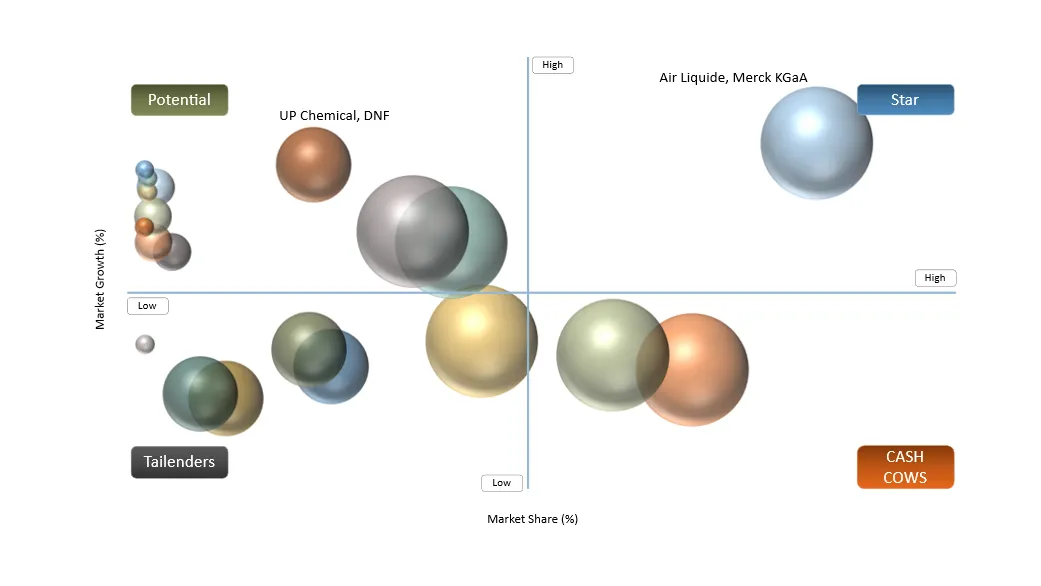
| Category | Representative Companies | Strategic Interpretation |
| Stars | Air Liquide, Merck KGaA, Entegris, SK Inc. Materials | Strong share in high-growth advanced materials, broad qualification networks and capacity near leading fabs. |
| Potential | UP Chemical, DNF, Soulbrain, ADEKA, Nata Opto-electronic Material | High-growth specialty portfolios with expansion potential but lower global breadth or narrower customer coverage. |
| Cash Cows | Linde, Taiyo Nippon Sanso, Resonac | Established electronic-materials and gas relationships supporting recurring demand in mature and advanced fabs. |
| Tailenders | Smaller regional and laboratory suppliers | Limited qualified scale, concentrated customers or exposure to slower-growth precursor categories. |
Air Liquide, Merck, Entegris and SK Inc. Materials are positioned as Stars because they combine advanced chemistry, application support, global manufacturing and relationships with leading chipmakers. Potential players can move upward by securing advanced-node qualifications and building regional high-volume capacity. Cash Cows retain value through established customer approvals and broad electronic-material portfolios, while smaller suppliers face difficulty meeting capital, purity and redundancy requirements.
Semiconductor Precursor Market Dynamics
Driver Impact Analysis
| Driver | Growth Impact | Demand Concentration | Strategic Impact |
| Rising deposition intensity | High | Advanced logic and 3D memory | Increases precursor consumption per wafer and expands demand for conformal ALD films. |
| AI, HBM and data-center chips | High | Memory, foundry and packaging | Accelerates high-k, metal, barrier and packaging precursor demand. |
| Regional fab expansion | Medium-High | U.S., Japan, Taiwan and Korea | Creates demand for localized production, inventory and dual-source qualification. |
| Material substitution | Medium-High | Advanced nodes | Creates premium opportunities in molybdenum, ruthenium and cobalt. |
Driver: Rising Deposition Intensity in Advanced Logic and Memory
Advanced devices use more layers, more three-dimensional structures and tighter film specifications. Gate-all-around transistors require highly conformal gate, spacer and contact materials. 3D NAND increases deposition cycles as layer counts rise, while HBM adds advanced packaging and interconnect steps. This expands precursor demand even when wafer growth is moderate. Suppliers benefit when their materials solve scaling problems that cannot be addressed through equipment alone.
FOR INSTANCE: Air Liquide states that its Subleem portfolio includes ultra-high-purity molybdenum chlorides and proprietary gas-phase delivery systems designed for advanced memory and logic devices, including 3D NAND architectures where continuous high-flow delivery is required.
Restraint Impact Analysis
| Restraint | Drag on Growth | Primary Impact Area | Strategic Impact |
| Lengthy qualification cycles | High | New product commercialization | Delays revenue and raises risk that a material roadmap changes before adoption. |
| High customer concentration | High | Pricing and bargaining power | Creates dependence on a small number of foundry and memory accounts. |
| Purity and scale-up complexity | Medium-High | Manufacturing yield | Requires expensive analytical controls and can limit qualified capacity. |
| Hazardous handling and transport | Medium | Regional logistics | Raises compliance cost and favors local production. |
Restraint: Lengthy Qualification and High Customer Concentration
A new precursor must pass molecule screening, deposition testing, integration, reliability and high-volume manufacturing validation. The process can take several years and depends on close access to customer tools and wafers. Revenue is concentrated among a limited number of large chipmakers, which strengthens buyer negotiating power. Suppliers must therefore fund R&D and pilot capacity before commercial certainty is established.
Semiconductor Precursor Market Segment Analysis
The global market is segmented by precursor family, deposition process, material function, device type, node category, end-use application and region.
By Precursor Family
Metal Precursors Will Lead Value Creation
Metal precursors are expected to remain the largest value segment because advanced devices require conductive films, liners, barriers, contacts and electrodes with increasingly demanding resistance and conformality. Tungsten remains important, while cobalt, ruthenium and molybdenum gain attention for advanced scaling. Silicon precursors retain broad volume demand, high-k materials remain essential for gate and capacitor structures, and compound-semiconductor precursors support power, RF and optoelectronic growth.
By Deposition Process
Atomic Layer Deposition Will Record the Fastest Growth
ALD leads growth because it provides atomic-scale thickness control and conformal coverage across deep, narrow and three-dimensional structures. CVD remains a major volume process for silicon, dielectric and metal films. Plasma-enhanced processes support lower temperatures, while epitaxy is central to advanced silicon and compound semiconductors. Area-selective deposition is emerging but remains at an earlier commercial stage.
By Material Function
Conductive and Metal Films Will Capture the Largest Revenue Pool
Conductive films command high value because interconnect and electrode resistance directly affects device performance. Dielectric films remain a broad foundational category across logic and memory. Barrier, liner and seed layers gain importance as features shrink. Doping and junction engineering use smaller volumes but require exact electrical control, while passivation and encapsulation are expanding in advanced packaging.
By Device Type
Memory Will Remain the Largest Application Segment
Memory leads because 3D NAND and DRAM require repeated deposition of dielectrics, electrodes and liners. HBM investment further supports advanced metal and dielectric demand. Logic and foundry applications provide the highest innovation intensity, while power and compound semiconductors create opportunities for specialty epitaxy and dielectric precursors. Advanced packaging is the fastest-growing device-adjacent segment.
By Node Category
Advanced Nodes Below 7 nm Will Generate the Highest Value per Wafer
Advanced nodes use more complex architectures, tighter defect budgets and higher-value materials. They require new metal, high-k and selective deposition solutions. Mature nodes generate substantial volume through analog, automotive and industrial demand, while legacy nodes support stable use of established chemistries. Non-silicon nodes expand through silicon carbide, gallium nitride and photonics.
By End-Use Application
AI and Data Centers Will Be the Fastest-Growing Demand Driver
AI accelerators, network chips and high-bandwidth memory increase demand for advanced logic, memory and packaging precursors. Smartphones remain a large installed demand base, automotive growth supports power and mature-node semiconductors, and industrial electrification expands compound-semiconductor use. Aerospace and defense provide smaller but strategically important demand for trusted supply and specialty devices.
Semiconductor Precursor Market Geographical Penetration
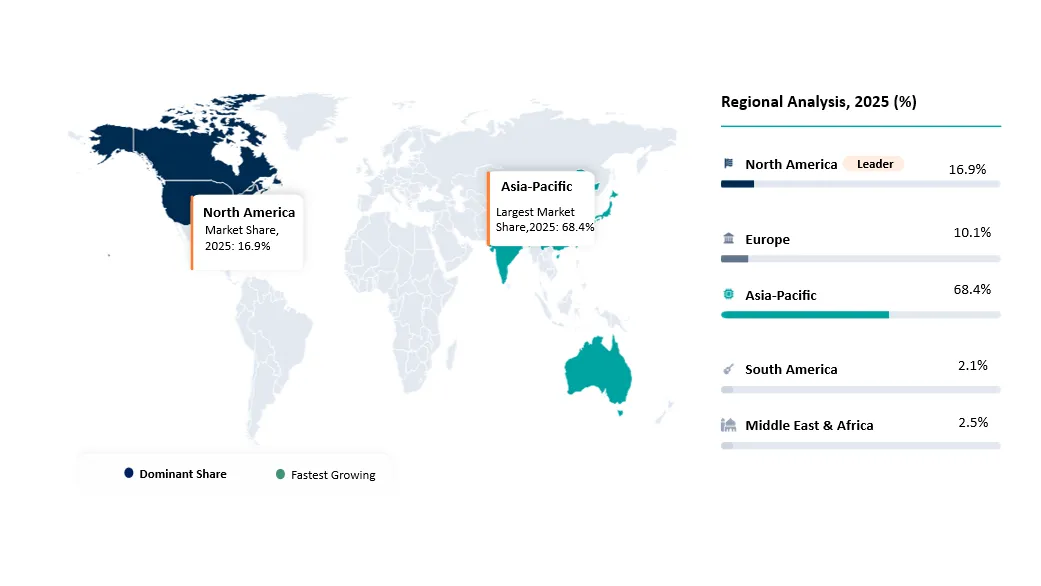
| Region | 2025 Share | 2026-2035 CAGR | Core Demand Drivers |
| Asia-Pacific | 68.4% | 8.0% | Taiwan foundry, Korean memory, Chinese localization and Japanese materials leadership |
| North America | 16.9% | 9.1% | New logic and memory fabs, CHIPS-linked localization and AI infrastructure |
| Europe | 10.1% | 7.4% | Power semiconductors, specialty logic, R&D and advanced materials |
| South America | 2.1% | 6.2% | Packaging, electronics assembly and emerging industrial programs |
| Middle East & Africa | 2.5% | 7.0% | Israel design and manufacturing, Gulf semiconductor strategies and specialty electronics |
U.S. Semiconductor Precursor Market Landscape
The U.S. market is accelerating through advanced logic, memory and foundry investments in Arizona, Texas, New York, Idaho and Ohio. Domestic precursor opportunity is strongest in local purification, high-purity packaging, on-site inventory and qualification support. Federal and state incentives are encouraging suppliers to locate materials capacity near fabs. Buyers prioritize supply security and second-source readiness alongside technical performance.
Taiwan Semiconductor Precursor Market Trends
Taiwan remains the most important advanced foundry market and a critical qualification location for deposition materials. Suppliers benefit from proximity to leading-edge process development and high wafer volumes. The opening of new advanced-materials capacity in Taichung reflects the need for local production of deposition and etching materials. Sustainability, water constraints and resilient logistics are increasingly relevant purchasing criteria.
South Korea Semiconductor Precursor Market Outlook
South Korea combines global leadership in DRAM, NAND, HBM and growing foundry investment. It is a major market for metal, dielectric and dopant precursors. The country is also an important production base for Korean and international suppliers. Molybdenum, diborane and specialty material investments indicate a shift toward new advanced-node chemistries and regional high-volume manufacturing.
China Semiconductor Precursor Market Outlook
China is expanding domestic precursor production to reduce dependence on imported electronic materials. Demand spans mature-node logic, memory, power semiconductors and packaging. Local suppliers are improving purity and gaining domestic qualifications, while global companies continue to invest around major basins. Export controls create uncertainty but also strengthen localization incentives.
Japan Semiconductor Precursor Market Trends
Japan has a strong base in specialty chemicals, purification, containers and process materials. New fab investment in Hokkaido, Kumamoto and Hiroshima supports demand for ultra-high-purity gases and advanced precursors. Japanese suppliers are positioned in silicon, dielectric, metal and compound-semiconductor chemistries. Partnerships with tool and chip companies remain central to qualification.
Germany and Europe Semiconductor Precursor Outlook
Europe is anchored by Germany, Ireland, France, the Netherlands and Italy. Demand is supported by power semiconductors, automotive chips, specialty logic and R&D. European chemical expertise creates opportunities in advanced materials, while environmental regulation raises the value of safer, lower-emission chemistries. Regional supply security is gaining policy attention.
India Semiconductor Precursor Market Opportunity
India is at an early stage but is building fab, compound-semiconductor and packaging projects. Near-term opportunities center on electronic-grade gases, packaging materials, local warehousing and quality laboratories. Over time, precursor manufacturing could develop around anchor fabs, supported by chemical-industry capabilities and government incentives.
Middle East and Africa Semiconductor Precursor Outlook
Israel provides the strongest existing semiconductor demand through advanced manufacturing and design. Gulf countries are exploring semiconductor investment, which could create future opportunities in gases, packaging and specialty materials. The region remains small and will depend on successful anchor projects, technical talent and reliable utilities.
FOR INSTANCE: Air Liquide announced in July 2026 that it would invest more than US$160 million in Arizona to supply an advanced-node fab expansion, while a separate US$150 million Idaho investment would support memory-chip capacity. These projects illustrate the rapid creation of local materials infrastructure around U.S. semiconductor clusters.
Semiconductor Precursor Market Competitive Landscape
- The market is concentrated among global specialty-material companies, industrial-gas suppliers and East Asian electronic-chemical specialists with qualified relationships at leading fabs.
- Competition is molecule-specific. A company may lead in one silicon, high-k or metal precursor while having limited presence in adjacent chemistries.
- Qualification history and application support create stronger barriers than manufacturing scale alone. Suppliers with deposition tools and film analytics can shorten development cycles.
- Regional manufacturing and redundant capacity are becoming differentiators as customers seek continuity across geopolitical and logistics disruptions.
- Delivery hardware, containers and bulk sublimation systems are increasingly bundled with solid and low-volatility precursors.
- Mergers, licensing and partnerships are expected to increase as large companies seek specialized molecules and smaller developers need scale and customer access.
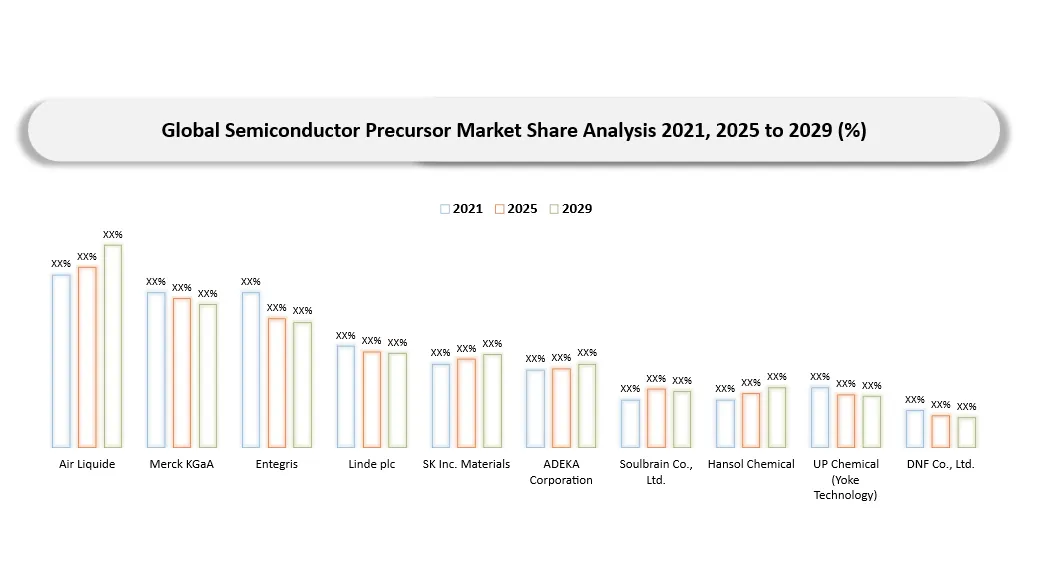
Key Companies of Semiconductor Precursor Market
- Air Liquide
- Merck KGaA
- Entegris
- SK Inc. Materials
- ADEKA
- UP Chemical
- Soulbrain
- DNF
- Hansol Chemical
- Linde
- Taiyo Nippon Sanso
- Resonac
- JSR
- Strem Chemicals
- Gelest
- Dockweiler Chemicals
- Pegasus Chemicals
- Kojundo Chemical Laboratory
- Nata Opto-electronic Material
- Jiangsu Yoke Technology
Semiconductor Precursor Market Major Pain Points
- Qualification cycles that can extend for several years before meaningful revenue begins.
- Extreme purity requirements and the risk that trace contamination causes expensive wafer yield loss.
- Concentrated demand among a small number of leading foundry and memory customers.
- Difficulty scaling solid, corrosive or thermally sensitive precursors into reliable high-volume delivery.
- Exposure to rare-metal prices, specialized packaging and limited qualified logistics providers.
- Need for regional redundancy while maintaining consistent product quality across plants.
- Hazardous-material regulation, abatement requirements and increasing customer sustainability expectations.
- Rapid device-roadmap changes that can reduce the commercial life of a newly developed chemistry.
Semiconductor Precursor Market Recent Developments
- March 2026: Air Liquide inaugurated its first large-scale Advanced Materials manufacturing plant in Taiwan to produce deposition and etching materials for next-generation semiconductors.
- April 2026: Air Liquide announced a EUR 200 million investment in two ultra-pure gas production units in Hiroshima, Japan, supporting next-generation AI chip production from 2028.
- May 2026: Entegris and JSR/Inpria announced a non-exclusive cross-licensing agreement covering metal-oxide-resist patents for next-generation EUV lithography.
- July 2026: Air Liquide announced more than US$160 million of investment in Arizona to supply an advanced-node fab expansion.
- July 2026: Air Liquide announced more than US$150 million of investment in Idaho to support memory-chip manufacturing capacity, with operations planned for 2028.
- July 2025: Air Liquide started a large-scale molybdenum advanced-materials plant in South Korea for high-purity precursor production and proprietary delivery systems.
Analyst View / Opinion on Semiconductor Precursor Market
The market is entering a durable expansion phase because architecture complexity is increasing the number and value of deposition steps. Growth will not be evenly distributed. Established silicon and dopant precursors provide stable volume, while the strongest margin and strategic value lie in advanced metal, high-k, selective and low-temperature platforms. Suppliers should avoid treating all fab capacity as equivalent and instead map precursor demand to specific device transitions.
- Asia-Pacific will remain the center of qualification and high-volume demand, but North America will offer the fastest regional growth through localization.
- Memory and advanced logic will remain the primary value pools, with advanced packaging becoming a major adjacent opportunity.
- Molybdenum and ruthenium have high strategic potential, though adoption timing will vary by device architecture and customer integration route.
- Application engineering, delivery systems and regional manufacturing will matter as much as molecule ownership.
- Suppliers with reusable platforms across several precursors will achieve better risk-adjusted returns than single-product developers.
- Customer concentration and long qualification cycles require disciplined capital allocation and milestone-based commercialization planning.
Semiconductor Precursor Market Target Audience
| Industry | Who Should Buy This Report? | Reason to Buy |
| Electronic Materials | Precursor suppliers, specialty chemical companies and industrial gas groups | Prioritize chemistries, capacity, customers and regional manufacturing. |
| Semiconductor Manufacturers | Foundries, memory companies, IDMs and packaging houses | Assess supply security, alternate sourcing and material roadmaps. |
| Equipment Companies | ALD, CVD, epitaxy and delivery-system providers | Identify materials partnerships and process-integration opportunity. |
| Investors & Consulting | Private equity, venture capital and strategy teams | Evaluate qualification risk, market size and acquisition targets. |
| Government & Economic Development | Semiconductor program agencies and regional authorities | Map materials gaps and local ecosystem requirements. |
| Research Organizations | Universities, consortia and national laboratories | Understand commercialization pathways and industrial demand. |
Why Choose DATAM?
- Data-driven market sizing linked to wafer capacity, deposition intensity and material pricing.
- Post-purchase analyst consultation for qualification, entry strategy, partner identification and capacity planning.
- Annual updates covering fab ramps, material adoption, supplier investment and regulatory change.
- Specialized coverage of emerging materials and regional supply ecosystems.
- Actionable analysis connecting process technology with commercial opportunity.
What DATAM Uniquely Provides
- Ten-year forecasts across precursor family, process, function, device, node, application and region.
- Material-level analysis of silicon, metal, high-k, dopant and compound-semiconductor platforms.
- Buyer-focused assessment of purity, qualification, delivery and supply continuity.
- Regional views linking fab construction with precursor localization.
- Strategic recommendations for R&D, partnership, manufacturing and market entry.


























































