


Semiconductor Gas Filter Market Size
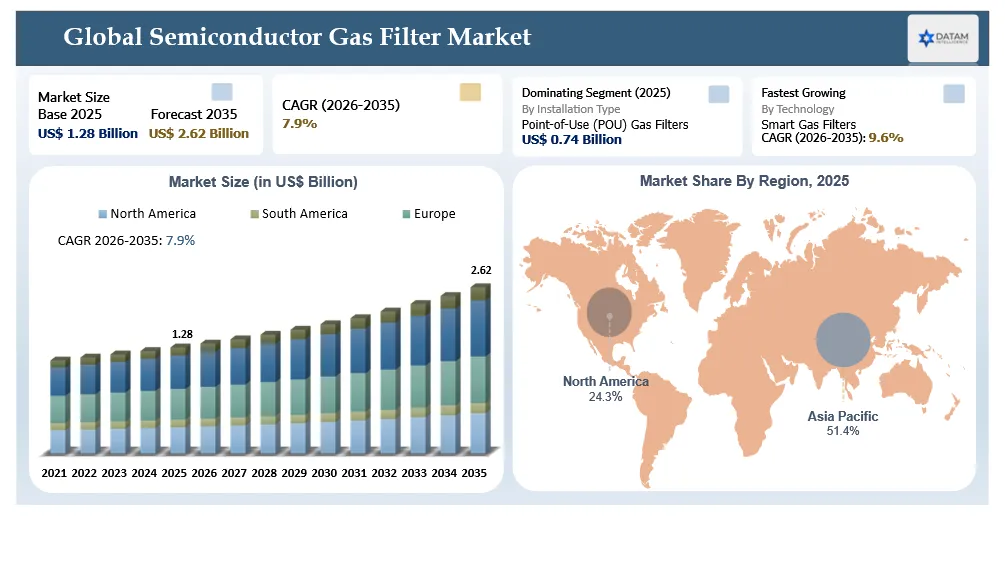
The global Semiconductor Gas Filter market reached US$ 1.28 billion in 2025 and is expected to reach US$ 2.62 billion by 2035, growing with a CAGR of 7.9% during the forecast period 2026-2035.
The industry is driven by rigorous contamination control regulations in semiconductor manufacturing. With regards to the sophisticated layers of 5 nanometers, 3 nanometers and the emerging technology of 2 nanometers, extremely tiny pollution is capable of causing huge issues regarding wafer production and devices’ functioning, thus making ultra-pure gas filtering a significant aspect of gas delivery systems. In contemporary semiconductor facilities, there are more than 50 specialized and common gases including nitrogen, hydrogen, argon, helium, ammonia and other fluorinated gases, which all require filtration for keeping impurities in parts-per-billion concentration levels. In 2025, over $180 billion were spent by the semiconductor industry on wafer production equipment and expanding facilities.
Demand is also augmented by the number of worldwide semiconductor fabrication plants in the pipeline for construction through 2030, whereby every next generation semiconductor fab has numerous ultra-high purity gas filtration points throughout their bulk gas distribution system, gas cabinets, valve manifold boxes and point-of-use gas distribution systems. With the continued development of the semiconductor industry in terms of 5 nm, 3 nm and even 2 nm process technologies, it is becoming increasingly challenging for contamination controls in terms of deposition, etching, lithography and ion implantation processes. It makes semiconductor manufacturers turn to membrane gas filters, ceramic filters and sintered metal filters in order to sustain ultra-high gas purity.
Semiconductor Gas Filter Market Key Takeaways
- Future of Advanced Semiconductor Fab Drive Market Growth: Over 90 semiconductor fabrication plants are expected to be constructed, or expanded from 2024 to 2030, while the investments made in wafer fabrication equipment and capacity expansion of semiconductor companies exceeded US$180 billion in 2025, greatly boosting the demand for ultra-high purity gas filters.
- Dominance of POU Gas Filters Segment: Point of use gas filter segment held 57.8% market revenue share of the global market in 2025 due to their widespread adoption at process tools, gas cabinets, valve manifold boxes and other gas delivery systems for the prevention of contamination during semiconductor manufacturing processes.
- Ultra-High Purity Standards Drive Technology Adoption: Contemporary semiconductor fabrication plants deploy over 50 specialty and bulk gases, with impurity concentrations managed to ppb level or below, as well as filtration systems that can filter particles down to sub-1 nm sizes necessary for advanced technology nodes.
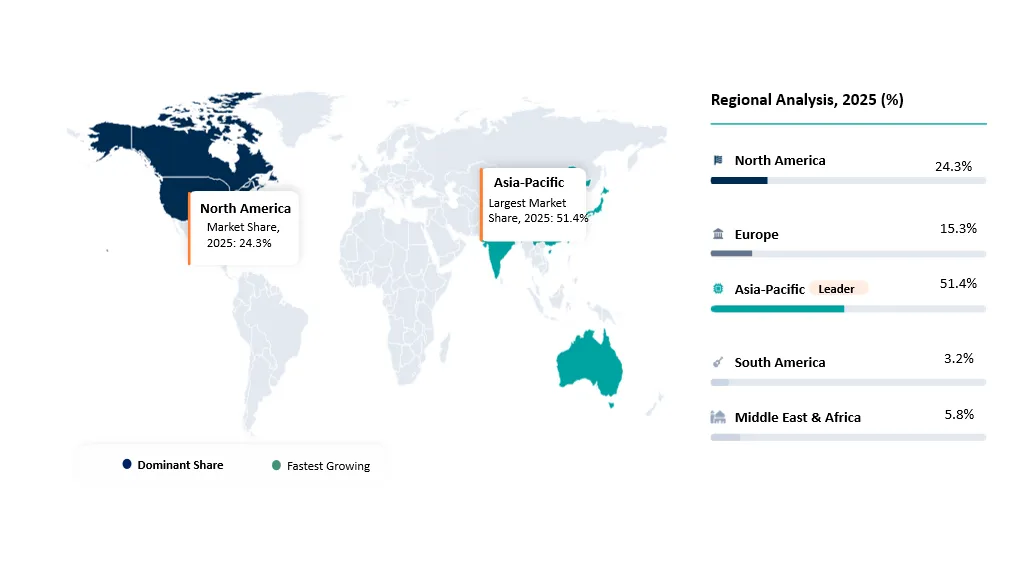
- Asia-Pacific Dominates the Market: In 2025, Asia-Pacific was responsible for 51.4% of the total Semiconductor Gas Filter market worldwide, owing to the presence of semiconductor fabrication plants and continuous development in chip fabrication operations in Taiwan, South Korea, China and Japan.
- Advanced Nodes Raise Filtration Needs: With the industry making strides towards 5nm, 3nm and even the new 2nm node technology, there is an increasing need for new gas filters to increase yield and reliability of the devices while keeping contamination control during the deposition, lithography, etching and ion implantation steps.
Semiconductor Gas Filter Industry Trends and Strategic Insights
- Increased interest in advanced node semiconductors (3 nm, 2 nm and below) is driving the need for ultra-high purity gas filter technology to provide nanometer levels of contaminant control for crucial manufacturing processes.
- Semiconductor manufacturing programs funded by governments and expanded fabs worldwide are offering long-term growth prospects for companies producing semiconductor gas filters that can help with new fabrications.
- Use of specialty gases in electronics is driving the advancement of chemically resistant filtration technologies that meet the needs of semiconductor manufacturing environments.
- The semiconductor industry is becoming more conscious about improving yields and reliability in processes, thus making way for investments in next generation point of use gas filtration systems.
- The participants in the market are making efforts to innovate, forge alliances and gain expertise in qualifying products for semiconductors in view of the fact that there are tough barriers of entry in this market.
Semiconductor Gas Filter Market Scope
| Metrics | Details | |
| 2025 Market Size | US$ 1.28 Billion | |
| 2035 Projected Market Size | US$ 2.62 Billion | |
| CAGR (2026-2035) | 7.9% | |
| Largest Market | Asia-Pacific | |
| Fastest Growing Market | Asia-Pacific | |
| By Installation Type | Point-of-Use (POU) Gas Filters, Bulk Gas Filters, Process Gas Lines, Exhaust Lines, Venting/Purge Lines and Others | |
| By Filter Media Type | Membrane Filters, Ceramic Filters, Sintered Metal Filters, PTFE Filters, Stainless Steel Filters and Others | |
| By Filtration Type | Surface Mesh Filtration, Depth Filtration, Adsorptive Filtration and Hybrid Filtration | |
| By Gas Type | Nitrogen (N₂), Hydrogen (H₂), Argon (Ar), Helium (He), Oxygen (O₂) and Specialty Electronic Gases | |
| By Contaminant Type | Particles, Moisture, Oxygen, Organic/Metal Carbonyls, Acid Gases and Alkaline Gases | |
| By Filtration Rating | Below 1 nm, 1–3 nm, 3–10 nm and Above 10 nm | |
| By Technology | Conventional Filters and Smart Filters | |
| By Application | Photolithography, Chemical Vapor Deposition (CVD), Physical Vapor Deposition (PVD), Dry Etching, Ion Implantation, Chemical Mechanical Planarization (CMP), Semiconductor Packaging & Assembly and Others | |
| By End-User | Integrated Device Manufacturers (IDMs), Semiconductor Foundries, Outsourced Semiconductor Assembly and Test (OSAT) Providers, Semiconductor Equipment Manufacturers, Photovoltaic Manufacturers, Research Institutes & Laboratories and Others | |
| By Region | North America | U.S., Canada, Mexico |
| Europe | Germany, UK, France, Spain, Italy, Poland | |
| Asia-Pacific | China, India, Japan, Australia, South Korea, Indonesia, Malaysia, Singapore, Vietnam, Thailand, Philippines, Taiwan | |
| South America | Brazil, Argentina | |
| Middle East and Africa | Israel, Saudi Arabia, UAE, Turkiye, South Africa, Nigeria | |
| Report Insights Covered | Competitive Landscape Analysis, Company Profile Analysis, Market Size, Share, Growth | |
Why does this report matter in 2026?
Market for the Semiconductor Gas Filter Market has become more strategically important in 2026 as companies that produce semiconductors are constantly increasing their capacities for production as well as moving towards smaller process nodes which requires high-level contamination control. It is highly necessary to have ultra-high-purity gas filtration equipment in order to preserve purity of gas at various stages of semiconductor production process, where even the slightest contamination in the form of particulates and molecules may reduce wafer yields and efficiency of the process.
On the other hand, investments across the globe into semiconductor manufacturing plants are providing continuous opportunities to semiconductor gas filter manufacturers providing contamination control solutions for next generation chip manufacturing. The use of specialty electronic gases, together with stringent qualifications set by semiconductor manufacturers for their suppliers, is stressing the importance of high-quality and chemical compatible filtration technology. In the process of optimizing yields, scaling up of production and process stability, semiconductor gas filters have become essential parts of advanced semiconductor manufacturing processes.
Semiconductor Gas Filter Market White Space & Investment Opportunities
- Advanced semiconductor node manufacturing (3 nm, 2 nm and below) presents substantial opportunities for investments in ultra-high-purity gas filtration technologies capable of meeting increasingly stringent contamination control requirements.
- There are several semiconductor fabrication plants that have been opened recently in the US, Europe, India and Southeast Asia, providing great white space opportunities for the manufacturers of semiconductor gas filters.
- The rise in demand for specialty electronic gases will create chances for the development of chemically compatible filtration systems designed specifically for advanced deposition, etching and ion implantation processes.
- Higher supplier qualifications requirements in the semiconductor industry will raise the importance of strategic alliances and supply contracts, offering chances for existing companies to build up their positions by means of semiconductor product qualification expertise.
- The creation of future point-of-use gas filtration systems that improve wafer yields and scalability will create competitive advantages as semiconductor companies keep expanding their capacities.
Semiconductor Gas Filter Future Market Transformation
The Semiconductor Gas Filter Market will witness major changes during the coming decade due to increased emphasis on contamination control by semiconductor producers during fabrication of devices through the latest technology node. The move towards the advanced semiconductor node technology, increasing use of specialty electronic gases and increasing semiconductor fabrication facilities across the world will drive the need for ultra-high purity gas filters which have improved capabilities to remove particles and are compatible with chemicals. In the future competition in the market is expected to be about not just filter but the qualifications in semiconductors, supply chain partnership and innovative products for specific applications. As semiconductor manufacturing becomes increasingly complex and the tolerance level of contamination decreases, the role of gas filtration will become increasingly important.
Semiconductor Gas Filter Market Buyer Decision-Making Criteria
Major Buyer Decision-Making Criteria:
- Filtration Efficiency and Contamination Control Performance
- Ultra-High-Purity (UHP) Gas Compatibility
- Chemical Compatibility with Specialty Electronic Gases
- Supplier Qualification and Product Validation Status
- Reliability and Operational Lifespan
- Compatibility with Semiconductor Gas Delivery Systems
- Technical Support and Supply Chain Reliability
In terms of the Semiconductor Gas Filter market, purchasing decisions are mainly driven by the performance of filters in terms of filtration efficiency, ability to control contamination and adherence to the ultra-high purity requirements associated with semiconductor manufacturing processes. Semiconductor companies look for gas filters that can offer nanometer particle retention, high chemical resistance to specialty electronic gases, as well as reliability in various critical fabrication processes. Supplier qualification status, validation history and compatibility of the products with current gas delivery systems become important purchasing criteria, because semiconductor fabrication plants normally follow a stringent process of evaluating contamination control technologies before incorporating them into the existing production process. In addition, purchasing criteria may include factors like life span of the product, pressure stabilization ability and reliability of the supplier in providing consistent quality of the product across all manufacturing operations around the world.
Semiconductor Gas Filter Market Economic & Investment Analysis
Market players can derive significant investment returns in the Semiconductor Gas Filter Market because of the significance of the products in semiconductor contamination and the rigorous supplier evaluation process in the industry. The high entry barrier in terms of high purity gas filtration technology, extended product validation periods and strict performance criteria from semiconductor manufacturing make the existing manufacturers highly competitive and help form long-term relationships with customers. Increasing demand for high node semiconductors and specialty electronic gases presents opportunities for specialized gas filtration systems.
From the economic point of view, it is predicted that continued investment in semiconductor fabrication plants throughout the world will continue to create demand for high-quality semiconductor filtration systems incorporated into highly advanced gas delivery systems. Players in the industry have been showing increased interest in innovation of products, local manufacturing and partnerships with semiconductor equipment providers and electronic gases to build strong presence in the market. With semiconductor companies focusing on yield optimization and reliability of the processes, the future of the market looks promising.
Semiconductor Gas Filter Investment Trends in the Market
- Greater investment in cutting-edge semiconductor fabrication equipment is driving the consistent need for semiconductor-grade gas filtration systems that have been installed in ultra-high-purity gas delivery systems.
- The industry is making greater investments in next-generation ultra-high-purity gas filtration systems, which can cater to the needs of next-generation semiconductor nodes.
- The strategic investments being made by companies in qualification facilities and long-term supply contracts are improving the competitive position of the existing players in the market.
- The companies are making efforts towards localized manufacturing and logistics to benefit from the government initiatives related to the production of semiconductors.
- Increasing investments in application-specific gas filtration solutions for specialty electronic gases are driving innovations in the product.
Strategic Indicators for Semiconductor Gas Filter Market
High Regulation Impact
The Semiconductor Gas Filter Market displays a high level of regulation due to strict standards related to contamination control, ultra-high-purity gas handling and qualification procedures for semiconductor products. Compliance with requirements regarding clean room specifications, material compatibility and validation of performance plays a considerable role in the cost of product development, qualification periods and selection of suppliers. The regulatory and industry standards related to semiconductor manufacturing environments provide barriers to market entryance and give preference to manufacturers who possess reliable products and strong customer relationships. Further development of semiconductor manufacturing technologies is expected to increase the importance of adherence to purity and contamination control requirements in the future.
High Investment Activity
There is an increase in investments within the market of Semiconductor Gas Filters due to major capital investments in semiconductor fabrication plants, government-supported semiconductor production programs and rising infrastructure for contamination control around the world. The companies operating in this market are making efforts to increase their investment in research & development in order to develop ultra-high purity gas filters that can be utilized in advanced semiconductor nodes and specialty electronic gases. Manufacturers are also making investments in the capabilities to qualify their products for semiconductors, setting up manufacturing plants locally and creating robust supply chains in order to meet the changing needs of semiconductor producers. Collaborations among gas filter manufacturers, semiconductor equipment manufacturers and electronic gas companies have been speeding up investments in the next generation gas delivery and contamination control systems.
Supply Chain Disruption
The Semiconductor Gas Filter market displays notable supply chain vulnerability due to its reliance on filtration media and processes of a very high purity level and supplier qualification criteria that are specific to semiconductors. Delays and disruptions within the procurement of specialized raw materials or components that are specific to semiconductors and the global nature of the supply chain may affect the production schedule and delivery of ultra-high purity gas filtration systems. Given the strict qualification criteria in the industry, a quick switching to alternative suppliers or material solutions is not possible, creating even more difficulties during periods of supply shortages.
Pricing Volatility
The Semiconductor Gas Filter Market is characterized by moderate prices due to volatile changes in the prices of high-purity filtration materials and sophisticated manufacturing demands, along with the capital investment cycles in the semiconductor industry. The prices of semiconductor-grade gas filter products may experience variations of about 5%–10% due to differences in filtration criteria, need for contamination control and chemical compatibility of the filter material with specialty gases used in electronics. Also, supply issues of semiconductor-grade materials may result in annual price changes of about 2%–5% in highly specialized filter products. The strict qualification criteria for suppliers and emphasis on product quality facilitate premium prices for the semiconductor-grade gas filter technology, thus partially neutralizing the pressure from volatile prices of raw materials.
Procurement Pressure
In the Semiconductor Gas Filter Market, procurement pressures are medium to high, driven by factors such as rigorous supplier qualification criteria, lengthy product validation periods and low availability of semiconductor grade gas filter materials. Semiconductor manufacturers prioritize contamination control performance, product reliability and supply continuity, making procurement decisions highly selective and qualification-intensive. The heavy reliance of the industry on certified suppliers and application-specific gas filtration systems results in reduced procurement options and may be a cause for extended lead times when semiconductor production is increased. Moreover, investments in modern semiconductor manufacturing plants are raising the demand for ultra-high purity gas filtration systems, which makes supply reliability an increasingly important factor. With the continuing development of contamination control requirements, the availability of resilient supply chains will be a crucial element for future procurement decisions.
New Technology Adoption
The Semiconductor Gas Filter Market is showing high usage of advanced filtration technologies, as there is an increase in the intricacy of the semiconductor manufacturing process and the rise in contamination control requirement. Companies are adopting new-generation ultra-high-purity gas filters that offer nano-particle retention capacity, superior chemical compatibility with specialty electronic gases and operational dependability for crucial fabrication environments. With the rise in adoption of advanced semiconductor nodes, there is a trend towards the adoption of application-specific filtration technologies for advanced deposition, etching and ion implantation applications. In addition, advancements in filtration media, precision engineering and gas delivery systems have resulted in better contamination control performance as well as wafer yield optimization and scalability. With the advancement in semiconductor fabrication technology, the adoption of advanced gas filter solutions is anticipated to be a major factor for innovation in products and competitiveness in the market.
Regional Expansion Opportunity
The Semiconductor Gas Filter Market is highly likely to experience considerable potential for regional expansion, due to steady investments in semiconductor fab facilities in regions like Asia-Pacific, North America and Europe. The government-sponsored manufacturing of semiconductors coupled with huge investments in advanced fab capacity is likely to drive demand for high purity gas filters for several years to come. Key semiconductor manufacturing nations, including the US, Taiwan, South Korea, Japan, China and various European economies continue to present major opportunities, while emerging nations like India and South East Asia continue to open up new frontiers for semiconductor gas filters market development. Moreover, manufacturers are steadily increasing investments in regional manufacturing plants and supply chains to cater to special semiconductor qualifications.
Government Policy Support
The Semiconductor Gas Filter Market is experiencing significant advantages from the favorable government policy backing that is aimed at enhancing the semiconductor manufacturing capabilities within the country and developing robust supply chains for semiconductors on a global scale. The national programs for semiconductor development and government backing in the form of incentives is leading to substantial investments in the latest fabrication plants, which will ensure sustained demand for the extremely high purity gas filters and contamination control measures used in semiconductor manufacturing. Such government policies for localized semiconductor development, strengthening of the supply chains and strategic development of technology are ensuring investments in the regional infrastructure.
Pricing Intelligence
Semiconductor Gas Filter Market exhibits pricing strategy based on value owing to the need for stringent contamination control, very high performance standards and the supplier qualification process specific to the semiconductors. The pricing of highly valued semiconductor-grade gas filter products may be 15%-30% higher than the general industrial gas filter products due to their capability of filtering particles in nanometers, compatibility with specialty electronic gases and reliability in various applications for fabrication. Products that are specifically qualified semiconductor gas filters may be priced between 10%-25% higher than the general products. Cost of ownership becomes a priority factor for semiconductor manufacturers in decision-making processes in terms of reliability, availability and lifetime. As a result, established suppliers of these products with unique technology and customer relationship have an advantage in maintaining the premium pricing in the market.
| HS Code | Reporter | Trade Flow | 2025 Trade Value | Interpretation |
| 8421.39 | China | Imports | US$ 4.82 Billion | Reflects robust demand for gas filtration and purification equipment driven by semiconductor manufacturing expansion and contamination control requirements. |
| 8421.39 | United States | Imports | US$ 3.67 Billion | Indicates substantial investments in semiconductor fabrication capacity and ultra-high-purity gas handling infrastructure. |
| 8421.39 | Taiwan | Imports | US$ 1.96 Billion | Highlights the extensive use of gas filtration solutions across advanced semiconductor foundry operations. |
| 8421.39 | South Korea | Imports | US$ 1.74 Billion | Demonstrates significant adoption of gas purification technologies in memory and logic semiconductor manufacturing facilities. |
AI Impact Analysis of Semiconductor Gas Filter Market
The rising use of AI technology is impacting the Semiconductor Gas Filter Market in an indirect manner by fueling investments in the advanced capacities of semiconductor manufacturing. The growing need for AI accelerators, processors for high-performance computing and advanced memory devices is leading to the manufacture of cutting-edge semiconductor chips that necessitate ultra-high-purity gas filters in different manufacturing steps. In this way, the use of AI is expanding semiconductor manufacturing and adding pressure on the industry for contamination controls in advanced process nodes, thus boosting the demand for high-performance gas filters with better particle retention capabilities and chemical compatibility. At the same time, major investments in future-oriented semiconductor fabrication plants for producing AI-based chips are presenting considerable growth prospects for the manufacturers of semiconductor gas filters.
Disruption Analysis of Semiconductor Gas Filter Market
The Semiconductor Gas Filter Market is witnessing competitive disruption arising from increasingly stringent semiconductor-specific qualification requirements and the growing preference for application-specific contamination control solutions. There has been increasing focus from the semiconductor manufacturers on the supplier’s reliability, product qualification and ultra-high purity specifications resulting in low levels of supplier substitution. Thus, the competition has moved from filtration technology to qualification, technical support and application-specific gas filtration solutions.
On the other hand, changes in the demands for semiconductor manufacturing are also creating chances for differentiation on the part of the manufacturers. Increasing emphasis on specialized gas filtration technologies, localized manufacturing and contamination control measures have become significant aspects of meeting the changing demands in semiconductor manufacturing. Changes in the areas of supply security and customization of products for semiconductors will result in the need to change the approaches towards procurement in favor of firms that combine technology and customer engagement.
Semiconductor Gas Filter Market BCG Matrix: Company Evaluation
STAR
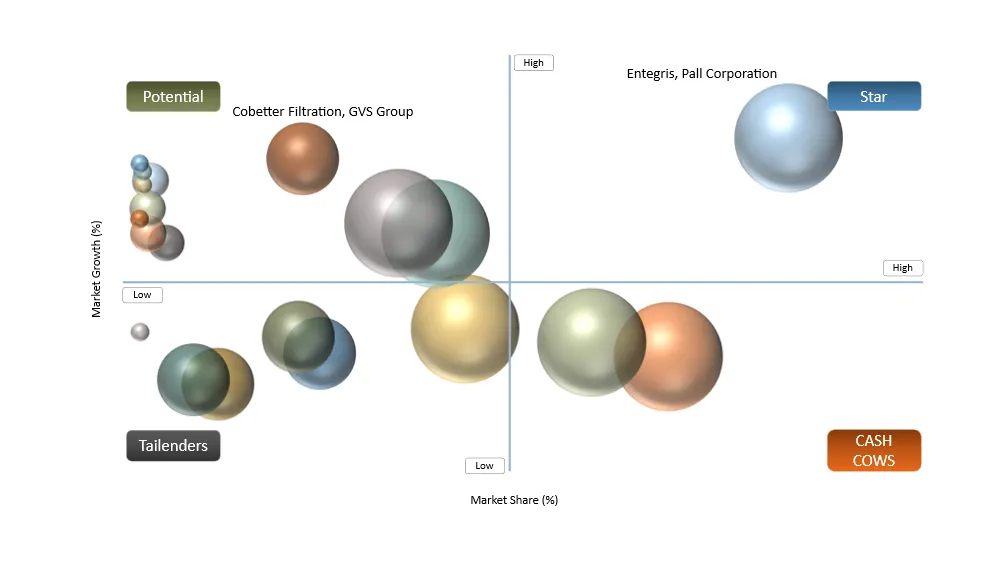
Entegris, Pall Corporation, Fujikin Incorporated, Mott Corporation and CKD Corporation belong to the Star category because of their dominance in the market of semiconductor contamination control and ultra-high-purity gas filtration. These companies have longstanding supply chains with the major semiconductor foundries and integrated device manufacturing companies backed up with product qualification, wide product offerings including point-of-use and bulk gas filtration technologies and investments in the development of filtration technologies based on membranes and sintered metals. Their dominance in advanced 5 nm, 3 nm and upcoming 2 nm fabs allows them to benefit from ongoing growth in semiconductor chip manufacturing.
POTENTIAL
Cobetter Filtration, GVS Group, KITZ SCT Corporation, SAES Pure Gas, HyupSung Co., Ltd., M&C TechGroup, Ham-Let Group and MATHESON Tri-Gas are considered Potential competitors because of their increasing range of semiconductor products and presence in ultra-high-purity gas delivery and contamination control applications. These companies are building up their competitiveness through regional expansion, product development, formation of partnerships with semiconductor equipment manufacturers and investment in Asia Pacific's emerging fabrication landscape. With increasing global semiconductor capacity, these firms are likely to gain market access by providing solutions in gas filtration and purification.
Semiconductor Gas Filter Market Dynamics
Driver Impact Analysis
| Driver | Market Growth Impact (%) | Demand Concentration | Impacted Use Case | Strategic Impact |
Rising Investments in Advanced Semiconductor Fabs (3 nm, 2 nm and Below) | 8.70% | High in Asia-Pacific and North America | Ultra-High Purity (UHP) Gas Filtration for Leading-Edge Semiconductor Manufacturing | Expands demand for nanometer-scale filtration technologies required for next-generation semiconductor processes. |
Increasing Adoption of Specialty Electronic Gases in Chip Manufacturing | 7.90% | High among Foundries and IDMs | Gas Delivery Systems for CVD, Etching and Ion Implantation Processes | Creates opportunities for chemically compatible filters designed for highly reactive process gases. |
Stringent Yield and Contamination Control Requirements | 7.20% | High in Advanced Logic and Memory Chip Production | Point-of-Use Gas Filtration for Critical Process Equipment | Strengthens the adoption of high-efficiency gas filters to minimize particle contamination and improve wafer yields. |
Expansion of Domestic Semiconductor Manufacturing Programs Worldwide | 6.80% | High in the United States, China, South Korea, Japan and Europe | Bulk Gas Distribution Systems for New Semiconductor Fabs | Supports long-term demand for semiconductor-grade gas filtration systems across newly established fabrication facilities. |
Driver: Rising Investments in Advanced Semiconductor Fabrication Facilities
The growing investments in advanced semiconductor fabrication plants are one of the major reasons behind the growth of the Semiconductor Gas Filter Market owing to the rise in demand for ultra-high purity gas filter technology needed in advanced semiconductor fabrication. With the trend shifting towards smaller semiconductor fabrication nodes, the demands for contamination control are rising in several semiconductor fabrication processes, which is further fueling the need for high-end gas filter technology that can effectively retain particles at nanometer size along with superior chemical compatibility with speciality gases used in electronics industry. The future investments in advanced semiconductor manufacturing technologies will be among the major drivers of the market.
Restraint Impact Analysis
| Restraint | Drag on Market Growth (%) | Primary Impact Area | Impacted Use Case | Strategic Impact |
High Manufacturing and Qualification Costs of Ultra-High Purity (UHP) Gas Filters | 4.80% | Product Development and Manufacturing | Nanometer-Scale Gas Filtration for Advanced Semiconductor Nodes | Increases production costs and extends qualification timelines for semiconductor-grade filtration products. |
Lengthy Customer Qualification and Validation Processes | 4.20% | Semiconductor Fab Procurement and Supplier Approval | Point-of-Use Gas Filtration Systems | Limits rapid market penetration, particularly for new entrants seeking approval from semiconductor manufacturers. |
Limited Supplier Qualification Opportunities in Semiconductor Fabs | 3.90% | Vendor Selection and Supply Agreements | Ultra-High Purity Gas Delivery Systems | Strengthens incumbent suppliers' market positions and creates high entry barriers for emerging manufacturers. |
Supply Chain Constraints for High-Purity Filtration Materials | 3.50% | Raw Material Procurement | Bulk and Specialty Gas Filtration Systems | Creates procurement challenges and may affect production scalability amid rising semiconductor industry demand. |
Restraint: Stringent Supplier Qualification Requirements and Extended Product Validation Cycles
Stringent supplier qualification criteria and prolonged product validation periods constitute an important restraint for the Semiconductor Gas Filter Market in terms of prolonging both time and cost involved in bringing semiconductor gas filtration products into the market. Semiconductor manufacturers adopt stringent qualification processes in order to ensure that the filtration products are able to meet the contamination control criteria, ultra-high purity requirements and long-lasting durability in terms of performance. Prolonged validation processes may delay the release of products and limit the diversity of suppliers of the products along with slowing down innovation within filtration technology in the semiconductor industry. Also, large investments in semiconductor testing and qualification processes set a very high threshold for entry into the market.
Semiconductor Gas Filter Market Segment Analysis
The global Semiconductor Gas Filter market is segmented based on the Installation Type, Filter Media Type, Filtration Type, Gas Type, Contaminant Type, Filtration Rating, Technology, Application, End-User and region.
By Installation Type
Point-of-Use (POU) Gas Filters Remain the Preferred Installation Type
The Semiconductor Gas Filter market in 2025 was predominantly captured by the Point-of-Use (POU) Gas Filters segment, which accounted for 57.8% of the market share globally. Factors leading this segment’s success are related to its unique contribution to overall semiconductor manufacturing process, wherein the POU gas filters work as the last filtration to be applied before the process gases are sent for use in semiconductor equipment. POU gas filters are responsible for removing the particulate, moisture and molecular contaminants from ultra-pure gases that are used at the deposition, lithography, etching, ion implantation and important fabrication procedures. Adding to their popularity is the rising need for POU filtration systems as many production facilities are busy running with the 5 nm, 3 nm and upcoming 2 nm technologies in favor of more aggressive contamination control regimes, positively affecting the wafer yield, process consistency and device performance.
By Technology
Smart Gas Filters Expand with Increasing Digital Monitoring Requirements
It is anticipated that the Smart Gas Filters segment will witness the highest CAGR of 9.6% from 2026 to 2035. The growth can be attributed to increased investments in semiconductor manufacturing processes and the integration of digital monitoring technology in fabrication facilities. Smart gas filters permit the ongoing monitoring of filter performance and gas delivery efficiency and thus allow producers to schedule maintenance work optimally, reduce unforeseen equipment failures and maintain a constant ultra-high purity of gas. The adoption of smart gas filters will surge as semiconductor producers continue paying more attention to efficiency and contamination control in advanced manufacturing processes.
Semiconductor Gas Filter Market Geographical Penetration
Taiwan Semiconductor Gas Filter Market Landscape
Taiwan is considered to be the most strategically significant market for semiconductor gas filters due to its dominance in terms of semiconductor foundry manufacturing and presence of leading fabrication facilities. Contamination control needs for next-generation semiconductor production in Taiwan have led to increased demand for semiconductor gas filters that are capable of filtering at the nanometer level and can be used for various specialty electronic gases. Semiconductor manufacturers in Taiwan employ strict supplier quality and purity controls in their processes of fabrication, which has led to use of advanced semiconductor gas filtration systems. With the help of continuous innovations in semiconductor manufacturing technology, Taiwan will continue to be an important source of demand for advanced contamination control systems in the coming years.
U.S. Semiconductor Gas Filter Market Landscape
The US holds considerable potential as a market for semiconductor gas filters due to the swift development of facilities for cutting-edge semiconductor manufacturing capacities along with the growing production of AI accelerators, advanced logic semiconductors and high-speed memory chips. Such manufacturing processes necessitate the use of ultra-pure gas delivery systems with high contamination control measures; hence, semiconductor gas filtration systems play a critical role in many stages of the fabrication process. The growing use of specialty electronic gases and wafer yield management in the semiconductor manufacturing industry are some other factors that are propelling the demand for effective gas filter systems that ensure nanometer-level particulate retention and excellent chemical compatibility.
South Korea Semiconductor Gas Filter Market Outlook
The Republic of South Korea is a strategically important market for gas filters used in the semiconductor industry owing to its dominance in the world market in terms of its memory semiconductors and investments in new technology production of chips. The increasing contamination-sensitivity of manufacturing environment requires the use of ultrahigh purity gas filtration equipment suitable for specialty electronic gas handling and semiconductor manufacturing on a large scale. Semiconductor manufacturers in South Korea emphasize the need for efficiency, consistency and advanced contamination control capabilities in the process of producing larger amounts of semiconductor products. Further technological developments in semiconductor manufacturing processes are likely to stimulate the demand for semiconductor gas filters in the region.
Japan Semiconductor Gas Filter Market Outlook
Japan emerges as a strategic market for semiconductor gas filters due to its highly competitive semiconductor materials environment and strict contamination control requirements in all semiconductor manufacturing processes. Increased investment by Japan in next generation semiconductor production is contributing to the rising need for ultrahigh purity gas filter technologies that are capable of ensuring process stability and optimization of wafer yields. Japanese companies emphasize on chemical purity, reliability and specialty electronic gas handling, which has led to the use of high-end gas filtration systems with improved particle retention and chemical resistance features. With constant developments in semiconductor manufacturing technologies and a developed semiconductor supply chain, Japan is likely to emerge as a key market for advanced semiconductor gas filtration solutions during the forecast period.
China Semiconductor Gas Filter Market Trends
The country is becoming an increasingly important strategic market for semiconductor gas filters as a result of huge investments in the semiconductor manufacturing capacity within the nation, as well as an increasing focus on semiconductor self-reliance. With a very rapid increase in the construction of wafer fabrication plants, there is a high demand for ultra-high purity gas filter technology that is needed in maintaining strict contamination control levels within the semiconductor production process. With an increasing focus on process reliability, localizing the supply chain and contamination control systems within Chinese semiconductor producers, there is an expectation that investments in semiconductor manufacturing and specialty electronic gas handling will boost the demand for semiconductor gas filters.
Semiconductor Gas Filter Market Competitive Landscape
- Competition is headed by players in UHP gas filtration, with players concentrating on attaining ppb levels of contaminant removal for processes like deposition, etching, lithography and ion implantation in advanced semiconductor manufacturing.
- The long qualification periods of semiconductor foundries and OEMs provide a substantial competitive advantage, considering that once a gas filtration system is qualified, it will stay in place throughout the entire lifecycle of its production process.
- Innovation in products is still an important factor of differentiation, with top firms developing innovative membranes, sintered metal and PTFE filtration systems and smart filters capable of performance monitoring and maintenance.
- Expansion in terms of capacity and regional production facilities has increased the level of competition; this trend is most pronounced in Asia-Pacific countries like Taiwan, South Korea, China, Japan and Southeast Asia, where semiconductor plants have been established recently.
- Differentiation through competitiveness is now determined by such factors as filtration efficiency, pressure stability, service life and ability to work with advanced nodes of semiconductors.
Key Companies of Semiconductor Gas Filter Market
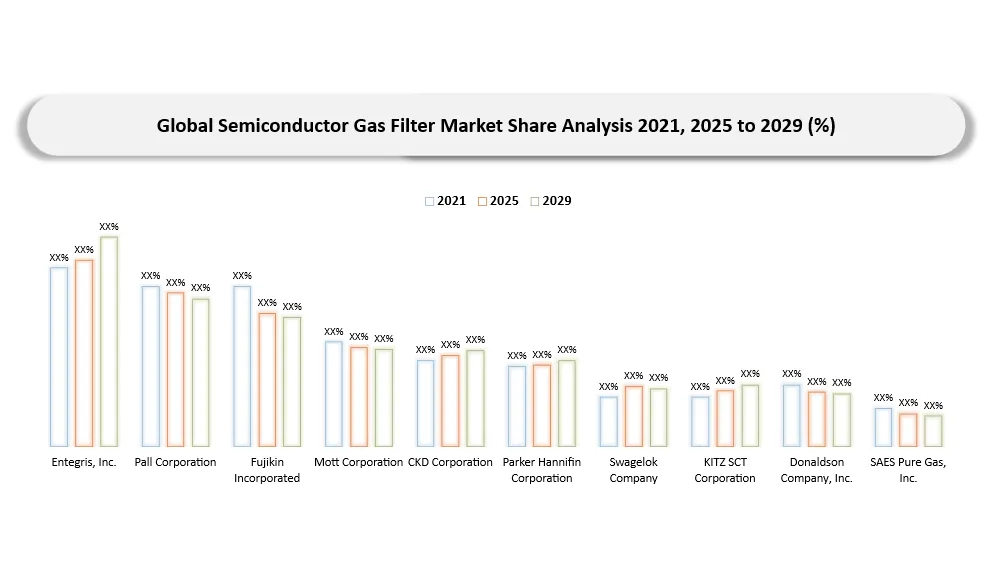
- Entegris, Inc. (United States)
- Pall Corporation (United States)
- Mott Corporation (United States)
- Fujikin Incorporated (Japan)
- CKD Corporation (Japan)
- Nippon Seisen Co., Ltd. (Japan)
- Parker Hannifin Corporation (United States)
- Porvair Filtration Group (United Kingdom)
- Donaldson Company, Inc. (United States)
- SAES Pure Gas, Inc. (United States)
- Swagelok Company (United States)
- KITZ SCT Corporation (Japan)
- Cobetter Filtration Group (China)
- GVS S.p.A. (Italy)
- SMC Corporation (Japan)
- Ham-Let Group (Israel)
- Camfil AB (Sweden)
- M&C TechGroup Germany GmbH (Germany)
- MATHESON Tri-Gas, Inc. (United States)
- HyupSung Co., Ltd. (South Korea)
Semiconductor Gas Filter Market Major Pain Points
- Supplier qualification and validation timelines: Before deploying gas filters for semiconductors, thorough qualification is mandatory, thus extending the commercialization and qualification process of suppliers.
- Ensuring Ultra High Purity Levels Controlling the contamination level to a nanometer scale and chemical compatibility of the specialty gases are still major issues that must be addressed in advanced processing conditions.
- Dependent Supply Chain on Specialized Filtration Components: Dependence on specialized filtration materials and components becomes more risky as well as increases vulnerability of the supply chain for the manufacturers.
- Rising Demand for Contamination Control as Process Nodes Become More Advanced : As process nodes in semiconductors become smaller, there is an increasing demand for higher quality filtration in order to ensure process stability and optimize wafer yields.
- Ensuring High Performance, Longevity and Cost-effectiveness: Semiconductor manufacturers need gas filtration systems that provide outstanding reliability and longevity at an affordable cost of ownership.
Semiconductor Gas Filter Market Recent Developments
- March 2026: Fujikin Incorporated unveiled a new generation of the integrated gas panel module, which is provided with ultra-clean SUS316L double compression ring filters to meet the requirements of high-pressure semiconductor gas delivery systems with ultra-high purity.
- April 2026: Pall Corporation introduced its new generation of Gaskleen® IV and V gas filtration systems, which are based on an O-ring less metal system design, minimizing the generation of particles and outgassing in highly corrosive fluorine gas environment for advanced semiconductor manufacturing.
- May 2026: CKD Corporation made a significant step forward in upgrading the company’s gas control solutions by presenting ultra-clean gas filter modules in conjunction with mass flow controllers (MFCs).
- April 2025: The Swagelok Company released an improved version of its Ultra-High-Purity (UHP) gas distribution panels equipped with integrated metal gas filters that are intended to minimize outgassing and dead-leg generation during high-cycle purging processes of atomic layer deposition (ALD) technology and others.
- September 2025: The KITZ SCT Corporation unveiled the compact C-seal type gas filter range, helping semiconductor equipment producers decrease the size of gas boxes for future EUV lithography tools.
Analyst View / Opinion on Semiconductor Gas Filter Market
- The ever-increasing trend towards the adoption of advanced semiconductor production processes will serve to bolster the market demand for highly pure gas filtration solutions, thus making contamination control capability an important point of differentiation for the market.
- Supplier qualification capability will be as critical as filtration capability itself, given that semiconductor producers are now looking at reliability and compatibility as major factors in choosing gas filter suppliers.
- Investments in semiconductor production plants across the globe will ensure the existence of ample market opportunities for manufacturers of application-specific gas filtration solutions.
- There would be higher uptake of premium gas filters for semiconductors with longer service lives and improved contamination control capabilities in order to enable value-based pricing of semiconductors.
- The semiconductor gas filter manufacturers with the ability to provide solutions for gas filtration of semiconductors will gain greater market share as the production technology for semiconductors improves.
Semiconductor Gas Filter Market Target Audience
| INDUSTRY | WHO SHOULD BUY THIS REPORT? | REASON TO BUY THIS REPORT |
| Semiconductor Manufacturing | Semiconductor Foundries and Integrated Device Manufacturers (IDMs) | To evaluate contamination control requirements and optimize gas filtration strategies for advanced semiconductor manufacturing processes. |
| Semiconductor Equipment | Semiconductor Equipment Manufacturers | To identify filtration technology trends and opportunities across semiconductor process equipment and gas delivery systems. |
| Gas Filtration | Semiconductor Gas Filter Manufacturers | To benchmark competitive offerings, assess technological developments and identify high-growth market segments. |
| Electronic Specialty Gases | Electronic Gas Manufacturers and Suppliers | To align gas purification and delivery solutions with evolving semiconductor fabrication requirements. |
| Semiconductor Infrastructure | Semiconductor Fab Construction and Gas Delivery System Providers | To assess demand arising from new fab construction and capacity expansion projects worldwide. |
| Advanced Materials | High-Purity Filtration Media and Materials Suppliers | To identify opportunities across semiconductor-grade filtration materials and contamination control applications. |
| Investment and Financial Services | Private Equity Firms, Venture Capital Firms and Institutional Investors | To evaluate investment opportunities, market attractiveness and competitive positioning within the semiconductor supply chain. |
| Market Research and Consulting | Consulting and Market Intelligence Firms | To support strategic planning, competitive benchmarking and client advisory services. |
| Research Organizations | Research Institutes and Universities | To analyze technological advancements in ultra-high-purity gas filtration for next-generation semiconductor nodes. |
| Government and Industry Bodies | Government Agencies, Semiconductor Associations and Policymakers | To support semiconductor ecosystem development initiatives and domestic manufacturing programs. |
Why Choose DATAM?
- Data-Driven insights: Dive into detailed analyses with granular insights such as pricing, market shares and value chain evaluations, enriched by interviews with industry leaders and disruptors.
- Post-Purchase Support and Expert Analyst Consultations: As a valued client, gain direct access to our expert analysts for personalized advice and strategic guidance, tailored to your specific needs and challenges.
- White Papers and Case Studies: Benefit quarterly from our in-depth studies related to your purchased titles, tailored to refine your operational and marketing strategies for maximum impact.
- Annual Updates on Purchased Reports: As an existing customer, enjoy the privilege of annual updates to your reports, ensuring you stay abreast of the latest market insights and technological advancements. Terms and conditions apply.
- Specialized Focus on Emerging Markets: DataM differentiates itself by delivering in-depth, specialized insights specifically for emerging markets, rather than offering generalized geographic overviews. The approach equips our clients with a nuanced understanding and actionable intelligence that are essential for navigating and succeeding in high-growth regions.
- Value of DataM Reports: Our reports offer specialized insights tailored to the latest trends and specific business inquiries. The personalized approach provides a deeper, strategic perspective, ensuring you receive the precise information necessary to make informed decisions. The insights complement and go beyond what is typically available in generic databases.
What DATAM Uniquely Provides
- In-depth segmentation analysis for the Semiconductor Gas Filter Market, considering process level segments, with analysis on demand from various applications of semiconductors, gases used and filtration needs.
- Unique competitive analysis for major semiconductor gas filters manufacturers, covering aspects such as technological capability, qualification capability, product portfolio and positioning strategy.
- Comprehensive analysis of the semiconductor factory enlargement, needs for contamination prevention, specialty electronic gas consumption and regional manufacturing investments affecting long-term demand in the market.
- Useful information on the pricing trend, vulnerabilities of the supply chain, procurement policy, regulatory changes and opportunities for investments to assist in the strategic planning.
- Predictions of analysts emphasizing the technology trends, regions of growth, particularities of customer qualification and future chances of competing in the semiconductor gas filtration ecosystem.
Questions This Report Answers
- What are the primary demand drivers, restraints and emerging opportunities shaping the global Semiconductor Gas Filter Market?
- Which semiconductor manufacturing processes, gas types and regional markets are expected to generate the highest growth and investment potential through the forecast period?
- How are leading manufacturers differentiating themselves through technology innovation, semiconductor qualification capabilities and strategic partnerships?
- How will advancements in semiconductor fabrication technologies, contamination control standards and specialty electronic gas adoption influence future market demand?
- What competitive, regulatory, supply chain and procurement trends should stakeholders monitor to develop effective growth and investment strategies in the Semiconductor Gas Filter Market?


























































