


Security Service Edge Market Size and Share and Forecast
The global Security Service Edge market is positioned for sustained double-digit growth through 2035 as enterprises move security inspection from fixed network perimeters to distributed cloud enforcement. SSE has become a core architecture for securing users, devices, branches, cloud applications and web traffic without requiring every session to traverse a central data center. The commercial category combines recurring software subscriptions with implementation, policy migration, managed operations and premium data-protection modules.
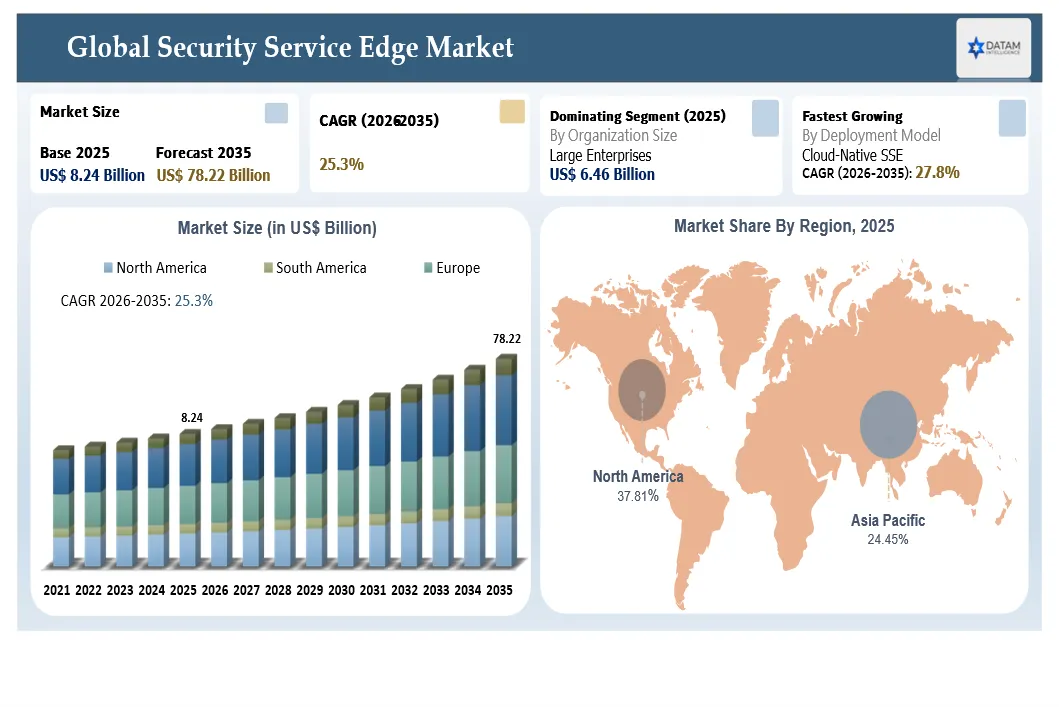
Growth is strongest where organizations are replacing multiple point products with a unified platform. Secure web gateway and zero trust network access form the initial control plane, while CASB, DLP, browser isolation, digital experience monitoring and AI-security capabilities raise module attach rates and contract values. The market is also benefiting from regulatory pressure to implement least-privilege access, continuous verification, data governance and auditable policy enforcement.
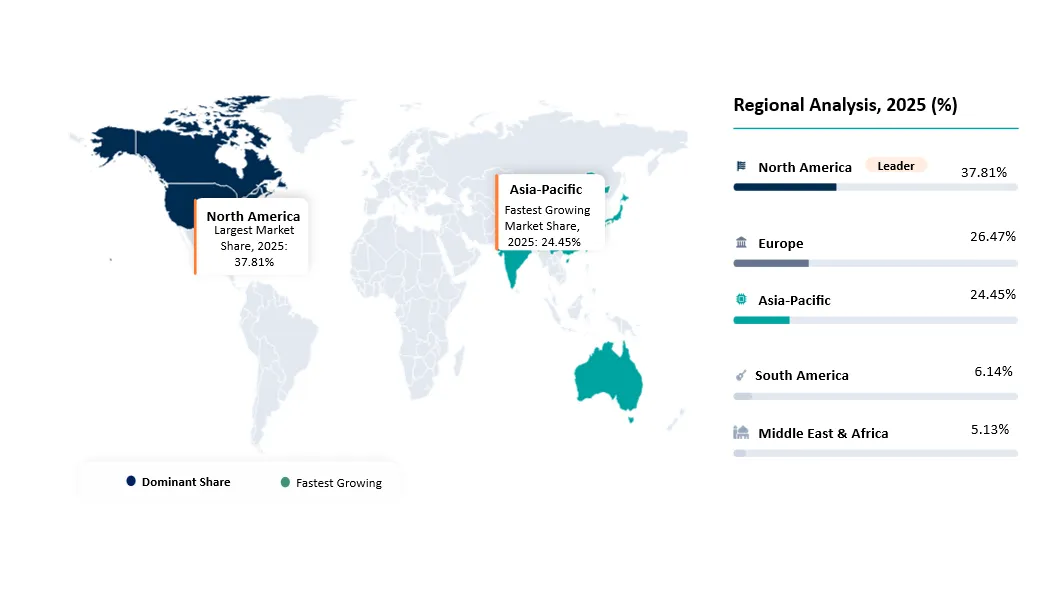
North America remains the largest market due to high cloud adoption and mature cybersecurity spending. Asia-Pacific is expected to be the fastest-growing region as enterprises modernize networks, expand remote access and adopt cloud-delivered security. Competitive leadership will depend on global point-of-presence coverage, policy consistency, data protection, threat intelligence, identity integration, user experience and the ability to demonstrate lower total cost than fragmented security stacks.
Security Service Edge Market Key Takeaways
- Zero Trust Network Access and Secure Web Gateway are the primary entry points, while DLP, CASB, browser isolation and digital experience monitoring drive platform expansion.
- Large enterprises lead current spending, but managed SSE and simplified bundles are opening the midmarket.
- AI usage creates new demand for prompt and data protection, sanctioned application controls, agent identity, inline inspection and model-access governance.
- Platform consolidation is shifting procurement from product-by-product comparisons toward architecture, operational efficiency and cross-module outcomes.
- SSE and SD-WAN convergence is strengthening the broader SASE proposition and increasing competition between cloud-native security vendors and network-security incumbents.
- Data sovereignty and local processing requirements create demand for sovereign points of presence, customer-controlled keys and flexible traffic-routing models.
Security Service Edge Industry Trends and Strategic Insights
- Enterprises are adopting identity-aware access in place of network-level trust and broad VPN connectivity.
- Browser-based security is gaining importance for unmanaged devices, contractors and high-risk web sessions.
- Data security posture, inline DLP and SaaS controls are converging into unified data-protection policies.
- AI copilots and autonomous agents increase east-west and machine-to-machine access, expanding the addressable identity and policy surface.
- Channel partners are moving from resale toward migration, policy engineering, managed operations and experience assurance.
- Vendors are using freemium, bundled and platform-credit models to accelerate adoption and increase module attach rates.
Security Service Edge Market Scope
| Metrics | Details |
| Study Period | 2024-2035 |
| Base Year | 2025 |
| Forecast Period | 2026-2035 |
| Largest Market | North America |
| Fastest-Growing Market | Asia-Pacific |
| By Component | Solutions and Services |
| By Solution | SWG, CASB, ZTNA, FWaaS, DLP, RBI, DEM and Other Capabilities |
| By Deployment Model | Cloud-Native Public, Private or Sovereign and Hybrid SSE |
| By Organization Size | Large Enterprises and SMEs |
| By Enterprise Use Case | Workforce, Branch, Third-Party, SaaS, AI and M&A Integration |
| By Industry Vertical | BFSI, Healthcare, Government, IT, Retail, Manufacturing, Energy, Education, Transportation and Others |
| By Sales Channel | Direct, Partners, MSSPs, Telecom and Cloud Marketplaces |
| Report Insights Covered | Market Size, Share, Growth, Competitive Landscape, Company Profiles and Country-Level Opportunity |
Why does this report matter in 2026?
The year 2026 is a decision point for SSE because enterprise AI adoption, cloud application growth and cyber-risk are increasing faster than traditional perimeter-security models can adapt. Organizations are reassessing VPNs, proxy appliances, standalone CASB products and branch firewalls while seeking a common policy layer for users, applications, data and machine identities. At the same time, security leaders face pressure to reduce tool count and demonstrate measurable cost and risk outcomes.
The report matters because vendor performance is diverging. Cloud-native SSE specialists continue to post strong recurring-revenue growth, broader cybersecurity platforms are using consolidation strategies to expand wallet share and network vendors are integrating security with SD-WAN and campus infrastructure. The Q1-Q2 2026 comparison included in this study helps buyers and investors distinguish headline company growth from the specific factors supporting SSE momentum.
Security Service Edge Market White Space & Investment Opportunities
- Managed SSE for midmarket organizations without dedicated cloud-security teams.
- Sovereign SSE and regulated-industry architectures with local processing and key control.
- AI security for prompts, models, agents, data leakage and unsanctioned generative-AI applications.
- Unified DLP across web, SaaS, private applications, endpoints and collaboration channels.
- Digital experience monitoring that connects security policy, network path and application performance.
- Migration tooling that automates policy conversion from legacy proxies, VPNs and firewalls.
Security Service Edge Future Market Transformation
The market will move from user-to-application inspection toward a broader security fabric for human, device, workload and agent identities. Policy decisions will increasingly combine identity, device posture, data sensitivity, behavior, application context and risk. SSE platforms will become more programmable, with security controls invoked through APIs and integrated into cloud, browser, endpoint and AI development workflows.
By 2035, successful vendors are likely to combine global enforcement infrastructure, zero-trust access, data security, AI governance, experience monitoring and managed operations. Differentiation will shift from feature checklists toward policy quality, detection accuracy, platform reliability, latency, operational simplicity and economic value per protected user or transaction.
Security Service Edge Market Buyer Decision-Making Criteria
Buyers prioritize security efficacy, global service availability, latency, application compatibility, identity integration, policy consistency and data protection. They also evaluate migration effort, logging and analytics, incident response, regulatory coverage, support quality and the ability to consolidate existing licenses. Large enterprises require flexible routing, private application discovery, delegated administration and integration with SIEM, SOAR, endpoint and identity platforms.
Commercial decisions increasingly depend on transparent unit economics. Buyers compare per-user and bandwidth costs, premium module pricing, egress and log-retention charges, implementation services and expected savings from retiring appliances or overlapping tools. Proof-of-value programs that quantify user experience, blocked risk, help-desk reduction and operational effort are becoming central to vendor selection.
Security Service Edge Market Economic & Investment Analysis
SSE economics are attractive because subscription revenue is recurring, gross margins are high and platform expansion can increase revenue without a proportional increase in customer-acquisition cost. However, vendors must invest in global infrastructure, threat research, data processing, sales capacity and partner enablement. Competitive pricing and free-platform credits can delay near-term monetization even when they accelerate long-term platform adoption.
Investors should distinguish total company growth from SSE-specific growth. ARR, RPO, billings, large-customer additions and module attach rates provide better forward indicators than quarterly revenue alone. The strongest models combine high retention, multi-product expansion, efficient cloud infrastructure and a credible route to sustained operating margin.
Security Service Edge Investment Trends in the Market
- Capital is moving toward AI-security, data-security and browser-security capabilities that expand SSE beyond access control.
- Platform vendors are acquiring adjacent identity, observability and data-security assets to strengthen consolidation strategies.
- Service providers are investing in managed SASE and SSE operations for midmarket and regulated customers.
- Cloud infrastructure investment is focused on capacity, local data processing, private backbone connectivity and performance optimization.
- Channel investment is shifting toward lifecycle services, policy migration and continuous optimization.
Strategic Indicators For Security Service Edge Market
High Regulation Impact
Privacy, cybersecurity and critical-infrastructure rules increase demand for access controls, data protection, logging and auditability. Data-localization obligations influence point-of-presence architecture and traffic routing.
High Investment Activity
Public vendors are funding cloud infrastructure, AI security, data protection and platform sales. Private vendors continue to attract capital around unified SASE, browser security and managed security.
Supply Chain Disruption
The market is software-led, but service continuity depends on cloud capacity, network transit, data centers, chips and third-party identity or endpoint integrations. Outages can affect large customer populations.
Pricing Volatility
Pricing varies by protected user, bandwidth, module, log retention and service tier. Platform credits, bundled contracts and competitive displacement discounts can create wide effective-price differences.
Procurement Pressure
CISOs seek consolidation and measurable outcomes, while procurement teams push for multi-year discounts, flexible true-ups and protection against data-volume cost escalation.
New Technology Adoption
AI inspection, browser isolation, agent identity, post-quantum readiness, confidential computing and experience telemetry are expanding the technology roadmap.
Regional Expansion Opportunity
Asia-Pacific, the Middle East and Latin America offer growth as cloud adoption and cybersecurity regulation increase, but local processing and channel requirements vary.
Government Policy Support
Zero-trust mandates, cloud-first strategies and critical-infrastructure rules support adoption in public-sector and regulated industries.
Pricing Intelligence
Enterprise contracts increasingly bundle core access with premium data, AI and experience modules. Buyers should normalize offers across users, sites, traffic, logs and services.
AI Impact Analysis of Security Service Edge Market
AI is both a demand driver and a product capability. Generative-AI applications create new data-leakage, shadow-AI and prompt-injection risks, while autonomous agents increase machine identity and application-access complexity. SSE platforms can enforce sanctioned use, inspect prompts and responses, apply DLP, isolate risky sessions and govern access to private models.
Vendors are also applying AI to policy recommendations, anomaly detection, incident investigation, digital experience diagnostics and support automation. Commercial success will depend on model accuracy, explainability, privacy, data residency and integration with enterprise security operations.
Disruption Analysis of Security Service Edge Market
SSE is disrupting appliance-centric security by moving inspection and policy enforcement to globally distributed cloud infrastructure. It reduces dependence on backhauling traffic through central data centers and challenges legacy VPN, proxy and branch-firewall architectures. It also changes the channel model because recurring operations, policy management and migration services become more valuable than hardware installation.
The next disruption is the convergence of access, data and AI security. Vendors that cannot unify policies across web, SaaS, private applications and AI workflows may be displaced by broader platforms. Conversely, platform breadth without operational simplicity can create complexity and weaken customer outcomes.
Security Service Edge Market BCG Matrix: Company Evaluation
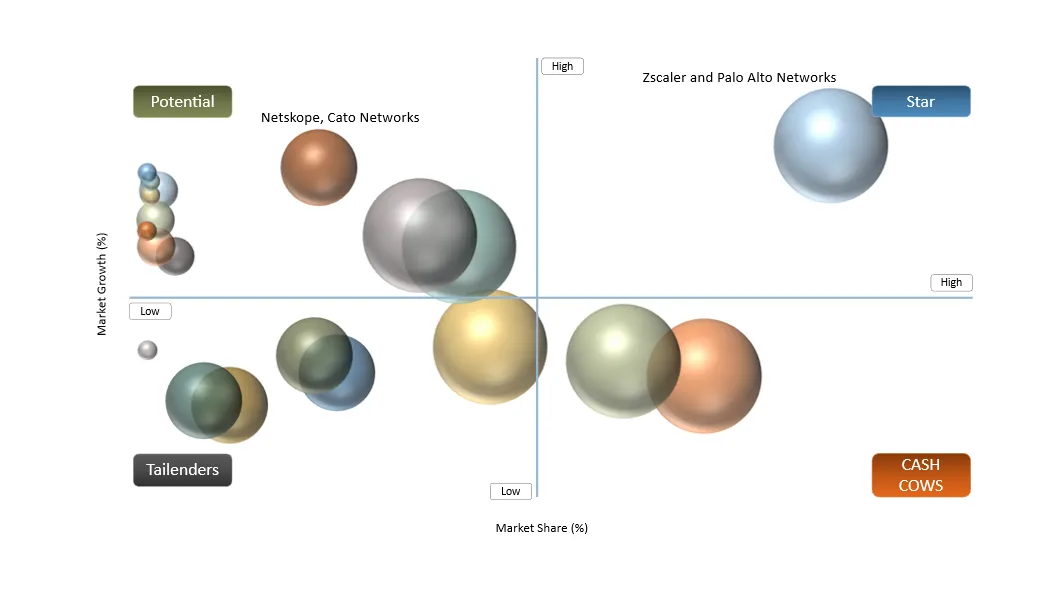
STAR
Zscaler and Palo Alto Networks are positioned as Stars because they combine large recurring-revenue bases, strong growth and broad enterprise adoption. Cloudflare is a high-growth challenger with a global network and increasing enterprise security relevance. Fortinet and Cisco have large installed bases and strong networking channels, but their SSE momentum must be assessed within broader product portfolios.
POTENTIAL
Netskope, Cato Networks, iboss, Menlo Security, Versa Networks and Skyhigh Security represent potential leaders in selected segments. Their future position depends on enterprise scale, channel execution, platform breadth, infrastructure economics and the ability to compete against bundled offerings from larger public vendors.
Security Service Edge Market Dynamics
Driver Impact Analysis
| Driver | Market Growth Impact | Demand Concentration | Impacted Use Case | Strategic Impact |
| Zero-trust and cloud transformation | High | Global large enterprises | Private-app and web access | Accelerates replacement of VPN and proxy appliances. |
| Hybrid work and third-party access | High | Distributed organizations | Remote workforce and contractors | Expands protected-user base and identity integrations. |
| AI application adoption | High | Technology, finance and professional services | Prompt, model and agent security | Raises demand for DLP, CASB and browser controls. |
| Security platform consolidation | Medium-High | Enterprises with tool sprawl | Unified policy and operations | Increases multi-module contracts and competitive displacement. |
Driver: Rapid Adoption of Zero Trust and Cloud-Delivered Security
Zero trust is moving access decisions from network location to continuous evaluation of identity, device posture, application context and risk. This supports SSE because policies can be applied consistently to web, SaaS and private applications through distributed cloud enforcement. The architecture also aligns with cloud migration and hybrid work, where users no longer operate primarily behind a corporate perimeter.
Restraint Impact Analysis
| Restraint | Drag on Growth | Primary Impact Area | Impacted Use Case | Strategic Impact |
| Legacy integration and migration complexity | High | Deployment execution | Proxy, VPN and firewall replacement | Extends sales cycles and increases professional-services needs. |
| Data sovereignty and privacy concerns | Medium-High | Regional architecture | Regulated traffic inspection | Requires local processing, encryption and policy controls. |
| Vendor lock-in and platform concentration | Medium | Procurement | Multi-year platform contracts | Encourages interoperability and exit clauses. |
| Latency and application compatibility | Medium | User experience | Real-time and legacy applications | Makes PoV testing and DEM essential. |
Restraint: Integration Complexity and Data-Sovereignty Requirements
Migration from existing proxies, VPNs, firewalls and CASB tools requires policy conversion, application discovery, identity integration and staged traffic cutover. Regulated customers may also restrict where decrypted content and logs are processed. Vendors must provide migration automation, local inspection options, transparent data flows and strong service-level commitments.
Security Service Edge Market Segment Analysis
The global Security Service Edge market is segmented based on Component, Solution, Deployment Model, Organization Size, Enterprise Use Case, Industry Vertical, Sales Channel and region.
By Solution
Secure Web Gateway Holds the Largest Share
The Secure Web Gateway (SWG) accounted for 34.9% of the SSE market in 2025 and thus was the most significant segment in terms of solutions. SWG solutions help secure users against the risks posed by web threats, malicious websites, phishing attacks, malware, and any unauthorized internet usage, besides enforcing security policies within an organization. The growing dependency on SaaS applications and web processes has increased the demand for secure internet access to areas that go beyond the typical corporate network.
By Deployment Model
Cloud-Native SSE Dominates the Market
The cloud-native implementation of SSE had grown up to 58.3% of the total market share in 2025 due to the growing trend from appliance security to cloud security services. Cloud-native security can help organizations implement security policies near the user/application and not in terms of its physical presence. This model offers features like scalability, easier management, faster implementation, and easy integration with cloud and SaaS architectures. The growing trend of hybrid working and cloud workloads will drive growth.
By Organization Size
Large Enterprises Lead the Market
The category of large firms made up 78.4% of the total market of SSE in 2025 and was therefore the most dominant in terms of size of organizations. This high adoption has been facilitated by the complexities in their IT infrastructures, large numbers of dispersed employees, high reliance on cloud/SaaS applications, and exposure to more advanced attacks. These large enterprises usually have more than one branch or environment and hence more external access points, necessitating a security policy that is uniform throughout their network.
Security Service Edge Market Geographical Penetration
U.S. Security Service Edge Market Landscape
The U.S. leads through high cloud adoption, large cybersecurity budgets, zero-trust programs and a dense ecosystem of platform vendors, cloud providers, integrators and managed service providers. Demand is concentrated in BFSI, technology, healthcare, government and large distributed enterprises.
Germany Security Service Edge Market Outlook
Germany combines strong industrial demand with strict privacy and data-governance expectations. Buyers emphasize EU processing, auditability, integration with identity systems and controlled migration from legacy network-security architectures.
Japan Security Service Edge Market Trends
Japan is adopting SSE through large enterprises, telecom channels and managed services. Reliability, local support, application performance and integration with established network environments are decisive buying criteria.
China Security Service Edge Market Outlook
China presents demand from domestic cloud, internet and enterprise sectors, but market access, data localization and cybersecurity regulation favor localized architectures and local providers.
India Security Service Edge Market Outlook
India is a fast-growing market driven by IT services, digital banking, SaaS companies, distributed workforces and cloud adoption. Managed SSE and scalable per-user models are attractive for both large enterprises and midmarket buyers.
Middle East and Africa Security Service Edge Market Outlook
Gulf markets are investing in cloud, digital government and critical-infrastructure security, creating demand for sovereign processing and managed services. Adoption elsewhere is concentrated in telecom, finance and multinational enterprises.
Security Service Edge Market Competitive Landscape
- Competition includes cloud-native SSE specialists, broad cybersecurity platforms, network-security incumbents, cloud and software companies and managed service providers.
- Zscaler, Palo Alto Networks, Cloudflare, Cisco and Fortinet are major public-company reference points, while Netskope, Cato Networks and other private vendors remain strategically important.
- Differentiation centers on platform breadth, points of presence, data security, AI capabilities, user experience, identity integrations, channel coverage and total cost.
- Platform credits and bundled offers are intensifying price competition and raising the importance of renewal quality and module attach rates.
- MSSPs and telecom operators are influential because many customers require deployment, policy migration and continuous operations rather than software alone.
Public Company Q1-Q2 2026 Performance Comparison
| Public Company | Q1-Q2 2026 Performance | SSE-Relevant Growth Drivers | Strategic Interpretation |
| Zscaler (NASDAQ: ZS) | Fiscal Q1 revenue US$788.1M, +26% YoY; ARR US$3.204B, +26%. Fiscal Q2 revenue US$815.8M, +26%; ARR US$3.359B, +25%. | Zero Trust Exchange expansion, AI security, platform consolidation, large-customer growth and upsell across web, private access and data protection. | Strongest pure-play SSE growth profile among the selected public companies, supported by recurring revenue and cloud-native architecture. |
| Palo Alto Networks (NASDAQ: PANW) | Fiscal Q1 revenue US$2.5B, +16%; NGS ARR US$5.9B, +29%. Fiscal Q2 revenue US$2.6B, +15%; NGS ARR US$6.3B, +33%. | Platformization, Prisma SASE, AI security, cross-sell across network, cloud and security operations and large enterprise consolidation. | Broad platform scale and strong ARR growth support share gains, although results include security categories beyond SSE. |
| Cloudflare (NYSE: NET) | Calendar Q1 revenue US$639.8M, +34%; current RPO +34%. Q2 results were scheduled for release on August 6, 2026 and were not available at the document research cut-off. | Global connectivity cloud, Zero Trust, developer platform, AI inference and security delivered on a unified edge network. | High growth and infrastructure differentiation; enterprise SSE monetization is expanding from a broad connectivity and developer base. |
| Cisco (NASDAQ: CSCO) | Fiscal Q2 revenue US$15.3B, +10%, while Security revenue declined 4%. Fiscal Q3, covering most of calendar Q2, revenue US$15.8B, +12%; Security revenue was flat at US$2.008B. | Installed-base conversion, secure networking, Duo identity, Secure Access, Splunk integration, campus refresh and AI infrastructure demand. | Large channel and customer base create cross-sell potential, but reported security growth trailed cloud-native SSE specialists during the period. |
| Fortinet (NASDAQ: FTNT) | Calendar Q1 revenue US$1.85B, +20%; billings US$2.09B, +31%; product revenue +41%. Q2 revenue was reported at approximately US$2.05B, +26%, with billings approximately US$2.37B, +33%. | Secure networking convergence, FortiSASE, firewall refresh, FortiOS 8.0, AI-driven security and broad channel execution. | Strong acceleration and profitability support SASE investment; hardware and services remain material to the company’s model. |
Note: Fiscal calendars differ. Cloudflare Q2 2026 results were due after the U.S. market close on August 6, 2026, coinciding with the research cut-off. Fortinet Q2 figures are based on the company’s late-July 2026 reporting as summarized in contemporaneous market coverage where the official release was not yet indexed in the source set.
Factors Driving Public-Company Growth
- Expansion of zero-trust access from remote users to branches, contractors, private applications and AI agents.
- Consolidation of SWG, CASB, ZTNA, FWaaS, DLP and experience monitoring into larger platform contracts.
- Growth in AI-related security demand, including sanctioned-use controls, prompt and data protection and model-access governance.
- Replacement of legacy VPN, proxy and firewall appliances with cloud-delivered enforcement.
- Cross-selling through installed bases, cloud marketplaces, telecom channels and managed service providers.
- Higher recurring revenue from large-customer expansion, premium modules and multi-year commitments.
Security Service Edge Market Ecosystem Table
| Value-Chain Sector | Role in the Ecosystem | Representative Companies |
| Cloud and Network Infrastructure | Compute, edge points of presence, backbone connectivity, DNS, CDN and cloud marketplaces. | Amazon Web Services, Microsoft Azure, Google Cloud, Oracle Cloud, Equinix, Digital Realty, Lumen, Akamai, Cloudflare |
| Core SSE Platform Vendors | SWG, CASB, ZTNA, FWaaS, DLP, RBI and unified policy enforcement. | Zscaler, Palo Alto Networks, Netskope, Cloudflare, Cisco, Fortinet, Cato Networks, Skyhigh Security, iboss, Forcepoint |
| Identity and Device Context | Identity, MFA, directory, device posture and endpoint risk signals. | Microsoft, Okta, Cisco Duo, Ping Identity, CrowdStrike, SentinelOne, Ivanti, Jamf |
| Data Security and Governance | Data discovery, classification, DLP, DSPM and rights management. | Microsoft Purview, Palo Alto Networks, Netskope, Zscaler, Forcepoint, Proofpoint, Varonis, BigID, Cyera |
| Browser and Isolation Security | Enterprise browsers, remote browser isolation and unmanaged-device access. | Menlo Security, Island, Palo Alto Networks, Zscaler, Cloudflare, Broadcom, Ericom |
| Observability and Experience | Digital experience monitoring, network telemetry and incident analytics. | Cisco ThousandEyes, Palo Alto Networks, Zscaler, Netskope, Riverbed, Catchpoint, Datadog, Dynatrace |
| Distribution and Integration | Resale, architecture, deployment, migration and support. | TD SYNNEX, Ingram Micro, Arrow Electronics, Westcon-Comstor, WWT, CDW, Accenture, Deloitte, Capgemini, NTT DATA |
| Telecom and Managed Security | Managed SSE/SASE, connectivity, operations and lifecycle services. | Verizon, AT&T, BT, Orange Business, Vodafone Business, Telefónica Tech, Deutsche Telekom, NTT, Kyndryl, Secureworks |
| Enterprise Buyers | Organizations purchasing SSE to protect users, branches, applications and data. | Banks, hospitals, government agencies, manufacturers, retailers, telecom operators, universities and technology companies |
| Standards and Regulatory Bodies | Security frameworks, privacy rules, zero-trust guidance and certification requirements. | NIST, CISA, ENISA, ISO, PCI SSC, national data-protection authorities and sector regulators |
Key Companies of the Security Service Edge Market
- Zscaler
- Palo Alto Networks
- Cloudflare
- Cisco
- Fortinet
- Netskope
- Microsoft
- Broadcom
- Check Point Software Technologies
- Akamai Technologies
- Forcepoint
- Skyhigh Security
- Cato Networks
- iboss
- Lookout
- Menlo Security
- Versa Networks
- Ericsson
- Hewlett Packard Enterprise
- Proofpoint
Company Profiles
Zscaler
Zscaler is a cloud-native SSE leader built around the Zero Trust Exchange. Its portfolio spans internet access, private access, data protection, digital experience and AI security. Competitive strengths include scale, recurring revenue and enterprise referenceability. Priorities include expanding platform adoption, securing AI workloads and increasing large-customer penetration.
Strategic positioning should be evaluated through product coverage, recurring-revenue momentum, global delivery infrastructure, customer concentration, partner ecosystem, innovation cadence and the ability to support migration from legacy security controls.
Palo Alto Networks
Palo Alto Networks competes through Prisma SASE within a broader cybersecurity platform. Its platformization strategy combines network security, cloud security, security operations and identity capabilities. The company benefits from large-enterprise relationships, cross-selling and substantial R&D investment.
Strategic positioning should be evaluated through product coverage, recurring-revenue momentum, global delivery infrastructure, customer concentration, partner ecosystem, innovation cadence and the ability to support migration from legacy security controls.
Cloudflare
Cloudflare delivers Zero Trust and security services over a global connectivity cloud. Its network architecture supports low-latency inspection, application access, web security and developer services. Growth is driven by enterprise adoption, AI traffic and expansion from connectivity into security.
Strategic positioning should be evaluated through product coverage, recurring-revenue momentum, global delivery infrastructure, customer concentration, partner ecosystem, innovation cadence and the ability to support migration from legacy security controls.
Cisco
Cisco combines Secure Access, Duo, networking, SD-WAN, observability and Splunk capabilities. Its installed base and channel ecosystem support integrated secure-networking propositions. Execution depends on converting customers from legacy architectures and demonstrating unified cloud-security outcomes.
Strategic positioning should be evaluated through product coverage, recurring-revenue momentum, global delivery infrastructure, customer concentration, partner ecosystem, innovation cadence and the ability to support migration from legacy security controls.
Fortinet
Fortinet combines FortiSASE with secure networking, SD-WAN, firewalls and security operations. Its custom hardware, broad channel and installed base support performance and commercial reach. Growth is linked to firewall refresh, networking-security convergence and expansion of recurring services.
Strategic positioning should be evaluated through product coverage, recurring-revenue momentum, global delivery infrastructure, customer concentration, partner ecosystem, innovation cadence and the ability to support migration from legacy security controls.
Netskope
Netskope participates in the Security Service Edge ecosystem through cloud security, secure access, networking, data protection, identity, browser security, managed services or enabling infrastructure. Competitive relevance depends on platform breadth, customer scale, channel execution, service reliability, regulatory coverage and integration with enterprise security operations.
Strategic positioning should be evaluated through product coverage, recurring-revenue momentum, global delivery infrastructure, customer concentration, partner ecosystem, innovation cadence and the ability to support migration from legacy security controls.
Microsoft
Microsoft participates in the Security Service Edge ecosystem through cloud security, secure access, networking, data protection, identity, browser security, managed services or enabling infrastructure. Competitive relevance depends on platform breadth, customer scale, channel execution, service reliability, regulatory coverage and integration with enterprise security operations.
Strategic positioning should be evaluated through product coverage, recurring-revenue momentum, global delivery infrastructure, customer concentration, partner ecosystem, innovation cadence and the ability to support migration from legacy security controls.
Broadcom
Broadcom participates in the Security Service Edge ecosystem through cloud security, secure access, networking, data protection, identity, browser security, managed services or enabling infrastructure. Competitive relevance depends on platform breadth, customer scale, channel execution, service reliability, regulatory coverage and integration with enterprise security operations.
Strategic positioning should be evaluated through product coverage, recurring-revenue momentum, global delivery infrastructure, customer concentration, partner ecosystem, innovation cadence and the ability to support migration from legacy security controls.
Check Point Software Technologies
Check Point Software Technologies participates in the Security Service Edge ecosystem through cloud security, secure access, networking, data protection, identity, browser security, managed services or enabling infrastructure. Competitive relevance depends on platform breadth, customer scale, channel execution, service reliability, regulatory coverage and integration with enterprise security operations.
Strategic positioning should be evaluated through product coverage, recurring-revenue momentum, global delivery infrastructure, customer concentration, partner ecosystem, innovation cadence and the ability to support migration from legacy security controls.
Akamai Technologies
Akamai Technologies participates in the Security Service Edge ecosystem through cloud security, secure access, networking, data protection, identity, browser security, managed services or enabling infrastructure. Competitive relevance depends on platform breadth, customer scale, channel execution, service reliability, regulatory coverage and integration with enterprise security operations.
Strategic positioning should be evaluated through product coverage, recurring-revenue momentum, global delivery infrastructure, customer concentration, partner ecosystem, innovation cadence and the ability to support migration from legacy security controls.
Forcepoint
Forcepoint participates in the Security Service Edge ecosystem through cloud security, secure access, networking, data protection, identity, browser security, managed services or enabling infrastructure. Competitive relevance depends on platform breadth, customer scale, channel execution, service reliability, regulatory coverage and integration with enterprise security operations.
Strategic positioning should be evaluated through product coverage, recurring-revenue momentum, global delivery infrastructure, customer concentration, partner ecosystem, innovation cadence and the ability to support migration from legacy security controls.
Skyhigh Security
Skyhigh Security participates in the Security Service Edge ecosystem through cloud security, secure access, networking, data protection, identity, browser security, managed services or enabling infrastructure. Competitive relevance depends on platform breadth, customer scale, channel execution, service reliability, regulatory coverage and integration with enterprise security operations.
Strategic positioning should be evaluated through product coverage, recurring-revenue momentum, global delivery infrastructure, customer concentration, partner ecosystem, innovation cadence and the ability to support migration from legacy security controls.
Cato Networks
Cato Networks participates in the Security Service Edge ecosystem through cloud security, secure access, networking, data protection, identity, browser security, managed services or enabling infrastructure. Competitive relevance depends on platform breadth, customer scale, channel execution, service reliability, regulatory coverage and integration with enterprise security operations.
Strategic positioning should be evaluated through product coverage, recurring-revenue momentum, global delivery infrastructure, customer concentration, partner ecosystem, innovation cadence and the ability to support migration from legacy security controls.
iboss
iboss participates in the Security Service Edge ecosystem through cloud security, secure access, networking, data protection, identity, browser security, managed services or enabling infrastructure. Competitive relevance depends on platform breadth, customer scale, channel execution, service reliability, regulatory coverage and integration with enterprise security operations.
Strategic positioning should be evaluated through product coverage, recurring-revenue momentum, global delivery infrastructure, customer concentration, partner ecosystem, innovation cadence and the ability to support migration from legacy security controls.
Lookout
Lookout participates in the Security Service Edge ecosystem through cloud security, secure access, networking, data protection, identity, browser security, managed services or enabling infrastructure. Competitive relevance depends on platform breadth, customer scale, channel execution, service reliability, regulatory coverage and integration with enterprise security operations.
Strategic positioning should be evaluated through product coverage, recurring-revenue momentum, global delivery infrastructure, customer concentration, partner ecosystem, innovation cadence and the ability to support migration from legacy security controls.
Menlo Security
Menlo Security participates in the Security Service Edge ecosystem through cloud security, secure access, networking, data protection, identity, browser security, managed services or enabling infrastructure. Competitive relevance depends on platform breadth, customer scale, channel execution, service reliability, regulatory coverage and integration with enterprise security operations.
Strategic positioning should be evaluated through product coverage, recurring-revenue momentum, global delivery infrastructure, customer concentration, partner ecosystem, innovation cadence and the ability to support migration from legacy security controls.
Versa Networks
Versa Networks participates in the Security Service Edge ecosystem through cloud security, secure access, networking, data protection, identity, browser security, managed services or enabling infrastructure. Competitive relevance depends on platform breadth, customer scale, channel execution, service reliability, regulatory coverage and integration with enterprise security operations.
Strategic positioning should be evaluated through product coverage, recurring-revenue momentum, global delivery infrastructure, customer concentration, partner ecosystem, innovation cadence and the ability to support migration from legacy security controls.
Ericsson
Ericsson participates in the Security Service Edge ecosystem through cloud security, secure access, networking, data protection, identity, browser security, managed services or enabling infrastructure. Competitive relevance depends on platform breadth, customer scale, channel execution, service reliability, regulatory coverage and integration with enterprise security operations.
Strategic positioning should be evaluated through product coverage, recurring-revenue momentum, global delivery infrastructure, customer concentration, partner ecosystem, innovation cadence and the ability to support migration from legacy security controls.
Hewlett Packard Enterprise
Hewlett Packard Enterprise participates in the Security Service Edge ecosystem through cloud security, secure access, networking, data protection, identity, browser security, managed services or enabling infrastructure. Competitive relevance depends on platform breadth, customer scale, channel execution, service reliability, regulatory coverage and integration with enterprise security operations.
Strategic positioning should be evaluated through product coverage, recurring-revenue momentum, global delivery infrastructure, customer concentration, partner ecosystem, innovation cadence and the ability to support migration from legacy security controls.
Proofpoint
Proofpoint participates in the Security Service Edge ecosystem through cloud security, secure access, networking, data protection, identity, browser security, managed services or enabling infrastructure. Competitive relevance depends on platform breadth, customer scale, channel execution, service reliability, regulatory coverage and integration with enterprise security operations.
Strategic positioning should be evaluated through product coverage, recurring-revenue momentum, global delivery infrastructure, customer concentration, partner ecosystem, innovation cadence and the ability to support migration from legacy security controls.
Security Service Edge Market Major Pain Points
- Complex migration from VPN, proxy and firewall policies.
- Data-residency and encrypted-traffic inspection requirements.
- Inconsistent policy across web, SaaS, private apps and endpoints.
- Latency, application compatibility and user-experience concerns.
- Shortage of zero-trust architecture and policy-engineering skills.
- Vendor lock-in and dependence on a single cloud security fabric.
- Difficulty normalizing pricing across users, traffic, modules and logs.
- Limited visibility into machine identities, AI agents and shadow AI.
Security Service Edge Market Recent Developments
- May 2026: Zscaler reported fiscal Q3 2026 revenue and ARR growth of 25%, citing Zero Trust and AI-security demand.
- June 2026: Palo Alto Networks reported fiscal Q3 2026 revenue growth of 31% and RPO growth of 36%, reflecting platformization and portfolio expansion.
- May 2026: Cloudflare reported first-quarter 2026 revenue growth of 34% and current RPO growth of 34%, highlighting AI as a major demand tailwind.
- May 2026: Cisco reported fiscal Q3 2026 revenue growth of 12%, with security revenue flat and continued emphasis on connecting and securing AI infrastructure.
- May 2026: Fortinet reported first-quarter 2026 revenue growth of 20% and billings growth of 31%, supported by secure networking, SASE and FortiOS 8.0.
Analyst View / Opinion on Security Service Edge Market
- The SSE market is moving from remote-access modernization into a broader platform replacement cycle covering web, SaaS, private applications, data and AI.
- Cloud-native specialists retain architectural and growth advantages, while broader platforms can win through consolidation, installed-base leverage and bundled economics.
- AI security will become a core SSE module rather than a separate niche because prompts, responses, agents and model access all traverse user-to-application control points.
- Public-company comparisons should emphasize ARR, RPO, billings and large-customer expansion because total revenue includes businesses outside SSE.
- Long-term leaders will combine strong security efficacy, low latency, data protection, global coverage, migration tooling and measurable operational savings.
Security Service Edge Market Target Audience
| Industry | Who Should Buy This Report? | Reason to Buy This Report |
| Cybersecurity Vendors | Product, strategy, sales and business-development leaders | Assess segment growth, competition, platform gaps and partnership priorities. |
| Enterprises | CISOs, network leaders, cloud architects and procurement teams | Compare architectures, buying criteria, deployment models and vendor economics. |
| Telecom and MSSPs | Managed-security and SASE service leaders | Evaluate managed-service opportunities, partner ecosystems and regional demand. |
| Cloud and Infrastructure | Cloud providers, data-center operators and network carriers | Identify infrastructure demand, marketplace opportunities and integration priorities. |
| Channel and Integrators | Distributors, resellers, consultants and system integrators | Plan migration, implementation, managed operations and lifecycle services. |
| Investors and Consulting | Private equity, venture capital, institutional investors and advisors | Evaluate public-company performance, growth drivers, market structure and investment white space. |
| Government and Regulators | Digital-government, cybersecurity and privacy authorities | Understand zero-trust adoption, data sovereignty and critical-infrastructure requirements. |
Why Choose DATAM?
- Data-driven analysis combining market sizing, vendor metrics, platform adoption, pricing and country-level demand.
- Post-purchase analyst consultations for market entry, vendor benchmarking, partnership and investment decisions.
- Annual updates covering results, product launches, acquisitions, regulations and competitive changes.
- Specialized focus on emerging markets, sovereign architectures and managed-service opportunities.
- Actionable analysis connecting technology capabilities with buyer economics and go-to-market execution.
What DATAM Uniquely Provides
- Ten-year forecasts across seven segmentation categories and five regions.
- Public-company Q1-Q2 2026 performance comparison focused on SSE-relevant growth factors.
- Market ecosystem mapping across infrastructure, platforms, identity, data security, channels and end users.
- Buyer-focused analysis of architecture, migration, pricing, user experience and data sovereignty.
- Country-level views linking cloud maturity, regulation, channel strength and enterprise demand.


























































