


Satellite Solar Cell Materials Market Size and Overview
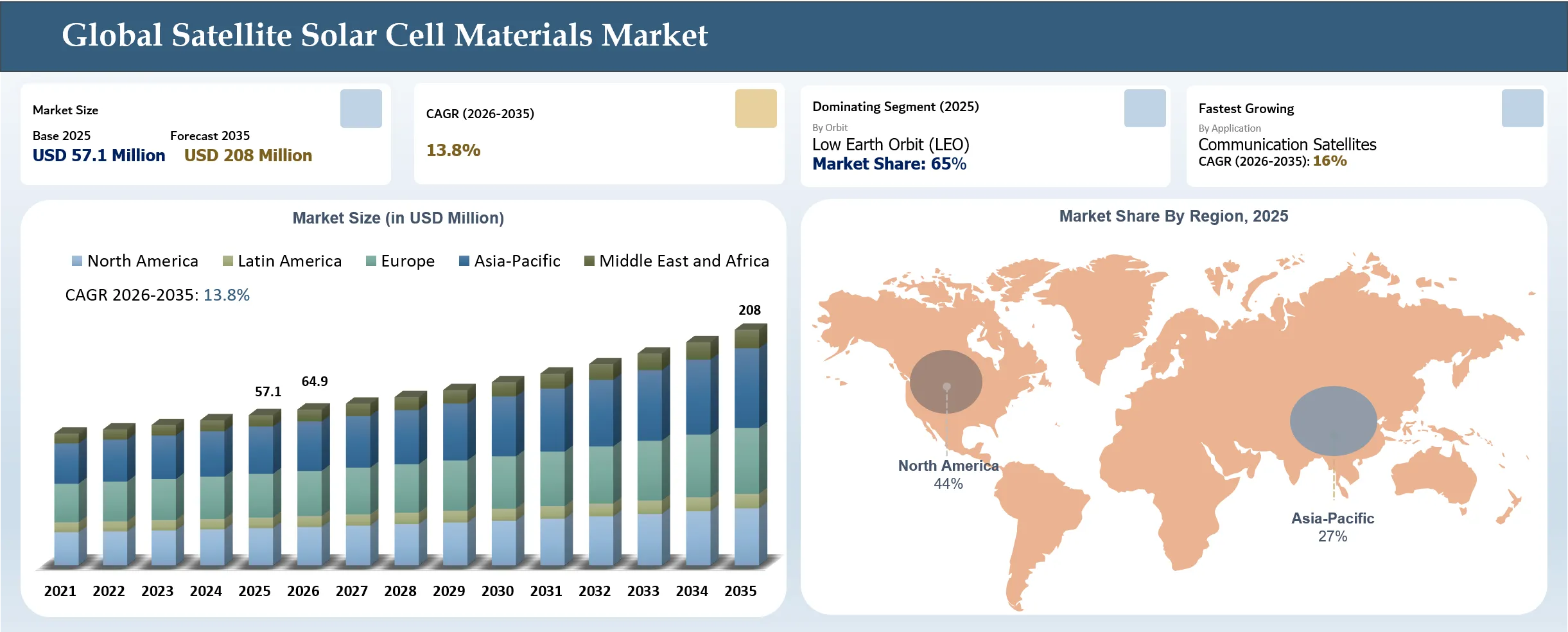
The global satellite solar cell materials market reached USD 57.1 million in 2025 and is expected to reach USD 208 million by 2035, growing with a CAGR of 13.8% during the forecast period 2026-2035. The market is being supported by increasing satellite deployment and the requirement for high-efficiency, radiation-resistant materials capable of maintaining power generation over extended missions. According to the European Space Agency (ESA), the demand between 2024 and 2033 is estimated to be 32 MW of addressable installed solar-cell power and around 20 million addressable solar cells, with telecommunications satellites representing 46% and Earth-observation satellites representing 17% of the addressable demand.
Solar cells that are light and have high efficiency have become more relevant with the efforts of satellite companies trying to reduce weight while increasing efficiency. In September 2026, Rocket Lab launched its IMM Apex space solar cell that achieved an efficiency rate of 31.5% at the beginning of life without using germanium substrates. The space solar cell is 40% lighter compared to conventional triple junction space solar cells and serves as an alternative to older germanium-based space solar cells, supporting deployment across commercial satellite constellations, civil space missions, and national-security spacecraft.
White-Space Opportunities for Space-Based Solar Power and Advanced Satellite Photovoltaic Technologies
In April 2025, Aetherflux, a U.S.-based space-solar technology company, raised USD 50 million in Series A funding led by Index Ventures and Interlagos, with participation from Breakthrough Energy Ventures, Andreessen Horowitz (a16z), NEA, and other investors, bringing its total funding to USD 60 million.
The largest investment area is space-based solar power generation and energy transmission, with Aetherflux developing low-Earth-orbit satellites equipped with solar collectors that wirelessly transmit electricity to ground stations; the company is targeting its first space demonstration in 2026 and has also received U.S. Department of Defense funding for a proof-of-concept demonstration.
The investment is also contributing to opportunities for companies operating across the broader space solar and satellite power ecosystem. Aetherflux benefits directly through funding for satellite development, solar-energy collection and wireless power transmission, while SpaceX benefits as the launch provider for Aetherflux's planned 2026 demonstration.
In space photovoltaic cells and lightweight solar technology, Ascent Solar Technologies benefits from demand for lightweight flexible CIGS photovoltaic products for space applications, while Spectrolab and SolAero Technologies support the market through high-efficiency multi-junction solar cells and space solar panels; Rocket Lab is also expanding opportunities through its advanced space solar-cell technology, including lightweight high-efficiency cells for spacecraft.
In solar-array deployment and satellite power systems, companies such as Redwire, Northrop Grumman, Airbus Defence and Space, Beyond Gravity, and Mitsubishi Electric can benefit from increased demand for deployable solar arrays, spacecraft power systems, and photovoltaic integration.
Satellite Solar Cell Materials Market Key Takeaways
- North America led the global market in 2025, accounting for 44% of total market share. Growth is underpinned by automated space-solar manufacturing and an established aerospace ecosystem.
- Low Earth Orbit (LEO) emerged as the dominant segment, commanding a 65% market share in 2025. Growth is driven by small satellites and commercial communications constellations.
- Germanium-free solar-cell architecture development exhibits a 22% impact on market expansion. Commercial satellite constellation expansions contribute a 24% impact factor to overall growth.
- Aetherflux secured USD 50 million in Series A funding in April 2025, elevating its total funding pool to USD 60 million. The capital supports low-Earth-orbit satellites designed for wireless electricity transmission.
Satellite Solar Cell Materials Market Scope
| Metrics | Details | |
| 2025 Market Size | USD 57.1 Million | |
| 2035 Projected Market Size | USD 208 Million | |
| CAGR (2026-2035) | 13.8% | |
| Largest Market | North America | |
| Fastest Growing Market | Asia-Pacific | |
| By Material | Gallium Arsenide (GaAs), Silicon, Copper Indium Gallium Selenide (CIGS), Others | |
| By Orbit | Highly Elliptical Orbit (HEO), Medium Earth Orbit (MEO), Low Earth Orbit (LEO), Geostationary Orbit (GEO), Polar Orbit, Others | |
| By Application | Space Stations, Satellites, Rovers, Others | |
| By Region | North America | U.S., Canada, Mexico |
| Europe | Germany, UK, France, Spain, Italy, Poland, Netherlands, Switzerland | |
| Asia-Pacific | China, India, Japan, Australia, South Korea, Indonesia, Malaysia | |
| Latin America | Brazil, Argentina | |
| Middle East and Africa | UAE, Saudi Arabia, South Africa, Israel, Türkiye | |
| Report Insights Covered | Competitive Landscape Analysis, Company Profile Analysis, Market Size, Share, Growth | |
Satellite Solar Cell Materials Market BCG Matrix: Company Evaluation
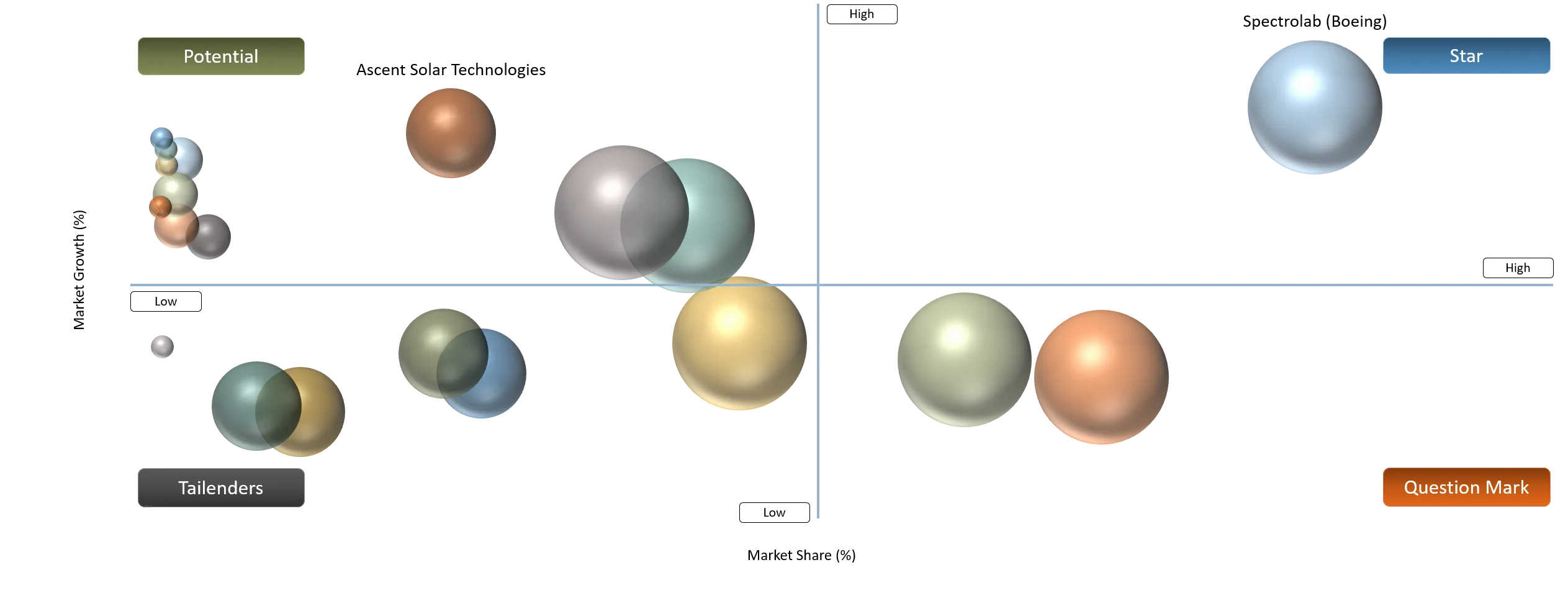
Stars include Spectrolab (Boeing), Rocket Lab, and AZUR SPACE Solar Power GmbH, which have established positions in space-qualified solar-cell technologies and strong exposure to high-efficiency photovoltaic systems. Question Marks include CESI S.p.A., MicroLink Devices, Thales Alenia Space, and Solestial, Inc. The companies have relevant capabilities in space photovoltaic technologies but operate with different levels of specialization and market exposure.
Potential includes Ascent Solar Technologies and mPower Technology, which have technology platforms relevant to lightweight, flexible, and high-performance photovoltaic applications. Tailenders among the top 10 companies specified, there are no companies that need to be placed in this category based on their direct relevance to satellite solar-cell technologies.
Satellite Solar Cell Materials Market Dynamics
Driver Impact Analysis
| Driver | Market Growth Impact (%) | Demand Concentration | Impacted Use Case | Strategic Impact |
Rising satellite launches and constellation deployments are increasing demand for lightweight, high-efficiency solar-cell materials. | 32% | High - LEO constellations, North America, Asia-Pacific | Communications satellites, broadband constellations, Earth observation | Encourages suppliers to develop scalable, lightweight, high-efficiency solar-cell materials capable of supporting high-volume satellite production. |
Demand for lightweight solar cells is accelerating as satellite manufacturers seek higher power-to-weight ratios and lower spacecraft mass. | 26% | High - small satellites, LEO spacecraft, commercial constellations | Small satellites, CubeSats, Earth observation, communications | Drives adoption of lightweight substrates, thin solar-cell architectures, flexible technologies, and high-power-density photovoltaic materials. |
Development of germanium-free solar-cell architectures is driving demand for alternative semiconductor and substrate materials. | 22% | Medium-High - advanced space solar cells, commercial satellites | High-efficiency multi-junction cells, next-generation satellite solar arrays | Creates opportunities for alternative substrates and III-V semiconductor architectures while reducing dependence on conventional germanium-based designs. |
Expansion of commercial satellite constellations is creating demand for scalable and cost-efficient solar-cell material technologies. | 24% | High - commercial LEO constellations, North America, Europe, Asia-Pacific | Broadband satellites, IoT satellites, Earth observation, satellite communications | Increases the importance of high-volume manufacturing, material cost optimization, automated production, and standardized solar-cell designs. |
Rising satellite launches and constellation deployments are increasing demand for lightweight, high-efficiency solar-cell materials
The rapid increase in satellite launches and large-satellite constellations is resulting in increased demand for lightweight and efficient solar cell materials used to power the spacecraft. As more satellites operate in low Earth orbit and commercial satellite constellations expand, there is growing demand for solar cells that generate more power while adding minimal weight to the spacecraft. With increased emphasis on developing small, light satellites with higher power capacity, advanced materials like Gallium Arsenide, multi-junction semiconductor materials, and lightweight substrates are becoming important.
In parallel, the rapid expansion of the global satellite industry is making demands for lighter, more efficient solar cell materials needed to generate more energy within the ever-smaller structures of satellites. In May 2026, according to the Satellite Industry Association (SIA), there were a record number of 296 launches that deployed 4,434 satellites in Earth orbits in 2025, marking an increase of 65% compared to last year, whereas the total number of satellites in operation was 14,266 at the end of 2025. In addition to that, the revenue from the production of satellites amounted to USD 20.4 billion, while the number of manufactured and launched satellites was 4,434 during that year.
Satellite Solar Cell Materials Market Segment Analysis
The global satellite solar cell materials market is segmented based on material, orbit, application, and region.
Low Earth Orbit (LEO) as the Dominant Orbit Segment Driving Satellite Solar-Cell Material Demand
The low Earth orbit (LEO) segment is dominating in the satellite solar cell materials market, contributing 65% of market share in 2025. The significant presence of LEO orbits in the market can be attributed to the fast pace of launch activities of small satellites and commercial constellations in areas like communications, Earth observations, Internet of Things (IoT), and other applications in space. In the case of LEO spacecraft, there is a strong correlation between spacecraft weight, spacecraft surface area, and power generation capabilities.
In parallel, in May 2026, according to NASA's State-of-the-Art of Small Spacecraft Technology, over 90% of nanosatellite and SmallSat form factors feature solar panels and rechargeable batteries. NASA has stated that the current state-of-the-art solar cells used in space consist of 3-5 junction III-V structures, such as GaAs, InGaP, and Ge, with efficiencies at around 30% and maximum efficiencies of 34%. In addition, the standardization of solar array and panel designs is becoming a necessity for large and proliferated constellations, while low Earth orbit microsatellites have the advantage of a relatively benign thermal and radiation environment.
Satellite Solar Cell Materials Market Geographical Penetration
North America’s Established Space Ecosystem Supporting Satellite Solar-Cell Material Demand
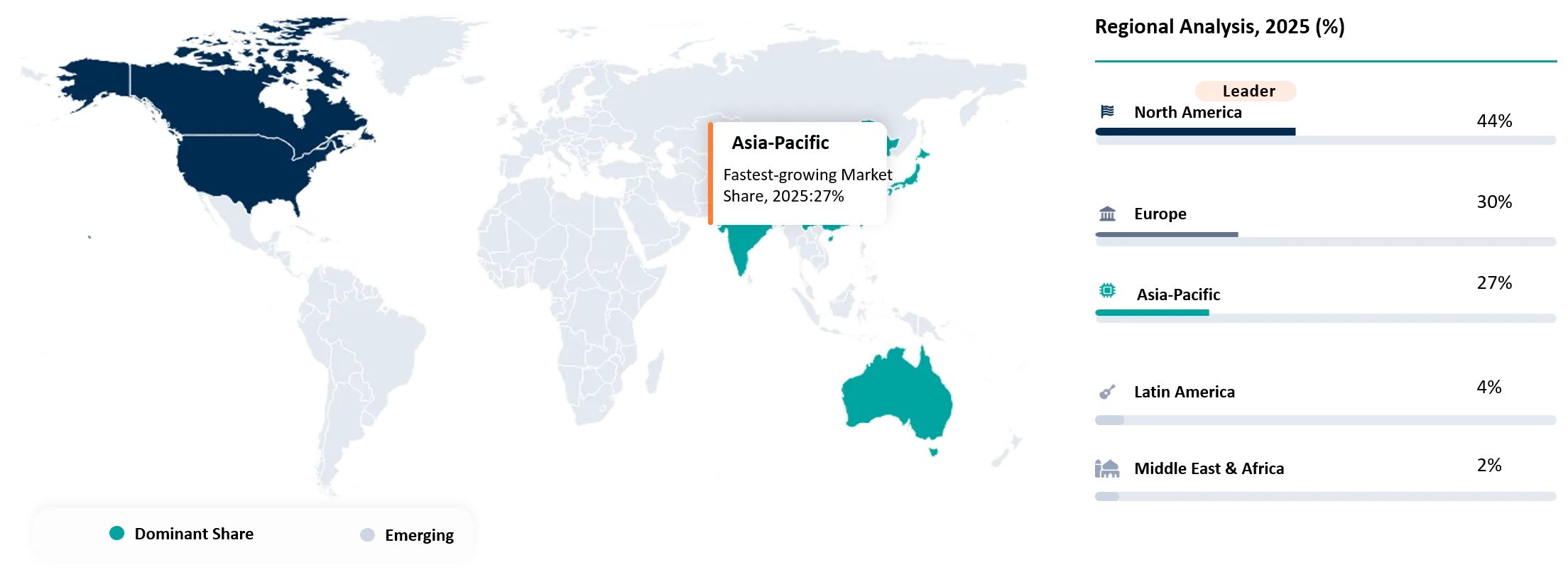
North America is the dominant region in the satellite solar cell materials market, accounting for 44% market share in 2025. The region's leading position is supported by its large commercial and government space ecosystem, extensive satellite manufacturing capabilities, and strong presence of space-qualified solar-cell technology suppliers. High levels of satellite deployment, communications infrastructure, Earth-observation programs, and defense-related space activity are sustaining demand for high-efficiency and lightweight photovoltaic materials.
The expansion of automated space-solar manufacturing is strengthening North America's domestic supply of scalable photovoltaic technologies for next-generation satellite constellations. In November 2025, mPower Technology Inc., a U.S.-based space-solar technology company, launched the world's first automated high-volume production line for space-solar modules at its facility in Conklin, New York. The facility began with an annual production capacity of 1 MW of DragonSCALES solar modules and was on track to expand to 2 MW, supporting demand from satellite constellations and other space missions. Airbus Defence and Space, a global aerospace and satellite manufacturer, selected mPower's DragonSCALES modules for its MDA AURORA supply chain, which is designed to support more than 200 spacecraft.
U.S. Satellite Solar Cell Materials Market Trends
The U.S. holds a dominant position in the North America satellite solar cell materials market, supported by its established aerospace and space-technology ecosystem, advanced solar-cell manufacturing capabilities, and strong investment in next-generation spacecraft power systems. The country hosts major space solar-cell technology developers and manufacturers, including Rocket Lab and Boeing-Spectrolab, with capabilities spanning high-efficiency multi-junction cells, III-V semiconductor materials, lightweight architectures, and radiation-resistant photovoltaic technologies.
The acquisition is strengthening vertical integration across the U.S. satellite manufacturing and space-solar technology ecosystem. In May 2026, York Space Systems, a U.S.-based satellite manufacturer and space-infrastructure company, agreed to acquire Solestial, a U.S.-based space-solar technology company specializing in silicon-based solar cells and photovoltaic systems for spacecraft. The transaction strengthens York Space Systems' access to space-solar-cell technology and supports the development of scalable power systems for satellite platforms and constellations.
Canada Satellite Solar Cell Materials Market Outlook
Canada is an important country in the North American satellite solar cell materials market, supported by its established space-technology ecosystem, government-backed research programs, and capabilities in satellite systems and advanced solar-array technologies. The Canadian Space Agency (CSA) is supporting the development and commercialization of space technologies through its Space Technology Development Program (STDP), including projects focused specifically on lightweight and lower-cost solar-array technologies.
The expansion reflects accelerating demand for high-efficiency photovoltaic technologies used in satellites and other space missions. In February 2026, 5N Plus Inc., a Canada-based specialty semiconductor and performance-materials company, announced a further 25% increase in space solar-cell production capacity, with the additional capacity expected to come online progressively from the second half of 2026. The expansion follows a 30% capacity increase in 2025 and a 35% increase in 2024, reflecting growing demand for high-efficiency solar cells for satellite programs and space missions.
Asia-Pacific’s Expanding Satellite Solar-Cell Materials Market Driven by High Satellite Production and Next-Generation Solar Technology
Asia-Pacific is the fastest-growing region in the satellite solar cell materials market, which represents about 27% market share in 2025 due to the growing satellite manufacturing industry, rapid launches of commercial constellations, and advancements in the field of lightweight and flexible solar cells. Countries such as China, Japan, South Korea, among others, are enhancing their abilities to manufacture satellites, thus generating demand for high-efficiency photovoltaics, flexible solar cells, and lightweight solar array configurations.
The strategic investment is accelerating the development and commercialization of advanced photovoltaic technologies for satellite and space-power applications. In December 2025, Drinda (Hainan Drinda New Energy Technology Co., Ltd.), a China-based solar-cell manufacturer, entered into a strategic cooperation and equity-investment agreement with Shangyi Optoelectronics, a China-based satellite solar-cell technology company specializing in flexible perovskite photovoltaic technologies for space applications. The partnership focuses on perovskite solar-cell R&D, in-orbit validation, industrialization, and expansion of space-energy applications, with Shangyi developing material formulations and radiation-resistant structures for extreme space environments.
Japan Satellite Solar Cell Materials Market Trends
Japan is one of the major players in the Asia-Pacific satellite solar cell materials market owing to the presence of advanced aerospace and electronics technologies, space programs that receive support from the government, as well as efforts to create domestically-made solar cell materials and arrays. Increasingly, Japan has turned to such materials as CIGS, compound thin film, and perovskite in order to minimize the reliance on imported solar cell materials and enhance the scalability and performance of space solar panels. It is especially pertinent to highlight the current trend in light of rising demand for solar cells as the number of LEO satellite constellations grows.
The collaboration is expanding Japan's capabilities in advanced photovoltaic technologies designed specifically for demanding space environments. In November 2025, Idemitsu Kosan Co., Ltd., a Japan-based energy and materials company, and Source Energy Company, a U.S.-based space-solar technology company, announced a strategic collaboration to co-develop next-generation solar-array products for the space market. The collaboration combines Idemitsu's CIGS (copper indium gallium selenide) solar-cell technology, designed for high radiation tolerance in space, with Source Energy's advanced solar-module technology for high-LEO and MEO satellite applications.
Satellite Solar Cell Materials Market Competitive Landscape
- The satellite solar cell materials market is characterized by three key participant groups: space-qualified solar-cell manufacturers, advanced photovoltaic technology developers, and vertically integrated aerospace and satellite-system companies. Spectrolab (Boeing), Rocket Lab, AZUR SPACE Solar Power GmbH, CESI S.p.A., Sharp Corporation, and MicroLink Devices compete through high-efficiency multi-junction cells, III-V semiconductor materials, lightweight architectures, and specialized space-qualified photovoltaic technologies; Solestial and Ascent Solar Technologies focus on lightweight, flexible, and thin-film solar technologies; while Thales Alenia Space and mPower Technology contribute through integrated solar-array and spacecraft power-system capabilities.
- Key players include Spectrolab (Boeing) (United States), Rocket Lab (United States), AZUR SPACE Solar Power GmbH (Germany), CESI S.p.A. (Italy), Sharp Corporation (Japan), MicroLink Devices, Inc. (United States), Thales Alenia Space (France), Solestial, Inc. (United States), Ascent Solar Technologies (United States), and mPower Technology (United States).
Key Developments
- December 2025: Solestial, Inc., a U.S.-based space-solar technology company, signed a Space Act Agreement with NASA’s Glenn Research Center, a U.S. government space research facility, to advance the development and testing of thin-film solar cells and solar-array architectures for lunar and orbital environments.
- August 2026: Dcubed GmbH, a Germany-based space-hardware company, partnered with Source Energy Company, a U.S.-based spacecraft power-system manufacturer, to simplify solar-array deployment testing for spacecraft.
- July 2026: Flexell Space, a South Korea-based space-solar-cell technology company, raised KRW 25 billion (USD 18 million) in Series A funding, bringing its cumulative funding to KRW 30 billion (USD 21.9 million).
- September 2026: Hanwha Solutions Qcells, a South Korea-based solar-cell manufacturer, and Hanwha Systems, a South Korea-based aerospace and defense company, signed a joint development agreement to develop high-efficiency perovskite-silicon tandem solar cells for satellite power systems.
- July 2026: Hanwha Solutions Qcells, a South Korea-based solar-cell manufacturer, and Hanwha Systems, a South Korea-based aerospace and defense company, signed a development agreement to jointly develop high-efficiency solar cells and panels for satellite applications.
Key Procurement Priorities and Buyer Evaluation Criteria
- Organizations procuring materials for the Satellite Solar Cell Materials Market increasingly select suppliers based on their ability to provide high-efficiency, lightweight, radiation-resistant, and space-qualified photovoltaic materials that can deliver reliable power generation under demanding space conditions.
- The procurement decision-making process is increasingly influenced by the growth of LEO satellite constellations, small satellites, high-power spacecraft, and next-generation space missions, creating demand for solar-cell materials that combine high power density, low mass, long operating life, and compatibility with compact solar-array designs.
- Buyers consider factors such as beginning-of-life and end-of-life efficiency, radiation resistance, thermal stability, power-to-weight ratio, substrate performance, material purity, and space-qualification history when evaluating satellite solar-cell material suppliers.
Why Choose DataM?
- Technological Innovations: Explores advancements in satellite solar-cell materials, including multi-junction III-V cells, germanium-free architectures, flexible photovoltaics, thin-film technologies, and high-efficiency solar-cell designs, enabling higher power generation, lower spacecraft mass, and improved performance under radiation and extreme space conditions.
- Product Performance & Market Positioning: Evaluates how different players differentiate their solar-cell materials and technologies based on conversion efficiency, power-to-weight ratio, radiation resistance, thermal stability, mission lifetime, substrate selection, and scalability across commercial, civil, defense, and scientific spacecraft applications.
- Real-World Evidence: Highlights the deployment and development of advanced solar-cell technologies for LEO constellations, small satellites, Earth-observation spacecraft, communications satellites, and space-station applications, demonstrating benefits such as reduced spacecraft mass, higher power density, longer operating life, and improved energy generation.
- Market Updates & Industry Changes: Tracks key developments such as new space solar-cell launches, flexible and lightweight photovoltaic technologies, germanium-free cell commercialization, domestic manufacturing initiatives, and satellite-production expansion across North America, Europe, and Asia-Pacific, supporting the evolution of advanced spacecraft power systems.
- Competitive Strategies: Analyzes how leading companies expand through solar-cell efficiency improvements, next-generation material development, manufacturing-scale expansion, strategic partnerships, and vertical integration of solar cells with spacecraft solar-array systems to address growing demand from satellite constellations and high-power missions.
- Pricing & Market Access: Explains pricing variations according to material composition, cell efficiency, junction configuration, substrate type, radiation-hardening requirements, qualification level, production volume, and customization, while examining access through specialized space-solar-cell manufacturers, aerospace companies, and satellite-system integrators.
- Market Entry & Expansion: Identifies growth opportunities driven by LEO satellite constellations, small satellites, Earth observation, satellite communications, defense spacecraft, and next-generation exploration missions, while outlining strategies such as lightweight material development, high-volume manufacturing, germanium-free technologies, flexible solar-cell integration, and partnerships across the global space ecosystem.
Target Audience 2026
- Satellite Manufacturers and Spacecraft Integrators
- Space Solar-Cell Manufacturers
- Solar-Cell Material and Semiconductor Suppliers
- Aerospace and Defense Companies
- Space Agencies and Government Organizations
- LEO Constellation Operators
- Solar-Array and Space Power-System Developers




























































